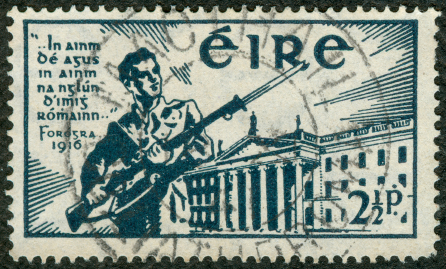
Reflections on Ireland’s Long Revolution Part 2

Testimonies of the disillusioned – Irish Zhivagos

Ernie O’Malley’s later life and the records he has left us tell their own story, subjective but very revealing in a way which the sanitised glorification of the New Republic never is. Those who deny that the IRA of recent years bears any resemblance to that of the early 20th century should familiarise themselves with it. O’Malley, in the ten years before his death, reacted to the state-sponsored Bureau of Military History. This was the state agency entrusted with the task of setting down the official record of all that happened between 1916 and the truce of 1921. O’Malley set out to compile what for him would be a true account.

In pursuit of this he criss-crossed Ireland in his old Ford, searched out his old companions in arms and interviewed over 500 of them. The transcriptions of these remain – although the magnum opus which he had planned never saw the light of day. Foster writes: “The memories recorded therein suggest a less sanitized and more embittered memory of revolutionary violence than those of the Bureau of Military History. Violence, expropriation, intimidation, random killings and enduring resentment can be inferred through many of the recollections he recorded.” One of his interviewees regretfully observed, “Sandy Nagle should never have been shot; he was a harmless ould devil.” Sandy, whoever he was, typified the victims of the callous violence of the war. There would be many more Sandys in Northern – and indeed Southern – Ireland when the war was reignited at the end of the century.

One of the literary figures of the early years of the century, George Russell (AE), thought and hoped that the violence of the epoch was just a phase, a “passing illness” contracted from all that had gone on in Europe during the Great War. He was not to know that within 50 years it would sweep over Ireland again in the final decades of the century, leaving a death toll even higher than that of the 1916 Rebellion and its immediate aftermath.

O’Malley and many of his companions might have been the embodiment of Pasternak’s Dr. Zhivago, a revolutionary caught in the blinding light of what looked like a new dawn for humanity but ending up in the pit of disillusion and terror. In his last years O’Malley was still looking for that illusive light – “How does one reconstruct a spiritual state of mind?” he asked himself despairingly. He ended up describing his life as a “broken” one, rejecting the world many of his former comrades had constructed for themselves in the New Ireland.

For some it was an unfinished business

Another dimension of the Irish story which Foster’s book reveals, but which will surely be played down by official Ireland for all sorts of reasons in the forthcoming celebrations, is the strong undercurrent of rebellion against the Catholic ethos of Ireland. This Catholic consciousness, in the aftermath of the persecutions of the seventeenth and eighteenth centuries had grown in the nineteenth century and had developed very powerful institutional roots. Indeed, if the commemoration were really honest it would be celebrating the fact that it is just now, finally, after one hundred years, that the dream of some of those revolutionary visionaries has finally come true – the vanquishing of the Catholic Church in Ireland and the rooting out of its influence among its people.

Rosamund Jacob, another whose post rebellion life was one of disillusion and disappointment, set out vehemently at the start to undo the Catholic influence in Ireland. Foster observes of her: “In classic back-to-the-people mode, Jacob records her attempts to learn Irish, to seek out like-minded people, and to make the contacts which would bring her…into revolutionary nationalist circles in Dublin… In this world, she searched for similarly secularist thinkers, though she was often disappointed: her robust if rather reductionist belief that ‘the Catholic Church is one of the greatest influences for evil in the world’, and that it was incomprehensible how any sane person of any intelligence could be a Catholic’, did not always meet with approval among her new nationalist companions.”

Jacob, also obsessively interested in matters sexual, would feel much more at home in the Ireland of today where student debating societies regularly rubbish the Catholic Church and Catholic beliefs in terms similar to those she expressed, where secularism is enthroned in Government departments – particularly in Health, Justice and Education – and where, among other things dear to her heart, radical gender ideology, among other secularist dogmas, reigns supreme across ninety percent of Irish media.

Undoubtedly in 1916 the view that Irish Catholicism was part of the national malaise was a minority one – but not insignificant. It would have been shared, among others, by the Sheehy-Skeffingtons, P.S. O’Hegarty and Muriel McSweeney, later to be the widow of the pious Terence McSweeney but not particularly pious herself. She later became a communist. All of these were later to take the view that the undeniably stronger Catholic element in this generation ended up hijacking the revolution and returning Ireland to what was, in their view, a different form of subservience. George Russell was among the disillusioned, moaning in the 1930s about “Catholic thought-control,… smug Catholic self-satisfaction with its own sanctity”.

Next week: The pitfalls of commemorations

Update on the progress of a bad law – Ireland’s bogus pretext for abortion

IMG_0624

Ireland’s Pro Life Campaign has issued a statement saying that the fact that a number of abortions have already taken place using the ‘suicide’ ground brings to light the entrenched problems with the legislation introduced by the present government in 2013. Three recorded terminations took place on the suicide grounds in the period January-July 2014. No figures have been released for the number of abortions since then. In recent days, outgoing Master of the Rotunda Hospital, Dr Sam Coulter Smith, criticised the new abortion legislation, primarily on the grounds that it set no time limits for when abortions can take place. He said however that he overestimated the number of abortions that would occur on the suicide ground and that the “floodgates” had not opened as predicted.

Commenting on the impact of the new law, Pro Life Campaign spokesperson, Dr Ruth Cullen said: “Within months of the new law being activated three pregnancies were terminated on the ‘suicide’ ground resulting in the intentional ending of unborn human life. The loss of even one life is a tragedy but the fact that we now have a law that facilitates the taking of human life, with the full knowledge that abortion is not a treatment for suicidal feelings, is shameful in the extreme.

“No one on the pro-life side forecast that the floodgates to wide-ranging abortion would happen overnight. Our criticism of the new law was that over time it would normalise abortions taking place on the ‘suicide’ ground given that the decision to carry out an abortion does not have to be based on any medical evidence showing that the intervention was necessary to save the life of the mother. Sadly, it has already been shown that abortions are taking place using this bogus ground despite all the reassurances given by the Taoiseach that it wouldn’t happen.”

Reflections on Ireland’s Long Revolution Part 1

Part I: A Commemoration Nurtured in Bad History?

There is something of the tragic about Ireland and her story. But then, there is something of the tragic in all of human history. Last year Roy Foster published Vivid Faces, his study of the generation and the cultural milieu in which the Irish Insurrection of 1916 and its aftermath fermented. It is a masterful study. It is a book which, if it were read with the detachment from the current received mythology of Ireland with which it is written, will stand as one of the most valuable reflections on that Rebellion which its centenary next year will be likely to leave us.

How honest, how intelligent, will this exercise in the enhancement of the memory of a people be next year – which is what this kind of commemoration is all about? Will it lay before us the “terrible” element of the “beauty” born in those years or will it just give us the feel-good version and go on feeding the legend. This is the legend which has to this day sustained the blood-lust of Sinn Fein and its military incarnation, the Irish Republican Army – and its multiple Hydra heads.

The roots of tragedy often lie in the failure of a man to recognise his inner truth – his real self, warts and all. The value of good history to a people is the revelation of the truths of the past, the motives, the mistakes, the right turnings and the wrong turnings, the good and the bad, their roots and all the things which make that people what they are today. It is not there to condemn or to praise. It is there simply to try to tell the truth.

The curse of bad history – which is no history at all – is that it blinds the people whose story it purports to tell. It is not even good mythology – for mythology is good only when it is true to the core truths which underlie reality. It is a corrupting and pernicious mythology when it does not.

It is unlikely that Ireland in 2016 will be commemorating with any sense of tragedy the events which were the catalyst which brought it independent statehood. Should anyone suggest that the horrors of the years between 1969 and the end of the last century had any roots in the armed struggle which followed the 1916 Rebellion, there will be a shaking of heads and muttering of “no, no, no”. This will be the first self-deception. There will be many more.

“In the name of God…” Did he really approve?

There are many passages in Foster’s book which reflect the reality of the epoch and its lingering legacy of hatred of Britain. Ireland now boasts that it has relations with its nearest neighbour that have never been seen before in its history, at least not since the time some fourteen hundred years ago when Irish missionaries crossed the seas and brought Christianity to Scotland and the North of England. It is true that the visit of Queen Elizabeth II to Ireland in 2011 was a watershed in relations between the two islands. We can but be grateful for it. But it is also true that there still resides in the hearts and minds of many of the Irish a level of animosity towards the people of Britain – and of England in particular – that is as deep and unchristian as it is silly and distasteful.

One such passage in Vivid Faces – the title comes from W.B. Yeats celebrated poem, Easter 1916 -tells the story of Ernie O’Malley, a survivor of the Anglo-Irish War which followed the 1916 Rebellion. Having fought in the war and in the subsequent civil war, he lived on until 1957 but never joined the new Irish Establishment in independent Ireland. He cuts a sad figure in the story. O’Malley left instructions for his burial. He was to be buried upright, facing eastwards across the Irish Sea, facing his enemies, the British. But, Foster tells us, he added a coda: “In fact they are no longer my enemies. Each man finds his enemy within himself.” And so he died.

Foster’s achievement in this book is to give us pictures of the dramatis personae of the Irish cultural revival as flesh and blood human beings like ourselves and those around us today. That revival, which began in the last years of the 19th century, fed into a new Irish and Gaelic consciousness. It was one strand of this which exploded in the face of the Government in 1916. It seemed, to a radicalized minority in the Gaelic movement, that the only way forward to their vision of Ireland was through the barrel of a gun. Irish republican mythology has turned that minority into heroes and Ireland finds it very difficult to surrender the comfort of that mythology. The truth is that they were men and women like many of those who are leaders in our country today – no better, no worse. That, however, is not good enough for the myth. The mixture of good and bad common to all humanity is thought to be unworthy of these men and women. We are not allowed to see them as they saw themselves, as for, example, we see in Dr. Patrick McCartan’s assessment of Sean MacDiarmada, one of the executed leaders of the rebellion. He “was bright and energetic but mentally superficial; he had not an idea in his head when (Bulmer) Hobson took him up and directed his ‘education’….he was cunning rather than clever, would do a crooked thing if it served his purpose.” McCartan himself was a survivor. He lived until 1963. He went on to become one of the co-founders, with Sean McBride, son of Maude Gonne and John McBride, another of the executed leaders – of Clann na Poblachta in the 1940s. This new political party was yet another failed attempt to reincarnate the vision of the revolutionary generation.

The executed leaders.

The paradox inherent in Yeats’ “terrible beauty” is terrible in many ways and not the least of them is the distortion of the humanity of the men and women of 1916. With our need to make sacred martyrs of them we simply distorted into a parody of beauty. To seek the truth about them, and to tell it as is was is to be thought of now as sullying their memory. But if we cannot admire them as they really were what is the point of admiring them at all?

Next Friday: Testimonies of the disillusioned

When Amnesty International and Liam Neeson signed up to the culture of death

  
Amnesty International has started a campaign to legalise abortion in Ireland. They’ve launched it with an ad voiced by Liam Neeson, famous for playing Hannibal in The A-Team (well, we’ve all got bills to pay), writes Tim Stanley in the Daily Telegraph.

We are in a very sad place when an organisation which was founded for the protection of people denied freedom and persecuted because of their beliefs is now campaigning for the destruction of millions of unborn human beings awaiting release into this world.

Stanley continues, referring to the Amnesty/Neeson video:

Its visuals tell you everything you need to know about the true motivations behind this secular crusade. Creepy music plays as the camera pans overs a deserted church. “A ghost haunts Ireland,” says Liam. “A cruel ghost of the last century… It blindly brings suffering, even death, to the women whose lives it touches.”

This doesn’t look like a campaign against Ireland’s abortion laws. It looks like a campaign to exorcise the Catholic Church from Ireland. Which is highly ironic because the liberals behind it are exactly the kind of people who always insist that religion should be kept out of politics. On this occasion, however, they’re very happy to play the faith card.
In their ad they don’t quote statistics or talk about health or show a single image of a woman. No, they focus straightforwardly on the ghastly, nasty Catholic Church. Boo. Hiss.

Their overriding concern appears social rather than medical. They probably want to drive the last remnant of religious influence from Irish public life. They likely believe that things started well with the legalisation of gay marriage and that now they can move smoothly on to the legalisation of abortion.

Never mind that the two are far from synonymous. On the contrary, one can be pro-gay marriage, or gay, and very concerned about introducing abortion on demand. One can be atheist and pro-life, as the writer Christopher Hitchens sort of was. But never mind all of those nuances, because Amnesty has leapt upon a simple formula: Ireland – abortion = a non-Catholic country. And I sense that’s what fuels this angry crusade.

Amnesty looks like it is exploiting the tragedies of people like the Linehans (see Stanley’s full article) for the sake of a political campaign against the Catholic Church

There are two tragedies here. First, that they are ruining a genuine, serious, science-rooted debate that could be had about the ethics of abortion. They look like they are exploiting the tragedies of people like the Linehans for the sake of a political campaign against a Church that is already dying in influence.

Second, they are destroying the reputation of Amnesty International itself. Amnesty was established by deeply religious people with the goal of preserving the lives of the oppressed and unrepresented. If anything, Amnesty ought to be pro-life.

Until now most of us have associated the face of Neeson with mayhem and murder – but of the fictional kind. From now on it will be hard to look at his face or hear his voice without associating it with the mayhem and murder we associate with the name of Kermit Gosnel.

As for Amnesty International – or is it now Abortion International – not another cent, dime or penny into its coffers.

A kinder light on a disturbing event

With the passage of time – just a matter of a little over four months in this case – the sense of bewilderment and disappointment of what looked like a radical change in the Irish people’s understanding and commitment to the values enshrined in marriage and the family has mellowed.

To help us understand that things might not be as bleak as they seemed on the afternoon of 23 May last, the words of the Archbishop of Dublin, Dr. Diarmuid Martin, to the Synod of Bishops in Rome yesterday set what looked like a revolution in a more balanced and kinder context.

Dr. Martin made his remarks about the Irish situation in the context of the social culture of marriage, the culture in which he said our young people grow up and the culture which influences their understanding of almost every dimension of marriage and family life.  He made the crucial point that society often uses the same words as the Church does, however with a radically different meaning. He continued:

Many ask what happened at the recent referendum on same-sex marriage in Ireland.   Has an authentic Christian culture of marriage disappeared in Ireland?  It is not as simple as that.   Ireland after the referendum is still marked by a very strong family culture.  The numbers who get married – and who get married in Church – are high and divorce statistics are among the lowest in Europe.  Families are strong and generous. That has not changed substantially.

The referendum was debated within a social culture where people struggle to understand abstract moral principles.  What they do understand is the predicament of individuals whom they wish to see happy and included.  It is a very individualistic culture, but not necessarily an uncaring one. Indeed those in favour of same-sex marriage based their campaign on what was traditionally our language:  equality, compassion, respect and tolerance.

Our young people make their decisions on marriage and the family within the context of a flawed and antagonistic social culture.  It is however not enough to condemn that culture.  We have somehow to evangelise that culture.  The Synod is called to revitalise the Church’s pastoral concern for marriage and the family and to help believers to see family life as an itinerary of faith.  But simply repeating doctrinal formulations alone will not bring the Gospel and the Good News of the Family into an antagonistic society.  We have to find a language which helps our young people to appreciate the newness and the challenge of the Gospel.

Where do we find that language?  Certainly it cannot be a language which reduces the fullness of the Church’s teaching. We have to find a language which is a bridge to the day-to-day reality of marriage – a human reality, a reality not just of ideals, but of struggle and failure, of tears and joys. Even in within a flawed social culture of the family there are those who seek something more and we have to touch their hearts.

Allow me to give an example.   We talk about indissolubility. Most families would not feel that they live indissolubility; they live fidelity and closeness and care in ways we underestimate.  As a student, I worked in a centre for prisoners which held a space for women who had to travel long distances before going to visit their spouses in prison.  These women were not models of respectable society. They would hardly have been able to pronounce indissolubility. But these women never missed a weekly visit.  They understood fidelity, even to a husband who might have betrayed them.  And their visit humanised even for a few moment the life of a man whose hope was low.

What the Irish referendum showed was a breakdown between two languages.  It showed also that when the demanding teaching of Jesus is presented in a way which appears to lack mercy, then we open the doors to a false language of cheap mercy.

A threshold has been crossed in Ireland. There is no doubt about that. Whether, however, it is a threshold to a future of social decline and disintegration depends on the acceptance of a challenge, the challenge implicit in Dr. Martin’s remarks. The Church, and those of good will throughout this island and across western society as a whole, must seek to touch the hearts and minds of all those who are seeking something more than is currently available to sustain their spirit in our flawed social culture.

– See more here.