Before video tape recorders came along it was the masterpiece that was very hard to see. But was it a masterpiece or just a dumbing down of great music on the back of Disney animation?
In a short online piece today courtesy of the New York Times we are reminded that Walt Disney’s Fantasia is 75 years old this month.
The movie, the Times tells us was Walt Disney’s most artistically ambitious feature. It was “dreamed up to bring highbrow masterpieces to everyone.” It didn’t succeed, at first. It cost the equivalent of $39 million and it was only after repeated releases over decades that it finally recouped its costs.
Like all approaches to classical music which concentrate on the “good bits” of the masterpieces of the repertoire, it is ultimately disappointing – little better than what Old Spice did for Carmina Burana or what Hamlet cigars did for Bach’s Orchestral Suite No. 3 in D major. On wonders how many people hearing any of these actually ever found their way to the originals in all their glory?
Fantasia features unrelated segments set to music performed by the Philadelphia Orchestra.
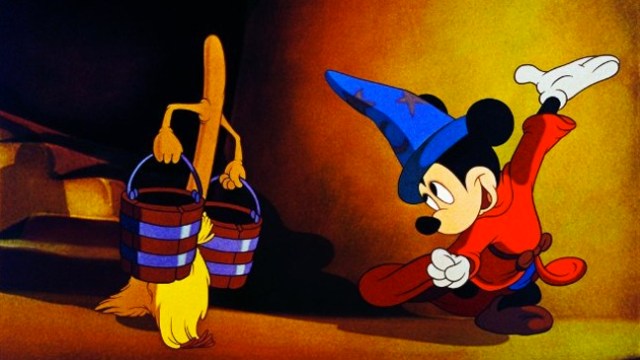
“Sorcerer’s Apprentice,” accompanying an 1897 composition by Paul Dukas, features Mickey Mouse as a wannabe magician.
Animation for “The Rite of Spring,” composed by Igor Stravinsky, tells the story of evolution.
And “Dance of the Hours,” from the opera “La Gioconda,” becomes a comic ballet performed by animals.
When the film finally arrived in video tape format it was an immediate bestseller among school teachers who saw it as a way of awakening an interest in great music in their pupils. There is not much evidence that it helped in any way to stem the tide of inane pop which was already swamping musical taste across the globe. Reaching the higher reaches of any great mountain requires effort and stamina. The same applies to the great works of literature, drama and music. Funny pictures and soft options are not enough. Pretending that they are is in fact selling out on the things of real value in our culture, those things which will really enrich our lives and cultivate our sensibilities at the deepest level.
What “an open, honest and under-oath detailed description of what goes on during state-of-the-art legal abortion” revealed in the Kermit Gosnell trial in Pensylvania, but which no Irish news outlet has ever printed or broadcast, is openly spelled out in the pages of the pro-abortion Irish Times today.
That story, in the Irish context, may be even more significant than the abortion story itself. Has the editor of the Irish Times cracked the stranglehold which his pro-abortion staff have held the paper in for more than a decade? Might we now get other media to follow suit and give the Irish people the honest discussion on this issue which they have been denied to date?
The article comes from two journalists, a husband and wife film-making team based in Los Angeles. They are Phelim McAleer and Ann McElhinney and write of their experiences watching the trial of Gosnell. This was a trial ignored by Irish media – and a good deal of international media as well – because it did not flow with the politically correct current which sweeps our media along its biased way.
In their article they tell us that it was not primarily the crimes of Gosnell which shocked anyone who spent time at the trial. It was the evidence from legitimate abortion providers describing to the court what their daily practices involved.
It was the industrial scale of the abortion industry that shocked the jury and spectators who gasped (the only time during a horrific trial) when Dr Charles Benjamin matter of factly stated he had performed over 40,000 abortions. They write:
We were always fairly disinterested in abortion. And by “disinterested” we mean we never thought much about it but, when we did, believed it was an unfortunate but probably necessary part of modern life.
And as such we would have agreed with those who have called in The Irish Times and elsewhere for more honesty and openness about abortion in the belief it would lead to a more liberal abortion regime in Ireland.
However, our recent experience would suggest that campaigners might want to rethink this strategy if they want Irish people to support a campaign to repeal the eighth amendment. .
We are making a movie and writing a book about Dr Kermit Gosnell – described by ABC News as “America’s biggest serial killer”. Gosnell was a Pennsylvania abortion doctor who performed illegal abortions past the state’s 24-week limit. His abortion “technique” was to have the babies born alive and then to stab them to death with scissors.
His case led many people, investigators, lawyers and jury members to hear for the first time the reality of abortion, illegal and legal, and how it affected them might surprise those calling for more honesty surrounding the procedure.
A pro-choice prosecutor told us how she and her female co-worker were amazed that the legal limit in Pennsylvania was 24 weeks: “That’s six months” she remembers blurting out as they read the statue for the first time. Then they discovered that PA wasn’t an outlier.
In several US states you can have, and people do have, abortions up to the day of delivery.
But the evidence that shocked the most was the evidence that was supposed to reassure the most.
To highlight Gosnell’s illegality, prosecutors decided the jury should hear from “good abortionists”.
In other words just what those campaigning to repeal the eighth amendment to the constitution are demanding – an open, honest and under-oath detailed description of what goes on during state-of-the-art legal abortion.
It was the industrial scale of the abortion industry that shocked the jury first. They gasped (the only time during a horrific trial) when Dr Charles Benjamin matter of factly stated he had performed over 40,000 abortions.
An arm or a leg
Dr Karen Feisullin was also called to describe what a legal abortion looked like. The jury and many in the courtroom shifted uncomfortably as they heard about “tools going up into the uterus and basically pulling parts out . . . an arm or a leg or some portion of that”.
And those were the easy, early abortions. For later procedures, Dr Feisullin explained the foetus was so well-formed that it couldn’t be ripped apart in the uterus. It was normally removed – through the birth canal – completely intact. But, as Feisullin explained, a baby born at 23 weeks has a 40-50 per cent chance of surviving. To avoid a live baby coming out during an abortion, the doctor demonstrated how, before the abortion, a poison – potassium chloride – was injected through the woman’s stomach directly into the baby’s heart. This would stop the heartbeat, allowing the foetus to be pulled out intact.
Dr Feisullin was asked what would happen if she missed the heart and the baby was born alive.
She explained that the live baby would be covered with a blanket and given “comfort care”.
You could see the genuine puzzlement of people in the court about what “comfort care” was until Dr Feisullin cleared up any confusion.
“You . . . really just keep it warm, you know. It will eventually pass,” she said.
Steve Volk, a Philadelphia-based journalist for an alternative newspaper who described himself as comfortably pro-choice before the trail, said that, as Dr Feisullin spoke, his fellow reporters all checked if they had heard correctly.
Dehydration and neglect
Was it really standard medical practice to let a baby die of dehydration and neglect if an error was made during an abortion? It was and they were shocked.
Local journalist JD Mullane, who interviewed many of the key players, confirmed our research that the trial changed many minds and shook assumptions.
“Almost everyone . . . who spent significant time at the Gosnell trial was less pro-choice at the end. This change was probably because they were for the first time hearing about the reality of abortion from experts under oath . . .
“They had to tell the truth and they had to tell it in detail,” he said.
Out of the shadows
Those seeking to remove the constitution ban on abortion believe the best way to do it is to bring it out of the shadows in the hope that when people hear the details, they will support the liberalisation of abortion in Ireland.
Two years ago, we might have agreed with them.
But our experience of the Gosnell case is that anyone who has learned more about the reality of abortion – the pullings apart of the foetus, the injecting of poison into the heart, the “comfort care” – has come away with only negative feelings about the procedure.
The Week (Europe) reports a bad week for “official figures”, after the body responsible for university funding in England had to admit to an embarrassing blunder: this summer, the HEFCE claimed that 82% of students from state schools achieved a first or upper second class degree, compared to only 73% of those from independent schools. But it has now been forced to admit that it got the figures the wrong way around.
Be wary of commemoration. Be careful about what you celebrate. Not only may they be perniciously divisive but they may also grossly distort the truth which should first and foremost be the guide to authentic freedom and the ground on which we build our lives and our communities. When we commemorate what we call the Irish Revolution we should know that it was not really a revolution – certainly not at the time. It was a rebellion against the authority of the state and a rejection of its legitimacy. Those who rebelled were undeniably revolutionary in their intent – although their revolutionary agendas were not uniform.
While Ireland’s 1916 rebellion ultimately achieved regime change, for most of the century nothing else of a very radical nature happened. Ireland remained much the same culturally. The flowering of Irish literature, drama and the burning commitment to a Gaelic Ireland which had flourished in the two decades prior to the rebellion were in fact never matched again in the century which followed. In fact the new regime ultimately alienated many from the ideal of a Gaelic Ireland by seeking a compulsory imposition of Ireland’s native language on the people. Ireland is much less Gaelic at the beginning of the 21st century than she was at the beginning of the 20th. That is tragic. She is quintessentially Irish, no less now than she was then, although that Irishness is now heavily influenced and characterised by Anglo-American culture. Meanwhile, her Gaelic soul is on life-support.
Politically, Ireland continued to be ruled and administered through the time honoured institutions it had inherited from the old regime. That was no bad thing. They are the institutions, the machinery of state, that are envy of most of the world. In terms of political life, for many decades Ireland stagnated in the strait-jacket of the enmities generated in its post-rebellion Civil War. Only now, in the 21st century, does there seem to be any hope of escape from that. Escape to what? That remains a moot question.
For most of the 20th century the new Irish State sought to assert her sovereignty in the world and for a number of the early decades sought somewhat ineptly to do so economically. That came to an end with another Act of Union, union with the evolving entity which is now the European Union. Clearly there were differences between the terms and conditions which applied under this Act and the Act of 1801. Just as the terms and conditions of that first Act had evolved into a more benign character by 1900, so also the terms and conditions of our union with Europe are of a new order as well. By 1916 Home Rule for Ireland had been put on the statute books.
The modern British state has evolved by Burkean principles for more than two centuries. Its mode of change was and remains evolutionary and constitutional. This was not good enough for the Irish. The Irish insurgents took the law into their own hands in a way which would be an anathema to that greatest of Irishmen, Edmund Burke. The foolish violence which ensued, after the inept leader of the militants tried to call off the planned insurrection, begot more and equally terrible counter-violence, including the foolish execution of the Insurrection’s leaders. Ireland has had to live with the consequences of that ever since.
One way or the other – and probably it had nothing to do with the act of rebellion in 19 16 – Ireland is now a society much closer to the mores and ideals of Rosamund Jacob, P.S. O’Hegarty and the Sheehy-Skeffingtons of that time. If it was a revolution, it really was a long revolution. What cannot be denied is that in what is now about to be celebrated there is much of the tragic – not least the loss of almost 6000 lives between its inception and its celebration 100 years later.
But human history will never be devoid of tragedy. How could it be otherwise if what Christian theology and divine revelation tell us is true? We are a fallen nature and on the level of nature much of what we touch does not turn to gold. This may be denied by the Jacobs and the O’Hegartys of the New Ireland – of whom there are now many more among us. That does not make it any less true.
Commemorate? Yes, perhaps. There was nobility and heroism in the lives of many of those who sought to carve a different identity for their country than the one they found it had in their time. Celebrate their actions and all their consequences? That path seems more problematic. Commemoration allows for a level of questioning of the wisdom of those we commemorate? Celebration seems not to do so.
How we should learn learn to stop complaining and love the New York Times! How could we not, for it has given us a Chesterton for our times. Who would have believed it? It did not begin this week – but it certainly reached a new level of power this week. The latest shining of this new and welcome light began last Monday with the First Things Erasmus lecture in New York City. Then today we have a penetrating column, a veritable gauntlet for the cause of orthodoxy in the Roman Catholic Church thrown at the feet of its heterodox academic theologians, in one of the free world’s greatest liberal newspapers.
We are talking about New York Times columnist Ross Douthat. His star as an interpreter, explainer and sometimes warrior in the culture battles of our time has been rising for a number of years. Since his move to the Times a handful of years ago it has reached super-nova dimensions.
Don’t buy the jibe that he is the Times’ token conservative. The Times is a genuinely liberal paper and as such will inevitably give voice to – and at its top level may also sincerely subscribe to – a view of human nature which is wide of an accurate reading of the real nature of the human condition. But its first ideal is to try to give voice to intelligent human beings who are seeking the truth. This it will generally do regardless of what the paper’s own view of the truth at any time might be. The Times may even be as confused as Pilate was about the very possibility of Truth. Its starting point is, however, unarguably a good ideal, one which is at the very heart of our civilization. Because of a commitment to this ideal we can hear the voice of Ross Douthat.
This week Douthat gave us a razor-sharp analysis – for me at any rate – of where the “Catholic moment” is today. This was the 28th Annual Erasmus Lecture. It presents a challenge to be sensible, honest and continuously courageous in thinking about where we have been, where we are and where we are going with out Christian civilization yesterday, today and tomorrow.
You can watch and listen to this lecture here courtesy of First Things (firstthings.com). Now in its 28th year, the Erasmus Lecture has been bringing world-renowned speakers to New York—including Joseph Cardinal Ratzinger, Archbishop Timothy Dolan, Gilbert Meilaender, and Rabbi Jonathan Sacks—to address an audience of over five hundred people each year.
Ross Douthat, who like Chesterton – but without the semantic and rhetorical fun and games – is nothing if not provocative, is the author of Bad Religion: How We Became a Nation of Heretics (Free Press, 2012), Privilege: Harvard and the Education of the Ruling Class (Hyperion, 2005), and the co-author, with Reihan Salam, of Grand New Party: How Republicans Can Win the Working Class and Save the American Dream (Doubleday, 2008).
Last week he was challenged by a group of academic theologians who must surely now regret their silly passing remark casting doubt on his “authority” to speak about religion at all since he had no qualification in theology. In fact they did not challenge him. They complained behind his back – like true liberals – to the New York Times for giving him a platform at all on “their” subject. Today he answers their silliness – silliness which all honest people will laugh at but which nevertheless they should also take seriously, as he does. He begins:
Iread with interest your widely-publicized letter to my editors this week, in which you objected to my recent coverage of Roman Catholic controversies, complained that I was making unfounded accusations of heresy (both “subtly” and “openly”!), and deplored this newspaper’s willingness to let someone lacking theological credentials opine on debates within our church. I was appropriately impressed with the dozens of academic names who signed the letter on the Daily Theology site, and the distinguished institutions (Georgetown, Boston College, Villanova) represented on the list.
I have great respect for your vocation. Let me try to explain mine.
A columnist has two tasks: To explain and to provoke. The first requires giving readers a sense of the stakes in a given controversy, and why it might deserve a moment of their fragmenting attention span. The second requires taking a clear position on that controversy, the better to induce the feelings (solidarity, stimulation, blinding rage) that persuade people to read, return, and re-subscribe.
Both his lecture, his column today and on many other occasions, make compelling reading.
He concludes today’s column, making reference to their elitist and Gnostic jibe, where they imply that all these things are above his pay grade and that he does not understand them because he is not a theologian: “…indeed I am not. But neither is Catholicism supposed to be an esoteric religion, its teachings accessible only to academic adepts.”
What is their real position on doctrine and the teaching of the Church, he asks? He suspects that it is that almost anything Catholic can change when the times require it, and “developing” doctrine just means keeping up with capital-H History, no matter how much of the New Testament is left behind. He concludes:
As I noted earlier, the columnist’s task is to be provocative. So I must tell you, openly and not subtly, that this view sounds like heresy by any reasonable definition of the term.
Now it may be that today’s heretics are prophets, the church will indeed be revolutionized, and my objections will be ground under with the rest of conservative Catholicism. But if that happens, it will take hard grinding, not just soft words and academic rank-pulling. It will require a bitter civil war.
And so, my dear professors: Welcome to the battlefield.



 Garvan Hill