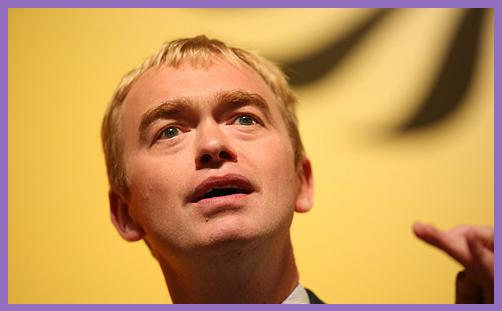
Tim Farron’s Fate

tim-farron
Tim Farron

They were different times, times when men and women sometimes paid with their lives for their disagreement with the political establishment – or for trying to swim against the spirit of their age because of the evil they perceived in that spirit. Such was the time of Thomas More, Lord Chancellor of England, whose head rolled from the block on Tower Hill because he would not say that his king’s marriage to his wife, Catherine of Aragon, was invalid. Driven by pride and his lust for another woman, that king, Henry VIII, did away with More.

Tim Farron will not be taken to the Tower of London, tried by a kangaroo court and judicially murdered. Nevertheless, nearly 500 years after Thomas More suffered that fate, Farron has had  his political career sacrificed on an almost identical pagan altar as his Christian predecessor.

Farron could not bring himself to say that human acts which Judaeo-Christian morality has deemed to be sinful for thousands of years, were not so.  Farron refused to answer a politically irrelevant question – as to whether he thought gay sex is a sin. He also thinks abortion is wrong. For that, hounded by the agents of the sexual revolution and assisted by the neo-Cromwellian interrogators of the libertarian media, Farron has now been consigned to the margins of the public square.

The High Priests of the Sexual Reformation – call them the gay lobby, the abortion lobby, the gender benders, call them whatever you like – are now in control.  They are the apostles of intolerance and their spies are everywhere. Their agents are policing thought. If those whose thoughts do not measure up to the new moral standards step into the public square they will be trampled on.

Farron has written in less dramatic terms than what has been outlined above about the predicament he faced. But the reality of his position is the same. He has been crushed by the thought police. In this week’s Spectator he put it like this:

From the very first day of my leadership, I have faced questions about my Christian faith.  I’ve tried to answer with grace and patience.  Sometimes my answers could have been wiser.  At the start of this election, I found myself under scrutiny again – asked about matters to do with my faith.  I felt guilty that this focus was distracting attention from our campaign, obscuring our message.

Journalists have every right to ask what they see fit.  The consequences of the focus on my faith is that I have found myself torn between living as a faithful Christian and serving as a political leader. A better, wiser person than me may have been able to deal with this more successfully, to have remained faithful to Christ while leading a political party in the current environment.

The conclusion Farron has had to come to is a chilling one:

To be a political leader – especially of a progressive, liberal party in 2017 – and to live
as a committed Christian, to hold faithfully to the Bible’s teaching, has felt impossible for me. 
That’s why I have chosen to step down as leader of the Liberal Democrats.  

At every turn he found himself the subject of suspicion because of what he believes and who his faith is in. He says we are kidding ourselves if we think we yet live in a tolerant, liberal society.

Despite the sadness of this story, despite even the sordidness which lies at its root, in Farron’s concluding words in his Spectator piece, something beautiful, something ineffable shines through:

I joined our party when I was 16, it is in my blood, I love our history, our people, I thoroughly love my party.  Imagine how proud I am to lead this party.  And then imagine what would lead me to voluntarily relinquish that honour. In the words of Isaac Watts it would have to be something ‘so amazing, so divine, (it) demands my heart, my life, my all’.

Those words come from Watts’ 1707 hymn, When I Survey The Wondrous Cross.

When I survey the wondrous cross
On which the Prince of glory died,
My richest gain I count but loss,
And pour contempt on all my pride.

Forbid it, Lord, that I should boast,
Save in the death of Christ my God!
All the vain things that charm me most,
I sacrifice them to His blood.

See from His head, His hands, His feet,
Sorrow and love flow mingled down!
Did e’er such love and sorrow meet,
Or thorns compose so rich a crown?

Were the whole realm of nature mine,
That were a present far too small;
Love so amazing, so divine,
Demands my soul, my life, my all.

Ominous sounds

Civil wars often, very often, start when political factions abandon civilised democratic principles and practices.

Then someone starts shooting and the war of words gives way to the taking of life.

Partisans of the American Democratic Party are now, by their implicit rejection of the will of the American People who elected Donald Trump, treading dangerous ground. We can only hope that the shots which rang out in this Washington baseball field will not go down in history as the start of something much more terrible.

Wednesday, June 14, 2017 11:41 AM EDT, the New York Times flashed this across the world:

Steve Scalise Among 5 Shot at Baseball Field
A lone gunman opened fire on Republican members of the congressional baseball team at a practice field in a Washington suburb Wednesday, using a rifle to shower the field with bullets that struck five people, including Steve Scalise, the majority whip of the House of Representatives.

And The Hill now reports: Scalise shooter identified, was Sanders volunteer.

A 66-year-old Illinois man has been identified as the gunman who shot Rep. Steve Scalise (R-La.) and several others on Wednesday morning as they were practicing for the congressional baseball game.

Multiple media outlets citing law enforcement officials have reported that the gunman, who died after being shot by police, is James T. Hodgkinson of Belleville, Ill.

congressman_shot_07213-7281a_c0-235-2400-1633_s575x335
James T. Hodgkinson

The Facebook page of the  shooter was steadily losing “friends” as news about the shooting mounted.

The Times adds, that the Virginia shooting suspect was an opponent of President Trump and “wasn’t happy with the way things were going,” his brother said.

The shooting is believed to have dragged on for 10 minutes or more, according to eye-witness accounts.

The violence was even more nerve-wracking given the political implications.

Bernie Sanders ‘sickened’ after learning campaign volunteer was shooter James Hodgkinson, according to The Washington Times
Sen. Bernard Sanders took to the Senate floor Wednesday to condemn the morning attack on Republican members of Congress, saying he was horrified to learn that the suspect had been a campaign volunteer for his presidential bid last year.

Dylan’s long journey to the “Father of Night”

A Rare Smile

Bob’s in the news again, Bob Dylan, that is. He is eventually going to collect his Prize money, having finally paid his debt to the Nobel Committee by penning his truly Dylanesque lecture – a duty he had to fulfil before they could give him the money. He deserves it.

You could say it is all about three books. These are the books which he says have been central in his life and his music: Moby Dick, All Quiet on the Western Front, and Homer’s Odyssey. 

Alexandra Schwartz in The New Yorker magazine touches the flavour of the lecture in her reflections on the man and his work in her piece in the magazine this week.

At the end of his lecture, Dylan describes the moment in the Odyssey when Odysseus visits Achilles in the underworld. Achilles tells him that trading a long life of peace for a short one of honor and glory was a mistake. He is dead for eternity; “if he could, he would choose to go back and be a lowly slave to a tenant farmer on Earth rather than be what he is—a king in the land of the dead,” Dylan says. “That’s what songs are, too. Our songs are alive in the land of the living.” Dylan never needed to make that trade. He has had more lives than a cat, and all of them add up to one long life of enough honor and glory to sustain a small nation. One day, he, too, will go down under the ground. But his songs will stay forever alive, up here.

Scott M. Marshall, the author of the soon-to-be-published book, Bob Dylan: A Spiritual Life, takes the eschatological theme a bit further. 

As the lyric goes, may his song always be sung. It doesn’t appear that will ever not be the case, even long after he’s gone on — tryin’ to get to heaven before they close the door.

Marshall looks at the element of Faith in Dylan’s life and work and gives us an account of some short biographical anecdotes which tell their own story. This “song and dance man” is no ordinary song and dance man.

Miami, Florida, January 1974: A man in a hat in his early 30s pedals up on a 10-speed bike to a Jesus People rally. He wants to chat after the rally with Arthur Blessit, one of the speakers. Blessit, a man known for literally carrying a large cross around the world, is a Jesus freak if there ever was one. The man on the bike asks Blessit questions about his faith and Jesus. Their meeting lasts about 10 minutes, and is briefly cited by Rolling Stone magazine.

The man on the 10-speed bike is Bob Dylan, and he’s just returned to touring for the first time since 1966 — and happens to be in the middle of a wildly popular U.S. concert tour.

A few years prior, in autumn 1970, Dylan took in an Eric Clapton concert in New York and then found himself on a station wagon ride with Clapton and two old friends, Scott Ross and Al Aronowitz. Ross, married to former Ronettes singer Nedra Talley, had become a Christian since the two last met in 1965, and he shared his faith with Dylan after the singer inquired about it. Before the evening dissipated, Dylan stopped by his apartment to pick up and give Ross a copy of his then-current album, “New Morning.” Dylan referred Ross to its final song, “Father of Night,” a song that served up evidence that its composer, the utterly reluctant counter-cultural idol, had not forgotten there was a Creator.

The recording of his Nobel address: