The Life and Art of Andrey Tarkovsky

Part II

Romanov, Yermash, Sisov and all those within the decaying soviet totalitarian system were bereft of ideas and their only guiding principle was to try and not make mistakes which superiors might deem contrary to Bolshevism – which they themselves probably did not even understand. The removal of Romanov was just one symptom of this.

Out of these early contradictions and the pressures with which Tarkovsky had to contend to get his films made, he forged the artistic and creative principles by which he knew he had to work. In 1970 he wrote:

One doesn’t need a lot to be able to live. The great thing is to be free in your work. Of course it’s important to print or exhibit, but if that’s not possible you still are left with the most important thing of all – being able to work without asking anybody’s permission. However, in cinema that is not possible. You can’t take a single shot unless the State graciously allows you to. Still less could you use your own money. That would be viewed as robbery, ideological aggression, subversion.

Stalker, Tarkovsky’s last film made in the Soviet Union, is based on Roadside Picnic, a story by the Strugatsky brothers. But in Tarkovsky’s hands it probes the depths of what the film-maker saw as the fundamental crises of the modern world: the rift between natural science and belief; the future of mankind living with the atomic bomb; and, ultimately, the dim glimmer of hope still left to man.

The dream sequence in Stalker

What these four films (Andrey Rublev, Solaris, Mirror and Stalker) up to this point revealed – and his enemies in the system sensed this, but did not understand it – was Tarkovsky’s Christian faith and his realisation of the totally corrupting influence of Marxist materialism. Mirror, so beautiful but equally obscure to them, was more personal. But they also hated it. However, by now his international acclaim was such a huge factor that their obnoxious treatment had to be camouflaged.

In his diaries at that time he revealed his soul and his devastating critique of the system he lived under.

By virtue of the infinite laws, or the laws of infinity that lie beyond what we can reach, God cannot but exist. For man, who is unable to grasp the essence of what lies beyond, the unknown – the unknowable is GOD. And in a moral sense, God is love.

His reading of Marxism and the faltering regime he had to try to live and work under is summed up as follows:

Man is estranged. It might seem that a common cause could become the basis of a new community; but that is a fallacy. People have been stealing and playing the hypocrite for the last fifty years, united in their sense of purpose, but with no community. People can only be united in a common cause if that cause is based on morality and is within the realm of the ideal, of the absolute…Because each one only loves himself… Community is an illusion, as a result of which sooner or later there will rise over the continent evil, deadly, mushroom clouds…An agglomeration of people aiming at one thing – filling their stomachs – is doomed to destruction, decay, hostility. 

‘Not by bread alone,’ he concluded.

Elsewhere he said, materialism – naked and cynical – is going to complete the destruction.

Despite the fact that God lives in every soul, that every soul has the capacity to accumulate what is eternal and good, as a mass people can do nothing but destroy. For they have come together not in the name of an ideal, but simply for the sake of a material notion… Man has simply been corrupted…. Those who thought about the soul have been – and still are being – physically eliminated.

In watching a Tarkovsky film one has to take note of the way in which he wants viewers to respond. In this we are not far from Christopher Nolan’s expectations of his audiences. Nolan Admired Tarkovsky and his work, and particularly Mirror.

Tarkovsky described what he saw as a basic principle of film-making… the mainspring is, I think, that as little as possible has actually to be shown, and from that little the audience has to build up an idea of the rest, of the whole. In my view that has to be the basis for constructing the cinematographic image. And if one looks at it from the point of view of symbols, then the symbol in cinema is a symbol of nature, of reality. Of course it isn’t a question of details, but of what is hidden.

Like Nolan, Tarkovsky makes demands on his audience. Viewers have to, as it were, learn a cinematic language which mainstream Hollywood does not teach or even know.

The battles for distribution continued with Yermash. But there were some signs of a thaw and Tarkovsky was eventually able to make two films abroad, one in Italy and one in Sweden.

He began to see his battles as a cross Christ asked him to bear. He wrote of the Cross and identified his woes with Christ’s Cross. At one point he saw himself facing two years of misery: with Andriushka at school; and Marina, and Mother, and Father. It is going to be hell for them. What can I do? Only pray! And believe.The most important thing of all is…to have faith in spite of everything, to have faith.

We are crucified on one plane, while the world is many-dimennional. We are aware of that and are tormented by our inability to know the truth. But there is no need to know it! We need to love. And to believe, Faith is knowledge with the help of love.
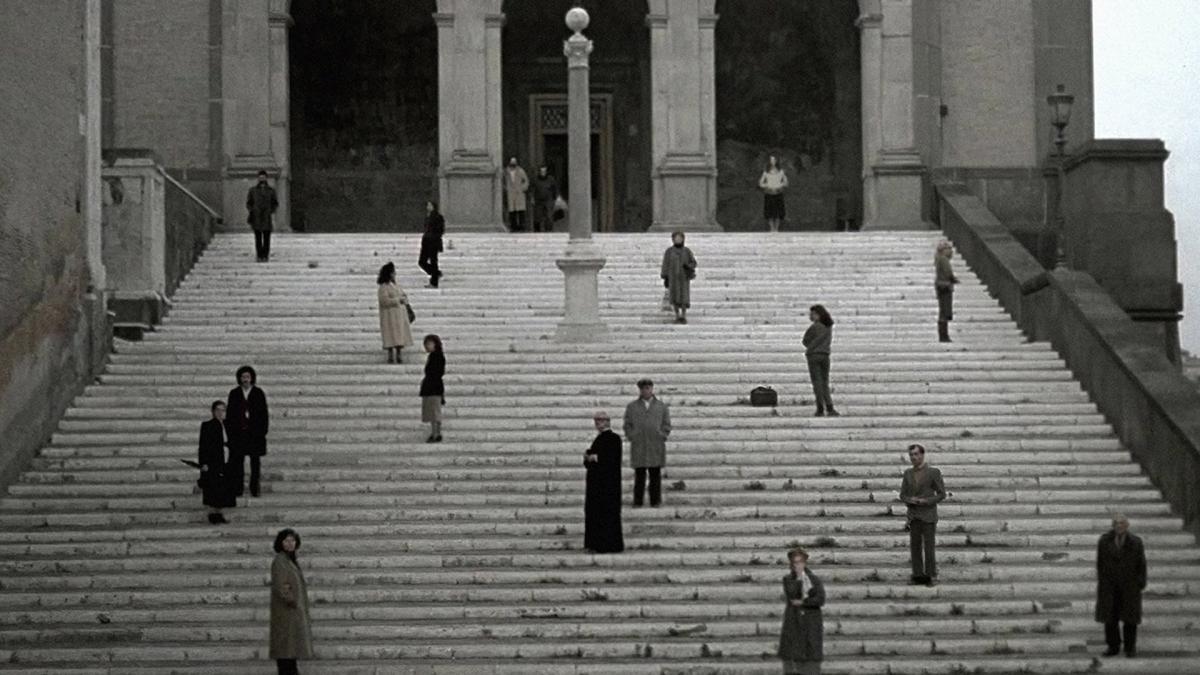
Tarkovsky was allowed to travel to Italy in the 1980s to shoot Nostalgia. This was a Soviet-Italian co-production. The theme is, however, typical of the Russian dilemma: that of the artist abroad, smitten by homesickness, unable to live in his country or away from it — the very fate that befell Tarkovsky himself in the last years of his life. It was even more painful still for him because the authorities restricted the movement of his family and starved him of financial support. It was not until the end of his life that they allowed his young son, Andriushka, to be with him.

His time in Italy in 1980, apart from the creative work he did there on Nostalgia, was spiritually enriching for him. Two extraordinary events in particular highlight this. One was his visit to the Holy House in Loreto. Of this he recorded something very personal in his diary.

An amazing thing happened to me today. We were in Loreto where there is a famous cathedral (rather like Lourdes) in the middle of which stands the house in which Jesus was born (sic), transported here from Nazareth. While we were in the cathedral, I felt it was wrong that I can’t pray in a Catholic cathedral; not that I cannot, but that I don’t want to. It is, after all, alien to me. Then later, quite by chance, we went into a little seaside town called Porto Nuovo, and into its small, tenth century cathedral. And what should I see on the altar but the Vladimir Mother of God.

Apparently some Russian painter had, at some time, given the church this copy of the Mother of God of Vladimir, evidently painted by him.

I couldn’t believe it: suddenly to see an Orthodox ikon in a Catholic country, when I had just been thinking about not being able to pray at Loreto.

It was wonderful.

The second event he recorded as follows:

Today I relaxed while Tonino finished dictating his script. I went to St. Peter’s Square. I saw and heard the Pope’s appearance in front of the people-the crowd filled the entire square with flags, banners and placards. It’s odd that although I was surrounded simply by large numbers of curious people, such as foreigners and tourists, there was a unity about them which impressed me deeply.

There was something natural, organic in it all. It was obvious that all these people had come here of their own free will. The atmosphere reigning in the Square made that perfectly clear.

I also felt it was wonderful that as I was wandering round the streets, before going by chance into St. Peter’s Square, I had been thinking that today was Sunday and what fun it would be when I got back to Moscow to be able to say that I had been present at a Papal audience at the Vatican. 

He also recorded some moments of prayer in his diaries. One such was this conversation with God:

Lord! I feel You drawing near, I can feel Your hand upon the back of my head. Because I want to see Your world as You made it, and Your people as You would have them be. I love You, Lord, and want nothing else from You. I accept all that is Yours, and only the weight of my malice and my sins, the darkness of my base soul, prevent me from being Your worthy slave, O Lord!

These thoughts of death – he was never really in good health – were noted when he was battling with the authorities over the content of Stalker, a film in which the protagonist seeks unsuccessfully to open the minds of his two pilgrim companions to the meaning of our existence:

If God takes me to himself I am to have a church funeral and be buried in the cemetery of the Donskoy Monastery. It will be difficult to get permission. And no one is to mourn! They must believe that I am better off where I am. The picture is to be finished according to the pattern we decided for the music and sound. Lucia must try and tidy up the end of the bar scene. ‘The Room’ should include the new text from the notebook (the sick child) plus the old one, written for the scene after the ‘Dream’. 

At the end of 1985, after the release of Nostalgia, again to international acclaim, he completed the shooting of his last film, The Sacrifice, in Sweden. Described as a parable by Tarkovsky, the story revolves around a family awaiting an impending nuclear catastrophe in a remote Scandinavian seaside location. The paterfamilias prays and offers himself to God as a sacrificial victim to save the world from the impending disaster. It is a profoundly mysterious, reflective and beautiful work, regarded by some as the artist’s masterpiece.

 Andrey Tarkovsky returned to Rome after completing it. Already afflicted by the cancer to which he succumbed a year later, he died on 29 December 1986, at a Parisian clinic. His last diary entry was made on 15 December. He is buried in a graveyard for Russian émigrés in the town of Saint-Geneviève-du-Bois, France.
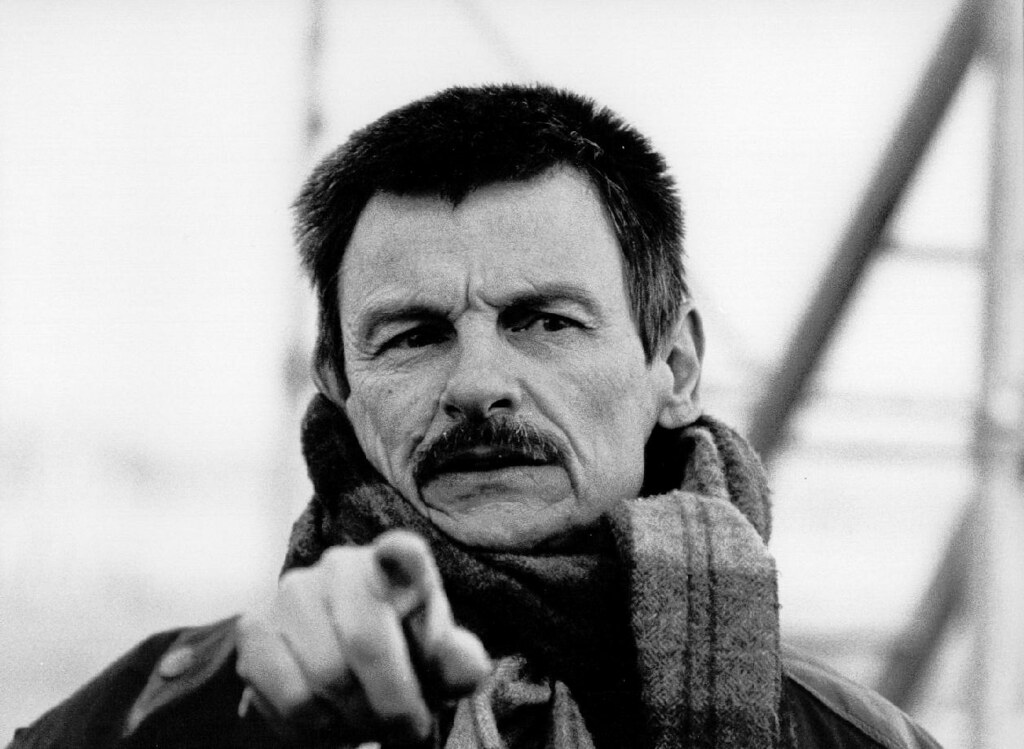
The Extraordinary Life and Art of Andrey Tarkovsky

Part I

What is it about Russia? What is it about her creative artists? To a man they love their country but to a man – with very few exceptions – particularly for the past century – they have been persecuted by their country’s rulers. Her great composers in the modern age, Prokofiev and Shostakovich, had to tread very carefully and tailor their work to please the political masters. Her great ballet artists had to flee Russia to express their genius freely. Above all, her great writers of the past hundred years suffered unspeakable indignities. Even today the number one persona non grata is Mikahil Bulgakov even though he died over 70 years ago. Why? Because ordinary Russians are flocking to cinemas to see a film version of his magnificent anti-Stalinist novel, The Master and Margarita. This has been made by an expat Russian and is now being interpreted as an anti-Putin satire.

Hannah Arendt, in her master work, The Origins of Totalitarianism, while recognising the post Stalinist communist system as one of dictatorship, did not see it in 1966  as totalitarianism. It lacked the quality of complete domination and while vicious, was but a crumbling edifice, a shadow of its former self.

Arendt wrote in 1966:

“The clearest sign that the Soviet Union can no longer be called totalitarian in the strict sense of the term is, of course, the amazingly swift and rich recovery of the arts during the last decade. To be sure, efforts to rehabilitate Stalin and to curtail the increasingly vocal demands for freedom of speech and thought among students, writers, and artists recur again and again, but none of them has been very successful or is likely to be successful without a full-fledged re-establishment of terror and police rule. 

“No doubt, the people of the Soviet Union are denied all forms of political freedom, not only freedom of association but also freedom of thought, opinion and public expression. It looks as though nothing has changed, while in fact everything has changed. When Stalin died the drawers of writers and artists were empty; today there exists a whole literature that circulates in manuscript and all kinds of modern painting are tried out in the painters’ studios and become known even though they are not exhibited.”

In the world of creative cinema, one of the saddest stories of all is that of Andrey Tarkovsky. Tarkovsky was born on 4 April 1932, probably the darkest decade in Soviet history. His mother, Maria Ivanovna, was a talented actress, and his father, Arseniy Tarkovsky, a respected poet and translator. Both his parents have featured in his work. His mother had a central role in his masterpiece, Mirror. The haunting poems of his father were used in several of his films.

In addition to regular classes at school he began to study music and drawing. In 1954 he successfully applied for admission to the prestigious All-Union State Institute of Cinematography (VGIK) in Moscow.

Tarkovsky’s first major feature film, Ivan’s Childhood, was shown in Moscow in April 1962. This was a haunting and tragic story, beginning idyllically in pre-World War II Russia and then descending into horrors of that war. The story focuses on the evil of war and how it turns Ivan’s childhood into a monstrous nightmare.The film won the Venice Festival’s Golden Lion in that year and drew the attention of the world to the thirty-year-old director.

It also drew the attention of the Soviet authorities, creating an expectation that here was an artist who could serve their propaganda purposes. They were to be bitterly disappointed. The long and bitter harassment of Tarkovsky began at this point. His diaries, dating from 1970 up to just a couple of weeks before his early death in 1986, record the details of this struggle, as well as the creative instincts and the deep religious consciousness from which they sprang. That this consciousness could be nurtured by his mother in the terrifying environment of Stalinist Russia is one of the most extraordinary things about this man.

The trouble began around the end of 1966, with the begrudging release of his second film, the three-hour long Andrey Rublev. Initially his ideological masters did not seem to know what to make of it. But soon the penny dropped. It attracted international attention and with the critical interpretation of its themes, the apparatchiks realised they had a problem on their hands. They still wanted him to work for them, but on their terms. This effectively turned his working life into something like a living hell. 

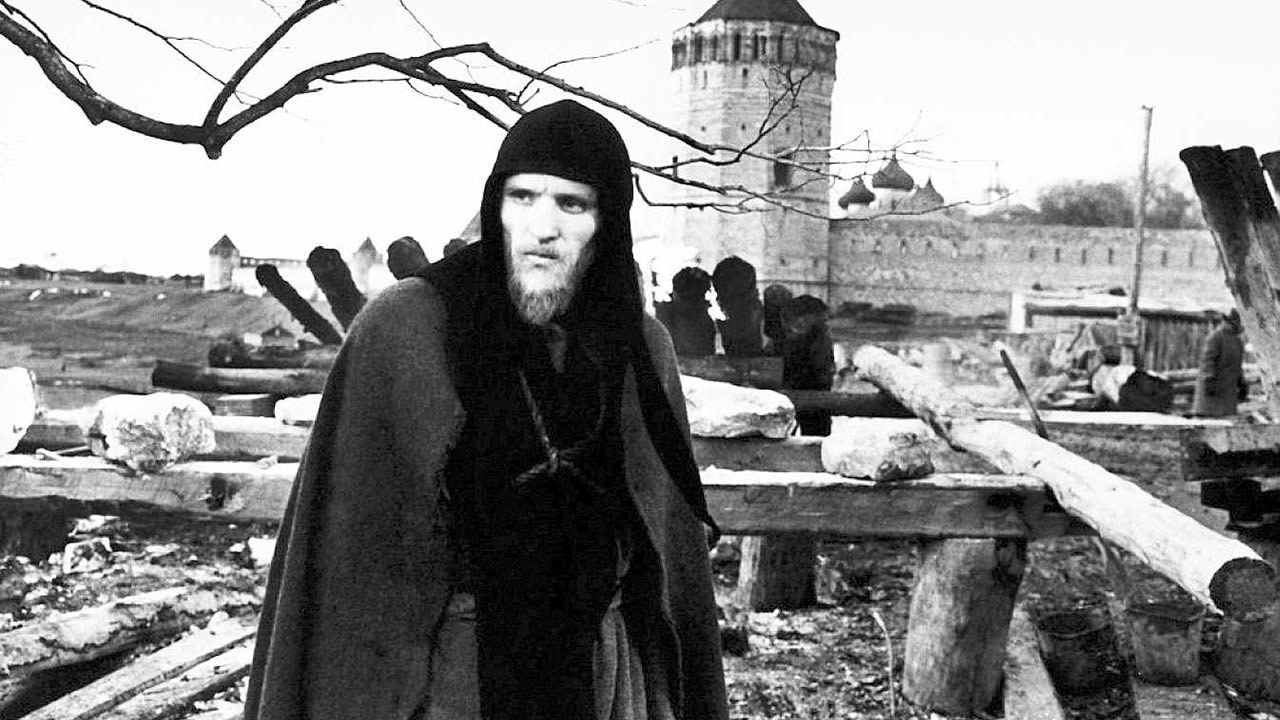
Andrey Ruble

Of his battle to have the film released he wrote:

Late yesterday evening E. D. rang and said that Chernoutsan just telephoned him: Suslov signed the document for the release of Rublev immediately after the Congress. I must find out from K straightaway which cinemas and how many copies. Of course the Committee insists on cuts.  I’ll tell them to go to hell. So I must contact A. N. Kosygin as soon as possible. He apparently wanted to meet and spoke highly of the film.

Kosygin was Russian Prime Minister from 1964 to 1980.

Andrey Rublev is structured in three parts and features the life and work of the great Russian icon painter of that name. One of his most famous icons is that of the Blessed Trinity. The central section depicts the struggles of the early evangelisers of Russia and their battles with the remnants of paganism. The last symbolic section shows the battle of a small Christian community to restore a bell to their church. This bell had to be built in a makeshift foundry and could only be done by a young boy who was the last person alive who knew the secret of how to do this. It is an utterly dramatic and moving sequence, clearly symbolic of the hopes of a Christian future for Russia.

The first article about the film in Russia appeared in Komsomolskaya Pravda. “A nasty little piece,” Tarkovsky commented, “which will have the effect of bringing the public to see the film. There is no announcement in any paper about Rublev being on. Not a single poster in the city. Yet it’s impossible to get tickets”. 

When Rublev was eventually shown in Sweden, Ingmar Bergman said it was the best film he had ever seen. He is reported to have watched it ten times. In an interview Bergman described Tarkovsky as the best contemporary director, superior even to Fellini.

Andrey Rublev, which was shown out of competition at the Cannes Festival in 1966, and won an award there, was only cleared for export by the Soviets in 1973. Similarly Mirror, completed in 1974 against strong bureaucratic resistance, reached west European cinemas only years later. Mirror is a deeply moving reflection of the life and travails of Tarkovsky’s own family.

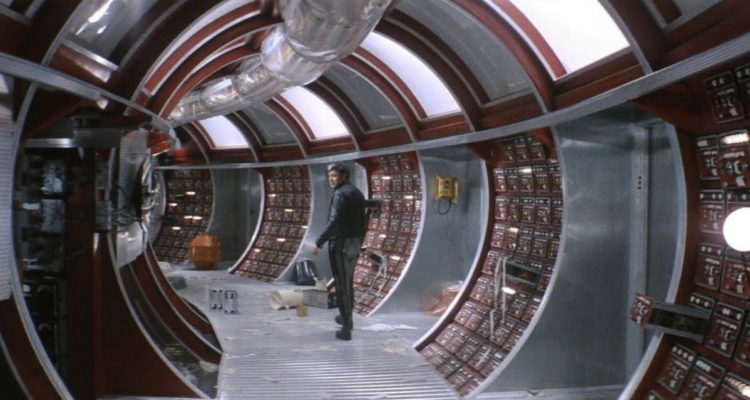
With Solaris, made over 1971/1972, based on a science fiction novel by Polish writer, Stanislas Lem, Tarkovsky touched upon a subject that seemed relatively innocuous in the Soviet Union at the time – man forging ahead into space. But even here his approach generated a long list of criticisms and objections. This was because in his hands it was not just a science fiction work but a deep exploration of a man grappling with his conscience.

The Central Committee attempted to destroy Solaris.

Tarkovsky made a note of some thirty-three cuts they demanded but which he considered would destroy the whole basis of the film. “In other words, it’s even more absurd than it was with Rublev.” Among the alterations they demanded were the following:

There ought to be a clearer image of the earth of the future. (Presumably a communist future).

Cut out the concept of God. 

Cut out the concept of Christianity. 

The conference. Cut out the foreign executives.

He wrote in desperation, Am I really going to be sitting around again for years on end, waiting for somebody graciously to let my film through?

What an extraordinary country this is? Don’t they want an international artistic triumph, don’t they want us to have good new films and books? They are frightened by real art. Quite under-standably. Art can only be bad for them because it is humane, whereas their purpose is to crush everything that is alive, every shoot of humanity, any aspiration to freedom, any manifestation of art on our dreary horizon. They won’t be content until they have eliminated every symptom of independence and reduced people to the level of cattle.

In the end he decided to make just those alterations that were consistent with his own plans and would not destroy the fabric of the film.

Then something like a miracle happened which he described as follows:

Romanov came to the studio on the 29th and Solaris was accepted without a single alteration. Nobody can believe it. They say that the agreement accepting the film is the only one to be signed personally by Romanov. Someone must have put the fear of God into him.

I heard that Sizov showed the film to three officials whose names we don’t know and who are in charge of the academic and technological side of things; and their authority is too great for their opinion to be ignored. It’s nothing short of miraculous, one can even begin to believe that all will be well.

In the next act in the drama Aleksey Romanov was removed and replaced by another equally opaque apparatchik. F. T. Yermash. He was to be Tarkovsky’s nemesis for the remainder of his career.

Part II next week.

Endgame or Game On?

Endgame? Part II

In the hope of finding some glimmer of hope and optimism in the face of what looks like catastrophic population decline I went to the ideas of Alasdair McIntyre in his famous book, After Virtue. For it seemed to me that while Klein and Sciubba talked about values, those values only floated in a vague soup of feelings and nothing more. While their analysis and searching for answers remain in the realm of the moral framework of the emotivism which MacIntyre finds at the heart of modernity, they will get nowhere. We have no reason to doubt their good intentions or their sincerity, but are they unwitting victims – as our culture in general is – of the disastrous philosophical turning which occurred after the Renaissance and on into the Enlightenment? The only virtue people seem to talk about in the contemporary context is that barren species known as ‘virtue signalling’. There is a cliche that tells us that ‘ideas have consequences’. They do but they often do so without people realising that the consequences they are suffering, or are about to suffer, are rooted in false ideas.

Alasdair MacIntyre casts light on the darkness confronting our race in two ways. The first does not offer much solace. It envisions the collapse of all that we take for granted in our civilization.

He does this in terms of an allegory suggestive of the premise of the science-fiction novel A Canticle for Leibowitz: a world where all sciences have been dismantled quickly and almost entirely. MacIntyre asks what the sciences would look like if they were re-assembled from the remnants of scientific knowledge that survived the catastrophe. 

From his extrapolation of that allegory we may extrapolate something about our own demographic predicament: The grim effect of catastrophic population collapse will be the inevitable destruction of the infrastructure which in material terms sustains our comfortable way of life, ultimately perhaps descending into a variation of the kind of unexplained chaos depicted by Cormac McCarthy in The Road.

We already know what a shortage of competent and trained workers means for our daily life and comfort. “I just can’t find a plumber to repair that leaking valve”.

Again extrapolating from the theses of After Virtue, we can find the roots of our demographic predicament in corrupt philosophy.

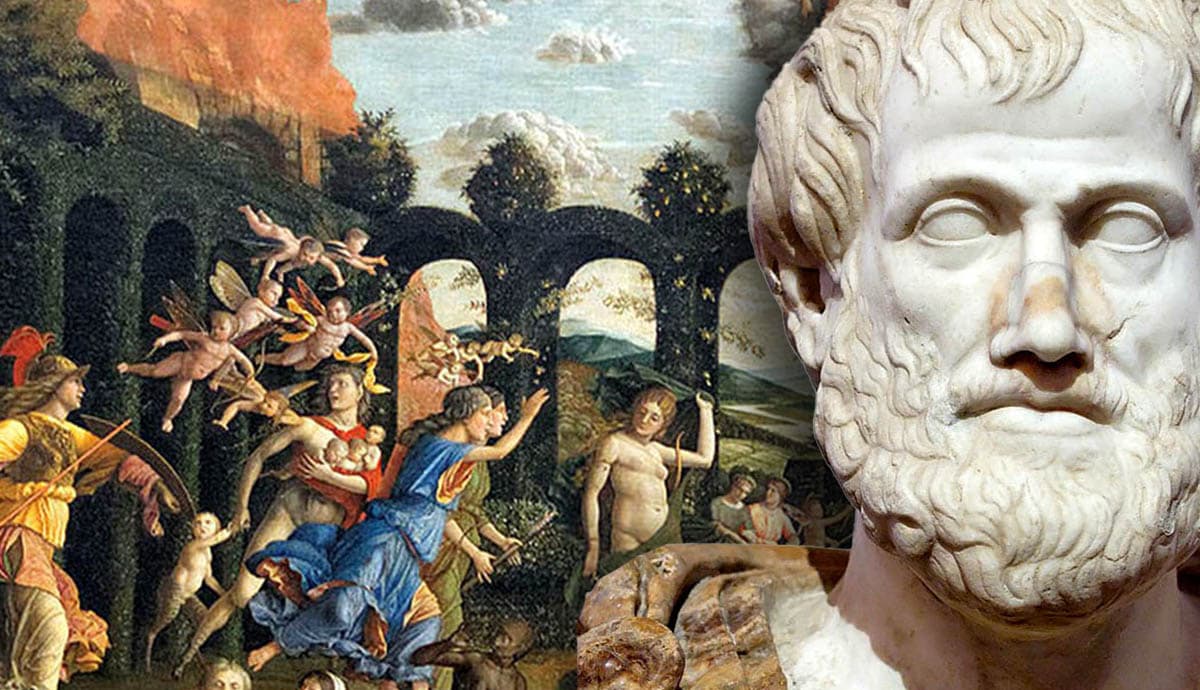
“The hypothesis which I wish to advance”, MacIntyre argues, “is that in the actual world which we inhabit the language of morality is in the same state of grave disorder as the language of natural science in the imaginary world which I described.” He holds that the moral structures that emerged from the Enlightenment were philosophically doomed from the start because they were formed using an incoherent language of morality. In abandoning Aristotelian teleology – the view that only by contemplating mankind in terms of its purpose and its end, and these as the foundation for the moral life – philosophy took a disastrous wrong turn. 

He argues that when we abandoned the idea that human life had a proper end or character we were heading into a dark and confused place. Individualism and emotivism were going to be the ruling principles of what we might call our morality. 

The Enlightenment  ascribed moral agency to the individual. He claims this made morality no more than one man’s opinion.  Philosophy became a forum of inexplicably subjective rules and principles. From this stems the now dominant moral principle of emotivism. We, in our time, now see that it is from this source that the virus of wokism flows  – which is nothing more or less than a deranged moral code. Where that will lead remains to be seen. It may die as most ideologies do, but as long as emotivism remains supreme, worse may follow.

In his critique of capitalism, the bureaucratic state, and its associated liberal and Enlightenment-inspired ideology, he defends ordinary social “practices”and the “goods internal” to practices, much as Edmund Burke did in his critique of the ideology of the French Revolution. MacIntyre argues that pursuit of these practices helps to give narrative structure and intelligibility to our lives. What we have to do is ensure that these goods are defended against their corruption by “institutions”, which pursue such “external goods” as money, power and status.

MacIntyre’s vision, while somewhat dark, is not pessimistic – because he has a Christian vision of our existence. He tells us that we are waiting not for Godot but for Benedict of Nursia. MacIntyre sees morals and virtues as only comprehensible through their relation to the community which they come from – echoes of Burke again. True virtue is rooted in knowing who we are and where we come from. 

It also must carry within it something of the value of sacrifice. I write this on Thursday of Holy Week, the day on which the Eucharist  was given by Christ to his disciples for the first time, he himself, Body and Blood, soul and divinity. As I do, I recall words from G. M. Hopkins’ translation of Aquinas’ great Eucharistic hymn, Adoro Te Devote:

O thou our reminder of Christ crucified,

Living Bread, the life of us for whom he died,

Lend this life to me then: feed and feast my mind,

There be thou the sweetness man was meant to find.

Many years ago Romano Guardini wrote:

“How great is the transformation of our conception of man through Christianity. It is something we are again beginning to appreciate, now that its validity is no longer generally accepted. Perhaps the moment is not distant in which the Christian ideal, like that of antiquity during the Renaissance, will overwhelm the modern consciousness with its unspeakable plenitude.” (Guardini, The Lord).

We do not need to relocate to Monte Casino to live with this vision. We are, as people of the Judaeo-Christian tradition, people who believe in Divine Goodness, Justice and Mercy, called by God to live here and now in this real world and with this Spirit. Only by doing so will we live our lives with the sense of, and commitment to, priorities, often involving a spirit of sacrifice, which will ensure the fruitfulness mandated for us by our Creator. Thus, and thus only, will we avert the impending disaster threatening our race.

The Lancet reported recently on a study about  the low-fertility future. The interpretation of the study which it offered made sobering reading, much as did the conversation between Ezra Klein and Jennifer Sciubba. 

Fertility is declining globally, with rates in more than half of all countries and territories in 2021 below replacement level. Trends since 2000 show considerable heterogeneity in the steepness of declines, and only a small number of countries experienced even a slight fertility rebound after their lowest observed rate, with none reaching replacement level. Additionally, the distribution of live births across the globe is shifting, with a greater proportion occurring in the lowest-income countries. Future fertility rates will continue to decline worldwide and will remain low even under successful implementation of pro-natal policies. These changes will have far-reaching economic and societal consequences due to ageing populations and declining workforces in higher-income countries, combined with an increasing share of live births among the already poorest regions of the world.


In 1985 the great Russian film director, Andrey Tarkovsky, made his last film, just before his untimely death. It was called The Sacrifice and centered on a man offering his life to save a world threatened by imminent nuclear catastrophe. Mankind has to stop thinking that anything good can be achieved without a spirit of sacrifice. Without sacrifice there is no love and without love there will be no future worth talking about..

Endgame?

This is the way the world ends  

Not with a bang but a whimper.

Unless… Unless what? The problem is, we cannot give a coherent answer to that question. The truth is we seem not to know even how to begin to answer that question. That is, the agencies which try to govern our destinies on this planet, our governments, our academics, our experts, do not know, have not got the slightest idea of what to do to head off that “whimper”.

Ezra Klein, columnist with the New York Times, one of their best, and Jennifer Sciubba, distinguished demographer, began a heavyweight discussion on the columnist’s NYT based The Ezra Klein Show recently. They grappled with a frightening prospect for humanity – nothing less than what looks like the impending collapse of our civilisation.

Klein began, “So, tell me what ‘the total fertility rate’ is?”

Sciubba explained that the total fertility rate is — “let’s just say it’s the average number of children born per woman in her lifetime.” 

Klein then went on to say that when he listens to the conversation about total fertility rates, there are two conversations going on at the same time. One on the left is that it’s way too high. There are too many people. The other conversation is about how critically low it is and that we’re facing “a demographic bust. We’re going to see population collapse. We are a planet growing old, certainly a bunch of countries growing old.” 

They left aside the first conversation and focused on the second. They talked about the consequences of the fact that women have, on average, worldwide, about 2.2 children these days. Sciubba explained that basically, that is the replacement level. But then she said that in this century so far, we are in a global demographic divide. For example, the area in the world where it really is the highest is in parts of sub-Saharan Africa, over five children per woman on average.

But while there’s a divide, she said, the bottom line is that we’re all moving in the same direction. In the second part of the century, that’s really where we’re all going to start converging down at those lower levels. 

Klein then asked her how true the statement was that as countries get richer and more educated, their fertility rate drops. “Partially true” was her answer because there are “huge” examples where that has not been the case. “Huge” as in India. India is already really below replacement level for the whole country.

She cited Paul Ehrlich’s opening to his 1968 book, Population Bomb. He recalled a trip to India. There were people everywhere, people on the streets, people eating, people drinking, people sleeping, people, people, people. “And now, those people have a total fertility rate below replacement level. And India is not a wealthy country.” 

But they agreed that in general if a country has gotten richer, and that country is highly educated, highly literate, it is wealthy, that generally allows you to predict with a high level of certainty that this country is probably going to have a low fertility rate, probably below replacement level.

They were baffled by this “slightly mysterious” (Klein’s phrase) thing at the heart of their conversation. Why is it a demographic fact that when you look around the world, rich countries, more educated countries have fewer children? Why does wealth lead to fewer children?

They then moved from the focus on material well-being and began to talk about human values and the tremendous shift in values and norms across western societies. Sciubba then got personal and almost went to confession:

“And so, I think about my own life. So I have two children. And I have values beyond just wanting those children. Sorry to them if they listen to this. Thank goodness, they probably won’t, till they’re older. I do value my free time. I do value a nice meal at a restaurant. I value time with friends, time with my spouse, et cetera, et cetera. I value my career. And I value time with them the most. But you know what? It does compete for time.” 

Klein agreed but put it a little differently. “As countries become richer and more educated, they become more individualistic. And when you’re more individualistic, and people are making decisions more about their life, their self-expression, their set of choices,… then, children are one choice competing among many.”

They didn’t say this but it comes down to “freedom” of choice, “freedom” for choice. Ultimately it is about how we understand freedom.

So, on a personal level it all seems to come down to the choices people are offered by our society and our economic circumstances. As a society we expect to be able to make our choices freely and at the end of the day it is our personal value system which will guide us – or be a moral imperative for us – in making those choices. That, however, offers no solution to the demographic winter which our world faces.

They then considered the powerful impact of societal cultural values on all this – clearly implying that while people might feel they are acting freely in all the decisions they make, their freedom is much more limited than they think, limited by the norms prevailing in their communities.

They then nuanced their view of how much real freedom they might actually be enjoying.

Klein reflected that if he had told his parents that he was going to have kids at 24, they would wonder what went wrong with birth control. “We’d have been the only ones in our friend group with kids at that point. And so, there is this way in which, yes, there’s a lot of individualism, but the individualism also has very potent cultural grooves, right? You’re supposed to go and get education, and then more education and then more education, and then establish yourself in your career and be financially in a good spot, and of course, be married.

“And by the time you’ve done all that, you might be 30. You might be 32. You might be 36. And even if you wanted to have three or four kids at that point, you do end up running, particularly for women, into a biological clock problem.”

Sciubba drew from this observation the consequence that the total fertility rate for the U.S., writ large, is about 1.6 to 1.7 children per woman. Below replacement level. For the more education the lower it is on average. However she also pointed out that the gap with highly educated and less highly educated is not that big anymore.

They then moved to look at what we might call the global picture and how state policy – or any other agency’s policy – might shift us from a path which many see as a path of self-annihilation.

Is this really something that is amenable to policy change, though? Klein asked. “One of the things that is most striking to me about the data here…is that across many different kinds of societies, including some that have seen this as a crisis for their country for some time — I think here of Japan, I think here of South Korea — the ability to shift this through policy — and people have tried a lot of different things and a lot of different kinds of messaging and tax incentives and this and that — it doesn’t really seem like anything has worked.”

“And in the most extreme cases — again, I think here of South Korea, which I believe is now below total fertility rate of one, so I mean, you’re entering geometric decline — they’ve not been able to turn that around…Some of the extreme cases, like some of these East Asian countries” now see this as a genuine threat?

Klein and Sciubba then go on a virtual tour of the world to find a country which has tackled its demographic decline successfully. Depressingly, nothing seems to work. 

Sweden, which I visited last summer and where I was impressed by the evidence I saw of young families – and was told that Sweden is the best country in Europe in which to have children because of all the benefits offered. But all this is to no avail in bringing their fertility rate to or above replacement level.

The demographic “engineers” are trying to raise fertility rates to replacement level and trying to create what Sciubba describes as this nice stovepipe age structure. In this you get a steady number of people being born, aging into the workforce and aging out, without any scramble to build kindergartens or scramble to pay for Social Security.

Dream on.

The conclusion of their virtual tour is that we really don’t have societies that hang out there at replacement level. Once they tend to fall below it, they tend to stay there. 

Klein asks how do you get a population, if you’re a state, to have fertility rates that go back up above replacement level? “Well, you can strip away individual rights.” He hastens to add that he is not advocating this. Some totalitarian regimes tried and one succeeded monstrously – that of Nicolai Ceausescu in communist Romania. “So, no,” he concludes, “we do not really have examples where a society goes way below and then comes back up to above replacement level and hangs out there, and everyone is happy.”

No one thinks that the Ceausescu road is the one we will be travelling! But what road will we be traveling? Neither Klein nor Sciubba, with the best will in the world, really have any suggestions.  It appears that the modern world, in its modernity or postmodernity incarnations, as regards this impending threat is just stumped? 

In Part II of this article, next week, we will look at Alasdair MacIntyre’s seminal work, After Virtue, which traces false ideas which have colonised our culture and are conceivably at the root of this predicament.

Parts I and II will appear in the print and online summer editions (May and June/July) of Position Papers Review.