A Very Happy Christmas

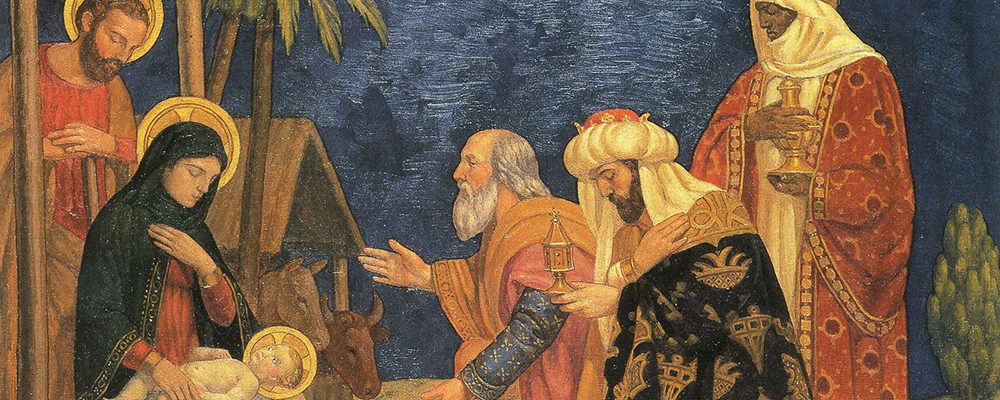
Then at dawn we came down to a temperate valley,
Wet, below the snow line, smelling of vegetation,
With a running stream and a water-mill beating the darkness,
And three trees on the low sky.
And an old white horse galloped away in the meadow.
Then we came to a tavern with vine-leaves over the lintel,
Six hands at an open door dicing for pieces of silver,
And feet kicking the empty wine-skins.
But there was no information, so we continued And arrived at evening, not a moment too soon Finding the place; it was (you may say) satisfactory.

All this was a long time ago, I remember,
And I would do it again, but set down
This set down
This: were we led all that way for Birth or Death?
There was a Birth, certainly,
We had evidence and no doubt. I had seen birth and death,
But had thought they were different…
– from T.S. Eliot Journey of the Magi

We may not all sing from the same hymn book and indeed some may not have any hymnbook. But we have all been sharing something of our life vision in one way or another for decades now. I really want to share with you what brings you joy and wisdom in this life. Here I am taking the liberty of hoping that my joy will not be an alien thing to you.

I usually send a good number of greeting cards at Christmas but a number of health related issues in the past few months have knocked me off my stride and slowed me down – most recently routine eye surgery last week. Don’t be concerned. I’m in good hands and all shall be well.

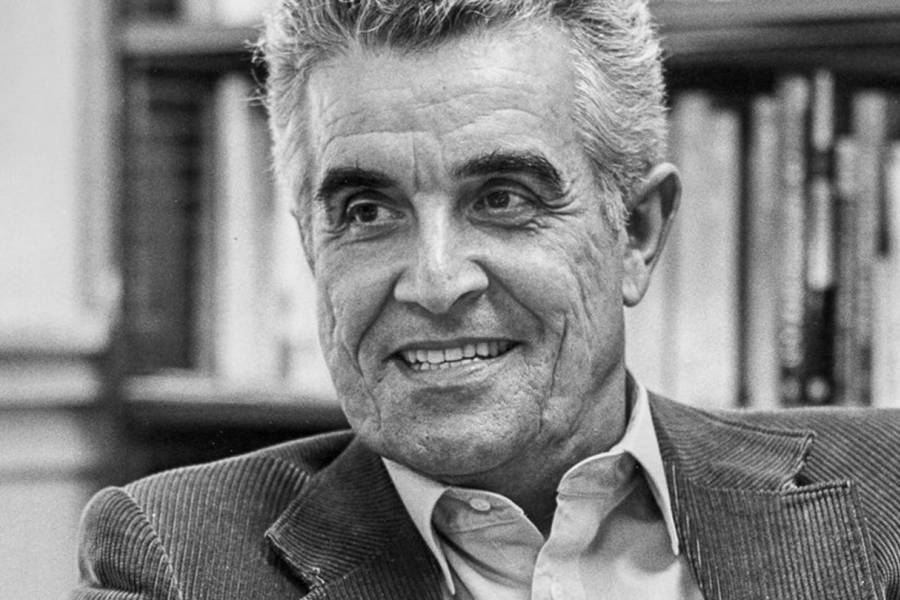
René Girard, Conversion and its Consequences

(René Girard, Part 3)

Fyodor Dostoyevsky – a central figure in Girard’s journey

Rene Girard’s first book, the fruit of his thinking and research in the 1950s was published in 1960. It was called Deceit, Desire, and the Novel.   Writing it resulted in not just a fascinating study of the genesis of  great writing but it also transformed his own life forever.

He describes his attitude and disposition as he started work on that book. It was “very much in the pure demystification mode: cynical, destructive, very much in the spirit of the atheistic intellectuals of the time. I was engaged in debunking.” He realised  that at the heart of his negative attitude was just one manifestation of his theory of imitative desire, mimesis. He was following the crowd. 

In writing Deceit, Desire and the Novel he explores what he takes to be the mind, the thought process and even the souls of great novelists. Among whom, as explicit models of his theory, are Marcel Proust, Dostoevsky and Cervantes.

He argues that with a number of great writers their first conception of their novels was very different from what they ultimately became. “The author’s first draft is an attempt at self-justification, which can assume two main forms. It may focus on a wicked hero, who is really the writer’s scapegoat, his mimetic rival, the one whom he desires to debunk, whose wickedness will be demonstrated by the end of the novel. It may also focus on a “good” hero, a knight in shining armour, with whom the writer identifies, and this hero will be vindicated by the end of the novel.”

But Girard then puts the writer to the test and argues that If the writer has a potential for greatness, after writing his first draft, as he rereads it, he sees the trashiness of it all. His project fails. The self-justification the novelist had intended in his distinction between good and evil will not stand self-examination. The novelist comes to realise that he has been the puppet of his own devil. He and his enemy are truly indistinguishable. The novelist of genius thus becomes able to describe the wickedness of the other from within himself, whereas before it was completely artificial. 

“This experience is shattering to the vanity and pride of the writer. It is an existential downfall. Very often this downfall is written symbolically, as illness or death, in the conclusion. In the case of Proust and Dostoyevsky it is explicitly presented as a change in outlook. Or to take Don Quixote, on his deathbed he sees finally his own mimetic madness, which is also illness and death. And this existential downfall is the event that makes a great work of art possible.”

In this imagining of the writer’s mind, Girard sees the following happening: once the writer experiences this collapse and a new perspective, he can go back to the beginning and rewrite the work from the point of view of this downfall. It is no longer self-justification. It is not necessarily self-indictment, but the characters he creates are no longer “Manichean” good guys or bad guys.

“So the career of the great novelist is dependent upon a conversion, and even if it is not made completely explicit, there are symbolic allusions to it at the end of the novel. These allusions are at least implicitly religious. 

“When I realized this, I had reached a decisive point in the writing of my first book, above all in my engagement with Dostoyevsky. Dostoyevsky’s Christian symbolism was important for me. Demons (The Possessed), presents Stepan Verkhovensky, whose deathbed conversion is particularly moving, but there is also the end of Crime and Punishment and The Brothers Karamazov. The old Verkhovensky discovers that he was a fool all the time and turns to the Gospel of Christ. This is the existential conversion that is demanded by a great work of art.

“When I wrote the last chapter of my first book, I had had a vague idea of what I would do, but as the chapter took form I realized I was undergoing my own version of the experience I was describing. I was particularly attracted to the Christian elements, for example, Stepan Verkhovensky’s final journey… So I began to read the Gospels and the rest of the Bible. And I became a Christian.”

Girard, however, later reflecting back on that conversion, realised that it was no more than what he called “an intellectual-literary conversion”, something deeply satisfying, even enjoyable. But he realised that his initial conversion did not imply any change of life. The change in his life came when he found out that he had a cancerous spot in the middle of his forehead. A biopsy revealed a cancerous growth. “From that time on I was pretty scared.  For all I knew, I had melanoma, the worst form of skin cancer.” 

It turned out to be a false scare but it brought him to a point where his intellectual conversion, which was a very comfortable experience, self-indulgent even, was totally changed. “I could not but view the cancer and the period of intense anxiety as a warning and a kind of expiation, and now this conversion was transformed into something really serious in which the aesthetic gave way to the religious.”

This was an agonising time. But for him it was significant that it coincided with the liturgical period of Lent in 1959. He was aware of this although he had never been a practicing Catholic. He was now thirty-five years old. Then on the Wednesday before Easter, his doctor gave him the ‘all clear’. That Wednesday is traditionally the end of  the lenten period of penance, the beginning of the holiest part of Holy Week. 

After that experience, he went to confession and  had his children baptized. His wife and he were remarried by a priest. So on Holy Thursday he went to Mass and received  the Eucharist. “I felt that God liberated me just in time for me to have a real Easter experience, a death and resurrection experience.”

He later reflected that the prior conversion was too easy. “it entailed no demands or commitments which I perceived at the time, but it prepared the way. So with the definitive conversion I was both emotionally and mentally prepared to accept God’s grace and believe.”

In his interview with James Williams, the editor of A Girard Reader, a collection of key extracts from his books, he describes himself as just ‘an ordinary Christian’.

In that interview he revealed some things about what being a Christian meant to him and what he saw as some essential commitments for any true Christian. Williams asked him about his dispositions towards non-Christians and a pluralistic society? He was asked “Do you favour converting all non-Christians to Christianity?”

Girard simply recalls what Jesus said, “I am the way, the truth, and the life,” and that he told his disciples to go into the world and make converts. “If we give that up, are we still Christian? The idea that if we respect other religions more than our own and act only according to politically correct principles, peace will break out all over the world is fantasy and delusion. I think the Christians who do not want to share their faith do not really believe. The fear of religious tyranny – meaning the forced imposition of our Faith on others –  is an  anachronism. It is a false issue which puts political correctness ahead of the truth and the only way of telling it (the truth) is by connecting with people”

On a  question related to the mission Christ gave his disciples, Williams also asked should one’s Christian faith enter into one’s approach to other religions and cultures? Or is it necessary to “bracket out” one’s faith in order to do scholarly work or to be a thinker?

To this he answered, “I don’t think you can bracket out a faith which is responsible for the best in the modern world. That is totally artificial. I don’t think you can bracket out any idea or ideal that you really hold — or that holds you. If you bracket out something that is central to your life, you become a shadow of yourself and your intelligence is not effective.”

Asked about those who advocate the suspension of their own belief in their approach to other religions he said, “No, that is a Stoic term, and you can practice that if you believe in Stoicism. But it has nothing to do with being a Christian or with real Christianity.

“If you believe that Christianity is the truth, including societal truth, you are not going to reach the truth by bracketing it out. You can see the result of this method all around us, in the current academic debacle for instance. The biblical scholars who are still talking in terms of bracketing truth out are still thinking in nineteenth-century terms. They are on their way to a goal which the deconstructors reached long ago. If we must have nihilism, let us not dilute it with water and let us drink it full strength, with Nietzsche, Heidegger, and the deconstructors. In order to reach the end of the present crisis we must…not interminably repeat attempts which already failed a hundred years ago, like “the quest for the historical Jesus.” Mine is a search for the anthropology of the Cross, which turns out to rehabilitate orthodox theology.

The interviewer then raised the question of freedom and totalitarianism. Girard responded by drawing attention to what he saw as the two forms of totalitarianism. One tries to destroy the concern for victims openly and directly. Its proponents basically attempt to kill as many victims for as little reason as possible. To him this was effectively  a process of mass scapegoating.

Then he went on to point out that today there is in place a process of insidious totalitarianism. In this it is hard not to think that he was foreseeing the bizarre way in which political correctness has degenerated in all the excesses of ‘woke’ culture. 

“Communism in many of its forms was insidious, but it will probably be replaced by ideologies still more insidious which outflank the Gospel on the left, presenting themselves as better than the Gospel…Some of these people see themselves as super-Christians, but they are heirs of the predecessors of Marx who thought they could achieve a new humanism. Feuerbach, for example. But they laid the groundwork for a disrespect of truth. I think it would be helpful to study Feuerbach, who was a primary agent of the transformation of Christianity into Marxism.”

On the question of death, dying and assisted suicide he had this to say. 

“The experience of death is going to get more and more painful, contrary to what many people believe,…euthanasia will make it more rather than less painful because it will put the emphasis on personal decision in a way which was blissfully alien to the whole problem of dying in former times, It will make death even more subjectively intolerable, for people will feel responsible for their own deaths and morally obligated to rid their relatives of their unwanted presence.

Euthanasia will further intensify all the problems its advocates think it will solve.

Rene Girard firmly believed that Christianity had all the answers to the existential problems which confront us in this world and we are presented with choices which our mimetic desires suggest to us.

“One should always look to the Gospels.”

“What are the prescriptions of the Kingdom of God? Basically, give up a dispute when mimetic rivalry is taking over. Provide help to victims and refuse all violence. I find the allegory of the sheep and goats in Matthew 25 to be a key text; it’s all there. When we identify with the person in need or who has been victimized, we encounter the Son of Man, Jesus. What the mimetic theory as such facilitates is the understanding that these ethical prescriptions or principles are against the mimetic spirit of the mob. The Gospels show that faith emerges when individuals come out of the mob.

“All the excesses of the modern world are distortions of Christian truth. The fact that there is a new type of individual in Christianity is the most important thing in the world. The Christian person is new and would have been viewed by traditional cultures as subversive. The only difference is that our narcissistic culture is a deviation and a caricature of the Christian person, not its fulfillment.”

René Girard, The Golden Bough and Mimesis

René GIRARD, PART 2

René Girad was born into a Catholic family in Avignon in France on 25 December 1923. His father, Joseph Girard, was a historian.

René studied medieval history at the École des Chartes, Paris. In 1947, Girard went to Indiana University. He was to spend most of his career in the United States. Although his research was in history, he also taught French literature. A multi-disciplinary character was a marked feature of his academic interests. This facilitated his occupation of positions in a variety of prestigious institutions – at Duke University, Bryn Mawr College and Johns Hopkins University, Baltimore, where he became a full professor in 1961.

In 1981, Girard was appointed Professor of French Language, Literature, and Civilization at Stanford University, where he remained until his retirement in 1995 and subsequently in an active emeritus role. On 17 March 2005, Girard was elected to the Académie française.

Throughout these years he published just short of 30 books, covering all the interlocking disciplines which were the subjects of his thought and research,

Girard’s reading of Dostoevsky, in particular, The Brothers Karamazov and The Possessed (Demons) – especially the deathbed. conversion of Stepan Verkhovensky in that book – were influential in his conversion from agnostic to Christianity. But equally important was where  his reading of Sir James Frazer’s The Golden Bough led him.

Girard read and studied Frazer’s book before his conversion to Christianity. He suspected flaws in Frazer’s reading of mythology and how it contradicted  the Bible.

In The Golden Bough Frazer catalogued all the mythic scapegoats of the ancient stories. But he confused the scapegoating of Christ with the ancient mythical scapegoats. Frazer failed to see that Christ was an innocent victim of scapegoating.

From his murderers’ point of view his death would save the people, as Caiphas said in his unconsciously prophetic utterance. Girard says that Frazer was perfectly right to point to the similarities between the ancient myths and Christianity – in both instances you have a victim who is killed by an entire community. In the ancient myths the victims were eventually seen as gods. In Christ’s case the victim was in fact God incarnate.

“But what Frazier didn’t see, which is the simplest thing of all and should convince everybody immediately, if they were honest, that Christianity is very different from mythology – while being the same. It is exactly the same situation but it is very different because Christianity tells you that Christ was innocent whereas all myths tell you that the victim is guilty….People don’t see that this is the first time in the history of mankind that a myth occurs where the victim is not guilty but innocent, sent by God himself.”

Answering why Christ’s death on the Cross is a saving event, Girard explains that “If you read the ‘mythical’ situation the way I do you can see there is something that is not purely human about it. In classical mythology we are offered all these victims and we take them for culprits, and so forth. In the case of Christianity there are a few disciples who say ‘no, no, He is not guilty’, who maintain to the end that he is innocent. Therefore they say the truth simply. They say a truth which is anthropological before being religious, but which is the same thing.”

Girard points out that Christ’s death on the Cross frees humankind from this deep, profound, inescapable and largely hidden cycle of the scapegoating impulse in which his mythologies imprisoned him. Scapegoating in biblical accounts goes back to the story of Cain and Abel and features in many other biblical accounts – for example in the suffering endured by the prophets. Christianity asserts with certainty that it is the only true religion. It tells the truth about man and about God.  In an interview with Peter Robinson of Stanford’s Hoover Institute, Girard commented, ”Very few people take this statement seriously, as you well know. They should take that literally.” Answering the question as to why don’t they see that Christianity is different, he replies, “They do not want it. Christianity destroys mythology.”

Girard’s rebuttal of Frazer’s errors is complex, the details of which we do not have the space to unravel here. But at the root of it he finds  “That incoherence traditionally attributed to religious ideas…associated with the theme of the scapegoat. Frazer treats his subject at length; his writing is remarkable for its abundance of description and paucity of explanation. Frazer refuses to concern himself with the formidable forces at work behind religious significations, and his openly professed contempt for religious themes. (This) protects him from  unwelcome discoveries.” 

At the heart of Frazer’s total mis-reading of the Passion of Christ is his rejection of the sacrifice at its heart. Girard comments that anyone who tries to subvert the sacrificial principle by turning to derision invariably becomes its unwitting accomplice. Frazer is no exception. “His work in treating the act of sacrificial substitution as if it were pure fantasy, a non phenomenon, recalls nothing so much as the platitudes of second-rate theologians.” 

Because of a wilful blindness, Girard alleges, modern thinkers continue to see religion as an isolated, wholly fictitious phenomenon cherished only by a few backward peoples or milieus. And these same thinkers can now project upon religion alone the responsibility for a violent projection of violence that truly pertains to all societies including our own. This attitude is seen at its most flagrant in the writing of Frazer. Along with his rationalist colleagues and disciples, he was perpetually engaged in a ritualistic expulsion and consummation of religion itself, which he used as a sort of scapegoat for all human thought.

Elsewhere Girard argued that the historical phenomenon of Christians warring with Christians was not in fact a Christian phenomenon but its contrary.

Girard’s second revolutionary idea is that of mimetic desire, that is desire driven by the impulse to imitate another or the other. Mimesis = imitation. This can be good or bad. In Sacred Scripture there are two short passages which lead us to a consideration of René Girard’s theory. By this theory he potentially de-fangs the pernicious analysis of human desire inflicted on us by Sigmund Freud.

In the third letter of St John we are exhorted,

“Beloved, do not imitate evil but imitate

good. He who does good is of God; he who does evil has

not seen God.”

In the letter of St James we are asked:

“What causes wars, and what causes fighting among you? Is it not your passions that are at war in your members? You desire and do not have; so you kill.

And you covet and cannot obtain; so you fight and wage war.”

Girard identifies a triangular relationship in desire – object, model and subject are the same. In his interview with Girard, Peter Robinson puts this in the simplest of terms: 

Serpent, Eve, apple?

Girard accepts this. “Serpent in the mimetic theory of desire is an image of the mediator, the one who directs the subject towards the bad desire.

The churches, you know, who know what they are talking about, better than most people think, know that example is the key to bad as well as good behaviour. This is what I call mimetic desire.”  In the pursuit of illicit desires this is what we call  the occasion of sin.

The imitative nature of desire will often lead to conflict, sometimes violent and catastrophic conflict. Mythology warns us of this: Paris desires Helen and makes Menelaus his enemy and the end of it all is the destruction of Troy.

In this reading of our nature and the process of desiring, Girard identifies good and bad desires – good desires leading to human fulfilment, bad desires leading to rivalry and conflict. One of the great classical spiritual books, Thomas a Kempis’, The Imitation of Christ, points us in the direction of God  – as all great spiritual writing does, encouraging us to do as St James did.

But as Girard points out, people polarise around objects of desire. This is true even for food, shelter, places where you can live and so on. But because of limited availability, scarcity, conflict ensues. Desire to have what the other has, and which we have no right to have, makes for conflict, envy, aggressive attempts to acquire it.

Gil Ballie, is a lay theologian and one of the leading interpreters of Girard’s thought. He summarises mimetic attraction  and its importance in terms of the current crisis in our culture.

We are, he says, in a civilizational crisis, one that is the outworking of anthropological mistakes that have long festered. Increasingly in the history of Western culture, mistakes which we have forgotten or ignored or misconstrued. Among these he lists mimesis, but also  “the most essential fact of human existence, namely, religious longing.” 

“This feature of the human condition is vastly more important than the opposable thumb or the discovery of fire. Our mimetic predisposition cannot be overlooked without catastrophic consequences, nor can its role in mankind’s religious life be discounted. The great question is: how is this religious acuity awakened and thereafter properly ordered? No small number of people have tried to dispense with it as the residue of an earlier stage of human affairs. It is only a matter of time, however, before that religious longing is transferred to ideologies that promise to relieve the boredom of not having a real religion, ideologies that exonerate the violence of their adherents.” 

Baillie cites a moment in the tragic life of the poet Sylvia Plath which tragically illustrates our emptiness and our struggle to escape from it. He quotes a passage in Plath’s journals where she longs for God and for purpose in her life. In desperation, she toys with the possibility of committing herself completely to some political “cause” with a capital “C,” the violence of which could be justified as a “splurge of altruism.” Countless people today, he says,  are doing exactly that. Plath’s final desperate response was suicide.

“There is one feature of this quintessential religious longing that must be recognized: it is always mediated. It is awakened by another or others. The entire biblical canon and the history of the Church provide the guidelines for properly channeling this religious longing, and it does so by showing us countless examples of sinners and saints whose lives and legends convey something about how our religious longing might properly be channelled and ordered.”

In the final part of this series we will look at Girard’s personal journey and how his conversion and deep religious life brought him and us to an understanding of mankind’s deepest aspirations and how to fulfil them.

René Girard and the test of history

(Part One)

The final years of the nineteen hundreds and the early years of the succeeding century produced two thinkers whose ideas had an enormous influence on our culture over the twentieth century, extending even into the present age.

Both were effectively enemies of religion, even  virulently so. One will be familiar to us, his name even having a byword status in our language. The other is not so familiar but, regardless of that, they both left a mark on our culture which did much to transform it from an essentially Christian one into a post Christian atheistic one.

The first of these is Sigmund Freud. The second is the anthropologist, Sir James Frazer. Freud’s legacy is a vastly more extensive one than that of Frazer – and not malign in all its aspects. But his reading of man’s nature and his emphasis on sexual appetite as the root of our desires has been both a determinant of the under-belly of our popular culture and a potent force destroying many of the noble values which have characterised our civilisation for millennia.

Sir James Frazer’s seminal work is The Golden Bough, famous enough and influential enough to be very meaningfully referenced in Francis Ford Coppola’s film, Apocalypse Now. Frazer is not taken very seriously by professional anthropologists but that does not diminish his influence on our culture. Frazer’s destructive idea helped sow the seeds of twentieth century agnosticism and atheism.

Frazer presented The Golden Bough as an exhaustive study of human mythology and how it reveals to us the deeper aspects of anthropology. In particular he focused on the pervasive phenomenon of scapegoating as the cathartic  agent which rescued human societies from one catastrophe after another. Think of the myth of Oedipus here. Frazer’s grave and destructive error, however, was to include the scapegoating, suffering and death of Jesus as just one more myth in the long catalogue which he assembled. He failed to see the radical difference between the scapegoating of Christ and all the others in his list – remember, Caiphas did present Christ to the Sanhedrin as such. 

“Nor do you understand that it is expedient and politically advantageous for you that one man die for the people, and that the whole nation not perish” (John 11:50).

But neither Caiphas nor Frazer understood the true meaning of Christ’s voluntary sacrifice for the redemption of mankind.

There is one twentieth century thinker  who many regard as one who by the end of this century will be regarded as one of the greatest influences on our time and whose thought will explode the fallacies perpetrated by, among others, both Frazer and Freud. His reading of man as man and our relationship with God and the world will tower head and shoulders over all others. He will do so because he directly confronts Freud’s corrupt reading of the roots of human desire.  He also demolishes Frazer’s simplistic confusion of the phenomenon of mythological scapegoating with Christ’s truly salvific sacrifice on the Cross.

This man was René Girard (1923-2014). Girard was a man whom Bishop Robert Barron describes as one of the great Catholic philosophers of our time and predicts that in the future his influence will be regarded as that of a modern Church Father.  Girard was a member of the Académie Française, taught in the universities of Indiana, Johns Hopkins and finally in Stanford. Barron classifies two types of academics, those who beguile you with brilliant ideas and those who will shake our world. Girard, he says, was one of the latter. The Canadian sociologist, Charles Taylor, writes of the “ground-breaking work” of  Girard. In reading contemporary attempts of our efforts to confront our society’s problems it is not unusual to find writers talk of ‘Girardian’ approaches to these.

But his influence is multifaceted and penetrates into the secular world in a remarkable way. He has influenced some of the leading movers and shakers in Silicon Valley – people like Peter Theil and Mark Andriessen. J.D. Vance has attributed his conversion to Catholicism to reading Girard. Thiel, founder of PayPal and now one of the West’s leading public intellectuals studied under Girard at Stanford. He has said that Girard has had a tremendous impact on his life, and considers the author’s book Things Hidden Since the Foundation of the World           to be Girard’s masterpiece.

Theil says “Girard ranges over everything: every book, every myth, every culture — and he always argues boldly. That made him stand out against the rest of academia, which was and still is divided between two approaches: specialized research on trivial questions and grandiose but nihilistic claims that knowledge is impossible. Girard is the opposite of both: He makes sweeping arguments about big questions based on a view of the whole world. So even when you set aside the scandalous fact that Girard takes Christianity seriously, there is already something heroic and subversive about his work.”

Bari Weis, former Wall Street Journal and New York Times writer, and now upsetting mainstream media’s applecart as founder-editor of The Free Press, published a series  recently listing nine twentieth century prophets. Girard was one of them. The piece on Girard was by one of his recent biographers, Cynthia Haven.

Haven reflected on how  “Today, a single tweet could wreck a career. It could even bring down a government, if the stars are aligned. Mobs gather online instantly, ideologies form seemingly overnight, and cancel culture punishes those who dare dissent. This precarious, pernicious world is the one we live in now. But decades before anyone had heard of “doxxing” or “downvoting” or “dragging,” a French literary scholar at Stanford, born more than 100 years ago, warned of what was to come. He foresaw the perils of combining human nature with a globally connected world.”

“When the whole world is globalized, you’re going to be able to set fire to the whole thing with a single match,” predicted Girard. 

In Girard’s deep and penetrating study of the nature of human desire – forget Freud’s blinkered sexual preoccupations – he explored envy, imitation, crowd behaviour, and reciprocal violence. Starting in the 1950s, he first developed his insights not by poring through datasets or running a social science lab but, surprisingly, from a deep study of great literature.  Great novels tell us the truth, he said. In them we see the truest reflections of men and women’s inner being.

Girard was not a superficial optimist. Neither was he a grim pessimist. He was a man of Faith and Hope but he did take the apocalyptic passages of Sacred Scripture seriously. He looked at the point at which we have now arrived in human history and worried deeply about what he saw unfolding. He takes very seriously the apocalyptic passages in the New Testament. For example the second letter of St Peter:

“Since all these things are thus to be dissolved, what sort of persons ought you to be in lives of holiness and godliness, waiting for and hastening the coming of the day of God, because of which the heavens will be kindled and dissolved, and the elements will melt with fire!  But according to his promise we wait for new heavens and a new earth in which righteousness dwells.

“Therefore, beloved, since you wait for these, be zealous to be found by him without spot or blemish, and at peace.  And count the forbearance of our Lord as salvation. ”

Girard has written, “History you might say is a test for mankind but we know very well that mankind is failing that test.” (quote from his book, Battling To The End). He explains what he means by this: “Mankind is failing that test because mankind has the truth in the reality of Christianity, which is there. This truth has been there for 2000 years, and instead of moving ahead and becoming more widespread it is becoming more restricted.”

But he goes on to say that when the anti-religious are attacking Christianity, it is not the essence pf Christianity they are attacking but their own false reading of it. What is really going on is an effort to restore a mythical pagan world.

Girard reflects that when he was a child, before the invention of the atom bomb priests always talked in church of the apocalyptic texts, particularly before Advent, the last Sunday of Pentecost time. He speaks of how they impressed him. “In a way the inspiration of my whole work is there. I have been talking about these texts all the time.”

“In some way the gospels and scripture are predicting that mankind will fail the test of history since they end with an eschatological theme, literally the end of the world”.

Girard’s calm rational vision of the ‘end times” are reminiscent of what Romano Guardini wrote about the Book of Revelation

“The apocalyptical is that which reveals temporality’s true face when it has been demasked by the eternal. It was given to St. John to behold this. No pleasurable favor, this gift of the visionary eye. He who has it can no longer look upon the things of existence without trembling at sight of ‘the hair’ by which they hang. He lives under the awful pressure of constant uncertainty. Nothing is safe. The borders between time and eternity melt away. From all sides eternity’s overwhelming reality closes in upon him, mounting from the depths, plunging from the heights. For the visionary life ceases to be peaceful and simple. He is required to live under duress, that others may sense how things really stand with them; that they not only learn that this or that is to take place—still less the futile details of the time and circumstances—but that they may possess the essential knowledge of what all existence undergoes at the approach of the eternal. Only he reads the Apocalypse properly who leaves it with some sense of this.”

In exploring the errors of our time and in presenting his interpretation of our true nature  Girard seems to be offering us a way out  of our contemporary self-destructive maze. What that way is, based on the twin pillars of his study of the process of human desiring and the truly redemptive sacrifice of Jesus Christ which Frazer denied, will be approached in part two of this article.

The Life and Art of Andrey Tarkovsky

Part II

Romanov, Yermash, Sisov and all those within the decaying soviet totalitarian system were bereft of ideas and their only guiding principle was to try and not make mistakes which superiors might deem contrary to Bolshevism – which they themselves probably did not even understand. The removal of Romanov was just one symptom of this.

Out of these early contradictions and the pressures with which Tarkovsky had to contend to get his films made, he forged the artistic and creative principles by which he knew he had to work. In 1970 he wrote:

One doesn’t need a lot to be able to live. The great thing is to be free in your work. Of course it’s important to print or exhibit, but if that’s not possible you still are left with the most important thing of all – being able to work without asking anybody’s permission. However, in cinema that is not possible. You can’t take a single shot unless the State graciously allows you to. Still less could you use your own money. That would be viewed as robbery, ideological aggression, subversion.

Stalker, Tarkovsky’s last film made in the Soviet Union, is based on Roadside Picnic, a story by the Strugatsky brothers. But in Tarkovsky’s hands it probes the depths of what the film-maker saw as the fundamental crises of the modern world: the rift between natural science and belief; the future of mankind living with the atomic bomb; and, ultimately, the dim glimmer of hope still left to man.

The dream sequence in Stalker

What these four films (Andrey Rublev, Solaris, Mirror and Stalker) up to this point revealed – and his enemies in the system sensed this, but did not understand it – was Tarkovsky’s Christian faith and his realisation of the totally corrupting influence of Marxist materialism. Mirror, so beautiful but equally obscure to them, was more personal. But they also hated it. However, by now his international acclaim was such a huge factor that their obnoxious treatment had to be camouflaged.

In his diaries at that time he revealed his soul and his devastating critique of the system he lived under.

By virtue of the infinite laws, or the laws of infinity that lie beyond what we can reach, God cannot but exist. For man, who is unable to grasp the essence of what lies beyond, the unknown – the unknowable is GOD. And in a moral sense, God is love.

His reading of Marxism and the faltering regime he had to try to live and work under is summed up as follows:

Man is estranged. It might seem that a common cause could become the basis of a new community; but that is a fallacy. People have been stealing and playing the hypocrite for the last fifty years, united in their sense of purpose, but with no community. People can only be united in a common cause if that cause is based on morality and is within the realm of the ideal, of the absolute…Because each one only loves himself… Community is an illusion, as a result of which sooner or later there will rise over the continent evil, deadly, mushroom clouds…An agglomeration of people aiming at one thing – filling their stomachs – is doomed to destruction, decay, hostility. 

‘Not by bread alone,’ he concluded.

Elsewhere he said, materialism – naked and cynical – is going to complete the destruction.

Despite the fact that God lives in every soul, that every soul has the capacity to accumulate what is eternal and good, as a mass people can do nothing but destroy. For they have come together not in the name of an ideal, but simply for the sake of a material notion… Man has simply been corrupted…. Those who thought about the soul have been – and still are being – physically eliminated.

In watching a Tarkovsky film one has to take note of the way in which he wants viewers to respond. In this we are not far from Christopher Nolan’s expectations of his audiences. Nolan Admired Tarkovsky and his work, and particularly Mirror.

Tarkovsky described what he saw as a basic principle of film-making… the mainspring is, I think, that as little as possible has actually to be shown, and from that little the audience has to build up an idea of the rest, of the whole. In my view that has to be the basis for constructing the cinematographic image. And if one looks at it from the point of view of symbols, then the symbol in cinema is a symbol of nature, of reality. Of course it isn’t a question of details, but of what is hidden.

Like Nolan, Tarkovsky makes demands on his audience. Viewers have to, as it were, learn a cinematic language which mainstream Hollywood does not teach or even know.

The battles for distribution continued with Yermash. But there were some signs of a thaw and Tarkovsky was eventually able to make two films abroad, one in Italy and one in Sweden.

He began to see his battles as a cross Christ asked him to bear. He wrote of the Cross and identified his woes with Christ’s Cross. At one point he saw himself facing two years of misery: with Andriushka at school; and Marina, and Mother, and Father. It is going to be hell for them. What can I do? Only pray! And believe.The most important thing of all is…to have faith in spite of everything, to have faith.

We are crucified on one plane, while the world is many-dimennional. We are aware of that and are tormented by our inability to know the truth. But there is no need to know it! We need to love. And to believe, Faith is knowledge with the help of love.

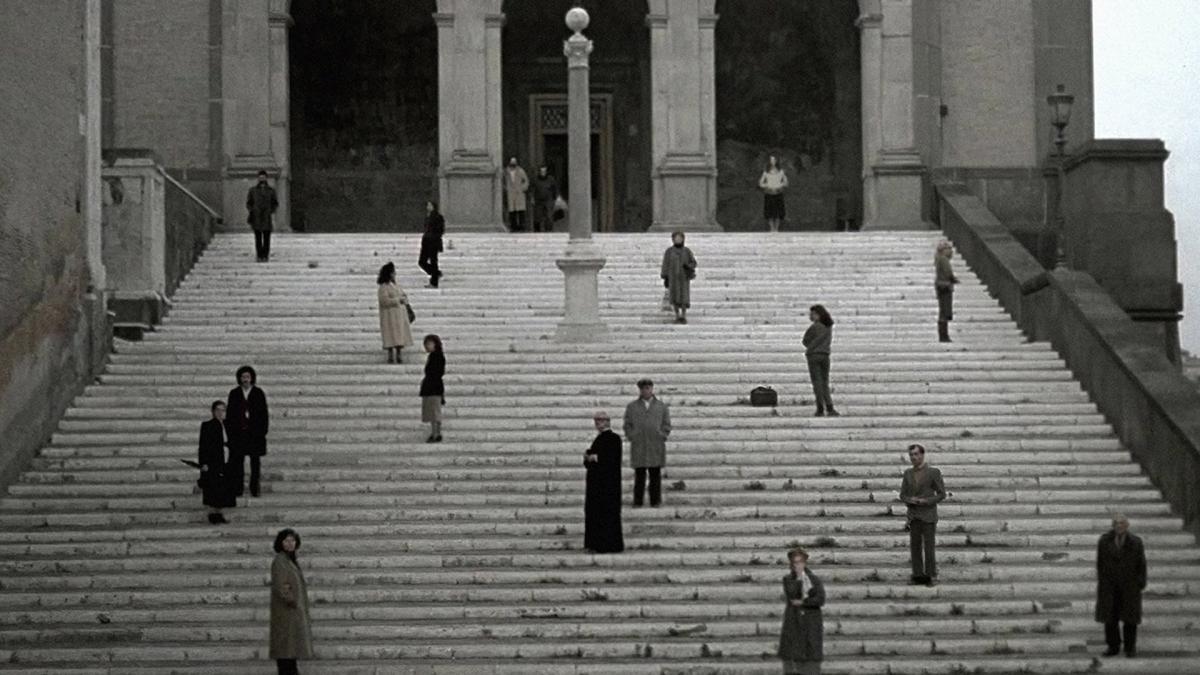
Tarkovsky was allowed to travel to Italy in the 1980s to shoot Nostalgia. This was a Soviet-Italian co-production. The theme is, however, typical of the Russian dilemma: that of the artist abroad, smitten by homesickness, unable to live in his country or away from it — the very fate that befell Tarkovsky himself in the last years of his life. It was even more painful still for him because the authorities restricted the movement of his family and starved him of financial support. It was not until the end of his life that they allowed his young son, Andriushka, to be with him.

His time in Italy in 1980, apart from the creative work he did there on Nostalgia, was spiritually enriching for him. Two extraordinary events in particular highlight this. One was his visit to the Holy House in Loreto. Of this he recorded something very personal in his diary.

An amazing thing happened to me today. We were in Loreto where there is a famous cathedral (rather like Lourdes) in the middle of which stands the house in which Jesus was born (sic), transported here from Nazareth. While we were in the cathedral, I felt it was wrong that I can’t pray in a Catholic cathedral; not that I cannot, but that I don’t want to. It is, after all, alien to me. Then later, quite by chance, we went into a little seaside town called Porto Nuovo, and into its small, tenth century cathedral. And what should I see on the altar but the Vladimir Mother of God.

Apparently some Russian painter had, at some time, given the church this copy of the Mother of God of Vladimir, evidently painted by him.

I couldn’t believe it: suddenly to see an Orthodox ikon in a Catholic country, when I had just been thinking about not being able to pray at Loreto.

It was wonderful.

The second event he recorded as follows:

Today I relaxed while Tonino finished dictating his script. I went to St. Peter’s Square. I saw and heard the Pope’s appearance in front of the people-the crowd filled the entire square with flags, banners and placards. It’s odd that although I was surrounded simply by large numbers of curious people, such as foreigners and tourists, there was a unity about them which impressed me deeply.

There was something natural, organic in it all. It was obvious that all these people had come here of their own free will. The atmosphere reigning in the Square made that perfectly clear.

I also felt it was wonderful that as I was wandering round the streets, before going by chance into St. Peter’s Square, I had been thinking that today was Sunday and what fun it would be when I got back to Moscow to be able to say that I had been present at a Papal audience at the Vatican. 

He also recorded some moments of prayer in his diaries. One such was this conversation with God:

Lord! I feel You drawing near, I can feel Your hand upon the back of my head. Because I want to see Your world as You made it, and Your people as You would have them be. I love You, Lord, and want nothing else from You. I accept all that is Yours, and only the weight of my malice and my sins, the darkness of my base soul, prevent me from being Your worthy slave, O Lord!

These thoughts of death – he was never really in good health – were noted when he was battling with the authorities over the content of Stalker, a film in which the protagonist seeks unsuccessfully to open the minds of his two pilgrim companions to the meaning of our existence:

If God takes me to himself I am to have a church funeral and be buried in the cemetery of the Donskoy Monastery. It will be difficult to get permission. And no one is to mourn! They must believe that I am better off where I am. The picture is to be finished according to the pattern we decided for the music and sound. Lucia must try and tidy up the end of the bar scene. ‘The Room’ should include the new text from the notebook (the sick child) plus the old one, written for the scene after the ‘Dream’. 

At the end of 1985, after the release of Nostalgia, again to international acclaim, he completed the shooting of his last film, The Sacrifice, in Sweden. Described as a parable by Tarkovsky, the story revolves around a family awaiting an impending nuclear catastrophe in a remote Scandinavian seaside location. The paterfamilias prays and offers himself to God as a sacrificial victim to save the world from the impending disaster. It is a profoundly mysterious, reflective and beautiful work, regarded by some as the artist’s masterpiece.

 Andrey Tarkovsky returned to Rome after completing it. Already afflicted by the cancer to which he succumbed a year later, he died on 29 December 1986, at a Parisian clinic. His last diary entry was made on 15 December. He is buried in a graveyard for Russian émigrés in the town of Saint-Geneviève-du-Bois, France.

The Extraordinary Life and Art of Andrey Tarkovsky

Part I

What is it about Russia? What is it about her creative artists? To a man they love their country but to a man – with very few exceptions – particularly for the past century – they have been persecuted by their country’s rulers. Her great composers in the modern age, Prokofiev and Shostakovich, had to tread very carefully and tailor their work to please the political masters. Her great ballet artists had to flee Russia to express their genius freely. Above all, her great writers of the past hundred years suffered unspeakable indignities. Even today the number one persona non grata is Mikahil Bulgakov even though he died over 70 years ago. Why? Because ordinary Russians are flocking to cinemas to see a film version of his magnificent anti-Stalinist novel, The Master and Margarita. This has been made by an expat Russian and is now being interpreted as an anti-Putin satire.

Hannah Arendt, in her master work, The Origins of Totalitarianism, while recognising the post Stalinist communist system as one of dictatorship, did not see it in 1966  as totalitarianism. It lacked the quality of complete domination and while vicious, was but a crumbling edifice, a shadow of its former self.

Arendt wrote in 1966:

“The clearest sign that the Soviet Union can no longer be called totalitarian in the strict sense of the term is, of course, the amazingly swift and rich recovery of the arts during the last decade. To be sure, efforts to rehabilitate Stalin and to curtail the increasingly vocal demands for freedom of speech and thought among students, writers, and artists recur again and again, but none of them has been very successful or is likely to be successful without a full-fledged re-establishment of terror and police rule. 

“No doubt, the people of the Soviet Union are denied all forms of political freedom, not only freedom of association but also freedom of thought, opinion and public expression. It looks as though nothing has changed, while in fact everything has changed. When Stalin died the drawers of writers and artists were empty; today there exists a whole literature that circulates in manuscript and all kinds of modern painting are tried out in the painters’ studios and become known even though they are not exhibited.”

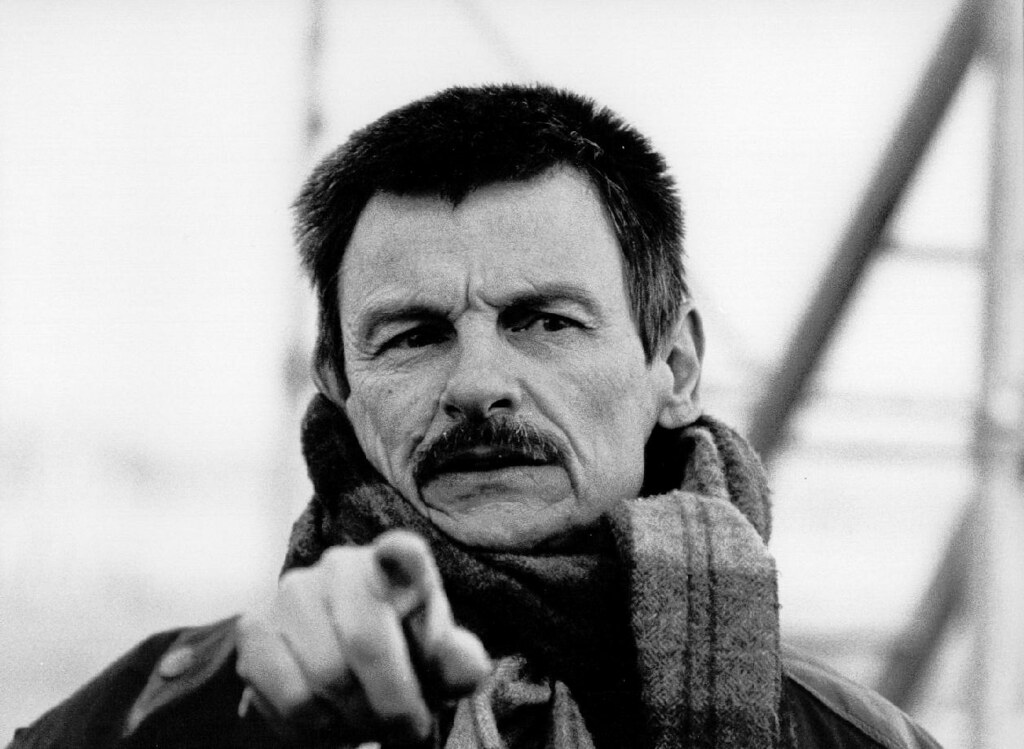
In the world of creative cinema, one of the saddest stories of all is that of Andrey Tarkovsky. Tarkovsky was born on 4 April 1932, probably the darkest decade in Soviet history. His mother, Maria Ivanovna, was a talented actress, and his father, Arseniy Tarkovsky, a respected poet and translator. Both his parents have featured in his work. His mother had a central role in his masterpiece, Mirror. The haunting poems of his father were used in several of his films.

In addition to regular classes at school he began to study music and drawing. In 1954 he successfully applied for admission to the prestigious All-Union State Institute of Cinematography (VGIK) in Moscow.

Tarkovsky’s first major feature film, Ivan’s Childhood, was shown in Moscow in April 1962. This was a haunting and tragic story, beginning idyllically in pre-World War II Russia and then descending into horrors of that war. The story focuses on the evil of war and how it turns Ivan’s childhood into a monstrous nightmare.The film won the Venice Festival’s Golden Lion in that year and drew the attention of the world to the thirty-year-old director.

It also drew the attention of the Soviet authorities, creating an expectation that here was an artist who could serve their propaganda purposes. They were to be bitterly disappointed. The long and bitter harassment of Tarkovsky began at this point. His diaries, dating from 1970 up to just a couple of weeks before his early death in 1986, record the details of this struggle, as well as the creative instincts and the deep religious consciousness from which they sprang. That this consciousness could be nurtured by his mother in the terrifying environment of Stalinist Russia is one of the most extraordinary things about this man.

The trouble began around the end of 1966, with the begrudging release of his second film, the three-hour long Andrey Rublev. Initially his ideological masters did not seem to know what to make of it. But soon the penny dropped. It attracted international attention and with the critical interpretation of its themes, the apparatchiks realised they had a problem on their hands. They still wanted him to work for them, but on their terms. This effectively turned his working life into something like a living hell. 

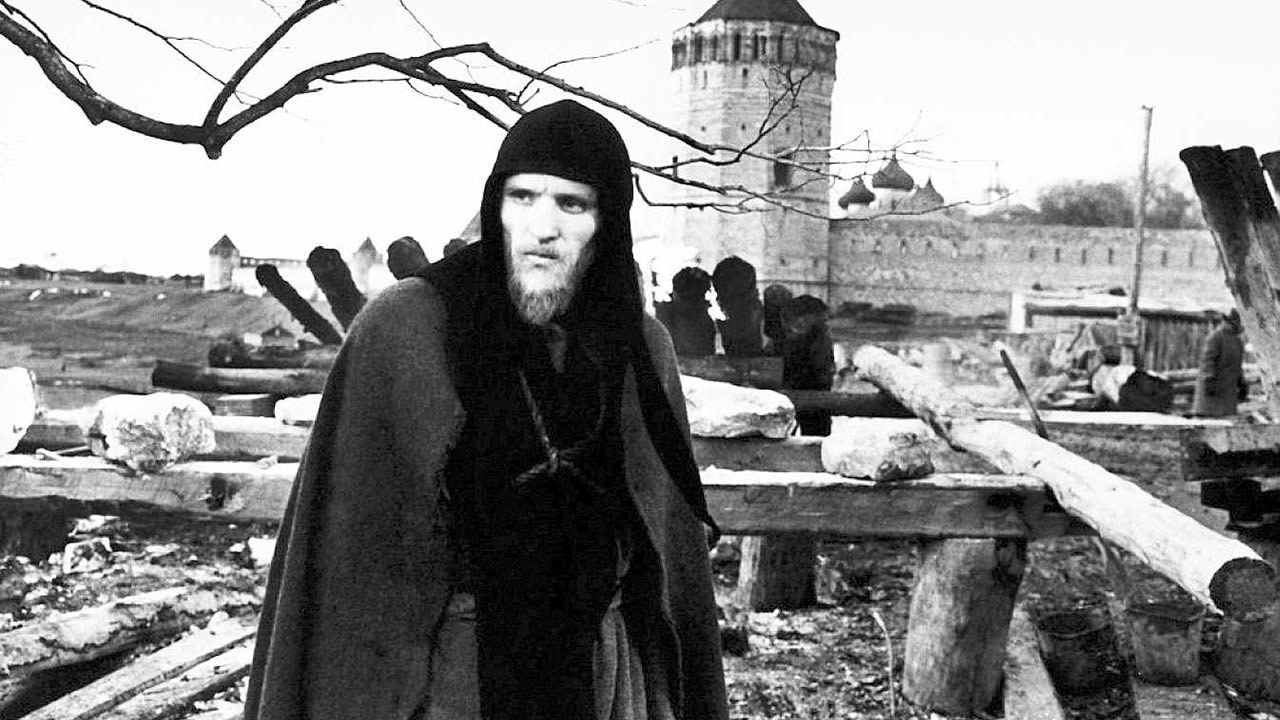
Andrey Ruble

Of his battle to have the film released he wrote:

Late yesterday evening E. D. rang and said that Chernoutsan just telephoned him: Suslov signed the document for the release of Rublev immediately after the Congress. I must find out from K straightaway which cinemas and how many copies. Of course the Committee insists on cuts.  I’ll tell them to go to hell. So I must contact A. N. Kosygin as soon as possible. He apparently wanted to meet and spoke highly of the film.

Kosygin was Russian Prime Minister from 1964 to 1980.

Andrey Rublev is structured in three parts and features the life and work of the great Russian icon painter of that name. One of his most famous icons is that of the Blessed Trinity. The central section depicts the struggles of the early evangelisers of Russia and their battles with the remnants of paganism. The last symbolic section shows the battle of a small Christian community to restore a bell to their church. This bell had to be built in a makeshift foundry and could only be done by a young boy who was the last person alive who knew the secret of how to do this. It is an utterly dramatic and moving sequence, clearly symbolic of the hopes of a Christian future for Russia.

The first article about the film in Russia appeared in Komsomolskaya Pravda. “A nasty little piece,” Tarkovsky commented, “which will have the effect of bringing the public to see the film. There is no announcement in any paper about Rublev being on. Not a single poster in the city. Yet it’s impossible to get tickets”. 

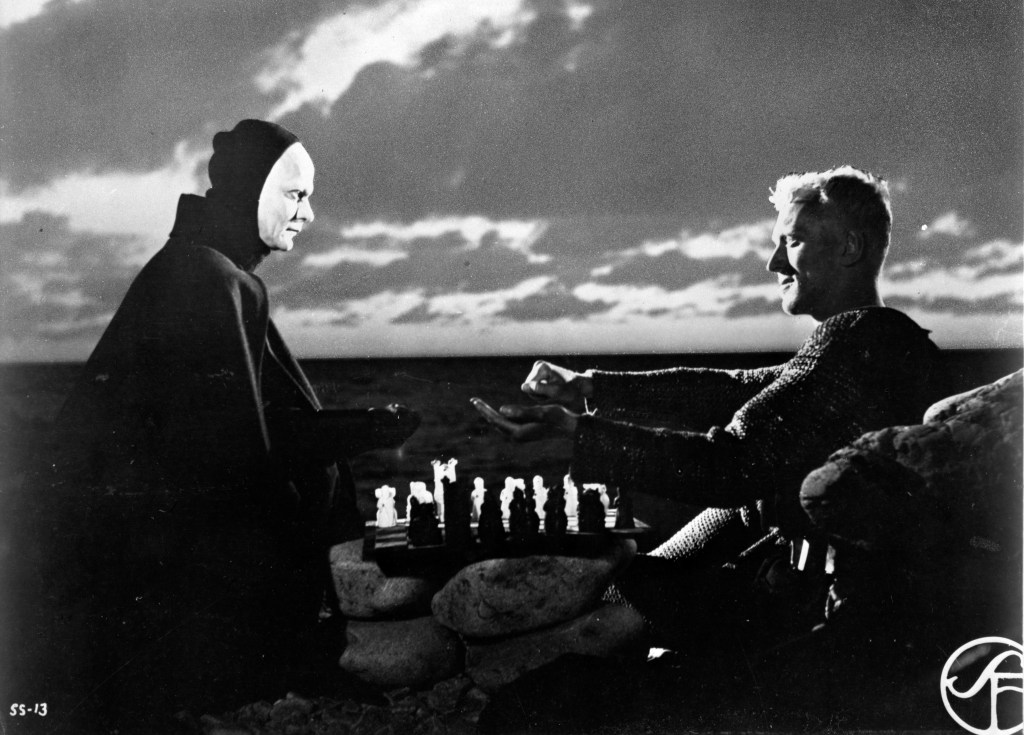
When Rublev was eventually shown in Sweden, Ingmar Bergman said it was the best film he had ever seen. He is reported to have watched it ten times. In an interview Bergman described Tarkovsky as the best contemporary director, superior even to Fellini.

Andrey Rublev, which was shown out of competition at the Cannes Festival in 1966, and won an award there, was only cleared for export by the Soviets in 1973. Similarly Mirror, completed in 1974 against strong bureaucratic resistance, reached west European cinemas only years later. Mirror is a deeply moving reflection of the life and travails of Tarkovsky’s own family.

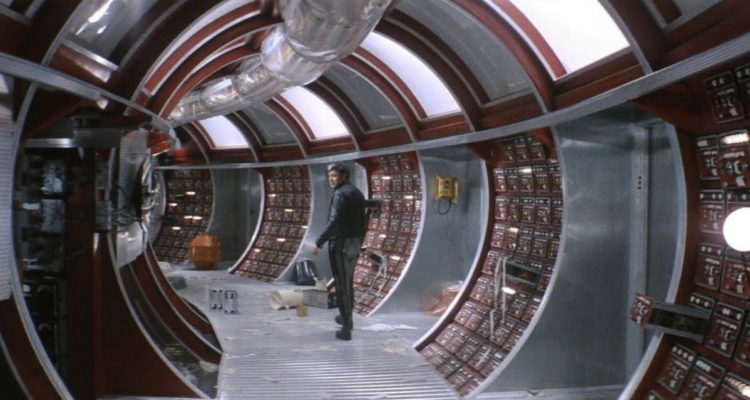
With Solaris, made over 1971/1972, based on a science fiction novel by Polish writer, Stanislas Lem, Tarkovsky touched upon a subject that seemed relatively innocuous in the Soviet Union at the time – man forging ahead into space. But even here his approach generated a long list of criticisms and objections. This was because in his hands it was not just a science fiction work but a deep exploration of a man grappling with his conscience.

The Central Committee attempted to destroy Solaris.

Tarkovsky made a note of some thirty-three cuts they demanded but which he considered would destroy the whole basis of the film. “In other words, it’s even more absurd than it was with Rublev.” Among the alterations they demanded were the following:

There ought to be a clearer image of the earth of the future. (Presumably a communist future).

Cut out the concept of God. 

Cut out the concept of Christianity. 

The conference. Cut out the foreign executives.

He wrote in desperation, Am I really going to be sitting around again for years on end, waiting for somebody graciously to let my film through?

What an extraordinary country this is? Don’t they want an international artistic triumph, don’t they want us to have good new films and books? They are frightened by real art. Quite under-standably. Art can only be bad for them because it is humane, whereas their purpose is to crush everything that is alive, every shoot of humanity, any aspiration to freedom, any manifestation of art on our dreary horizon. They won’t be content until they have eliminated every symptom of independence and reduced people to the level of cattle.

In the end he decided to make just those alterations that were consistent with his own plans and would not destroy the fabric of the film.

Then something like a miracle happened which he described as follows:

Romanov came to the studio on the 29th and Solaris was accepted without a single alteration. Nobody can believe it. They say that the agreement accepting the film is the only one to be signed personally by Romanov. Someone must have put the fear of God into him.

I heard that Sizov showed the film to three officials whose names we don’t know and who are in charge of the academic and technological side of things; and their authority is too great for their opinion to be ignored. It’s nothing short of miraculous, one can even begin to believe that all will be well.

In the next act in the drama Aleksey Romanov was removed and replaced by another equally opaque apparatchik. F. T. Yermash. He was to be Tarkovsky’s nemesis for the remainder of his career.

Part II next week.

Endgame or Game On?

Endgame? Part II

In the hope of finding some glimmer of hope and optimism in the face of what looks like catastrophic population decline I went to the ideas of Alasdair McIntyre in his famous book, After Virtue. For it seemed to me that while Klein and Sciubba talked about values, those values only floated in a vague soup of feelings and nothing more. While their analysis and searching for answers remain in the realm of the moral framework of the emotivism which MacIntyre finds at the heart of modernity, they will get nowhere. We have no reason to doubt their good intentions or their sincerity, but are they unwitting victims – as our culture in general is – of the disastrous philosophical turning which occurred after the Renaissance and on into the Enlightenment? The only virtue people seem to talk about in the contemporary context is that barren species known as ‘virtue signalling’. There is a cliche that tells us that ‘ideas have consequences’. They do but they often do so without people realising that the consequences they are suffering, or are about to suffer, are rooted in false ideas.

Alasdair MacIntyre casts light on the darkness confronting our race in two ways. The first does not offer much solace. It envisions the collapse of all that we take for granted in our civilization.

He does this in terms of an allegory suggestive of the premise of the science-fiction novel A Canticle for Leibowitz: a world where all sciences have been dismantled quickly and almost entirely. MacIntyre asks what the sciences would look like if they were re-assembled from the remnants of scientific knowledge that survived the catastrophe. 

From his extrapolation of that allegory we may extrapolate something about our own demographic predicament: The grim effect of catastrophic population collapse will be the inevitable destruction of the infrastructure which in material terms sustains our comfortable way of life, ultimately perhaps descending into a variation of the kind of unexplained chaos depicted by Cormac McCarthy in The Road.

We already know what a shortage of competent and trained workers means for our daily life and comfort. “I just can’t find a plumber to repair that leaking valve”.

Again extrapolating from the theses of After Virtue, we can find the roots of our demographic predicament in corrupt philosophy.

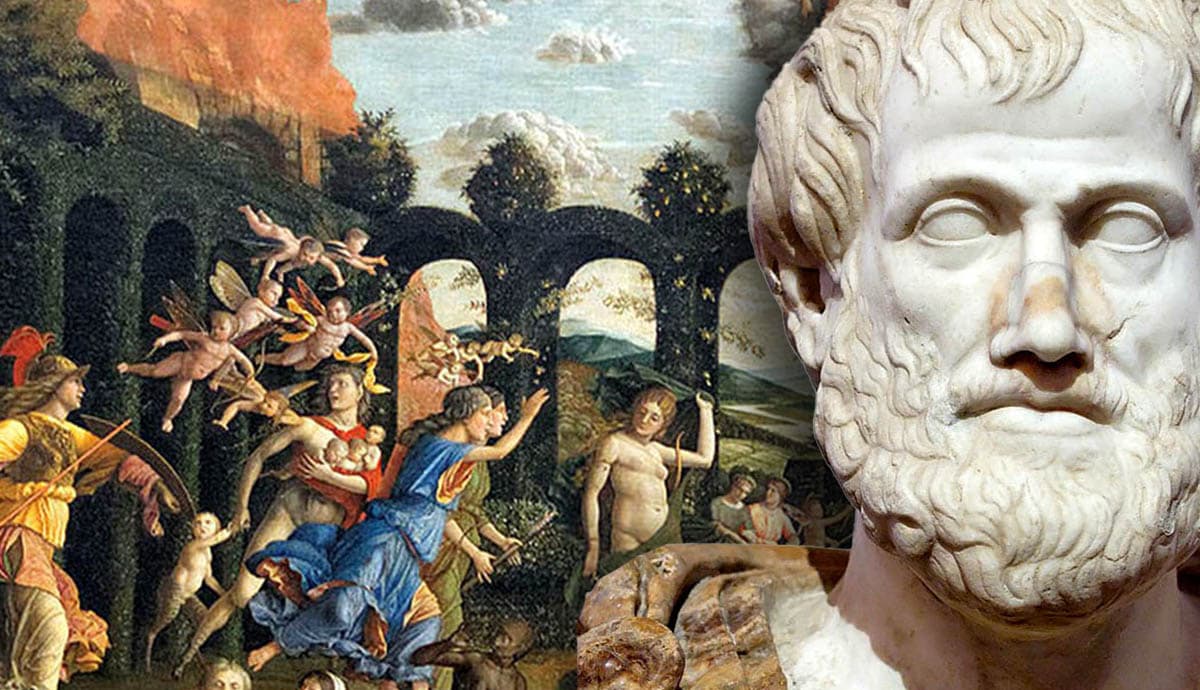
“The hypothesis which I wish to advance”, MacIntyre argues, “is that in the actual world which we inhabit the language of morality is in the same state of grave disorder as the language of natural science in the imaginary world which I described.” He holds that the moral structures that emerged from the Enlightenment were philosophically doomed from the start because they were formed using an incoherent language of morality. In abandoning Aristotelian teleology – the view that only by contemplating mankind in terms of its purpose and its end, and these as the foundation for the moral life – philosophy took a disastrous wrong turn. 

He argues that when we abandoned the idea that human life had a proper end or character we were heading into a dark and confused place. Individualism and emotivism were going to be the ruling principles of what we might call our morality. 

The Enlightenment  ascribed moral agency to the individual. He claims this made morality no more than one man’s opinion.  Philosophy became a forum of inexplicably subjective rules and principles. From this stems the now dominant moral principle of emotivism. We, in our time, now see that it is from this source that the virus of wokism flows  – which is nothing more or less than a deranged moral code. Where that will lead remains to be seen. It may die as most ideologies do, but as long as emotivism remains supreme, worse may follow.

In his critique of capitalism, the bureaucratic state, and its associated liberal and Enlightenment-inspired ideology, he defends ordinary social “practices”and the “goods internal” to practices, much as Edmund Burke did in his critique of the ideology of the French Revolution. MacIntyre argues that pursuit of these practices helps to give narrative structure and intelligibility to our lives. What we have to do is ensure that these goods are defended against their corruption by “institutions”, which pursue such “external goods” as money, power and status.

MacIntyre’s vision, while somewhat dark, is not pessimistic – because he has a Christian vision of our existence. He tells us that we are waiting not for Godot but for Benedict of Nursia. MacIntyre sees morals and virtues as only comprehensible through their relation to the community which they come from – echoes of Burke again. True virtue is rooted in knowing who we are and where we come from. 

It also must carry within it something of the value of sacrifice. I write this on Thursday of Holy Week, the day on which the Eucharist  was given by Christ to his disciples for the first time, he himself, Body and Blood, soul and divinity. As I do, I recall words from G. M. Hopkins’ translation of Aquinas’ great Eucharistic hymn, Adoro Te Devote:

O thou our reminder of Christ crucified,

Living Bread, the life of us for whom he died,

Lend this life to me then: feed and feast my mind,

There be thou the sweetness man was meant to find.

Many years ago Romano Guardini wrote:

“How great is the transformation of our conception of man through Christianity. It is something we are again beginning to appreciate, now that its validity is no longer generally accepted. Perhaps the moment is not distant in which the Christian ideal, like that of antiquity during the Renaissance, will overwhelm the modern consciousness with its unspeakable plenitude.” (Guardini, The Lord).

We do not need to relocate to Monte Casino to live with this vision. We are, as people of the Judaeo-Christian tradition, people who believe in Divine Goodness, Justice and Mercy, called by God to live here and now in this real world and with this Spirit. Only by doing so will we live our lives with the sense of, and commitment to, priorities, often involving a spirit of sacrifice, which will ensure the fruitfulness mandated for us by our Creator. Thus, and thus only, will we avert the impending disaster threatening our race.

The Lancet reported recently on a study about  the low-fertility future. The interpretation of the study which it offered made sobering reading, much as did the conversation between Ezra Klein and Jennifer Sciubba. 

Fertility is declining globally, with rates in more than half of all countries and territories in 2021 below replacement level. Trends since 2000 show considerable heterogeneity in the steepness of declines, and only a small number of countries experienced even a slight fertility rebound after their lowest observed rate, with none reaching replacement level. Additionally, the distribution of live births across the globe is shifting, with a greater proportion occurring in the lowest-income countries. Future fertility rates will continue to decline worldwide and will remain low even under successful implementation of pro-natal policies. These changes will have far-reaching economic and societal consequences due to ageing populations and declining workforces in higher-income countries, combined with an increasing share of live births among the already poorest regions of the world.


In 1985 the great Russian film director, Andrey Tarkovsky, made his last film, just before his untimely death. It was called The Sacrifice and centered on a man offering his life to save a world threatened by imminent nuclear catastrophe. Mankind has to stop thinking that anything good can be achieved without a spirit of sacrifice. Without sacrifice there is no love and without love there will be no future worth talking about..

Endgame?

This is the way the world ends  

Not with a bang but a whimper.

Unless… Unless what? The problem is, we cannot give a coherent answer to that question. The truth is we seem not to know even how to begin to answer that question. That is, the agencies which try to govern our destinies on this planet, our governments, our academics, our experts, do not know, have not got the slightest idea of what to do to head off that “whimper”.

Ezra Klein, columnist with the New York Times, one of their best, and Jennifer Sciubba, distinguished demographer, began a heavyweight discussion on the columnist’s NYT based The Ezra Klein Show recently. They grappled with a frightening prospect for humanity – nothing less than what looks like the impending collapse of our civilisation.

Klein began, “So, tell me what ‘the total fertility rate’ is?”

Sciubba explained that the total fertility rate is — “let’s just say it’s the average number of children born per woman in her lifetime.” 

Klein then went on to say that when he listens to the conversation about total fertility rates, there are two conversations going on at the same time. One on the left is that it’s way too high. There are too many people. The other conversation is about how critically low it is and that we’re facing “a demographic bust. We’re going to see population collapse. We are a planet growing old, certainly a bunch of countries growing old.” 

They left aside the first conversation and focused on the second. They talked about the consequences of the fact that women have, on average, worldwide, about 2.2 children these days. Sciubba explained that basically, that is the replacement level. But then she said that in this century so far, we are in a global demographic divide. For example, the area in the world where it really is the highest is in parts of sub-Saharan Africa, over five children per woman on average.

But while there’s a divide, she said, the bottom line is that we’re all moving in the same direction. In the second part of the century, that’s really where we’re all going to start converging down at those lower levels. 

Klein then asked her how true the statement was that as countries get richer and more educated, their fertility rate drops. “Partially true” was her answer because there are “huge” examples where that has not been the case. “Huge” as in India. India is already really below replacement level for the whole country.

She cited Paul Ehrlich’s opening to his 1968 book, Population Bomb. He recalled a trip to India. There were people everywhere, people on the streets, people eating, people drinking, people sleeping, people, people, people. “And now, those people have a total fertility rate below replacement level. And India is not a wealthy country.” 

But they agreed that in general if a country has gotten richer, and that country is highly educated, highly literate, it is wealthy, that generally allows you to predict with a high level of certainty that this country is probably going to have a low fertility rate, probably below replacement level.

They were baffled by this “slightly mysterious” (Klein’s phrase) thing at the heart of their conversation. Why is it a demographic fact that when you look around the world, rich countries, more educated countries have fewer children? Why does wealth lead to fewer children?

They then moved from the focus on material well-being and began to talk about human values and the tremendous shift in values and norms across western societies. Sciubba then got personal and almost went to confession:

“And so, I think about my own life. So I have two children. And I have values beyond just wanting those children. Sorry to them if they listen to this. Thank goodness, they probably won’t, till they’re older. I do value my free time. I do value a nice meal at a restaurant. I value time with friends, time with my spouse, et cetera, et cetera. I value my career. And I value time with them the most. But you know what? It does compete for time.” 

Klein agreed but put it a little differently. “As countries become richer and more educated, they become more individualistic. And when you’re more individualistic, and people are making decisions more about their life, their self-expression, their set of choices,… then, children are one choice competing among many.”

They didn’t say this but it comes down to “freedom” of choice, “freedom” for choice. Ultimately it is about how we understand freedom.

So, on a personal level it all seems to come down to the choices people are offered by our society and our economic circumstances. As a society we expect to be able to make our choices freely and at the end of the day it is our personal value system which will guide us – or be a moral imperative for us – in making those choices. That, however, offers no solution to the demographic winter which our world faces.

They then considered the powerful impact of societal cultural values on all this – clearly implying that while people might feel they are acting freely in all the decisions they make, their freedom is much more limited than they think, limited by the norms prevailing in their communities.

They then nuanced their view of how much real freedom they might actually be enjoying.

Klein reflected that if he had told his parents that he was going to have kids at 24, they would wonder what went wrong with birth control. “We’d have been the only ones in our friend group with kids at that point. And so, there is this way in which, yes, there’s a lot of individualism, but the individualism also has very potent cultural grooves, right? You’re supposed to go and get education, and then more education and then more education, and then establish yourself in your career and be financially in a good spot, and of course, be married.

“And by the time you’ve done all that, you might be 30. You might be 32. You might be 36. And even if you wanted to have three or four kids at that point, you do end up running, particularly for women, into a biological clock problem.”

Sciubba drew from this observation the consequence that the total fertility rate for the U.S., writ large, is about 1.6 to 1.7 children per woman. Below replacement level. For the more education the lower it is on average. However she also pointed out that the gap with highly educated and less highly educated is not that big anymore.

They then moved to look at what we might call the global picture and how state policy – or any other agency’s policy – might shift us from a path which many see as a path of self-annihilation.

Is this really something that is amenable to policy change, though? Klein asked. “One of the things that is most striking to me about the data here…is that across many different kinds of societies, including some that have seen this as a crisis for their country for some time — I think here of Japan, I think here of South Korea — the ability to shift this through policy — and people have tried a lot of different things and a lot of different kinds of messaging and tax incentives and this and that — it doesn’t really seem like anything has worked.”

“And in the most extreme cases — again, I think here of South Korea, which I believe is now below total fertility rate of one, so I mean, you’re entering geometric decline — they’ve not been able to turn that around…Some of the extreme cases, like some of these East Asian countries” now see this as a genuine threat?

Klein and Sciubba then go on a virtual tour of the world to find a country which has tackled its demographic decline successfully. Depressingly, nothing seems to work. 

Sweden, which I visited last summer and where I was impressed by the evidence I saw of young families – and was told that Sweden is the best country in Europe in which to have children because of all the benefits offered. But all this is to no avail in bringing their fertility rate to or above replacement level.

The demographic “engineers” are trying to raise fertility rates to replacement level and trying to create what Sciubba describes as this nice stovepipe age structure. In this you get a steady number of people being born, aging into the workforce and aging out, without any scramble to build kindergartens or scramble to pay for Social Security.

Dream on.

The conclusion of their virtual tour is that we really don’t have societies that hang out there at replacement level. Once they tend to fall below it, they tend to stay there. 

Klein asks how do you get a population, if you’re a state, to have fertility rates that go back up above replacement level? “Well, you can strip away individual rights.” He hastens to add that he is not advocating this. Some totalitarian regimes tried and one succeeded monstrously – that of Nicolai Ceausescu in communist Romania. “So, no,” he concludes, “we do not really have examples where a society goes way below and then comes back up to above replacement level and hangs out there, and everyone is happy.”

No one thinks that the Ceausescu road is the one we will be travelling! But what road will we be traveling? Neither Klein nor Sciubba, with the best will in the world, really have any suggestions.  It appears that the modern world, in its modernity or postmodernity incarnations, as regards this impending threat is just stumped? 

In Part II of this article, next week, we will look at Alasdair MacIntyre’s seminal work, After Virtue, which traces false ideas which have colonised our culture and are conceivably at the root of this predicament.

Parts I and II will appear in the print and online summer editions (May and June/July) of Position Papers Review.

A Howling Emptiness

Is this a metaphor for the narcissistic destruction of our civilisation ?

A website, Hyperallergic, suggests that one of the fastest-growing threats to museum collections may not be, as some members of the public think, climate protesters wielding canned foods, but a scourge of selfie-takers backing into paintings and other objects. It seems many visitors are increasingly more interested in strutting vaingloriously before a masterpiece than in having an ecstatic art experience. Art insurers are worried about this and are looking at ways to tighten up policies and  promote more rigorous protections.

A few years ago a visitor to the Fitzwilliam Museum in Cambridge smashed a few precious Chinese vases to smithereens because he tripped on his shoelace as he descended the stairwell where they were on display. That was very unfortunate – and very embarrassing for the untidy individual – but it was a once-off hazard which taught the museum a thing or two about risky displays.

“It strikes us as something that’s becoming a growing trend,” Robert Read, head of Fine Art and Private clients at the Hiscox insurance company, told Hyperallergic. “We’re not going to change the whole way we underwrite, but it’s something that’s becoming concerning for museums and other public spaces, as well.” There was a confirmed selfie-related incident in 2017 that broke a Yayoi Kusama pumpkin sculpture in one of the artist’s notoriously selfie-friendly Infinity Mirrors rooms. 

But the more chilling dimension of all this is the reminder of how our narcissistic enslavement to electronic devices and the ancillary objects that go with them now seems to be corrupting the sensitivity which should leave us in awe of great art.

Walter Benjamin is famous for, among other things, the statement that “There is no document of civilization which is not at the same time a document of barbarism.” His Marxist reading of history has, of course, to be read judiciously.  But there is no doubt that our fallen nature has mixed barbarism with the legacies of our culture and civilisation for millennia. However, the greatest danger we face today is that the documents of our civilisation are being confined for safe keeping to the vaults of our brutalist buildings, at best, and at worst to the rubbish dump by the growing phalanxes of woke narcissists.

Ignorance of history, blindness to truth and beauty are among the greatest afflictions of our age. Marilynne Robinson observed, in an essay in her collection,The Death of Adam:

“We are forever drawing up indictments against the past, then refusing to let it testify in its own behalf – it is so very guilty, after all. Such attention as we give to it is usually vindictive and incurious and therefore incompetent.” In many of the judgments which we pass on the events and characters which we disapprove of in the past, she finds clear evidence of our collective eagerness to disparage, without knowledge or information, just to be rewarded with the pleasure of sharing an attitude one knows is socially approved.”

Narcissism is at the heart of this malaise.

Sam Vaknin is an Israeli born psychologist and a pioneering expert on the study of narcissism. He is Professor of Psychology at the Centre for International Advanced and Professional Studies and is author of the bestselling book Malignant Self Love: Narcissism Revisited.

Narcissism is on the rise, he writes. He maintains that our civilization is elevating the self into the highest object of love and that a new strain of narcissism is morphing into a religion which threatens to consume not just narcissists, but everything else around them. He argues “that unless we tame and control our narcissism, the consequences for our culture could be devastating.”

Somewhat alarmingly, Vaknin argues that our civilisation rewards narcissism and veers towards it. The allure of this strange religion is growing exponentially, in his view. “It is beginning to be widely and counterfactually glamorized – even in academe – as a positive adaptation. Counterfactually because narcissism ineluctably and invariably devolves into self-defeat and self-destruction. 

The salutary mythological tale of Narcissus, we should remember, suffered that same fate.

Vaknin sees narcissism essentially as an illness which develops as a set of complex defences against childhood abuse and trauma in all its forms. By abuse he means not only “classical” maltreatment, but also idolizing the child, smothering it, parentifying it, or instrumentalizing it, all essentially forms of child abuse.

As the subject of these abuses, “The child forms a paracosm, a dream world, ruled over by an imaginary friend who is everything the child is not: omniscient, omnipotent, perfect, brilliant, and omnipresent. In short: a godhead or divinity. The child worships this newfound ally and therefore makes a human sacrifice to this Moloch: he offers his true self.”

Narcissism then becomes the celebration, elevation, and glorification of a superior absence, a howling emptiness, the all-devouring void of a black hole with a galaxy of internal objects swirling around it, Vaknin writes.

Many, and probably even most, grow out of this into normal adolescence and adulthood and willingly and effectively face the world. Most learn to develop an understanding of other people and cease to see themselves as the be-all and the end-all of existence. However, the problem now is that a growing number do not and have begun to wield influence and even power in our society.

Narcissism as a collective force, he maintains, is aggressive, intolerant and exploitative. It is a death cult. It elevates objects above people. In a society of spectacle, a society of Facebook, Instagram, YouTube and TikTok, everyone is rendered a commodity. Materialism and consumerism are manifestations of narcissism as is malignant, ostentatious individualism.

Vaknin is apocalyptic about the risks narcissism poses for our civilisation. Left unbridled and unconstrained and elevated ideologically, – which so many of its manifestations increasingly are in our culture and politics – it can bring about Armageddon in more than one way. The rise of narcissism is inexorable, he feels. For him It is comparable to climate change and to the shift in gender roles in terms of its potential to destroy the human race as we know it.

Are we really in as perilous a state as Vaknin envisages? There is no doubt that the critical institutions which maintain our civilisation – academe, media of communication, government  and even christian churches – are worryingly infiltrated by this pathological blindness. However, so many of these corrupting and anti-human ideologies in the past have carried within themselves the seeds of their own destruction, that there are surely grounds for hope that this one will also consume itself. The destructive forces unleashed by the French Revolution, wrecking as they did fundamental human institutions of church and state,  appalled Edmund Burke. Sadly he did not live to see that monster devouring itself or the ultimate taming of its remnants following over two decades of murderous war. Marxist communism ultimately imploded under the sheer weight of its own anti-human prescriptions. Narcissism, pathologically slippery as it is, will hopefully be eventually rendered harmless by human resilience and the antibody of common sense. Our race has a costly but good record in dealing with the multiple existential threats which it has had to deal with throughout our history.

(This article will appear in the April edition of Position Papers.)