An open letter to Mr. Kevin O’Sullivan, the Editor of the Irish Times

While there is an element of what you, Mr. O’Sullivan, might call ideology – but what I would simply call professional instinct and religious fidelity – in this, ultimately it is a matter of trust in the integrity of your newspaper.

I am a journalist and at the start of my career worked for a newspaper which stood alongside The Irish Times as one of Ireland’s three national dailies. I know how honest mistakes, errors of judgement and differing personal perspectives can all render news presentation less accurate and dependable than editors would wish.

However, the story on the front page of yesterday’s Irish Times shattered all my confidence and trust in your paper’s sincerity and commitment to even-handedness. The entire thrust of the story and my dissatisfaction with it as straightforward presentation and reporting seemed to me to come from something inherently dishonest.

I would be reassured if you were to tell me that there was here an honest mistake or a simple error of judgement at play. If not I have to say that I doubt if I can continue to subscribe to the Irish Times, something that I have been doing consistently for 50 years. A paper which could bring itself to stand over such a gratuitous and tendentious news report is no longer a reliable source of news.

The news report was in fact nothing less than a pretext to make a not-so-veiled attack on the Catholic Church and its teaching. I had to read it several times before I could believe that it was actually saying what I seemed to understand. I still cannot work out what connection it was making between Catholic moral teaching on contraception and sterilisation and the dubious medical procedure which was ostensibly the subject of the report.

In the end all I could see was that an individual doctor seemed largely responsible for the continued use of this procedure in a particular hospital when other hospitals had ceased to follow this procedure. That he did this was attributed to the “church”. Carl O’Brien’s introductory paragraph on the front page – or was that your subeditor’s work, as undoubtedly your headline was – told us that the Government’s draft report “says one of the reasons it was used was to obey laws influenced by the Catholic Church that banned contraception and sterilisation.” However, in his report on page 5 Carl writes that the “report suggests this”. There is a difference.

This is a bad and regrettable scene, Mr. O’Sullivan. It simply adds to my growing suspicion – a suspicion I have so far tried to resist out of respect for the integrity of my profession and my colleagues – that the Irish Times really does have an anti-Catholic agenda.

I asked a few friends this morning if they had read the article and what they thought in meant. One described it as an utterly ridiculous story with a ridiculous angle. Another no longer reads the Irish Times because of the constant slant it gives its stories on the Catholic Church. A third only reads the Irish Independent now. That is something I would rather not have to do – but I fear that for Irish news coverage I may now have no alternative.

Sincerely, Michael Kirke.

The unborn child – personal property disposable at will?

Intelligent people can sometimes surprise us – with their utter folly. Take, for example Eric J. Segall. One can assume that Segall is an intelligent man because he is a law professor at Georgia State University. In mid-May, in an article in the Los Angeles Times, Professor Segall was discussing the probability of a backlash if the United States Supreme Court forces a change on the American people in line with President Obama’s recent “evolution” in the matter of gay rights. That change might well do more damage than good to the future of gay rights and other important causes, he argued.

Professor Segall’s main argument did make some sense. He was saying that changes forced through by the Supreme Court were not such a good idea. Congress, he said, was the better forum to effect change in a democratic society. But it was where he began to cite the precedents for this that his credibility broke down. To compare, confuse, to even suggest that there was even a remote similarity between the abolition of slavery and the campaign of self-indulgent adults with same sex-attraction looking for pseudo rights was astounding.

“By way of comparison,” he said, “at the time the Supreme Court invalidated bans on interracial marriage in 1967, 16 states prohibited whites and blacks from marrying, and there were few organized political movements devoted to defending the racism behind the anti-miscegenation laws.”

Not to see the essential difference between a battle to overcome an inhuman prejudice such as racism and an issue where those opposing change are doing so on the basis of the integrity of the conjugal relationship between a man, as he is biologically, and a woman, as she is biologically, simply beggars belief.

But that was the least of his folly. Roe V. Wade was then dragged into the equation and identified as a “progressive change” in the same way as civil rights battles of the 19th century – presumably including the abolition of slavery – and child labour laws in the early 20th century were progressive.

Arguing that legislation was a better way of effecting change than judicial activism, he holds the view that the Supreme Court’s 1973 decision in Roe V. Wade that abortion was a fundamental right protected by the 14th Amendment, set off a very undesirable anti-abortion movement. That decision overturned most state laws on the issue and “less than a decade later, the Moral Majority and the Christian right had become major forces in American politics.” How dreadful.

“I am a strong supporter of abortion rights, and if a woman’s right to choose had been truly secured by Roe, maybe the backlash would have been worth it. But poor women today still have a difficult time obtaining abortions, and burdensome regulations on abortion are proliferating every year.”

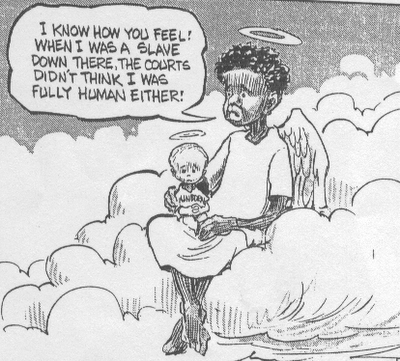
Regardless of the pros and cons of legislative as opposed to judicial activism, what seems preposterous in all this is that people like Professor Segall now think there is a parallel between the struggle of the African American against racism, and the system of slavery out of which it grew, and the assertion that yet-to-be-born, but actually living-in-the-womb, human beings are expendable at will. The frightening moral blindness involved here makes them incapable of seeing that the rights claimed by pro-abortionists are parallel with the very rights claimed by slave owners over the lives of the slaves whom they regarded as their personal property.

The slave trade in America accounted for the deaths of millions of African Americans. It is estimated that 11 to 15 million of those who were brought into America as slaves died unnatural and untimely deaths. That does not take account of the millions more who died in subsequent generations after the abolition of the Atlantic slave trade and before the abolition of slavery in North America. This carnage was defended for decades on the basis of property “rights”. The deaths of the yet-to-be-born resulting from the abortion trade, defended by pro-abortionists in the name of the “right” to choose, is much more accurately quantifiable. In the US it is reckoned to be 53 million since the Rove V. Wade decision.

Harriet Beecher Stowe in pre-Civil War America grappled with the conundrum of how her fellow-men, freedom loving citizens of her country, could justify the carnage, the destruction of life and the denial of freedom to other human beings which slavery entailed.

In Uncle Tom’s Cabin, she observed,

“Scenes of blood and cruelty are shocking to our ear and heart. What man has nerve to do, man has not nerve to hear. What brother-man and brother-Christian must suffer, cannot be told us, even in our secret chamber, it so harrows the soul! And yet, oh my country! these things are done under the shadow of thy laws!”

She described the horrors of the “property rights” enjoyed by slave owners and the way the law upheld those “rights”. Frederick Douglass, escaped slave and narrative chronicler of the miseries of the system described in factual but equally harrowing detail in his landmark account his early life.

“Let it be remembered that in all southern states,” Stowe wrote in her novel, “it is a principle of jurisprudence that no person of coloured lineage can testify in a suit against a white, and it will be easy to see that such a case may occur, wherever there is a man whose passions outweigh his interests, and a slave who has manhood or principle enough to resist his will. There is, actually, nothing to protect the slave’s life, but the character of the master.”

Can we not translate that observation right into our own time and say that in some countries where abortion on demand is now the de facto law of the land, “There is, actually, nothing to protect the life of a baby in the womb, but the character of the woman bearing it and the men and women who can bring their influence to bear on her?”

Horror stories of the abuses of abortion laws in countries where they have been passed surface with alarming regularity – like stories from Britain where the Daily Telegraph exposed widespread malpractice by abortion “providers” some months ago. Yet another was the house of horrors found in Philadelphia last year. Stories like these were also rife in the era of slavery in the US. Then as now, they were excused as aberrations and not typical of the system – and certainly not justifying the denial of the sacred property “rights” of slave owners. Mrs. Stowe noted it well. We can again translate her words to our own time and circumstances without any difficulty.

 “Facts too shocking to be contemplated occasionally force their way to the public ear, and the comment that one often hears made on them is more shocking than the thing itself. It is said, ‘Very likely such cases may now and then occur, but they are no sample of general practice.’”

Might we hope that someday a modern Harriet Beecher Stowe will emerge and write the novel – or make the movie – which will bring our planet’s inhabitants back to their senses where they will see the enormity of the holocaust in which a large portion of the world which calls itself civilized is currently perpetrating and justify on the basis of a simple “right” to choose.

Cassandra calling…

Jonah Goldberg has just written a new book entitled The Tyranny of Cliches: How Liberals Cheat in the War of Ideas. Goldberg is the bestselling author of Liberal Fascism, a book which set out to dismantle what he saw as the “progressive myths” that are passed-off as wisdom in our schools, media and politics.

Goldberg’s view of ascendant liberalism is that it portrays itself as reasonable, rational and rooted in the truth of the real world. The members of the liberal establishment claim to know what justice is and that those who oppose them don’t. If the greatest trick the Devil ever pulled was convincing the world he didn’t exist, he argues, the greatest trick liberals ever pulled was convincing themselves that they’re not ideological.

Goldberg identifies the ideology of non-ideology as the Trojan Horses that liberals use to cheat in the war of ideas. He argues that the grand Progressive tradition of denying an ideological agenda while pursuing it vigorously under the false-flag of reasonableness is alive and well. He holds the view that this dangerous game may lead us further down the path of self-destruction.

Golberg’s line is basically that this Trojan Horse is carrying within its belly a selection of “objective” journalists, academics and “moderate” politicians peddling some of the most radical arguments by hiding them in homespun aphorisms.  Their hero is Barack Obama who casts himself as a disciple of reason and sticks to one refrain above all others: he’s a pragmatist, opposed to the ideology and dogma of the right, solely concerned with “what works.”

Typifying this aphoristic onslaught are the following, with Goldberg’s antidote response:

One man’s terrorist is another man’s freedom fighter: Sure, if the other man is an idiot. Was Martin Luther King Jr. a terrorist? Was Bin Laden a freedom fighter?

Violence never solves anything: Really? It solved our problems with the British Empire and ended slavery.

Better ten guilty men go free than one innocent man suffer: So you won’t mind if those ten guilty men move next door to you?

We need complete separation of church and state: In other words all expressions of faith should be barred from politics …except when they support liberal programs.

David Mamet, a one-time liberal who blew the whistle on that establishment in the past decade, likes the book. Mamet in his liberal days was in fact a genuine liberal. The time came, however, when he realised the shallowness of his fellow travellers. He shouted “stop”, loud and clear, in his own book, The Secret Knowledge: On the Dismantling of American Culture, published last year.

“What can one say”, Mamet muses over Goldberg’s book, “to the self-proclaimed ‘independent’ who never has nor ever will vote other than Democratic; or to the wise soul suggesting, of any conflict at all, “the truth must lie somewhere in between”? Mr. Goldberg reminds us that one must stand up and demand of the muddled and supine either an absolute declaration of their principles and acknowledgment of the results of actions having flowed therefrom or a straightforward admission of their intransigence in refusing a concise reply.”

Goldberg’s take on the predicament of our civilization in terms of Barack Obama casting himself as a disciple of reason – whereas in fact he is nothing more than a pragmatist who is solely concerned with “what works” – finds an echo in another assessment of our current culture by Toby Young in the current issues of The Spectator. Young is re-visiting that seminal 25 year-old book by the late Professor Alan Bloom, The Closing of the American Mind, which opened with the following sentence:

‘There is one thing a professor can be absolutely certain of: almost every student entering the university believes, or says he believes, that truth is relative.’

In the intervening years since Bloom’s book was published, Young believes that this belief has become, if anything, even more ubiquitous. This all-encompassing relativism, he says, — which Bloom said was accepted as ‘a moral postulate, the condition of a free society’ — is shared by the educated and uneducated alike.

How did this happen, he asks? He first offers what he describes as a superficial answer – it is simply that children are taught to believe it.

If they happen to be studying the International Baccalaureate, they are literally taught it. One of the core requirements in the IB diploma is something called ‘Theory of Knowledge’ — or TOK for short — which is essentially a crash course in epistemological relativism. On the IB’s official website, it’s described as follows:

‘It is a stated aim of TOK that students should become aware of the interpretative nature of knowledge, including personal ideological biases, regardless of whether, ultimately, these biases are retained, revised or rejected.’

And the deeper reason? Why, he wonders, do responsible grown-ups feel a moral obligation to impose this doctrine? How did the ideas of Nietzsche and Heidegger become such an integral part of the fabric of liberal democracy?

The root of the problem, I think, is that the bonds of Western civilisation have become too weak. In our increasingly diverse and multicultural society, the only values that command anything like universal assent are procedural ones — ethics, rather than morality. We’ve been taught to value tolerance and mutual respect and to abhor racism and homophobia — essential conventions if all the different ‘communities’ are to get along — without being asked to believe in anything substantial to anchor those conventions in.

On the contrary, as Bloom observed, the prevailing orthodoxy that’s taught in our schools and universities is that one set of substantive moral values is no better than any other and to claim otherwise is to risk appearing racist or sexist. Indeed, there’s a widespread belief that the survival of the procedural conventions depends upon a general scepticism about anything deeper or more meaningful — that the one strengthens the other.

At the time, I thought of Bloom as just another Cassandra, albeit one who could write with extraordinary clarity and power. Now, as the forces of chaos gather on the darkling plain, I’m beginning to think I was wrong. Today, he looks more and more like a prophet.

Kevin Tobin, commenting on Young’s Spectator essay brings us right up to date on the state of play.

At a conference held here in the United Sates, just last week, he tells us, a spokesman for the University of Notre Dame observed that behind the current freedom of religion firestorm here lay a smug secular conviction that religious belief is mere bias and not particularly worthy of respect. That is how far the idea that truth is relative has already taken us — to a direct conflict between a secular government and millions of religious Americans. Dangerous stuff. Stay tuned.

Back in 1987, as Young says, Bloom was cast in the role of Cassandra. Not unlike Cassandra, while people were intrigued by him, not many really took him seriously enough to do anything about his dire analysis. There are now many more prophets of doom around. That they didn’t heed Cassandra in Troy was unfortunate – for Troy. That we remain beguiled by the relativism-riddled but nonetheless totalitarian clichés enumerated for us by Jonah Goldberg, and that so many cling to the idea that their personal choice is the only ground of truth, may prove to be the source of an equally great misfortune unless we come to our senses soon.

Triple tragedies of our times

The great tragedies of the 20th century are commonly accepted as Marxist Communism and National Socialism. No one should be so naive as to think that we have seen the end of either. But we can regard them as contained. But there was a third tragedy which may prove to be far more lethal. It is all-pervasive and is destroying societies across the globe. It is the elevation of sexuality as the most important element in life.

Think about it for a minute.

First of all, from its impact on lives. The combined body count of civilian deaths under the Nazis and under Stalin is about 20 million, according to Timothy Snyder, the author of the highly-praised 2010 book Bloodlands: Europe Between Hitler and Stalin. But according to the World Health Organization, there are about 40 million abortions, world-wide, every single year.

Second, from its impact on politics. In 2012 the most powerful nation on earth goes to the polls. The world is facing the most serious economic crisis since the Great Depression. The war on terror enters its tenth year. And what are the issues which divide Americans most? Same-sex marriage and abortion.

Opinion polls on the American presidential election show once again that the issue which concerns most people is the economy. Nevertheless, what is being highlighted by the Democrats is not the economy. Social policy issues, what they call human rights issues and personal attacks on their opponent’s characters – back down as far as schoolyard misdemeanours – seem to be their main concerns.

The issues they have chosen to fight on are important. Their policies on these issues, however, are leading their society further down the road of multi-faceted destruction through unrestrained individualism, coupled with chaotic and ungoverned sexual license provoking family break-up and educational dysfunction on a scale never seen before in a civilized society. They, of course, call this “progress”.

Where did all this come from? Prospect magazine in its February issue this year carried a short letter from a psychiatrist commenting on a feature on Sigmund Freud in its January issue. In it he rather unceremoniously rejoiced that the father of psychoanalysis was no longer flavour of the month – the idea suggested by the philosopher John Gray in the January article.

“Freud is out of favour because he was a deluded pervert who wrote a lot of idiotic tripe with about the same value as the Book of Mormon. I had to put up with this nonsense as part of ‘a balanced education in psychiatry’ as a medical student in the 1980s.”

Freud may be out of favour but the impact of what he did has remained long after the niceties of his theories on therapy have been forgotten or have been rubbished. He and the sources from which he derived his ideas and popularised them have had a devastating effect on the way a large portion of humanity now thinks about the human condition. The elevation of sexuality as the most important element in the life of human beings, the destruction of the idea of religion as anything other than – at best – a useful delusion, the coupling of science with atheistic determinism, can be clearly seen as a central plank on the platform of 21st century liberalism. This is the liberalism which is now responsible for the holocaust of the unborn; it is the liberalism which is behind the destruction of marriage and the family – with the consequent evils which flow from that. It is the liberalism which has generated the contraceptive mentality, separating the sexual act from its most fundamental raison d’etre, the generation of children.

Gray’s article emphasised the importance of the sources for Freud’s theories and among them highlighted Schopenhauer. He maintains that Schopenhauer

“shaped much of the central European intelligentsia’s thinking at the start of the 20th century. Schopenhauer’s impact on fin-de-siècle European culture can hardly be exaggerated. His view that human intelligence is the blind servant of unconscious will informs the writings of Tolstoy, Conrad, Hardy and Proust. Schopenhauer’s most lasting impact, however, was in questioning the prevailing view of the human mind—a view that had shaped western thought at least since Aristotle, continued to be formative throughout the Christian era and underpinned the European Enlightenment.”

“Schopenhauer posed a major challenge to the prevailing Enlightenment worldview. In much of the western tradition, consciousness and thought were treated as being virtually one and the same; the possibility that thought might be unconscious was excluded almost by definition. But for Schopenhauer the conscious part of the human mind was only the visible surface of inner life, which obeyed the non-rational imperatives of bodily desire rather than conscious deliberation. It was Schopenhauer who, in a celebrated chapter on ‘The Metaphysics of Sexual Love’ in The World as Will and Idea, affirmed the primary importance of sexuality in human life, suggesting that the sexual impulse operates independently of the choices and intentions of individuals, without regard for—and often at the expense of—their freedom and well-being.”

Isn’t that were we are now, whether we accept it or not. If not, why the all-pervasive exploitation of sex in advertising and marketing, in entertainment, and its emphasis in education? Gray argues that

“From one point of view, Freud’s work was an attempt to transplant the idea of the unconscious mind posited in Schopenhauer’s philosophy into the domain of science. When Freud originated psychoanalysis, he wanted it to be a science. One reason was because achieving scientific standing for his ideas would enable them to overcome the opposition of moralising critics who objected to the central place of sexuality in psychoanalysis.”

Of course, the “moralising critics” have not gone away you know. They are still battling against this terrible legacy of Schopenhauer and his disciple and all their descendents. Just now it seems an uphill struggle but it is without doubt one on which the future character of civilised society depends: one where man will either succumb to a hedonistic and materialistic slavery, characterised by the callous destruction of life of the very young, the old and the infirm, or one where he can live a life in true freedom.

(This is an edited and shorter version of an article posted last Wednesday. Part of the original article has been incorporated in the article about Jonah Goldberg’s new book which will be posted later today)

A very sobering but useful presentation

Mercatornet’s Conjugality blog has just posted a video presentation from the American Family Research Council on one of the burning social policy issues of the hour. What? The political drive to change the definition of marriage as a bond between a man and a woman to a bond between – well, who knows where it will stop? It looks at the the issue from a Judaic-Christian point of view but the factual picture it presents is truly disturbing from any perspective. Watch it here.

Fish gotta swim, birds gotta fly – that’s nature’s way

“No celebration for this lesbian”, Lauren Taylor tells us in yesterday’sWashington Post. She makes some good points in her response to President Obama’s jump off the fence earlier this week – but she still misses the truth at the heart of this debate.  Like her we all “love the idea of commitment, of getting community and family support for a relationship, and of the accountability to that community and family.” The institution of marriage as we have known it for millennia is about far more than that. Essentially the things it is about have to do with the very special relationship which a man and a woman can share, a relationship which can never be equated with that between two men or two women. In other words, conjugality.

We will all agree with her that “anyone who wants to should have a ceremony and make a commitment and throw a big party. But that shouldn’t affect whether they then get health insurance, or get to take time off to take a sick person to the doctor, or are able to sign a permission form for a field trip.”

She tells us that  she is “not fighting for access to marriage, and I wish that wasn’t where the gay rights movement was putting most of its effort and resources. (Violence, housing, employment, education, anyone?) But (with apologies to Groucho Marx), if someone is trying to keep me out of this club, I want in. How dare anyone say that I don’t deserve access to marriage and all it brings? How dare they say I, and my relationships, aren’t good enough?”

Those fighting for the very existence of the institution of marriage are not telling her that her relationships are not good enough. They are just telling her that they are not the kind of relationships which fit the definition of marriage. Try this analogy: If you want to swim you need water to swim in. Mountain air is very refreshing and beautiful but it won’t support you swimming. Pretend you are swimming in it and you will just look silly. If you are a man and want to marry you need a woman to marry, and vice versa. Or as Julie sings in Jerome Kern’s Showboat, “Fish gotta swim, birds gotta fly, I gotta love one man till I die, Can’t help loin’ dat man of mine.” The sea is for fish, the air is for birds and marriage is for men and women – sorry, that’s Mother Nature’s way.

(Posted earlier to MercatorNet’s Conjugality blog)

Are Obama and Cameron playing with electoral fire?

As was widely anticipated, President Obama’s “evolution” on the marriage question has now reached its final resting place in the gay lobby camp. But the political consequences are not so clear and the electoral rout which the other convert to the redefinition of marriage cause, Britain’s David Cameron, experienced at the polls last week might be worrying him. But really, given his imprisonment – not necessarily an unwilling confinement – by the ultra liberal caucus, he had little choice as to which side of the fence he was ultimately going to choose.

Political observers in Britain are already speculating that the coalition government there, following the disastrous showing in last week’s nation-wide local elections, rewrote the content of yesterday’s Queen’s Speech, the speech written by the Prime Minister but read by the Queen to Parliament and outlining the forthcoming legislative plans. “Gay marriage” was not mentioned in the speech…. Read more on the Conjugality blog.

“The most abused Faith on earth”

One of Irish television leading public square venues, The Frontline, recently took up the question of whether or not Irish faith communities were under attack from an aggressive secularism. It was, to say the least, a somewhat inconclusive debate. It might have been much better had it been asked to confront Michael Coren, whose latest book, Heresy: Ten Lies They Spread About Christianity has just been published.  

Coren, English born Canadian journalist and broadcaster, of Jewish antecedents, convert to Catholicism (twice), has just been interviewed by Charles Lewis in the National Post and spells out his view very clearly. In the West generally, he believes, Christians are now

“marginalized, they’re mocked, they’re told their views don’t belong, they’re told to keep their views out of the public square and keep their religion at home. And where it can be quite sinister is at universities where Christian students are told that their ideas are stupid. I’ve even seen it with my children who are in university. Somehow Christianity is not a valid area of thought any longer. You can bring your socialism, your feminism, your homosexuality, your anti-Zionism into the class but if you bring your Christianity that’s not to be taken seriously.”

No Christian carrying a banner for their Faith in the cultural mainstream of the West today would have any difficulty producing evidence to uphold every one of these assertions.  Any Catholic in Ireland today, seriously faithful to the teaching authority of that Church knows full well that they are on the frontline of a battle with a very militant force opposing them on all and more of the issues listed by Coren.

Coren calls Christianity the most abused faith on Earth. “I believe the evidence is overwhelming,” he writes.

 “I believe… that Christianity is the main, central, most common, and most thoroughly and purposefully marginalized, obscured, and publicly and privately mis-represented belief system in the final decades of the twentieth century and the opening years of the twenty-first century.” He rails that the same intellectual class that so quickly condemns anything Christian will do cartwheels to explain away Islamic terrorism.

Lewis put it to Coren in his interview that there is a lot about Christianity that can seem unreal: the Virgin Birth, the Resurrection of Jesus. Is it any surprise that people sometimes have trouble taking it seriously? To this Coren replies that these are really side-shows in the mocking game and that what they are really mocked for are the moral consequences of their beliefs: that life begins at conception and ends at natural death, that abortion is wrong, that promiscuity is wrong. “We live in a culture where no one wants to hear the word ‘no’” he says.

He lays bare the culture of intolerance facing orthodox Christianity:

“Intelligent people will give other ideologies and other religions a great deal of room to try to understand. When it comes to Christianity they seem to assume that any sense of fairness or sympathy should be thrown out the window. They will say things that are blatantly stupid.

“The idea that because a tiny number of Catholic priests acted in an appalling manner should jaundice everything said by the Roman Catholic Church is also so illogical. You might as well say that no comment by a Canadian should ever be taken seriously because there are some serial killers in Canada.”

On the issue of orthodox Christians’ position on homosexual acts he says they are being told our view on homosexuality is somehow wrong and called homophobic. “They’re going to be called homophobic whatever they do. I think the Catholic Church has spent too much time worrying about the reaction it might get rather than reacting itself.

“If someone calls me a homophobe because I believe marriage is between one man and one woman, then I would rejoice in that. But frankly, with gay friends, I try to avoid the subject. They know I am opposed to gay marriage and they also know I’m fond of them as people and would defend them against personal attack. But let me be clear, anyone who hates gay people is a moral criminal.”

 In the book Coren defends, but also contextualizes, the fact that the abortion question has such a high profile for Christians in the culture wars. In the first place it is because they feel intensely that they’re part of an institution given by God. This institution upholds the sacredness of all human life. Because of that “they feel it more when the most vulnerable are destroyed. And they feel it more intensely than other people. I guess we are obsessed because it is such a tragedy. And if we dare to mention it, the world tells us to be quiet.”

In his book Coren takes on Dan Brown’s ludicrous but astonishingly popular The Da Vinci Code. Why, his interviewer asks, given that by now Brown’s pot-boiler has become somewhat passé?

“Well,” he says, “it has influenced millions of people. They’ve been led by the book to read other books that oppose Christianity. Brown quotes real people and he makes a lot of it seem like non-fiction. I thought it was worth taking on again.” Above all he wanted to make sure that what is in The Da Vinci Code is shown again to be false.

So, the next time Radio Telefis Eireann, the BBC or any other broadcaster, takes up the issue of whether or not militant secularism is a reality, perhaps they should get an airline ticket for Michael Coren and bring him on to give us his formidable point of view.

Let this unseemly vendetta end now

Let this unseemly vendetta end now. Not our sense of justice, but perhaps our sense of prudence – and certainly our utter frustration – inclines one to say that Cardinal Brady should resign and let the shame for forcing that act on a good and just man fall on the heads of his relentless persecutors.

He should not resign because he is guilty of any serious dereliction of duty but because the ravaging wolves pursuing him have tasted his blood and will not stop until they have torn him to pieces and with him much of what he loves.

He did what he thought was his best at the time. Objectively it wasn’t good enough but there is no evidence that his intentions were anything but good. At worst they were the faltering efforts of a young priest who had made a heroic decision to give his life to the service of God, God’s Church and souls.

Every day this man stands at the foot of the altar and confesses his and – on our behalf – our sins, saying “through my fault, through my fault, through my own most grevious fault”. We have absolutely no reason to doubt his sincerity in uttering those words. What more do they want?

The heroism implicit in his vocation and the sincerity of his intentions, of course, cuts no ice with the motley gang pursuing him, any number of whom have been implicated in far more compromising activities than the Cardinal – 3000 murders in Northern Ireland, hobnobbing with one of the 20th century’s most monstrous regimes scrounging for funds for their own socialist political agenda, and who knows what else. It is enough to make one sick.

St. Peter’s weakness was of a much more devastating kind than any shown by Fr. Brady in and around 1975. Yet Christ did not ask for Peter’s resignation from the office he had given him.

If Cardinal Brady chooses to go now there will be no shame in that for him but history will judge otherwise on those who have pursued him to this end.

Their ulterior motives, their not very hidden agenda of the denigration of the Catholic Church, is clear to many now and will be clearer when history is written. It is not very far removed from the futile agenda of Diocletian et al in the 4th century. What hope is there of a Constantine emerging in our political world today to put an end to this different, but in truth no less brutal persecution? Not much just now.