A “sham”, empty and profoundly undemocratic document

As posted this morning to MercatorNet’s Conjugality blog where you can read much more and stay up to date on the issues facing the institution of marriage.

The initial verdicts on British Government’s ambiguously entitled “consultation” on the  proposal to legislate for same-sex marriage in England and Wales is pretty negative, – not just on the substantive issue but on the very muddled presentation in the document itself. The “consultation” was issued on Thursday.

The Coalition for Marriage (C4M), which now has a quarter of a million signatures to its petition to save marriage, proclaimed the whole process to be a “sham” and profoundly undemocratic. “The institution of marriage is not the play thing of the state; it belongs to society and therefore cannot be redefined by a few politicians obsessed with appearing ‘trendy’ and ‘progressive’ C4M says.

After reading it he Archbishop of Westminster, Vincent Nichols, told BBC Newsnight that it was “utterly astonishing  that the document made no reference to children throughout its 20 pages: “Marriage is about bringing difference together. Different sexes, sometimes different families, different tribes. It’s been used to bring kingdoms together. It’s about bringing difference together, out of which comes a new start and a new life.

“The gender difference is essential for its creativity and its complementarity.”

“It is excluding things that are of the very nature of marriage.

“What society says, I believe, is the best circumstances for conceiving and bringing up children is the partnership between two natural parents. That’s why the law is there to protect marriage and that’s why the change in the definition of marriage affects everybody” Dr. Nichals added.

The Coalition for Marriage accuses the government of not only “trying to change the meaning of ‘marriage’, now they’re trying to redefine the meaning of ‘consultation’.

“Consultation means listening to people before making up your mind. But Lynne Featherstone (Equalities Minister) has a new definition – she is going to bulldoze ahead with the plans whether the public like it or not. Some consultation. Yes, she’ll ask the public if they agree. But she says she’s already determined to push on. Asking isn’t the same as listening – unless the meaning of those words has been redefined too.”

Coalition for Marriage campaign director, Colin Hart, said:

“The Government has today launched a consultation on redefining marriage. After initially relenting and promising to include a question on the principle of introducing same sex marriage it is clear from the written statement given to both Houses of Parliament by the Equalities Minister that she will simply ignore any answers to this question.

“I always thought that a consultation was about listening to people and asking them their views, before making a decision. Not only are they redefining the meaning of marriage, they’re redefining the meaning of consultation.

“This consultation is a sham. It is being pushed through despite the public never having a say on this change. None of the main political parties proposed redefining marriage in their manifestos and the impact assessment misses out many of the possible problems that could occur if this institution is redefined, for example how this change will affect our schools.

“The institution of marriage is not the play thing of the state; it belongs to society and therefore cannot be redefined by a few politicians obsessed with appearing ‘trendy’ and ‘progressive’.

“It is also bizarre that Lynne Featherstone says that she wants to end the current two tier system’, yet wants to replace this with an even more complicated system that has two options for gays, and only one for heterosexuals. That’s equality for you.

“The plain truth is marriage is marriage and should not be redefined by politicians.

“C4M and the people who have signed our petition believe that this change is profoundly undemocratic, will have massive consequences for society and is simply unnecessary as civil partnerships provide all the legal rights of marriage.”

Meanwhile the blogs are putting in their knives as well. “Regardless of where people stand on the issue, they should quickly realise that (this document) is a shoddy piece of work, undermined by the fact that its authors clearly don’t know what they’re dealing with” writes The Thirsty Gargoyle, one of the more incisive social values inhabitants of the blogosphere.

He begins at a very basic level pointing out that weddings and marriages are not the same thing.

“A wedding — otherwise referred to as a marriage ceremony — is an event. This event gives access to marriage, that being an institution.

“There is no legal distinction between civil and religious marriages. There are legal distinctions between civil and religious marriage ceremonies, but that’s it. In English law, it is legally meaningless to speak of either civil or religious marriage. There is only marriage. That’s it.

“Bearing that in mind, you should realise that the document is misnamed. It’s impossible to speak of ‘equal civil marriage’ in a meaningful British context; one can only speak of ‘equal marriage’.

“Of course, those of us who subscribe to the Universal Declaration of Human Rights are already signed up to the concept of equal marriage; men and women, it says, have the right to marry and found a family, with both men and women being entitled to equal rights as to marriage, during marriage, and at its dissolution.  Calling ‘same-sex marriage’ ‘equal marriage’ is an Orwellian hijacking of an established term.”

Questions five and six in the annexe at the end of the document, he says, are an example of the nonsense which fills the document, for instance.

“’Question 5: The Government does not propose to open up religious marriage to same-sex couples. Do you agree or disagree?’

“’Question 6: Do you agree or disagree with keeping the option of civil partnerships once civil marriage is available to same-sex couples?’

“Yep, utter gibberish. Questions five and six make no legal sense unless the Government is planning on legislating to create new institutions called ‘religious marriage’ and ‘civil marriage’. As it stands, there’s only the one institution, which we call marriage, and which has been defined, since at least 1662, as being the union of a man and a woman primarily for the purpose of bearing and rearing children.”

There is a great deal more in The Thirsty Gargoyle exposing what he – or is it she or it – sees as the folly of this whole project.

The tail wagging the dog – again?

This week the British Government begins a 12-week public consultation on its proposal to legislate for gay marriage.  The battle lines are drawn and a Sunday Telegraph opinion poll at the weekend showed that for populist politicians, the issue is fraught with risk – which they don’t seem to recognise yet. While  45 per cent support the proposal in principle, 36 per cent oppose it, and the rest say they do not know, the more significant finding for the Conservatives, the larger of the two political parties in the governing coalition, is that among their supporters 50% are opposed.

Even more significantly, a majority of voters are saying to the Government, “stop wasting your time on this issue and get on with the job we elected you to do.” Asked whether the Government is right to prioritise this issue – with other issues such as the economy and public-service reform battling for parliamentary time – voters overwhelmingly disagree.

More than three quarters – 78 per cent of all voters and 88 per cent of Tories – think it is wrong to fast-track new laws ahead of 2015 while only 14 per cent say it is right to do so, in the ICM survey for The Sunday Telegraph.

Mr Cameron is driving this, with many Tories believing a large part of the reason he is doing so is a desire to prove his party has changed,is now more “modern” and is no longer the “nasty party”.

Meanwhile the newspaper and magazine columns of the nation are keeping the pot on the boil, for and against. Melanie McDonagh in The Spectator remarks that “Consultations are, for the prudent, an exercise you only engage in when you’re quite sure of the outcome.”

Perhaps the Government has miscalculated on this one and that the outcome of the battle which both sides are now galvanised for will not be what they had hoped for. Charles Moore, a former editor of The Spectator, suggested this in his column in London’s Daily Telegraph on Saturday that the Tories are out of touch with voters on this issue.

Melanie McDonagh

McDonagh notes that leaders of the Catholic Church are in the vanguard on this one. She says that in a pastoral letter issued by two of its London Archbishops this weekend it is “wisely make clear is that this is not a religious question at all. It’s about human nature, or what Catholics would call natural law.”

Objections to gay marriage, she suggests are best based on respect for the inherent nature of marriage, not the religious conception of a sacrament. She supports civil partnerships on the basis that they do away with inequity. Previously, if one member of a gay partnership died, the other had to pay inheritance tax on their property. “Objection to gay marriage isn’t about religion at all and the letter that the bishops are sending to Catholic churches does, to do them credit, make that clear.”

“It’s all to do with the nature of marriage”, she says. “And that is, a natural institution providing the optimal situation for raising children. It’s vulgarly biological, marriage — a state for bringing up children in. And that’s how it’s been for almost all of human history. Even in ancient Greece, which practically invented homosexuality — alright, it was especially about the Socratic master-pupil relationship — reserved marriage for men and women, for the conceiving and bearing of children. And it’s that fundamental character of marriage which makes it essentially heterosexual. It’s to do with the complementarity of the sexes. Men and women fulfil different roles when it comes to the rearing of their offspring, and even in an atypical family like my own, in which I’m the sole breadwinner, those complementary roles make sense. Children relate differently to mothers and fathers; they pick up cues about how the sexes work, even children who go on to become gay. And departing from that biological foundation for marriage is a radically new departure.

“Obviously, there are infertile normal marriages, which are no less valid and exemplary for that. The most perfect Catholic marriage I know is involuntarily childless. Some people marry post-menopause, and their marriages aren’t second class, just exceptional. But these are the exceptions to the norm. The Anglican marriage service, which gives an excellent account of the purposes of marriage, talks about the mutual comfort that the couple give to each other and the function of the institution as an outlet for sexual urges, as well as for the raising of children. But those purposes, in heterosexual marriage, complement the basic utility of the thing. They are meant to accompany the essential role of marriage in raising children, not become an alternative for it.

“Of course, homosexual relationships share important aspects of heterosexual marriage, though the element of permanence may not be quite what it is in conventional marriage because children — the reason so many people stay in unsatisfactory marriages — are absent from the equation. Plainly gay partnerships can be committed and loving, and civil partnerships recognise the commitment. And on the margins, post-IVF, gay men can now father children by surrogate mothers and raise them with their own partners, and gay women can use surrogate gametes to do the same. But that parental relationship is always going to have something absent at its heart, the complementarity of the sexes, which means that sons and daughters learn about gender from how it’s lived out in their own family. And a relationship cannot be a marriage, as traditionally and everywhere understood, where children cannot naturally be part of the equation.

“What I’m saying, and what the bishops are saying, is that marriage is child-centred, even though children may be involuntarily absent from good marriages. We cut that anchor at our peril. For the optimal environment for raising children you need a stable environment with parents of either gender. And even in a reluctantly childless marriage, the complementarity of the sexes, the very fact of sexual difference, gives the institution its nature, its charge. To say as much isn’t to advance a religious argument. It’s to work from nature, from history, from human experience. The very definition of a marriage is a union between a man and a woman. Let’s leave it like that.”

Charles Moore, also a former editor of the Sunday Telegraph and later, the Daily Telegraph, came to more or less the same conclusion.

Charles Moore

Accepting that the Tory party needs to update itself, he still feels that doing so on this issue and in this way is a shortsighted way of doing so and betrays nothing more than its old tendency to just go on talking to itself – populism with an abysmally narrow focus.

With “modernisation” in mind, Moore wrote, “Mr Cameron said from the first that his party should become gay-friendly, in its policies and its selection of candidates. In his first party conference speech as leader, he equated, morally, the ‘commitment’ that man makes to man or woman to woman with that which men and women make to one another.

“To Mr Cameron and most of the people with whom ministers spend their time, this will seem logical. Indeed – for it is the chief subject about which self-consciously “modern” people feel extremely righteous – it will seem unquestionable. The Government’s current “consultation” will not, despite its name, pay heed to anyone who disagrees. Ministers have adopted the language of equality and rights, and any other language is, to use an unmodern word, blasphemous.

“But let me play back at the Tory leadership the very thing that worried it in the first place – the danger of talking to oneself. The orthodoxy in favour of gay marriage is an iron one if you are well off, well educated, live in central London and wish to hold political or public office. By adhering to it, Mr Cameron ensures that he will not be insulted in BBC studios or at Downing Street receptions for the creative industries. It does not follow, however, that it is a legislative priority for the general public, or the way by which they judge a politician’s virtue. If you talk to the wider public, you get a very different perspective.”

“The number of civil partnerships contracted in this country “, he poined out, “is less than one per cent of the number of marriages each year. You can sell to most people the proposition that such small minorities should be fairly treated. You will encounter sales resistance if you insist they be allowed to redefine something which belongs to us all. That something, in this case, is marriage. And on the ‘what matters to voters’ index, which rightly worries modernisers, marriage comes high; the precise situation of homosexuals comes low.

“Marriage has never meant simply the right of all people who believe they love one another to have their relationship legally recognised on demand. There are qualifications. You have to be adult. You cannot be married to somebody else. You cannot be closely related by blood to the person you marry. And the person you marry must be of the opposite sex.

“You could say that these are restrictions. The decision to permit only monogamy was controversial at the time, and upsetting for lots of people, particularly men. After all, you may genuinely want to have three wives at once and claim that you can truly love them all. I do not know how Mr Cameron, if he opposes discrimination, can possibly sustain the view that Muslims, who are much more numerous in Britain than homosexuals, should be forbidden the polygamy which their faith sanctions.

“If you talk to ministers just now, they say, “Gay marriage is like the smoking ban. People thought they were against it, but when it happened, they just accepted it.” I cannot prove this wrong, but the triviality of the comparison makes me suspicious. Marriage is a great, big, deep subject. There is no crying need to change it just because a vociferous lobby says we must. I recommend a policy which should surely unite all conservatives, trad or modernising – masterly inactivity.”

For this and more on the issue of the future of marriage, go to MercatorNet’s Conjugality blog.

A ‘story’ that may or may not come true

The inevitable retreat of big government, third wave feminism and selfish individualism – all of them inherently unsustainable, –  was proposed as a golden opportunity for the rejuvenation of the institution of marriage, the rescue of the family,and the well-being of society over the coming decades at a conference on marriage in Belfast, Ireland, last weekend.

In seizing this opportunity men and women would need to change their attitudes to themselves and to each other. The family had no future without the engagement, commitment and support of its young women. Women had been profoundly misled by radical feminism, by the myth that they can be happy and fulfilled by a career that provides financial independence, making men and marriage optional, the conference was told.

Gerard O’Neill, Chairman of Amárach Researchamárach means tomorrow in the Gaelic language – was speaking in a personal capacity on the future of marriage to Ireland’s Catholic marriage care service, Accord, on the occasion of the 50th anniversary of its foundation. Mr. O’Neill spoke of the “new and often hostile forces arrayed against marriage as an institution and preferred choice in the early 21st century.”

He began by examining  marriage rates, past and present. Back in 1962, he said, there were 7 marriages per 1,000 people in Northern Ireland; in the Republic of Ireland there were just over 5 marriages per 1,000. Fast forward fifty years and the marriage rate in the North, part of the UK, has fallen from 7 to 4.5 marriages per 1,000, and in the Republic from 5.2 to 4.6 per 1,000. He put these rates in a European context, pointing out that  the rate in Cyprus was 7 per 1,000; Slovenia’s was the lowest at 3 per 1,000.”

He then moved to look at another significant social change over the past fifty years impacting on marriage and the family – births outside marriage. He described the trend here as “alarming”. Back in 1962, he pointed out, fewer than 3% of births were outside of marriage in Ireland. Today, the proportion is close to 40% and it is well over 50% in the cities. He set that in a European context where the rate today varies from a low 7% in Greece to a high 64% in Iceland.

“I say ‘alarming’ because the life prospects for a child born outside of marriage (to a single parent or even to a cohabiting couple) are worse on virtually every single measure we can derive than are the prospects for a child born to a married couple. Not for every child everywhere, of course, but for the vast majority consistently over the past fifty years. We have every cause to be alarmed.”

He then looked forward and began by looking at the forces which he believed would – one way or another – shape the future of marriage in Ireland and everywhere else for that matter. He didn’t offer forecasts or prophecies: only a ‘story’ that may or may not come true, perhaps all of it or just some of it. Reasuringly – somewhat, depending on your reading of half a glass of water – he quoted Herb Stein who said “If something can’t go on forever, it won’t”.

He suggested that in the coming years Western societies would face a number of surprising, even disturbing ‘stopping points’. He referred to the dire prediction known as “peak oil” – which describes a trend whereby global oil output reaches a peak as oil reserves are consumed faster than they are replaced and from that point on the flow of oil goes into decline. His view is that this peaking phenomenon can apply to more than oil and that it may affect three important factors which determine our lives and our society today – “big” government, radical feminism, and individualism.

We have already hit “peak government”, he suggested, in that we are living through an epic economic crisis in the developed world. That crisis has flowed from the finance and banking sector on to governments through sovereign debt. The bottom line was that a growing number of governments would be unable to fund their financial commitments into the future and so their spending would have to be cut, he said.

He connects this with marriage in a very simple way:

“in many parts of the world the Government has become the ‘daddy state’ – replacing fathers and husbands with expanding social welfare provisions.  But the ‘daddy state’ is about to become the ‘miser state’ – and so the dependency culture that was allowed to grow up around the expansion of profligate state spending will have to rapidly go into reverse.”

O’Neill moved into very controversial territory when he approached feminism. The second and third waves feminism, he said, had expanded rapidly throughout the second half of the twentieth century, especially in the Anglophone world, on the back of economic, cultural and technological changes.  The first wave had wanted equal citizenship for women – the right to vote at the beginning of the twentieth century. Second wave feminism wanted equal economic access for women – the right to paid employment. Third wave feminism, however, wanted, and still wants, much, much more, namely: “the transformation of society to the detriment of men. In case you haven’t noticed, feminism is no longer about equality.

“Of course, many feminists will deny this. They will point to the gender wage gap or other such controversies. But they then ignore gender gaps that are to men’s detriment: higher rates of unemployment, of emigration, imprisonment, sucide, as well as greater victimhood from violent crime. Men are also failed by our educational system (a growing majority of third level/university students throughout Ireland and the developed world are women). Men still die five years younger than women on average despite all the advances of science in the past fifty years.”

As he sees it, many feminists talk about the glass ceiling, while conveniently ignoring the glass cellar that traps their brothers, fathers, sons and husbands – or should that be partners, he asked? A Western culture sadly afflicted in the past by misogyny was now one afflicted by a strident culture of misandry – both equally intolerable.

“But as Herb said, if it can’t go on, it won’t. The thing is, most of the ‘success’ of gender feminism in the late 20th century has been the result of substituting men with the state: as employer, provider and defender. Ergo, Peak Government means Peak Feminism. Again, it won’t be pretty after the peak has past”, he promised.

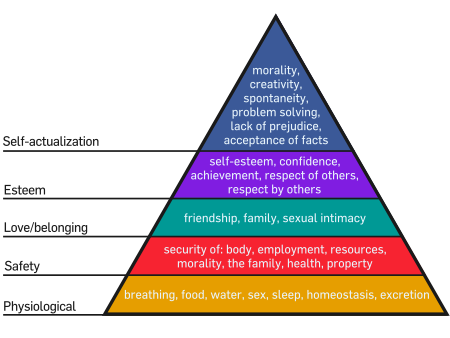
In describing his third peak, he locked horns with the arch-priest of individualism, Abraham Maslow, in a full frontal assault. Maslow, an American psychologist, was at the centre of an unprecedented global revolution in values, culture and behaviour which took place over 50 years ago. Maslow’s description of the human “hierarchy of needs” said that security and sustenance were at the bottom while “self-actualisation” was at the top.

Abraham Maslow

“All very hippy, all very self-centred,” O’Neill said, “but a perfect charter for the radical liberal agenda of autonomy and individualism that has swept the world over the past fifty years. And also very wrong: we now know that the deepest psychological drivers of people relate to bonding, parenting and belonging.”

At this point O’Neill opts to read the glass of water as half-full rather than half-empty and states his optimistic belief that we have now reached the point of “peak individualism”. The tide which began to sweep over us form the 1960s onwards is now ebbing – along with “peak government” and “peak feminism” – because of “our ageing populations; the emergence of new types of communities and networks; and the resurgence of an older, deeper wisdom about what makes life meaningful and worthwhile. And it isn’t self-actualisation.”

O’Neill then suggests that if we are to realise the opportunity for positive change which our descent from these peaks presents to the institution of marriage, the family – and as consequence, our society – three things will have to happen.

Firstly, men will have to find their purpose again. Unemployment among young men throughout the world is the biggest threat to the future of marriage bar none, he said.

“It is also the biggest barrier in the way of our future wellbeing as a society. No civilised society can survive without the engagement, commitment and support of its young men. And right now we are failing an entire generation of young men throughout the Western world. Nor will men be civilised without the pre-requisites that historically have given them purpose and identity, namely: a job, a wife and a child – preferably in that order!”

Secondly, women, for their part must ‘woman up’

“we are all familiar with the call for men to ‘man up’ when the circumstances call for it. We’re less familiar with the call for women to ‘woman up’. Just as civilisation has no future without its men, so the family has no future without the engagement, commitment and support of its young women. Women have been profoundly misled by radical feminism, by the myth that they can be happy and fulfilled by a career that provides financial independence, making men and marriage optional. It doesn’t. The bottom line is that the family will only be saved by young women realising that marriage and motherhood are more important than a career.”

Thirdly, people of faith and Christians in particular must go on the offensive. While fifty years, he said, is a long time for a human being it is but a mere blink in historical time. Institutions like the Christian churches can and should take a longer term view of the future.

“Peak Government, Peak Feminism, and Peak Individualism”, he warned, “will unleash new forces in the world, not all of them benign. But it will also open up new spaces for organisations like the Catholic Church and other faiths (including Muslims) to use their wisdom, authority and resources to provide guidance and inspiration through the turbulent times ahead.”

He concluded by declaring that marriage and parenthood are as relevant to our wellbeing today as they were fifty years ago – or 2,000 years ago for that matter – and that marriage will be even more important to our wellbeing in the “post-peak” future we are now entering.

Conscience sacrificed on the altar of personal choice and selfish convenience

“Excluding any known wishes of the patient or family to the contrary, a decision to preserve the life of a patient in a state of permanent unconsciousness based on respect for life itself is morally no more sound than a decision to take that life.”

Those words must surely send a shiver down the spine – or more likely, land a blow to the solar plexus – of any half sensitive moral conscience. They are reported on the Careful! blog of MercatorNet.com this morning and they come from an American doctor writing in the latest issue of the leading journal Bioethics.  There, Dr Catherine Constable, of New York University School of Medicine, tells us that artificial nutrition and hydration should be withdrawn from all patients in a permanent vegetative state – unless there is clear evidence that they want to be kept alive. She argues that the current presumption in favour of maintaining ANH is misguided. It is not in the interests of the patient nor, because of its cost, in the interest of society.

Surely we have reached the nightmare of moral chaos to which Joseph Conrad’s Mr. Kurtz, and his later incarnation, Francis Ford Coppola’s Col. Kurtz, descended in Heart of Darkness/Apocalypse Now when (in Coppola’s film) he confessed and protested his hellish vision of a judgement-free world – by which he meant the judgement of conscience –  in which the only criteria of choice is the selfish pursuit of our pragmatic ideologies and where the most sacred of all human gifts, life itself, is placed on the sacrificial altar of that merciless god.

“I’ve seen horrors… horrors that you’ve seen”, Kurtz – a rogue US Marine commander fighting the Viet Cong – expounded his confused and contradictory moral reasoning to Willard who has been sent to “terminate” him. “But you have no right to call me a murderer. You have a right to kill me. You have a right to do that… but you have no right to judge me. It’s impossible for words to describe what is necessary to those who do not know what horror means. Horror… Horror has a face… and you must make a friend of horror. Horror and moral terror are your friends. If they are not, then they are enemies to be feared. They are truly enemies!”

Kurtz (Marlon Brando), the heart of darkness

It is hard not to conclude, reading things like those written by Dr. Constable, that we have already surrendered to that horror. Because some living human beings are not able to express their intentions it is deemed that they are no longer interested in living. Therefore, “because of its cost,” their lives are no longer “in the interest of society.”

Kurtz recalled the moment he surrendered his conscience to the evil of a world freed from the restrictions imposed by that inner voice:

“I remember when I was with Special Forces… seems a thousand centuries ago. We went into a camp to inoculate some children. We left the camp after we had inoculated the children for polio, and this old man came running after us and he was crying. He couldn’t see. We went back there, and they had come and hacked off every inoculated arm. There they were in a pile. A pile of little arms. And I remember… I… I… I cried, I wept like some grandmother. I wanted to tear my teeth out; I didn’t know what I wanted to do! And I want to remember it. I never want to forget it… I never want to forget.

“And then I realized… like I was shot… like I was shot with a diamond… a diamond bullet right through my forehead. And I thought, my God… the genius of that! The genius! The will to do that! Perfect, genuine, complete, crystalline, pure. And then I realized they were stronger than we, because they could stand that these were not monsters, these were men… trained cadres. These men who fought with their hearts, who had families, who had children, who were filled with love… but they had the strength… the strength… to do that. If I had ten divisions of those men, our troubles here would be over very quickly. You have to have men who are moral… and at the same time who are able to utilize their primordial instincts to kill without feeling… without passion… without judgment… without judgment! Because it’s judgment that defeats us.”

Can we not say that  forces of “enlightenment” at work in the propagation of this new morality represented by Dr. Constable are driven by the same dreadful ethic which Kurtz adopted in which the judgement of conscience is seen as a hindrance to the proper running of this world of ours. Let us set aside all those “taboos”, they say, with which we clutter our proper judgement and let us act coldly, clinically and ruthlessly for the end we desire. Kurtz knew – and Conrad knew – in his heart where all that led, to the horror of a hell on earth. The leaders of our new enlightenment, sadly, do not seem to know.

Am I exaggerating? I don’t think so. It is all around us and is clearly manifested in the spectacle unfolding in the United States’ current political debate on the Obama “mandate”. The subtext of this entire proposal is the disregard and sacrifice of moral conscience – as understood for 2000 years in its fullest clarity, and for eons before that, albeit in a less clear way – on the altar of personal choice and convenience. It all emanates from a philosophy of freedom devoid of any judgement based on a rational and principled understanding of the truth of our nature. It is a philosophy of freedom where freedom is seen as the right to do what you like within the arbitrary bounds of the general will of a given group of people – which we know even from history can lead to the greatest atrocity. Slavery was once supported by such a general will. The deaths of millions of unborn human beings is now enjoying the same support.

Another more recent visit to the heart of darkness was Cormac McCarthy’s  No Country For Old Men, filmed by the Coen brothers in 2007. In the book, the wise and weary Sheriff Bell, who is pursuing the semi-mystical but diabolical Chigurh, reflects on the sorry state of our society in telling us of an encounter with a fully paid-up member of our brave new world.

The wise and weary Sheriff Bell (Tommy Lee Jones)

“Here a year or two back …I got set next to this woman, she was the wife of somebody or other. And she kept talkin’ about the right wing this and the right wing that. I ain’t even sure what she meant by it…. She kept on, kept on. Finally told me, said: I don’t like the way this country is headed. I want my granddaughter to be able to have an abortion. And I said well ma’m I don’t think you got any worries about the way the country is headed. The way I see it goin’ I don’t have much doubt but what she’ll be able to have an abortion. I’m goin’ to say that not only will she be able to have an abortion, she’ll be able to have you put to sleep. Which pretty much ended the conversation.”

The tragedy may be just this – that the conversation has ended. But perhaps there are a few more battles to be fought and with them the tide may be turned and sanity may return to the earth. If not, like Sherrif Bell said, we may all look forward to being put to sleep.

Marriage, a mere rite of passage?

The following article appeared on February 27 in MercatorNet’s new blog on the issues confronting the institution of marriage in the western world today. The blog, Conjugality, already contains a number of articles focusing on the challenge being presented to the integrity of marriage by the campaign to have same-sex unions recognized as marriage by legislatures across the world.

“This is about the underlying principles of family, society, and personal freedoms”, Miss Lynne Featherstone MP, Britain’s Equalities Minister, wrote in London’s Daily Telegraph last week, referring to her Government’s plans to introduce legislation enabling gay people to describe their civil partnerships as marriage. Reading those words you might think that at last someone is about to address this fraught subject on the basis of such basic things as principles, family, society and personal freedom. But alas, no. Clearly, what we are confronted with here is more of the same – phony principles, redefinition of that basic building brick of community, the family, and therefore a very wobbly definition of society itself.

One would have hoped for more from the mother of parliaments.

Lynne Featherstone

“Marriage [she maintained] is a rite of passage for couples who want to show they are in a committed relationship, for people who want to show they have found love and wish to remain together until death do them part. Why should we deny it to people who happen to be gay or lesbian who wish to show that commitment and share it with their family, friends and everybody else? We should be proud of couples who love each other and a society that recognises their love as equal.

“That is why you will not find us watering down this commitment.”

Watering down? A mere rite of passage? Marriage is a state in which a man and woman live. This is nothing less than complete obliteration of the very concept of natural marriage. When Romeo and Juliet tried to grapple with the Capulet-Montague problem they bypassed names and solved the conflict – up to a point.

“What’s in a name? That which we call a rose

By any other name would smell as sweet…”

But this does not solve the marriage problem which gays have created for themselves. Call a rose an onion and it is still a rose. But it does not work the other way around – no matter how many things you call by the name of rose you will never turn them into roses. The onion which you call a rose remains an onion. It will look like an onion, smell like an onion and will still sting your eyes and, like an onion, make you. The exercise is sheer folly. So is the effort to make into marriages things that are not marriages and never will be marriages. This bond between a man and a woman which we call marriage is something “given”, as the former Archbishop of Canterbury, George Carey said when he wrote in the English and Irish editions of The Daily Mail on February 20. It is given by our nature and it has its own intrinsic and inherent meaning. We do not give it its meaning. It, of itself, like Romeo, gives us its value and meaning.

“The fierce debate over the past few weeks [Miss Featherstone wrote] has shown people feel very strongly about marriage. Some believe the Government has no right to change it at all; they want to leave tradition alone. I want to challenge that view – it is the Government’s fundamental job to reflect society and to shape the future, not stay silent where it has the power to act and change things for the better.”

Miss Featherstone is working by the notorious definition of the powers of the British Parliament left to us by Sir Hartley Shawcross, then British Attorney General, when he declared that

Lord Hartley Shawcross

“Parliament is sovereign; it can make any laws. It could ordain that all blue-eyed babies should be destroyed at birth, and because Parliament so declared it, it would be legal.”

Legal, but utterly immoral. It is not enough that Parliament “reflect” society. Parliament’s duty is seek justice and legislate according to the principles of that justice and right reason.

People who understand what marriage really is are calling on the British Government to bring this question to the people and in doing so are showing a much deeper trust in the good sense of the British people than the Government is showing. Is it another instance of the drive for statute law riding roughshod through the treasure-house of British common law, something noted and predicted over 60 years ago by a British legal expert, Richard O’Sullivan, Q.C., when he wrote,

“All around us here today…is a scene of material destruction. In a recent lecture on “Law and Custom at the University of St. Andrews, Lord Macmillan (not to be confused with former British prime Minister, Harold Macmillan) drew attention to what he called the suppression – and what we may call the spiritual destruction – of the common law. The lover of our ancient laws and institutions, which we have inherited from our fathers, cannot but look on with some dismay at the process which we see daily’ in operation around us whereby the customary common law of the land, which has served us so well in the past, is being more and more superseded by a system of laws which have no regard for the usages and customs of the people, but are dictated by ‘ideological theories’.”

This is not a question of “rights”. It is a question of possibilities. It is not simply a question a tradition which people wish to preserve for some sentimental reason. It is a question of a law of nature which is prior to anything we call tradition, which has its roots in our very being and on which the common good of our society depends.

We are not prioritising gay rights, Featherstone added, or trampling over tradition; we are allowing a space for the two to exist side by side. In other words, she wants to allow one group of people to continue to see roses where roses exist and she wants to facilitate another group to see roses in a field of onions and say that there is no difference between the two.

Lord Carey commented on Miss Featherstone’s article:

“Lynne’s logic implies the will of the people is sovereign. So let’s suppose that in 10 years’ time it is proposed that, as people are living in multiples of four, we may call that marriage also.”

Why not, we might add, should those people living in what we euphemistically call a ménage a trios not also be granted the right to call their union a marriage bond. The possibilities are endless.

Ms. Featherstone and others are muddying the waters when they make all this is a Church-State conflict. It is not. It is a matter of logic, epistemology and anthropology. Any parliament which sets out – as foolish legislatures across the western world are now doing – to redefine things “given” by nature is confusing, in this instance, the law written in men’s hearts and minds with the law written in their libido. In the process they are legitimising social chaos, not enhancing human freedom. They are surely taking us back over a thousand years to that moment at the end of the Dark Ages when on a shore on the east coast of England the legendary King Cnut tried to command the tide of the North Sea to change its ways. But at least he learned a lesson and did no harm. This foolishness, sadly, will have no such happy outcome.

“The horror… the horror…”

Look at this video and you will be left wondering – almost to the point of despair – about what kind of world we live in where stories like this one can be considered normal. They are happening every day, the “values” underlying them are being promoted every day, not just tolerated, by the Western World Ascendancy. The most chilling moment for me was when Tyler told her “It is the right thing to do”. Right? Did someone – was it Bernard Nathenson – once call this the flight from reason? “The horror… the horror…”

www.youtube.com

In the band Aerosmith’s autobiography “Walk This Way”, lead singer Steven Tyler talks about his former fiancée and mentions his experience with abortion. Her…

All at Sea on Same Sex Marriage – and Everything Else

I can’t but help thinking that while the whole boring topic of same-sex marriage rages on and our fellow human beings throw insults at each other across the divide, we are letting the human race slide down the tubes of oblivion in a welter of sentimentality and gross self-indulgence – all for want of not seeing the wood from the trees. The debate is irrelevant for a number of reasons. The debate we should be having is anthropological and because we have abandoned that debate we are all at sea with the same-sex marriage issue and any number of other questions as well.

In the last decade of the 20th century the people of the Irish Republic voted in a referendum which changed their constitution to allow its legislature to pass laws which would govern the dissolution of marriages. Up to that time marriage in that jurisdiction was “until death do us part”. After that constitutional change – passed by the people with the narrowest of margins – marriage ceased to be a “for life” thing. One pro-marriage campaigner at the time argued that if you had divorce enshrined in legislation then your laws had immediately changed the definition of marriage – it ceased to be, in law, what it was before. In Ireland the net result was that the value of marriage plummeted, as it has done throughout the rest of the western world.  Marriage became a flashy and expensive ceremony which simply put some kind of stamp of a relationship between – until recently – a man and a woman. The old vows were uttered – until death do us part – but everyone now knows that they do not really mean that in law.

For a multitude of different reasons many people began to by-pass the whole thing altogether. As happened throughout the rest of the world more and more couples began to co-habit rather than get married. With that, since co-habiting couples tend to break up (see Brad Wilcox’s research on the matter,  here ) single parenthood became endemic.  Across the world some people still get married and they firmly intend that this will be until death does them part. However, the state no longer supports them in their pursuit of this intention – because if one of them were to wilt in that intention, the state would row in behind that partner and dissolve the marriage. No fault divorce is the name of that brand and it is the clear leader where this product is concerned.

Caesar Augustus, grappling with the citizens of Rome’s slide into debauchery tried to tighten up divorce laws in the lex Julia – if divorced by her husband, a wife found guilty of adultery in a special court might sacrifice the return of half her dowry and was forbidden to remarry. His tinkering failed miserably, of course. Our own tinkering, as experience shows, will fare no better.

Parallel with all this in our own time came what has been euphemistically called the sexual revolution – based on a reading of human sexuality which was as anthropologically flawed as was the reading which ended up giving us no-fault divorce. The real problem came when people began to replace  serious thinking about our condition as human beings – and the circumstances in which we live together in this world – with sheer sentimentality.

This week, Frank Bruni in the New York Times gives one of the clearest examples I have seen of adult human beings, elected legislators, abdicating their duty to make rational judgements in matters of great concern and surrendering to their emotions in a way which betrays their public trust and their responsibility to those they love in their personal lives. Bruni, of course, is totally approving of such behaviour.

He was cheerleading the onward march of the gay marriage campaign and how the opposition to it crumbled in one Washington State senator’s soul in the face of a totally emotional argument. In the final hours of the debate on the issue in that State, “Senator Brian Hatfield, a Democrat who considers himself a devout Christian and who said in a statement that he ‘went as far as to ask God for a sign.’ It came, he said, in an e-mail he got from former State Representative Betty Sue Morris, a fellow Democrat, who recounted how much she regretted a vote she cast against same-sex marriage in 1996 — and why.

“She shared her story with me on the phone on Monday. ‘In December of 1998,’ began Morris, 70, who then started crying. ‘Excuse me. I just remember it so vividly. My beautiful daughter, Annie, was home for Christmas, and she told us that she was gay.’

“In the days that followed, Morris said, she remembered her vote and ‘felt like I had denied her something.  A wholeness.  A freedom.’

“‘Here’s this precious child that you love and you care for,’ she added. ‘You don’t want to be a part of making them grieve for anything.’

“As it happens, she said, Annie didn’t even remember the vote. Now 47, she lives in California and married her long-time partner in 2008, just before Proposition 8 overturned the state’s short-lived same-sex marriage law.

“Morris told me: ‘Whenever someone opposes this, I always counsel: you never know. You never know when it will be your child or your grandchild. And you will eat your words.’

The Ninth Circuit Court of Appeals in California ruled yesterday that the proposition was unconstitutional. The battle will now probably go to the State Supreme Court.

That is a sad story – but it is sad for far more reasons than Frank Bruni is likely to accept. It is sad ultimately because it show legislators acting like marshmallow idiots and it show a parent treating her child with less responsibility than they would their pet poodle. Wholeness?  Freedom? What are we thinking?

The root problem is our total loss of any sense of human beings as human beings, our loss of our sense of their real nature and the needs of that nature. We are substituting that sense with a response built entirely on our emotional feelings. Unless we go back to a serious anthropological understanding of our nature – of which sexuality and relationships are a part – we can forget about all the frills we put on our silly ceremonies and all the names we put on them. Most of them mean nothing already. Soon none of them will mean anything at all.

Folly of Obama’s Technocratic General

David Brooks makes a cri de couer in yesterday’s New York Times – prompted by the folly of Obama’s technocratic general, Kathleen Sibelius. It reminds one of Tolstoy’s take on Ernst Heinrich Adolf von Pfuel, the Prussian mastermind who lined up against Napoleon as the French Emperor drove east. Tolstoy was summing up the various modes of foolish self-assurance which he observed among different nationalities.

“The German’s self-assurance”, he said, “is worst of all, stronger and more repulsive than any other, because he imagines that he knows the truth – science – which he himself has invented but which is for him the absolute truth.

“Pfuel was one of those hopelessly and immutably self-confident men, self-confident to the point of martyrdom as only Germans are, because only Germans are self-confident on the basis of an abstract notion – science, that is, the supposed knowledge of absolute truth.

“Pfuel was one of those theoreticians who so love their theory that they lose sight of the theory’s object – its practical application. His love of theory made him hate everything practical, and he would not listen to it. He was even pleased by failures, for failures resulting from deviations in practice from the theory only proved to him the accuracy of his theory.”

Obama’s generals are demoralising Brooks. He tells us why: http://www.nytimes.com/2012/02/07/opinion/brooks-flood-the-zone.html?

Every once in a while, the Obama administration will promulgate a policy that is truly demoralizing. A willingness to end the District of Columbia school voucher program was one such case. The decision to force Catholic social service providers to support contraception and other practices that violate their creed is another.

These decisions are demoralizing because they make it harder to conduct a serious antipoverty policy.

The essential truth about poverty is that we will never fully understand what causes it. There are a million factors that contribute to poverty, and they interact in a zillion ways.

Some of the factors are economic: the shortage of low-skill, entry-level jobs. Some of the factors are historical: the legacy of racism. Some of the factors are familial: the breakdown in early attachments between infants and caregivers and the cognitive problems that often result from that. Some of them are social: the shortage of healthy role models and mentors.

The list of factors that contribute to poverty could go on and on, and the interactions between them are infinite. Therefore, there is no single magic lever to pull to significantly reduce poverty. The only thing to do is change the whole ecosystem.

If poverty is a complex system of negative feedback loops, then you have to create an equally complex and diverse set of positive feedback loops. You have to flood the zone with as many good programs as you can find and fund and hope that somehow they will interact and reinforce each other community by community, neighborhood by neighborhood.

The key to this flood-the-zone approach is that you have to allow for maximum possible diversity. Let’s say there is a 14-year-old girl who, for perfectly understandable reasons, wants to experience the love and sense of purpose that go with motherhood, rather than stay in school in the hopes of someday earning a middle-class wage.

You have no idea what factors have caused her to make this decision, and you have no way of knowing what will dissuade her. But you want her, from morning until night, to be enveloped by a thick ecosystem of positive influences. You want lefty social justice groups, righty evangelical groups, Muslim groups, sports clubs, government social workers, Boys and Girls Clubs and a hundred other diverse institutions. If you surround her with a different culture and a web of relationships, maybe she will absorb new habits of thought, find a sense of belonging and change her path.

To build this thick ecosystem, you have to include religious institutions and you have to give them broad leeway. Religious faith is quirky, and doesn’t always conform to contemporary norms. But faith motivates people to serve. Faith turns lives around. You want to do everything possible to give these faithful servants room and support so they can improve the spiritual, economic and social ecology in poor neighborhoods.

The administration’s policies on school vouchers and religious service providers are demoralizing because they weaken this ecology by reducing its diversity. By ending vouchers, the administration reduced the social intercourse between neighborhoods. By coercing the religious charities, it is teaching the faithful to distrust government, to segregate themselves from bureaucratic overreach, to pull inward.

Members of the Obama administration aren’t forcing religious organizations to violate their creeds because they are secular fundamentalists who place no value on religious liberty. They are doing it because they operate in a technocracy.

Technocrats are in the business of promulgating rules. They seek abstract principles that they can apply in all cases. From their perspective, a rule is fair when it can be imposed uniformly across the nation.

Technocratic organizations take diverse institutions and make them more alike by imposing the same rules. Technocracies do not defer to local knowledge. They dislike individual discretion. They like consistency, codification and uniformity.

Technocratic institutions have an unstated theory of how change happens. It’s the theory President Obama sketched out at the beginning and end of his State of the Union address: Society works best when it is like a military unit — when everybody works together in pursuit of a mission, pulling together as one.

But a realistic antipoverty program works in the opposite way. It’s not like a military unit. It’s like a rain forest, with a complex array of organisms pursuing diverse missions in diverse ways while intertwining and adapting to each other.

I wish President Obama would escape from the technocratic rationalism that sometimes infects his administration. I wish he’d go back to his community-organizer roots. When he was driving around Chicago mobilizing priests and pastors on those cold nights, would he really have compelled them to do things that violated their sacred vows?

I don’t think so. I think if that Barack Obama possessed the power he has today, he’d want to flood the zone with as much rich diversity as possible.

Peril of Ignoring the Ghost in the Machine

A rather chilling scenario of our future has been laid before us by Roger Scruton in a review of some books dealing with the nature/nurture issue in this month’s Prospect Magazine. One of the books is Professor Susan Greenfield’s YOU AND ME: The Neuroscience of Identity, in which she asks questions about the risks posed for the moral development of children by our careless approach to the new technology of communications. This technology is dominating society’s nurture of its young more and more and the implications of Greenfield’s and Scruton’s observations are that we allowing a kind of nurture of our future generations which borders on the irresponsible.

Roger Scruton

Echoing Greenfield concerns, Scruton reminds us that nurture can as easily destroy freedom as enhance it. We can bring up children on passive and addictive entertainments that stultify their engagement with the real world and rewire the neural networks on which their moral development depends. The short-term pursuit of gratification can drive out the long-term sense of responsible agency. Moreover, if children learn to store their memory in computers and their social life in portable gadgets, then gradually both memory and friendship will wither, to linger on only as futile ghosts haunting the digital archives.

Greenfield is taking on a formidable high-tech establishment on this issue and they throw charges at her that there is no hard evidence out there to back up her fears. She recalls that the tobacco giants in the last century made exactly the same charges against those who warned of the dangers of smoking. By the time the evidence came along millions had died. As she reminds us, “Absence of evidence is not evidence of absence”

Baroness Greenfield is no Luddite. She is Professor of Synaptic Pharmacology at Lincoln College, Oxford, and knows all about the powers and effects of addiction – be it to whatever kind of good thing the boffins of this world can come up with. She acknowledges the great advantages which modern communications have left us with but clearly thinks that there is a dangerous laisszez faire element in our approach to the whole thing.

“Mind change” is what she thinks is going on. It is for her “an issue that’s as important and unprecedented as climate change”. Watch her explain what she means on this Guardian clip here .

Susan Greenfield

Scruton is a philosopher and sees another dimension to the plague we may be unleashing on ourselves and on future generations. He sympathises with all her worries and sees that her argument suggests that there is a kind of human development that prepares us, at the neurological level, for the exercise of responsible choice. If we bring up our children correctly, not spoiling them or rewiring their brains through roomfuls of digital gadgetry, the sense of responsibility will emerge. They will enter fully into the world of I and You, become free agents and moral beings, and learn to live as they should, not as animals, but as persons.

In her book, Greenfield asks: what is it that makes “you” distinct from “me”? Human identity is the term she grapples with. She says that it has long been a topic of fascination for philosophers but has been regarded with aversion by neuroscientists – like herself. Her study searches for a biological interpretation of what she sees as a most elusive of concept. In it she looks into all the social and psychiatric perspectives and ultimately into the heart of the physical brain. As the brain adapts exquisitely to environment she wonders if the cultural challenges of the 21st century are threatening to change human identity itself?

Scruton, the philosopher, takes her concerns on board and once more ends up calling us to our senses with regard to what our responsible behaviour should be towards our children in the face of the tsunami of high-tech gadgetry with which they are now being swamped. If we fail to recognise the need of the young for meaningful and real contact with other thinking, feeling and breathing human beings – as opposed to virtual ones – then we are effectively denying them the right to remain truly human. The evolutionist – of whatever type – who maintains that all these things will in time be positively adapted to by human beings is, he seems to be saying, a dangerous threat to civilization because she or he is ignoring something essential in our nature. Simply because they cannot understand the mysterious elements in the human condition, they choose to ignore it. In doing so they put us in peril.

He concludes, Allow children to interact with real people, therefore, and the grammar of first-person accountability will emerge of its own accord. Undeniably, once it is there, the I-to-you relation adds a reproductive advantage, just as do mathematical competence, scientific knowledge and (perhaps) musical talent. But the theory of adaptation tells us as little about the meaning of “I” as it tells us about the validity of mathematics, the nature of scientific method or the value of music. To describe human traits as adaptations is not to say how we understand them. Even if we accept the claims of evolutionary psychology, therefore, the mystery of the human condition remains. This mystery is captured in a single question: how can one and the same thing be explained as an animal, and understood as a person?

Read Nature, nurture and liberal values by Roger Scruton in Prospect Magaazine.

Waterloo looming?

So it looks like it is all over and Republicans are going to unite behind Romney as their best hope of beating Obama. It may be a very close run thing.
Mitt Romney scored a sweeping victory in Nevada today with a broad coalition of voters that included groups that he has struggled to win in previous contests, including very conservative voters, strong Tea Party supporters and evangelicals.The victory extends the momentum Mr. Romney received from his commanding victory in Florida last Tuesday, and pushes forward his march toward the Republican nomination.

Mr. Romney’s rivals largely conceded the state before the results were known, with some leaving Nevada to campaign in Colorado and Minnesota. Mr. Romney, who won Nevada in 2008, had never given up the lead in polls here.

http://www.nytimes.com/?emc=na