There Be Dragons Gala Premiere in Madrid

The world premiere of Roland Joffé’s new film, takes place in Madrid tonight, March 23. In large part due to a grassroots marketing campaign in Spain, the film has sold out across 360 screens in 300 cinemas this weekend.

Joffé himself attended a special screening in Rome on Monday night and talked intimately about the impact of the film and his hope for the message it contained. The film spans a period of almost 100 years but is set mainly in the period of the fratricidal Spanish Civil War. Its focus, however, is not the action of the war itself – although there is no shortage of that action in the background to the central drama. That drama  revolves around the lives of the two central characters, one of whom is Saint Josemaría Escriva, the other a fictional childhood friend. In essence the film is a study of two human responses to a world in which these two men find themselvs enveloped in hatred, violence and persecution.

Joffé spoke to the Roman audience of 150 Vatican officials and others of how in an era of ideological conformity Escriva, the founder of Opus Dei, had the courage to tell people to think for themselves, and like Nelson Mandela in South Africa brought healing to Spain.

He said St Josemaría Escrivá  “answered the question that his time gave him, which is that when politics was industrialising and the world was splitting into rigid opposing camps a young priest stood up in Spain and refused to condemn.”

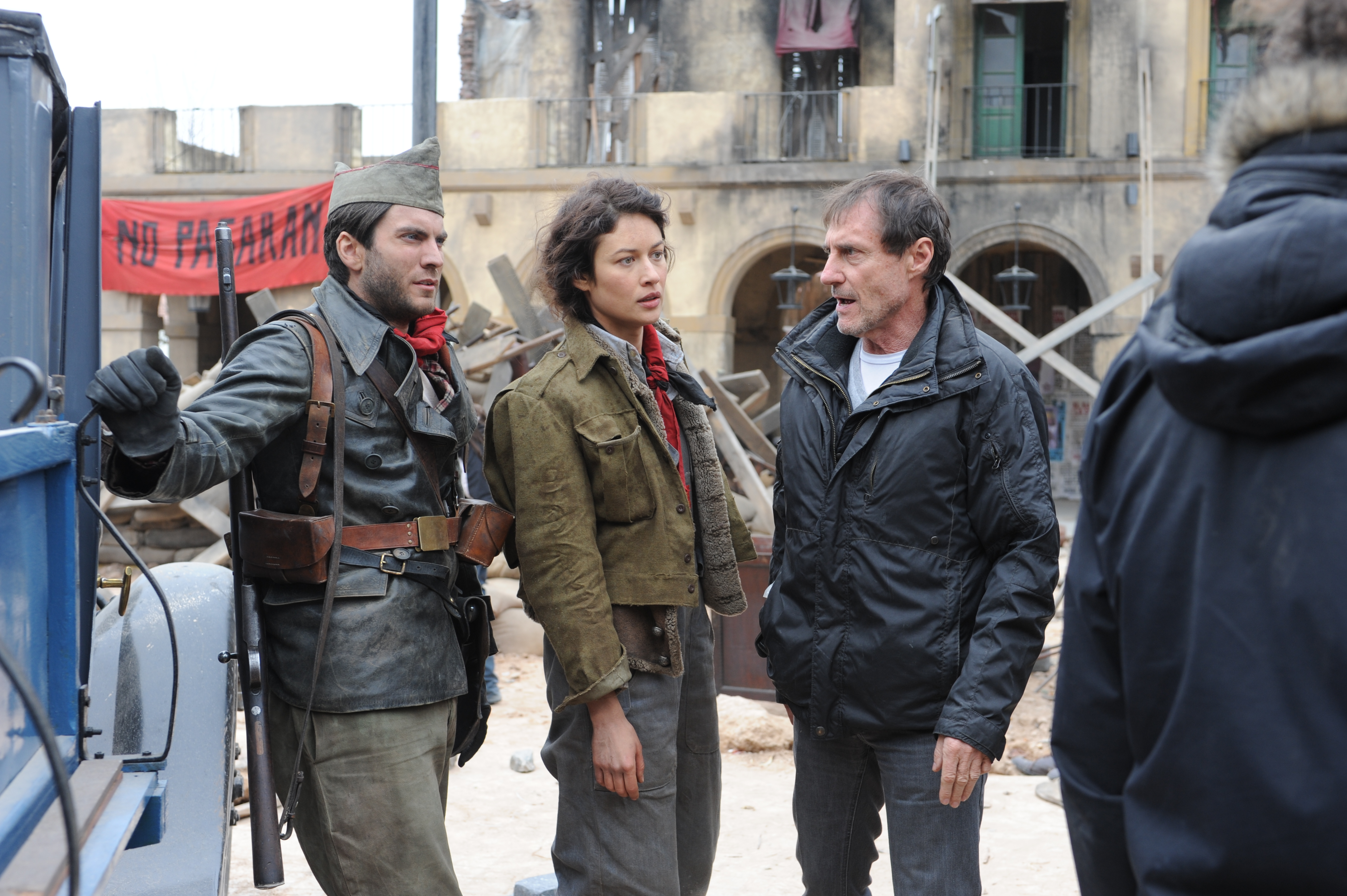
Joffe with Wes Bentley and Olga Kurylenko

In this way, said Joffé, “Josemaría extended what I would call the warm embrace of the Church to people who weren’t Christian as well  … We are all in this world together. That was an extraordinary thing to do, and the power of that message I think is extraordinary and relevant to us.”

The Spanish Civil War (1936-39)  left half a million dead and continues to divide Spain. In the movie the young Fr Escrivá tells his followers in the newly-created Opus Dei that they must forgive and not take sides – even those who are wrong.

The UK based media service, Catholic Voices, reporting on the Rome screening said that among the audience in the North-American College, there were 11 cardinals, eight bishops, 14 monsignori, and 24 ambassadors, as well as representatives from movements such as Focolare and Sant’Egidio as well as Jesuits, Franciscans and Dominicans.

Also in the audience were the writer and director Susanna Tamaro and the film composer Ennio Morricone, who composed the theme to one of Joffé’s 1980s epics, The Mission. After the screening, Morricone said: “With this film Roland Joffe confirms his greatness as an intense and profound director of the highest quality”.

Tamaro described the film as “powerful, very well filmed, and dramatically very effective”. By choosing to tell the story of opposing paths taken by two childhood friends, Joffé “brings out the importance of freedom which God gave us to try to reduce the power of evil in the world”.

A murderous fratricidal war

Tamaro added that the film had the power “to do great good for the new generations deprived of great figures to admire and emulate”.

Joffé told them “it would be wonderful” if There Be Dragons, helped the 21st century to be seen as “the century of reconciliation”, in which “we began once again to discover our innate humanity that exists in all of us” and to heal the wounds of the 20th century wars.

He added: “It’s wonderful that President Mandela was capable of doing that in South Africa, and it’s wonderful to me that Josemaría Escrivá as a young man fought for the importance of that, and carried the Christian message in such a remarkable way that I who am, I confess, a rather wishy-washy agnostic, found myself standing in total admiration and driven to want to do my best for this movie.”

Joffé was introduced by the film’s executive producer, Ignacio Gómez-Sancha, who in 2008 left his job as general counsel to the Spanish stock exchange to raise the $40m budget for the film, attracting more than 100 investors from 10 different countries to his private equity fund, Mount Santa Fe.

Some of the investors, like Gómez-Sancha, are members of Opus Dei, but the organization itself has had no role in the movie. Joffé, who wrote the script, had complete creative freedom.

He told the audience at the Vatican that he rejected the idea of a “biopic” or biographical portrait of Escrivá. “No saint would be saying, ‘make a film about me’, he told the audience.  “But he might be saying, ‘make a film about what I thought about what I loved; about what drove me.’”

Among those watching last night was Mgr Luis Clavell, a Spanish priest of Opus Dei who worked closely with St Josemaría in Rome over many years. Mgr Calvell, who spent many hours sharing anecdotes with Joffé when the director was researching the script, said the portrayal of the Opus Dei founder in the fim was “excellent”, capturing the saint’s “strength of character”, as well as his capacity for love and forgiveness.

Because St Josemaría was naturally hot-tempered, his capacity for forgiveness was heroic, said Mgr Clavell. He recalled how, after the Spanish Civil War, a taxi driver had told the founder of Opus Dei it was a pity he had not been killed along with other priests.  St Josemaría’s reaction was to pay the driver and add a large tip to spend on a gift for his children.

http://www.romereports.com/palio/There-Be-Dragons-presented-at-the-Vatican-with-Roland-Joffe-and-Ennio-Morricone-english-3745.html

A True Hero For Our Times

He was described as “a towering figure in the history of the United States”. That is, as they might say in the United States, an “awesome” accolade. Who was he? He was Dr. Bernard Nathanson. The words were those of Fr. Gerald Murray, in his homily at the Requiem Mass for Dr. Nathanson in St. Patrick’s Cathedral, New York City. He died last month.

The twentieth century has any number of truly “Pauline” conversions, but very few match the scale of Bernard Nathanson’s. He was born in New York to Jewish parents. He became a doctor – like his father – and specialised in obstetrics and gynaecology and was for a time the director of the Center for Reproductive and Sexual Health (CRASH), at that time the biggest abortion provider in the world. During his career there and elsewhere he claimed that he was responsible for more than 75,000 abortions.

Throughout these years he was one of the leading activists in the pro-abortion campaign which eventually came to a head with the US Supreme Court judgement in the Roe V Wade case which legalised abortion across the country and gave the lead to so many other western states to do the same. He professed himself to be a Jewish atheist, was married four times and admitted in one of his books to taking the life of his own child in one of the abortions he carried out.

But then in the 1970s, with the development of ultrasound, he was able to observe a real-time abortion. This shocked him to the core of his being and he ceased to perform any more abortions. This was his first conversion, his ethical conversion. He continued to be an atheist. In his 1996 autobiography, Hand of God, which was quoted by Fr. Murray, he tells of the experience. He wrote: “Ultrasound opened up a new world. For the first time we could really see the human foetus, measure it, observe it, watch it, and indeed bond with it and love it. I began to do that.”

Dr. Nathanson wrote: “By 1984 … I had begun to ask myself more questions about abortion: What actually goes on in an abortion? …I said to a friend of mine, who was doing fifteen or maybe twenty abortions a day, ‘Look, do me a favour, Jay. Next Saturday, when you are doing all these abortions, put an ultrasound device on the mother and tape it for me.’ He did, and when he looked at the tapes with me in an editing studio, he was so affected that he never did another abortion. I, though I had not done an abortion in five years, was shaken to the very roots of my soul by what I saw.”

He continued “Having looked at the ultrasound, I could no longer go on as before”. For him the abortion movement was then seen as “the most atrocious holocaust in the history of the United States”. From then on he became the implacable foe of the movement he himself had spent his life up until that time promoting. Consequently he became its number one source of embarrassment by exposing what he called “the dishonest beginnings of the abortion movement”. He was now declaring: “After my exposure to ultrasound, I began to rethink the prenatal phase of life… When I began to study foetology, it dawned on me, finally, that the prenatal nine months are just another band in the spectrum of life… To disrupt or abort a life at this point is intolerable – it is a crime. I don’t make any bones about using that word: Abortion is a crime.” He humbly confessed “I am one of those who helped usher in this barbaric age.”

In 1984, he directed and narrated the pro-life film which galvanised anti-abortion forces across the globe. This film, The Silent Scream opened people’s eyes to the reality of the “procedure”. It removed any doubt that what was in fact being “terminated” was not just the clinical condition of pregnancy but a human being’s life. His second documentary, Eclipse of Reason, dealt with horror of late-term abortions.

One of the battles which Nathanson and others now began to fight was the battle against the corruption of language, meaning and truth which was part and parcel of the pro-abortionists’ campaign in their efforts to win over and consolidate public opinion on their side. Fr. William Smith, one of his companions in the struggle was another great hero of the pro-life movement. His axiom was: “Social engineering is always preceded by verbal engineering.” For them abortion was the killing of new life and had to be called that.

Then in 1996 came his second conversion. Some time before that he met an Opus Dei priest, Fr. C. John McCloskey. Already deeply troubled by the memories of the work he had been doing for so many years he was searching for some kind of peace – and could not find it. He had, however, the example of one man whose memory haunted him. His medical school professor had been Karl Stern, also Jewish, but a convert. He wrote of Stern later: “…he possessed a secret I had been searching for all my life – the secret of the peace of Christ”. With the help of Fr. McCloskey’s spiritual guidance he arrived at the moment of truth and grace.

In December 1996, Nathanson was baptized by Cardinal John O’Connor in a private Mass with a group of friends in St. Patrick’s Cathedral. He also received Confirmation and first Communion from the Cardinal. When asked why he converted to Roman Catholicism, Nathanson affirmed simply that “no religion matches the special role for forgiveness that is afforded by the Catholic Church”.

In his homily Fr. Murray described Dr. Nathanson as “a fearless advocate of the self-evident truth that it is a grave injustice to kill people before they are born. The unjust decisions of the United States Supreme Court in Roe v. Wade and Doe v. Bolton mandating legalized abortion in our country cry out for the counter-witness of those who will not abide this injustice. Heroism is called for. True heroism is never easy and is only possible through God‟s grace.”

Dr. Nathanson reminded Fr. Murray of another great champion of truth and a witness against evil in the twentieth century, Whittaker Chambers. Chambers renounced his membership of the Communist and confessed to being a Soviet spy. He suffered for it, he was vilified, but he stood firm. He spoke the truth. Chambers wrote of himself in the foreword to his famous book, Witness: “I do not know any way to explain why God’s grace touches a man who seems unworthy of it. But neither do I know any other way to explain how a man like myself – tarnished by life, unprepossessing, not brave – could prevail so far against the powers of the world arrayed almost solidly against him, to destroy him and defeat his truth. In this sense, I am an involuntary witness to God’s grace and to the fortifying power of faith.”  

Fr. Murray went on to tell a haunting story in Chambers’ book which he connected to Dr. Nathanson’s rejection of abortion. Chambers wrote: “The daughter of a former German diplomat in Moscow was trying to explain to me why her father, who, as an enlightened modern man had been extremely pro-Communist, had become an implacable anti-Communist. But she loved her father and the irrationality of his defection embarrassed her. ‘He was immensely pro-Soviet’, she said, ‘and then –you will laugh at me – but you must not laugh at my father – and then, one night, in Moscow he heard screams. That’s all. Simply one night he heard screams’.

“A child of Reason and the 20th century, she knew that there is a logic of the mind. She did not know that the soul has a logic that may be more compelling than the mind’s. She did not know at all that she had swept away the logic of the mind, the logic of history, the logic of politics, the myth of the 20th century, with five annihilating words: one night he heard screams.

“The scream Dr. Nathanson heard was a silent scream. A silent scream uttered by an unseen victim; that is, until the ultrasound machine brought the truth of abortion into plain view for this medical doctor who had expended great effort to make this horror legal and widespread in America. That doctor thereafter boldly decided to make the reality of human life in the womb visible for the whole world to see.”

Has Common Sense Been Abandoned?

This was inevitable – and it is only beginning. Everyone is blaming the judges for the decree handed down by the High Court in Britain on Monday that Eunice and Owen Johns, a Christian couple, married almost 40 years, could no longer foster children aged between five and 10. They are deemed unsuitable, in law, to do so any longer because they are unwilling to promote a homosexual lifestyle to a child. Neither Mr nor Mrs Johns has anything against gay people but they are not in favour of sex before marriage, whatever an individual’s orientation.

But this is not the fault of the judges. The law is not an ass. That is too easy. It is the law-makers who are asses. As soon as the steamroller of “gay liberation” got rolling on its relentless way and sought to have legislation to back all the rights it set itself up as having, the law-makers began to make asses of themselves. And this goes for every other politically correct tom-foolery which late twentieth century men and women allowed themselves to be hoodwinked by and sought legal standing for.

Commonsense has been abandoned. These laws are so flawed and so full of inherent contradictions in the context of the whole fabric of the common law system that they inevitably lead to the kind of judgement which has just been handed down from the British High Court. The confusion, the anguish and the distress of two innocent people is the outcome of this debacle

The statement issues by Owen and Eunice Johns after the judgement reveals the depths of their anguish. “We are extremely distressed at what the judges have ruled today. All we wanted was to offer a loving home to a child in need. We have a good track record as foster parents. But because we are Christians, with mainstream Christian views on sexual ethics, we are apparently unsuitable as foster parents.

“The judges have suggested that our views might harm children. We have been told by the Equality and Human Rights Commission that our moral views may ‘infect’ a child. We do not believe that this is so. We are prepared to love and accept any child. All we were not willing to do, was to tell a small child that the practice of homosexuality was a good thing.”

But all this is part of a campaign to obliterate any common sense and rational approach to dealing with ourselves as human beings. The language of the Equality and Human Rights Commission that the moral views of the Johns may ‘infect’ a child says it all. This is now a society where the Church of the Equality and Human Rights is the arbiter of morality and all other moral viewpoints are dangerous infections against which society must be immunised. British society – and by extension and in time all western societies – are now being defined in such a way that the Church of Human Rights will rule supreme.

These two British judges have now solemnly declared and defined English society to be a “largely secular”, multi-cultural country in which the laws of the realm “do not include Christianity”. The judges remarked that it was not yet “well understood” that in British society the law really has no place for Christianity. “Although historically this country is part of the Christian West, and although it has an established church which is Christian, there have been enormous changes in the social and religious life of our country over the last century,” they said.

Homosexual rights campaigners of course welcomed the judgment which they describe as putting “21st-century decency above 19th-century prejudice”. The ruling in this case is only the latest in a series of judgments in which Christians have been defeated in the courts for breaching equality laws by manifesting their beliefs on homosexuality. Part of the problem here is that the question of homosexuality is being kept in the realm of “belief”. This protects the lobby from having to engage in rational debate about this issue on health, scientific or simple sociological grounds. As soon as anyone raises these issues there are screams of homophobia, prejudice, and bigotry.

All one has to do to get a glimpse of the depth of hatred towards anyone who questions the politically correct orthodoxy on this matter now is to read the comments on the story in the newspapers. The Daily Telegraph in London, as I write, has already clocked up over 1500 responses to just one of its stories on the subject. An Irish parliamentary candidate in the election there last week who has a somewhat nuanced position of the gay rights issue – she supported civil union legislation but considers marriage per se to be, in the interests of children, something for a man and a woman. The volume of hate mail and abuse which descended on her smelt very much like a jihad.

The Rt Rev Michael Nazir-Ali, the former bishop of Rochester, described the High Court judgment as absurd. “However, what really worries me about this spate of judgments is that they leave no room for the conscience of believers of whatever kind. This will exclude Christians, Muslims and Orthodox Jews from whole swaths of public life, including adoption and fostering.”

The judges saw their predicament as follows: “We sit as secular judges serving a multicultural community of many faiths. We are sworn (we quote the judicial oath) to ‘do right to all manner of people after the laws and usages of this realm, without fear or favour, affection or ill will’.”

It was in this context that the Daily Telegraph leader article put the blame firmly in the court of the law-makers. It had no qualms about declaring that we were now witnessing the emergence of a modern, secular Inquisition. “The reason that they were even asked about their views on homosexuality was because Parliament passed the Sexual Orientation Regulations, making it an offence to discriminate on the grounds that someone is heterosexual, homosexual or bisexual. These are the same laws under which Peter and Hazelmary Bull, Christian owners of a guest house, were fined last month for refusing to let a gay couple share a room. But in the case of Mr and Mrs Johns, where is the victim? They were not turning anyone away. Quite the contrary – they were offering a home to children who will otherwise end up in care, and there are precious few people who will. Furthermore, since the children would be aged under 10, matters of sexuality are hardly relevant – or is it being suggested that they should be? Astonishingly, the High Court suggested that it was not so much their Christian faith as the moral certainties of the Johns that were potentially harmful to children.

“There is another troubling aspect of this case, the Telegraph concluded. “Equality laws are supposed to uphold the rights to religious belief. Yet the High Court ruled that laws protecting people from discrimination because of their sexual orientation “should take precedence” over the right not to be discriminated against on religious grounds. Why has it been left to judges to decide whose rights trump those of others? This should have been decided by Parliament but, yet again, another sloppily drafted measure will have far-reaching consequences for freedom of conscience in this country. Already the Roman Catholic Church has had to close its adoption agencies because they cannot conform to the law. Perhaps there is a historical irony here, because we are witnessing a modern, secular Inquisition – a determined effort to force everyone to accept a new set of orthodoxies or face damnation as social heretics if they refuse. Parliament and the courts should protect people like Mr and Mrs Johns, but have thrown them to the wolves. It is a disgrace.” But then, what do asses really know about human nature?

Olga Kurylenko on a film which deals with the big questions

Olga Kurylenko as Ildeko

Olga Kurylenko thinks her latest movie, Roland Joffé’s There Be Dragons, is important for everyone and not just another piece of escapism – and Olga knows what escapism is all about having been Daniel Craig’s love-interest in James Bond’s last outing – A Quantum of Solace.

Why is it important? “Because”, she says, “it just treats the most crucial questions. This movie speaks about love. And it concerns all of us. It speaks about searching for the purpose in life. That’s what we all look for, I hope. It looks for happiness, which is what we’re all looking for in life. It’s about making choices, and we’re constantly, everyday, brought to make choices. It’s about actually struggling with negative feelings; it’s about struggling with hatred and anger. And it is about trying to be a better person.”

Kurylenko, Ukrainian-born actress and model, grew up in poverty sharing a Soviet flat with her aunt, uncle, grandparents and cousin. In her own life she has been no stranger to struggle. Her mother and father were divorced soon after her birth and her mother struggled to survive as an art teacher. Young Olga was brought up by her mother and her grandmother, Raisa. During her youth, Olga had a humbling experience of living in poverty and recounts how she had no choice but to wear rags and had to darn the holes on her sweater. During the years in Ukraine, she studied art, languages, did 7 years of musical school studying piano and went to a ballet studio.

When she was 13, Olga and her mother made a trip to Moscow. There, she was spotted by an agent who approached her at a subway station and offered her a job as a model. Initially, Olga’s mother was suspicious but, eventually, Olga started training as a model. By age 16, she moved to Paris, learned French in six months, and was signed by the Madison agency. Then, in 2005, she made her debut in films and in 2008 hit the big-time with A Quantum of Solace. Next came There Be Dragons which has its world premier in Madrid on 25 march and then goes on release across the US on 6 May.

Since making this movie over six months in 2009 she has spoken about its impact on her. “One of the main characters”, she says, “is extremely angry and full of hate. He is totally lost. And I think that’s something that’s extremely common in our world today, and always was. Let’s agree that we’ve been struggling with it for… centuries. It’s something that’s still worth talking about, because it’s still our problem! And that’s what sanctity is, I guess. As Roland said, there’s no sanctity without struggle and fight and suffering. It’s not just a person who sits in his chair and does nothing and just has great ideas.”

She sees Josemaría Escrivá, who is one of the central characters in this semi-historical portrayal of personal conflict between its protagonists during the Spanish Civil War in the 1930s, as representing this kind of human being. It is about a man “who gets up and goes and does something. In spite of the hatred that directed at him, he keeps believing in a better world; he keeps doing good. That’s something easy to say but not very easy to do at all.” But there are people like that, and Josemaria was one of those people. When people were spitting on him and throwing stones at him, he was still turning back with a smile and kept loving those who were doing these things to him. And there are lines in the movie, where he says ‘Well, we still should love them.’ That’s something! It’s very idealistic, but it is possible, because there are people like that.

I never met Josemaría, but I’ve actually met people like that in the present life, nowadays. There are people like that. And those are the people who chose not the easy way but rather the difficult way. That’s what makes life more interesting, rather than those who choose the easy way, that’s what gives sense to life.

“TRUE” IN EVERY WAY THAT MATTERS – SOME OF THE TIME

For Hollywood, it seems, history is the new rock’n’roll. Anne Applebaum, writing in the Washington Post recently on the spate of films centered on historical events or historical characters puts it down to the phenomenon of reality TV. She quotes Peter Morgan, who wrote the script for The Queen – a movie focused on the aftermath of the death of Princess Dianna: “If people need to explain what a film is about, the film stands very little chance of surviving. Reality is a brand which people can sell” he says.” Some of the biggest films on release over the past year have been such – the story of the Harvard student who invented Facebook, the story of a stuttering king – The King’s Speech, Danny Boyle’s 127 Hours, and a story for which Applebaum was herself a historical consultant, The Way Back.

But Hollywood and history are strange and uneasy bedfellows and not everyone is happy with the progeny they produce. Hollywood has played fast and loose with historical truth on so many occasions that we approach new movies based on history with not a little suspicion. But they keep coming and the latest soon to appear on a screen near you will be Roland Joffé’s new film, There Be Dragons – which some anticipate will be a return to form for the director of two of the most memorable films of the 1980s, The Mission and The Killing Fields, both again based on real events in history.

Joffé’s film, starring Charlie Cox, Wes Bentley, Dougray Scott and Olga Kurylenko, is set against the background of the horrors of the Spanish Civil War and the life of a canonised saint, Josemaría Escrivá (Cox), the founder of Opus Dei. The genre into which this movie fits, however, has much more in common with the historical novel than with films purporting to be a narrative account of historical events. In this there is a very open mixture of fact and fiction and without doubt the film-maker is setting out to show us what moves, inspires and shapes lives rather than give us a dry factual account of events. In every sense this is very much an auteur work since Joffé not only directs but also conceived and wrote the screenplay.

Applebaum’s musing on history and cinema are in the context of The Way Back, the recently released Peter Weir film based on a “true story” of prisoners escaping from Stalin’s gulag back in the 1940s. The original story came in the form of a book called The Long Walk by Slavomir Rawicz, a Gulag survivor. It was a controversial book because while it appeared to be a first-hand account of Rawicz’s own story it later transpired that it was a story told to him by another escapee.

But, Applebaum argues that the story, certainly as portrayed in the film, is “true” in every way that matters. “Many of the camp scenes are taken directly from Soviet archives and memoirs. The starving men scrambling for garbage; the tattooed criminals, playing cards for the clothes of other prisoners; the narrow barracks; the logging camp; the vicious Siberian storms. Among the very plausible characters are an American who went to work on the Moscow subway and fell victim to the Great Terror of 1937, a Polish officer arrested after the Soviet Union’s 1939 invasion of Poland and a Latvian priest whose church was destroyed by the Bolsheviks.”

Joffé argues for the same kind of truth in his There Be Dragons, a truth built into the fictional story of London-based investigative journalist Robert Torres (Scott) who tries to unravel a deadly mystery nearly 70 years old that links his father to the founder of a Catholic organization called Opus Dei, only to discover that the shocking truth is far more than he bargained for.

Roland Joffé describes his experience of bringing the story to the screen in the following terms: “There Be Dragons was a wonderful experience that paralleled the one I had making The Mission. It is an intimate story of love and forgiveness set during one of the most bitter wars of the 20th century. Yet the themes of the film are as relevant today as ever, and I am hopeful that audiences will embrace them in that spirit.”

The film, made for $35 million, is being distributed in the US by Samuel Golden Films and is being released there on May 6. According to Meyer Gottlieb, president of the company: “We feel privileged to be working with such an acclaimed filmmaker in Roland Joffé and look forward to bringing There Be Dragons to audiences everywhere. This beautifully mounted and executed film based on true events is moving and inspirational, and it will make moviegoers cheer and applaud.”

The film has been made in English but rather unusually is having its dubbed Spanish language version released first. Its Spanish distributors have pushed and succeeded in getting it released there on screens across the country from 25 March. The release in Spain is timely because 2011 marks the 75th anniversary of the Spanish Civil War. During this brutal conflict thousands of priests and nuns were persecuted and murdered. How a still-divided Spanish society will react to this retelling of those events is something which will be watched with great interest.

The film’s themes are already resonating with people of all faiths who must make daily choices to “conquer the dragons” – the allusion of the title – they encounter by avoiding conflict in favor of embracing opportunities for forgiveness. Previewers of the movie have described it as “a deeply moving depiction of the triumph of love and forgiveness”.

Motive Entertainment, the company that championed films like Mel Gibson’s The Passion and Disney’s Chronicles of Narnia, have been contracted to promote the film across the US and further afield in the Anglophone world.

See trailers: http://www.youtube.com/user/therebedragonsfilm

The Elephant At the Polling Station

There’s no question about it. There’s an elephant in the room and there is a massive conspiracy of silence to say nothing about it among in the mainstream Irish media covering the general election set to take place there on February 25. But hell hath no fury like an animal such as this when roused to anger by being ignored. Some are just now beginning to prod this one into action.

Admittedly Ireland’s continuing struggles to escape the clutches of the biggest recession, probably in its history, preoccupies both the electorate and the politicians in this campaign. But other issues are also at stake and these are the one the politicians are furtively seeking to avoid. Proposals to legislate for abortion, for gay marriage and limiting choice of schools to parents are all there in the small print. Like small print everywhere the hope of the printer is that it might not be read. On these issues it is Ireland’s own version of “don’t ask, don’t tell.”

The first mainstream flagging of the abortion issue came last week in David Quinn’s weekly column in Ireland’s biggest broadsheet, the Irish Independent.  www.independent.ie/opinion/analysis/david-quinn-any-vote-for-the-labour-party-is-a-vote-for-abortion-2535719.html . He spelt out the reality confronting the Irish electorate on these issues and effectively asked them to wake up to it.

These questions have become important because the final composition of the Irish parliament will most likely leave the two centre right parties (Fianna Fail and Fine Gael) without overall majorities. They will then have to look for government partners among the left-liberal groupings, Labour and the Greens. The polls currently suggest that the new Irish government will be formed from a coalition of Fine Gael and Labour. It is the familiar story of the tail getting to the position where it can wag the dog on social policy while the centre right gets on with the economic business. That is what happened in the outgoing parliament where the liberal Greens got their pound of flesh in the form of civil partnership legislation for homosexuals. For all those who campaigned on this issue, this was only a half-way house. The same groupings are now going all out for full gay-marriage legislation. That is no surprise, nor would it be seen as much of a threat by those opposed to these changes if these groupings were not in danger of getting an influence in the new parliament far beyond what their actual electoral support would warrant.

Quinn put his finger on the heart of the problem in his column when he pointed to the failure of the electorate to waken up to this danger. As he sees it – from his reading of the traditional sector of the electorate “a lot of them haven’t the first clue about Labour’s position on abortion. Amazing, but true. They don’t know, for example, that Labour wants to legislate for (a court) ruling of 1992. That ruling allows for abortion, and furthermore, it permits abortion simply on the say-so of a medical practitioner – it doesn’t have to be a doctor or psychiatrist – who is willing to say that his or her patient is suicidal.

In addition, Eamon Gilmore (Labour Party leader) favours abortion where the ‘health’ of the mother is in danger. In practice, this would replicate in Ireland the British abortion law. In Britain, abortion is permitted where a woman’s life or health is at risk. Health includes mental health. In practice, this translates into abortion-on-demand.

Gilmore favours this policy despite the fact that Ireland is the safest place in the world for a woman to have a baby, according to World Health Organisation figures.

And from a Catholic and Christian point of view, it is not only Labour’s stance on abortion that is problematic. It favours same-sex marriage and same-sex adoption. Its attitude towards denominational schools is also a problem.”

Quinn then deals with what he sees as the failure of the sector of the electorate for which traditional values on these issues are important.  He sees two categories of error being made by some of those who might be thinking of voting for Labour. The first category of are those who just don’t know the party’s position on abortion; the second category  somehow manages to rationalise away the Labour position, to say that it doesn’t matter, or that there are more important issues to be considered. Some, he finds, seem to think Labour doesn’t really mean it. “Sorry, it does. If it gets a chance – and that will be up to Fine Gael – we will have abortion in this country.”


The response to Quinn’s column seemed to bear out his point – so far. There were just three letters in the paper the following day and the politicians in the two main parties themselves studiously avoided the issue. I say “so far” because there are some signs that the Labour Party is now coming out more clearly on these issues. If it does so it may force the electorate – or the sizeable sector of it which, if awake, would be concerned about these matters to ask the main parties’ prospective members of parliament where they stand. They might then ask them fair and square whether, if in power with Labour, will they give their backing to health social legislation which denies the unborn their rights, denies society the marriages it needs to maintain the family as a meaningful institution, and denies parents the right to a choice of school without penalizing them financially.

The day after Quinn’s column appeared the paper’s deputy political editor, Michael Brennan, reported that the “Labour Party is making a pitch for the ‘gay vote’ by calling for a same-sex marriage referendum – but it risks alienating more conservative voters. Leader Eamon Gilmore yesterday said the party wanted to push ahead with a referendum to allow gay people the same right to marry as straight people.”  And on abortion he said “Labour is still maintaining its policy on another divisive social issue – it wants to introduce legislation which would copper-fasten the right of women to access life-saving abortions.”

However, Brennan warned, Labour’s social policies could cause divisions with its likely coalition partner Fine Gael, which is opposed to holding an abortion referendum and has not publicly backed same-sex marriages.

Fine Gael’s leader, and the man most likely to be Ireland’s next prime minister, is still less than forthright on exactly what terms he will enter coalition with Labour if he fails to gain an overall majority for this own party. Campaigning in Galway last week one journalist observed him as follows: “Enda has a word for everyone and looks like he’ll stand talking to anyone for as long as his aides will tolerate it. He engages in extended impromptu discussions about abortion, Shell to Sea (a local controversy in the West), the pubic service, and each time sets out his position in full.” Really?

The electorate knows he is “personally” opposed to abortion and considers marriage as a bond between a man and a woman. But but they have also heard him acknowledge that “there are other points of view”. What those seemingly tolerant words will mean if and when he come to form a government with those of that other point of view is what the traditional electors of Ireland do not yet know. The elephant is still in the room.

The Last Straw: booting Boots

This one is a little – perhaps more than a little – personal. My conscience has been troubling me over the past few weeks. I have not had occasion to go to my favourite pharmacist since the Boots chain announced its intentions of providing, from January 12, over-the-counter “emergency contraception” in its Irish stores. My favourite pharmacist is, sadly, a Boots pharmacist. While this is personal it is also a matter which touches directly on the common good of our society and the life and death of human beings. As such I feel I should make my personal response a little public.

It seems to me that, yet again, we have here an instance of corporations taking another step to obliterate all sense of the identity and value of human life in their ruthless pursuit of profits – and then boast of it as “service to the public”.

 I have written as follows to my pharmacist – but do not disclose here either the identity or my pharmacist or the Boots branch where, until January 11, I have been a customer.

 “I have been a customer with Boots for a good number of years now. From time to time I have had misgivings of conscience about this choice of pharmacy in view of some of the products which you provide to the public. Until now I have given the company the benefit of my doubts. However, on reflection, in relation to the latest service which you have announced which you are providing – effectively an abortifacient medication as a so-called ‘emergency contraception’ – I can no longer give Boots the benefit of the doubt. This is contrary to the moral norms which I consider absolute in relation to our responsibility for human life. I don’t think I need to spell this out.

“As a consequence I would request that you set aside for collection, or send to me by post, any current prescriptions which you are holding there so that I can transfer them to one of my local pharmacies.

 “I very much regret having to do this and wish to express my appreciation for your personal courtesy and advice over the past few years. Even though I moved house in September my appreciation for this help was the reason why I had hoped to retain my account with Boots despite some inconvenience. Unfortunately, powers – which I would like to think, are beyond your control – now make it impossible for me to do so any more.

Yours gratefully…”

Garvan Hill: 2010 in review

The stats helper monkeys at WordPress.com mulled over how this blog did in 2010, and here’s a high level summary of its overall blog health:

Healthy blog!

The Blog-Health-o-Meter™ reads Fresher than ever.

Crunchy numbers

Featured image

A helper monkey made this abstract painting, inspired by your stats.

A Boeing 747-400 passenger jet can hold 416 passengers. This blog was viewed about 2,100 times in 2010. That’s about 5 full 747s.

In 2010, there were 24 new posts, growing the total archive of this blog to 53 posts. There were 3 pictures uploaded, taking up a total of 920kb.

The busiest day of the year was August 16th with 72 views. The most popular post that day was The End of Cocoon Culture.

Where did they come from?

The top referring sites in 2010 were mercatornet.com, facebook.com, mail.live.com, mail.yahoo.com, and google.ie.

Some visitors came searching, mostly for garvan hill, michael kirke, garvan wordpress, and the gods are just. no doubt. but their code of law is dictated, in the last resort, by the people who organize society; providence takes its cue from men.”.

Attractions in 2010

These are the posts and pages that got the most views in 2010.

1

The End of Cocoon Culture August 2010
4 comments

2

Brave New World Now? September 2009
1 comment

3

About March 2007
6 comments

4

The State We’re In July 2010
2 comments and 1 Like on WordPress.com,

5

A Distasteful Display of Acrimony: Frank Rich on Mel Gibson July 2010
4 comments

A Song Which Every Age Needs To Sing

Germaine Greer, for whom I’ve always had a soft spot, maybe a misguided one, once did a television programme on the Psalms. It was a slaughterhouse of a programme. I can’t remember her liking them for anything – neither their poetry, their power, their antiquity nor their mystery. They were evidence for her of man’s creation of a terrible God.

Her reading of the Psalms saw nothing in them other than weapons used by men to wield a terrible power over their fellowmen.  What a pity. But then if you reject God and substitute him with your own fantasy, what have you left? You lose all sense of the unfathomable mystery of his goodness, mercy and fearsome power. You fail utterly to see that the fearsomeness of God is a radically different thing from the fearsomeness of man. Inevitably you end up concentrating on power as a terrible and terrifying thing, conjuring up all the images and memories of the deeds of any or all of the monstrous regiment of human beings who have been corrupted by too much power down through history.

But read God as he is, as the divinity that we can only comprehend as “through a glass darkly”, and our whole reading of the psalms becomes a totally different experience.

Take just the second song of the Psalter as an example, one singled out for special opprobrium by Ms. Greer. Read it as a mythological text and it will certainly confound you. At best it will be a text depicting an epic tribal struggle between ancient peoples. At its worst it will be a call to arms dangerously akin to a contemporary jihad.  But read it as the Word of God, as the Word revealed to us in the total context of Sacred Scripture and Tradition and you have a text which speaks to all ages and speaks overwhelmingly of God as the loving Father from whom all fatherhood takes its name. It certainly reveals an all-powerful God to us. But with power to what end? It reveals a God who has the power to conquer the world – as in “the world, the flesh and the devil” – and power above all to make us sons of God, heirs to the kingdom of heaven. It is a song which every age needs to sing, for in every age – and in our own par excellence – there is the temptation that we are losing that battle.

The Church’s chosen antiphon opening the recitation of this psalm sets the tone of confidence which pervades it: His kingdom is a kingdom of all ages, and all kings shall serve and obey him. The opening line then asks a question which never ceases to be relevant. Why this tumult among nations, among peoples this useless murmuring?  This is followed by the familiar spectacle of folly we see around us every day: They arise, the kings of the earth, princes plot against the Lord and his Anointed.


Then comes the harder bit, the bit that gave Germaine so much trouble, the call to action. “Come, let us break their fetters, come let us cast off their yoke”.  He who sits in the heavens laughs; the Lord is laughing them to scorn. Then he will speak in his anger, his rage will strike them with terror. “It is I who have set up my king on Zion, my holy mountain”.  But what Germaine misses is that this is more than a text of its time, written in history and in the spirit of its time. It is that but it is more than that. It is a text for all time, about all time, and with a meaning that utterly transcends the spirit of its time, the spirit of monarchic conflict between ancient tribes in the Middle East. It is a text about the Messiah, the Saviour of the human race, coming to effect the adoption of all members of that race as children of his Father, God. I will announce the decree of the Lord: the Lord said to me: “You are my Son. It is I who have begotten you this day. Ask and I shall bequeath you the nations, put the ends of the earth in your possession. With a rod of iron you will break them, shatter them like a potter’s jar”. In truth we break ourselves when we indulge ourselves in all this useless murmuring and plot against the Lord and his Anointed. What, indeed, is all this talk about a “broken society” in modern Ireland, Britain and America, but a fulfillment of these ancient prophesies?

St. Josemaría Escrivá reads this Psalm as a profound expression of God’s paternity, God’s intervention in human history to save us from ourselves. “The kindness of God our Father has given us his Son for a king. When he threatens he becomes tender, when he says he is angry he gives us his love. You are my son: this is addressed to Christ — and to you and me if we decide to become another Christ, Christ himself. Words cannot go so far as the heart, which is moved by God’s goodness. He says to us: You are my son. Not a stranger, not a well‑treated servant, not a friend — that would be a lot already. A son! He gives us free access to treat him as sons, with a son’s piety and I would even say with the boldness and daring of a son whose Father cannot deny him anything.” (Christ Is Passing By, 185)


The psalm ends with a warning. If it is a warning which seems to contain a threat, it is one which we must again read in the context of all of Revelation and the history of our Redemption. Now, O kings, understand, take warning, rulers of the earth; Serve the Lord with awe and trembling, pay him with your homage. Lest he be angry and you perish; for suddenly his anger will blaze. Christ did make a whip of cords and did throw the traders out of the temple. But when those traders then turned on him later he went like a lamb to his death. Here is a mystery which we can only be in awe of but which the last line of the psalm gives us the key to: Blessed are they who put their trust in God. Without that trust we will remain in the muddle in which we found Germaine Greer when she attempted to interpret this great Messianic psalm without the help of its Author.

Calling All Grumbletonians

Are you a “grumbletonian”? The word – if you can call it that – looks new but is in fact at least 200 years old. You can check it out in Francis Grose’s 1785 Classical Dictionary of the Vulgar Tongue. It describes, obviously enough, a person who is constantly dissatisfied with life and everything else. We would all rather not be described as such but in the present climate, national or international, it is hard not to succumb to grumbletonianism.

But the trouble with this condition is that it produces a severe partial blindness – we see only the bad and the ugly and miss out on the good. Our current preoccupation with the Great Recession and the political turmoil it has brought in its wake has infected too many of us with this virus. For example, if we were asked to give a summary of the economic developments in the world over the past five or six years what would we come up with? Or if asked to compile the top ten headlines of world news over the same period what would the list look like? It would be replete with economic chaos stories, power-shifts deemed to be of an ominous kind, debt and dropping standards of living. Certainly, there would seem to be very little to cheer about.

But in fact there is a great deal to cheer about. The dramatic changes of the past few years have not all been bad. Indeed, perhaps, the dominant and potentially more permanent change has been very good news indeed. Two fellows of the Brookings Institution in Washington, Laurence Chandy and Geoffrey Gertz, in a recent article in the Financial Times, have drawn our attention to one very good piece of news. In the years between 2005 and 2010 more people have been lifted out of poverty than has ever been done before in the history of the world, over such a short period.

Poverty has been defined by the United Nations and the World Bank as the condition of those people who are living on less than $1.25 a day. In 2005 that left a total of 1.37 billion people across the world below the poverty line – about one third of them in China and about 208 million in India. The World Bank has not updated its figures since then but the Brookings Institution has now produced a report which updates the picture and the change is, to put it mildly, very encouraging.

Their estimate is that between 2005 and 2010, nearly half a billion people escaped extreme hardship, as the total number of the world’s poor fell to 878 million people. “Never before in history”, Chandry and Gertz maintain, “have so many people been lifted out of poverty in such a short period. The U.N. Millennium Development Goals established the target of halving the rate of global poverty between 1990 and 2015; this was probably achieved by 2008, some seven years ahead of schedule. Moreover, using forecasts of per capita consumption growth, we predict that by 2015, fewer than 600 million people will remain poor. At that point, the 1990 poverty rate will have been halved and then halved again.”

Now, should we not call that progress?

This decline in poverty is universal. It is happening in all the world’s regions and most of its countries, though at varying speeds. The emerging markets of Asia are recording the greatest successes; the two regional giants, China and India, are likely to account for three-quarters of the global reduction between 2005 and 2015. Over this period, Asia’s share of the world’s poor is anticipated to fall from two-thirds to one-third, while Africa’s share is expected to rise to nearly 60 percent. Yet Africa, too, is making advances; they estimate that in 2008 its poverty rate dropped below the 50 percent mark for the first time. By 2015, African poverty is projected to fall below 40 percent, a feat China did not achieve until the mid-1990s.

“These findings are likely to surprise many, but they shouldn’t,” they conclude. “We know that growth lies at the heart of poverty reduction. As the growth of developing countries took off in the new millennium, epitomized by the rise of emerging markets, a massive drop in poverty was only to be expected.

“With few exceptions, however, those who care about global development have been slow to catch on to this story. We hear far more about the 64 million people held back in poverty because of the Great Recession than we do about the hundreds of millions who escaped impoverishment over the past six years. While there is good reason to focus public attention on the need to support those still stuck below the poverty line, there is also reason to celebrate successes and to ensure that policy debates are grounded in reality.”

If all this is a by-product – in part anyway – of emerging economies unsettling the global status quo, and consequent power-shifts, perhaps we should be happy to set aside our silly and self-centred worries about loss of hegemony and start cheering again. So, let us all ease up on the grumbling. There is some really good news out there .