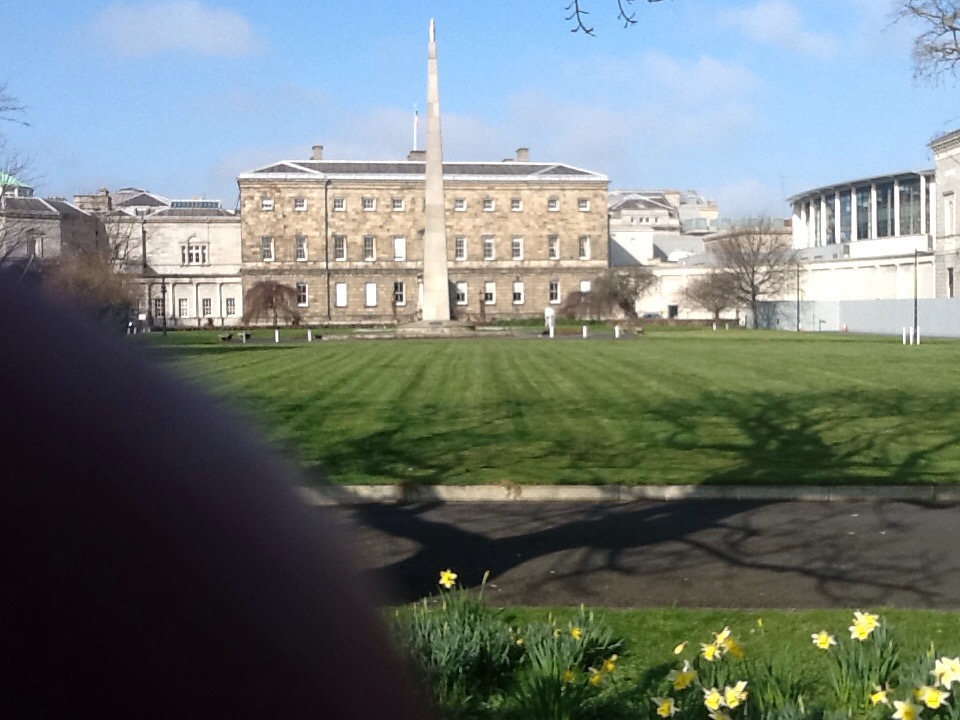
A modern Burke speaks to power in defence of reason and good government

Edmund Burke, champion of modern democracy, gracing the front lawn of Trinity College, Dublin, where he graduated.

Bruce Arnold’s astounding open letter to Ireland’s Prime Minister (Taoiseach), Enda Kenny, should find him a place in the pantheon of political thinkers alongside Edmund Burke, Abraham Lincoln, Cicero and just a handful of others.

This letter, a call to prudence and wisdom to a straying political establishment is heroic, practical and much deeper in its implications than it might at first seem.

Edmund Burke, an Irishman in England’s 18th century House of Commons, twice called on his fellow parliamentarians to come to their senses. Firstly he did so over their folly in their treatment of the American colonists. Secondly he warned them of the bloody consequences which he saw flowing from the rash political excesses of their French contemporaries in 1789.

In the one, his call for conciliation with the British settlers in America, he failed to win their support and both England and the thirteen colonies paid the price in a bloody war. In the other he was more successful and his countrymen set their faces against the excesses of the French and braced themselves for the eventual and finally victorious struggle with the megalomaniac who sought to straddle the world.

Arnold is an Englishman, a journalist and writer, who has made his home in Ireland and, while not a parliamentarian, is playing a crucial role as one of the leading voices of the only political opposition Ireland’s parliament has today.

Ireland’s Dáil now bears all the hallmarks of a one-party state. Recently it rushed through an important and radical piece of legislation on Children and Family Relationships. While this enactment contained some important reforms it was, however, riddled with provisions which many felt were inimical to children and the family. It was initially envisaged that it would make provision for surrogacy as a legitimate way for same-sex couples to beget children. This was withdrawn for strategic reasons and will now be proposed in separate legislation. Other elements were questioned but, despite some efforts by independent parliamentarians to propose amendments, the Party machines on all sides of the parliament, Government and non-Government, pushed the Bill into law.

Simultaneously – and not coincidentally, for the latter was part of strategic plot to help win the other – it rushed through legislation for a referendum on same-sex marriage. It was so rushed in fact that they did not even take time to get the Irish language – the “first” official language of the State – wording of the measure to synch with the English. They had to correct this to avoid what would have been a very embarrassing legal quagmire.

Arnold’s open letter – ostensibly to the Taoiseach but it should in fact be taken to heart by 90% of the Irish parliament who have sheepishly followed his lead on these things – deals with the detail of what is proposed to the electorate as a change to their constitution. It reveals the devastating superficiality of what is passing for government in the Irish Republic today and which is exemplified in this current political action.

This journalist, in the role now of a true tribune of the people, is calling on Ireland’s political class to come to its senses and to start thinking seriously again. His call has worrying resonances, touching on much more than one single issue. His questioning of the political wisdom of this small country’s parliament casts doubt over its competence to deal with everything that it touches. The context of Arnold’s remarks is the current issue of this referendum. The broader issue which it exposes is that of quality of governance – which is why we can call the letter “astounding”. That this should be so on the eve of Ireland’s centenary celebrations of its achieving independence as a nation is truly disheartening.

Ireland gave the gift of Edmund Burke to England in the 18th century, and to parliamentary democracy across the world. He is now recognised as the father of a political philosophy which puts common sense, the value of the common good and an inherent but open-minded respect for society’s good traditions, over fanatical ideology. Perhaps England has now returned the compliment by giving Ireland a voice which loudly and clearly speaks to power on behalf of a people whose parliament is now attempting to foolishly destroy an institution which has served it beneficially from time immemorial and replace it with an empty and meaningless shell, genderless marriage, which will serve no one’s real interest.

Arnold first wrote to Kenny on this issue of the referendum in February last. That was  a more formal approach, raising the constitutional, social and moral questions that are actively bothering about 25 percent of the electorate – a percentage increasing as the campaign continues towards it finale on May 22. Most people now concede that the result of this ballot will be much closer than the opinion polls suggest.

This letter, Arnold begins, is more familiar and personal than the previous one for reasons that will soon become apparent.

We have known each other for the whole of your political career, having first met after you succeeded your father in the by-election that resulted from his death. Henry Kenny was a friend of mine during his two short years as a parliamentary secretary to the Minister for Finance, Richie Ryan. These were my first two years as a journalist working in the Dail. It is probable I met you at that time as well. With ups and downs, inevitable in the relationship between politicians and the journalists who record their lives, I have always had an admiration for your calm style, in opposition and in power, and for a quality I have admired in you, the likeable human appeal that I think of when I think about the career of another politician I have always greatly admired, Jack Lynch. He had the common touch as you have, an ability to be naturally relaxed and friendly.

Perhaps the most important challenge you faced in your political career was the last general election. Fianna Fail had made an undoubted mess of their time in office, tolerating excessive spending, wildly uncontrolled property development and a political dishonesty that was deeply damaging to this country.

I supported your candidature and your courage in putting a quality back into the search for power and a set of principles, not always effective, but good enough to support in the contest during that election. You had the good grace to recognise and acknowledge my consistent support for your campaign and I have no hesitation in saying now that I did it for good and reasoned endorsement of those principles for which you stood.

I have to confess that much of this support and sympathy has been undermined by the inept and already damaging impact of your handling of the Marriage Referendum. If the referendum is carried, I see this as irreparably damaging to moral life in this country, to married life and the future of the family, and leading to the encroachment of wildly inappropriate approaches to the birth and development of children. It runs the risk of splitting the country irreparably.

I have shown recently (through the document I circulated on Wednesday about international developments in the area of same-sex marriage) how totally out of step with the rest of the world Ireland has become in pursuing an unwanted and unjustified constitutional amendment. It is being pushed through in a political atmosphere of almost total ignorance and hysteria. If the referendum is carried, Ireland will be the only jurisdiction in the world providing explicitly for same-sex marriage in its Constitution. It will become the flag bearer for same-sex marriage and gender ideology internationally.

This week, in a pithy and courageous call to the people, Brendan Howlin used a phrase about an aspect of the economy that resonated immediately with me. He called for “the full ventilation of the full truth”. In the marriage referendum the opposite has been the case. In your article in the Irish Independent on April 27th, for example, you repeat the blatant untruth that underlies your whole approach (“… importantly, marriage equality will not in any way affect the institution of marriage. It will only extend equal legal protections to all couples.”). How then could the Chief Justice of the US Supreme Court also say on April 27th, to proponents of gay marriage: “you’re not seeking to join the institution, you’re seeking to change what the institution is. The fundamental core of the institution is the opposite-sex relationship and you want to introduce into it a same-sex relationship?”

Do you, Enda, take us all for fools? The dogs in the street know that marriage will change radically. What is now a natural institution that predates the Constitution and is protected by it, will become an artificial creation of the Constitution and be defined by it.

An approach of almost unprecedented ignorance is being purveyed and blindly supported. Talk of love and equality is no substitute for reasoned analysis of the consequences. Huge sums of money from outside the state have been employed, contrary to firm expenditure principles in most other political campaigns. Ministers are hailing the Yes Vote while at the same time refusing to say why and how it is appropriate. They are not answering any of the questions being put to them. Largely this is because they do not know the answers.

You are leading a campaign in a prejudicial and one-sided way that has all the faults of previous referendums, faults that led on several occasions to successful challenges by private citizens. The purpose of a referendum is to allow the Irish people to legislate directly on whether to amend their Constitution or not. Such acts of direct legislation should take place without voters feeling pressurised and intimidated by the Government of the day into voting in a particular way, with all members of that Government favouring a particular outcome, and certain organs of the State being allowed or even encouraged to act in a one-sided way also.

The Gardai have been engaged, quite inappropriately, on the side of the Yes Vote. Their permitting of voter registration sites in universities, enrolling young people, to be used as posts to distribute Yes campaign materials and literature and to be decked with Yes campaign posters and murals, is a denial of their pledge to uphold the Constitution. Young and innocent people are being deliberately misled. The older generations are bewildered by the mood of near-hysteria that prevails in the country.

The criticism of the Gardaí by Nuala O’Loan was devastating. Yet Minister Fitzgerald has taken no effective action as she should have done. She has tolerated silently this putting of the legality of the referendum process at risk. How would you like to stand in an election in which the supervision of the integrity of the ballot, the collection of votes and the transfer of boxes were all entrusted to Sinn Féin with that party supervising registration? That is what it looks like when the Gardaí take sides in a referendum. Have no doubt that the Supreme Court would deem this to be a grave misconduct. You and the members of your Government have been silent about it.

I gave you a copy of a Private Study Paper on Same Sex Marriage in the Irish Constitution with my letter of 25th February. (It is referred to as a private study paper as it was prepared by private citizens who have done work the State should have done.) You replied to me saying that you would read the study paper. I acknowledge that you heeded my call to rectify the crass error in the Irish text of amendment, but I have not heard from you since.

You have instead chosen to deal with an issue that is exceptionally complex, both legally and morally, and which has implications for family law that are at the borders of medical technology and that stretch ethics to their very limits, and indeed beyond, in a trivial manner through a one-page referendum Bill, a single line in the Constitution and a threadbare draft Marriage Bill.

That is no way for a developed state to behave. It is also entirely contrary to the intent and spirit of the huge reform work undertaken by the Constitutional Review Group led by Ken Whitaker. I cannot understand why you have chosen to approach same-sex marriage in such a reckless and ill-thought out manner, a manner that would result in referendum after referendum to try to correct the results of a “yes” vote and which will make us the laughing stock internationally.

It has now also come to my attention that the Marriage Referendum, if carried, will serve to subvert directly the first of the Irish (Treaty of Lisbon) Protocols in relation to Article 41 (The Family) and Article 42 (Education). As Leader of the Opposition, you witnessed the defeat of the referendum on the Treaty of Lisbon in June, 2008 and it being subsequently carried in a second referendum in 2009, once certain protocols for Ireland were secured. These protocols became legally binding when, appended to the Croatian Accession Treaty, it became law on December 1st, 2014.

It really is bewildering for me to see that once we adopt a protocol to protect the integrity of Article 41 and Article 42 of the our Constitution from being overridden by European law and the new wave of European genderless ideology, which utterly and falsely denies the differences between men and women, we then proceed within six months thereafter to try to change, radically and irreparably, our national understanding that marriage is based on gender difference. Thereafter, we will insist that the falsehood of genderless ideology be taught to our children in schools.

Young children and young adults will become increasingly confused, when as boys and girls, young men and young women, they are told that there is no difference between the male and the female. If this Referendum is carried our young people will be told in schools that marriage, which is based on the dignity of the difference between a man and a woman, has no regard to this difference. Can you not see how the false genderless ideology will underpin all of this in a way that leads to confusion? Great confusion will be done to our young people in realising their true identities and their God-given potential?

While certain countries in Europe are being seduced by a false gender ideology, which denies the differences between men and women, we have a clear defence against this falsehood with the first of the Irish (Treaty of Lisbon) Protocols. You worked hard for these protocols yet your Government are now trying to abolish their protection. More significantly, ministers are telling the Irish people nothing about this. Can you not see how wrong this is? Has no adviser explained that the first of the protocols, which were necessary to secure the carrying of the referendum on the Treaty of Lisbon in 2009, will be destroyed if this referendum is carried?

In fairness to you, one cannot expect that you will have heard this from our Irish Human Rights and Equality Commission. This body is meant to advise all of us independently upon how our human and constitutional rights are being affected. Since leading representatives of the Irish Council for Civil Liberties and the Gay and Lesbian Equality Network shape its policy statements, there is no surprise there.

In the light of all that has happened and of our long relationship, I would deeply appreciate answers from you to the following questions:

  1. Did the Ministers for Justice and Equality or Foreign Affairs and Trade or the Attorney General inform the Government of the Irish (Treaty of Lisbon) Protocols when considering the Marriage Referendum Proposal? Was there any discussion about the first protocol (in so far as it protects Articles 41 and 42) being totally undermined by the Marriage Referendum proposal?
  2. When Article 41.3.1 of the Constitution provides that the State pledges to protect the institution of Marriage upon which the Family is founded from attack, what does this really mean for a marriage of two men? Does it not mean that they will have a constitutional right to donor assisted human reproduction and surrogacy to “found” their family? Must not all legislative restrictions on these practices be subject to this new and radical constitutional right?
  3. Did the Minister for Education and Skills inform the Government of the potential effect on the education system of

placing same-sex marriage on the same level as heterosexual marriage for the future of primary and secondary education in our country in terms of what will be taught to children and young adults about gender, sexual orientation and sexual practices?

  1. Has the Minister for Justice and Equality informed the Government of her view of the involvement of the Gardai on

the “yes” side of the referendum campaign?

  1. Have you not considered the inappropriate and unwarranted statements made by state employees on behalf of their organisations, pledging a support they should be unable to offer?

We need answers. Remembering your father and what he stood for, I need answers.

I do not doubt that you and the Government have done enormous damage to any fair, balanced and EQUAL handling of this Marriage Referendum. I think that you should put a stop immediately by qualifying your position and that of the Government and indicating that you at least are reconsidering your own vote on 22 May, and that you are doing this in light of the many unforeseen, unintended and unconsidered consequences of this referendum that have been brought to your attention.

Yours sincerely,

Bruce Arnold

Will debate-shy Kenny respond meaningfully to this wise and democratic cri de coeur? Kenny has made prepared speeches on the issue. He has yet to engage in public debate on the matter – despite multiple invitations to do so. Will he even give a meaningful reply to this letter? We are, wisely, not going to hold our breath.

Price of Irish Government’s rushed referendum on marriage laid bare

It appears very likely that the Irish Government, backed by all the political parties in the country’s parliament, may have very good reasons to regret its rush to judgement in putting a referendum on marriage – on the basis of what they call a “marriage equality” Bill –  before the electorate.

Already it has been pointed out that before such referendums are proposed on constitutional issues they are preceded by a “green paper” and a “white paper” which are laid before the parliament for study and discussion. None of these prudential measures of good government procedure were taken in the case of this hurried proposal.

A legal opinion has now been obtained at the behest of the Iona Institute, the country’s premier think-tank on values and the family, which suggests that if this referendum redefining marriage is carried a veritable Pandora’s Box of legal contradictions and conflicting rights will be opened. The redefinition proposed will obliterate the identification of marriage as a bond formed by a man and a woman exclusively and as that on which the natural family is founded.

“If we pass the marriage referendum as the Government wants it will have profound changes on how we view the family in our law”, the Institute concludes. The legal opinion commissioned by Iona examines the possible legal consequences of the change, if it is accepted by the people on 22 May when they go to the polls. Fundamentally the study  shows that any ability to lawfully distinguish between same sex and opposite sex couples for purposes such as adoption etc. will be severely and probably wholly undermined.

The legal implications of this are far-reaching.

The legal opinion is by Michael Collins, a  Senior Council,  and Paul Brady, Barrister at Law who has a doctorate in Law from Oxford University. It examines the Irish  Constitution, and in particular Article 41, called ‘The Family’, in the light of various past rulings by the country’s Supreme Court.

It shows that the constitutionally protected right to marry is also a constitutionally protected right to found a family, which includes the right to have children. The right to marry therefore is unavoidably linked to the definition of the family.

The specific question to Counsel was:  If the Amendment takes effect will it be constitutionally permissible in any law or in the application of any law to require, permit or give effect to more favourable treatment for a married couple comprising a man and woman than for any other type of married couple, in particular with regard to laws (a) providing for adoption and fostering of children, (b) regulating surrogacy, (c) regulating assisted human reproduction?

The legal opinion is of the view that the answer in each case would probably be ‘No’. That is, if either adoption law or laws around surrogacy and assisted human reproduction (AHR) were to give preference to married men and women as distinct from two married parents of the same sex on the grounds, for example, that children being placed for adoption or conceived via AHR and/or surrogacy ought to have a married mother and a father where practicable, such laws would likely be struck down as unconstitutional save in very exceptional circumstances.

In other words, if Article 41 is changed as is proposed, it would become constitutionally more difficult to reflect in our laws the view that married men and women are different from two married people of the same sex in matters concerning the raising and welfare of children.

The opinion is confined to a legal analysis of the above question regarding the legal implications of the proposed amendment. It does not express any view on the merits of the amendment.

The Iona Institute itself believes “the conclusions of this opinion are very significant for the current debate. For example, the recently passed Children and Family Relationships Act permits same-sex couples to adopt and use AHR on the same terms as married men and women despite the fact that two men or two women can never give a child a mother and a father.

“Given what the opinion says about the legal implications of the amendment for future laws dealing with such matters, it should now be clear that the amendment, if passed, will make it much harder for a future Government to reverse those aspects of the Children and Family Relationships Act 2015.”

To read the legal opinion in full, click here.

How the world’s greatest Catholic poet healed this ex-Catholic’s heart

Thomas J. Neal, Ph.D.'s avatarCatholic Springtime

Originally at: http://www.cnn.com/2015/04/23/living/dreher-dante/index.html

by Rod Dreher

As a young man, I converted with great enthusiasm to Catholicism, and for 13 years was an ardent Catholic, eager to argue for the faith with all comers. The idea of not being a Catholic was utterly alien to me.

But spending four long years writing as a journalist about the sex abuse scandal destroyed my ability to believe in the Catholic Church’s claims. I didn’t lose my faith suddenly; it was torn from me bit by bit, like a torturer ripping out his victim’s fingernails.

I had never believed that the Catholic Church (or any church) was perfect, and had full confidence that the arguments for Catholicism would enable me to withstand any challenge.

But nothing prepared me for the things I learned in writing about the scandal — the cruelty, the mendacity, the cynicism of the clergy. I eventually lost the ability to believe…

View original post 1,244 more words

An Orwellian future for Ireland too?

If it happened there, why do we think it will not happen in Ireland as well? What happened?

Freedom of speech, press, religion, and association have suffered greatly due to government pressure. The debate over same-sex marriage that is taking place in the United States could not legally exist there today. Because of legal restrictions on speech, if you say or write anything considered “homophobic” (including, by definition, anything questioning same-sex marriage), you could face discipline, termination of employment, or prosecution by the government. That country is Canada.

Canada used to be one of the most democratic countries in the world, and one of the countries which was regularly ranked as one of the best countries in the world in which to live. Is it so anymore? Canada is now one of the countries in the world which is leading the charge to the totalitarianism of political correctness, which is threatening the treasured values of freedom of speech, freedom of religion and the rights and duties of parents to raise and educate their children. Communist ideology in the heyday of its practical application will be very much in the historic shade if democratic countries fail to stop this new totalitarian juggernaut.

Dawn Stefanowicz is an internationally recognized speaker and author. She is a member of the Testimonial Committee of the International Children’s Rights Institute. In a recent essay, posted on the website of the Princeton-based Witherspoon Institute, she gives a chilling picture of not just where Canada is headed but of where it has already arrived.

I am one of six adult children of gay parents who recently filed amicus briefs with the US Supreme Court, asking the Court to respect the authority of citizens to keep the original definition of marriage: a union between one man and one woman to the exclusion of all others, so that children may know and may be raised by their biological parents. I also live in Canada, where same-sex marriage was federally mandated in 2005.

I am the daughter of a gay father who died of AIDS. I described my experiences in my book: Out From Under: The Impact of Homosexual Parenting. Over fifty adult children who were raised by LGBT parents have communicated with me and share my concerns about same-sex marriage and parenting. Many of us struggle with our own sexuality and sense of gender because of the influences in our household environments growing up.

We have great compassion for people who struggle with their sexuality and gender identity—not animosity. And we love our parents. Yet, when we go public with our stories, we often face ostracism, silencing, and threats.

I want to warn America to expect severe erosion of First Amendment freedoms if the US Supreme Court mandates same-sex marriage. The consequences have played out in Canada for ten years now, and they are truly Orwellian in nature and scope.

Canada’s Lessons

In Canada, freedoms of speech, press, religion, and association have suffered greatly due to government pressure. The debate over same-sex marriage that is taking place in the United States could not legally exist in Canada today. Because of legal restrictions on speech, if you say or write anything considered “homophobic” (including, by definition, anything questioning same-sex marriage), you could face discipline, termination of employment, or prosecution by the government.

Why do police prosecute speech under the guise of eliminating “hate speech” when there are existing legal remedies and criminal protections against slander, defamation, threats, and assault that equally apply to all Americans? Hate-crime-like policies using the terms “sexual orientation” and “gender identity” create unequal protections in law, whereby protected groups receive more legal protection than other groups.

Having witnessed how mob hysteria in Indiana caused the legislature to back-track on a Religious Freedom Restoration Act, many Americans are beginning to understand that some activists on the Left want to usher in state control over every institution and freedom. In this scheme, personal autonomy and freedom of expression become nothing more than pipe dreams, and children become commodified.

Children are not commodities that can be justifiably severed from their natural parentage and traded between unrelated adults. Children in same-sex households will often deny their grief and pretend they don’t miss a biological parent, feeling pressured to speak positively due to the politics surrounding LGBT households. However, when children lose either of their biological parents because of death, divorce, adoption, or artificial reproductive technology, they experience a painful void. It is the same for us when our gay parent brings his or her same-sex partner(s) into our lives. Their partner(s) can never replace our missing biological parent.

The State as Ultimate Arbiter of Parenthood

Over and over, we are told that “permitting same-sex couples access to the designation of marriage will not deprive anyone of any rights.” That is a lie.

When same-sex marriage was legalized in Canada in 2005, parenting was immediately redefined. Canada’s gay marriage law, Bill C-38, included a provision to erase the term “natural parent” and replace it across the board with gender-neutral “legal parent” in federal law. Now all children only have “legal parents,” as defined by the state. By legally erasing biological parenthood in this way, the state ignores children’s foremost right: their immutable, intrinsic yearning to know and be raised by their own biological parents.

Mothers and fathers bring unique and complementary gifts to their children. Contrary to the logic of same-sex marriage, the gender of parents matters for the healthy development of children. We know, for example, that the majority of incarcerated men did not have their fathers in the home. Fathers by their nature secure identity, instill direction, provide discipline, boundaries, and risk-taking adventures, and set lifelong examples for children. But fathers cannot nurture children in the womb or give birth to and breast-feed babies. Mothers nurture children in unique and beneficial ways that cannot be duplicated by fathers.

It doesn’t take a rocket scientist to know that men and women are anatomically, biologically, physiologically, psychologically, hormonally, and neurologically different from each other. These unique differences provide lifelong benefits to children that cannot be duplicated by same-gender “legal” parents acting out different gender roles or attempting to substitute for the missing male or female role model in the home.

In effect, same-sex marriage not only deprives children of their own rights to natural parentage, it gives the state the power to override the autonomy of biological parents, which means parental rights are usurped by the government.

Hate Tribunals Are Coming

In Canada, it is considered discriminatory to say that marriage is between a man and a woman or that every child should know and be raised by his or her biological married parents. It is not just politically incorrect in Canada to say so; you can be saddled with tens of thousands of dollars in legal fees, fined, and forced to take sensitivity training.

Anyone who is offended by something you have said or written can make a complaint to the Human Rights Commissions and Tribunals. In Canada, these organizations police speech, penalizing citizens for any expression deemed in opposition to particular sexual behaviors or protected groups identified under “sexual orientation.” It takes only one complaint against a person to be brought before the tribunal, costing the defendant tens of thousands of dollars in legal fees. The commissions have the power to enter private residences and remove all items pertinent to their investigations, checking for hate speech.

The plaintiff making the complaint has his legal fees completely paid for by the government. Not so the defendant. Even if the defendant is found innocent, he cannot recover his legal costs. If he is found guilty, he must pay fines to the person(s) who brought forth the complaint.

If your beliefs, values, and political opinions are different from the state’s, you risk losing your professional license, job, or business, and even your children. Look no further than the Lev Tahor Sect, an Orthodox Jewish sect. Many members, who had been involved in a bitter custody battle with child protection services, began leaving Chatham, Ontario, for Guatemala in March 2014, to escape prosecution for their religious faith, which conflicted with the Province’s guidelines for religious education. Of the two hundred sect members, only half a dozen families remain in Chatham.

Parents can expect state interference when it comes to moral values, parenting, and education—and not just in school. The state has access into your home to supervise you as the parent, to judge your suitability. And if the state doesn’t like what you are teaching your children, the state will attempt to remove them from your home.

Teachers cannot make comments in their social networks, write letters to editors, publicly debate, or vote according to their own conscience on their own time. They can be disciplined or lose any chance of tenure. They can be required at a bureaucrat’s whim to take re-education classes or sensitivity training, or be fired for thinking politically incorrect thoughts.

When same-sex marriage was created in Canada, gender-neutral language became legally mandated. Newspeak proclaims that it is discriminatory to assume a human being is male or female, or heterosexual. So, to be inclusive, special non-gender-specific language is being used in media, government, workplaces, and especially schools to avoid appearing ignorant, homophobic, or discriminatory. A special curriculum is being used in many schools to teach students how to use proper gender-neutral language. Unbeknownst to many parents, use of gender terms to describe husband and wife, father and mother, Mother’s Day and Father’s Day, and “he” and “she” is being steadily eradicated in Canadian schools.

Which Is More Important: Sexual Autonomy or the First Amendment?

Recently, an American professor who was anonymously interviewed for the American Conservative questioned whether sexual autonomy is going to cost you your freedoms: “We are now at the point, he said, at which it is legitimate to ask if sexual autonomy is more important than the First Amendment?”

Under the Canadian Charter of Rights and Freedoms, Canadian citizens were supposed to have been guaranteed: (1) freedom of conscience and religion; (2) freedom of thought, belief, opinion, and expression, including freedom of the press and other media of communication; (3) freedom of peaceful assembly; and (4) freedom of association. In reality, all of these freedoms have been curtailed with the legalization of same-sex marriage.

Wedding planners, rental halls, bed and breakfast owners, florists, photographers, and bakers have already seen their freedoms eroded, conscience rights ignored, and religious freedoms trampled in Canada. But this is not just about the wedding industry. Anybody who owns a business may not legally permit his or her conscience to inform business practices or decisions if those decisions are not in line with the tribunals’ decisions and the government’s sexual orientation and gender identity non-discrimination laws. In the end, this means that the state basically dictates whether and how citizens may express themselves.

Freedom to assemble and speak freely about man-woman marriage, family, and sexuality is now restricted. Most faith communities have become “politically correct” to avoid fines and loss of charitable status. Canadian media are restricted by the Canadian Radio, Television, and Telecommunications Commission (CRTC), which is similar to the FCC. If the media air anything considered discriminatory, broadcasting licenses can be revoked, and “human rights bodies” can charge fines and restrict future airings.

An example of legally curtailed speech regarding homosexuality in Canada involves the case of Bill Whatcott, who was arrested for hate speech in April 2014 after distributing pamphlets that were critical of homosexuality. Whether or not you agree with what he says, you should be aghast at this state-sanctioned gagging. Books, DVDs, and other materials can also be confiscated at the Canadian border if the materials are deemed “hateful.”

Americans need to prepare for the same sort of surveillance-society in America if the Supreme Court rules to ban marriage as a male-female institution. It means that no matter what you believe, the government will be free to regulate your speech, your writing, your associations, and whether or not you may express your conscience. Americans also need to understand that the endgame for some in the LGBT rights movement involves centralized state power—and the end of First Amendment freedoms.

Dawn Stefanowicz’s book, Out From Under: The Impact of Homosexual Parenting, is available at http://www.dawnstefanowicz.org. Dawn, a full-time licensed accountant, is married and has two teenaged children.


Still flying in the face of language, truth and logic

Clare’s question about yesterday’s Garvan Hill post on the Irish Government’s confusion of language, truth and logic needs a reply. She asked: In what way do you imagine any straight marriage would be different, after marriage equality? Do you think the partners would no longer love each other, or no longer complement each other, or what?

In the real world different things need different names. If we do not give different things different names we can get very confused. 

In this case the two types of partnership we are talking about do share a number of things, desire, commitment and, above all love. But each has distinctly different modes of expressing that love physically. In one case, that of a man and a woman, a very distinct set of consequences can follow from the act of love. This makes the totality of the man and woman partnership radically distinct from the man and man or woman and  woman partnership. To say that this difference is radically different is not in itself to elevate the one over the other. It is a simple matter of fact. 

If, in our language – and as a consequence, in our laws – we do not signify that difference we will confuse things in a serious way. Our laws depend on clarity of language – knowing what we mean when we speak. Understanding what a law obliges requires understanding the things that law is about. This requires that our naming of things fits the realty of things.

If I give the name ‘marriage’ to the binding commitment of persons in any sexual relationship I create confusion. Issues surrounding consanguinity, consummation, generation of offspring, and many other elements have to be encompassed in our laws governing marriage between men and women but have no relevance in the relationships of same sex couples. Trying to cater for both with the same law is to no one’s interest – other than that of the Anarchists who have now jumped on to the Yes bandwagon.

However, if we keep the term Civil Union, or Partnership, for one and Marriage for the other, the laws needed for the benign regulation of each can be framed appropriately. There is no denial of equality in this. In fact it is enabling us to do what is of the very essence of equality, giving to each what is his and her due.

To come back to the flawed concept of equality, by looking again at the case of our two diplomats, we can see that the logic of the “Yes to equality” campaign would require us to meddle with language to achive their “equality”. If  the posting was to Russia, and one diplomat did not speak Russian but did speak Chinese, to treat him “equally” we can resort to calling his Chinese by the name Russian, and, hey presto, we can ignore the difference in their skills and send either of them off to represent us in Russia. 

The “Yes to equality”  campaign, not so ably, but very ruthlessly, led by our elected parliament is still flying in the face of language, truth and logic.

Irish political class defying language, truth and logic

It is a mind-boggling experience to walk through the streets of Dublin these days. Left, right and centre, posters are screaming at us, “Yes to equality”, “Yes to equality”, “Yes to equality”. But when we ask ourselves what does this mean we are confronted with a choice of two very worrying conclusions. The first is that the members of our political establishment  – across all party divides – have no grasp of the English language, nor of the logic which normally guides human reasoning. The second, probably more plausible – since they are all reasonably well-educated men and women – is that they are deliberately attempting to deceive and manipulate the electorate which put them into power, all for some unfathomable reason.

The starting point of their error – or deception – is the fundamental error of thinking that equality, fairness, and justice can be achieved by obliterating or ignoring the differences which distinguish one thing from another.

Men love women in one way, men love men in another way – generally, but not always, in the disinterested love we call friendship. The same is true for women. Arguably the love found in friendship, be it between people of opposite sexes or of the same sex, is the purest and most generous form of love there is. But the love of a man for a woman, given the full complementarity of their sexual natures, is a truly unique expression of love. No other love is like it, in either its form of expression or in its potential consequences. This makes it very special both for them, for the human life which that love can generate and for human society as a whole. This is the only love which generates new love as well as new life, not just the love of man and woman, but the love of children and parents, the love of siblings, the love of uncles and aunts, the love of generations down through the centuries, our love for our ancestors – and for those of faith, their everlasting love for us.

This love is very special. It is special not simply because it is expressed sexually but special because of how it is expressed sexually and because of the potential consequences which its physical expression has. It has its own unique form of communication and which come from both nature and society. Its rules of engagement have been refined and developed over millennia but rest on one constant element – the complementary sexual gifts of male and female. Remove that element from the relationship between two people and we have something entirely different. You may have love but you do not have the raison d’etre for the institution we call marriage.

Marriage is the name we give to this structure, these rules of engagement which we have created around this unique relationship. Marriage is the name which society and its laws give to this venerable edifice. It is not only there in statute law but also used to be there in common law – when a man and a woman, outside of the laws of society, independently established a mutual sexual bond with each other, we called it ‘a common law marriage’. When two people got married but then discovered that the male partner was unable to perform the “marriage act” our understanding was that no marriage existed. Marriage is no fluffy, luvvie dovey thing. It is a fundamental building block of our civilization.

Society has taken on itself the task of establishing the rules for this relationship because of the multiple implications it has for its members in general and for the flourishing of individuals, generation after generation, who come into society by virtue of the acts of love of its married members. It is not the love itself that demands this. The love of friendship, sexually expressed or not, does not require society to manage it, the love of siblings, aunts and uncles does not require it. The sexual expression of the love of a man and woman does. The management of love is not the business of society. The management of procreation – and many of its consequences – is. That is why marriage exists.

What has happened to create in our world today this demand of a redefinition of marriage which takes from under it the very foundation on which it is based. It is the emergence of another demand, the demand for a social recognition and approval of the sexual expression of the love of friendship between men themselves and between women themselves. This expression of love has been disapproved of in most societies in varying degrees down through history. That is a matter of fact on which we make no judgement. What we can judge is that there is no question but that this disapproval has been accompanied by appalling injustices.

However, the efforts now being made to win approval for this physical expression of love, by seeking to equate it with the love of a man for a woman and a woman for a man, and to apply to it all the structures which nature and society place around that relationship for the protection of families and society, is profoundly misguided.

To suggest, to argue, that maintaining the traditional definition of marriage is to deny equality to two men or two women who want to love each other and be committed to each other’s company for life is a denial of equality is deeply flawed.

The nature of things must always be taken into account when a judgement is being made about the fairness or otherwise of their distribution among people. The different nature of the way in which love can be expressed – as between a man and a woman and between two of the same sex – make the application of the test of equality in this case meaningless. Think of these different forms of expression as a language. They are different forms of communication. We do not need to go into detail. It is obvious. Now consider two people seeking a diplomatic post in a foreign country. They are equally qualified in all respects except one: one of them does not speak the language of the country he wishes to be posted to; the other does. Is the obvious preference of one over the other an unjust discrimination? Is it an unjust denial of equality? No. The reality is that they are not equal in this respect. In the same way the relationship between two men or two women is not equal to the relationship between a man and a woman. Nature, not society has determined that.

The longing for respect, recognition and approval by homosexual people needs to follow a path other than that being pursued at present, the path of redefining marriage. The pursuit of this end can only result in the ultimate destruction of the very thing they wrongly identify as the panacea for the injuries suffered in the past, or which they anticipate in the future.

Thoughts on the Irish marriage referendum


Apart from the very serious matters at stake in the substantive issue in the forthcoming Irish referendum – marriage, family, and children’s right to health, happiness and well-being – the two politically disturbing things are the thuggery on the street and the sinister uniformity among the paties. There is a real stench of political corruption here. If we are not successful in securing the integrity of our Constitution we can only fear the worst in terms of what these people, the political establishment here and their Stormtroopers trying to crush free expression, will be prepared to move on to after victory. The stakes in this are very high and very frightening.

It is painful to think that on the eve of the centenary of the beginning of the struggle through which mythology tells us we heroically secured political independence, we find our political culture in such a depraved condition. Was it worth it? I honestly do not know. Can we rescue our politics and begin all over again? We can only hope so.

No matter which side you might be on in this referendum, you  have reason to be worried about the future.

A little light relief – for some anyway


BACK STORY, courtesy of the New York Times

“All we know is that it was a documentary about coconuts that rather lost its way.”
That’s Michael Palin, one of the members of the British comedy troupe Monty Python, riffing on the origins of their cult classic “Monty Python and the Holy Grail.”
The spoof of the King Arthur legend, alternately hilarious and ridiculous, is frequently on top-10 lists of the greatest comedies.
Mr. Palin and the four other surviving members of Monty Python regroup at the Tribeca Film Festival in New York today for a 40th anniversary screening of “Holy Grail.”
Another member, Terry Gilliam, said a “lack of money” saved the film from mediocrity: “We couldn’t afford real horses.”
The Monty Python actors, now in their 70s, rose to fame with a BBC television series, “Monty Python’s Flying Circus,” that ran from 1969 to 1974. Their surreal, nonconformist and irreverent humor influenced shows like “Saturday Night Live.”
On Saturday, they will also debut the feature-length documentary “Monty Python — The Meaning of Live,” which followed the clan on their reunion performances in London last summer.
Your Morning Briefing is published weekdays at 6 a.m. Eastern and updated on the web all morning.

Psalm 1

Caroline's avatarBeautiful Life with Cancer

I want joy, not happiness. Forever, not temporary. I want joy because the wicked man speaks and I do not listen. I see the error of his ways. Oh Lord, give me joy. 

When it turns to gossip, as it always does, oh Lord show me the way!  I want to build up, not tear down. I don’t have to insult to build up. Oh Lord, show me your way!

Like a love letter, I delight in your words. I hold them to my chest and I can’t wipe this smile off my face. I can’t get enough, it is never enough, all I want is you. Lord, all I want is you.

Make me like a tree, planted firm along the riverbank. Give me abundant fruit, pleantiful and never ceasing. I will drink of your eternal water and my leaves will never cease.  Oh Lord, make me a tree. 

View original post