Mephistopheles at Large?

Kit Harington, as Marlowe’s anti-hero Doctor Faustus 

Do we live in the best of times or do we live in the worst of times?

Ross Douthat of the New York Times seems to think we stand somewhere in between and has been mulling over the direction in which we might be heading.

His mulling is mainly in an American context but his spectrum encompasses the wider Western world as well. Ireland, as an offshore island for the driving forces of corporate America, is certainly not difficult to include in his exploratory analysis of the watershed our western civilisation now seems to straddle.

In some recent writing – in his weekly NYT column and his newsletter for subscribers – he admits to no more than “dabbling” in a peculiar kind of optimism about the American future, arguing that if we can avoid various forms of self-destruction over the next decade or two, we might find ourselves in a better position than almost any peer or rival — as an ageing world’s last bastion of dynamism and growth.

But he admits that dynamism and growth are a far cry from what ultimately matters or what can give any guarantee of even a semblance of human happiness.

Rod Dreher is an apostle preaching a more pessimistic vision of the direction in which he sees us currently hurtling. He is proposing a more radical and demanding solution to a decaying world than Douthat: cut yourself off from all that corrupts you in modernity – because it is irredeemable. Abandon it.

No matter how comfortable and cultured we might feel in this present dispensation, Dreher argues that if the human spirit is denied what it takes to fulfil the deepest longings of the soul: a sense of cosmic purpose beyond mere individualism, and common values beyond the whims and aspirations of the self, it will remain lost in a wilderness.

Douthat is a more optimistic apostle. He seems to suggest that we have a different kind of choice. His optimism rests on his reading of the history of mankind, right back to the Garden of Eden. In a certain way the choice before us is the same fatal choice which confronted Adam and Eve. Do we make a pact with Satan, as they attempted to do, or do we draw all the benefits we can from the second chance given to us and them by the Creator after their Fall?

Douthat reminds us how the serpent gave Eve and Adam some sort of forbidden knowledge, “yes – but it’s before that Fall, not afterward, that God tells humanity to fill the Earth and subdue it, and when Adam and Eve are cast out of Eden that mission carries on, just freighted with more suffering and pain.”

The great temptation confronting the modern world, Douthat suggests, is the temptation succumbed to by the legendary Doctor Faustus, who made a pact with Mephistopheles to gain the whole world and lost his soul in the process.

Douthat identifies a line of tension that runs through a lot of his own writing.

I’m a Catholic writer who often criticizes the decadence of the late modern world and urges it to rediscover dynamism and ambition. But if techno-capitalist ambitions are fundamentally Faustian, should a Catholic observer (or anyone else with similar commitments) really wish for them to rise again? In the Bible, after all, Promethean dreams are not always treated kindly. It’s the serpent who promises forbidden knowledge, the bloody-handed Cain who founds the first city (Genesis 4:17-18), the builders of Babel who are scattered to the winds. Maybe the Promethean spirit in America needs to be exorcised, not revived.

Douthat is looking for a way in which serious conservative or convinced religious believers can welcome a new American century not defined by the spirit of the famous doctor, whose impulse was to bargain for power with the very devil?

Douthat gently takes issue with some who would consider Christianity to be a religion exclusively concerned with bearing suffering in the present for the sake of the hereafter. In fact, he says, the dynamism of Christian cultures has usually reflected the working-through of the tensions between that conception of the faith and the equally powerful conception of Christianity as a religion of repair, reform, healing even revolution. He sees in the fabric of both the Old and New Testaments a weaving of this tension reflecting both a fallen world to be patiently endured and a fertile world that can be mastered and transformed.

The first murderer builds the first metropolis, yes, but the history of God’s people centers on Jerusalem, the holy city; the Bible culminates in a transformed and redeemed cosmopolis, not a return to a purely pastoral Eden. God lets Israel suffer invasions because of its unfaithfulness, he scatters his chosen people and sends them into exile – but in the rare moments when the Israelites have faithful leaders, faithful kings, they prosper in worldly as well as supernatural terms.

He reminds us that Jesus treats suffering, his own and that of others, as part of God’s unfolding plan, a cup to be drunk deeply no matter how strong the urge to let it pass. But then he also heals the sick and suffering everywhere he goes, rewards people seeking healing who take extraordinary steps to reach him, and sends his disciples out to heal more people.

Then there is the history of the Christian Church and its interface with the world of human culture and development.

Followers of Christ went into the desert and lived on pillars and built monasteries and accepted violent death in every form. But they also built and developed and invented, forging the medieval and early modern forms of civilization that carried us forward into the scientific and industrial revolutions that made our own global civilization possible.

He does take note of a certain doom-laden Catholic account of this dynamic modern history (which tracks with certain doom-laden left-wing accounts of modern industrial capitalism) in which the last few hundred years of technological breakthroughs and rising life expectancies and soaring skyscrapers are just one long Faustian bargain, carrying us toward the same self-destructive endpoint as the architects of Babel.

He doesn’t think this account really works: “There has been so much growth and vitality for Christianity within the long era of scientific and technological progress, so many surprising rebirths for different forms of Christian faith, and an underappreciated relationship between dynamism in the secular order and revival in the religious realm that if you’re any kind of providentialist you have to see a version of technological modernity as part of God’s unfolding plan.” He cites Kendrick Oliver’s  To Touch the Face of God, a study of  “The Sacred, the Profane, and the American Space Program, 1957–1975”, affirming his view.

He is not saying that there isn’t also a version that tends to corruption, dehumanization and ultimately our destruction. He agrees with Dreher and other pessimists that you can see that darkness visible along some of the tech frontiers that our society is currently exploring, and in those futurist worldviews that imagine humanity superseded or replaced.

But in American history he sees plenty of evidence of ambitious, developmentalist, exploration-oriented visions which seek humane forms of economic growth, the wise use of new technologies, a moral discernment about scientific achievements but not the rejection of their fruits: “However attenuated and fragmented, those impulses still exist – more so, I would say, in our country than in any rival power or alternative cultural redoubt – and I think they still offer the best chance to battle the chronic illness of decadence without bargaining our humanity away.”

In the context of all this we might leave the last word to Romano Guardini, writing more than eighty years ago – in a book published in German just before the cataclysm of World War II. He was much preoccupied with the modern world and the advance of technology, both with the good in it and with those aspects which seemed to threaten our very humanity. He wrote:

One day the Antichrist will come: a human being who introduces an order of things in which rebellion against God will attain its ultimate power. He will be filled with enlightenment and strength. The ultimate aim of all aims will be to prove that existence without Christ is possible – no, that Christ is the enemy of existence, which can be fully realized only when all Christian values have been destroyed. His arguments will be so impressive, supported by means of such tremendous power – violent and diplomatic, material and intellectual – that to reject them will result in almost insurmountable scandal, and everyone whose eyes are not opened by grace will be lost.

When he wrote those words that Antichrist had already arrived on his continent in two incarnations, Joseph Stalin and Adolf Hitler. Both were defeated but their progenitor, Mephistopheles, is still as present as ever. Guardini assures us, in the depths of his Christian faith, that no matter how often he returns he will never prevail over those living in the grace of God, those to whom it will be clear what the Christian essence really is: that which stems not from the world, but from the heart of God; victory of grace over the world; redemption of the world, for her true essence is not to be found in herself, but in God, from whom she has received it. When God becomes all in all, the world will burst into flower.

The way of resistance to and correction of evil – implicitly Douthat’s way – seems to offer us a better future than the way of abandonment and flight from the world suggested by the pessimistic option. All time, in Guardini’s reading of our life in the world, is not of the world but “from the heart of God”. Therefore, we live in the best of times.

First published in the March edition of Position Papers Review

The Journey of T. S. Eliot

Part Two

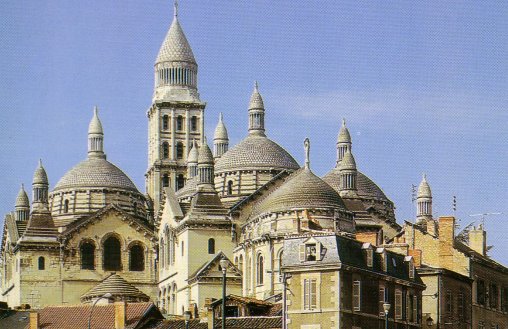
In the heart of Périgueux’s historic district, stands Saint-Front Cathedral

In August 1919 Eliot was still battling with the ideas and the form that would become The Waste Land. In that month he went, with Ezra Pound, on a walking tour of Provence. At one point they separated, Pound leaving to meet his wife. At this stage Eliot made what Matthew Hollis describes in his 2022 book on The Waste Land as a “his defining visit to Périgueux cathedral”. Hollis continues by saying that no account of what happened there is available but that “what is known is that what took place at the cathedral would be a turning point in Eliot’s life”.

The cathedral was dedicated to the legendary St Front, sent by St Peter to preach in the lands of Aquitaine. It was its later history which moved Eliot in some way, perhaps through the example of the powerful convictions of the protagonists of a later story. Provence and Aquitaine became battlegrounds in which Christianity had to confront two separate heresies in different ages, Arianism in one age and Albigensianism in another. 

Bishop Paternus had been deposed as the Bishop of Périgueux in 361 AD for preaching Arianism, the heresy which held that Jesus was not truly the Son of God, and unequal to Him. Paternus, was fiercely punished by St Hilary of Poitiers, known as the “Hammer of Arians”. Hilary proclaimed that to deny the Trinity was not only folly, but  a heresy. In substance Hilary said: To undertake such a thing is to embark upon the boundless, to dare the incomprehensible; to attempt to speak of God with more refinement than He has provided us with; it is enough that He has given His nature through the Trinity of Father, Son and Holy Spirit. “Whatever is sought over and above this is beyond the meaning of words, beyond the limits of perception, beyond the embrace of understanding.”

Hilary was writing in the fourth century but his  language would resonate in Eliot in the twentieth. Eliot now found himself rudderless. It would be more than twenty years until his belief in the Blessed Trinity would flower definitively in Four Quartets. But in the early 1920s he still had many miles to travel. Nevertheless, these early Christian struggles shattered what was left of Eliot’s Unitarian foundations. 

Hollis writes:

In Périgueux, that summer, Eliot was a son separated from the love of a father in death and in life, and had yet to find the guidance of a holy spirit with which his joining of the Church of England in 1927 would allow him to commune. In the chronicles of the building before him, and in his walking conversations with Pound, Eliot could trace the accounts of martyrs and heretics alike who had gone into exile – or gone into the fire – for their convictions or their sins, people who had found a measure to live by and even to die for, who had found a family of higher calling. What had Eliot to offer compared to such commitment? Not the “one great tragedy” of the war in which he was denied a part. Not the daily negotiations at the bank for a treaty that he considered immoral and unjust, and altogether “a bad peace”. Not the wedding vows, taken before God, that seemed to him to have turned to ashes in his hands. He found he had no ideological framework from which to respond. The Unitarianism of his childhood seemed to him a poor man’s fuddle: a culture of humanitarianism, of ethical mind games rather than a passionate adherence to Incarnation, Heaven and Hell… And in the absence of a religious conviction, his writing simply could not bear the weight: regarded merely for its satire and wit, it had yet to find the ground from which to respond to the intensity of the emotions he was experiencing.

Eliot now felt alone. Pound was a kind of Confucian and this meant nothing to Eliot. “There are moments,” wrote Eliot in 1935, “perhaps not known to everyone, when a man may be nearly crushed by the terrible awareness of his isolation from every other human being.” But this religious anxiety filling him at times with a sense of dispossession, of emptiness, turned out in fact to be cathartic, his dark night of the soul.

Hollis interprets it this way: “a dispossession was also an exorcism: a word to describe the purging of demons, as applied by the Catholic Church from as early as its second century: it is a removal of the bad by the good. But that wasn’t exactly what Eliot had said. A dispossession not of the dead but by the dead:  not an action undertaken by him, but one done to him.”

He was now experiencing intimations of Purgatory, something alien to the theology of Unitarianism but surely something which might have remained in his subconscious from Annie Dunn’s prayers for the souls she believed to be in that place for a time. Hollis comments:

What transfixed Eliot in this moment was not heaven and hell, but purgatory, the temporary suffering or expiation for the purpose of spiritual cleansing. “In purgatory the torment of flame is deliberately and consciously accepted by the penitent,” Eliot wrote in his 1929 Dante. He made his own translation of the moment in the Purgatorio in which Dante is approached by souls from the  flames: “Then certain of them made towards me, so far as they could, but ever watchful not to come so far that they should not be in the fire. The souls in purgatory suffer “because they wish to suffer, for purgation”, he wrote, because they wish to be in the fire, because “in their suffering is hope”. 

Dante and Virgil encountering souls in Purgatory

In such a moment of isolation, Hollis notes, Eliot would write in years to come, he felt only pity for the man who found himself alone, as he had, “alone with himself and his meanness and futility, alone without God”. Even later he wrote that to be without the company of God is to be abandoned to the wilderness, to an endless seesaw between anarchy and tyranny: “a seesaw which in the secular world, I believe, has no end”. 

Eliot’s The Waste Land  was, in a way, a journey through Purgatory. Indeed its power to this day may ultimately rest on its character as a grim but hopeful reminder of this supernatural reality believed in by Christians and Jewish people. The Scriptural basis for the Christian belief in Purgatory is the instruction of Judas Maccabeus to his soldiers to pray for the souls of their dead companions.

The three last words of The Waste Land, one word repeated three times in fact, are Shantih shantih shantih. Eliot’s note on this tells us that repeated as here, they are a formal ending to an Upanishad. He adds a translation, “The peace which passeth understanding”, but says that this is “a feeble translation of the content of this word.”

Eliot’s great poem was soon recognised as a masterpiece of the modern world. Eliot took a few more years to reach his shantih in the Christian faith. He did reach it and from that vantage gave English literature more than one magnificent literary work which reflected the spirit of his now Christian soul.

The Journey of Thomas Stearns Eliot

Part One

A cold coming he had of it. First there was the sterile unitarian background of his family in St. Louis. Then there was the rejection by his first love, Emily Hale – even though they became life-long epistolary confidants. Next there was the half-exile in England and the family rancour which his tragic marriage to Vivienne Haig-Wood provoked. Add to all that, living through the terrible war which he had to watch from the sidelines, combined with its aftermath when all the hopes of humanity were painfully drained from European civilisation for decades.

All this fed into his tortured soul and helped produce his most famous – if not his greatest – masterpiece, The Waste Land, in 1922. Within that complicated and mysterious work, however, are early glimpses of a soul emerging from the grim panorama of an apparently decaying and hopeless world. In it intimations can already be felt of the journey he had already unconsciously embarked upon:

Who is the third who walks always beside you?

When I count, there are only you and I together

But when I look ahead up the white road

There is always another one walking beside you

Gliding wrapt in a brown mantle, hooded

I do not know whether a man or a woman

—But who is that on the other side of you?

Of course no reader of Eliot’s poetry – or, he would hold, any genuine poetry – should dare to say what he meant by any given assembly of lines. But that does not mean that they did not mean something.

There is an account of a reading in Oxford in 1929 of the very difficult poem, Ash Wednesday, a kind of confession of faith at the time of his conversion, in which a polite student asked him ‘Please, sir, what do you mean by the line: “Lady, three white leopards sat under a juniper tree” . Eliot looked at him – I hope kindly – and said: ‘I mean, “Lady, three white leopards sat under a juniper tree.” In 1948 Eliot said of poetry,A poem does not say something, it is something”.

Matthew Hollis in his magnificent book on The Waste Land, published in 2022, quotes Eliot as saying “…that in the construction of the poem (and here he paused to spell out precisely what he meant by construction: what he called ‘the mental operation of writing it’) there had been no appearance of an ‘intellectual generalisation’, only mood, variation and associative memory. That may have been keeping his powder dry, but in doing so he rehearsed an increasingly familiar position that no reader should look to an author for meaning, whether or not it stands for a civilisation in decline. ‘It may certainly be what the poem “means”,’ he commented, ‘so long as that is not identified with what the author is supposed to have consciously meant when he wrote it.’  Meaning, in other words, lies at the discretion of the reader”.

Using that discretion is one of the great joys of reading great poetry. It is also one of the keys to revealing the truth which unfolds in our ears, before our eyes and in our hearts through the images, intimations and moods which make up the totality of a poetic work.

But what we glean about Eliot’s journey – and of course we are talking of his journey to the Christian faith – is to be found in more than his verse. Hard facts are not wanting.

We know, for example, that Eliot, in his examination of the legacies of our past, had given much thought to the role of tradition in the religions of the world. Robert Crawford, in the first volume of his biography of the poet, Young Eliot, which takes us up to the publication of The Waste Land in 1922, noted:

He had been thinking more widely, too, about tradition and theology. To innovate, he argued, required consciousness of tradition, even if only to avoid repeating what had been accomplished already. Yet ‘Tradition’ with a capital ‘T’ could be a mere repository of unexamined practices. Strikingly, when reflecting on contemporary poetry in late 1917, he had suggested that ‘for an authoritative condemnation of theories attaching extreme importance to tradition as a criterion of truth, readers should consult a nineteenth-century papal encyclical… Tom’s commitment to avant-garde work by Joyce and Wyndham Lewis accompanied his reading of Catholic theologically-minded philosophers including Father John Rickaby, Cardinal Joseph Mercier (whose Manual of Modem Scholastic Philosophy was published in English in 1917) and Father Peter Coffey on interpretation of the tradition of ‘modern Catholic thought’. Tom belonged to no church. Yet, visiting Anglo-Catholic City churches in his lunch hours, he was conscious of Catholicism as ‘the only Church which can even pretend to maintain a philosophy of its own, a philosophy, as we are increasingly aware, which is succeeding in establishing a claim to be taken quite seriously’.

Thomas Stearns was the seventh and last child of Charlotte and Henry (Hal) Eliot. She was forty- three when he was born. Matthew Hollis recounts how his upbringing was entrusted to Annie Dunn, a nursemaid of Irish parents from Co. Cork, who heated the bath water for Eliot each morning, and whose affectionate presence in the house warmed the space in the young boy’s life that his mother left vacant. It was Annie, said Eliot later, who was his earliest influence, and the household figure to whom he was greatly attached. She took him to school, and sometimes to pray in the small Catholic Church of Immaculate Conception which she attended. There he would delight in the colourful statues, the bright paper flowers and glowing lights. It was with Annie that he had his first conversations about the presence of God. To a young boy of six and seven, her religion was the vivid entertainment that his family’s Unitarianism was not. ‘I was devoted to her,’ he recalled.

Who can measure influence, especially at so young an age? But all truth is not measurable to us and it would be foolish to rule out the influence of Annie on the intimations of mortality – and immortality – revealed later by Eliot. When he showed Gerontion, his pre-Waste Land poem about old age and death to his sceptical friend Ezra Pound, he is also reported to have revealed something of his ongoing wrestling with religion: ‘I am afraid of the life after death,’ he told his friend. A religious anxiety worried him, filling him at times with a sense of dispossession, of emptiness.

Eliot, without apology, ‘borrowed’ from others and from tradition for his own art.

About Gerontion he wrote to Pound: “But I can show you in the thing I enclose how I have borrowed  from half a dozen sources.” Among the borrowings to which he referred was The Dream of Gerontius, a poem by John Henry Newman written in 1865 after his conversion to Roman Catholicism. The poem was set to music in 1900 in a magnificent choral work by Edward Elgar. Newman’s poem follows a life through to death into reawakening before God.

Eliot’s pre Waste Land years were full of influences which laid the foundations not only for his great poem but also for that moment when he discovered that he was “no longer at ease here, in the old dispensation, with an alien people clutching their gods”. But to reach that point his journey had to take him through The Waste Land.

(Posted on Position Papers,  in In Passing)

Part Two next Friday

“Atheism was the centre from which ran out all the mischiefs and villainies” of the French Revolution

EDMUND BURKE AND THE WAR ON THE ORIGINS OF SECULARISM – Part Two

The Goddess of Reason enthroned by the revolutionaries on the High Altar of Notre Dame Cathedral in Paris

Edmund Burke’s battles with what he saw as the malign interpretations in early Protestantism of mankind’s relations with the Creator is the focus of this second part of our reflections on the early life of this great Irishman.

Edmund Burke can be seen as an early warrior in the crucial confrontation of our civilisation with the degenerating phenomenon of secularism. Richard Bourke’s splendid book Edmund Burke: Empire and Revolution  has a much wider focus and constitutes what was   described by the late Seamus Deane, himself a Burke scholar, as “the finest of all books on Edmund Burke”. I hope I can be forgiven for a degree of paraphrasing of Professor Bourke’s words in what follows.

The Catholic influences in Burke’s life are not over-emphasised by Professor Bourke. Nevertheless they were very real and cannot but be taken into account in any assessment of his overall grasp of the Christian faith. The backdrop of the Penal Laws to his life and the lives of many in his wider family, and to his Catholic friends and associates, inevitably had a bearing on what he could write and say. 

The author tells us that Burke’s sister, Juliana, married Patrick William French, a member of a prominent Catholic family from Galway. Burke himself was to marry Jane Nugent, daughter of the Catholic physician Christopher Nugent, based in Bath, whose son is also known to have married a Nagle from Ballyduff. Burke remained on intimate terms throughout his life with Richard Hennessy, the Irish Catholic brandy merchant, whose family had intermarried for generations with the Nagles. His “strong and affectionate memory” of Cork families like the Barretts and the Roches is similarly evident in much of his correspondence.  

We are told how Burke’s intimacy with his Nagle relations first developed during the five years  or so that he spent in the Blackwater Valley, beginning around 1737. Having received his earliest education from his mother and subsequently from assorted instructors, Burke was sent to reside with the Nagles in Ballyduff. He went to school in nearby Monanimy Castle, where he was first taught Latin by a Mr. O’Halloran, the village schoolmaster.  

O’Halloran’s influence shows in Burke’s familiarity with Virgil. In a letter of that time he quotes the classical Master’s tribute paid in the Georgics to “the pathways of the stars and the heavens, the various lapses of the sun and the various labours of the moon”. In a letter to his lifelong friend from his school days, Richard Shackleton, revealing a Christian sense of wonder, he wrote:

“What grander Idea can the mind of man form to itself than a prodigious, glorious, and firy globe hanging in the midst of an infinite and boundless space surrounded with bodies of whom our earth is scarcely any thing in comparison . . . held tight to their respective orbits. . . by the force of the Creator’s Almighty arm.”

In a debate in Trinity in 1749, talking about the Sermon on the Mount, he spoke of how the Christian religion marked an advance on heathen morality by educating the feelings of the heart, perhaps sensing the same idea embraced in John Henry Newman’s wonderful phrase, “heart speaks unto heart”.

Burke’s friend, Richard Shackleton, was a committed Quaker coming from that famous Ballitore family whose school Edmund attended before Trinity, also in the company of Richard. The author notes how Burke was aware of the “Different Roads” towards Christian truth which both he and his friend earnestly pursued, and reflected on the “melancholy” fact that there existed “Diversities of Sects and opinions among us.” He lamented the reality of Christian disunity.  

For Burke, the author notes, toleration among Christians was a mark of piety, although his attitude to infidels was another matter. His hostility to atheists would reach a crescendo in the 1790s in connection with the French Revolution: “Atheism,” he said, “was the centre from which ran out all their mischiefs and villainies.” Beginning in the 1790s, he vociferously denounced the “enlightened” ideals of the Revolution. His intention was to ridicule the presumptuousness of natural reason and the pretensions of moral philosophies based on hostility to organised religion. 

The shadow of the “wars of religion” of the 17th century, not to mention the Irish rebellion of 1641 and the Cromwellian aftermath loomed large over the thinkers of the early 18th century. For many, religion was a malign force and they looked for ways to remove that malignity. For others that was a false road to peace and simply reflected a total misunderstanding of what the Christian religion was about.

Professor Bourke explains: While toleration… seemed to him a basic ingredient of the Christian message, he thought the dogmatism of sceptical deists promoted persecution. It was a common refrain among polemical deists that religion was a source of bigotry, leading inexorably to sectarian prejudice and strife. Burke accepted  Bishop Berkeley’s inversion of this formula:

“Christianity was a morally emollient system of belief. Religion was commonly a pretext of animosity, but never its fundamental cause…the identification of blind fury with religious piety by sceptics was the product of a pernicious brand of fanaticism.”

In formulating his approach to reconciling the worlds of faith and reason he argued that eighteenth century irreligion replicated the same tendency and could only provoke more conflict. The deist project to realise the “freedom of philosophy” nurtured an uncritical belief in the oracles of  reason. With this certainty came contempt for the utility of social habit, and disregard for the natural moral sentiments of mankind. 

Burke saw no alternative but to take on the radical sceptics and deists who were hell-bent on not only denuding religion of all meaning and value, but on destroying civilisation in the process. One of the targets of the sceptics was the destruction of the idea of mystery in religion and the elevation of pure reason as the only source in which mankind could find the answer to the meaning of life.

Burke argued, according to Professor Bourke, that while the foolish might expect that they could penetrate metaphysical secrets, the wise were struck with awe in contemplating the operations of the universe. Burke settled on this perspective after an extensive study of theology. In the process he came to doubt the powers of pure reason. This did not imply a rejection of the utility of rational inquiry. It meant instead that Burke accepted the limitations on human knowledge.

Burke’s weapon of choice was a polemical and satirical tract entitled A Vindication of Natural Society in which he attempts to expose the limits of deism. To some it was confusing, missing the satirical thrust of the work – because it is not at all a “vindication”. It is an attack on religious scepticism as publicised by men like John Toland, Anthony Collins, Matthew Tindal and Viscount Bolingbroke. 

From it, if read accurately, Professor Bourke says that Burke emerges as a figure keen to credit natural sentiment and convinced of the ongoing bearing of divine providence on human life. The immortality of the soul and promise of an afterlife were essential  to his conception of providential theodicy.

He saw the work of those authors as a pernicious attempt to barbarise and denature man. In their different ways, Thomas Hobbes, the third Earl of Shaftesbury, Anthony Collins and Bernard Mandeville had variously contributed to this process. In their hands, the ancient schools of philosophy had been resuscitated and debauched in the service of a dogmatic assault upon religion. 

For Burke the style of reasoning of these writers dismantled the foundation of all belief. Its influence would lead to the elimination of Christianity as well as to the destruction of society in general. 

In the 1750s, Burke challenged the deists’ denial of providence which he saw as something driven by a determination to annihilate mystery. In the process this threatened to dissolve all confidence in society, and everything that supported benign credulity and civilisation.  

One of them had declared “Where the mystery begins, religion ends.”

For Burke mystery could be credited in the absence of demonstration on the basis of reasonable faith. The idea of reasonable faith implied degrees of probability extending from moral certainty to extreme implausibility. For him, Christian revelation, while not a mathematical certainty, nonetheless commanded our assent. Although the content of scripture was often miraculous in nature, its credibility could not reasonably be doubted.  

Edmund Burke’s political thinking, his un-ideological and common sense approach to the way we can best organise the business of statecraft, is now at the heart of the thinking of many who are opposing the dying but still poisonous progressive liberalism that has infected our public squares.

But much of Burke’s clear-sighted analysis of the attacks on religion in his time – and what, prophetically, that to which he saw them leading – can still also be of use to us in our ongoing conflict with the secularist movement of our time with all its crazy progeny. 

(First published in print and online in Position Papers)

Next Week: The Journey of Thomas Stearns Eliot – Part One

EDMUND BURKE AND THE WAR ON THE ORIGINS OF SECULARISM

Part One

The forward march of secularism may seem to be a relentless one. It is. But we should also observe that it is a pointless one. A march to nowhere. Secularism and its deformed progeny, the so-called secularist world, have been well analyzed in its roots and progress by Charles Taylor, Brad Gregory and others in recent years. There is no question but that it has been a destructive force in our civilization, masquerading as benign progress. Taylor and Gregory note its origins in the corruption of the Christian faith dating back to the Reformation and beyond.

But it is not a triumphant force and champions of Christianity have been opposing it for centuries with their robust allegiance to its dual enemies, faith and reason, ever since it appeared among us in either its nascent or full-blooded incarnation.

For both Taylor and Gregory the gradual flowering of this weed emerged with what Taylor terms the disenchantment of religion following the Protestant Reformation and the emergence of the illusion that reason alone had all the answers. In its most viral form religion itself, for Protestant “influencers,” became a solely rational thing and faith, if it did not satisfactorily answer all the questionings of reason, was but a fanciful thing.

But the voices which have resisted the removal of the element of enchantment from religious consciousness over the centuries have not been vanquished and never were. They were there when the first sceptical utterances began to emerge in the seventeenth century and then reached something of a crescendo in the eighteenth, morphing into deism and outright atheism. In the nineteenth century the great John Henry Newman exposed the inevitable consequences of the liberal mindset of his age, and in the twentieth and twenty-first centuries his thought has proved an important part of the foundation of the powerful encyclicals of Pope John Paul II and Pope Benedict XVI defending the truth about mankind and our destiny.

From the secular world itself, in the twentieth century, the voices of G.K. Chesterton, T.S. Eliot, C.S. Lewis and many more spoke up for the truth of Christianity, exposing once again the folly of men who say in their heart, “there is no God.” Ross Douthat of the New York Times very recently drew our attention to a reality that secularist triumphalism wants to ignore:

Yet for Christianity, the modern era is actually two stories intertwined: a story of conflict and failure and disappointment for many Christian institutions, their division and their weakness in the face of other powers, woven together with the story of the Christian religion’s resilience and global spread. Whether or not liberal modernity represents a “metaphysical catastrophe” (to pluck a phrase from one of its eloquent religious critics), it has created a world civilization in which the Gospel has been preached in the far corners of the planet; in which there are today, according to one study, 2.6 billion Christians; in which, amid a long-running crisis for Western Catholicism, more young Catholics attended the just-completed World Youth Day in Portugal than inhabited all of medieval Rome and Paris and London put together.

Back at the beginning of what Brad Gregory calls the “unintended reformation,” the very existence of Christian faith in the anglophone world was, either intentionally or unintentionally, under attack from thinkers nurtured in Protestantism – Bacon, Hobbes, Locke. Later, and more virulent, in the seventeenth century, came Bernard Mandeville, Viscount Bolingbroke, David Hume, and a host of others displaying various brands of scepticism, deism, and atheism. But there were voices of opposition, and among these one of the most powerful was Edmund Burke’s. Burke is probably the Irishman in history who has had the greatest influence on mankind’s efforts to organise the world in a civilised way for the betterment of humanity. The only competitors I can think of would be the Irish missionaries of the early Middle Ages – people like Saints Columbanus, Gall, Columba, Killian, and others who brought Northern Europe back from the brink of barbarism.

But just as it is impossible to engage with the modern literary world without knowing and understanding something of the work of James Joyce, Yeats, and Beckett, so it is impossible to engage with the great political debates of our time without knowing Edmund Burke and the influence he has had on political thought over the past 250 years. Burke is best known for the four great causes he espoused on behalf of mankind throughout his political career. These were firstly his search for justice for the people of the Indian subcontinent, victims of the East India Company operating under the protective umbrella of the British Empire. Secondly, there was his futile effort to try to rein in the folly of the British monarch and parliament in their trampling on the civil rights of the citizens of New England. Thirdly, there was his constant effort to ameliorate the lot of Catholics in Ireland and Britain, persecuted as they were by the Penal Laws passed by the English parliament in the early 1700s. Finally there was his resistance to the influence of the revolutionary forces unleashed in France in 1789 which he saw as a force which could destroy all religion and as a consequence the wellbeing of humanity itself.

But to understand Burke and everything he stood for we have to go back to his early years and the first great cause he undertook – his defence of religion, faith, and reason in the face of the enemies we have referred to earlier. This phase of Burke’s life has rarely been examined in much detail. Those four great causes have overshadowed the early part of his life. Yet it is crucial in understanding the man and everything for which he stood.

In 2015, as I think never before, Burke’s early years in Ireland, even his childhood and adolescence, his time in Trinity College Dublin, his move to London to study law, his early writings, and his preoccupations with religion and philosophy, were masterfully dealt with by Professor Richard Bourke in his book, Edmund Burke: Empire and Revolution. Bourke covers this ground exhaustively. However, as his title suggests, the main focus of the work, just short of a thousand pages, is Burke’s more global preoccupation.

Not only, however, is his life and thinking in those years of interest in the context of what Conor Cruise O’Brien referred to as “The Great Melody,” the title of his biography of Burke. They also represent a fifth great cause to which Burke vehemently lent his not inconsiderable powers of persuasion – the cause of religion.  Burke was intensely conscious mankind’s dependence on religion for the future of our civilisation, threatened by what we now see were the poison seeds of secularism.

Professor Bourke, with great subtlety, sets Burke’s Protestant faith in the context of the Penal Laws: his father’s pragmatic conversion, his mother’s under-the-radar Catholicism; his close relations with his mother’s up-front Catholic family, the Nagels of Ballyduff in Cork with whom Edmund lived and was schooled during some of his childhood years; his schooling up to the age of fifteen in the Shackleton Quaker school in Ballitore; his years in Trinity where he developed his debating skills and his theological sensibilities which became the armour and armament for his battles with the skeptics, deists, and atheists of his time; finally, his early years in London studying law.

In part two of this article we will look at how Professor Bourke explores those early years and how Edmund Burke confronted what he saw as the malign interpretations of mankind’s relations with the Creator in early Protestantism.

Part 2, THE DELUSION OF ‘SECULARISM TRIUMPHANT’, next Friday.

(Posted on Position Papers on )

A conversation resumes – because hope springs eternal…

I have been encouraged to return to my efforts to make some conversation on my trusty blog, Garvan Hill. I have not been silent but I have neglected posting to GH. Health issues can be a conversation-stopper in more ways than one. Medical professionals have been paying more attention to me over the past year and as you may know, that means consuming large chunks of available time. I am resolving now not to let them take any more from Garvan Hill. Don’t be concerned. I’m well and I’m grateful for all their attention – because they are keeping me well!

As I said, I’ve not been idle and have kept up writing a monthly In Passing column for Position Papers. I had just neglected to post the content of those columns to my loyal readers via Garvan Hill.

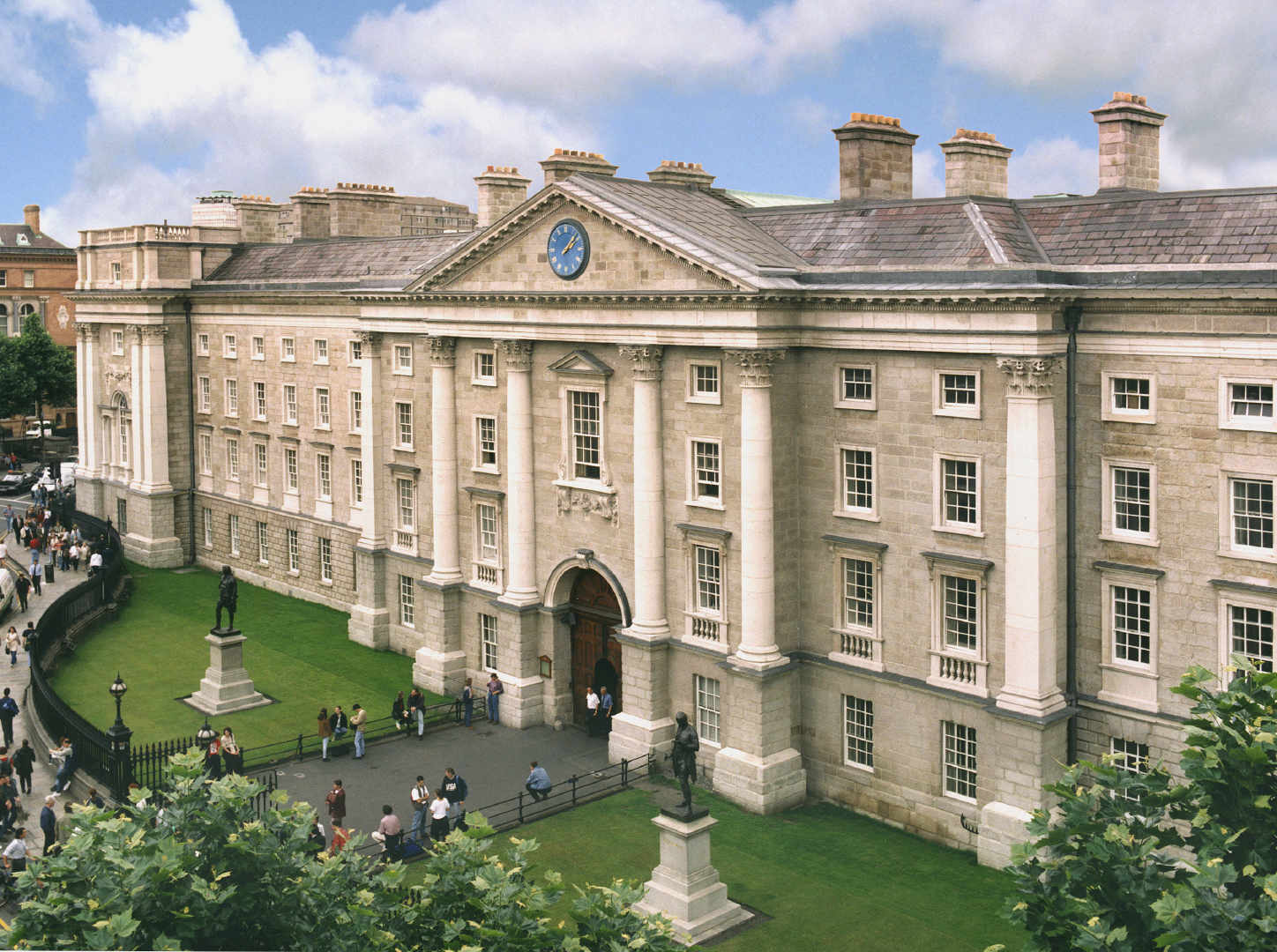
This is the service which I now hope to resume, beginning this week with the first of two pieces on that great and noble Irishman, Edmund Burke. Burke’s image – his statue at the entrance to Dublin University on College Green – has been gracing the masthead of Garvan Hill for a few years. On either side of the entrance to Trinity College stand two larger than life (I think) statues of two of its 18th century graduates, one of Burke and the other of his friend, the gentle Oliver Goldsmith.

Please do not be hesitant about engaging with me in this effort to make conversation. Life is more interesting when you are not just talking to your self. I try to put links to Garvan Hill on Facebook, X (formerly called Twitter), LinkedIn and other platforms.

‘Looking forward to hearing from you.

Michael

Glimpses of the personal and spiritual universe of Christopher Nolan

Part Three: Christopher Nolan and the real power which will change the world

All of Christopher Nolan’s films to date carry within them at least two levels on which one can enjoy and appreciate them. Each and every one of them works on the level of entertainment. Even if, as with Memento, and to a degree with The Prestige, they keep us asking “What the hell is going on?” We remain hungry to get and answer.

When Nolan was a kid he first saw Stanley Kubrick’s 2001: A Space Odyssey.

 “I think I had been warned that it wasn’t going to be like Star Wars, but when you look at the Discovery passing, each one of those miniature shots was deeply fascinating to me. It’s just such a primal atmosphere – the bit in the beginning with the cheetah, his eyes glowing, the image of the star child appearing on the screen at the end, and being baffled by it, but not in a frustrated way.  There’s a level of pure cinema, of pure experience that’s working there. 2001: A Space Odyssey is the movie that first showed me that movies can be anything”.

Nolan knows that whatever mysterious scenarios he gives us, they will stand or fall on whether or not they entertain us. With the majority of us they do – the box office is evidence enough of that. But that is not all they do. Nolan does not tell us what to think or what we should think, but if we pay attention to what he is doing they will make us think, and perhaps think even as deeply as he does.

Three of his films are deeply personal. A fourth is also so but in a different way from the other three. This is his study of the heroism of which ordinary people are capable. In it he is retelling a version of an epic event which none of us should ever forget – the evacuation of Dunkirk in 1940. That event has a special resonance for Nolan. His grandfather Francis Thomas Nolan was a navigator on a Lancaster bomber and was shot down over France in 1944, after surviving forty-five previous missions.

Of the dramatic final scene in Dunkirk, Nolan says:

“That scene at the end is a very important moment to me and one that I really wanted to make work. I think because of the absence of overt heroics elsewhere in the film, it packs an enormous punch…I don’t think it would have been possible for me to portray a World War II pilot in anything other than heroic terms. World War II was always something that was incredibly important to my father. He used to tell me stories about the air raids. So that was very much a part of my dad’s history that he would relate to us, and so, while it wasn’t something I was conscious of at the time, when I look back on it, I feel like inevitably at some point I was going to want to tell a World War II story in some way.”

However, it is in the three science fiction works which he has directed that we really enter deeply into the personal and spiritual world of Christopher Nolan.

The relationship each of us has with our dreams puzzles all of us.  We find ourselves asking about our dreams,  “Where did that come from”. Dreams have always featured in literature, art and cinema since its beginnings. It is not for nothing that Hollywood is known as ‘the dream factory’. 

A list of dream themed works of art could begin with the  great and beautiful  medieval religious poem, The Dream of the Rood, down through Kubla KahnAlice in WonderlandThe Wizard of Oz and now into Nolan’s puzzling and magnificent adventure, Inception

The origin of Nolan’s Inception goes back to his school days and has had many different forms. It finally came together and took its final shape as a story about the abiding power of family and  the dangers of dream-induced delusions which threaten and often succeed in destroying lives.  In approaching Inception – I would not dare attempt a synopsis – what we need to realise is that Nolan is not attempting to give us a treatise on dreams but is simply using the powerful imaginative dream scenario he creates to help us keep our feet on the ground.

After the success of The Dark Knight the family went on holiday to an island off the Florida coast. He watched his youngest sons, Rory and Oliver, making sand castles. That image was enough to trigger and reignite the whole project and is in the heart of the movie. He came home, dug out the draft ideas he had been working on seven or eight years earlier. This time he said, I think it will work.

“It was like, Oh, of course, and then I finished the script very quickly after that. The script finally worked, because suddenly you understood the emotional stakes. I hadn’t known how to finish the script emotionally. I think I had to grow into it.”

The permanent values of family, children, love for the real precious world over any delusional forms which may attempt to draw us into their web, even the memories of loved ones no longer with us, is what Inception is about.

Interstellar does not take us too far from the same territory. Its origin story is remarkable and involves his long term musical collaborator, Hans Zimmer, and a conversation about fatherhood which they had in a London restaurant. After the conversation Nolan asked Zimmer to compose a theme for him on that very topic. He brought it to Nolan some time later. Nolan liked it and then said, “I suppose I’d better make the movie now.” A bit bemused, Zimmer replied, “Well, yes, but what is the movie?” Nolan then gave him a synopsis of his epic conception of our fight for survival in the face of the ‘end times’. Now bewildered, Zimmer protested, “Chris, hang on, I’ve just written this highly personal thing, you know?” “Yes, Nolan replied, but I now know where the heart of the movie is.”

He suggests that Interstellar can be read as a ghost story. “That notion of the parent as a ghost of the child’s future. That was in the fable that I gave him (Zimmer), because I wanted him to write music that was the emotional heart of that story. It’s about the parent revisiting the child as a ghost, and struggling to then be free.”

“I very much related to the dilemma of somebody who is having to go off and do this thing, leave his kids, whom he dearly wants to be with, but really wants to go do this thing,” he says. “My job is something that I absolutely love. I consider myself unbelievably lucky to do it, but there is a lot of guilt involved in doing that – a lot of guilt. I have a daughter who is the same age as the character…As my kids were growing up, I had this desire to hang on to the past. You become quite melancholy about how fast it’s going. All parents talk about it, all parents experience it. So Interstellar came from a very personal place.

“Interstellar comes down very firmly behind the idea of the emotional connection between people. That’s why I wanted the Dylan Thomas poem.

‘Rage, rage against the dying of the light.’ That is exactly what I’m talking about. You rage because the lights are dimming. Time certainly is the enemy, quite specifically so in Interstellar, an insidious force, one that can play tricks on you. I don’t think there was ever any question that I could or would let time win. For me, the film is really about being a father. The sense of your life passing you by and your kids growing up before your eyes. Very much what I felt watching Richard Linklater’s Boyhood, an extraordinary film, which did the same thing in a completely different way. We all deal with this. There is a positive side to it. I think that’s where some of the optimism in the film comes from.

A sticking point for Shone was what he considered a deus ex machina in the plot. Five dimensional beings play a key role in resolving the pain and problems of the astronauts and Cooper. For Shone these pass all understanding and do not ring true. I think that this is possibly where the world view of both men encounter irreconcilable difficulties and the impact of Nolan’s Christian/Catholic upbringing shows itself. Although he confesses that he is not a practicing Catholic, clearly the resonance of Christian belief is there.

Shakespeare may or may not have been a practicing Catholic. But there is little doubt that all his sensibility was Catholic. It was probably no easier to be one in his age than sadly it might be for a busy Hollywood director in our age. Nevertheless, Shakespeare had no problem dramatically getting Hamlet, encountering his father’s ghost, to call on Angels and ministers of grace to defend him! 

Nolan responds to Shone’s skepticism: 

“I think you’re missing the narrative point, which is that jumping into black holes is the ultimate act of faith.” Cooper is caught by creatures who you know exist, and you’ve been wondering who they are for the entire film. Who are they? 

It’s first said in the first act. It’s all up front.

Who put the wormhole there? And so they’re not a deus ex machina; they’re specified right from the beginning, whether you like it or not.” 

Nolan grew up knowing about the reality of divine providence and the existence of angels, good and bad. Interstellar gives you all that – and much more – to think about.

Finally there is TENET, the ‘troublesome’ one. But it is not troublesome. On one level it is a superbly produced spy story to match the experience of watching the most sophisticated pyrotechnics of the best Bond productions. However, that is not its real value. There are two strands running through the story.

The first is probably a sad reflection on the troubled conscience of Robert Openheimer, the subject of Nolan’s latest film, the genius behind the Atomic Bomb. Nolan read about  the wrangling of those people with this thing they unleashed. “How’s that going to be controlled? It’s just this most monstrous responsibility. Once that knowledge is out there in the world, what can you do? You can’t put the toothpaste back in the tube.” 

He further reflects on how he grew up in the postnuclear age. “We’ve grown up in the shadow of the ultimate destructive knowledge… To know something is to have power over it, generally, but what if the reverse is true, if knowing something gives it power over you?”

TENET is about two forces imagined to be from the future, the one trying to get control of the ultimate algorithm for ‘inversion’ – Nolan’s imagined invention – which can turn the world upside down, inside out, The other trying to negate it.

“To know its true nature is to lose,” says Dimple Kapadia’s character. “We’re trying to do with inversion what we couldn’t do with the atomic bomb – uninvent it. Divide and contain the knowledge. Ignorance is our ammunition.”  How prescient was Nolan in this, now that we are all worrying about what that force – which just a few years ago was in the future and is now present among us – Artificial Intelligence.

The second strand in the story is the battle Kat (Elizabeth Debicki), the villain Sator’s estranged wife, is fighting to  get back her son who is being kept from her by her husband. 

The denouement of the film requires you, I think, to again accept Nolan’s understanding that there is ‘a divinity that shapes our ends, rough hew them how we will.’

At the end of TENET, John David Washington’s Protagonist looks on as Kat meets her son at the school gate. The Protagonist’s professional partner, Neil, (Robert Pattison) in a voice over says mysteriously,

“…but it’s the bomb that didn’t go off….the danger no one knew was real…”

He then adds, again somewhat mysteriously, as the Protagonist, whose name we never know, watches Kat and Max walk away and the boy offers his mother his hand, 

“That’s the bomb with the real power to change the world.” 

What ‘bomb’? Motherhood? Family? Selfless human love and affection?

TENET grossed $58.5 million in the United States and Canada and $306.8 million in other territories, for a worldwide total of $363.7 million. With a production budget of $200 million, it is Nolan’s most expensive original project. Its relatively poor performance must surely be partly attributed to its untimely release to cinemas just as the pandemic panic was fading. 

Its complexity is a bit daunting but it is well worth the effort required to dig into that complexity.

Christopher Nolan’s Dark Knight trilogy and the meaning of heroism

Part Two  of a three part series, examining the work of film director Christopher Nolan.

Each one of Christopher Nolan’s films is about much more than it seems to be concerned with on the surface. After Memento Hollywood was probably still thinking of it as a flash in the pan. They showed little interest in offering him a remake of a Norwegian original they had in their sights for adaptation and which he was pitching. Eventually, with the help of Steven Soderberg and George Clooney, they relented and he got the job, which involved the intimidating challenge of directing Al Pacino, Robin Williams and Hilary Swank – all of whom had already won Oscars. The result was Insomnia. On the surface it is a thriller about hunting down the killer of a teenage girl in Alaska but under the surface it is a probing examination of the troubled conscience of the cop (Pacino) whose tragedy is the heart of the story. The sleepless condition of the cop in ‘the land of the midnight sun’ has all the echoes of Macbeth’s troubled soul as he cries out for a merciful sleep that is now denied him.

Insomnia grossed more than $113 million worldwide against a production budget of $46 million. The film received critical praise and after that there was no more hesitation in Hollywood. He tells it like this.  “I got one of those calls, like ‘You wouldn’t be interested in this, but, you know, nobody can figure out what to do with Batman,” he recalls. But he was interested and immediately pitched to them what he could do with Batman.

Batman Begins was born in that moment and changed the fortunes of the superhero genre forever – well for at least two decades.

“I didn’t want to treat it as a comic book movie. Everything we did was about being in massive denial that there was such a thing. Batman Begins and The Dark Knight go to massive lengths to do that. By the time we got to The Dark Knight Rises, there indeed was a superhero genre – The Avengers came out the same summer and then it grew and grew after that.

“The superhero genre as it exists now, that’s just a given. At the time, we were simply making action films that aspired to stand alongside any kind of action film. We were trying to make epics.”

The trilogy is not part of the superhero genre as we now know it – and perhaps loath it – but it created the space for that genre’s resurrection, for better or worse.

I have found no comments by Nolan about Todd Phillips’ The Joker. I think that figures. Phillips’ The Joker is the character’s origin story. Nolan’s Joker has no explicit origin story. We just know that he is a ‘Lord of Misrule’ and master of Chaos with echoes straight from Milton’s Paradise Lost

Nolan is very personal when he talks about the character.

“He’s just ‘I’m just going to tear it down because f**k it.’ He doesn’t even care about why he’s doing it. He’s that out there. It’s a very real force of human nature, and it’s not one that I have. I’m afraid of that in myself. I’m afraid of that side of human nature. 

“The Joker is what I’m afraid of more than anything, more than any of the villains, these days particularly, when you feel civilization is very thinly lined. All three films, we did with a real truthfulness of our intentions. What do we worry about? What am I actually afraid of? What’s the worst thing the villain could be doing? I don’t have that anarchic impulse, I really don’t. I’m much more controlled. I’m afraid of that in myself. I feel like I carefully used it as the engine of the movie, but I was afraid of it the whole time I was making the film.”

Nolan is very conscious of mankind’s capacity for corruption and has talked about how heroes can easily turn into villains.

“Watching Lawrence of Arabia with the kids at the weekend, and it absolutely presents Lawrence as this vain, false icon, but what people take away is the iconography. That scene where he goes back for the guy in the desert, it’s an amazingly rousing moment. Afterward, they give him the robes and he becomes this icon.  That moment feels sincere but afterward you see him admiring his reflection in the blade of his dagger.”

In this Nolan clearly sees the seed of pride and vanity seeping into the soul of a character who might have been a great man but ends up being corrupted by the first of all the deadly sins, the sin of Satan himself.

“A lot of great films are like this. The Dark Knight films absolutely believe in heroism, but what they say is, true heroism is invisible. That’s the kind of heroism that people aspire to but almost never live up to, in my experience.” 

Nolan emphatically does not want to be read ideologically. But that does not mean that he is someone sitting on a fence.

“I’ve had conversations with friends of mine and am asked about why I don’t make a film about the things I care about politically and I always say, ‘Well, because it doesn’t work.’ You can’t use narrative to tell people what to think. It never works. People just react against it… It doesn’t mean you don’t care about something, or that it doesn’t mean anything to you, but you have to be neutral or objective in your approach. You can’t tell people what to think; you can only invite them to feel something.“

We come back here to Nolan’s instincts.  Benign humanitarian instincts – are the underlying framework for the values in all his films. The trilogy ends with a quotation read over an empty grave. Alfred reads the last words of Sidney Carton from A Tale of Two Cities of which The Dark Knight Rises is essentially a retelling. 

The self-sacrifice of Carton, one of the most inspiring acts of heroism in literature, is replicated in the heroism of a flawed Bruce Wayne. ““It is a far, far better thing that I do, than I have ever done; it is a far, far better rest that I go to than I have ever known.”

Ross Douthat of The New York Times wrote:

“Across the entire trilogy, what separates Bruce Wayne from his mentors in the League of Shadows isn’t a belief in Gotham’s goodness; it’s a belief that a compromised order can still be worth defending, and that darker things than corruption and inequality will follow from putting that order to the torch. This is a conservative message, but not a triumphalist, chest-thumping, rah-rah-capitalism one: It reflects a “quiet toryism” rather than a noisy Americanism, and it owes much more to Edmund Burke than to Sean Hannity.”

Released on July 18, 2008, The Dark Knight took in $238 million in its first week, $112 million in its second, $64 million in its third, before receiving boosts from overseas as it opened in England, Australia, and the Far East. By October, it was closing in on $1 billion. Then it leveled out, but slowly playing in theaters right through until March of the following year, when it received the further boost of eight Oscar nominations. The Dark Knight Rises also topped $I billion.

Which all goes to show that a mass audience is not necessarily an alien arena for ideas and serious exploration of values when a team of artists and competent technicians – very competent – present them to us. Nolan’s ensemble is just such a team.

End of Part two

CHRISTOPHER NOLAN AND THE QUEST TO UNDERSTAND

This post, the first of a three part series, examines the work of film director Christopher Nolan.

TENET was Christopher Nolan’s eleventh feature film, released to cinemas on the reopening of theatres after the pandemic restrictions were lifted in the US. Like other Nolan films – but even more so – it left many audiences scratching their heads with its very challenging interpretation of our relationship with time, space and technology. Nolan takes no prisoners when it comes to making demands on his audience. His motto is no less than this: “The only thing you can do is trust your initial instincts. You just have to say ‘This is what I’m making. This is what I’m doing. This is why I wrote this script.’ It is going to work. Just trust it.”

In all eleven films, not one of them has failed to repay that trust for anyone who really takes his oeuvre seriously. In a certain way, for anyone who places that trust in Nolan’s instincts, every one of explorations – for that is what they are – replicates the history of his first Hollywood release, Memento.

Tom Shone, in his fascinating study of Nolan, built around occasional interviews with him over practically the entire span of his career, tells the story of Memento’s creation and release.

Memento is a story, told backwards, of a man who after an assault in which his wife was murdered, has lost his short term memory. He is now hunting the perpetrator of the crime. 

After two years pitching Memento to studios and distributors, eventually getting it filmed grudgingly, it was finally released into eleven theatres. It took in $352,243 in its first week. Then word about it got around and in the second week it was in fifteen theatres, where it took in another $353,523. 

Among the distributors who had initially turned the film down, Shone tells us, was Harvey Weinstein’s Miramax. Smelling the coffee they then tried to buy the film. But now, in its third week, it was in seventy-six theatres, taking in $965,519. “Miramax could only watch as the film took off, spending four weeks in the top ten, sixteen in the top twenty, eventually playing in 531 theatres, a larger number of venues than even Jaws played in during the summer of 1975.” The film eventually made £40 million and got two Oscar nominations. They were a heady two years for Nolan, his brother Jonathan who had collaborated with him on the film, and his wife Emma Thomas who became his long-term producer.

After that came Insomnia and with that Hollywood’s “trust” in Nolan’s instincts – helped by his own canny and careful playing of the whole Hollywood machine – was no longer much of a problem. It just became a story of onwards and upwards. The next decade and a half saw this team making such blockbusters as Batman BeginsThe Dark Knight (2008), Inception (2010), Interstellar (2014), The Dark Knight Rises and Dunkirk (2017), between them earning $4.7 billion worldwide.

Michael Mann (HeatThe Last of the Mohicans), one of the dominant directors in Hollywood in the 1990s, says of Nolan, “He works within the system here in a very commanding way. He has large ideas. He invented the post-heroic superhero. He came up with an idea for a science-fiction heist inside the moving contours of a dreaming mind and he had the boldness and audacity to have that singular vision and make it happen. I think that the reason he has such a great response and great resonance with people is because he operates very much in the present, in the now. He’s tuned into the reality of our lives, our imagination, our culture, how we think, how we try to live. We’re living in a post-modern, post-industrial world with decaying infrastructure. Many feel disenfranchised. Seclusion is difficult. Privacy is impossible. Our lives are porous. We swim in a sea of interconnectedness and data. He directly deals with these intangible but very real anxieties. The quest to understand that and to tell stories from there, that is a central motivator for him, I think.”

The late British director Nicolas Roeg (Walkabout) said Nolan worked in the commercial arena and yet there’s something very poetic about his work. They’re marvellously disguised. Memento has this backward-running time scheme, and yet you automatically find yourself applying the situation to oneself, to one’s daily life, which is very strange.”

“Poetic” is a key element in Nolan’s work and this reflects the influence other poets of cinema and one great poet of the twentieth century have had on his work.

Echoing something that Michaelangelo is supposed to have said, Nolan maintains that “I’m definitely a subscriber to the school of thought that when the writer is working, or the filmmaker is working, it’s because you’re uncovering something, like the sculptor carving something away because it was always there.”

Nolan feels that what he does “is based more in artifice and abstraction and theatricality. I feel more of a craftsman than an artist…. I think there are filmmakers who are artists. I think Terrence Malick is an artist. Maybe it’s the difference between saying ‘are you using it to express something purely personal, that comes from inside that you’re just trying to get out there, or are you trying to communicate with people, and tap into their expectations and their experience.’” 

I doubt this distinction. Nolan and these film-makers are both poets and artists – or as Andrei Tarkovsky would have put it, “sculptors in time”.  For Nolan, Malick’s The Thin Red Line is one of the best films ever made. Tarkovsky’s Mirror was one of the influences, particularly in its theme of parent-child relationship, in the making of Interstellar. The only difference between Nolan and other great artists sculpting in time is that he can draw mass audiences to his work.

One of the most impressive things about Nolan as a person is how he never loses sight of the really essential things about our life in this world. 

He observes that “The Prestige was an important film in terms of work-life balance because we’d just had our third child and Emma, even though she loved the project, was quite keen to step back and not be as involved. She wanted to be able to take more of a backseat.” In fact she did not need to. They worked it out as a family. The Prestige was about two obsessive Victorian magicians who ruined their lives and their families because of their obsession. Everything that Nolan – or I should say the Nolans – has done connects with life and living our lives in this world.

Family again became an issue while making The Dark Knight. “The family were around for an enormous amount of the film, but Emma was pregnant with Magnus at the time. The last two months, I think, I was in England, finishing the film, and they had to be back here. I was able to be present for Magnus’s birth; I flew over, but I had to go right back to England and carry on the film. I spent about two months there. To this day, I think that’s the longest I’ve been away from them. I remember thinking, I know it’s more fun when we’re all together and we can do the thing together. That’s why we keep it as a family business. We were learning how to balance those things.”

Nolan communicates with his audience on the basis that it knows the truth: the world is simple. But it also knows its miseries. He sets out to make them wonder at that dichotomy. It would be depressing – if one were to go down Sartre’s existential rabbit hole. He doesn’t. “The reason it’s not”, he says, “is we want the world to be more complicated than it is. It’s pleasurable, because what it’s really saying is there’s more to this place than meets the eye. You don’t want to know the limits of your world. You don’t want to feel this is all there is. I make films that are huge endorsements of the idea that there’s more to our world than meets the eye.” 

That is exactly what poets try to do. 

T. S. Eliot has been one of the poetic and cultural influences in his life. Referring to Four Quartets, Eliot’s very Christian masterpiece about time and memory, he reflects, “I come back to that one a lot: 

Footfalls echo in the memory  

Down the passage which we did not take  

Towards the door we never opened  

Into the rose-garden. 

“It’s very cinematic. All of Eliot is. I think I first encountered Eliot through  Apocalypse Now, where Brando reads parts of The Hollow Men. When I first watched that film, I was so fascinated by that sense of madness and enigma. Then later I read The Waste Land, which absolutely confounded me. I love that poem.”

Nolan’s family and educational background is Catholic and Christian. He attended a thoroughly Catholic prep school run by Josephite priests, who ran a series of seminaries and boarding schools as far afield as the Democratic Republic of the Congo. That was followed by pre-university years boarding in an up-front Anglican high school. 

“At the time, it’s like you’re a bunch of kids and they’re the enemy,” says Nolan. “It’s like they’re trying to make you take it seriously and praying, and you’re sort of naturally reacting against that, not in any intellectual way or anything, but I come from that era, the seventies, when there wasn’t any doubt in anybody’s mind that science was supplanting religion.”

Significantly he adds, “Of course, now I’m not sure that’s the case. That seems to have shifted somewhat.” A transition in faith not unlike that of Eliot himself.

In the next post, I hope to look at some of the work Nolan has left us with so far, and in particular to show that those who find themselves bewildered by aspects of it should not be. But before we do that, we need to clarify one thing about Nolan’s use of images and concepts from science in the unfolding of the metaphors with which he shows us the world in which we live, or, scarily, might live. 

In The Divine Comedy, Dante describes Hell, Purgatory and Heaven to us in images created by him using the analogies available to him and his readers in his time. Both he and they knew that those supernatural realities were nothing, are nothing, like his description of them. His visions of them, however, still help us to understand our flawed nature, who we are and what may be in store for us in eternity. 

Nolan, in the imagery he offers us which asks us to think about time, space, the workings of the human mind does not purport to be anything other than reasonably consistent approximations of the science of those things. They are not scientific treatises. I think  people’s bewilderment to a great degree comes from thinking of them as such. The poverty of our poetic imagination in this modern – or postmodern – world often kills our capacity to see the truth of so much of what Nolan the poet-filmmaker is saying to us.

We eagerly await the release this Summer of his latest film, Oppenheimer, which will doubtless give us much more than a simple retelling of the story of the Manhattan Project.

This is a slightly modified version of an article published in the current issue of Position Papers.