The dangerous arrogance of victors

Is there not something terribly arrogant about this?

“There is no doubt about the fact that the president reflects this country,” David Axelrod, Mr Obama’s senior strategist said. “He put together a broad coalition that reflected the country. At the end of the day, elections are not just about metrics; they’re about people.”

Obama, his campaign and his philosophy is supported by a little over half of the voting electorate of the United States. Yet he is now described as the mirror of his nation. That sounds dangerously totalitarian to me. Éamon de Valera, one of the dominant political figures in twentieth-century Ireland reputedly once said that he could look into his heart and know what the will of the Irish people was. Recollection of this is generally accompanied with a bout of laughter.

But in Obama’s case it is no laughing matter. It is a forewarning of a political campaign of marginalization of 50 percent of the people of the United States. If Obama and his administration proceed to govern on the basis of this “vision” of itself then it could be taken as nothing short of a declaration of a cold civil war – a war he had already started in his first term with policies which trample on the religious freedom of many of the citizens of the US.

American independence from the British Empire came about when the Mother of Parliaments chose to ignore the legitimate rights and liberties of its loyal subjects in the 13 colonies. After about ten years of struggle to find a way of  living freely and peacefully within what they considered their true skin as people of the wider British community, these loyal subjects saw that they could no longer abide the suppression of their rights. Consequently they rose – very reluctantly – in bloody rebellion and won their rights back.

Mr Axelrod said the Republican party “has some soul-searching to do”. On the contrary, it is Mr. Axelrod, Mr. Obama and the Democratic which has to look into its soul and nip in the bud, the totalitarian seed which they will find there.

Exit polls, we are told, showed 56 per cent of self-described moderates voted for Mr Obama; only 41 per cent for Mr Romney. I don’t know what these “metrics” are meant to tell us. They are certainly not telling us very much about people. Every dictator who ever existed thought of himself as a moderate.

Obama – the anti-American’s American?

Everyone is now aware that if the rest of the Western world’s electorates had votes in Tuesday’s US election, Barack Obama would be shoe-in. Why? Because that world is still anti-American and it is myth-making to say that Obama has changed that.

Charles Moore, in today’s Daily Telegraph, gives us a very interesting reading of the two opposing cultures represented in next week’s American election. In it he observes how badly a myopic and delusional European media establishment has misread it all in their fascination and adulation of the Obama presidency of the past four years. They do not see that Mr. Obama is not in fact what he appears to be.

In Britain and, even more, in continental Europe, the people who bring their fellow citizens the news do not really see this. To them, Mr Obama’s combination of historically persecuted ethnicity and posh seminar tone is just perfect. It satisfies their mildly Left-wing consciences and fits in with their cultural assumptions. The chief of these is that the excesses of the West, especially of America, are the biggest problem in the world. Mr Obama comes as near to saying this as anyone trying to win American votes ever could. His “apology tour” to the Middle East early in his presidency remains, for the European elites, the best thing he has ever done. He is the anti-Americans’ American.
Mitt Romney is not. Although he is a moderate Republican, it is fascinating how profoundly he clashes culturally with Obama, and, a fortiori, with the European media and political classes.

Read more here.

The first casualty in war, and in elections?

This is one we really need a “fact check” on: like the facts that make up the definition of what a practising Catholic is. This is eligible for the classic example of the half-truth – or even .099 of the truth: In a campaign video released this week, Vice President Joe Biden claims that President Obama shares his belief in the social teachings of the Catholic Church. We have no doubt about that. What is in doubt is the correspondence between what the VP believes and the social teaching of the Catholic Church – or any of its other teachings for that matter.

For the video on YouTube go to LifeSite News here.

Questions to answer?

The Irish Times reported today that the country’s Minister for Health James Reilly has again been taken to task by the Ceann Comhairle (Speaker in the Irish parliament) for failing to answer a Dáil question about primary care centres.

But in the light of the revelations in one of the country’s newspapers last week perhaps he has even more serious questions to answer – like the question of the position of the new CEO, Dr. Tony O’Brien, whom he has appointed to the Health Service Executive?

Sam Coulter Smith, clinical professor of obstetrics and gynaecology at the Royal College of Surgeons, was quoted las Saturday as saying that he was “shocked and very disappointed” to learn that Irish women who travel to Britain for abortions are being told they should hide this from their doctors. This advice was given to them by agents of the Irish Family Planning Association

Dr. O’Brien, the new HSE chief, was  Chief Executive of the Irish Family Planning Association from December 1991 to August 2002. He was also Chief Executive of the UK Family Planning Association from May 1995 to April 1996, an organisation which is even more suspect that its Irish equivalent, when it comes to cavalier approaches to women’s and children’s health.

Was advice like this being given to women under Dr. O’Brien’s watch at the IFPA?

In the light of last week’s revelations there has now been a call by members of the Oireachtas (parliamentary) Committee on Health and Children for an independent review of counselling practices at IFPA and HSE crisis pregnancy counselling clinics. The Irish Pro Life Campaign has welcomed the call.

Perhaps the country’s “paper of record”, the Irish Times, will now no longer be able to ignore this 5-day-old story if it is forced on to the records of the Oireachtas.

Reported in today’s Irish Independent, Fine Gael TD Jerry Buttimer, Chairman of the Oireachtas Committee on Health and Children, said he would be contacting the HSE as a matter of urgency to “seek clarification on the nature, independence and partiality of their inquiry”.

His concerns were echoed by other members of the Committee including TDs Regina Doherty, Denis Naughton, Mary Mitchell O’Connor, Robert Troy, Mattie McGrath and Senator John Crown.

Dr Ruth Cullen of the Pro Life Campaign said: “We welcome the fact that the Oireachtas Committee on Health and Children are treating the findings of the undercover investigation with the seriousness they deserve.  It is vital that an independent review takes place without delay. These findings transcend the abortion debate.  The type of counselling shown by the undercover investigation to take place at IFPA and HSE pregnancy counselling clinics quite literally puts women’s lives at risk.

She continued “We are calling for an independent public inquiry into how such professional malpractice has been allowed to go unnoticed and uncorrected by the body legally tasked with monitoring them. Since the Health Service Executive (HSE) are themselves implicated in the failure of proper governance of the crisis pregnancy agencies, they are part of the problem and cannot be allowed to supervise the investigation.”

“The reality is that the Irish taxpayer is subsidising counsellors to give unsafe information to women.   This must be investigated promptly and thoroughly” Dr. Cullen concluded.

See link to today’s Irish Independent report  – HSE chiefs face grilling over illegal advice on abortion. See link to reports from last Saturday’s Irish Independent Shocking breach of good medical practice says Rotunda Chief and Revealed – The Abortion advice that could put lives at risk

So what is the real agenda?

After all this will they still be proclaiming themselves as the guardians of women’s health?

In today’ s Irish Independent,  Gemma O’Doherty reports a shocking story which puts this big question-mark over the self-advertising of the Irish Family Planning Association, an affiliate of International Planned Parenthood Federation.

A “Shocking breach of good medical practice” is how the Master of one of the country’s major maternity hospitals describes the abortion advice given at IFPA centres throughout the country which could put lives at risk. O’Doherty’s report follows.

STAFF at some taxpayer-funded pregnancy counselling services are putting women’s lives at risk and breaking the law, an undercover probe has revealed.

The investigation was carried out over several months by a team of women, some from the pro-life movement, who secretly recorded counsellors at 11 locations around the country.

Some of the advice they gave about abortion was illegal, according to a leading lawyer, and some was medically dangerous, a top doctor says.

In several instances, women were told to hide their abortions from their doctors, a course of action that could endanger life if post-surgery abortion complications remain undiagnosed.

A small percentage of women suffer perforation of the womb following terminations, which can remain undetected but can cause problems in later pregnancies.

The Irish Independent has viewed and listened to the investigation tapes.

Following a five-hour examination of the material, the HSE has launched an investigation.

A spokesperson said that any potential breaches of the legislation will be pursued.

Gardai at Dublin’s Store Street station are also looking into the findings of the probe.

At the Dundalk office of the Irish Family Planning Association (IFPA), a client was told she could lie to her doctor about having had an abortion, advice that could put a woman’s life at risk, Professor Sam Coulter Smith, the master of Dublin’s Rotunda Hospital, has warned.

He said he was aware of cases where women have died because they did not tell their doctors they’d had a termination.

At two Dublin branches of the IFPA in Tallaght and Cathal Brugha Street, women were also told they could conceal their abortions from doctors.

The same advice was given by a HSE employee at Ballinasloe Crisis Pregnancy Support Service in Galway.

In response, Dr Simon Mills, a barrister and medical doctor, said: “It is definitely reckless and probably negligent advice to tell a woman to conceal from doctors something that may be a vital part of her medical history.

“This is especially the case if she presented unwell in the immediate aftermath of a termination and felt that she shouldn’t tell her doctor about it when it could be the key piece of information to deliver prompt and life-saving treatment.

“If somebody turned around and said the reason I didn’t tell my doctor was because a counsellor told me it wasn’t necessary, civil liability would almost certainly arise and I think it is possible that criminal liability could too.”

The revelations come a week after the first private abortion clinic on the island of Ireland opened its doors in Belfast.

The investigation was carried out by a group of women posing as pregnant clients. The research team, made up of 30 people, included teachers, lawyers and doctors. Some of them come from the pro-life movement.

They instigated the probe after receiving information that some pregnancy advice centres may be breaking the law.

The clinics involved are overseen and funded by the HSE’s Crisis Pregnancy Programme (CPP).

This state body was set up to cut the number of unplanned pregnancies and the number of Irish women travelling for abortions by making the other two options of parenting and adoption more ‘attractive’.

At the Tallaght and Cork branches of the IFPA, women were told how to get an abortion pill, which is illegal here, by smuggling it into the State through Northern Ireland.

The HSE has confirmed that crisis pregnancy counsellors should not provide information on how to get the abortion pill.

The pills induce an abortion by causing a miscarriage. They should only be taken under medical supervision because they can cause bleeding, severe infection or, in rare instances, death.

A leading constitutional lawyer, Paul Anthony McDermott, has said that telling somebody how to access and take an illegal drug could be seen as “aiding and abetting a crime”.

Some of the results of the undercover recording show:

– At Dundalk IFPA, a woman was told: “Now when you go for medical attention they have no way of knowing that you have had an abortion. You need to say that you had a miscarriage. They will know you were pregnant but you need to say that you had a miscarriage.”

– A counsellor at Tallaght IFPA told a woman how to import the abortion pill illegally. She said: “If you have an address in the North or you can buy a PO box number, and get them to send it . . . You can. . . then go and collect the tablets in the North and take them down here.”

– At the Sexual Health Centre in Cork, another woman was told how to get an abortion pill. Her counsellor said: “I suppose I’m not encouraging you to break the law or get into trouble . . . but it can be done.”

She also admitted that giving this sort of advice could get her arrested.

According to the HSE’s CPP, information given by counselling services about abortion must be truthful, objective and must not involve the ‘promotion or advocacy’ of it.

Last year, more than €3.1m of public money was spent on crisis pregnancy services overseen by the HSE.

A spokeswoman for the organisation said the CPP would “agree whatever measures necessary with these agencies to ensure that the highest possible standard in crisis pregnancy counselling is provided within the existing legal framework”.

In a statement, the IFPA said that “all of its counsellors set out to work in adherence with the law” and that its services operate “under protocols and procedures which take into account all legislative requirements”.

An offer to review the audio and video evidence from the probe was declined by the organisation.

It was furnished with the transcripts of the investigation by the Irish Independent three weeks ago.

Eilis Mulroy, a Galway-based solicitor who was part of the research team and is a member of the pro-life movement, said: “We had heard that questionable practices were going on.

“The 1995 Abortion Information Act is very clear when it comes to the obligations of counsellors and the information they are allowed to give.

“But our investigation found that this legislation is being breached on a wide scale and that Irish women in crisis pregnancies are getting dangerous medical advice.

“This reflects a high level of contempt for their health and well-being, not to mention the law.”

Last night, the Irish Medicines Board expressed “grave concern and disappointment” that healthcare professionals would give advice on how to source illegal medicines.

A spokesperson said: “This contradicts our consistent warnings against such practices. We would additionally be concerned in relation to abortifacients in that self-medication is not appropriate for such products.”

The most recent statistics show that 4,149 Irish women had terminations in Britain in 2011.

The revelations come as an expert group set up by Health Minister James Reilly prepares to publish a report on whether abortion should be legalised in Ireland under limited circumstances.

– Gemma O’Doherty

Exploring integrity

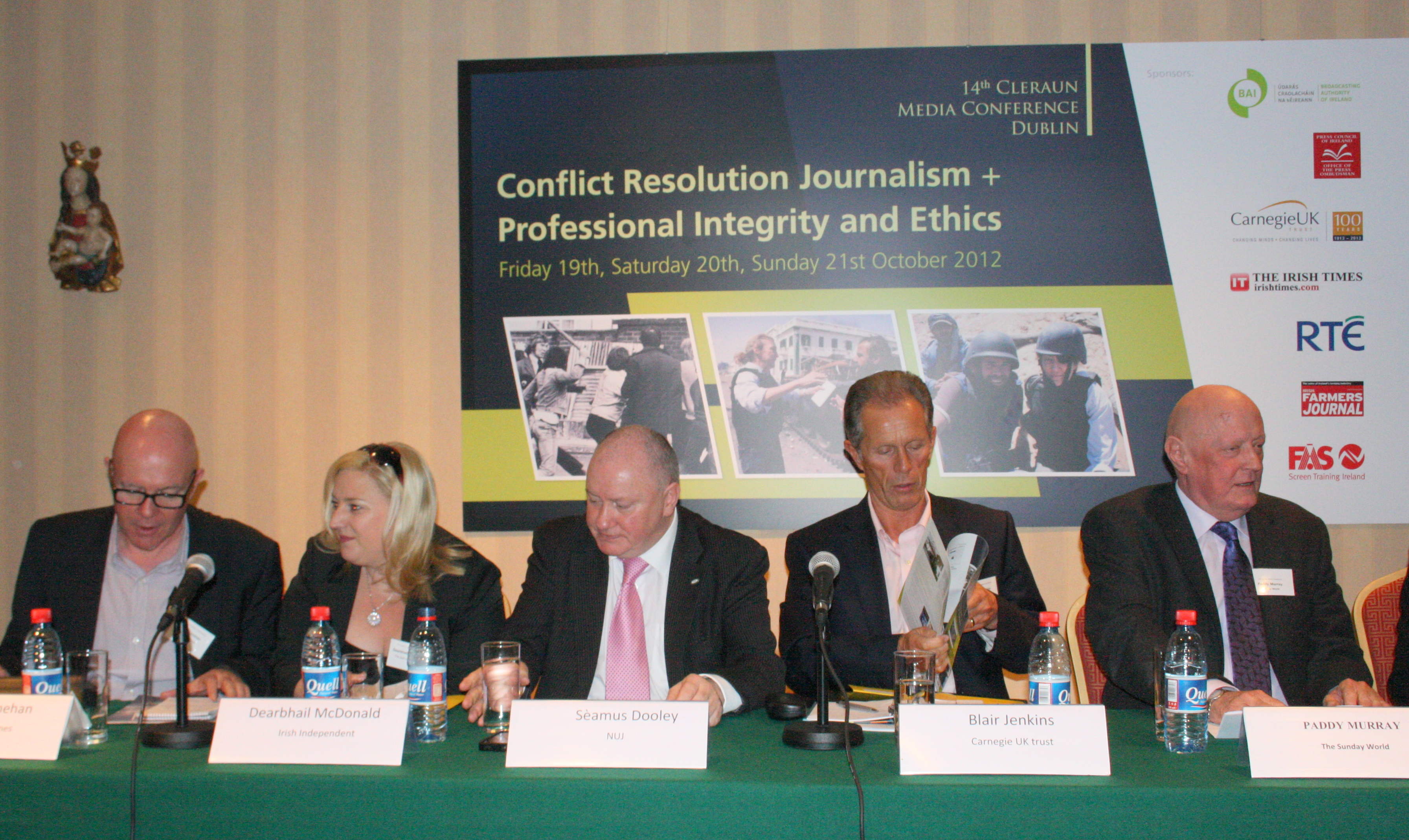
Hugh Linehan, Dearbhail McDonald, Seamus Dooley, Blair Jenkins and Paddy Murray - the panel for the discussion on the Leveson Inquiry.
Hugh Linehan, Dearbhail McDonald, Seamus Dooley, Blair Jenkins and Paddy Murray – the panel for the discussion on the Leveson Inquiry.

It was low-key – something over  one hundred people, representing a generation span spread over about 60 years, and it took place in a relatively small venue which serves as a home for about a dozen university students. But it was high-end in every other way you looked at it –  theme, quality of presentation, depth and vigour and a panel of speakers to die for.

It was the biennial Cleraun Media Conference , held in Cleraun University Centre in Dublin, Ireland. Its theme was professional integrity and ethics in the context of conflict resolution journalism – which must look a little like an oxymoron to many who associate journalism with the promotion of  what it thrives on, conflict generation  rather than conflict resolution. But resolving that paradox was what the conference was all about and what it did in a very deep and penetrating way  – both in the presentations from journalists and film makers from the very top of the media pyramid, and in the questions and discussion from Ireland’s top media practitioners and students from its third-level media schools.

Over three days, from the opening on Friday to its conclusion on Sunday, participants heard from documentary producers, directors, editors and presenters of the calibre of Peter Taylor of BBC’s Panorama, Stefan Ronovicz (editor of  the 2010 BAFTA winner, Terror in Mumbai), and the veteran  and universally admired flim-maker, George Carey. The audience was riveted listening to Paul Conroy, Sunday Times photographer who is still recovering from the injuries he received in Syria in the targeted military attack which took the lives of his colleagues Marie Colvin and Remi Ochlik earlier this year.

From the home front there were film makers Alan Gilsenan , Steve Desmond, and Trevor Birney, Barbara O’Shea and Anne Cadwallader, and the icing on that particular cake, Kevin Bakhurst, the new MD of News and Current Affairs in RTE, post Mission to Prey scandal. Hugh Lenihan, Dearbhail McDonald, Paddy Murray, and Blair Jenkins OBE – formerly of BBC Scotland and STV – participated in a panel which dissected the proceedings, so far, of the Leveson Inquiry in Britain. This was  moderated by the Irish Ombudsman and Information Commissioner, Emily O’Reilly, a former political correspondent with The Irish Press and columnist with The Sunday Times.

At the end of the conference Blair Jenkins was presented with the Cleraun Award for Outstanding Contribution to Journalism, a contribution which had it most recent manifestation in the publication of his recent report for the Carnegie UK Trust, Better Journalism in the Digital Age, on journalism ethics and regulation.

But if that line-up was impressive the outcomes were no less so and the impact of the three days’ proceeding was well reflected in the constant tweeting from the conference by the media students attending, picking up and recirculating the insights and observations which were coming hot and heavy from the speakers in their presentations and in their follow-up Q and A sessions.

No summary can really do justice to what went on at this conference and the best place to get a taste of it all will be to go to the Dublin Institute of Technology’s Journalism School soundcloud and (later) YouTube webcast of the proceedings which should be posted over the next few days, and in due course on the conference’s own webpage.

But if one line of thought could summarise the outcome, it was the clear conviction presented by all the speakers and taken away by all the participants that, when it comes down to it, integrity comes from the inner life of the human subject, not from rules and regulations – necessary though they may be. There was a good deal of talk about the soulless DNA of certain publications needing to be replicated in the DNA of people who wanted to be successful journalists within those organisations. But it was clear that if the DNA of those human beings lacked the chromosomes of common decency and human courtesy then it was bye-bye to any hope for integrity and ethics in conflict-resolution journalism or any other kind of journalism you care to mention.

Last, but not the least significant element in this entire venture was the heavy-hitter sponsorship which it attracted and which – presumably – made it possible: RTE, Ireland’s public broadcasting service, The Irish Times,  the Broadcasting Authority of Ireland, the Office of the Press Ombudsman, The Carnegie UK Trust, the Irish Farmers’ Journal, and the screen training division of FAS, the Irish National Training and Employment Authority.

Last words – Jenny McGovern’s tweet at the end of the conference: Jenny McGovern ‏@Jenabelle4@Cleraun GREAT JOB!!!

Does this not make an awful – and awesome – lot of sense?

I found this interesting comment on a post – equally interesting, as well as being disturbing – on the Conjugality blog this morning:
Fr. Bill MCNeeley commented on Marriage = biology (not bigotry) with this: It reminds me of when in my senior year of an Episcopal Church seminary (I am now Catholic) and one of my classmates said, “Conservatives in the church can hit the road if they do not like inclusive language.” I pointed out that such a statement is not inclusive. She replied “Oh, it’s okay to exclude those who are not inclusive.”

See the video here.

Mary, Mary, quite contrary

Heretical thought…will ever be foreign, strange,….to the pious but uncontroversial mind; for what have good Christians to do, in the ordinary course of things, with the subtle hallucinations of the intellect?

So Newman tells us in The Grammar of Assent. He was adressing a particular problem relating the assent of ordinary Christians to articles of faith defended by the Church against the products of what we might call ‘controversial minds’. It was hard not to think of his words when reading the products of the mind of the former Irish President, Mary McAleese, widely disseminated throughout a range of media last week.

She clearly would have very little time for John Henry Newman’s kind of fidelity to the teaching of Jesus Christ and His Church.

Why, Newman asks, should the refutations of heresy  – and Mrs McAleese’s utterings are full of that old-fashioned phenomenon – be our objects of faith? if no mind, theological or not, can believe what it cannot understand, in what sense can the Canons of Councils and other ecclesiastical determinations be included in those credenda (things to be believed) which the Church presents to every Catholic as if apprehensible, and to which every Catholic gives his firm interior assent? He was defending the genuineness of the faith of people who assented whole-heartedly to the doctrines of Christianity even though they did not or could not fully understand them in a rational way.

 There is clearly a great deal in the teaching of the Catholic Church and in its refutation of contrary teaching – on priestly celibacy, on the possibility of ordaining women, on the nature and meaning of other sacraments as well, on sexual morality – which Mary McAleese cannot understand and because she cannot understand it she proposes her own alternative teaching.

 Mrs. McAleese and many of her kind – for example her fellow-travellers in that not-so-merry band, the Association of Catholic Priests – has great difficulty giving assent to any principle of the Catholic faith and morals which is out of sync with modern liberal wisdom, particularly if it contravenes the rather mindless principles of equality which that wisdom currently embraces.

She and they have no time for a Church which has a duty, as Newman expresses it, to act as “the pillar and ground of the Truth,”  a Church manifestly obliged from time to time, and to the end of time, to denounce opinions incompatible with that truth, whenever able and subtle minds in her communion venture to publish such opinions.

 Newman suggested considering a scenario in which certain Bishops and priests began to teach that Islamism or Buddhism was a direct and immediate revelation from God. She would be bound to use the authority which God has given her to declare that such a proposition will not stand with Christianity, and that those who hold it are none of hers; and she would be bound to impose such a declaration on that very knot of persons who had committed themselves to the novel proposition, in order that, if they would not recant, they might be separated from her communion, as they were separate from her faith.

Now it is very unlikely that these sort of measures are going to be taken against Mrs. McAleese  – particularly in view of the hue and cry which has followed the mild requirements being made of certain priests who are teaching within the fold of the Church views quite at variance with accepted doctrine. But surely the implications of Newman’s writing should not be lost on her and others holding similar views. There is unlikely to be a de jure separation sought but is there not already a clear de facto separation in place? If it is not clear should it not be made so – as bishops in the US have requested from those politicians who have set their face against the moral teaching of the Catholic Church on a number of issues?

Civil servants are expected to publicly support and implement the policies of their governments – and if they do no they are asked to leave their office. Why is the same standard not accepted for and by the “servants of the servants of God”? Mrs. McAleese holds no office in the Catholic Church – although there is a suspicion that she might like to – but she does profess to be in communion with it. In this profession there is a huge contradiction.

In the case of the masses of the faithful Catholic population faced with the choice of following the innovators of doctrine or following the Church as understood by Newman he was clear that in such a case, her masses of population would at once take part with her, and without effort take any test, which secured the exclusion of the innovators; and she on the other hand would feel that what is a rule for some Catholics must be a rule for all. Who is to draw the line between who are to acknowledge that rule, and who are not? It is plain, there cannot be two rules of faith in the same communion, or rather, as the case really would be, an endless variety of rules, coming into force according to the multiplication of heretical theories, and to the degrees of knowledge and varieties of sentiment in individual Catholics.

 A-la-carte or pick-and-choose Catholics now seem to resent being called such but in doing so they are just trying to have their cake and eat it. As Newman explained:

The “One Holy Catholic and Apostolic Church” is an article of the Creed, and an article, which, inclusive of her infallibility, all men, high and low, can easily master and accept with a real and operative assent. It stands in the place of all abstruse propositions in a Catholic’s mind, for to believe in her word is virtually to believe in them all. Even what he cannot understand, at least he can believe to be true; and he believes it to be true because he believes in the Church.

In the end of the day that is what it comes down to and is it not about time that we began to shout it from the roof- tops so that it will be clear to everyone in this Year of Faith. Is it not time for those who wish to be authentic Catholics to make it very clear with Whom they stand and Whose standard they follow?

It’s not about “cold fish” or “wet fish” – it’s about people’s lives, stupid

What a breath of fresh air this sober analysis is after the rantings of Paul Krugman  and utterly blinkered wishful thinking of Lara Marlow in the Irish Times and her other platforms.

Liberalism’s Glass Jaw by ROSS DOUTHAT in today’s New York Times calmly and coolly exposes the bubbly substance of everything that Obama stands for and shows us that the real problem with all this is not Obama himself but the fragile ideology he stands on. We can only hope that while he has been able to fool a majority of the people to get  one term in office he will not be able to fool enough of them to get a second.

As Doubthat reads it, all of Obama’s signature accomplishments have tended to have the same weakness in common: They have been weighed down by interest-group payoffs and compromised by concessions to powerful insiders, from big pharma (which stands to profit handsomely from the health care bill) to the biggest banks (which were mostly protected by the Dodd-Frank financial reform).

It may have been an empty rhetorical gesture, but the fact that Romney could actually out-populist the president on “too big to fail” during the last debate speaks to the Obama-era tendency for liberalism to blur into a kind of corporatism, in which big government intertwines with big business rather than restraining it.

Doubthat does not mention his social policy “evolutions” and the concessions he has risked making to the gay lobby on marriage, the ease with which he has slipped into assuming that Christian consciences on sexual morality issues can be tossed around the ring like so many rag dolls. But he might have done. These were the cotton wool compassionate gestures which Obama has allowed to distract him from really grappling with the more difficult challenges of getting the country back on its feet.

One hopes that the American electorate will get well beyond the preoccupation which some in the media have tried to focus on – whether it is Romney as a “cold fish”, or Obama as a “wet fish” – and look at the real issues of substance which Doubthat summarizes here.