We need to talk

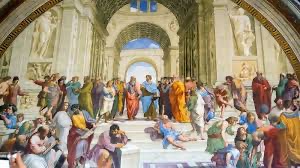
The School of Athens

Socrates died for it. Charlie Kirk died doing it. They both died because some people, powerful or not, hated them for what they said and did. Socrates died from a dose of hemlock his enemies obliged him to swallow; Kirk died from a bullet in the neck.

Essentially what these two men had in common, and for which they were hated by their political enemies, was the dangerous habit of trying to dialogue and converse with those who opposed them. Nothing seems to have changed in two and a half millennia and every time in our human culture, when civilised conversation and the freedom to speak our minds and search for truth has been abandoned, we descend into barbarism. It is not only heroic people who die. With them will also die true friendship and true political life.

An essay in the Financial Times back in 2012 proclaimed that the art of conversation was on a death list. “It’s a dying art,” wrote John McDermot, “struck down by texting, email and messaging”

McDermott, at that time an FT comment editor, recalled an account by Thomas de Quincy of an evening spent in the company of Samuel Taylor Coleridge. The experience was like being swept into some great river, a continuous strain of dissertation, certainly the most novel, the most finely illustrated, traversing the most spacious fields of thought…”

He did not think it probable that many of us would enjoy that level of conversation. Nevertheless, he hoped that we might at some time have felt the elation of staying up all night talking with a friend or loved one.

What is it that makes a conversation something more than idle chatter? Cicero’s formula was summarised by The Economist in 2006: “Speak clearly; speak easily but not too much, especially when others want their turn; do not interrupt; be courteous; deal seriously with serious matters and gracefully with lighter ones; never criticise people behind their backs; stick to subjects of general interest; do not talk about yourself; and, above all, never lose your temper.”

“But”, McDermott reflects,  “Cicero was lucky: he never went on a first date with someone more interested in their iPhone than his company.”

People have been preoccupied by the question of what real conversation is for a long time. The British philosopher Michael Oakshott connected it with the very idea of the pursuit of learning itself. Oakshott was one of the founders of the free University of Buckingham back in the 1960s.

This foundation embodied the principle that the pursuit of learning is not a race in which the competitors jockey for the best place. It is not, he said, “even an argument or a symposium; it is a conversation. And the peculiar virtue of a university (as a place of many studies) is to exhibit it in this character, each study appearing as a voice whose tone is neither tyrannous nor plangent, but humble and conversable. Its value lies in the relics it leaves behind in the minds of those who participate. A conversation does not need a chairman, it has no predetermined course, we do not ask what it is ‘for’ and we do not judge its excellence by its conclusion; it has no conclusion, but is always put by for another day.”

The New York Times columnist, Ezra Klein recently drew attention to another angle of the demise of conversation. He reflected that  while holidays – like Christmas time – are an unusually social time, filled with parties and family get-togethers, for most of the year, we feel isolated and unsatisfied with our social lives. Our society, he thought, wasn’t  structured to support connection year-round. He drew our attention to a book by Sheila Liming, an associate professor of professional writing at Champlain College and the author of “Hanging Out: The Radical Power of Killing Time.” In the book, Liming investigates the troubling fact that we’ve grown much less likely to simply spend time together outside our partnerships, workplaces and family units. “What would it look like,” Klein asked, ”to reconfigure our world to make social connection easier for all of us?

For Hannah Arendt, conversation was about much more than ‘hanging out’, valuable and pleasurable a human experience as that might be. ‘Gladness, not sadness,’ she wrote, “is talkative, and truly human dialogue differs from mere talk or even discussion in that it is entirely permeated by pleasure in the other person and what he says.” 

In her short biography of Arendt, Samantha Rose Hill writes, “Aside from Arendt’s husband Heinrich Blücher, no one understood this better than her mentor, the philosopher Karl Jaspers. In Jaspers, Arendt found a man who understood the art of listening and conversation, and elevated these worldly activities to the centre of his life and work”

Arendt said of Jaspers, “Within this small world he unfolded and practiced practicsed his incomparable faculty for dialogue, the splendid precision of his way of listening, the constant readiness to give a candid account of himself, the patience to linger over a matter under discussion, and above all the ability to lure what is otherwise passed over in silence into the area of discourse, to make it worth talking about. Thus in speaking and listening, he succeeds in changing, widening, sharpening – or, as he himself would beautifully put it, in illuminating.”

For Arendt, Karl Jaspers embodied what it meant to think, because they both understood the importance of conversation, lingering over topics and returning to subjects of contemplation.

The central elements of Jaspers’s philosophy, Hill writes, left a lasting impression on Hannah Arendt’s work. At the centre of her conception of thinking is conversation, or the ‘two-in-one’ dialogue one has with oneself. Studying with Jaspers meant that, for Arendt, thinking was no longer confined to a hidden realm. Her dissertation work on Saint Augustine drew together the disciplines of theology and philosophy in order to understand neighbourly love as a secular value for being with others in the world.

Hill writes that friendship was an oasis for Arendt, and in dark times – of which there were a number in her life – it offered a refuge. She said, in being with others, “one heart reaches out directly to the other. It is a meeting ground of equals, where one is free to go without a mask, without the pressures of performance and appearance. It is the intimacy of close relationships with others that teaches us how to breathe, to co-exist.

Another Arendt scholar, Kathleen B. Jones writes, “For Arendt, friendship thrived on equality, but only in the sense of a shared commitment to independent thinking and a willingness to take risks. For Arendt, conversation was the lifeblood of friendship and friendship was the lifeblood of society.

Arendt saw genuine conversation and friendship as the place where truth can be spoken without the distortions of ideology, propaganda, or power. She held that with a friend, you do not speak to persuade, command, or manipulate.
You speak to seek understanding and to “appear” authentically before one another.

In that way friendship preserves individuality. Friendship helps people remain distinct individuals rather than absorbed into mass movements and she saw conversation as the essence of human plurality. Arendt thought human beings live in a condition of plurality—we each see the world differently. Conversation for her was how we come to terms with these differences without violence. It is not aimed at agreement but at mutual understanding. Conversation is how the world becomes “real” between us.

What would our world look like if these values, these practices and dispositions prevailed within it? Conversations and friendships are surely the key to resolving the terrible polarisation which now afflicts us and kills the genuine plurality which is part of our true human inheritance. Polarisation, mindless ideology, and the hatred they induce are driving our world to a very lonely and unforgiving place. We must resist them with all our moral strength – as heroes in all ages have done.

A Watershed Year?

What is it about 2025? Will it be remembered as the year in which a new awakening finally exposed the shallowness and idiocy of the poisonous ‘awokening’ which has blighted our politics and our societies and mark the beginning of its end.

The Mulberry Bush


That so-called ‘awokening’ nightmare was the surface manifestation of the fatal flaws revealed in the answers Patrick Deneen gave to the question he asked in his landmark book, Why Liberalism Failed

Liberalism in its late 20th and early 21st century version failed, he wrote, because it did not live up to its promises. We might also say that it failed because it had absorbed the toxic utopian principles of Marxism – as did those earlier Marxist ideologies of the Communist Manifesto (1848), the Russian Revolution and Chinese Maoism, with all their lethal progeny.

All of these, including contemporary Liberalism, promised a more just society but ended up perverting justice – with utterly lethal consequences in their naked Marxist forms, and with socially destructive consequences in its hidden Marxist contemporary forms.

Signs of hope in 2025

What are the signs which 2025 offers that might make us think our civilisation is on a new threshold? Essentially they are signs of a new Judeao-Christian revival – it embraces Catholics, other Christians of various denominations, and practising Jews.

Where do we look for these signs?  We might begin with the widely reported phenomenon of Catholic baptisms across the secular West last Easter. Around that time The Economist’s four-minute morning news podcast selected as its ‘word of the week’, ‘Catechumen’. It followed later with a report on the phenomenon we have just mentioned. A sceptical secular world is taking notice.

What is being noticed is that many Catholic dioceses in the UK, Ireland, and the US reported significant growth in conversions to the Catholic faith this Easter, with increases in catechumens and candidates for the Rite of Election, particularly among young adults aged 20s and 30s. This surge is seen in both established dioceses and others across the regions, with some leaders attributing the trend to a societal spiritual crisis and increased interest in the Church’s historical and spiritual truths

Specific examples from the UK and Ireland include,

  • Westminster Cathedral which saw over 500 attendees at the Rite of Election, with 250 catechumens. 
  • Southwark Archdiocese (London South of the Thames and Kent) reported over 450 participants.
  • Birmingham saw 201 catechumens and candidates, up from 130 the previous year. 
  • In Motherwell in Scotland numbers rose from 45 to 72 and in 
  • Dublin, nearly 70 individuals joined in the Pro-Cathedral.

These figures, impressive as they are, are dwarfed by the experience of  France, which had a surge in adult baptisms this year — at more than 10,000, the highest number since a national annual report on such figures began in 2002. Something is definitely happening!  

Canterbury Summer 2025

Something amazing definitely did happen this Summer – Mass in Canterbury Cathedral, celebrated by the Papal Nuncio to the UK, Archbishop Miguel Maury Buendia. It happened on July 7, to commemorate St. Thomas Becket. Normally a Mass is celebrated annually in the Catholic Church of St Thomas Becket, but this year’s Mass was the largest Catholic gathering at the cathedral since the Reformation. Disclosure: I had the great privilege of being present at the Mass.

Madeline Tehan reported on this event for the US based Catholic News Agency.“For the first time in modern history, the apostolic nuncio to the United Kingdom has celebrated Mass in England’s most celebrated Anglican cathedral…

During his homily, Maury Buendía said: ‘This Mass of pilgrimage takes place within the context of the jubilee year. It highlights the Christian life as a spiritual journey, moving through life’s trials and joys with hope anchored in Christ. Having travelled as pilgrims today, we do more than just honour a figure from history.’

He continued: ‘The stained-glass windows all around us illustrate the many miracles attributed to St. Thomas in the medieval period. This should be a living story, too. Our world, today as then, is in need of hope. We come in this jubilee year as pilgrims of hope to be inspired by St. Thomas’ holiness and his courageous witness to Christ and his Church.’ ”

In the USA 

In the United States ten dioceses, including Memphis, Rockford, and Los Angeles, experienced significant increases in conversions. For the first time in decades, the US Catholic Church has seen more people joining than leaving, a trend that began to shift around 2024. 

On September 28, The Spectator reported that in the US, school voucher schemes have seen enrolment in private Christian schools rise dramatically.

What is driving all this? There are definite proximate motives and Christian believers know that these factors are at play – but they also know that without the miracle of grace, nothing like this happens.

Just one moving example – The Burns Family in Ohio

Matthew McDonald,  a staff reporter for The National Catholic Register, recounts the story of  the Burns family.  Their path to the Catholic Church this Easter vigil started with a funeral.

Steve Burns, 43, a mechanical engineer who lives in Avon Lake, Ohio, was raised a Free Methodist. His wife, Corrine, 42, a homemaker who worked for years in a wholesale greenhouse, was raised a Catholic but stopped going to church when she was an adolescent. Their son Ryan, 12, wasn’t  baptised.

But when Corrine’s beloved Uncle Tony died in March 2023, she attended his funeral Mass and immediately felt at home. “For the first time I felt right, like I was in the right spot again,” Corrine told the Register. “In my head I’m thinking, ‘I’ve got to get my family in here, too.’ ”

That happened at last Easter’s Vigil Mass at St. Joseph’s in Avon Lake, followed by confirmation and first Communion. At the same Mass, Ryan was baptised, followed by confirmation and first Communion. Steve and Ryan went through the parish’s conversion program – a demanding procedure based on the teaching contained in The Catechism of the Catholic Church.

McDonald explains that these are part of a bumper crop in the Diocese of Cleveland, which welcomed over 800 converts at Eastertime 2025, which is about 50% higher than in 2024 (542) and about 75% higher than in 2023 (465). Significant increases in converts are common and widespread. Many are seeing increases not just since last year but also since 2019, the year before the coronavirus shutdowns led to sharp decreases in conversion. 

Back in Europe

One of the most spectacular Christian witnessing events of the Summer was surely that reported by Rod Dreher on the pilgrimage of young Europeans – and others – to the Cathedral of Chartres. This was  the three-day Pentecost pilgrimage. 

“It was astonishing”, Dreher wrote in his blog, which was republished by Bari Weiss on her website, The Free Press , “and gave me a real sense of hope for the future. You will recall that my journey as an adult into Christianity began at Chartres, which I first visited at seventeen, and was overwhelmed by wonder. Back then, in the summer of 1984, I stood at the center of the labyrinth there, looked all around, and felt strongly in my heart that God is real, and that He is calling me to Himself.”

Dreher took a seat near the altar for the Mass, which began with hundreds of the pilgrims, exhausted from having walked the sixty miles from Paris to Chartres in three days, streaming in carrying flags and banners. “They filled the nave, while many more thousands were outside on the parvis watching and listening to the Mass over loudspeakers and a giant screen. I saw the sunburned faces of these kids passing by, and was in awe. I thought, ‘These are the people who are going to save Christianity in Europe.’  Maybe fanciful, I don’t know, but if it’s going to happen, it will be through them.”

The Charlie Kirk Effect

Last, but perhaps by no means least, is what we read in this report by Amira Abuzeid, also of the Catholic News Agency on September 15. She was reporting on what some are calling “the Charlie Kirk effect,”  “People across the nation, including many college students who are not ordinarily churchgoers, have decided to go to church since the assassination last week of the conservative Christian political activist Charlie Kirk.”

Matt Zerrusen, co-founder of Newman Ministry, a Catholic nonprofit that operates on about 250 campuses nationwide, told CNA he has spoken with Catholic college ministry leaders throughout the country over the last few days, and “every one of them told me they’ve seen bigger crowds” at Masses and lots of people “they’ve never seen before.”

“I have not talked to anyone who has not seen an increase in Mass attendance,” Zerrusen said. “Some schools are reporting increases of 15%.” He told CNA that many more college students are also asking for spiritual direction. “So many people are asking ‘What do I do?’, ‘What is evil? How does God allow this?” Zerrusen said. “They are asking so many basic questions.”

One priest at a large state school in the North East told Zerrusen he spoke over the weekend with 15 young men he had never seen before who sought him out for faith advice. Zerrusen said the spiritual “revival” Kirk’s death has amplified what one he has been observing for months. He pointed out that more than 400 students at Texas A&M University in College Station are attending the Order of Christian Initiation of Adults (OCIA) class at St. Mary’s Catholic Center near campus. Social media users say Kirk inspired them to go to church.

Charlie Kirk said many things which ordinary good people found objectionable. Many have been misinterpreted and the jury may still be out on those. But there can be little doubt that the bullet which severed his neck was inspired by hatred for the Christian principles of sexual morality which he championed. It is hard not to see him as a martyr.

Peggy Noonan wrote a column  on ‘Charlie Kirk and the New Christian GOP’ in the Wall Street Journal in which she said:

“While watching the Charlie Kirk memorial Sunday, I was swept by a memory that yielded a realization.

“The memorial, in State Farm Stadium in Glendale, Ariz., has been well described. There was a height to it, and a gentleness, with a few rhetorical exceptions. More than 90,000 people attended. TV and online viewership is estimated to have reached tens of millions. Halfway through it struck me that the memorial might have been the biggest Christian evangelical event since the first visit to America of Pope John Paul II, in October 1979. He was a year into his papacy. ‘Be not afraid!’ he said, and took America by storm.

“At the memorial there was an altar call—at a public memorial for a political figure. It was singular, and moving. So was the dignity and peacefulness of the crowd. They didn’t indulge their anger or cry out against the foe. It was as if they understood that would be bad for the country. I couldn’t remember a time a big Trump-aligned group did that, as a corporate act, in the past 10 years. It struck me as a coming of age. They were taking responsibility.

“There is something you could have said at any time the past decade that is true now in some new way. It is that the GOP is becoming a more explicitly Christian party than it ever has been. A big story the past decade was that so many Trump supporters, especially but not only working-class ones, were misunderstood as those crazy Christians but in fact were often unaffiliated with any faith tradition and not driven to politics by such commitments.

“But it looks to me as if a lot of those folks have been in some larger transit since 2015, as Kirk himself was. He entered the public stage to speak politics but said by the end that his great work was speaking of Christ. If he had a legacy, he told an interviewer, ‘I want to be remembered for courage for my faith.’ ”

These stories suggest there are seeds of new life in the Catholic Church in many parts of the world. Particularly encouraging is the growth on College campuses allowing hope that the insidious growth of Wokeism may have peaked and that truth as always will out.