A Watershed Year?

What is it about 2025? Will it be remembered as the year in which a new awakening finally exposed the shallowness and idiocy of the poisonous ‘awokening’ which has blighted our politics and our societies and mark the beginning of its end.

The Mulberry Bush


That so-called ‘awokening’ nightmare was the surface manifestation of the fatal flaws revealed in the answers Patrick Deneen gave to the question he asked in his landmark book, Why Liberalism Failed

Liberalism in its late 20th and early 21st century version failed, he wrote, because it did not live up to its promises. We might also say that it failed because it had absorbed the toxic utopian principles of Marxism – as did those earlier Marxist ideologies of the Communist Manifesto (1848), the Russian Revolution and Chinese Maoism, with all their lethal progeny.

All of these, including contemporary Liberalism, promised a more just society but ended up perverting justice – with utterly lethal consequences in their naked Marxist forms, and with socially destructive consequences in its hidden Marxist contemporary forms.

Signs of hope in 2025

What are the signs which 2025 offers that might make us think our civilisation is on a new threshold? Essentially they are signs of a new Judeao-Christian revival – it embraces Catholics, other Christians of various denominations, and practising Jews.

Where do we look for these signs?  We might begin with the widely reported phenomenon of Catholic baptisms across the secular West last Easter. Around that time The Economist’s four-minute morning news podcast selected as its ‘word of the week’, ‘Catechumen’. It followed later with a report on the phenomenon we have just mentioned. A sceptical secular world is taking notice.

What is being noticed is that many Catholic dioceses in the UK, Ireland, and the US reported significant growth in conversions to the Catholic faith this Easter, with increases in catechumens and candidates for the Rite of Election, particularly among young adults aged 20s and 30s. This surge is seen in both established dioceses and others across the regions, with some leaders attributing the trend to a societal spiritual crisis and increased interest in the Church’s historical and spiritual truths

Specific examples from the UK and Ireland include,

  • Westminster Cathedral which saw over 500 attendees at the Rite of Election, with 250 catechumens. 
  • Southwark Archdiocese (London South of the Thames and Kent) reported over 450 participants.
  • Birmingham saw 201 catechumens and candidates, up from 130 the previous year. 
  • In Motherwell in Scotland numbers rose from 45 to 72 and in 
  • Dublin, nearly 70 individuals joined in the Pro-Cathedral.

These figures, impressive as they are, are dwarfed by the experience of  France, which had a surge in adult baptisms this year — at more than 10,000, the highest number since a national annual report on such figures began in 2002. Something is definitely happening!  

Canterbury Summer 2025

Something amazing definitely did happen this Summer – Mass in Canterbury Cathedral, celebrated by the Papal Nuncio to the UK, Archbishop Miguel Maury Buendia. It happened on July 7, to commemorate St. Thomas Becket. Normally a Mass is celebrated annually in the Catholic Church of St Thomas Becket, but this year’s Mass was the largest Catholic gathering at the cathedral since the Reformation. Disclosure: I had the great privilege of being present at the Mass.

Madeline Tehan reported on this event for the US based Catholic News Agency.“For the first time in modern history, the apostolic nuncio to the United Kingdom has celebrated Mass in England’s most celebrated Anglican cathedral…

During his homily, Maury Buendía said: ‘This Mass of pilgrimage takes place within the context of the jubilee year. It highlights the Christian life as a spiritual journey, moving through life’s trials and joys with hope anchored in Christ. Having travelled as pilgrims today, we do more than just honour a figure from history.’

He continued: ‘The stained-glass windows all around us illustrate the many miracles attributed to St. Thomas in the medieval period. This should be a living story, too. Our world, today as then, is in need of hope. We come in this jubilee year as pilgrims of hope to be inspired by St. Thomas’ holiness and his courageous witness to Christ and his Church.’ ”

In the USA 

In the United States ten dioceses, including Memphis, Rockford, and Los Angeles, experienced significant increases in conversions. For the first time in decades, the US Catholic Church has seen more people joining than leaving, a trend that began to shift around 2024. 

On September 28, The Spectator reported that in the US, school voucher schemes have seen enrolment in private Christian schools rise dramatically.

What is driving all this? There are definite proximate motives and Christian believers know that these factors are at play – but they also know that without the miracle of grace, nothing like this happens.

Just one moving example – The Burns Family in Ohio

Matthew McDonald,  a staff reporter for The National Catholic Register, recounts the story of  the Burns family.  Their path to the Catholic Church this Easter vigil started with a funeral.

Steve Burns, 43, a mechanical engineer who lives in Avon Lake, Ohio, was raised a Free Methodist. His wife, Corrine, 42, a homemaker who worked for years in a wholesale greenhouse, was raised a Catholic but stopped going to church when she was an adolescent. Their son Ryan, 12, wasn’t  baptised.

But when Corrine’s beloved Uncle Tony died in March 2023, she attended his funeral Mass and immediately felt at home. “For the first time I felt right, like I was in the right spot again,” Corrine told the Register. “In my head I’m thinking, ‘I’ve got to get my family in here, too.’ ”

That happened at last Easter’s Vigil Mass at St. Joseph’s in Avon Lake, followed by confirmation and first Communion. At the same Mass, Ryan was baptised, followed by confirmation and first Communion. Steve and Ryan went through the parish’s conversion program – a demanding procedure based on the teaching contained in The Catechism of the Catholic Church.

McDonald explains that these are part of a bumper crop in the Diocese of Cleveland, which welcomed over 800 converts at Eastertime 2025, which is about 50% higher than in 2024 (542) and about 75% higher than in 2023 (465). Significant increases in converts are common and widespread. Many are seeing increases not just since last year but also since 2019, the year before the coronavirus shutdowns led to sharp decreases in conversion. 

Back in Europe

One of the most spectacular Christian witnessing events of the Summer was surely that reported by Rod Dreher on the pilgrimage of young Europeans – and others – to the Cathedral of Chartres. This was  the three-day Pentecost pilgrimage. 

“It was astonishing”, Dreher wrote in his blog, which was republished by Bari Weiss on her website, The Free Press , “and gave me a real sense of hope for the future. You will recall that my journey as an adult into Christianity began at Chartres, which I first visited at seventeen, and was overwhelmed by wonder. Back then, in the summer of 1984, I stood at the center of the labyrinth there, looked all around, and felt strongly in my heart that God is real, and that He is calling me to Himself.”

Dreher took a seat near the altar for the Mass, which began with hundreds of the pilgrims, exhausted from having walked the sixty miles from Paris to Chartres in three days, streaming in carrying flags and banners. “They filled the nave, while many more thousands were outside on the parvis watching and listening to the Mass over loudspeakers and a giant screen. I saw the sunburned faces of these kids passing by, and was in awe. I thought, ‘These are the people who are going to save Christianity in Europe.’  Maybe fanciful, I don’t know, but if it’s going to happen, it will be through them.”

The Charlie Kirk Effect

Last, but perhaps by no means least, is what we read in this report by Amira Abuzeid, also of the Catholic News Agency on September 15. She was reporting on what some are calling “the Charlie Kirk effect,”  “People across the nation, including many college students who are not ordinarily churchgoers, have decided to go to church since the assassination last week of the conservative Christian political activist Charlie Kirk.”

Matt Zerrusen, co-founder of Newman Ministry, a Catholic nonprofit that operates on about 250 campuses nationwide, told CNA he has spoken with Catholic college ministry leaders throughout the country over the last few days, and “every one of them told me they’ve seen bigger crowds” at Masses and lots of people “they’ve never seen before.”

“I have not talked to anyone who has not seen an increase in Mass attendance,” Zerrusen said. “Some schools are reporting increases of 15%.” He told CNA that many more college students are also asking for spiritual direction. “So many people are asking ‘What do I do?’, ‘What is evil? How does God allow this?” Zerrusen said. “They are asking so many basic questions.”

One priest at a large state school in the North East told Zerrusen he spoke over the weekend with 15 young men he had never seen before who sought him out for faith advice. Zerrusen said the spiritual “revival” Kirk’s death has amplified what one he has been observing for months. He pointed out that more than 400 students at Texas A&M University in College Station are attending the Order of Christian Initiation of Adults (OCIA) class at St. Mary’s Catholic Center near campus. Social media users say Kirk inspired them to go to church.

Charlie Kirk said many things which ordinary good people found objectionable. Many have been misinterpreted and the jury may still be out on those. But there can be little doubt that the bullet which severed his neck was inspired by hatred for the Christian principles of sexual morality which he championed. It is hard not to see him as a martyr.

Peggy Noonan wrote a column  on ‘Charlie Kirk and the New Christian GOP’ in the Wall Street Journal in which she said:

“While watching the Charlie Kirk memorial Sunday, I was swept by a memory that yielded a realization.

“The memorial, in State Farm Stadium in Glendale, Ariz., has been well described. There was a height to it, and a gentleness, with a few rhetorical exceptions. More than 90,000 people attended. TV and online viewership is estimated to have reached tens of millions. Halfway through it struck me that the memorial might have been the biggest Christian evangelical event since the first visit to America of Pope John Paul II, in October 1979. He was a year into his papacy. ‘Be not afraid!’ he said, and took America by storm.

“At the memorial there was an altar call—at a public memorial for a political figure. It was singular, and moving. So was the dignity and peacefulness of the crowd. They didn’t indulge their anger or cry out against the foe. It was as if they understood that would be bad for the country. I couldn’t remember a time a big Trump-aligned group did that, as a corporate act, in the past 10 years. It struck me as a coming of age. They were taking responsibility.

“There is something you could have said at any time the past decade that is true now in some new way. It is that the GOP is becoming a more explicitly Christian party than it ever has been. A big story the past decade was that so many Trump supporters, especially but not only working-class ones, were misunderstood as those crazy Christians but in fact were often unaffiliated with any faith tradition and not driven to politics by such commitments.

“But it looks to me as if a lot of those folks have been in some larger transit since 2015, as Kirk himself was. He entered the public stage to speak politics but said by the end that his great work was speaking of Christ. If he had a legacy, he told an interviewer, ‘I want to be remembered for courage for my faith.’ ”

These stories suggest there are seeds of new life in the Catholic Church in many parts of the world. Particularly encouraging is the growth on College campuses allowing hope that the insidious growth of Wokeism may have peaked and that truth as always will out.



Hope and the Unmasking of Evil

In opening scenes of Terrence Malick’s film, The Thin Red Line, the raw recruit, Private Witt (above), who has gone AWOL from his company in the run up to the battle of Guadalcanal, muses about the problem of evil. He is wandering around a peaceful Melanesian village in a South Pacific island, its inhabitants unaffected by the war raging across the world.

The words he utters to himself are the original words written by James Jones, the author of the novel on which the film is based, published in 1962. Jones asked explicitly:

“This great evil, where’s it come from? How’d it steal into the world? What seed, what root did it grow from? Who’s doing this? Who’s killing us, robbing us of life and light, mocking us with the sight of what we might’ve known? Does our ruin benefit the earth, does it help the grass to grow, the sun to shine? Is this darkness in you, too? Have you passed through this night?” Jones was a veteran of that war.

We keep asking this question even though we’ve had the answer for as long as mankind has been inhabiting this earth. Not only do we ignore the answer but we also choose to muddle ourselves in all sorts of ways in trying to deny that there is an answer. We seem to prefer the darkness Jones refers to than to pass into the light.

Ross Douthat, columnist with The New York Times, writes  periodically on religious issues. He does his best to help us all cut through that darkness. He deals with evil in the context of the influence it has over our faith in God. Appalled by evil, some conclude that there simply can’t be a creator — or at least not a beneficent one — because the world is too laden with suffering and woe.”

There is, he finds, a muddle in their argument because its proponents often profess to be atheists. It isn’t properly speaking an argument that some creating power does not exist. Rather it’s an argument about the nature of that power, a claim that the particular kind of God envisioned by many believers and philosophers — all powerful and all good — would not have made the world in which we find ourselves, and therefore that this kind of God does not exist.

This argument of course ignores the multitude of good things in this world and what their source might be.

Rather than a straight rebuttal of an argument which is as muddled as this one, he suggests a set of challenges to it.

The first challenge he offers emphasises the limits of what the argument from evil establishes. It does not support an argument that God doesn’t exist, nor that the universe lacks a supernatural order. At best it seems to say that the traditional Christian or classical-theistic conception of God’s perfect goodness is somehow erroneous or overdrawn. 

The second challenge is that deniers of a ‘good God’ would do well to note that the books of  the Abrahamic tradition, which Jews and Christians themselves accept as divinely inspired, contain some of the strongest complaints against the apparent injustices of  the world. They are potentially much more worrying than those found in any atheistic tract. Check out the Bible

Douthat points out that the question of why God permits so much suffering is integral to Jewish and Christian Scripture, to the point where it appears that if the Judeo-Christian God exists, he expects his followers to wrestle with the question. Which means that you don’t need to leave all your intuitive reactions to the harrowing aspects of existence at the doorway of religious faith; there is plenty of room for complaint and doubt and argument inside the fold.

Finally, there is the evidence of the enormous good which Judeao-Christian civilisation has bestowed on this world, in the light of which the exclusive focus on the problem of evil seems a little overblown. Douthat suggests that “even if that evil makes it hard for you to believe in a God of perfect power, you still shouldn’t give up hope that something very good indeed has a role in the order of the world.”

But to return to the question posed by James Jones we must, and would be fools not to, resort to the historical sacred documents we have in Holy Scripture.

Romano Guardini shows us what we are really up against. In a chapter on ‘The Enemy’ in his meditations on the life and teachings of Christ in his book, The Lord, he gives us a very clear vision and understanding of the source of all evil in the world. He does this in the context of the accounts of Christ’s miracles in the New Testament – and one in particular.

Then there was brought to him a possessed man who was blind and dumb; and he cured him so that he spoke and saw. And all the crowds were amazed, and they said, ‘Can this be the Son of David?’ But the Pharisees, hearing this, said ‘This man does not cast out devils except by Beelzebub, the prince of devils.’ And knowing their thoughts Jesus said to them, ‘Every kingdom divided against itself is brought to desolation, and every city or house divided against itself will not stand. And if Satan casts out Satan, he is divided against himself; how then shall his kingdom stand? . . . But if I cast out devils by the Spirit of God, then the kingdom of God has come upon you’.  (Matt. 12:22–28). 

He tells us that what is reported here is essential to any genuine understanding of the New Testament. The account, he says, suggests similar cases of possession that Jesus has cured. “Not as a doctor cures; not even as Jesus himself has usually cured, by simply applying his miraculous powers of healing to the ravaged body. Here, behind the torment of body and soul, the Lord recognizes an evil power: the Demon, Satan. It is he who has made the invalid his abode; the physical pain involved is a result of his terrible habitation. It is he whom Jesus attacks, dislodging him by sheer spiritual force, and with him the accompanying ailment.” 

He is aware that sceptical and ultra-rationalist moderns  protest against the existence of intangible powers. He says they willingly enough recognise natural reality on the one hand, spiritual norms on the other:  given conditions of being and of intention. But then they baulk, afraid of fantastic folly. All reference to the demonic smacks of the unclean, of things belonging to a lower level of religion that must be overcome.  Here, he says,  lies the crux of our attitude toward Jesus: do we accept him, once and for all, as our ultimate authority in everything, or do we rely solely on our own judgment? 

He says that “If we think as Christians, we accept him as the starting point and norm of all truth, and we listen to everything he says with open minds, eager to learn, particularly when we are dealing, not with chance remarks of Jesus, but with a fundamental attitude that asserts itself again and again. The Lord’s acceptance of the inevitable struggle with satanic powers belongs to the kernel of his Messianic consciousness. He knows that he has been sent not only to bear witness to the truth, to indicate a way, to animate a vital religious attitude, to establish contact between God and man; but also to break the power of those forces which oppose the divine will. 

“For Jesus there is more than the mere possibility of evil as the price of human freedom; more than the inclination to evil, fruit of individual or collective (inherited) sin. Jesus recognizes a personal power that fundamentally wills evil: evil per se. It is not satisfied by the achievement of positive values through wicked means; it does not simply accept the evil along with the good. Here is something or someone who positively defies divinity and attempts to tear the world from God’s hands—even to dethrone God.”

Isn’t this the answer to the cri de coeur of James Jones, echoed by Malick? Jones asks, “Who’s doing this? Who’s killing us, robbing us of life and light, mocking us with the sight of what we might’ve known? … Is this darkness in you, too? Have you passed through this night?”  One senses that the question intuits the answer.

Guardini goes on to assert that the demon’s plan is to  lead the world into apostasy and self-destruction. This is what Holy Scripture means when it says that Satan creates that darkness which refuses the light that comes from God and is the seducer of mankind; that “He was a murderer from the beginning” for “by the envy of the devil, death came into the world” (John 8:44; Wisdom 2:24). 

“The Bible often speaks of him as lord of a “kingdom,” founder of a perverted order in which the hearts and minds of men—their creations, their deeds, their relations to things and to each other—seem sensible and coherent, but actually are senseless and incoherent. Long passages in John’s gospel describe Satan’s attempts to establish a kingdom of evil in opposition to God’s holy kingdom, anti-world to the new divine creation unfolding.”

This was the struggle witnessed by and bewildering Jones and his creation, Private Witt, in the horrors of Guadalcanal. It is the struggle which bewilders us as we contemplate the atrocities of October 7 on the border of Israel, of the devastation in Gaza, in Ukraine, Sudan and the Congo today.

Devastation on the Ukrainian-Russian border (NYT image)

But Guardini reassures us that Satan is no principle, no elementary power, but a rebellious, fallen creature who frantically attempts to set up a kingdom of appearances and disorder. He has power, but only because man has sinned. He is powerless against the heart that lives in humility and truth. His dominion reaches as far as man’s sinfulness, and will collapse on the Day of Judgment—a term long in itself, for every moment of evil is dreadfully long for those who stand in danger of Satan—but only a moment as compared with eternity. 

“‘Soon’,” as the Apocalypse reveals, it will be over (3:11; 22:7). Jesus knows that he has been sent forth against Satan. He is to penetrate Satan’s artificial darkness with the ray of God’s truth; to dispel the cramp of egoism and the brittleness of hate with God’s love; to conquer evil’s destructiveness with God’s constructive strength. The murkiness and confusion which Satan creates in men’s groping hearts are to be clarified by the holy purity of the Most High. Thus Jesus stands squarely against the powers of darkness; he strives to enter into the ensnared souls of men—to bring light to their consciences, quicken their hearts and liberate their powers for good.”

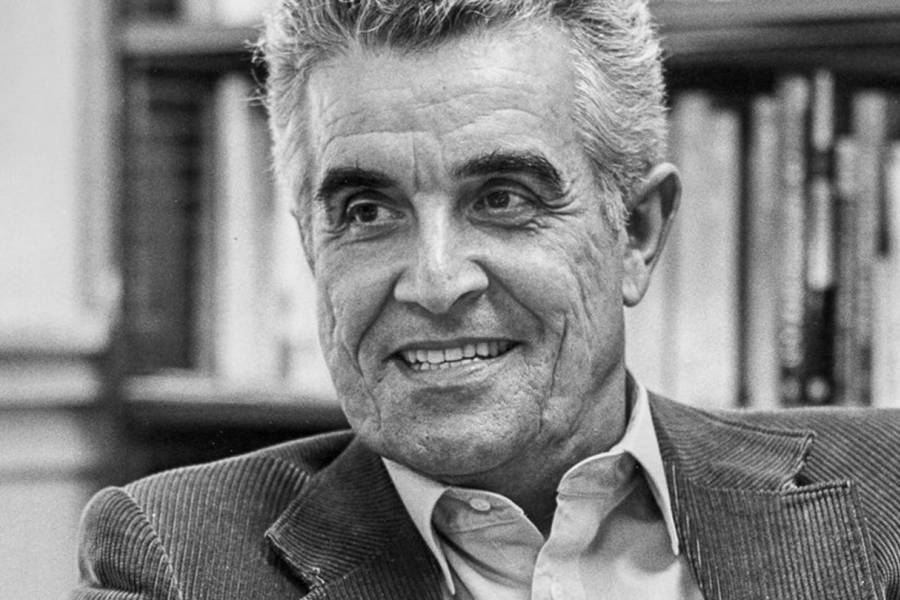
René Girard, Conversion and its Consequences

(René Girard, Part 3)

Fyodor Dostoyevsky – a central figure in Girard’s journey

Rene Girard’s first book, the fruit of his thinking and research in the 1950s was published in 1960. It was called Deceit, Desire, and the Novel.   Writing it resulted in not just a fascinating study of the genesis of  great writing but it also transformed his own life forever.

He describes his attitude and disposition as he started work on that book. It was “very much in the pure demystification mode: cynical, destructive, very much in the spirit of the atheistic intellectuals of the time. I was engaged in debunking.” He realised  that at the heart of his negative attitude was just one manifestation of his theory of imitative desire, mimesis. He was following the crowd. 

In writing Deceit, Desire and the Novel he explores what he takes to be the mind, the thought process and even the souls of great novelists. Among whom, as explicit models of his theory, are Marcel Proust, Dostoevsky and Cervantes.

He argues that with a number of great writers their first conception of their novels was very different from what they ultimately became. “The author’s first draft is an attempt at self-justification, which can assume two main forms. It may focus on a wicked hero, who is really the writer’s scapegoat, his mimetic rival, the one whom he desires to debunk, whose wickedness will be demonstrated by the end of the novel. It may also focus on a “good” hero, a knight in shining armour, with whom the writer identifies, and this hero will be vindicated by the end of the novel.”

But Girard then puts the writer to the test and argues that If the writer has a potential for greatness, after writing his first draft, as he rereads it, he sees the trashiness of it all. His project fails. The self-justification the novelist had intended in his distinction between good and evil will not stand self-examination. The novelist comes to realise that he has been the puppet of his own devil. He and his enemy are truly indistinguishable. The novelist of genius thus becomes able to describe the wickedness of the other from within himself, whereas before it was completely artificial. 

“This experience is shattering to the vanity and pride of the writer. It is an existential downfall. Very often this downfall is written symbolically, as illness or death, in the conclusion. In the case of Proust and Dostoyevsky it is explicitly presented as a change in outlook. Or to take Don Quixote, on his deathbed he sees finally his own mimetic madness, which is also illness and death. And this existential downfall is the event that makes a great work of art possible.”

In this imagining of the writer’s mind, Girard sees the following happening: once the writer experiences this collapse and a new perspective, he can go back to the beginning and rewrite the work from the point of view of this downfall. It is no longer self-justification. It is not necessarily self-indictment, but the characters he creates are no longer “Manichean” good guys or bad guys.

“So the career of the great novelist is dependent upon a conversion, and even if it is not made completely explicit, there are symbolic allusions to it at the end of the novel. These allusions are at least implicitly religious. 

“When I realized this, I had reached a decisive point in the writing of my first book, above all in my engagement with Dostoyevsky. Dostoyevsky’s Christian symbolism was important for me. Demons (The Possessed), presents Stepan Verkhovensky, whose deathbed conversion is particularly moving, but there is also the end of Crime and Punishment and The Brothers Karamazov. The old Verkhovensky discovers that he was a fool all the time and turns to the Gospel of Christ. This is the existential conversion that is demanded by a great work of art.

“When I wrote the last chapter of my first book, I had had a vague idea of what I would do, but as the chapter took form I realized I was undergoing my own version of the experience I was describing. I was particularly attracted to the Christian elements, for example, Stepan Verkhovensky’s final journey… So I began to read the Gospels and the rest of the Bible. And I became a Christian.”

Girard, however, later reflecting back on that conversion, realised that it was no more than what he called “an intellectual-literary conversion”, something deeply satisfying, even enjoyable. But he realised that his initial conversion did not imply any change of life. The change in his life came when he found out that he had a cancerous spot in the middle of his forehead. A biopsy revealed a cancerous growth. “From that time on I was pretty scared.  For all I knew, I had melanoma, the worst form of skin cancer.” 

It turned out to be a false scare but it brought him to a point where his intellectual conversion, which was a very comfortable experience, self-indulgent even, was totally changed. “I could not but view the cancer and the period of intense anxiety as a warning and a kind of expiation, and now this conversion was transformed into something really serious in which the aesthetic gave way to the religious.”

This was an agonising time. But for him it was significant that it coincided with the liturgical period of Lent in 1959. He was aware of this although he had never been a practicing Catholic. He was now thirty-five years old. Then on the Wednesday before Easter, his doctor gave him the ‘all clear’. That Wednesday is traditionally the end of  the lenten period of penance, the beginning of the holiest part of Holy Week. 

After that experience, he went to confession and  had his children baptized. His wife and he were remarried by a priest. So on Holy Thursday he went to Mass and received  the Eucharist. “I felt that God liberated me just in time for me to have a real Easter experience, a death and resurrection experience.”

He later reflected that the prior conversion was too easy. “it entailed no demands or commitments which I perceived at the time, but it prepared the way. So with the definitive conversion I was both emotionally and mentally prepared to accept God’s grace and believe.”

In his interview with James Williams, the editor of A Girard Reader, a collection of key extracts from his books, he describes himself as just ‘an ordinary Christian’.

In that interview he revealed some things about what being a Christian meant to him and what he saw as some essential commitments for any true Christian. Williams asked him about his dispositions towards non-Christians and a pluralistic society? He was asked “Do you favour converting all non-Christians to Christianity?”

Girard simply recalls what Jesus said, “I am the way, the truth, and the life,” and that he told his disciples to go into the world and make converts. “If we give that up, are we still Christian? The idea that if we respect other religions more than our own and act only according to politically correct principles, peace will break out all over the world is fantasy and delusion. I think the Christians who do not want to share their faith do not really believe. The fear of religious tyranny – meaning the forced imposition of our Faith on others –  is an  anachronism. It is a false issue which puts political correctness ahead of the truth and the only way of telling it (the truth) is by connecting with people”

On a  question related to the mission Christ gave his disciples, Williams also asked should one’s Christian faith enter into one’s approach to other religions and cultures? Or is it necessary to “bracket out” one’s faith in order to do scholarly work or to be a thinker?

To this he answered, “I don’t think you can bracket out a faith which is responsible for the best in the modern world. That is totally artificial. I don’t think you can bracket out any idea or ideal that you really hold — or that holds you. If you bracket out something that is central to your life, you become a shadow of yourself and your intelligence is not effective.”

Asked about those who advocate the suspension of their own belief in their approach to other religions he said, “No, that is a Stoic term, and you can practice that if you believe in Stoicism. But it has nothing to do with being a Christian or with real Christianity.

“If you believe that Christianity is the truth, including societal truth, you are not going to reach the truth by bracketing it out. You can see the result of this method all around us, in the current academic debacle for instance. The biblical scholars who are still talking in terms of bracketing truth out are still thinking in nineteenth-century terms. They are on their way to a goal which the deconstructors reached long ago. If we must have nihilism, let us not dilute it with water and let us drink it full strength, with Nietzsche, Heidegger, and the deconstructors. In order to reach the end of the present crisis we must…not interminably repeat attempts which already failed a hundred years ago, like “the quest for the historical Jesus.” Mine is a search for the anthropology of the Cross, which turns out to rehabilitate orthodox theology.

The interviewer then raised the question of freedom and totalitarianism. Girard responded by drawing attention to what he saw as the two forms of totalitarianism. One tries to destroy the concern for victims openly and directly. Its proponents basically attempt to kill as many victims for as little reason as possible. To him this was effectively  a process of mass scapegoating.

Then he went on to point out that today there is in place a process of insidious totalitarianism. In this it is hard not to think that he was foreseeing the bizarre way in which political correctness has degenerated in all the excesses of ‘woke’ culture. 

“Communism in many of its forms was insidious, but it will probably be replaced by ideologies still more insidious which outflank the Gospel on the left, presenting themselves as better than the Gospel…Some of these people see themselves as super-Christians, but they are heirs of the predecessors of Marx who thought they could achieve a new humanism. Feuerbach, for example. But they laid the groundwork for a disrespect of truth. I think it would be helpful to study Feuerbach, who was a primary agent of the transformation of Christianity into Marxism.”

On the question of death, dying and assisted suicide he had this to say. 

“The experience of death is going to get more and more painful, contrary to what many people believe,…euthanasia will make it more rather than less painful because it will put the emphasis on personal decision in a way which was blissfully alien to the whole problem of dying in former times, It will make death even more subjectively intolerable, for people will feel responsible for their own deaths and morally obligated to rid their relatives of their unwanted presence.

Euthanasia will further intensify all the problems its advocates think it will solve.

Rene Girard firmly believed that Christianity had all the answers to the existential problems which confront us in this world and we are presented with choices which our mimetic desires suggest to us.

“One should always look to the Gospels.”

“What are the prescriptions of the Kingdom of God? Basically, give up a dispute when mimetic rivalry is taking over. Provide help to victims and refuse all violence. I find the allegory of the sheep and goats in Matthew 25 to be a key text; it’s all there. When we identify with the person in need or who has been victimized, we encounter the Son of Man, Jesus. What the mimetic theory as such facilitates is the understanding that these ethical prescriptions or principles are against the mimetic spirit of the mob. The Gospels show that faith emerges when individuals come out of the mob.

“All the excesses of the modern world are distortions of Christian truth. The fact that there is a new type of individual in Christianity is the most important thing in the world. The Christian person is new and would have been viewed by traditional cultures as subversive. The only difference is that our narcissistic culture is a deviation and a caricature of the Christian person, not its fulfillment.”

René Girard, The Golden Bough and Mimesis

René GIRARD, PART 2

René Girad was born into a Catholic family in Avignon in France on 25 December 1923. His father, Joseph Girard, was a historian.

René studied medieval history at the École des Chartes, Paris. In 1947, Girard went to Indiana University. He was to spend most of his career in the United States. Although his research was in history, he also taught French literature. A multi-disciplinary character was a marked feature of his academic interests. This facilitated his occupation of positions in a variety of prestigious institutions – at Duke University, Bryn Mawr College and Johns Hopkins University, Baltimore, where he became a full professor in 1961.

In 1981, Girard was appointed Professor of French Language, Literature, and Civilization at Stanford University, where he remained until his retirement in 1995 and subsequently in an active emeritus role. On 17 March 2005, Girard was elected to the Académie française.

Throughout these years he published just short of 30 books, covering all the interlocking disciplines which were the subjects of his thought and research,

Girard’s reading of Dostoevsky, in particular, The Brothers Karamazov and The Possessed (Demons) – especially the deathbed. conversion of Stepan Verkhovensky in that book – were influential in his conversion from agnostic to Christianity. But equally important was where  his reading of Sir James Frazer’s The Golden Bough led him.

Girard read and studied Frazer’s book before his conversion to Christianity. He suspected flaws in Frazer’s reading of mythology and how it contradicted  the Bible.

In The Golden Bough Frazer catalogued all the mythic scapegoats of the ancient stories. But he confused the scapegoating of Christ with the ancient mythical scapegoats. Frazer failed to see that Christ was an innocent victim of scapegoating.

From his murderers’ point of view his death would save the people, as Caiphas said in his unconsciously prophetic utterance. Girard says that Frazer was perfectly right to point to the similarities between the ancient myths and Christianity – in both instances you have a victim who is killed by an entire community. In the ancient myths the victims were eventually seen as gods. In Christ’s case the victim was in fact God incarnate.

“But what Frazier didn’t see, which is the simplest thing of all and should convince everybody immediately, if they were honest, that Christianity is very different from mythology – while being the same. It is exactly the same situation but it is very different because Christianity tells you that Christ was innocent whereas all myths tell you that the victim is guilty….People don’t see that this is the first time in the history of mankind that a myth occurs where the victim is not guilty but innocent, sent by God himself.”

Answering why Christ’s death on the Cross is a saving event, Girard explains that “If you read the ‘mythical’ situation the way I do you can see there is something that is not purely human about it. In classical mythology we are offered all these victims and we take them for culprits, and so forth. In the case of Christianity there are a few disciples who say ‘no, no, He is not guilty’, who maintain to the end that he is innocent. Therefore they say the truth simply. They say a truth which is anthropological before being religious, but which is the same thing.”

Girard points out that Christ’s death on the Cross frees humankind from this deep, profound, inescapable and largely hidden cycle of the scapegoating impulse in which his mythologies imprisoned him. Scapegoating in biblical accounts goes back to the story of Cain and Abel and features in many other biblical accounts – for example in the suffering endured by the prophets. Christianity asserts with certainty that it is the only true religion. It tells the truth about man and about God.  In an interview with Peter Robinson of Stanford’s Hoover Institute, Girard commented, ”Very few people take this statement seriously, as you well know. They should take that literally.” Answering the question as to why don’t they see that Christianity is different, he replies, “They do not want it. Christianity destroys mythology.”

Girard’s rebuttal of Frazer’s errors is complex, the details of which we do not have the space to unravel here. But at the root of it he finds  “That incoherence traditionally attributed to religious ideas…associated with the theme of the scapegoat. Frazer treats his subject at length; his writing is remarkable for its abundance of description and paucity of explanation. Frazer refuses to concern himself with the formidable forces at work behind religious significations, and his openly professed contempt for religious themes. (This) protects him from  unwelcome discoveries.” 

At the heart of Frazer’s total mis-reading of the Passion of Christ is his rejection of the sacrifice at its heart. Girard comments that anyone who tries to subvert the sacrificial principle by turning to derision invariably becomes its unwitting accomplice. Frazer is no exception. “His work in treating the act of sacrificial substitution as if it were pure fantasy, a non phenomenon, recalls nothing so much as the platitudes of second-rate theologians.” 

Because of a wilful blindness, Girard alleges, modern thinkers continue to see religion as an isolated, wholly fictitious phenomenon cherished only by a few backward peoples or milieus. And these same thinkers can now project upon religion alone the responsibility for a violent projection of violence that truly pertains to all societies including our own. This attitude is seen at its most flagrant in the writing of Frazer. Along with his rationalist colleagues and disciples, he was perpetually engaged in a ritualistic expulsion and consummation of religion itself, which he used as a sort of scapegoat for all human thought.

Elsewhere Girard argued that the historical phenomenon of Christians warring with Christians was not in fact a Christian phenomenon but its contrary.

Girard’s second revolutionary idea is that of mimetic desire, that is desire driven by the impulse to imitate another or the other. Mimesis = imitation. This can be good or bad. In Sacred Scripture there are two short passages which lead us to a consideration of René Girard’s theory. By this theory he potentially de-fangs the pernicious analysis of human desire inflicted on us by Sigmund Freud.

In the third letter of St John we are exhorted,

“Beloved, do not imitate evil but imitate

good. He who does good is of God; he who does evil has

not seen God.”

In the letter of St James we are asked:

“What causes wars, and what causes fighting among you? Is it not your passions that are at war in your members? You desire and do not have; so you kill.

And you covet and cannot obtain; so you fight and wage war.”

Girard identifies a triangular relationship in desire – object, model and subject are the same. In his interview with Girard, Peter Robinson puts this in the simplest of terms: 

Serpent, Eve, apple?

Girard accepts this. “Serpent in the mimetic theory of desire is an image of the mediator, the one who directs the subject towards the bad desire.

The churches, you know, who know what they are talking about, better than most people think, know that example is the key to bad as well as good behaviour. This is what I call mimetic desire.”  In the pursuit of illicit desires this is what we call  the occasion of sin.

The imitative nature of desire will often lead to conflict, sometimes violent and catastrophic conflict. Mythology warns us of this: Paris desires Helen and makes Menelaus his enemy and the end of it all is the destruction of Troy.

In this reading of our nature and the process of desiring, Girard identifies good and bad desires – good desires leading to human fulfilment, bad desires leading to rivalry and conflict. One of the great classical spiritual books, Thomas a Kempis’, The Imitation of Christ, points us in the direction of God  – as all great spiritual writing does, encouraging us to do as St James did.

But as Girard points out, people polarise around objects of desire. This is true even for food, shelter, places where you can live and so on. But because of limited availability, scarcity, conflict ensues. Desire to have what the other has, and which we have no right to have, makes for conflict, envy, aggressive attempts to acquire it.

Gil Ballie, is a lay theologian and one of the leading interpreters of Girard’s thought. He summarises mimetic attraction  and its importance in terms of the current crisis in our culture.

We are, he says, in a civilizational crisis, one that is the outworking of anthropological mistakes that have long festered. Increasingly in the history of Western culture, mistakes which we have forgotten or ignored or misconstrued. Among these he lists mimesis, but also  “the most essential fact of human existence, namely, religious longing.” 

“This feature of the human condition is vastly more important than the opposable thumb or the discovery of fire. Our mimetic predisposition cannot be overlooked without catastrophic consequences, nor can its role in mankind’s religious life be discounted. The great question is: how is this religious acuity awakened and thereafter properly ordered? No small number of people have tried to dispense with it as the residue of an earlier stage of human affairs. It is only a matter of time, however, before that religious longing is transferred to ideologies that promise to relieve the boredom of not having a real religion, ideologies that exonerate the violence of their adherents.” 

Baillie cites a moment in the tragic life of the poet Sylvia Plath which tragically illustrates our emptiness and our struggle to escape from it. He quotes a passage in Plath’s journals where she longs for God and for purpose in her life. In desperation, she toys with the possibility of committing herself completely to some political “cause” with a capital “C,” the violence of which could be justified as a “splurge of altruism.” Countless people today, he says,  are doing exactly that. Plath’s final desperate response was suicide.

“There is one feature of this quintessential religious longing that must be recognized: it is always mediated. It is awakened by another or others. The entire biblical canon and the history of the Church provide the guidelines for properly channeling this religious longing, and it does so by showing us countless examples of sinners and saints whose lives and legends convey something about how our religious longing might properly be channelled and ordered.”

In the final part of this series we will look at Girard’s personal journey and how his conversion and deep religious life brought him and us to an understanding of mankind’s deepest aspirations and how to fulfil them.

René Girard and the test of history

(Part One)

The final years of the nineteen hundreds and the early years of the succeeding century produced two thinkers whose ideas had an enormous influence on our culture over the twentieth century, extending even into the present age.

Both were effectively enemies of religion, even  virulently so. One will be familiar to us, his name even having a byword status in our language. The other is not so familiar but, regardless of that, they both left a mark on our culture which did much to transform it from an essentially Christian one into a post Christian atheistic one.

The first of these is Sigmund Freud. The second is the anthropologist, Sir James Frazer. Freud’s legacy is a vastly more extensive one than that of Frazer – and not malign in all its aspects. But his reading of man’s nature and his emphasis on sexual appetite as the root of our desires has been both a determinant of the under-belly of our popular culture and a potent force destroying many of the noble values which have characterised our civilisation for millennia.

Sir James Frazer’s seminal work is The Golden Bough, famous enough and influential enough to be very meaningfully referenced in Francis Ford Coppola’s film, Apocalypse Now. Frazer is not taken very seriously by professional anthropologists but that does not diminish his influence on our culture. Frazer’s destructive idea helped sow the seeds of twentieth century agnosticism and atheism.

Frazer presented The Golden Bough as an exhaustive study of human mythology and how it reveals to us the deeper aspects of anthropology. In particular he focused on the pervasive phenomenon of scapegoating as the cathartic  agent which rescued human societies from one catastrophe after another. Think of the myth of Oedipus here. Frazer’s grave and destructive error, however, was to include the scapegoating, suffering and death of Jesus as just one more myth in the long catalogue which he assembled. He failed to see the radical difference between the scapegoating of Christ and all the others in his list – remember, Caiphas did present Christ to the Sanhedrin as such. 

“Nor do you understand that it is expedient and politically advantageous for you that one man die for the people, and that the whole nation not perish” (John 11:50).

But neither Caiphas nor Frazer understood the true meaning of Christ’s voluntary sacrifice for the redemption of mankind.

There is one twentieth century thinker  who many regard as one who by the end of this century will be regarded as one of the greatest influences on our time and whose thought will explode the fallacies perpetrated by, among others, both Frazer and Freud. His reading of man as man and our relationship with God and the world will tower head and shoulders over all others. He will do so because he directly confronts Freud’s corrupt reading of the roots of human desire.  He also demolishes Frazer’s simplistic confusion of the phenomenon of mythological scapegoating with Christ’s truly salvific sacrifice on the Cross.

This man was René Girard (1923-2014). Girard was a man whom Bishop Robert Barron describes as one of the great Catholic philosophers of our time and predicts that in the future his influence will be regarded as that of a modern Church Father.  Girard was a member of the Académie Française, taught in the universities of Indiana, Johns Hopkins and finally in Stanford. Barron classifies two types of academics, those who beguile you with brilliant ideas and those who will shake our world. Girard, he says, was one of the latter. The Canadian sociologist, Charles Taylor, writes of the “ground-breaking work” of  Girard. In reading contemporary attempts of our efforts to confront our society’s problems it is not unusual to find writers talk of ‘Girardian’ approaches to these.

But his influence is multifaceted and penetrates into the secular world in a remarkable way. He has influenced some of the leading movers and shakers in Silicon Valley – people like Peter Theil and Mark Andriessen. J.D. Vance has attributed his conversion to Catholicism to reading Girard. Thiel, founder of PayPal and now one of the West’s leading public intellectuals studied under Girard at Stanford. He has said that Girard has had a tremendous impact on his life, and considers the author’s book Things Hidden Since the Foundation of the World           to be Girard’s masterpiece.

Theil says “Girard ranges over everything: every book, every myth, every culture — and he always argues boldly. That made him stand out against the rest of academia, which was and still is divided between two approaches: specialized research on trivial questions and grandiose but nihilistic claims that knowledge is impossible. Girard is the opposite of both: He makes sweeping arguments about big questions based on a view of the whole world. So even when you set aside the scandalous fact that Girard takes Christianity seriously, there is already something heroic and subversive about his work.”

Bari Weis, former Wall Street Journal and New York Times writer, and now upsetting mainstream media’s applecart as founder-editor of The Free Press, published a series  recently listing nine twentieth century prophets. Girard was one of them. The piece on Girard was by one of his recent biographers, Cynthia Haven.

Haven reflected on how  “Today, a single tweet could wreck a career. It could even bring down a government, if the stars are aligned. Mobs gather online instantly, ideologies form seemingly overnight, and cancel culture punishes those who dare dissent. This precarious, pernicious world is the one we live in now. But decades before anyone had heard of “doxxing” or “downvoting” or “dragging,” a French literary scholar at Stanford, born more than 100 years ago, warned of what was to come. He foresaw the perils of combining human nature with a globally connected world.”

“When the whole world is globalized, you’re going to be able to set fire to the whole thing with a single match,” predicted Girard. 

In Girard’s deep and penetrating study of the nature of human desire – forget Freud’s blinkered sexual preoccupations – he explored envy, imitation, crowd behaviour, and reciprocal violence. Starting in the 1950s, he first developed his insights not by poring through datasets or running a social science lab but, surprisingly, from a deep study of great literature.  Great novels tell us the truth, he said. In them we see the truest reflections of men and women’s inner being.

Girard was not a superficial optimist. Neither was he a grim pessimist. He was a man of Faith and Hope but he did take the apocalyptic passages of Sacred Scripture seriously. He looked at the point at which we have now arrived in human history and worried deeply about what he saw unfolding. He takes very seriously the apocalyptic passages in the New Testament. For example the second letter of St Peter:

“Since all these things are thus to be dissolved, what sort of persons ought you to be in lives of holiness and godliness, waiting for and hastening the coming of the day of God, because of which the heavens will be kindled and dissolved, and the elements will melt with fire!  But according to his promise we wait for new heavens and a new earth in which righteousness dwells.

“Therefore, beloved, since you wait for these, be zealous to be found by him without spot or blemish, and at peace.  And count the forbearance of our Lord as salvation. ”

Girard has written, “History you might say is a test for mankind but we know very well that mankind is failing that test.” (quote from his book, Battling To The End). He explains what he means by this: “Mankind is failing that test because mankind has the truth in the reality of Christianity, which is there. This truth has been there for 2000 years, and instead of moving ahead and becoming more widespread it is becoming more restricted.”

But he goes on to say that when the anti-religious are attacking Christianity, it is not the essence pf Christianity they are attacking but their own false reading of it. What is really going on is an effort to restore a mythical pagan world.

Girard reflects that when he was a child, before the invention of the atom bomb priests always talked in church of the apocalyptic texts, particularly before Advent, the last Sunday of Pentecost time. He speaks of how they impressed him. “In a way the inspiration of my whole work is there. I have been talking about these texts all the time.”

“In some way the gospels and scripture are predicting that mankind will fail the test of history since they end with an eschatological theme, literally the end of the world”.

Girard’s calm rational vision of the ‘end times” are reminiscent of what Romano Guardini wrote about the Book of Revelation

“The apocalyptical is that which reveals temporality’s true face when it has been demasked by the eternal. It was given to St. John to behold this. No pleasurable favor, this gift of the visionary eye. He who has it can no longer look upon the things of existence without trembling at sight of ‘the hair’ by which they hang. He lives under the awful pressure of constant uncertainty. Nothing is safe. The borders between time and eternity melt away. From all sides eternity’s overwhelming reality closes in upon him, mounting from the depths, plunging from the heights. For the visionary life ceases to be peaceful and simple. He is required to live under duress, that others may sense how things really stand with them; that they not only learn that this or that is to take place—still less the futile details of the time and circumstances—but that they may possess the essential knowledge of what all existence undergoes at the approach of the eternal. Only he reads the Apocalypse properly who leaves it with some sense of this.”

In exploring the errors of our time and in presenting his interpretation of our true nature  Girard seems to be offering us a way out  of our contemporary self-destructive maze. What that way is, based on the twin pillars of his study of the process of human desiring and the truly redemptive sacrifice of Jesus Christ which Frazer denied, will be approached in part two of this article.

A Christian future for liberalism?

x

The current geo-political turmoil, with Ukraine in the eye of the storm, is upsetting all kinds of certainties and semi-certainties. Many of these we may have been priding ourselves of possessing. One is the semi-certainty, held by perhaps a majority of Christians, that on the political spectrum their values were going to be better protected by the right as opposed to the left. This was so much so that in current discourse “the Christian right” itself became a political category.

Now, however, a great deal of rethinking has been forced on the lazy-minded categorizers. This has been forced on all who place value on religion itself, of any denomination or creed. A genuine orthodox Christian has no choice but to flee from the murderous political regime which until very recently was being seen as a defender of the faith. That title has now become as unworthy of Vladimir V. Putin as the title defensor fidei bestowed on Henry VIII by Pope Leo X in 1521 became. In the Islamic world the brutalities of Iran and Saudi Arabia, so-called defenders of the muslim faith, can only be an affront to its genuine adherents. The growing extremism of Narenda Modi’s regime must pain any peace-loving Hindu.

But the cleansing process does not end with the potential  it has for the purification of religions. It also shows signs of bringing the secular world back to its senses. Ezra Klein, a young liberal-minded columnist in the New York Times suggests that the exposure of the excesses of the right now gives liberalism itself an opportunity to bring itself back from the brink of disaster, a scenario outlined a few years ago by Patrick Deneen of Notre Dame in his book on the failure of liberalism. Its intolerances and narrow minded bigotry has been for years threatening what Klein sees as its true universal spirit.

In Klein’s reading, the anti-liberal right – where it was identifying itself as Christian – was never true to the Christian faith. In fact, in its true form it was something that they feared – as Vladimir V. Putin must now do. The liberal left, on the other hand, for the recent decades in which it has not adhered to universal principles has suffered by its separation from the belief of genuine Christians.

Klein explores all this in a recent long article in his newspaper. He does so partly in the context of what he describes as a moving and beautiful collection  of essays by Ukrainian writers on the country’s history and its troubled relationship with both Russia and the West.

In his article he echoes the famous opening epigram of L.P. Hartley’s novel, The Go-between – “The past is a foreign country. They do things differently there.” He suggests that the trap which liberalism fell into was to marginalize all those who valued elements of tradition, their histories and their nations. To do so for him was a fatal flaw, betraying the universal spirit which should imbue true liberals.

“Liberalism”, he writes, “needs a healthier relationship to time. Can the past become a foreign country without those who still live there being turned into foreigners in their own land? If the future is to be unmapped, then how do we persuade those who fear it, or mistrust us, to agree to venture into its wilds?

“I suspect another way of asking the same question is this: Can the constant confrontation with our failures and deficiencies produce a culture that is generous and forgiving? Can it be concerned with those who feel not just left behind, as many in America do, but left out, as so many Ukrainians were for so long?”

Then he moves to suggest this daring answer.

“The answer to that — if there is an answer to that — may lie in the Christianity the anti-liberals feared, which too few in politics practice. What I, as an outsider to Christianity, (he is Jewish) have always found most beautiful about it is how strange it is. Here is a worldview built on a foundation of universal sin and insufficiency, an equality that bleeds out of the recognition that we are all broken, rather than that we must all be great. I’ve always envied the practice of confession, not least for its recognition that there will always be more to confess and so there must always be more opportunities to be forgiven.”

Some of this spirit, in secular form, can, he writes, be seen in the Ukrainian essays. “The tone is anything but triumphalist, with Russia having taken Crimea and the rest of Europe and the United States shrugging it off. The perspective is largely tragic, clear-eyed about the work that may go undone and the distance left to travel. But the writing is generous, too: suffused with love for country, honesty about an often bloody history, determination despite a disappointing present and, above all, a commitment to one another.”

He concludes by saying that there is much to learn from that merger of self-criticism and deep solidarity. Put in Christian terms he might have said that with humility and Charity, the world might well be saved. It would. It will.

The hollow shell of ‘progress’

The stark communist ideology of the late 19th and early 20th centuries promised the world that its faithful implementation would lead the withering away of the state and the arrival of a utopia like man had only ever dreamed of. The modern Marxist now tells us that because those early enthusiasts got some things wrong in their analysis, poor dears, the great project somehow went off the rails and its wrong turning point resulted in some unfortunate consequences – like millions dying across the multiple nations which were brave enough to undertake the Marxist experiment.

Now they tell us they have got it right and all we need to do is follow the ideology of progressivism – which is essentially Marxism by another name, smelling just as foul. Marxism then as now worshiped at the altar of what it called History; then as now it also saw human beings in terms of raw matter, more or less maelable – more so now; all we needed to do was go along with this reading of our nature as soon we would all be enjoying to the full our time-limited sojourn in a Brave New World.

This is the steamroller of History-a-la-Marx now bearing down on us, constantly warning us not to get on the wrong side of the road. We’ve lost count of the number of progressive issues which carry this warning. Join us in our great triumph or get out of our way. Otherwise you will be crushed.

Crushed, like Keith Olbermann who this time last year was exhorting his readers to crush a certain political figure and his supporters – and the public servants who had the temerity to work for him. 

So, let us brace ourselves. The task is two-fold: the terrorist Trump must be defeated, must be destroyed, must be devoured at the ballot box, and then he, and his enablers, and his supporters, and his collaborators, and the Mike Lees and the William Barrs, and Sean Hannitys, and the Mike Pences, and the Rudy Gullianis and the Kyle Rittenhouses and the Amy Coney Barretts must be prosecuted and convicted and removed from our society while we try to rebuild it and to rebuild the world Trump has destroyed by turning it over to a virus.

Remember it, even as we dream for a return to reality and safety and the country for which our forefathers died, that the fight is not just to win the election, but to win it by enough to chasethe maggots off the stage and then try to clean up what they left”

This is the price to be paid now for being on ‘the wrong side of history’.

This reading of history is of course a travesty, just as their reading of literature is a travesty of literature. We are watching a version of progress which is slowly but surely eliminating both history and literature – and indeed everything cultural – from our lives. Critical theory, the current weapon of choice of progressive Marxism, does not read history. It simply molds its weapons of destruction from the fragments of history which it hand picks to suit its purpose. Harvard historian, Jill Lepore, tells us “History is the art of making an argument about the past by telling a story accountable to evidence.” The Marxist progressive turns this on its head and makes history tell us a story about the present, designed to suit its deterministic vision, playing fast and loose with the evidence.

With these people in the driving seat we are in a very dangerous place – and increasingly they are in the driving seat of all our major institutions – political, media and academic. One alone stands effectively against them.

As with the old more primitive form of Marxism, the abiding enemy of this ideology is of course religion. Religion is its enemy for two reasons. The first is that it has called out the ideology for the lies at its heart; the second is that any religion which teaches something of the transcendental truth about our race cannot coexist with an ideology which teaches that we are no more that a collection of cells.

Progressivism in its most vibrant form now dominates the United States and Canada – and their satelite anglophone nations – among whom I number my native Ireland. This progressivism is obliged denigrate and if possible eliminate the Christian religion. The Christian faith has no problem with rational modernity. As its path through history shows it has always sought to live peacebly with Caesar and has ultimately always succeeded in winning Caesar over to the marriage feast of faith and reason – from the Classical world down through the Renaissance and on into the Enlightment. That is why it is progressive Marxism’s Enemy Number One. Cartago delenda est has to be progressivism’s battle-cry.

We are now engaged in a new punic war. The engagement will be troublesome but the outcome will be the triumph of the good. Patrick Deneen in his study of the failure of Liberalism predicted that things would get worse and be more confused before they get better, before viable moral structures are restored on both the left and right. We can only hope that this will not take too long. The only show in town offering a true moral compass to the world is genuine Christianity.

What is the current state of play between the forces in the field just now?

Catholic President Biden was persuaded to leave the word “God” out of his first address to Congress last month. A win for progressives.

Across the Atlantic in Britain, Abby Day, professor of race, faith and culture at Goldsmiths, University of London, reports that less than half of Britons are expected to tick “Christian” in the UK census. In the 2011 census, 59.3% ticked Christianity, a fall from 71.6% a decade earlier. Day says post-war generations regard the church as irrelevant and immoral. Another win for progressivism.

Across the Irish Sea from Britain the Irish government is pummeling the Catholic Church and now the Deputy Prime Minister has declared that all publicly funded schools should adhere to Government policy by including LGBTI+ relationships in all sex education programmes. This is a response to a new sex education programme for Catholic primary schools which stated that the Church’s teaching on marriage between a man and a woman “cannot be omitted”. It’s description that sex was a “gift from God” is a problem for Irish progressives because it implies that as a gift it should be treated with due respect. This might still be a stalemate.

Back on the other side of the Atlantic, Republican Senator Tim Scott in his dignified reply to Biden’s Godless address spoke of his hope for a better future. “I am confident that our finest hour is yet to come. Original sin is never the end of the story. Not in our souls and not for our nation. The real story is always redemption.” Peggy Noonan in the Wall Street Journal commented, “Broadcasters missed the meaning, thinking it was just some sweet Christian talk.” It was more. It was a win.

Ross Douthat, in a New York Times column a few days ago reflected on the implications of what he saw as the gradual erosion of Catholic faith in the face of progressivism.

“If you’re a liberal Catholic, especially one whose peers are members of the secular clerisy in Europe and the United States”, he observed, “your position has become much more difficult as progressivism has become more comprehensive in its demands. A small but telling example was offered in a recent essay for The Hedgehog Review, in which a Catholic campus minister wrote about her experience as an impeccably liberal and feminist Catholic working on a contemporary liberal-arts campus. 

“She was startled to find that the new progressivism regarded even liberal Catholics as tainted by their association with something as white or patriarchal or Western as the official Catholic Church. She in turn cited the experience another: ‘It’s taboo to explore Western spirituality, especially in liberal circles. I’m careful who I tell about it.’ She was not alone. Other students asked me not to take photos of Mass and post them on social media. They didn’t want to be ‘outed’ as Catholic.” 

But we must remember that although Rome did destroy Carthage, nevertheless, it arose from the ashes and eventually was the home of St. Augustine who became bishop of neighbouring Hippo and one the greatest champions of the Christian faith the world has ever seen. His work still endures with powerful effect to this day.

Is it not all a question of the vine and the branches? You either reunite with the vine or you wither away. At the root of this whole debacle are misconceptions about human nature – and in our time, family and sexuality in particular. That in its turn however, is rooted in something else. It is rooted in a shriveling up of the life of the spirit and the spirit’s conversation with the God whom Biden chose to ignore. True knowledge of God only comes through that conversation. Tim Scott, in that same address, said:  “Becoming a Christian transformed my life,” He concluded telling us that he was “standing here because my mom has prayed me through some really tough times. I believe our nation has succeeded the same way, because generations of Americans in their own ways have asked for grace, and God has supplied it.”  

The great French novelist Georges Bernanos once wrote an essay on the train wrecks in the history of the Church. He reminded us all that the church is always saved by its saints. It is they who keep the train on the tracks.

Christianity and the political order

The world before Christ – and indeed for centuries after his advent – was a very savage place indeed. The ancient world, embodied in cultures which we identify as civilisations, and in doing so tend to soften the reality which they present to us, was a very cruel and unforgiving one. In this world, despite the benign and wise voices of people like Akenaten, Zoroaster, Socrates, Cicero and others, places like Egypt, Persia, Greece and Rome, placed very little value on individual human lives or on many of the values by which we live and govern ourselves today. 

Tom Holland’s Dominion and Professor Mary Beard’s S.P.Q.R. – to name but two relatively recent representations of that world – illustrate very well the great divide between the values of pre-Christian civilisation and that set in train by the advent of Christianity. 

But if Rome was not built in a day, neither was Christendom. Professor Peter Heather’s Fall of the Roman Empire, or the story of St. Columbanus and his missionaries in the turbulent Europe of the 6th and  7th centuries, show us how long it took to root the values we take for granted today in the soil of that still residually pagan world. Even into the 12th and 13th centuries, the flowering which we see in the lives of St. Francis, St. Bonaventure and St. Thomas Aquinas, took place side by side with a brutality underwritten by an utterly confused and confusing political morality, exemplified by The Hundred Years War, blundering Crusaders and the disedifying struggles between the Empire and the Papacy. 

The path to the civilisation we consider ourselves privileged to live in today, great as its deficiencies may still be, was a long and arduous one. It was not only long but it was also faltering, faltering so badly at times that it seemed, as it did so at least twice in the last century, to be even threatened with extinction. What was the common denominator of most if not all the regressions experienced by what we used to call Christian civilisation but now coyly call Western civilisation? It was the abandonment of the principles of life and living which the followers of Christ have derived from the teaching of a Man who claimed to be, and proved to their satisfaction that he is, the Son of God.

Mark Hamilton’s new book looks at our world today and at the dominant political mechanism by which we seek to organise and govern it. He finds it in grave danger of catastrophic collapse. Of his book he writes:

The book stems from an awareness that the secular state cannot adequately  protect its citizens and that as time progresses such failure may prove  catastrophic for democracy itself. Democracy without Christianity is fundamentally incomplete — it is like a tree which has lost the roots which anchor and feed it. 

Hamilton argues that the decline in democracy can only be reversed if the secular state rediscovers its Christian roots. For this to happen, he says, Christians need to understand the challenges, immerse themselves in political life, and take the opportunities presented to restore the democratic process to a condition where it ceases to be hypocritical.

The book is a calm piece of didacticism rather than a polemic raging against the failures of secularism, the flawed pedigree of relativism or the apathy of supposedly committed Christians. It logically explores the political landscape and encouragingly points to a way forward to restore the damaged fabric of democracy on the basis of the Christian values on which, he argues, it is based.

His arguments will make great sense to some. They will not be easily accepted by others, but one suspects that their counter-arguments will seldom rise above the level of superficial knee-jerk reactions – like the lazy confusing of misguided christian zeal with what is of the essence of Christianity. If superficiality could be avoided one might see the book provoking a valuable and intelligent exploration of a very real problem – the growing sense of deficit which is building up around our democratic institutions.

Dr. George Huxley, classicist, mathematician and archaeologist – to mention but three of the disciplines in which he is distinguished – is emeritus Professor of Classics at Queen’s University Belfast. In a lecture given in University College Dublin some years ago he defended Aristotle’s right still to be considered a wise man. Huxley said:

We speak much of democracy because we have elections and a wide franchise for women and men. But an ancient Greek democrat would with reason question our assumption that we are democrats. We emphasize elections, but we take too little thought for the quality of our elected rulers. Unlike the Athenians of the fifth and fourth centuries BC, we do not subject office holders to adequate scrutiny. 

While, he admits, some effective scrutiny is to be seen in the activities of Congressional Enquiries in the United States he describes House of Commons committees as toothless instruments by comparison and finds little evidence of scrutiny of European Commissioners. In judicial enquiries were necessary because elected representatives failed to police themselves, and for the most part were tardy, cumbersome, expensive, and inconclusive. 

Huxley suggests that we are deceiving ourselves. Perhaps it is this self-deception that is getting to us and disillusioning us about our ‘democracy’? Modern governments, he thinks, are not democratic but oligarchic. The oligarchic establishment of the self—describing ‘great and good’ knows how to use the law to defend itself. An Athenian, therefore, would question our democratic credentials and Aristotle, who yet had grave doubts about radical democracy, would have agreed with him: the millions. of dollars required to secure election to the Presidency of the United States, or the close connexion between British politicians of all parties and business interests, or the ability of powerful persons here in the Ansbacher polity to circumvent the law, are all oligarchic features. 

For an ancient Greek, he said, there were two important questions:  are the laws good and are they obeyed? If they are not good, they can be changed, but they must not be circumvented. How then would an ancient Greek, having read Aristotle’s Politics, classify most Western polities? He or she would not call them democracies. They are, rather, oligarchies interrupted by elections with low turnouts.

So, is it the case that in our readiness to live a lie about our political institutions we do not even reach the standard of the pre-Christian Greeks? Honesty, integrity and a sense of justice are human virtues attainable by all humans. But the element of Grace which is the gift devoutly to be wished for by all Christians is the most powerful of all the agents which reinforce these and the other virtues which keep us civilised. It is in recognising this that Hamilton is correct in seeing Christianity as the true guardian of the common good in the world. What makes a christian Christian is Grace and not self-description. A Christian’s  understanding of his or her identity is that to be truly human they are so because of their Grace-enabled identification with the perfect Man, Jesus Christ – who is also God. 

Democracy is a ground-upward system of defining and governing society. The character and identity of what that ground is composed of is the crucial issue. This brings us to the one haunting question posed implicitly by Hamilton’s book but not really addressed – perhaps because he feels it is not the context in which to address it. That is, where are the Christians who will transform this self-deceiving world? Democracy is not an ideology. It is a process through which a community gives expression to a vision. If that community is as dazed and confused as ours now is then democracy will do no more than create the chaos begotten by that confusion. By all means Christians should engage in the democratic process but perhaps their first responsibility and their first desire should be to speak their faith loudly and clearly, live by and help many others to live by the truths and values which their faith embodies. Then, perhaps slowly, as they did at the dawn of Christianity, but certainly surely, they will transform the society in which they live.

Faith in fiction and in fact

Oscar Wilde came to the sacraments of the Catholic Faith late in his tragic life. But he had, before his conversion, sensed their mystery and reflected on it in his portrayal of the goings-on in the troubled heart of his tragic hero, Dorian Gray. While on his deathbed he may have received only two from a Catholic priest – confessing his sins and receiving the last rites – his sense of their ineffable significance can be seen ten years earlier in that timeless moral masterpiece, The Picture of Dorian Gray.

The novel’s narrator, in taking us through the furtive meandering of Gray’s journey to destruction tells us that “It was rumoured of him once that he was about to join the Roman Catholic communion; and certainly the Roman ritual had always a great attraction for him. The daily sacrifice, more awful really than all the sacrifices of the antique world, stirred him as much by its superb rejection of the evidence of the senses as by the primitive simplicity of its elements and the eternal pathos of the human tragedy that it sought to symbolise.”

The narrator goes on to tell us that “he loved to kneel down on the cold marble pavement, and watch the priest, in his stiff flowered vestment, slowly and with white hands moving aside the veil of the tabernacle, or raising aloft the jewelled lantern-shaped monstrance with that pallid wafer that at times, one would fain think, is indeed the panis cælestis, the bread of angels, or, robed in the garments of the Passion of Christ, breaking the Host into the chalice, and smiting his breast for his sins.

Dorian, his narrator tells us, finishing his account of this encounter with the Holy, would, as he passed out of whatever church he was in the habit of visiting,  “look with wonder at the black confessionals, and long to sit in the dim shadow of one of them and listen to men and women whispering through the worn grating the true story of their lives.”

 A childhood memory which might perhaps be shared by any number of those of us of a certain generation who grew up in Catholic families might be this: the quiet joy and happiness of our parents on hearing that a lapsed friend, neighbour, or even some well known figure – celebrities are a modern phenomenon – had “returned to the sacraments”.

As believing children the hidden depth of that joy was not something we would have fully appreciated, but it was something palpable and indeed infectious. It left us with some sense that in these mysterious seven literal and tangible elements there was something special on which joy and happiness depended.

Those childhood intimations of the awful reality which the sacraments represent, literary representations of that same power reflected on by Oscar Wilde and other writers, all bring home to us the dangers in the version of modernity which now seem to confront us. This version denies this reality, or has such a superficial awareness of it that it is virtually blind to it.

This crisis for our human race is calmly and wonderfully laid before us in all its terrible beauty by Oliver Treanor in a book which he wrote a handful of years ago called Maelstrom Of Love. Treanor is an Irish theologian. In introducing his theme – the Eucharist and its pivotal role as the centre around which all the sacraments of Christ revolve and by which the Church lives – he tells us that the gravest danger for the human person and for civilisation is to lose touch with reality. Any version of reality which denies the existence of God is for him, something not only incomprehensible but a terrifying prospect.

He reminds us that in the twentieth century we all saw what happens when pure fantasy replaces “the realism of the good”: two world wars, totalitarianism, political breakdown, social chaos, moral disintegration, exploitation of the helpless, disregard for human life at its beginning and its end. In sum, he says, it was the century of mass genocide, physical and spiritual, the beginning of civilization’s descent into suicide. 

It was everything which Dorian Gray personified in Wilde’s prophetic novel.

Our grasp of reality is what is at stake if we lose sight of God because God is man’s foundational and ultimate reality is what Treanor is telling us. “The twentieth century lost sight of God. The Eucharist and the sacraments put us in touch again with him who touches us through them, re-forming our minds and hearts, bringing them back to reality. Given this, the Church is no optional extra for the pious and reverent, not a footnote to social history, some inconsequential aside non-essential to the text. Rather it can be said that without the Church and sacraments, primarily the Eucharist, the world would cease to exist. For they embody the mercy of God which alone sustains the creation in Christ ‘through whom and for whom all things were made and in whom all things hold together’.”

Treanor masterfully explains the entire Christian economy based on the the foundation which the Catholic Church calls the sacramental system. For him it is, in a manner of speaking, “the cipher that breaks the enigma of the cosmos and decodes the meaning of life. In short, it gives God away.” It is, he says, so simple that even a child can see it, yet so profound the mature intelligence cannot fathom it.

But he then comes to the false turning taken by the  forces now dominant in modern culture. While he sees in that turning, a search for the very answers which a God-centered worldview offers, he lays bare the fatal flaw in the alternative path they offer to man in his search for truth, meaning and happiness:

“The worldview that underpins post-modernism’s resistance to religious conviction (or grants it grudging tolerance as a social convention) is actually in its own right a response — however inadequate — to those questions at the heart of human existence that find their answer in the Eucharist. Atheistic autonomy, scientific rationalism, false pluralism, so-called liberationism, all have this in common with orthodox faith: they begin with some concept of what meaningfulness is, even if they settle for finding it in no meaning at all other than mere activity. But because God is not their centre and the human person not their end, they lack what the sacraments offer, namely real human progress.” ( p 23)

They are sterile and hopeless because “the object of their search is incomplete even though the search itself emanates from the Completeness that beckons to us all. Hence they look for knowledge but not truth, for expedience but not justice, for productivity but not fellowship, for engagement but not commitment, for absence of ties but not freedom, and for control but not service.”  

Treanor takes his reader through the sacraments one by one and does so in a way which makes clearer than anything I have ever read, the unity of the whole, with the Eucharist at its centre. Writing about Matrimony, for example, he describes how (p133) this sacrament springs from the Eucharist and finds its meaning and strength in returning to the Eucharist as “the sacrament of the purification of Christ’s bride, generated from his crucified side and espoused by his rising to claim her as his own. Gradually, married life takes on the self-sacrificing character of him who is its inspiration and example and the means to attaining love’s highest possibilities. The grace matrimony provides is that of centring on the person of Christ, his passion and resurrection as the foundation of life’s realism and love’s maturity.”

But the true crisis of our time is the loss of the sense we used to have of the value and unfathomable depth of the treasure which faith is, and which the sacraments keep alive in us. This loss is reflected in the scenario recounted by Treanor when he enumerates features of the laxity prevailing today (p166). These include Catholics who rarely attend Mass but who will routinely receive the Eucharist at weddings and funerals for instance; others, divorced and re-married or co-habiting without matrimony who are Mass-goers, and who will automatically receive on each occasion; others still whose ethical life contravenes the Church’s teaching on abortion, the regulation of birth, fertility treatment, homosexuality, or euthanasia — to name the principal areas of concern — will expect to be given communion as a matter of course as by right.

All this is done oblivious of the fact that the mystery that here stands revealed is an eternal truth that lays bare the mind of God, the real nature of mankind, the meaning of history and the destiny of creation. They are oblivious of all that Christ’s mandate, ‘Take, eat, thls is my body…Do this…’ really intended. They are unaware that ‘Love one another as I have loved you…’ is only truly Christian when it means washing feet en Christo, forgiving enemies en Christo, laying down one’s life for friends en Christo, following ‘my example’, keeping ‘my word’. Treanor explains that “it means entering the maelstrom of love to be caught up in the centrifugal force of Christ’s charity towards the world in union with God and in service of men; and then to be constantly drawn back again by that same charity in the centripetal force by which God in Christ is taking the world, as he always intended, into his heart. (p172)

He explains that “what the Eucharist is substantially, the Church is mystically so that it has even been said that the Church is the Eucharist extended, while the Eucharist is the Church condensed.” Both can be called the universal sacrament of salvation and are so by dint of their interrelatedness, the Eucharist generating the Church, the Church making the Eucharist. (p 195)

Is not a denial of the teaching of the Church and a refusal to accept its admonitions and moral guidance about the way we live our lives not also a denial of the Eucharist?

Among all the things which Treanor’s rich and revealing exposition of the Church, the Eucharist and the sacraments make very clear, two things stand out. The first is the blind and terrible folly of those who denigrate this sacred and ineffable truth because they confuse the errors and misjudgment of its servants with the holy thing that it is in itself. The second is the need to reaffirm, teach and learn how to love again those things which our forebears appreciated and which are the only secure basis of a moral life and a truly just society. Had Dorian Gray not passed out of that church and had he accepted the grace of conversion which Wilde depicts him walking away from in his weakness, his picture would have been a very different one.

The sacred and the profane

“History is written by the winners” is a trite adage which was probably first circulated by some losers. Ever since, it has been used to cast a shadow of doubt over every account of struggles between human beings of which history purports to tell us.

Searching through our past is a sacred pursuit. It is the pursuit of truth and, regardless of whether or not the goal is attained, if ever the pursuer veers from that course, seeking to serve ulterior motives, the sacred is profaned.

There is, sadly, a surfeit of this kind of profanity for us to contend with in our time. Pseudo historians and journalists – on the pretext that their work is the first draft of history – constantly try to pass off as a true account of the past, narratives which are nothing more than the whitewashing of the victors and the blacklisting of the vanquished.

In the ebb and flow of that cold conflict which we call the culture wars – particularly in the theatre of war where religion and secularism are the protagonists – the secularists seem currently to be the in the ascendant. Their ascendancy is partly the fruit of their committing this very kind of sacrilege – the representation, or misrepresentation, of facts in a wilfully selective way, serving an ulterior purpose.

Christian belief and the Catholic Church in particular are being vilified with every opportunity which presents itself to blacken the name of those who adhere to them. The shelves of our bookstores, the pages – hard or soft – of our news media, our broadcast services, all carry ample evidence of this. The callous indifference of the liberal West to the violent persecution of Christians and the burning of their churches in many parts of the world is just another dimension of their hidden – or not so hidden – agenda.

The consequences of this hostility are felt by ordinary Christians on our streets, in their workplaces and on college campuses every day. How about this, from David Quinn, director of Ireland’s Iona Institute, a secular Ireland’s bête noir in that country?

“It’s getting nastier out there. In the last couple of weeks, I have had a Sinn Fein supporter say on Twitter that I will be paying for my ‘crimes’, and sooner than expected. The University Observer at UCD tried to have me barred from taking part in a debate there and a guy from the paper accosted me afterwards. There was the protest against me the other night in Enniscorthy by People before Profit members. ” (Facebook post)

Even Dublin City Council, in its recent three-week-long Festival of History did not escape the reach of the secular culture warriors. A great deal of its programme was good, some of it very good, but a little too many of its presentations were no more than an opportunity for the ground troops of progressivism to gloat on their victories at the expense of the vanquished.

Black legends passing themselves off as the history of Christianity are nothing new. Each era seems to seek to generate its own to contribute to this destructive campaign. Here and now history is being used to pass judgement on and blacken the reputation of a generation of Irish people and of the Catholic Church, past and present. At the Festival Professor Frank McDonagh, in answer to a question related to his colloquy on his new book on Nazi Germany, wisely reminded us, History is an investigation of the past, not a judgement on it. Too many writers about the past undertake their work as counsels for the prosecution or the defence. They should be neither.

The destructive campaign against religion and religious institutions is being pursued ostensibly by some under the cover if investigating sad injustices perpetrated in the past by individuals and some institutions. In the way this is being done they are only piling injustice upon injustice.

This doubling of injustice is being perpetrated firstly by presenting fractions of truth as the whole truth; secondly by judging the deficiencies of another time in dealing with social problems by the mores, standards and circumstances of our own time; and thirdly – in the case of some at least – by weaponising the victims of past injustices in pursuit of the ulterior goal of destroying a targeted institution and its adherents.

Caelainn Hogan is a journalist who has written for the New Yorker, the New York Times, The Guardian, among others, chronicling for the whole world the injustices she claims the entire Irish State and the entire Catholic Church has inflicted on the people of this island. She has now written her first book, entitled Republic of Shame: Stories from Ireland’s institutions for ‘Fallen Women’. She contributed to the last weekend of this festival in an event where she was ‘in conversation with Tuam survivors.’ This was billed in the published programme as follows:

Until recently, the Catholic Church, in concert with the Irish state, operated a network of institutions for the concealment, punishment and exploitation of ‘fallen women’. In the Magdalene laundries, girls and women were incarcerated and condemned to servitude. And in the mother—and—baby homes, women who had become pregnant out of wedlock were hidden from view, and in most cases their babies were adopted — sometimes illegally. Mortality rates in these institutions were high, and the discovery of a mass infant grave at the mother—and—baby home in Tuam made news all over the world. The Irish state has commissioned investigations, but for countless people, a search for answers continues.

That may be good sensational journalism – if you like that sort of thing. But it has nothing to do with history. It was sad to see this rubbing shoulders with the contributions of people like Tom Holland and Margaret Macmillan and Jung Chang – all of whose presentations were filled with the nuance which the complexity of the past demands.

There is no doubt but that we need to hear the sad accounts of people who have suffered injustice. We need to hear it because we need to help heal the wounds inflicted on them. We need to hear it because we all need to reform what needs reform in ourselves and in our institutions. But when our response to this moves us to general judgements on whole populations and everyone serving in institutions, this does not serve any concept of truthfulness, the whole truth and nothing but the truth, which honest historical narrative seeks.

To identify the faltering but earnest efforts of the entire Irish state to serve its people in those decades with the tragic mistakes made in some of those efforts, is to portray it as a monster. To identify the Catholic Church in a similar manner is equally gross. This is the institution which for millennia has nurtured our civilization from the rough justice of pagan times, through era after era when new forms of barbarism threatened to swamp it.

In our own time the Catholic Church is the only global institution standing firm against the new barbarism which manifests itself in the daily slaughter of thousands of unborn children.

The writing of tendentious historical narratives seems to be just one more weapon in an arsenal assembled for the destruction of all semblances of Christian values in our civilization.

History gives us many examples of justice warriors who have felt it necessary to destroy their flawed but workable institutions to establish what they saw as justice. Most of them, in doing so, have left trails of pain and suffering in their wakes, until Christian inspired restorations brought the world back to some semblance of justice, even if only of the faltering kind which our race is capable of achieving.

Constantine reformed a Roman regime which brutally tried but failed to destroy the Christian religion; throughout the Middle Ages the Catholic Church resisted repeated incursions of barbaric forces, eventually converting them and with them laying the foundations for what we today call Western Civilization; honest historian now recognise that even the much maligned Inquisition was in fact and effort to ameliorate the kind of summary treatment of dissent which had been standard practice prior to that; nearer our own time came the French Revolution, whose reign of terror held sway until eventually a fragile Christian order brought the Enlightenment back to its sense of humanity; the sad history of the twentieth century’s blood-soaked efforts to supplant Christianity bled itself right into our own time

The Catholic Church has battled on through all these storms and for anyone who wants to question its perennial commitment to justice and truth and the ultimate welfare of mankind, let them start by taking up that seminal document, the Catechism of the Catholic Church. It is by this compendium of all the teaching of its Founder, as found in the scriptures, its traditions and its explicit pronouncements down through the 2000 years of its history, that it should be judged. The faltering efforts of its adherents can of course often be found wanting, sometimes gravely wanting – and indeed be occasion for scandal. They should not however, be a pretext for condemning that which the Catholic Church works constantly for, and which it insistently asks and encourages us to aspire to and strive for.