Revisiting a Modern Classic

Christopher Nolan has described it as the greatest war film ever made. I have not seen or read any elaboration by him of that opinion. It is not necessary. Not only isThe Thin Red Line a searing depiction of war, it penetrates to the heart of the struggle that is endemic in life itself.

One of the people who worked with him in the long process of making the film, Penny Allen has said of Terrence Malick’s oeuvre,

Terry’s work is all about the struggle for life. The fact that it’s a war film for me is only that it’s a metaphor for this and, in an odd way, I feel it’s true of all his films. He never judges people, as if there is nothing in Terry that is about existing morality in the conventional sense; it’s about man’s need for the spirit.

John Toll, his cinema photographer, said 

As much as any film I’ve ever worked on, this picture was about an idea. I believe that what Terry wanted the film to be about, most of all, was that the real enemy in war is the war itself. War  – not necessarily one side or the other – is the great evil. It isn’t often that one gets to work on films of this nature, and I’m grateful that I had the opportunity to participate in it.

There are two quotations, one from literature and the other from folklore which embody the phrase which gives the book by James Jones and Malick’s film its title. One is Rudyard Kiplings story Tommy, depicting the expendable private soldier fate in war:

 Then it’s Tommy this, an’ Tommy that, an’ “Tommy, ‘ow’s yer soul?”

  But it’s “Thin red line of ‘eroes” when the drums begin to roll,

  The drums begin to roll, my boys, the drums begin to roll,

O it’s “Thin red line of ‘eroes” when the drums begin to roll.

  • Tommy, Rudyard Kipling

The other is an old saying from the folklore of the midwestern United States.

There’s only a thin red line between the sane and the mad.

Both of them suggest something of the meaning of Mallick’s film, the second no less than the first. The madness of war, into which we see our world so disastrously embroiled even as we write, is a central theme in The Thin Red Line. But it is not just about the graphic portrayal of action on the World War II battlefield of Guadalcanal Island. It is also about the interior wars within a war as the main protagonists try to cope with this madness.

Two of the chief protagonists in Malick’s The Thin Red Line are Private Witt (Jim Caviezel) and Sergeant Welsh (Sean Penn). Their dialogue with each other,  as the skeptical Welsh tries to grapple with the reluctant but deep-thinking soldier, Witt, from beginning to redemptive end, are at the heart of Malick’s existential and spiritual vision of humanity.

Malick doesn’t talk publicly about his work. He doesn’t give interviews and he doesn’t do press conferences. But what he does do is talk to his actors and producers. Not only does he talk to them but he forms them and collaborates with them in creating the magnificent legacy of philosophy and cinematic art he is leaving us.

At the stage of his career by which he had produced his five masterpieces, Badlands, Days of Heaven, The Thin Red Line, The Tree of Life and To The Wonder, Faber and Faber published a book entitled Terrence Malick – Rehearsing the Unexpected. It was edited by Carlo Hintermann and Daniele Villa and consists of over 300 pages of reflective comments from multiple people who worked with Malick on all those films. In many ways it gives far more insight to the artist than you would ever get in press conferences or interviews with the man himself.

In everything they say you can see not only the artist, his vision and how it evolves, even on the set. You also see the profound influence, subtle but gentle, which he has on all those who work with him and how he draws out of them a powerful collaborative role in giving us the final product.

Jim Caviezel, speaking about the audition process in which he was selected for The Thin Red Line, his first (major) acting role, reflects something of this relationship.

It was a revelation to me, because I was a basketball player and all I ever wanted to do was play in the NBA. But I wasn’t given the gifts, I had to work very hard for what I have. I just took that work ethic and I applied it toward acting and that voice that was calling me to get into the acting profession led me eventually to this moment in time, to do this movie. When I met with Terry, I think he knew I felt uncomfortable because I had put myself out on a limb by giving his wife a rosary and I felt:

“Well, I just blew that audition.’

But he immediately tried to find a place where we both came from and made me feel comfortable around him. What impressed me about him, as I have gotten to know him, is that he has an extraordinary gift: Terry Malick has a mind that is extraordinary but he also has the gift of humility.

Caviezel went on to play Jesus to stunning and harrowing effect in Mel Gibson’s The Passion Of The Christ.

In casting Penn as the hard-nosed Sergeant Welsh it is clear that Malick knew his man.

Penn’s comment on working with Malick clearly shows the rather desperate vision he has of the battles we face in this world.

I haven’t met a non-desperate character on this earth, in some way … People are trying to balance their mortality, against their fears and their sense of themselves as men, as Americans – all of that stuff that’s dealt with in The Thin Red Line; all that balancing against the mysteries: ‘Is there somebody up there, is there not?’ And short of the knowledge of that, there’s some desperation. And war is as desperate as men can get. 

Malick, as Penn saw him, was concerned with the way that we are innocent, concerned with the way that we’re damaged, with the way that we’re cruel, the way that we love – he’s concerned about all the things that represent our lives. And I do think that he is a real poet among academics. ‘Cause he’s both. He’s a very complicated guy.

Ben Chaplin, who plays the troubled Private Bell also perceived Malick’s deepest preoccupations.

In all Malick’s films there’s almost always this question about original sin.

Do we have this thing in-built, this ability, this desire to kill, to destroy what’s around us? How can we maintain an innocence?

To a certain degree, they are all about the loss of innocence. And that loss of innocence is inevitable as soon as a child learns to speak. It’s like the garden of Eden with the apple: if the apple’s there you are going to try it. I suppose that’s what his films share.

As in any war, death is always a presence. The conversations which Witt and Welsh have elicit this reflection from the private about  death and immortality.

I remember my mother when she was dying.

Looked all shrunk up and grey. I asked her if she was afraid.

She just shook her head.

I was afraid to touch the death I seen in her.

I heard people talk about immortality, but I ain’t seen it.

I wondered how it’d be when I died.

What it’d be like to know that this breath now

was the last one you was ever gonna draw.

I just hope I can meet it the same way she did.

With the same … calm.

Cos that’s where it’s hidden – the immortality I hadn’t seen.

He reflected further that many times in our lives we are all afraid of death and most of us don’t want to talk about it, or be near it, but we are all going to end up there some day. He interpreted his character in the film as having a transformation in his soul after spending some time living with the natives on the island. 

There, he said, Witt saw beauty, peace and love; he had received grace in his heart. And that grace equates with God and the grace filled him and made him. But he saw something greater in Heaven than he did on this earth, that there’s another life out there, that you can start living in heaven now, even in hell, and war. And that was a gift that was given to him and that grace keeps growing in him because he keeps finding ways to save men. 

It’s easy to love people when they love you – but what if they hate you? Love your enemies … he concluded.

Mike Medavoy who played a central role in the production of The Thin Red Line said of it afterwards, 

I found the film to be very poetic, very religious: you almost have a Christ figure giving up his life for everybody else, for the rest of the guys. I thought it captured World War II in that venue very well. And, well, for me that character is Terrence Malick.

Sean Penn summed it up this way: The importance of Malick is just showing that it’s okay to put a couple of thoughts into a picture… in a culture that doesn’t. I think it’s really simple: he’s an artist and we need art.

Glimpses of the personal and spiritual universe of Christopher Nolan

Part Three: Christopher Nolan and the real power which will change the world

All of Christopher Nolan’s films to date carry within them at least two levels on which one can enjoy and appreciate them. Each and every one of them works on the level of entertainment. Even if, as with Memento, and to a degree with The Prestige, they keep us asking “What the hell is going on?” We remain hungry to get and answer.

When Nolan was a kid he first saw Stanley Kubrick’s 2001: A Space Odyssey.

 “I think I had been warned that it wasn’t going to be like Star Wars, but when you look at the Discovery passing, each one of those miniature shots was deeply fascinating to me. It’s just such a primal atmosphere – the bit in the beginning with the cheetah, his eyes glowing, the image of the star child appearing on the screen at the end, and being baffled by it, but not in a frustrated way.  There’s a level of pure cinema, of pure experience that’s working there. 2001: A Space Odyssey is the movie that first showed me that movies can be anything”.

Nolan knows that whatever mysterious scenarios he gives us, they will stand or fall on whether or not they entertain us. With the majority of us they do – the box office is evidence enough of that. But that is not all they do. Nolan does not tell us what to think or what we should think, but if we pay attention to what he is doing they will make us think, and perhaps think even as deeply as he does.

Three of his films are deeply personal. A fourth is also so but in a different way from the other three. This is his study of the heroism of which ordinary people are capable. In it he is retelling a version of an epic event which none of us should ever forget – the evacuation of Dunkirk in 1940. That event has a special resonance for Nolan. His grandfather Francis Thomas Nolan was a navigator on a Lancaster bomber and was shot down over France in 1944, after surviving forty-five previous missions.

Of the dramatic final scene in Dunkirk, Nolan says:

“That scene at the end is a very important moment to me and one that I really wanted to make work. I think because of the absence of overt heroics elsewhere in the film, it packs an enormous punch…I don’t think it would have been possible for me to portray a World War II pilot in anything other than heroic terms. World War II was always something that was incredibly important to my father. He used to tell me stories about the air raids. So that was very much a part of my dad’s history that he would relate to us, and so, while it wasn’t something I was conscious of at the time, when I look back on it, I feel like inevitably at some point I was going to want to tell a World War II story in some way.”

However, it is in the three science fiction works which he has directed that we really enter deeply into the personal and spiritual world of Christopher Nolan.

The relationship each of us has with our dreams puzzles all of us.  We find ourselves asking about our dreams,  “Where did that come from”. Dreams have always featured in literature, art and cinema since its beginnings. It is not for nothing that Hollywood is known as ‘the dream factory’. 

A list of dream themed works of art could begin with the  great and beautiful  medieval religious poem, The Dream of the Rood, down through Kubla KahnAlice in WonderlandThe Wizard of Oz and now into Nolan’s puzzling and magnificent adventure, Inception

The origin of Nolan’s Inception goes back to his school days and has had many different forms. It finally came together and took its final shape as a story about the abiding power of family and  the dangers of dream-induced delusions which threaten and often succeed in destroying lives.  In approaching Inception – I would not dare attempt a synopsis – what we need to realise is that Nolan is not attempting to give us a treatise on dreams but is simply using the powerful imaginative dream scenario he creates to help us keep our feet on the ground.

After the success of The Dark Knight the family went on holiday to an island off the Florida coast. He watched his youngest sons, Rory and Oliver, making sand castles. That image was enough to trigger and reignite the whole project and is in the heart of the movie. He came home, dug out the draft ideas he had been working on seven or eight years earlier. This time he said, I think it will work.

“It was like, Oh, of course, and then I finished the script very quickly after that. The script finally worked, because suddenly you understood the emotional stakes. I hadn’t known how to finish the script emotionally. I think I had to grow into it.”

The permanent values of family, children, love for the real precious world over any delusional forms which may attempt to draw us into their web, even the memories of loved ones no longer with us, is what Inception is about.

Interstellar does not take us too far from the same territory. Its origin story is remarkable and involves his long term musical collaborator, Hans Zimmer, and a conversation about fatherhood which they had in a London restaurant. After the conversation Nolan asked Zimmer to compose a theme for him on that very topic. He brought it to Nolan some time later. Nolan liked it and then said, “I suppose I’d better make the movie now.” A bit bemused, Zimmer replied, “Well, yes, but what is the movie?” Nolan then gave him a synopsis of his epic conception of our fight for survival in the face of the ‘end times’. Now bewildered, Zimmer protested, “Chris, hang on, I’ve just written this highly personal thing, you know?” “Yes, Nolan replied, but I now know where the heart of the movie is.”

He suggests that Interstellar can be read as a ghost story. “That notion of the parent as a ghost of the child’s future. That was in the fable that I gave him (Zimmer), because I wanted him to write music that was the emotional heart of that story. It’s about the parent revisiting the child as a ghost, and struggling to then be free.”

“I very much related to the dilemma of somebody who is having to go off and do this thing, leave his kids, whom he dearly wants to be with, but really wants to go do this thing,” he says. “My job is something that I absolutely love. I consider myself unbelievably lucky to do it, but there is a lot of guilt involved in doing that – a lot of guilt. I have a daughter who is the same age as the character…As my kids were growing up, I had this desire to hang on to the past. You become quite melancholy about how fast it’s going. All parents talk about it, all parents experience it. So Interstellar came from a very personal place.

“Interstellar comes down very firmly behind the idea of the emotional connection between people. That’s why I wanted the Dylan Thomas poem.

‘Rage, rage against the dying of the light.’ That is exactly what I’m talking about. You rage because the lights are dimming. Time certainly is the enemy, quite specifically so in Interstellar, an insidious force, one that can play tricks on you. I don’t think there was ever any question that I could or would let time win. For me, the film is really about being a father. The sense of your life passing you by and your kids growing up before your eyes. Very much what I felt watching Richard Linklater’s Boyhood, an extraordinary film, which did the same thing in a completely different way. We all deal with this. There is a positive side to it. I think that’s where some of the optimism in the film comes from.

A sticking point for Shone was what he considered a deus ex machina in the plot. Five dimensional beings play a key role in resolving the pain and problems of the astronauts and Cooper. For Shone these pass all understanding and do not ring true. I think that this is possibly where the world view of both men encounter irreconcilable difficulties and the impact of Nolan’s Christian/Catholic upbringing shows itself. Although he confesses that he is not a practicing Catholic, clearly the resonance of Christian belief is there.

Shakespeare may or may not have been a practicing Catholic. But there is little doubt that all his sensibility was Catholic. It was probably no easier to be one in his age than sadly it might be for a busy Hollywood director in our age. Nevertheless, Shakespeare had no problem dramatically getting Hamlet, encountering his father’s ghost, to call on Angels and ministers of grace to defend him! 

Nolan responds to Shone’s skepticism: 

“I think you’re missing the narrative point, which is that jumping into black holes is the ultimate act of faith.” Cooper is caught by creatures who you know exist, and you’ve been wondering who they are for the entire film. Who are they? 

It’s first said in the first act. It’s all up front.

Who put the wormhole there? And so they’re not a deus ex machina; they’re specified right from the beginning, whether you like it or not.” 

Nolan grew up knowing about the reality of divine providence and the existence of angels, good and bad. Interstellar gives you all that – and much more – to think about.

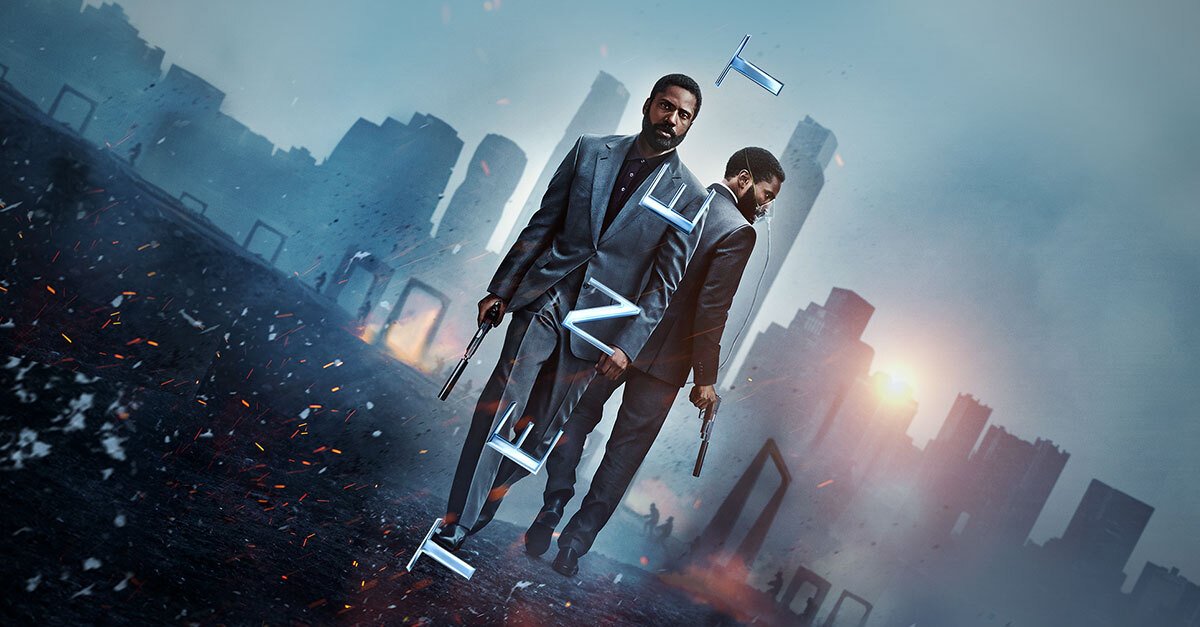
Finally there is TENET, the ‘troublesome’ one. But it is not troublesome. On one level it is a superbly produced spy story to match the experience of watching the most sophisticated pyrotechnics of the best Bond productions. However, that is not its real value. There are two strands running through the story.

The first is probably a sad reflection on the troubled conscience of Robert Openheimer, the subject of Nolan’s latest film, the genius behind the Atomic Bomb. Nolan read about  the wrangling of those people with this thing they unleashed. “How’s that going to be controlled? It’s just this most monstrous responsibility. Once that knowledge is out there in the world, what can you do? You can’t put the toothpaste back in the tube.” 

He further reflects on how he grew up in the postnuclear age. “We’ve grown up in the shadow of the ultimate destructive knowledge… To know something is to have power over it, generally, but what if the reverse is true, if knowing something gives it power over you?”

TENET is about two forces imagined to be from the future, the one trying to get control of the ultimate algorithm for ‘inversion’ – Nolan’s imagined invention – which can turn the world upside down, inside out, The other trying to negate it.

“To know its true nature is to lose,” says Dimple Kapadia’s character. “We’re trying to do with inversion what we couldn’t do with the atomic bomb – uninvent it. Divide and contain the knowledge. Ignorance is our ammunition.”  How prescient was Nolan in this, now that we are all worrying about what that force – which just a few years ago was in the future and is now present among us – Artificial Intelligence.

The second strand in the story is the battle Kat (Elizabeth Debicki), the villain Sator’s estranged wife, is fighting to  get back her son who is being kept from her by her husband. 

The denouement of the film requires you, I think, to again accept Nolan’s understanding that there is ‘a divinity that shapes our ends, rough hew them how we will.’

At the end of TENET, John David Washington’s Protagonist looks on as Kat meets her son at the school gate. The Protagonist’s professional partner, Neil, (Robert Pattison) in a voice over says mysteriously,

“…but it’s the bomb that didn’t go off….the danger no one knew was real…”

He then adds, again somewhat mysteriously, as the Protagonist, whose name we never know, watches Kat and Max walk away and the boy offers his mother his hand, 

“That’s the bomb with the real power to change the world.” 

What ‘bomb’? Motherhood? Family? Selfless human love and affection?

TENET grossed $58.5 million in the United States and Canada and $306.8 million in other territories, for a worldwide total of $363.7 million. With a production budget of $200 million, it is Nolan’s most expensive original project. Its relatively poor performance must surely be partly attributed to its untimely release to cinemas just as the pandemic panic was fading. 

Its complexity is a bit daunting but it is well worth the effort required to dig into that complexity.

CHRISTOPHER NOLAN AND THE QUEST TO UNDERSTAND

This post, the first of a three part series, examines the work of film director Christopher Nolan.

TENET was Christopher Nolan’s eleventh feature film, released to cinemas on the reopening of theatres after the pandemic restrictions were lifted in the US. Like other Nolan films – but even more so – it left many audiences scratching their heads with its very challenging interpretation of our relationship with time, space and technology. Nolan takes no prisoners when it comes to making demands on his audience. His motto is no less than this: “The only thing you can do is trust your initial instincts. You just have to say ‘This is what I’m making. This is what I’m doing. This is why I wrote this script.’ It is going to work. Just trust it.”

In all eleven films, not one of them has failed to repay that trust for anyone who really takes his oeuvre seriously. In a certain way, for anyone who places that trust in Nolan’s instincts, every one of explorations – for that is what they are – replicates the history of his first Hollywood release, Memento.

Tom Shone, in his fascinating study of Nolan, built around occasional interviews with him over practically the entire span of his career, tells the story of Memento’s creation and release.

Memento is a story, told backwards, of a man who after an assault in which his wife was murdered, has lost his short term memory. He is now hunting the perpetrator of the crime. 

After two years pitching Memento to studios and distributors, eventually getting it filmed grudgingly, it was finally released into eleven theatres. It took in $352,243 in its first week. Then word about it got around and in the second week it was in fifteen theatres, where it took in another $353,523. 

Among the distributors who had initially turned the film down, Shone tells us, was Harvey Weinstein’s Miramax. Smelling the coffee they then tried to buy the film. But now, in its third week, it was in seventy-six theatres, taking in $965,519. “Miramax could only watch as the film took off, spending four weeks in the top ten, sixteen in the top twenty, eventually playing in 531 theatres, a larger number of venues than even Jaws played in during the summer of 1975.” The film eventually made £40 million and got two Oscar nominations. They were a heady two years for Nolan, his brother Jonathan who had collaborated with him on the film, and his wife Emma Thomas who became his long-term producer.

After that came Insomnia and with that Hollywood’s “trust” in Nolan’s instincts – helped by his own canny and careful playing of the whole Hollywood machine – was no longer much of a problem. It just became a story of onwards and upwards. The next decade and a half saw this team making such blockbusters as Batman BeginsThe Dark Knight (2008), Inception (2010), Interstellar (2014), The Dark Knight Rises and Dunkirk (2017), between them earning $4.7 billion worldwide.

Michael Mann (HeatThe Last of the Mohicans), one of the dominant directors in Hollywood in the 1990s, says of Nolan, “He works within the system here in a very commanding way. He has large ideas. He invented the post-heroic superhero. He came up with an idea for a science-fiction heist inside the moving contours of a dreaming mind and he had the boldness and audacity to have that singular vision and make it happen. I think that the reason he has such a great response and great resonance with people is because he operates very much in the present, in the now. He’s tuned into the reality of our lives, our imagination, our culture, how we think, how we try to live. We’re living in a post-modern, post-industrial world with decaying infrastructure. Many feel disenfranchised. Seclusion is difficult. Privacy is impossible. Our lives are porous. We swim in a sea of interconnectedness and data. He directly deals with these intangible but very real anxieties. The quest to understand that and to tell stories from there, that is a central motivator for him, I think.”

The late British director Nicolas Roeg (Walkabout) said Nolan worked in the commercial arena and yet there’s something very poetic about his work. They’re marvellously disguised. Memento has this backward-running time scheme, and yet you automatically find yourself applying the situation to oneself, to one’s daily life, which is very strange.”

“Poetic” is a key element in Nolan’s work and this reflects the influence other poets of cinema and one great poet of the twentieth century have had on his work.

Echoing something that Michaelangelo is supposed to have said, Nolan maintains that “I’m definitely a subscriber to the school of thought that when the writer is working, or the filmmaker is working, it’s because you’re uncovering something, like the sculptor carving something away because it was always there.”

Nolan feels that what he does “is based more in artifice and abstraction and theatricality. I feel more of a craftsman than an artist…. I think there are filmmakers who are artists. I think Terrence Malick is an artist. Maybe it’s the difference between saying ‘are you using it to express something purely personal, that comes from inside that you’re just trying to get out there, or are you trying to communicate with people, and tap into their expectations and their experience.’” 

I doubt this distinction. Nolan and these film-makers are both poets and artists – or as Andrei Tarkovsky would have put it, “sculptors in time”.  For Nolan, Malick’s The Thin Red Line is one of the best films ever made. Tarkovsky’s Mirror was one of the influences, particularly in its theme of parent-child relationship, in the making of Interstellar. The only difference between Nolan and other great artists sculpting in time is that he can draw mass audiences to his work.

One of the most impressive things about Nolan as a person is how he never loses sight of the really essential things about our life in this world. 

He observes that “The Prestige was an important film in terms of work-life balance because we’d just had our third child and Emma, even though she loved the project, was quite keen to step back and not be as involved. She wanted to be able to take more of a backseat.” In fact she did not need to. They worked it out as a family. The Prestige was about two obsessive Victorian magicians who ruined their lives and their families because of their obsession. Everything that Nolan – or I should say the Nolans – has done connects with life and living our lives in this world.

Family again became an issue while making The Dark Knight. “The family were around for an enormous amount of the film, but Emma was pregnant with Magnus at the time. The last two months, I think, I was in England, finishing the film, and they had to be back here. I was able to be present for Magnus’s birth; I flew over, but I had to go right back to England and carry on the film. I spent about two months there. To this day, I think that’s the longest I’ve been away from them. I remember thinking, I know it’s more fun when we’re all together and we can do the thing together. That’s why we keep it as a family business. We were learning how to balance those things.”

Nolan communicates with his audience on the basis that it knows the truth: the world is simple. But it also knows its miseries. He sets out to make them wonder at that dichotomy. It would be depressing – if one were to go down Sartre’s existential rabbit hole. He doesn’t. “The reason it’s not”, he says, “is we want the world to be more complicated than it is. It’s pleasurable, because what it’s really saying is there’s more to this place than meets the eye. You don’t want to know the limits of your world. You don’t want to feel this is all there is. I make films that are huge endorsements of the idea that there’s more to our world than meets the eye.” 

That is exactly what poets try to do. 

T. S. Eliot has been one of the poetic and cultural influences in his life. Referring to Four Quartets, Eliot’s very Christian masterpiece about time and memory, he reflects, “I come back to that one a lot: 

Footfalls echo in the memory  

Down the passage which we did not take  

Towards the door we never opened  

Into the rose-garden. 

“It’s very cinematic. All of Eliot is. I think I first encountered Eliot through  Apocalypse Now, where Brando reads parts of The Hollow Men. When I first watched that film, I was so fascinated by that sense of madness and enigma. Then later I read The Waste Land, which absolutely confounded me. I love that poem.”

Nolan’s family and educational background is Catholic and Christian. He attended a thoroughly Catholic prep school run by Josephite priests, who ran a series of seminaries and boarding schools as far afield as the Democratic Republic of the Congo. That was followed by pre-university years boarding in an up-front Anglican high school. 

“At the time, it’s like you’re a bunch of kids and they’re the enemy,” says Nolan. “It’s like they’re trying to make you take it seriously and praying, and you’re sort of naturally reacting against that, not in any intellectual way or anything, but I come from that era, the seventies, when there wasn’t any doubt in anybody’s mind that science was supplanting religion.”

Significantly he adds, “Of course, now I’m not sure that’s the case. That seems to have shifted somewhat.” A transition in faith not unlike that of Eliot himself.

In the next post, I hope to look at some of the work Nolan has left us with so far, and in particular to show that those who find themselves bewildered by aspects of it should not be. But before we do that, we need to clarify one thing about Nolan’s use of images and concepts from science in the unfolding of the metaphors with which he shows us the world in which we live, or, scarily, might live. 

In The Divine Comedy, Dante describes Hell, Purgatory and Heaven to us in images created by him using the analogies available to him and his readers in his time. Both he and they knew that those supernatural realities were nothing, are nothing, like his description of them. His visions of them, however, still help us to understand our flawed nature, who we are and what may be in store for us in eternity. 

Nolan, in the imagery he offers us which asks us to think about time, space, the workings of the human mind does not purport to be anything other than reasonably consistent approximations of the science of those things. They are not scientific treatises. I think  people’s bewilderment to a great degree comes from thinking of them as such. The poverty of our poetic imagination in this modern – or postmodern – world often kills our capacity to see the truth of so much of what Nolan the poet-filmmaker is saying to us.

We eagerly await the release this Summer of his latest film, Oppenheimer, which will doubtless give us much more than a simple retelling of the story of the Manhattan Project.

This is a slightly modified version of an article published in the current issue of Position Papers.