
The folly of destroying an inheritance

In the February issue of the Irish-based magazine,  Position Papers, a review of Vandalising Ireland by historian and writer Eoin Lenihan was published. It was a kind of ‘call to arms’ in defence of an authentic Irish identity and nationhood. We might wish him luck. As the reviewer, Dr Tim O’Sullivan, implied, the sometimes sneering reception of the book in the mainstream media spoke volumes about the kind of culture-war vandalism Lenihan was calling out.

Sadly, those who treasure Ireland’s 3,000+ years of history and identity are a very despondent lot in contemporary Ireland—nor is there anyone in the present political or cultural landscape who looks remotely like a serious influence to counter the abysmal and destructive drift our nation is experiencing.

But it is not just a local issue confined to one nation’s historical heritage. It is a question of one nation or people being subsumed in an identity whose skewed values are poisoning and are pervading the dominant elites of Western civilisation.

In this platform some years ago, the point of view was advanced, admittedly not very original, that the Irish State could be seen as the 51st State of the American Union. What was new in that designation is that it was described as a politically very deep-blue state. Matters have got much worse in terms of our allegiance to the decadent progressivism of deep-blue US polities since that particular essay was posted.

The deep moral vacuum we see in Ireland today does nothing else but mirror the vacuum alarmingly described by a New York Times columnist, Ross Douthat, in a recent essay on the prospects for his country. He is not the only worried NYT columnist. Even the more left-leaning Ezra Klein is worried about it in the context of the compulsive power now being wielded by the dubious actors driving the runaway technological revolution, unimpeded by any restraining democratic agency. He articulated those concerns in a recent podcast discussion with a law professor and a prominent science-fiction writer.

Klein and his interlocutors, in the light of the plague of “Ragebait, Sponcon” (short for sponsored content), “A.I. slop”, asked what happened to the internet of 2026 “which makes a lot of us nostalgic for the internet of 10 or 15 years ago”. What exactly went wrong here? How did the early promise of the internet get so twisted? And what exactly happened to make it go so badly wrong? They rather hopelessly scratched their heads wondering what kinds of policies could actually make our digital lives more meaningful again.

They did not really have an answer.

The liberal-progressivist Matthew Yglesias takes issue, of course, with both these men searching for a better way forward—or a way back from a cliff, as they see it—to a more contented society. Yglesias thinks their concerns are bogus.

He sums up his rubbishing of their concerns in this way:

On December 7, for example, Ezra Klein linked his growing concern with the amount of time people spend on compulsive online scrolling with Michael Sandel’s longstanding communitarian critique of liberalism.

Michael Sandel is a Harvard political philosophy professor, recognised as one of the most influential modern-day political philosophers who has railed against what he considers the poisoning of US politics.

Yglesias continued by attacking Ross Douthat for touting an old reactionary critique of liberalism—“that what’s gained in wealth and freedom might be lost in alienation and anomie”—(that view) has “garnered new force in the last two decades because of a very specific interaction between technological change and libertarian values”.

Douthat takes his worries to an even more fundamental level than Klein. He goes straight for the jugular in his analysis and tentatively suggests an escape route from what he essentially sees as an existential dead end.

His core concern is what he describes as “the triumph of vice in American life”. He is not just talking about the moral hell-hole which swallowed up Jeffrey Epstein and his knowing associates. Douthat is talking about something much more pervasive.

The triumph of vice in American life—the haze of marijuana in our cities, the gambling apps pulsing in so many young male pockets, the success of OnlyFans layered atop the ubiquity of online porn—happened gradually and suddenly. Gradually in the sense that there was no one Supreme Court decision that made all the difference, no single presidential election that turned on legal pot or legal porn. Suddenly in the sense that a convergence of forces, legal and cultural and technological, had a turbocharging effect over just the past 10 years.

The denial of this decadent progression by left liberals like Yglesias has resulted in conservatives declaring the end of meaningful liberalism and the emergence of a new embryonic post-liberal society. Douthat challenges attempts, like that of Yglesias, to justify the old liberal philosophy and its political outcomes. Douthat unpicks the fallacy of Yglesias’s philosophy. The fact that liberal governments are obliged to “treat citizens as if they are atomised individuals”, Yglesias wrote, does not mean “that people should, in fact, be atomised individuals”. The liberal order allows for myriad social cures for hyper-individualism, all kinds of private sources of morality and meaning. It just does not impose a single one-size-fits-all model, because that way lies tyranny.

All of which seems to sum up why liberal progressivism is nothing less than a formula for utter moral and social chaos. The tyranny he imagines coming from conservative values bears no comparison with the tyranny of the ‘woke’ culture which gave us wholesale cancellation of any who dared to question their conventional wisdom.

Douthat continues: “I think that vice clarifies some ways in which this theory is naïve. In any society, politics is an arena for debates about the good life. The way the government taxes and spends and bans and regulates has a powerful effect on the behaviour of its citizens, and what the law allows or forbids has some effect—not decisive, but inevitably influential—on what ordinary people think and do. So if the law and the political theory underneath it treat people like atomised individuals, well, then people will inevitably behave more like atomised individuals, conceive of themselves more like atomised individuals and experience the ills of atomisation more acutely.”

He maintains that this is clearly part of what has happened with gambling and drugs and pornography. As our laws have become less moralistic and more libertarian, addictive behaviours have increased. An amoral understanding of liberalism has yielded, in a pretty direct way, to a more immoral society. . . .

He quotes Aaron Renn in a recent essay for The Wall Street Journal, who argues that in the US context it is fundamentally about the decline of Protestant Christianity as the core worldview in American life. That institutionalised generic Protestantism worked within and through liberal institutions before collapsing from the 1960s onward—which was when some kind of hell broke loose over a few generations, while complacent ‘boomers’ of the post-war generation complacently looked on.

Douthat feels that it is here that the stronger forms of religiously minded post-liberalism make their case, whether Catholic or Protestant. They argue that American liberalism was able to restrain vice only because of its religious inheritance; the secularising aspects of the liberal order have destroyed that inheritance; and so only an explicitly Christian politics that repudiates liberalism can restore the moral order.

But he is tentative about that. “If I had the answer,” he says, “I wouldn’t write so many open-ended newsletters on this subject (while urging my fellow Americans toward religion every chance I get).” That is a reference to his important recent bestseller, Believe.

So where does this leave Ireland? David Quinn’s (Irish Independent, 1 February 2026) unpicking of the cultural and religious travesty of the Irish State’s interpretation of the life and meaning of the country’s second patron, St Brigid, shows exactly where the country is going—straight into the abyss of post-Christian nothingness.

This is the legacy which Ireland’s pseudo-nationalist elite, installed firmly but hopefully not permanently in our political institutions and public service, is deliberately trying to bequeath to our country and people.

“Saint Brigid, we are informed,” Quinn wrote, was an “activist, healer and peacemaker”. We are shown images of suffragettes. We see pro-choice campaigner Ailbhe Smyth. We see activists holding up placards saying, “No banning family planning.” We see people celebrating in Dublin Castle the day the result of the same-sex marriage referendum was announced. We see a woman in a brightly coloured dress standing outside a church with a banner behind her opposing fracking. For some reason, the church is in Lagos, Nigeria. . . .

Far from the feminine being written out of history, what is happening now is that Christianity is being written out of Brigid’s story, and out of Ireland’s story, Quinn concluded.

Julian the Apostate, the Roman Emperor, attempted to reverse the decrees of his predecessor, Constantine, and restore the pagan gods as the moving spirits of the Empire. He failed miserably and died miserably on a battlefield somewhere in Asia. 

But we live in hope, indeed in Hope.  There is a Divinity that shapes our ends, rough hew them how we will.
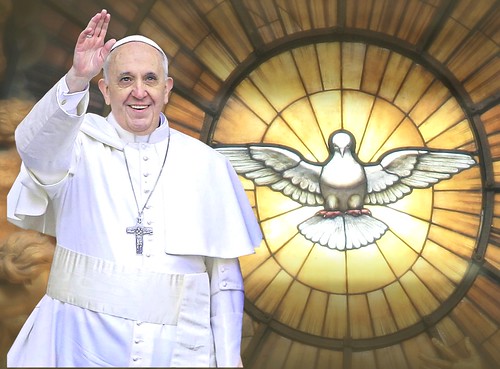
Misreading the heart and head of Pope Francis

David Quinn is, like a lot of us, amazed to read and listen to reports that essentially pit Pope Francis against the teachings of his own church. Writing in Friday’s Irish Independent, he parses the words of the Pope and equates his papacy more with that of Pope John XXIII, seen by many as a “liberal”, than with that of his two predecessors.

But was John XXIII a liberal? He was a Vicar of Christ, faithful in every detail to his Master’s teaching and the Tradition of His Church – that is tradition with a capital “T”, which should not be confused with tradition with a small “t” – just as his successors were and just as Francis most emphatically is. Both of them, John XXIII and Francis, very clearly distinguish between the two. Nor is there any evidence to show that any of the three popes (the short reign of the fourth, John Paul I, we leave aside for the purposes of this consideration)  who occupied the Chair of Peter between these two were in thrall to tradition with a small “t” either.

Is there any word more corrupted by usage than the word “liberal”? If liberal were really understood to mean what it is supposed to mean we could avoid a  great deal of confusion.  We would have no difficulty in accepting the actions of those who wish to preserve traditions that are good as equally free – in other words liberal  – as the actions of those who are prepared to discard traditions which have passed their sell-by date. Christ was a liberal in the truest sense of the word and anyone who claims to follow him should also be a liberal. He is the very ground of freedom, he is its author. It is on this ground that all five popes who are now the focus of so much speculation stand.

David Quinn attributes a great deal of the confusion which is now rampant to the “wishful thinking” of the liberals. But these “liberals” seem to live in a world, a fantasy world, where the word liberal means in many cases the contrary of what it really means. It really signifies a kind of slavery to their own ideological perceptions of the truth. It must be said that conservatives are guilty of a similar distortion of language and end up enslaved to the act of conserving regardless of the value of what they might be conserving. The liberality of valuing a free and open discussion is not the same as a “liberality” of compelling the endorsement of change driven by one particular ideology or way of seeing this world or the next.

John XXIII, David Quinn writes, was happy enough to see various aspects of church life and teachings discussed openly and a new approach adopted in certain areas but he was in no way a radical who supported a radical transformation of the church’s essential message.

The public are receiving an extremely skewed version of Francis. They hear that he said he does not judge gay people who are “seeking God”, but they do not hear that in the very next breath he said the Catechism explains the church’s teaching on homosexuality very well.

Whenever he criticises people in the church who are “rigid” it is widely reported. But when he criticises the opposite tendency, it receives far less coverage.

In his speech closing the synod on the family last weekend in Rome, the Pope spoke of both tendencies.

 On the one hand, he spoke of “a temptation to hostile inflexibility” which is “the temptation of the zealous, of the scrupulous, of the solicitous and of the so-called – today – ‘traditionalists’ and also of the intellectuals.”

Did he mean John Paul II by this? Did he mean Benedict XVI? No, he did not. After all, he recently presided over the canonisation of John Paul. Would he have presided over the canonisation of a man he believes was guilty of “hostile inflexibility”?

On the other hand, he spoke of, “The temptation to a destructive tendency to goodness that in the name of a deceptive mercy binds the wounds without first curing them and treating them; that treats the symptoms and not the causes and the roots. It is the temptation of the ‘do-gooders,’ of the fearful, and also of the so-called ‘progressives and liberals.'”

David catalogues some of the positions held by the “liberals” who would see themselves as allies of Francis – or, more likely, see him as their ally. In doing so he shows how far removed many of them are from reality. The positions they hold are profoundly at variance with the teaching of the Church which has been so clearly preached in countless sermons by this pope, even in his short reign so far. David Quinn explains:

They don’t believe in the hierarchy. They don’t believe that the church is “One, Holy, Catholic and Apostolic”.

They don’t believe Jesus founded an ordained priesthood, even indirectly.

They don’t believe that the bread and wine become the Body and Blood of Christ at the Consecration.

They don’t believe marriage is indissoluble, despite what Jesus taught. They don’t believe that marriage is by its very nature the sexual and emotional union of a man and a woman.

Some don’t even believe in the Incarnation. They don’t believe that Jesus rose literally and physically from the dead.

They dismiss all the miracles performed by Jesus and explain them away in purely naturalistic terms. (Question: if you believe God created the universe, isn’t it fairly trivial to then believe in the miracles of Jesus? After all, if God can create the universe, don’t you think he could turn water into wine, or multiply the loaves and fishes?)

Pope Francis is absolutely not a liberal in this sense. What he is simply trying to do is make the church’s message more convincing, that is, to present the Gospel of Jesus in a new way.

He knows that when many people think about the church’s teaching on relationships and sexuality, they think “harsh and judgmental”, even though you would be extremely hard pressed on any given Sunday to hear a priest preach about the family in a way that is even remotely harsh and judgmental.

You would also be hard pressed to find many people who even understand the church’s teaching on the family and why it thinks marriage is so important and why weakening that teaching, far from being an act of “mercy”, would in fact do a huge disservice to society.

The model for all Christians is Christ. The model for the Vicar of Christ on earth is, par excellence, the Good Shepherd. That model, preached explicitly by Christ, was lived in practice by him and that living example was recorded for us in a number of instances.

One was when he scandalized the Pharisees by dining with sinners – and we are not told that they were just considered to be sinners. He even dined with arrogant Pharisees. The scandal of the Pharisees many not be that far removed from the scandal of those shocked by the merciful words of Francis towards us in our struggles to live up to our faith.

Another was when he rescued the woman about to be stoned for adultery. In neither case did Christ say a sin was not a sin. In one he explained that he came to heal the sick, not the healthy. In the other, while he said “neither do I condemn you”, he also exhorted the woman to “go an sin no more”. He “welcomed” and loved all these people.

Pope Francis, in our time, is giving us all the living example of Christ. He is, as St. Catherine of Sienna said, “the sweet Christ on earth”. He is saying to us, “Go and do likewise.” He is giving us a great deal to think about – and for a bonus he has galvanised the attention of the world to the Word of God in a positive manner we have not seen since the early days of the pontificate of St. John Paul II.

Now you see it, now you don’t, now you see it again

A mystified David Quinn, Director of the Iona Institute

What is going on? Now you see it, now you don’t, now you see it again. Google has been involved in some sinister censorship – or perhaps they just blundered and then caught themselves on.

Late this morning the Irish Times in Dublin ran an online story that YouTube had terminated, without explanation or prior notice, the account of the Iona Institute, an Irish-based think-tank defending  the family, marriage, education and religion. Without giving any specifics the Institute got an email saying the the account had been closed “due to repeated or severe violations of our terms of service”.

By mid-afternoon the Irish Times story changed: the account was back in good standing again – but still without any explanations being given on the details of its mysterious death and resurrection.

Whether all this was a glitch or whether the furious cyber activity on Twitter which followed the Iona account’s demise caused Google to re-evaluate its censorious move we may never know. All attempts to prise information from the search engine have so far failed. Watch this space – but don’t hold your breath.

The only reason that David Quinn, the Director of the Institute, can give for the unilateral decision to terminate the account is that Google disapproved of a video which they have run on YouTube explaining the nature of marriage.

That they should have taken offence at this still mystifies him. There are many such video’s on the channel and why this one, not in any way offensive –  just soberly factual – does not make sense to him. Whatever the story, “all’s well that ends well”. Whether the Google gremlins behind this are likely to strike again we will have to wait and see.

“Unseemly rush to judgment”

Whipped-up fury

The unseemly – to put it mildly – opportunism of the pro-choice campaigners in Ireland and further afield is deeply disturbing in both its callousness and deceitfulness with regard to the tragic death of the young Indian woman, Savita Halappanavar, who died in a Galway hospital from the side-effects of a miscarriage earlier this month.

The pro-choice campaign – ably assisted by a swathe of national and international media, as pointed out by David Quinn in today’s Irish Independent – has not only rushed to judgemnt on what really happened in this case but has totally misrepresented the Irish law on abortion in dealing with the matter. They simply see this as a cause célèbre which they are going to make the most of to try to represent Irish law prohibiting abortion as a medieval and barbaric relic. Truth is once again being sacrificed on the altar of their relentless campaign to force the Irish Government to legislate for abortion.

The spin being put on the story from the time it first broke is that Savita Halappanavar died because she was denied an abortion. The truth is that this is not why she died.

As David Quinn points out:

We know this because if there was a need to end her pregnancy in order to save her life, then the hospital was free to do that. Nothing in law was preventing the hospital from doing so.

And to be absolutely clear, ending a woman’s pregnancy prematurely is not necessarily the same thing as abortion.

For example, inducing labour where it is necessary to save the life of the mother is not the same as abortion and Irish hospitals induce labour in these circumstances on a regular basis.

From the available facts, we know that Mrs Halappanavar was miscarrying and that she died within days of being admitted to hospital from septicemia and E Coli ESBL.

We do not know for certain whether ending the pregnancy upon her arrival in the hospital would have saved her life, but to repeat, if medical staff needed to do that they could have done it.

Therefore the ‘woman dies because she was denied abortion’ storyline is simply not true. The ‘woman dies because of Catholic opposition to abortion’ is also not true.

We simply do not know for certain at this stage whether Mrs Halappanavar would have died no matter what was done. This is what the investigation into her death will ascertain.

And we must also repeat for the umpteenth time that Ireland has one of the lowest maternal death rates in the world. It is lower than the British rate where abortion is available on demand.

In addition, it is necessary to remind ourselves that sometimes women die because of botched abortions in legal settings. Indeed, last year a doctor – Phanuel Dartey – was struck off in Britain because he nearly killed an Irish woman while performing an abortion on her in a Marie Stopes Clinic in the UK.

This story received remarkably little publicity here in Ireland. RTE did not cover it at all, whereas it has given the Savita Halappanavar story wall-to-wall coverage. Why this discrepancy?

And by what journalistic calculus did RTE decide to give so little coverage to the revelation by this newspaper that some staff at pregnancy crisis agencies in Ireland are giving women dangerous and illegal advice? It would be good to know.

There has been a tremendous and unseemly rush to judgment in this case.

In the same paper an opinion piece by Eílís Mulroy, one of Ireland’s leading pro-life advocates, quotes the comments of  Professor John Bonnar, one of Ireland’s leading gynaecologists, to a parliamentary committee some years ago explaining  that “In current obstetrical practice, rare complications can arise where therapeutic intervention is required at a stage in pregnancy when there will be little or no prospect for the survival of the baby, due to extreme immaturity.

“In these exceptional situations failure to intervene may result in the death of both the mother and baby. We consider that there is a fundamental difference between abortion carried out with the intention of taking the life of the baby, for example for social reasons, and the unavoidable death of the baby resulting from essential treatment to protect the life of the mother.”

It is clear that currently accepted ethical standards of medical practice in Ireland, if applied to this case, could not have been the cause of this sad death.  Something else was wrong here and we will have to await the results of the investigations now being carried out to find what precisely that was.