
The New Yorker is a world famous magazine, not least famous for the very quirky sense of humour of its very prolific team of cartoonists. But it is also famous for its long, very long, essays and articles. What it is not famous for is positive and sympathetic articles, long or otherwise about things Catholic. I’m not alleging it is anti-Catholic. Let’s just say you would not think of it as a place to go to reinforce your Catholic convictions.
For that last reason it was a great and pleasant surprise to find in a recent issue (April 17) a very balanced upbeat essay on a new and very encouraging Catholic educational and social initiative in the state of Ohio, USA. Its relevance stretches well beyond the state of Ohio.
The essay, by staff writer Emma Green, was long, indeed very long, – and fascinating to read – about a faith motivated venture, even adventure, which addresses not only a kind of black hole facing young people, particularly young males, in the essentially dysfunctional third-level US higher educational system today. Indeed it is a dysfunction paralleled in many Western societies.
What follows is an attempt at an abridgement of Ms Green’s very interesting description of this experiment.
Her essay begins with the story – so far – of a young man from Michigan, just across the Great Lakes from Ohio. His name is Brendan LaFave
Brendan grew up in a big Catholic family—the second-eldest of eight siblings living in a large house in Ann Arbor. He’s tall, with shaggy hair and an earnest manner, the kind of preternaturally thoughtful kid that adults love. He excelled at his Catholic high school, navigating calculus with ease, building sets for student theatre productions, and playing a box drum at worship events. But he also felt as if he had been born in the wrong era. His generation’s reliance on screens was making him miserable. After getting an iPhone in middle school, he spent several years “terminally on Snapchat and Instagram,” he said, which made his friendships with other kids feel shallow. “It just did a number on me,” he explained. “It caused a subtle depression.”
Brendan had plenty of options for after graduation; he had earned a nearly perfect score on the A.C.T. (standardized test for college readiness). But the University of Michigan did not attract him. He toyed with the idea of becoming a construction worker and just doing a lot of reading on the side. “I was very averse to the idea of college debt,” he said. “I had these ideas floating around about the spiritual life and pursuing the life of the intellect, and then working with my hands.”
As LaFave was thinking it over, he heard a discussion on a podcast. In it, a group of Catholic intellectuals discussed a new school opening in Steubenville, a small city in Ohio. Students would take classes on subjects such as the New Testament, advanced geometry, and rhetoric, and earn a liberal-arts degree in Catholic studies. At the same time, they would specialize in one of four trades—carpentry, electrical work, heating and ventilation, or plumbing—and work toward a certificate that signalled their expertise. The school was called the College of St. Joseph the Worker.
“We’re totally trying to call the bluff on the great divorce between the head and the hands,” Jacob Imam, the college’s founder, said on the podcast. His ambition is to reverse the idea that blue-collar work is no longer dignified. Unlike many other schools, which Imam described as keeping students contained in a “bubble,” the College of St. Joseph the Worker would expose students to the real world by having them work as apprentices, fixing up buildings and using their wages to pay their tuition and living expenses. The goal was for them to graduate debt-free.
For Brendan LaFave this seemed to tick all the boxes. He joined the first cohort of students, in the fall of 2024.
The college currently has sixty-two students. Imam’s diagnosis of the generation he is trying to reach is that after growing up online, young men seem to be more anxious and depressed than older generations, and in the worst cases they are incapacitated: nursing porn addictions, failing to launch, flirting with Holocaust denial. The College of St. Joseph the Worker was founded as a proposition that lost young men shouldn’t be condemned or written off.
“We find them on the internet,” Imam told Green. “We bring them here. And we say, ‘How about a life in reality instead?’ ”
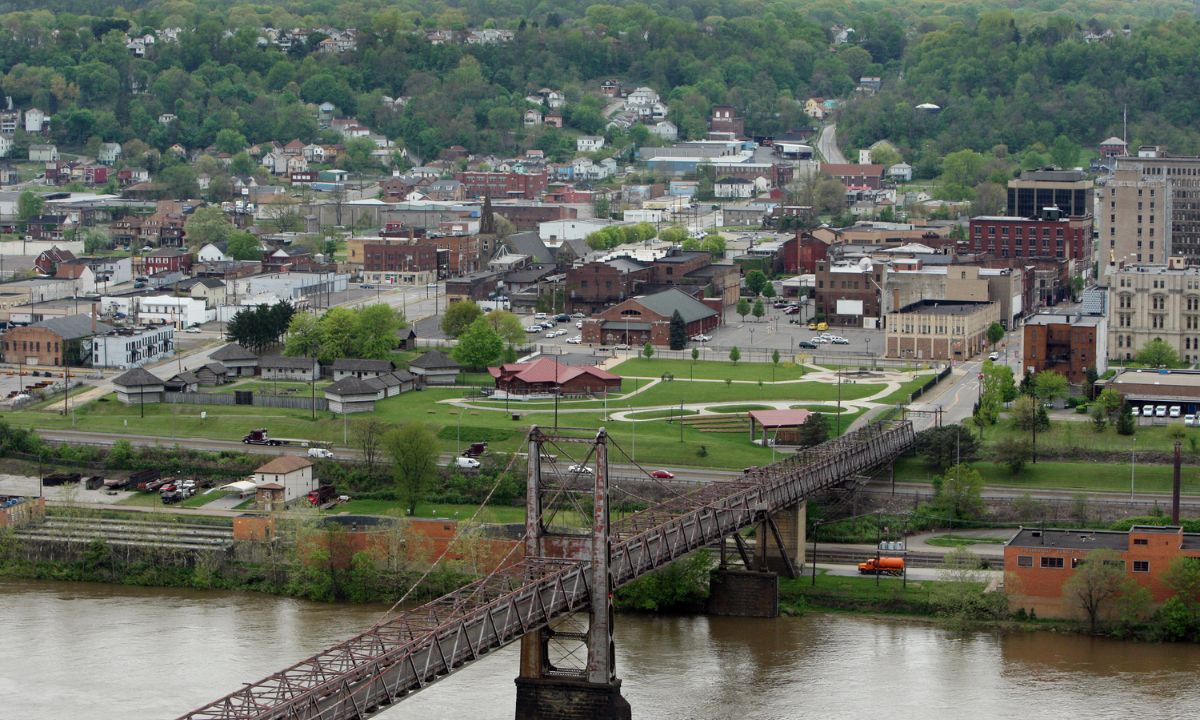
“Reality,” in this case, is Steubenville.
In the past half-century, Steubenville has quietly emerged as a paradise for big Catholic families. That is Emma Green’s description. In the nineteen-seventies, Franciscan University, a liberal arts college, was established on a hill above the downtown area. It was founded by the Third Order Regular of St. Francis, or TOR Franciscans. Now, across the Catholic world at least, it is universally identified as Steubenville University. One of its best known professors is the prolific author, theologian and Catholic new-evangelist, Scott Hahn

But now there is another Steubenville. It is this small College of St Joseph the Worker. Its campus is in downtown Steubenville, in a handful of run-down blocks around Fourth Street. As Imam said, the college aims to give its students an education that is not just about their work but about their lives—instilling in them a sense of purpose, restoring their feeling of competence, teaching them virtue. But it also exists to help rescue Steubenville from its rust-belt fate.
Marc Barnes, a thirty-two-year-old professor at the college, is the unofficial hype man of the downtown-revitalization effort. He first moved to Steubenville to become a student at Franciscan, in 2010. Then as now, many of the downtown buildings were boarded up. With barely any money, Barnes and roughly a dozen friends set about trying to bring some life back to Steubenville.
In 2017, Barnes temporarily left Steubenville to pursue a graduate degree in theology in England. A friend introduced him to Jacob Imam, who was in Oxford doing his own graduate studies. Imam was different from the scrappy Steubenville types with whom Barnes had spent his twenties. Unlike Barnes, who was born and raised Catholic, Imam had found his way to Catholicism later, after growing up in an interfaith household, with a Palestinian Muslim father and an evangelical mother. He was a consummate high achiever, a collector of mentors who quickly clocked him as a kid destined for great things. When he was in his first month of college, at Baylor University, a professor suggested that he apply for the Marshall and the Rhodes scholarships for postgraduate study in the U.K.
Barnes met Imam in a moment of soul-searching. Imam was headed toward a career in academia, but he felt queasy about participating in a debt-driven higher-ed system that can sometimes be more of a prison than a launching pad. “But I’m not inclined toward élite culture.” Barnes persuaded Imam and his new wife, Alice, to join the project in Steubenville, and the couple bought a house there in 2019.
For years, Imam had been nursing the idea that he might develop some of these ideas into something more concrete—a new kind of college.
Imam got initial donations from a few friends at Oxford, and eventually raised enough money to purchase the building that would become ‘the Workshop’—a vast, open warehouse with timber-filled bays. He made his first hires and began working on state approval.
The model of this remarkable college is work, study, prayer. Every morning, the students are encouraged to attend the eight o’clock Mass at the downtown Catholic parish. They have a full academic load, taking around three courses per quarter.
On top of this, the students practice their respective trades. The standards are high: students may get nearly twice as many instructional hours as what’s required by the state of Ohio. Students also spend a significant amount of time on worksites. Often, in traditional apprenticeships Last year, the college formed its own construction company, on the logic that it could give students apprenticeship opportunities and make money from jobs.
The college has so far bought up and started renovating more than a dozen buildings. The college’s students will be the ones doing this work. Just by being there, they have changed the town.
Imam has attracted some powerful patrons, such as Rick Santorum, the former U.S. senator from Pennsylvania and Republican Presidential candidate, who has introduced him to donors in the Catholic world. Santorum said that he sees Imam’s project as part of the fight to revive small-town America. “There are thousands of Steubenvilles, small towns that were once bustling industrial hubs, that are now really struggling,” Santorum told Green. “The very thing that made all these towns across America so successful, and knitted the communities together, was that combination of family and faith and industry—the village, if you will.”
The idea to have a college where students get a liberal-arts education, do physical labor, and pay their way is not new. Congress has awarded special funding to a handful of so-called Work Colleges for more than thirty years, and some small liberal-arts schools had work programs long before that.
However, the College of St. Joseph the Worker is distinct. It does not accept federal funding, including student financial aid; like many other conservatives, Imam believes that the federal government is too involved with education, and he wants the college to retain full control over its policies and curricula. The college also views skilled labor not just as an enriching experience on the way to a white-collar job but as a vocation. A core goal is to cultivate leaders on worksites, to be “the Harvard of this sort of thing,” Imam said.
In the world of higher education, there’s long been an insistence that college is for everyone, but this has resulted in many graduates unable to find suitable jobs; the employment prospects of English majors—or even computer-science grads—are looking increasingly grim. Meanwhile, there’s an acute shortage of skilled tradesmen around the country. Young people with these skills will likely be able to find well-paid work anywhere they want, long after many laptop jobs are made obsolete by A.I.
The college’s gift shop displays copies of “Shop Class as Soulcraft,” a 2009 book by the writer Matthew B. Crawford, which argues that the skilled trades require a level of mental and intellectual sophistication that often goes underacknowledged. “Because the work is dirty, people tend to assume it’s stupid,” Crawford said. Trade school is often talked about as an alternative to a four-year degree, but the discourse can be patronizing, with jobs in construction framed as an off-ramp for the kids who can’t cut it in real college. Crawford thinks that narrative is precisely backward: “There’s a burnout, and a sense of worthlessness, that hovers in the background of the laptop class—a kind of spiritual malaise.”
Perhaps it’s more generous to see the College of St. Joseph the Worker—along with the handful of other nascent Catholic trade schools that have recently popped up, in Michigan and Illinois and California—as a manifestation of America’s populist moment. Crawford maintains that “When you know how things work, how to repair them, how to build them in the first place, I think it gives you a little bit more of an independent ground to stand on against claims of expertise.”
In Steubenville there is a bookshop called Bookmarx (no irony intended). It is owned by John Kuhner and his wife, Catherine. Kuhner believes there will be people living in Steubenville in two hundred years. “Whether or not that means this bookstore will still turn a profit in four years—something like that is a different question,” he said. For now, his parish is lively and full of young families. His kids run up and down their block with friends their age. Sometimes, “you just feel like we’re camping out in the ruins,” Kuhner told me. “But I never feel without purpose here. And I never feel alone.”


