Revisiting a Modern Classic

Christopher Nolan has described it as the greatest war film ever made. I have not seen or read any elaboration by him of that opinion. It is not necessary. Not only isThe Thin Red Line a searing depiction of war, it penetrates to the heart of the struggle that is endemic in life itself.

One of the people who worked with him in the long process of making the film, Penny Allen has said of Terrence Malick’s oeuvre,

Terry’s work is all about the struggle for life. The fact that it’s a war film for me is only that it’s a metaphor for this and, in an odd way, I feel it’s true of all his films. He never judges people, as if there is nothing in Terry that is about existing morality in the conventional sense; it’s about man’s need for the spirit.

John Toll, his cinema photographer, said 

As much as any film I’ve ever worked on, this picture was about an idea. I believe that what Terry wanted the film to be about, most of all, was that the real enemy in war is the war itself. War  – not necessarily one side or the other – is the great evil. It isn’t often that one gets to work on films of this nature, and I’m grateful that I had the opportunity to participate in it.

There are two quotations, one from literature and the other from folklore which embody the phrase which gives the book by James Jones and Malick’s film its title. One is Rudyard Kiplings story Tommy, depicting the expendable private soldier fate in war:

 Then it’s Tommy this, an’ Tommy that, an’ “Tommy, ‘ow’s yer soul?”

  But it’s “Thin red line of ‘eroes” when the drums begin to roll,

  The drums begin to roll, my boys, the drums begin to roll,

O it’s “Thin red line of ‘eroes” when the drums begin to roll.

  • Tommy, Rudyard Kipling

The other is an old saying from the folklore of the midwestern United States.

There’s only a thin red line between the sane and the mad.

Both of them suggest something of the meaning of Mallick’s film, the second no less than the first. The madness of war, into which we see our world so disastrously embroiled even as we write, is a central theme in The Thin Red Line. But it is not just about the graphic portrayal of action on the World War II battlefield of Guadalcanal Island. It is also about the interior wars within a war as the main protagonists try to cope with this madness.

Two of the chief protagonists in Malick’s The Thin Red Line are Private Witt (Jim Caviezel) and Sergeant Welsh (Sean Penn). Their dialogue with each other,  as the skeptical Welsh tries to grapple with the reluctant but deep-thinking soldier, Witt, from beginning to redemptive end, are at the heart of Malick’s existential and spiritual vision of humanity.

Malick doesn’t talk publicly about his work. He doesn’t give interviews and he doesn’t do press conferences. But what he does do is talk to his actors and producers. Not only does he talk to them but he forms them and collaborates with them in creating the magnificent legacy of philosophy and cinematic art he is leaving us.

At the stage of his career by which he had produced his five masterpieces, Badlands, Days of Heaven, The Thin Red Line, The Tree of Life and To The Wonder, Faber and Faber published a book entitled Terrence Malick – Rehearsing the Unexpected. It was edited by Carlo Hintermann and Daniele Villa and consists of over 300 pages of reflective comments from multiple people who worked with Malick on all those films. In many ways it gives far more insight to the artist than you would ever get in press conferences or interviews with the man himself.

In everything they say you can see not only the artist, his vision and how it evolves, even on the set. You also see the profound influence, subtle but gentle, which he has on all those who work with him and how he draws out of them a powerful collaborative role in giving us the final product.

Jim Caviezel, speaking about the audition process in which he was selected for The Thin Red Line, his first (major) acting role, reflects something of this relationship.

It was a revelation to me, because I was a basketball player and all I ever wanted to do was play in the NBA. But I wasn’t given the gifts, I had to work very hard for what I have. I just took that work ethic and I applied it toward acting and that voice that was calling me to get into the acting profession led me eventually to this moment in time, to do this movie. When I met with Terry, I think he knew I felt uncomfortable because I had put myself out on a limb by giving his wife a rosary and I felt:

“Well, I just blew that audition.’

But he immediately tried to find a place where we both came from and made me feel comfortable around him. What impressed me about him, as I have gotten to know him, is that he has an extraordinary gift: Terry Malick has a mind that is extraordinary but he also has the gift of humility.

Caviezel went on to play Jesus to stunning and harrowing effect in Mel Gibson’s The Passion Of The Christ.

In casting Penn as the hard-nosed Sergeant Welsh it is clear that Malick knew his man.

Penn’s comment on working with Malick clearly shows the rather desperate vision he has of the battles we face in this world.

I haven’t met a non-desperate character on this earth, in some way … People are trying to balance their mortality, against their fears and their sense of themselves as men, as Americans – all of that stuff that’s dealt with in The Thin Red Line; all that balancing against the mysteries: ‘Is there somebody up there, is there not?’ And short of the knowledge of that, there’s some desperation. And war is as desperate as men can get. 

Malick, as Penn saw him, was concerned with the way that we are innocent, concerned with the way that we’re damaged, with the way that we’re cruel, the way that we love – he’s concerned about all the things that represent our lives. And I do think that he is a real poet among academics. ‘Cause he’s both. He’s a very complicated guy.

Ben Chaplin, who plays the troubled Private Bell also perceived Malick’s deepest preoccupations.

In all Malick’s films there’s almost always this question about original sin.

Do we have this thing in-built, this ability, this desire to kill, to destroy what’s around us? How can we maintain an innocence?

To a certain degree, they are all about the loss of innocence. And that loss of innocence is inevitable as soon as a child learns to speak. It’s like the garden of Eden with the apple: if the apple’s there you are going to try it. I suppose that’s what his films share.

As in any war, death is always a presence. The conversations which Witt and Welsh have elicit this reflection from the private about  death and immortality.

I remember my mother when she was dying.

Looked all shrunk up and grey. I asked her if she was afraid.

She just shook her head.

I was afraid to touch the death I seen in her.

I heard people talk about immortality, but I ain’t seen it.

I wondered how it’d be when I died.

What it’d be like to know that this breath now

was the last one you was ever gonna draw.

I just hope I can meet it the same way she did.

With the same … calm.

Cos that’s where it’s hidden – the immortality I hadn’t seen.

He reflected further that many times in our lives we are all afraid of death and most of us don’t want to talk about it, or be near it, but we are all going to end up there some day. He interpreted his character in the film as having a transformation in his soul after spending some time living with the natives on the island. 

There, he said, Witt saw beauty, peace and love; he had received grace in his heart. And that grace equates with God and the grace filled him and made him. But he saw something greater in Heaven than he did on this earth, that there’s another life out there, that you can start living in heaven now, even in hell, and war. And that was a gift that was given to him and that grace keeps growing in him because he keeps finding ways to save men. 

It’s easy to love people when they love you – but what if they hate you? Love your enemies … he concluded.

Mike Medavoy who played a central role in the production of The Thin Red Line said of it afterwards, 

I found the film to be very poetic, very religious: you almost have a Christ figure giving up his life for everybody else, for the rest of the guys. I thought it captured World War II in that venue very well. And, well, for me that character is Terrence Malick.

Sean Penn summed it up this way: The importance of Malick is just showing that it’s okay to put a couple of thoughts into a picture… in a culture that doesn’t. I think it’s really simple: he’s an artist and we need art.
THE SEARCHING SOUL OF INGMAR BERGMAN

Back in the late 1950s and 1960s the film-maker Ingmar Bergman’s prestige and reputation were at their height. In those years anticipation of the next Bergman film to arrive in cinemas was akin to the anticipation today of the next film from Christopher Nolan or Terrence Malick. They were the works which dominated cultural conversation for months after their release. Why was that? 

In a word I think we can say it was all about ‘meaning’ – man’s search for meaning, the mystery of human and divine love and the existence of God.

Bergman’s language, the visual language  with which he explored this overriding universal theme, was full of symbolism. Indeed, even at that time, symbolism was so central in his language that some whose literacy was less developed, felt the symbolic imagery was somewhat overwrought. That was nonsense. Sadly, however, that illiteracy seems to have increased.

Pope Francis, in his Apostolic Letter of 2022,  Disiderium desideravi, quoted Romano Guardini about the importance of liturgy as our path to God and the importance of symbols in liturgy. Guardini  wrote of what he saw as “the first task of the work of liturgical formation: man must become once again capable of symbols.” The Pope pointed the finger at us all in this regard: “This is a responsibility for all, for ordained ministers and the faithful alike. The task is not easy because modern man has become illiterate, no longer capable of reading symbols; it is almost as if their existence is not even suspected.” Strong words.

Moving back to Bergman’s work, here are even stronger words from Lawrence Brooks – a disaffected figure in the Hollywood ecosystem:

“95% of film directors are so dumb that the very idea of including symbolism in their movies is beyond their capabilities.”  Most film directors are just “trying to get the job done on time, on schedule. Messages & Symbolism in modern film? Ha! People like Fellini, Bergman, Kurosawa, Fincher, Nolan, and Kubrick are very rare indeed.” 

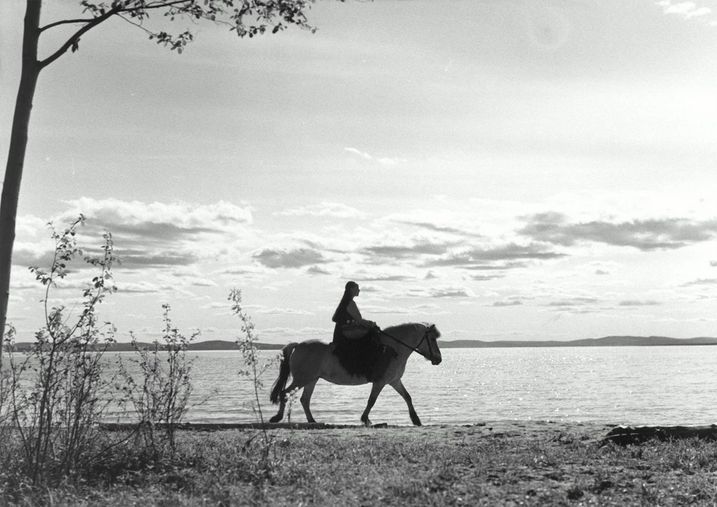
Bergman’s three great early films, The Seventh SealThe Virgin Spring and Through A Glass Darkly, even in their titles are all dependent on our capacity to read symbols if we are to have any chance of understanding what they are about. They are all deeply religious works. Much of his later work, while ultimately leading to questions of human fulfilment, are not explicitly religious. These are.

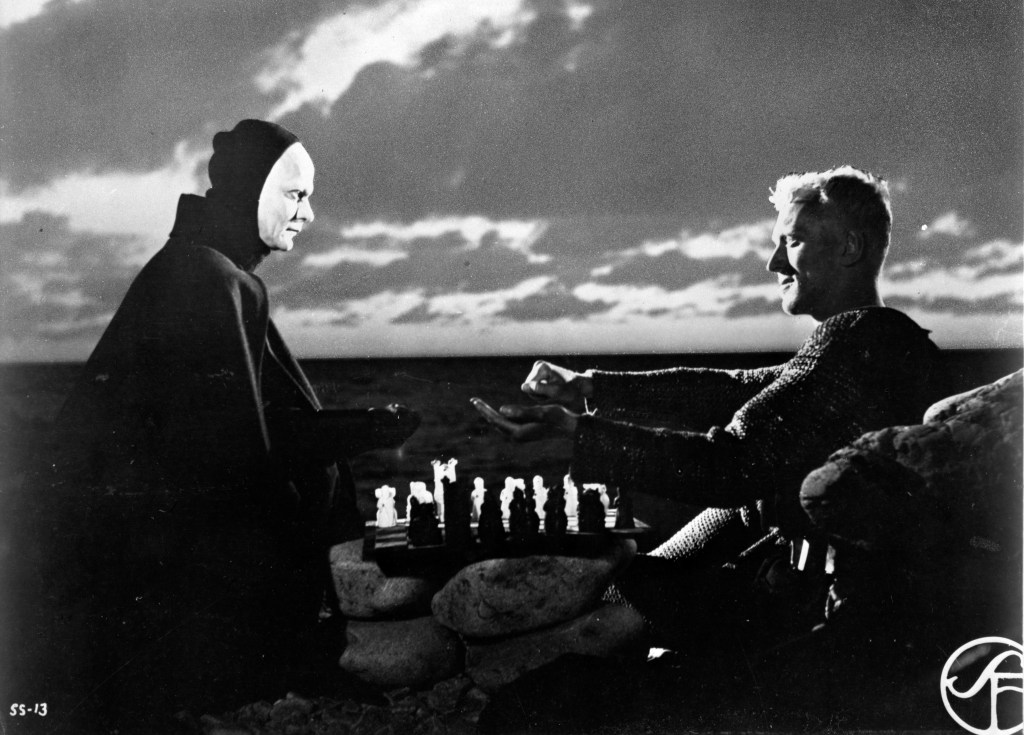
The Seventh Seal  tells of the journey of a medieval knight (Max von Sydow) and a game of chess he plays with the personification of Death (Bengt Ekerot) who has come to take his life. In The Book of Revelation the Lamb breaks open seven seals. “And when the Lamb had opened the seventh seal, there was silence in heaven about the space of half an hour.” The motif of silence refers to the “silence of God,”, the silence with which the knight is struggling and which is threatening to destroy his faith throughout the film. 

The two powerful iconic images in the film are those of Death playing that game of chess with the knight – which continues at intervals throughout the film – and the final image of the Dance of Death. Both these images are visible today in two different churches in Sweden, both Lutheran but both formerly Catholic.

Another writer from the Hollywood ecosystem, Rick Manly of the University of California, wrote of this film, “With its images and reflections upon death and the meaning of life, The Seventh Seal had a symbolism that was immediately comprehensible to people trained in literary culture who were just beginning to discover the ‘art’ of film, and it quickly became a staple of high school and college literature courses.”

British cultural broadcaster, Melvyn Bragg,  wrote of Bergman’s  work: “It is constructed like an argument. It is a story told as a sermon might be delivered: an allegory…each scene is at once so simple and so charged and layered that it catches us again and again…Somehow all of Bergman’s own past, that of his father, that of his reading and doing and seeing, that of his Swedish culture, of his political burning and religious melancholy, poured into a series of pictures which carry that swell of contributions and contradictions so effortlessly that you could tell the story to a child, publish it as a storybook of photographs and yet know that the deepest questions of religion and the most mysterious revelation of simply being alive are both addressed.”

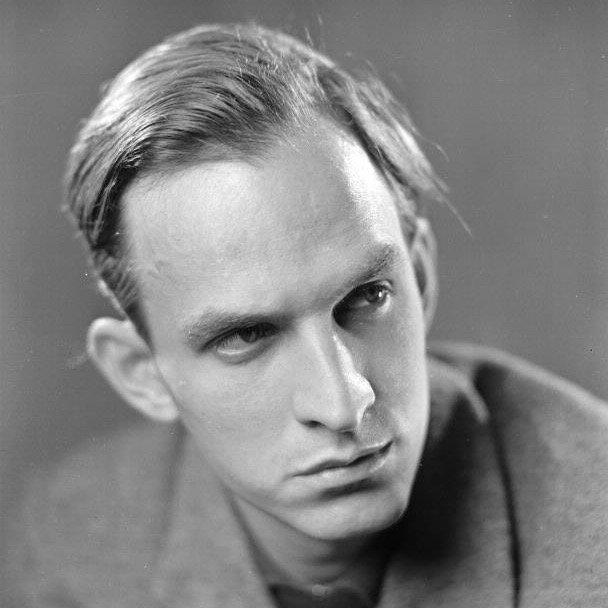
Ingmar Bergman

Benjamin Ramm is a journalist who writes for the BBC and other media. He argues that It’s not right that Bergman is always described as dark and gloomy. He was a deeply humane artist with great empathy. Bergman’s primary theme, he says, is not death but the redemptive possibility of love.

F. B. Myer, a Baptist pastor, writing  in light of World War I and the sufferings and sorrows that many endured during that time, refers to death as a sister and the enduring comfort and strength that God provides throughout the trials which may accompany it. The shrouded figure accompanying our protagonist throughout The Seventh Seal is spoken of as the personification of Death. In fact we realise at the very end of the film, as the young girl who had been rescued from a vicious attacker, looks and smiles at the face of the shrouded figure, that she is looking at the face of her Redeemer. What in fact is Death but a manifestation in our lives of the Providence of God? The dancing company of pilgrims silhouetted against the sky, following this figure, are on their way to eternity. All of them are people who have struggled against adversity of one kind or another. They are all good people now dancing to their eternal reward.

Another rich vein of symbolism in The Seventh Seal is seen in the figures of Jof and Mia with their infant child. The knight appears to shield them and let them go off unharmed by his shadowy chess opponent whom he assumes wants to harm them. Read it as you wish but his opponent is not taken in by the tossed-over chess board. He is aware of a greater mission to the world of of which this family is a symbol.

The Seventh Seal is an immortal work which ranks as one of the greatest achievements which the art of cinema has left us. It ranks in its own canon as Bach’s Mass in B Minor ranks in the musical canon.

In Benjamin Ramm’s view, what makes Bergman radical is his unfashionable sincerity.

“In over 60 films in a career spanning six decades, Bergman charted the harrowing cost of what he called ‘emotional poverty’. His work in all its variety is arrayed against the cynical, clinical, calculating, careless, and callous; he decries our lack of compassion and our “empty but clever” irony. What makes Bergman radical in our own era is his unfashionable sincerity, which leaves him open to mockery and parody”

Two other films, The Virgin Spring (1960) and Through a Glass Darkly (1961), both of which received Academy Awards, along with The Seventh Seal, constitute a kind of ‘faith trilogy’ in Bergman’ s work . The title of the 1961 film is a reference to St Paul’s first letter to the  Corinthians (13.12).

The Virgin Spring is set in medieval Sweden, It is a tale about a father’s merciless murder of two men and an innocent child implicated in the rape and murder of his young daughter. The story was adapted from a 13th century Swedish ballad well-known throughout Scandinavia. But it is not just a revenge tale. It is the story of the father’s response to a miracle on the site of his daughter’s murder in which a spring gushes forth from the dry forest earth. The father falls on his knees and asks God’s forgiveness for his own vengeful and sinful crime of murder. Bergman was himself a troubled soul – but then so was King David.

Through a Glass Darkly is a story, in a modern setting, about a troubled family group in which the daughter, Karin is suffering from intermittent symptoms of schizophrenia. Meanwhile (spoiler) her brother Minus is at emotional odds with his father, David. They seem not to be able to talk to each other. They are living on an isolated island and when Karin has a relapse she is taken off by helicopter to receive medical attention. At that point father and son help each other and Minus tells his father that he is afraid that he also may be losing his grip on reality. He asks his father if he can survive that way. David tells him he can if he has “something to hold on to”. He tells Minus of his own hope: love. David and his son, quoting Sacred Scripture, discuss the concept of love as it relates to God. They find solace in the idea that their own love may help sustain Karin. The ice is broken and Minus is exultant that he finally had a real conversation with his father. 

Bergman was not entirely happy that he had achieved his artistic and religious objective with this ending. He felt he had not fully expressed the truth he wanted to convey and that the optimistic epilogue was “tacked loosely onto the end,” causing him to feel  “ill at ease” when later confronted with it. He added that “I was touching on a divine concept that is real, but then smeared a diffuse veneer of love all over it.”

Through a Glass Darkly is a more complex story than the other two and while rich in symbolism is also influenced by neo-realism. Despite his reservations It is profoundly moving.  Among Bergman’s 60+ films it ranks as one of his definitive masterpieces.

The Life and Art of Andrey Tarkovsky

Part II

Romanov, Yermash, Sisov and all those within the decaying soviet totalitarian system were bereft of ideas and their only guiding principle was to try and not make mistakes which superiors might deem contrary to Bolshevism – which they themselves probably did not even understand. The removal of Romanov was just one symptom of this.

Out of these early contradictions and the pressures with which Tarkovsky had to contend to get his films made, he forged the artistic and creative principles by which he knew he had to work. In 1970 he wrote:

One doesn’t need a lot to be able to live. The great thing is to be free in your work. Of course it’s important to print or exhibit, but if that’s not possible you still are left with the most important thing of all – being able to work without asking anybody’s permission. However, in cinema that is not possible. You can’t take a single shot unless the State graciously allows you to. Still less could you use your own money. That would be viewed as robbery, ideological aggression, subversion.

Stalker, Tarkovsky’s last film made in the Soviet Union, is based on Roadside Picnic, a story by the Strugatsky brothers. But in Tarkovsky’s hands it probes the depths of what the film-maker saw as the fundamental crises of the modern world: the rift between natural science and belief; the future of mankind living with the atomic bomb; and, ultimately, the dim glimmer of hope still left to man.

The dream sequence in Stalker

What these four films (Andrey Rublev, Solaris, Mirror and Stalker) up to this point revealed – and his enemies in the system sensed this, but did not understand it – was Tarkovsky’s Christian faith and his realisation of the totally corrupting influence of Marxist materialism. Mirror, so beautiful but equally obscure to them, was more personal. But they also hated it. However, by now his international acclaim was such a huge factor that their obnoxious treatment had to be camouflaged.

In his diaries at that time he revealed his soul and his devastating critique of the system he lived under.

By virtue of the infinite laws, or the laws of infinity that lie beyond what we can reach, God cannot but exist. For man, who is unable to grasp the essence of what lies beyond, the unknown – the unknowable is GOD. And in a moral sense, God is love.

His reading of Marxism and the faltering regime he had to try to live and work under is summed up as follows:

Man is estranged. It might seem that a common cause could become the basis of a new community; but that is a fallacy. People have been stealing and playing the hypocrite for the last fifty years, united in their sense of purpose, but with no community. People can only be united in a common cause if that cause is based on morality and is within the realm of the ideal, of the absolute…Because each one only loves himself… Community is an illusion, as a result of which sooner or later there will rise over the continent evil, deadly, mushroom clouds…An agglomeration of people aiming at one thing – filling their stomachs – is doomed to destruction, decay, hostility. 

‘Not by bread alone,’ he concluded.

Elsewhere he said, materialism – naked and cynical – is going to complete the destruction.

Despite the fact that God lives in every soul, that every soul has the capacity to accumulate what is eternal and good, as a mass people can do nothing but destroy. For they have come together not in the name of an ideal, but simply for the sake of a material notion… Man has simply been corrupted…. Those who thought about the soul have been – and still are being – physically eliminated.

In watching a Tarkovsky film one has to take note of the way in which he wants viewers to respond. In this we are not far from Christopher Nolan’s expectations of his audiences. Nolan Admired Tarkovsky and his work, and particularly Mirror.

Tarkovsky described what he saw as a basic principle of film-making… the mainspring is, I think, that as little as possible has actually to be shown, and from that little the audience has to build up an idea of the rest, of the whole. In my view that has to be the basis for constructing the cinematographic image. And if one looks at it from the point of view of symbols, then the symbol in cinema is a symbol of nature, of reality. Of course it isn’t a question of details, but of what is hidden.

Like Nolan, Tarkovsky makes demands on his audience. Viewers have to, as it were, learn a cinematic language which mainstream Hollywood does not teach or even know.

The battles for distribution continued with Yermash. But there were some signs of a thaw and Tarkovsky was eventually able to make two films abroad, one in Italy and one in Sweden.

He began to see his battles as a cross Christ asked him to bear. He wrote of the Cross and identified his woes with Christ’s Cross. At one point he saw himself facing two years of misery: with Andriushka at school; and Marina, and Mother, and Father. It is going to be hell for them. What can I do? Only pray! And believe.The most important thing of all is…to have faith in spite of everything, to have faith.

We are crucified on one plane, while the world is many-dimennional. We are aware of that and are tormented by our inability to know the truth. But there is no need to know it! We need to love. And to believe, Faith is knowledge with the help of love.

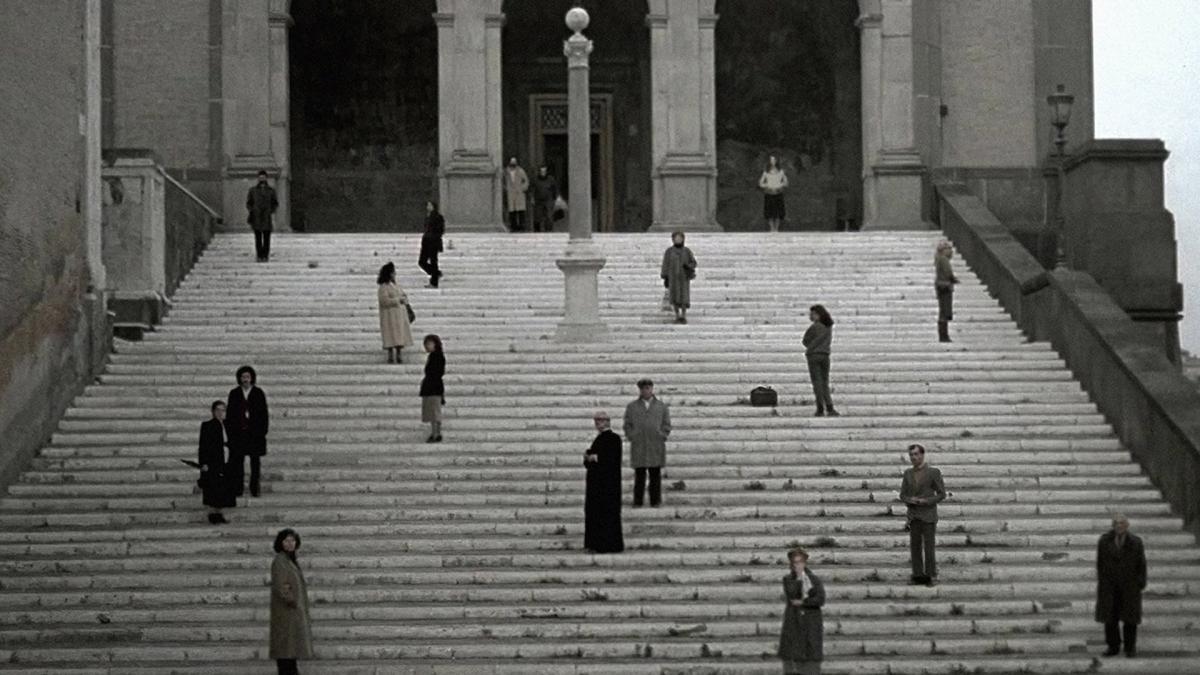
Tarkovsky was allowed to travel to Italy in the 1980s to shoot Nostalgia. This was a Soviet-Italian co-production. The theme is, however, typical of the Russian dilemma: that of the artist abroad, smitten by homesickness, unable to live in his country or away from it — the very fate that befell Tarkovsky himself in the last years of his life. It was even more painful still for him because the authorities restricted the movement of his family and starved him of financial support. It was not until the end of his life that they allowed his young son, Andriushka, to be with him.

His time in Italy in 1980, apart from the creative work he did there on Nostalgia, was spiritually enriching for him. Two extraordinary events in particular highlight this. One was his visit to the Holy House in Loreto. Of this he recorded something very personal in his diary.

An amazing thing happened to me today. We were in Loreto where there is a famous cathedral (rather like Lourdes) in the middle of which stands the house in which Jesus was born (sic), transported here from Nazareth. While we were in the cathedral, I felt it was wrong that I can’t pray in a Catholic cathedral; not that I cannot, but that I don’t want to. It is, after all, alien to me. Then later, quite by chance, we went into a little seaside town called Porto Nuovo, and into its small, tenth century cathedral. And what should I see on the altar but the Vladimir Mother of God.

Apparently some Russian painter had, at some time, given the church this copy of the Mother of God of Vladimir, evidently painted by him.

I couldn’t believe it: suddenly to see an Orthodox ikon in a Catholic country, when I had just been thinking about not being able to pray at Loreto.

It was wonderful.

The second event he recorded as follows:

Today I relaxed while Tonino finished dictating his script. I went to St. Peter’s Square. I saw and heard the Pope’s appearance in front of the people-the crowd filled the entire square with flags, banners and placards. It’s odd that although I was surrounded simply by large numbers of curious people, such as foreigners and tourists, there was a unity about them which impressed me deeply.

There was something natural, organic in it all. It was obvious that all these people had come here of their own free will. The atmosphere reigning in the Square made that perfectly clear.

I also felt it was wonderful that as I was wandering round the streets, before going by chance into St. Peter’s Square, I had been thinking that today was Sunday and what fun it would be when I got back to Moscow to be able to say that I had been present at a Papal audience at the Vatican. 

He also recorded some moments of prayer in his diaries. One such was this conversation with God:

Lord! I feel You drawing near, I can feel Your hand upon the back of my head. Because I want to see Your world as You made it, and Your people as You would have them be. I love You, Lord, and want nothing else from You. I accept all that is Yours, and only the weight of my malice and my sins, the darkness of my base soul, prevent me from being Your worthy slave, O Lord!

These thoughts of death – he was never really in good health – were noted when he was battling with the authorities over the content of Stalker, a film in which the protagonist seeks unsuccessfully to open the minds of his two pilgrim companions to the meaning of our existence:

If God takes me to himself I am to have a church funeral and be buried in the cemetery of the Donskoy Monastery. It will be difficult to get permission. And no one is to mourn! They must believe that I am better off where I am. The picture is to be finished according to the pattern we decided for the music and sound. Lucia must try and tidy up the end of the bar scene. ‘The Room’ should include the new text from the notebook (the sick child) plus the old one, written for the scene after the ‘Dream’. 

At the end of 1985, after the release of Nostalgia, again to international acclaim, he completed the shooting of his last film, The Sacrifice, in Sweden. Described as a parable by Tarkovsky, the story revolves around a family awaiting an impending nuclear catastrophe in a remote Scandinavian seaside location. The paterfamilias prays and offers himself to God as a sacrificial victim to save the world from the impending disaster. It is a profoundly mysterious, reflective and beautiful work, regarded by some as the artist’s masterpiece.

 Andrey Tarkovsky returned to Rome after completing it. Already afflicted by the cancer to which he succumbed a year later, he died on 29 December 1986, at a Parisian clinic. His last diary entry was made on 15 December. He is buried in a graveyard for Russian émigrés in the town of Saint-Geneviève-du-Bois, France.

The Extraordinary Life and Art of Andrey Tarkovsky

Part I

What is it about Russia? What is it about her creative artists? To a man they love their country but to a man – with very few exceptions – particularly for the past century – they have been persecuted by their country’s rulers. Her great composers in the modern age, Prokofiev and Shostakovich, had to tread very carefully and tailor their work to please the political masters. Her great ballet artists had to flee Russia to express their genius freely. Above all, her great writers of the past hundred years suffered unspeakable indignities. Even today the number one persona non grata is Mikahil Bulgakov even though he died over 70 years ago. Why? Because ordinary Russians are flocking to cinemas to see a film version of his magnificent anti-Stalinist novel, The Master and Margarita. This has been made by an expat Russian and is now being interpreted as an anti-Putin satire.

Hannah Arendt, in her master work, The Origins of Totalitarianism, while recognising the post Stalinist communist system as one of dictatorship, did not see it in 1966  as totalitarianism. It lacked the quality of complete domination and while vicious, was but a crumbling edifice, a shadow of its former self.

Arendt wrote in 1966:

“The clearest sign that the Soviet Union can no longer be called totalitarian in the strict sense of the term is, of course, the amazingly swift and rich recovery of the arts during the last decade. To be sure, efforts to rehabilitate Stalin and to curtail the increasingly vocal demands for freedom of speech and thought among students, writers, and artists recur again and again, but none of them has been very successful or is likely to be successful without a full-fledged re-establishment of terror and police rule. 

“No doubt, the people of the Soviet Union are denied all forms of political freedom, not only freedom of association but also freedom of thought, opinion and public expression. It looks as though nothing has changed, while in fact everything has changed. When Stalin died the drawers of writers and artists were empty; today there exists a whole literature that circulates in manuscript and all kinds of modern painting are tried out in the painters’ studios and become known even though they are not exhibited.”

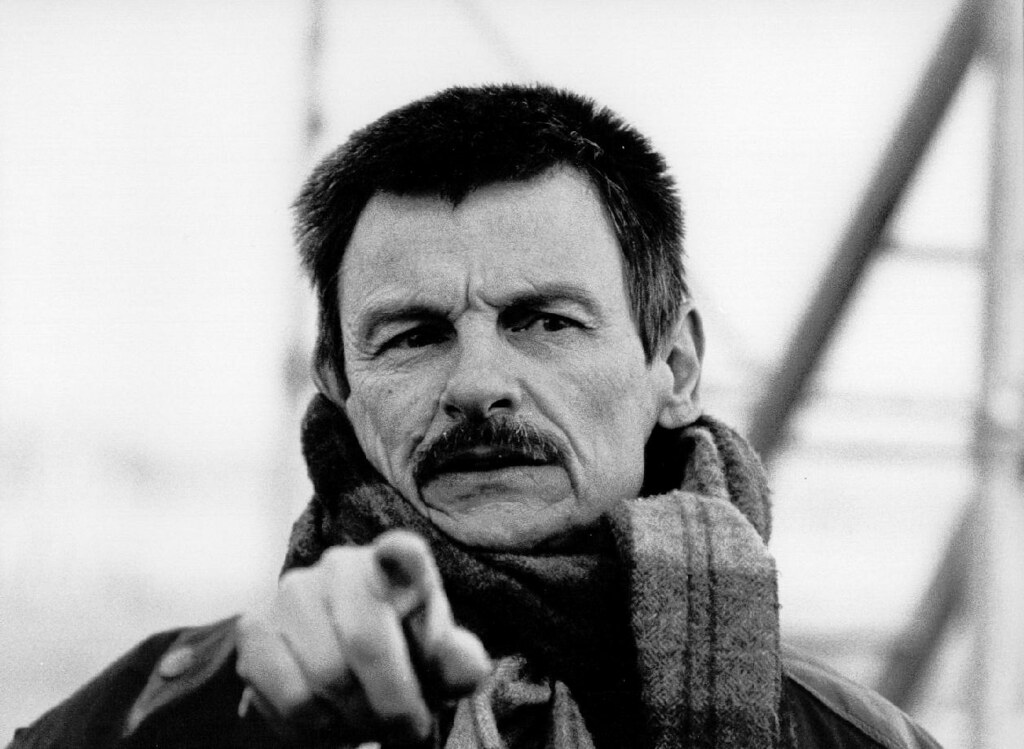
In the world of creative cinema, one of the saddest stories of all is that of Andrey Tarkovsky. Tarkovsky was born on 4 April 1932, probably the darkest decade in Soviet history. His mother, Maria Ivanovna, was a talented actress, and his father, Arseniy Tarkovsky, a respected poet and translator. Both his parents have featured in his work. His mother had a central role in his masterpiece, Mirror. The haunting poems of his father were used in several of his films.

In addition to regular classes at school he began to study music and drawing. In 1954 he successfully applied for admission to the prestigious All-Union State Institute of Cinematography (VGIK) in Moscow.

Tarkovsky’s first major feature film, Ivan’s Childhood, was shown in Moscow in April 1962. This was a haunting and tragic story, beginning idyllically in pre-World War II Russia and then descending into horrors of that war. The story focuses on the evil of war and how it turns Ivan’s childhood into a monstrous nightmare.The film won the Venice Festival’s Golden Lion in that year and drew the attention of the world to the thirty-year-old director.

It also drew the attention of the Soviet authorities, creating an expectation that here was an artist who could serve their propaganda purposes. They were to be bitterly disappointed. The long and bitter harassment of Tarkovsky began at this point. His diaries, dating from 1970 up to just a couple of weeks before his early death in 1986, record the details of this struggle, as well as the creative instincts and the deep religious consciousness from which they sprang. That this consciousness could be nurtured by his mother in the terrifying environment of Stalinist Russia is one of the most extraordinary things about this man.

The trouble began around the end of 1966, with the begrudging release of his second film, the three-hour long Andrey Rublev. Initially his ideological masters did not seem to know what to make of it. But soon the penny dropped. It attracted international attention and with the critical interpretation of its themes, the apparatchiks realised they had a problem on their hands. They still wanted him to work for them, but on their terms. This effectively turned his working life into something like a living hell. 

Andrey Ruble

Of his battle to have the film released he wrote:

Late yesterday evening E. D. rang and said that Chernoutsan just telephoned him: Suslov signed the document for the release of Rublev immediately after the Congress. I must find out from K straightaway which cinemas and how many copies. Of course the Committee insists on cuts.  I’ll tell them to go to hell. So I must contact A. N. Kosygin as soon as possible. He apparently wanted to meet and spoke highly of the film.

Kosygin was Russian Prime Minister from 1964 to 1980.

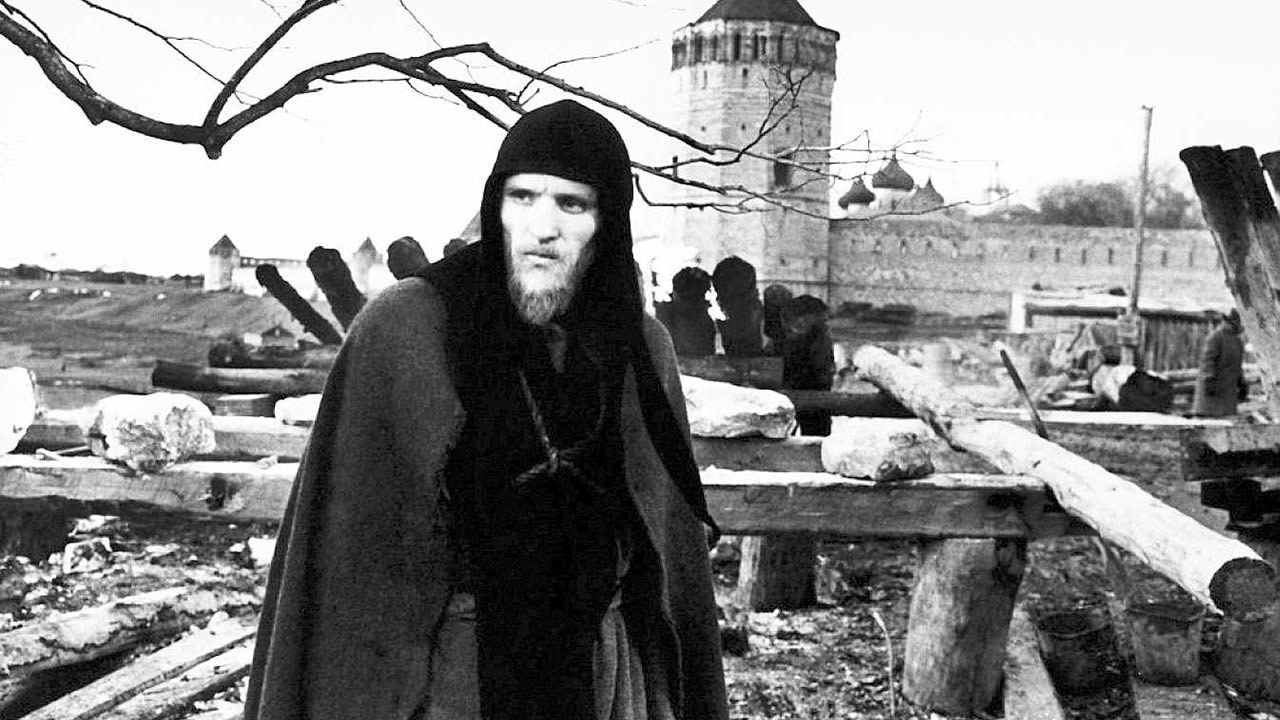
Andrey Rublev is structured in three parts and features the life and work of the great Russian icon painter of that name. One of his most famous icons is that of the Blessed Trinity. The central section depicts the struggles of the early evangelisers of Russia and their battles with the remnants of paganism. The last symbolic section shows the battle of a small Christian community to restore a bell to their church. This bell had to be built in a makeshift foundry and could only be done by a young boy who was the last person alive who knew the secret of how to do this. It is an utterly dramatic and moving sequence, clearly symbolic of the hopes of a Christian future for Russia.

The first article about the film in Russia appeared in Komsomolskaya Pravda. “A nasty little piece,” Tarkovsky commented, “which will have the effect of bringing the public to see the film. There is no announcement in any paper about Rublev being on. Not a single poster in the city. Yet it’s impossible to get tickets”. 

When Rublev was eventually shown in Sweden, Ingmar Bergman said it was the best film he had ever seen. He is reported to have watched it ten times. In an interview Bergman described Tarkovsky as the best contemporary director, superior even to Fellini.

Andrey Rublev, which was shown out of competition at the Cannes Festival in 1966, and won an award there, was only cleared for export by the Soviets in 1973. Similarly Mirror, completed in 1974 against strong bureaucratic resistance, reached west European cinemas only years later. Mirror is a deeply moving reflection of the life and travails of Tarkovsky’s own family.

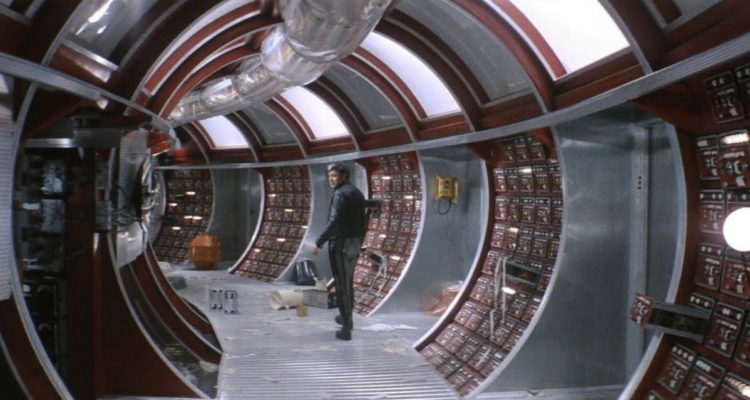
With Solaris, made over 1971/1972, based on a science fiction novel by Polish writer, Stanislas Lem, Tarkovsky touched upon a subject that seemed relatively innocuous in the Soviet Union at the time – man forging ahead into space. But even here his approach generated a long list of criticisms and objections. This was because in his hands it was not just a science fiction work but a deep exploration of a man grappling with his conscience.

The Central Committee attempted to destroy Solaris.

Tarkovsky made a note of some thirty-three cuts they demanded but which he considered would destroy the whole basis of the film. “In other words, it’s even more absurd than it was with Rublev.” Among the alterations they demanded were the following:

There ought to be a clearer image of the earth of the future. (Presumably a communist future).

Cut out the concept of God. 

Cut out the concept of Christianity. 

The conference. Cut out the foreign executives.

He wrote in desperation, Am I really going to be sitting around again for years on end, waiting for somebody graciously to let my film through?

What an extraordinary country this is? Don’t they want an international artistic triumph, don’t they want us to have good new films and books? They are frightened by real art. Quite under-standably. Art can only be bad for them because it is humane, whereas their purpose is to crush everything that is alive, every shoot of humanity, any aspiration to freedom, any manifestation of art on our dreary horizon. They won’t be content until they have eliminated every symptom of independence and reduced people to the level of cattle.

In the end he decided to make just those alterations that were consistent with his own plans and would not destroy the fabric of the film.

Then something like a miracle happened which he described as follows:

Romanov came to the studio on the 29th and Solaris was accepted without a single alteration. Nobody can believe it. They say that the agreement accepting the film is the only one to be signed personally by Romanov. Someone must have put the fear of God into him.

I heard that Sizov showed the film to three officials whose names we don’t know and who are in charge of the academic and technological side of things; and their authority is too great for their opinion to be ignored. It’s nothing short of miraculous, one can even begin to believe that all will be well.

In the next act in the drama Aleksey Romanov was removed and replaced by another equally opaque apparatchik. F. T. Yermash. He was to be Tarkovsky’s nemesis for the remainder of his career.

Part II next week.

‘Unplanned’ gets an Irish cinema release

Unplanned, a film adaptation of a memoir by Abby Johnson, a former clinic director for Planned Parenthood in Texas, who became a pro-life activist after seeing a distressing abortion, has finally secured a theatrical cinema release in Ireland.

The $6m (€5.5m) film has grossed almost $20m in the US and Canada since April. According to Paul Ward, co-owner of Irish Multiplex Cinemas, Unplanned will be shown from Friday at its four Dublin theatres, including the Savoy, and in Omagh, Co Tyrone. “We have been asked by our patrons to screen it,” he said.

The pro-abortion lobby is up in arms.

Peter Boylan, a retired obstetrician and gynaecologist, has contested a claim in the film that a 13-week-old foetus has the physiological capacity to feel pain. “Certainly not at 13 — the neural pathways aren’t developed enough,” he said. “It’s at 20-plus weeks.”

He would say that wouldn’t, he?

If those who dispute the accuracy of this film want to be taken seriously they should get someone with more credibility than arch-abortion advocate Peter Boylan to do so.