

In opening scenes of Terrence Malick’s film, The Thin Red Line, the raw recruit, Private Witt (above), who has gone AWOL from his company in the run up to the battle of Guadalcanal, muses about the problem of evil. He is wandering around a peaceful Melanesian village in a South Pacific island, its inhabitants unaffected by the war raging across the world.
The words he utters to himself are the original words written by James Jones, the author of the novel on which the film is based, published in 1962. Jones asked explicitly:
“This great evil, where’s it come from? How’d it steal into the world? What seed, what root did it grow from? Who’s doing this? Who’s killing us, robbing us of life and light, mocking us with the sight of what we might’ve known? Does our ruin benefit the earth, does it help the grass to grow, the sun to shine? Is this darkness in you, too? Have you passed through this night?” Jones was a veteran of that war.
We keep asking this question even though we’ve had the answer for as long as mankind has been inhabiting this earth. Not only do we ignore the answer but we also choose to muddle ourselves in all sorts of ways in trying to deny that there is an answer. We seem to prefer the darkness Jones refers to than to pass into the light.
Ross Douthat, columnist with The New York Times, writes periodically on religious issues. He does his best to help us all cut through that darkness. He deals with evil in the context of the influence it has over our faith in God. Appalled by evil, some conclude that there simply can’t be a creator — or at least not a beneficent one — because the world is too laden with suffering and woe.”
There is, he finds, a muddle in their argument because its proponents often profess to be atheists. It isn’t properly speaking an argument that some creating power does not exist. Rather it’s an argument about the nature of that power, a claim that the particular kind of God envisioned by many believers and philosophers — all powerful and all good — would not have made the world in which we find ourselves, and therefore that this kind of God does not exist.
This argument of course ignores the multitude of good things in this world and what their source might be.
Rather than a straight rebuttal of an argument which is as muddled as this one, he suggests a set of challenges to it.
The first challenge he offers emphasises the limits of what the argument from evil establishes. It does not support an argument that God doesn’t exist, nor that the universe lacks a supernatural order. At best it seems to say that the traditional Christian or classical-theistic conception of God’s perfect goodness is somehow erroneous or overdrawn.
The second challenge is that deniers of a ‘good God’ would do well to note that the books of the Abrahamic tradition, which Jews and Christians themselves accept as divinely inspired, contain some of the strongest complaints against the apparent injustices of the world. They are potentially much more worrying than those found in any atheistic tract. Check out the Bible
Douthat points out that the question of why God permits so much suffering is integral to Jewish and Christian Scripture, to the point where it appears that if the Judeo-Christian God exists, he expects his followers to wrestle with the question. Which means that you don’t need to leave all your intuitive reactions to the harrowing aspects of existence at the doorway of religious faith; there is plenty of room for complaint and doubt and argument inside the fold.
Finally, there is the evidence of the enormous good which Judeao-Christian civilisation has bestowed on this world, in the light of which the exclusive focus on the problem of evil seems a little overblown. Douthat suggests that “even if that evil makes it hard for you to believe in a God of perfect power, you still shouldn’t give up hope that something very good indeed has a role in the order of the world.”
But to return to the question posed by James Jones we must, and would be fools not to, resort to the historical sacred documents we have in Holy Scripture.
Romano Guardini shows us what we are really up against. In a chapter on ‘The Enemy’ in his meditations on the life and teachings of Christ in his book, The Lord, he gives us a very clear vision and understanding of the source of all evil in the world. He does this in the context of the accounts of Christ’s miracles in the New Testament – and one in particular.
Then there was brought to him a possessed man who was blind and dumb; and he cured him so that he spoke and saw. And all the crowds were amazed, and they said, ‘Can this be the Son of David?’ But the Pharisees, hearing this, said ‘This man does not cast out devils except by Beelzebub, the prince of devils.’ And knowing their thoughts Jesus said to them, ‘Every kingdom divided against itself is brought to desolation, and every city or house divided against itself will not stand. And if Satan casts out Satan, he is divided against himself; how then shall his kingdom stand? . . . But if I cast out devils by the Spirit of God, then the kingdom of God has come upon you’. (Matt. 12:22–28).
He tells us that what is reported here is essential to any genuine understanding of the New Testament. The account, he says, suggests similar cases of possession that Jesus has cured. “Not as a doctor cures; not even as Jesus himself has usually cured, by simply applying his miraculous powers of healing to the ravaged body. Here, behind the torment of body and soul, the Lord recognizes an evil power: the Demon, Satan. It is he who has made the invalid his abode; the physical pain involved is a result of his terrible habitation. It is he whom Jesus attacks, dislodging him by sheer spiritual force, and with him the accompanying ailment.”
He is aware that sceptical and ultra-rationalist moderns protest against the existence of intangible powers. He says they willingly enough recognise natural reality on the one hand, spiritual norms on the other: given conditions of being and of intention. But then they baulk, afraid of fantastic folly. All reference to the demonic smacks of the unclean, of things belonging to a lower level of religion that must be overcome. Here, he says, lies the crux of our attitude toward Jesus: do we accept him, once and for all, as our ultimate authority in everything, or do we rely solely on our own judgment?
He says that “If we think as Christians, we accept him as the starting point and norm of all truth, and we listen to everything he says with open minds, eager to learn, particularly when we are dealing, not with chance remarks of Jesus, but with a fundamental attitude that asserts itself again and again. The Lord’s acceptance of the inevitable struggle with satanic powers belongs to the kernel of his Messianic consciousness. He knows that he has been sent not only to bear witness to the truth, to indicate a way, to animate a vital religious attitude, to establish contact between God and man; but also to break the power of those forces which oppose the divine will.
“For Jesus there is more than the mere possibility of evil as the price of human freedom; more than the inclination to evil, fruit of individual or collective (inherited) sin. Jesus recognizes a personal power that fundamentally wills evil: evil per se. It is not satisfied by the achievement of positive values through wicked means; it does not simply accept the evil along with the good. Here is something or someone who positively defies divinity and attempts to tear the world from God’s hands—even to dethrone God.”
Isn’t this the answer to the cri de coeur of James Jones, echoed by Malick? Jones asks, “Who’s doing this? Who’s killing us, robbing us of life and light, mocking us with the sight of what we might’ve known? … Is this darkness in you, too? Have you passed through this night?” One senses that the question intuits the answer.
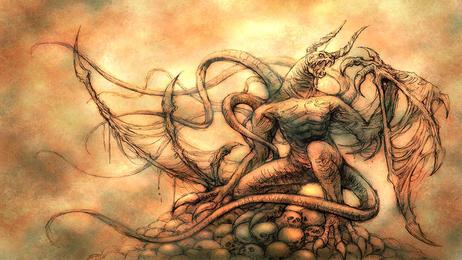
Guardini goes on to assert that the demon’s plan is to lead the world into apostasy and self-destruction. This is what Holy Scripture means when it says that Satan creates that darkness which refuses the light that comes from God and is the seducer of mankind; that “He was a murderer from the beginning” for “by the envy of the devil, death came into the world” (John 8:44; Wisdom 2:24).
“The Bible often speaks of him as lord of a “kingdom,” founder of a perverted order in which the hearts and minds of men—their creations, their deeds, their relations to things and to each other—seem sensible and coherent, but actually are senseless and incoherent. Long passages in John’s gospel describe Satan’s attempts to establish a kingdom of evil in opposition to God’s holy kingdom, anti-world to the new divine creation unfolding.”
This was the struggle witnessed by and bewildering Jones and his creation, Private Witt, in the horrors of Guadalcanal. It is the struggle which bewilders us as we contemplate the atrocities of October 7 on the border of Israel, of the devastation in Gaza, in Ukraine, Sudan and the Congo today.

But Guardini reassures us that Satan is no principle, no elementary power, but a rebellious, fallen creature who frantically attempts to set up a kingdom of appearances and disorder. He has power, but only because man has sinned. He is powerless against the heart that lives in humility and truth. His dominion reaches as far as man’s sinfulness, and will collapse on the Day of Judgment—a term long in itself, for every moment of evil is dreadfully long for those who stand in danger of Satan—but only a moment as compared with eternity.
“‘Soon’,” as the Apocalypse reveals, it will be over (3:11; 22:7). Jesus knows that he has been sent forth against Satan. He is to penetrate Satan’s artificial darkness with the ray of God’s truth; to dispel the cramp of egoism and the brittleness of hate with God’s love; to conquer evil’s destructiveness with God’s constructive strength. The murkiness and confusion which Satan creates in men’s groping hearts are to be clarified by the holy purity of the Most High. Thus Jesus stands squarely against the powers of darkness; he strives to enter into the ensnared souls of men—to bring light to their consciences, quicken their hearts and liberate their powers for good.”

 Garvan Hill