
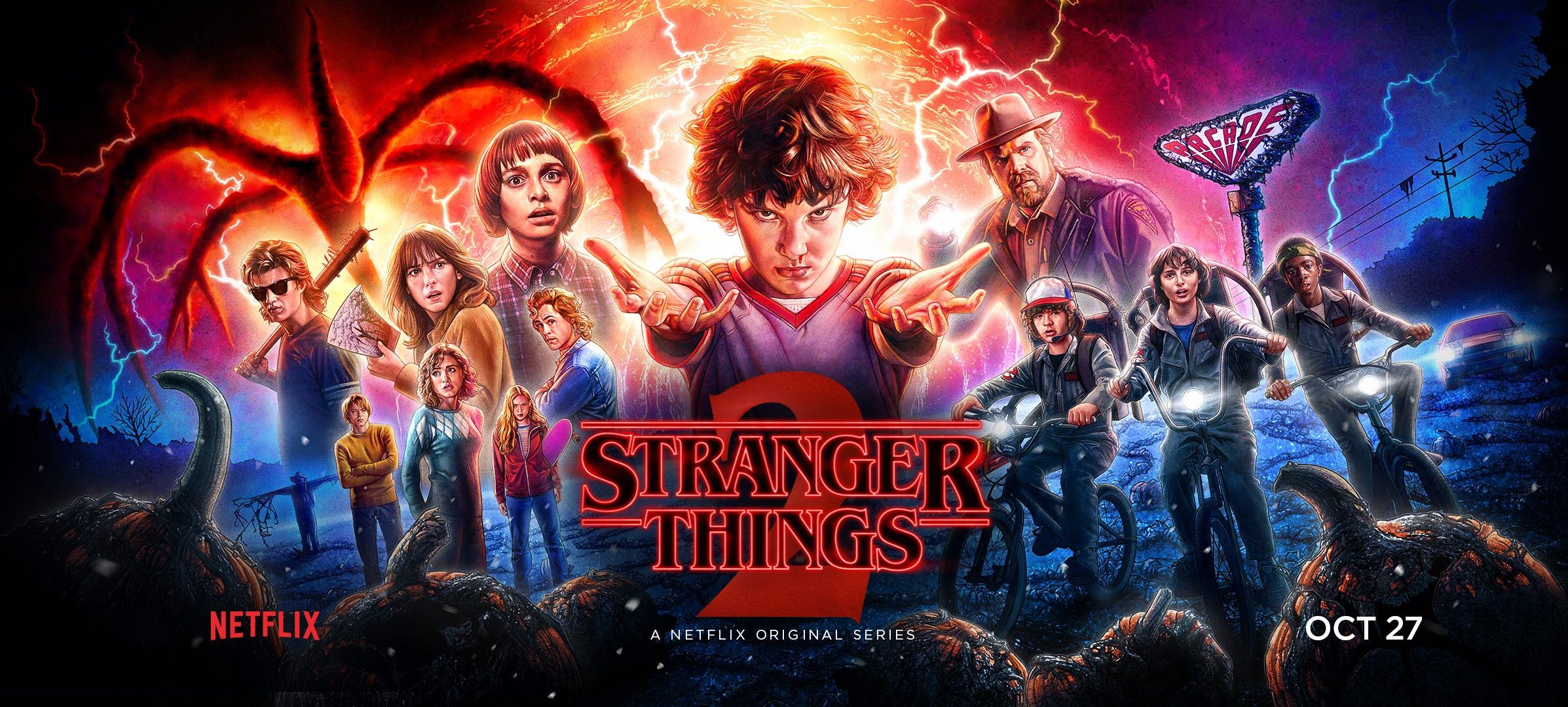
The end times have come. No, not the Apocalypse. Just a popular culture phenomenon – Stranger Things. This is Netflix’s incredibly successful science fiction magnum opus. Science fiction, however, is only a fraction of the narrative genre that it represents. It certainly touches on the apocalyptic genre and like the Apocalypse its central theme is the struggle between good and evil. But It is also about friendship, love and animosity, truth and falsehood and the triumph of innocence over deceit. Again, like the Apocalypse, the ultimate triumph being fought for is the one which we all hope for. Not exactly the New Jerusalem but instead, the new Hawkins, the small fictional Indiana town where the Beast of the Book of Revelation is waging war on humanity.
Stranger Things is the brainchild of the Duffer brothers, Matt and Ross. Born in North Carolina, they migrated to California where they studied film. Then, when what became Stranger Things was born, they relocated to Atlanta, Georgia where for more than ten years they devoted themselves to creating this astounding cultural artefact.
Only time will tell what the long-term cultural impact of this will be. It is too soon to say whether this work of imagination will take its place with those other great truth-telling fantasies or fables which were left with us in the 20th century, C.S. Lewis’ Narnia novels and J. R. R. Tolkien’s The Lord of the Rings. If it does it will be because it shares with them a vision of our world, existentially and permanently threatened by the forces of evil and in which the resistance and eventual defeat of that evil depends on the power of innocence, innate human goodness and a mysterious strength which we see as grace – although the Duffer brothers are not explicit about that.
Stranger Things, however, is not a book. It is a creative work in a medium which can be powerful but which lacks the capacity for subtlety which a literary work possesses. That is why the representations of Lewis’ and Tolkien’s work in the medium of film ultimately failed to convey any of the real meaning of the Narnia stories or of Lord of the Rings.
The surface sources for the Duffers inspiration in making Stranger Things are clear – the works of Stephen King, John Carpenter and Steven Spielberg, as well as other iconic films and books with which their childhood and adolescence were populated. What is not so clear but equally part of the creative mix are the mystical and spiritual influences on the work. The audience is left to make its own interpretation here and many ‘readers’ of this fantasy-fable see Christian and religious themes running through it, down to the powerful very last scenes.
We have, however, no reliable public statements from either of the Duffers to indicate a commitment to a specific religion or spiritual belief system. They have kept this aspect of their personal lives largely private, and their mainstream interviews focus on their creative influences and their professional work rather than personal faith. Read into this what you like: Duffer is a version of the Irish name, Duffy. Have the old Celtic spiritual values been at work here in some way? The jury is out on that.
One way or the other, like true artists, the Duffers leave their work to carry on its own conversation with us, our values and our imagination.
Stranger Things is a visual tour de force of adventure and dramatic energy. But in all that there is also a very powerful subtext. This is carried from start to final climax over its five series by the dozen or more protagonists who fill out the story which has taken ten or eleven years to tell. At least six of them started as pre-teens and have just finished their narrative in their early 20s. That alone is an incredible achievement.
The story begins by telling us that something very sinister is going on in Hawkins. Firstly, there is a secret government research facility. What is its mission? It has been set up to design and create two different weapons of war – both utterly unethical and ultimately monstrous. The first is the creation of a new kind of animal – like a wild beast; the second is the development of a modified human being, one with extraordinary and lethal powers. The latter are formed from children stolen from their mothers at the moment of birth. Over the years of their childhood and adolescence they are then processed to have extraordinary powers with a view to training them to be killers. In addition to this, a new version of the world is created, either advertently or inadvertently. This is called ”The Upside Down”, and is a terrifying mirror image of the real Hawkins, located underneath its streets and woods. It is in fact hell-on-earth.
The government Frankensteinian agents operating this monstrous research facility are undoubtedly evil but unknowingly they clearly also become agents of an evil force beyond the human realm.
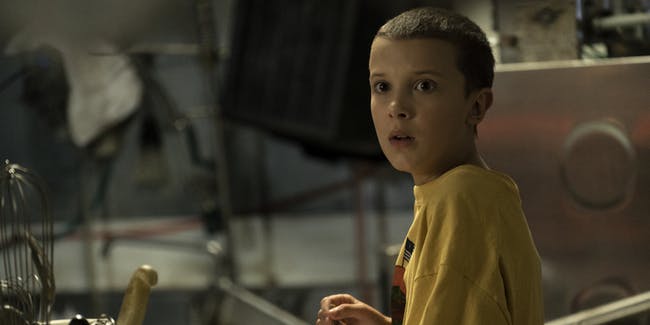
In the beginning of the drama three things happen around which the entire plot revolves: one of the doglike monsters escapes and begins to murder and cause havoc in this apparently peaceful town. Four boys are playing Dungeons and Dragons – we are in the 1980s – in the basement of the home of one of them. They finish the game and three cycle off home but one never gets there; the alarm is raised next day and when three of the boys are searching in the woods of Hawkins for their friend they find a small girl wandering around in what looks like a polka-dot night-dress. She is a victim of the dark experiments going on in the Hawkins laboratory. She has escaped from there. She turns out to already have special preternatural powers cruelly developed in her by her vicious captors. The boys befriend her and unknown to their parents hide her in the basement where they play their games. That is just the beginning of their long adventure.
There have been numerous and varied interpretations of Stranger Things, many of them seeing in it a morality tale – although some behaviour, even by sympathetic characters, falls short of the moral standards we might like to see. The production of this epic took place over the decade in which ‘wokeism’ and DEI values reached their nadir. With hundreds of people feeding ideas into the story and with the Duffers allowing creative freedom to guest writers and directors, it would probably be too much to expect that it might escape those influences.
In the religious website, Patheos, Frederick Schmidt writes about the series as a treatise on the enormity of evil. At first what he found powerfully attractive were the friendships, alliances, and the struggle of the adults in the story to be good parents. Then as the story told by the Duffers progressed he found it taking on a surprising and deeper significance. “They seemed”, he wrote, “to be telling a story about what happens when evil inserts itself into a world where no one expects it and, as such, it is simply a horror story.”
The escaped girl is called El by the boys, short for Eleven, because the digits ‘011’ were branded on her wrist in the laboratory. Schmidt says that as she begins to defend her new friends and probe her own history, a still deeper level is exposed. “It becomes apparent that (consciously or not) the Duffer brothers aren’t just telling a story about what happens when evil reveals itself. It is a story about how evil – once we give ourselves to it – can possess and dominate us.” He argues that through the callous technocracy rampant in the Hawkins lab the scientists are wounded by the logic of someone who is guided only by what he can do and not what he should do. Anything familiar resonating there?
“In a world without God”, Schmidt writes, “into which the power of evil makes itself felt, the central diabolical character – called Vecna – threatens Hawkins and the world with destruction. In a cosmos where confession and absolution is unavailable, we are undone by our guilt.”
Guilt and the need for forgiveness are touched on in the story of Max, a girl from a broken home who joins El and the band of boys. Sadly, on her conscience she carries a sense of guilt about ongoing quarrels she has had with her abusive older – much older – brother before he became another victim of Vecna. When she herself seems destined to become Vecna’s victim she cries out, “I am not ready to die” implying that until she can get forgiveness for that past she cannot face death. At this point Kate Bush (off screen) intervenes inviting her in the words of her great anthem, Make a Deal With God. Sound like Confession?
In another sequence, a troubled high school kid, Eddie Munson, who is another late entrant to the band fighting Vecna, draws off attacking monsters by separating himself from his besieged friends. (Spoiler). He dies in the process but before his last breath he whispers to his friend Justin who has tried to save him, “Look after my sheep.” It all adds up to validating why so many people interpret this story as a kind of parable of martyrdom and redemption.
At the end of the final chapter – this may be a spoiler, – after a character’s life has been willingly sacrificed to save Hawkins and all who live there, one of the boys reads this for what it is, a salvific act, believing that the character in question is alive and happy in a new world. He tells this to his friends, once again gathered around the table in his basement, now joined by a few others who have become protagonists, including Max. He says explicitly, this “I believe”. He then looks at each of the others and each in turn confesses, “I believe”.
Make of it what you will.


 Garvan Hill