Revisiting a Modern Classic

Christopher Nolan has described it as the greatest war film ever made. I have not seen or read any elaboration by him of that opinion. It is not necessary. Not only isThe Thin Red Line a searing depiction of war, it penetrates to the heart of the struggle that is endemic in life itself.

One of the people who worked with him in the long process of making the film, Penny Allen has said of Terrence Malick’s oeuvre,

Terry’s work is all about the struggle for life. The fact that it’s a war film for me is only that it’s a metaphor for this and, in an odd way, I feel it’s true of all his films. He never judges people, as if there is nothing in Terry that is about existing morality in the conventional sense; it’s about man’s need for the spirit.

John Toll, his cinema photographer, said 

As much as any film I’ve ever worked on, this picture was about an idea. I believe that what Terry wanted the film to be about, most of all, was that the real enemy in war is the war itself. War  – not necessarily one side or the other – is the great evil. It isn’t often that one gets to work on films of this nature, and I’m grateful that I had the opportunity to participate in it.

There are two quotations, one from literature and the other from folklore which embody the phrase which gives the book by James Jones and Malick’s film its title. One is Rudyard Kiplings story Tommy, depicting the expendable private soldier fate in war:

 Then it’s Tommy this, an’ Tommy that, an’ “Tommy, ‘ow’s yer soul?”

  But it’s “Thin red line of ‘eroes” when the drums begin to roll,

  The drums begin to roll, my boys, the drums begin to roll,

O it’s “Thin red line of ‘eroes” when the drums begin to roll.

  • Tommy, Rudyard Kipling

The other is an old saying from the folklore of the midwestern United States.

There’s only a thin red line between the sane and the mad.

Both of them suggest something of the meaning of Mallick’s film, the second no less than the first. The madness of war, into which we see our world so disastrously embroiled even as we write, is a central theme in The Thin Red Line. But it is not just about the graphic portrayal of action on the World War II battlefield of Guadalcanal Island. It is also about the interior wars within a war as the main protagonists try to cope with this madness.

Two of the chief protagonists in Malick’s The Thin Red Line are Private Witt (Jim Caviezel) and Sergeant Welsh (Sean Penn). Their dialogue with each other,  as the skeptical Welsh tries to grapple with the reluctant but deep-thinking soldier, Witt, from beginning to redemptive end, are at the heart of Malick’s existential and spiritual vision of humanity.

Malick doesn’t talk publicly about his work. He doesn’t give interviews and he doesn’t do press conferences. But what he does do is talk to his actors and producers. Not only does he talk to them but he forms them and collaborates with them in creating the magnificent legacy of philosophy and cinematic art he is leaving us.

At the stage of his career by which he had produced his five masterpieces, Badlands, Days of Heaven, The Thin Red Line, The Tree of Life and To The Wonder, Faber and Faber published a book entitled Terrence Malick – Rehearsing the Unexpected. It was edited by Carlo Hintermann and Daniele Villa and consists of over 300 pages of reflective comments from multiple people who worked with Malick on all those films. In many ways it gives far more insight to the artist than you would ever get in press conferences or interviews with the man himself.

In everything they say you can see not only the artist, his vision and how it evolves, even on the set. You also see the profound influence, subtle but gentle, which he has on all those who work with him and how he draws out of them a powerful collaborative role in giving us the final product.

Jim Caviezel, speaking about the audition process in which he was selected for The Thin Red Line, his first (major) acting role, reflects something of this relationship.

It was a revelation to me, because I was a basketball player and all I ever wanted to do was play in the NBA. But I wasn’t given the gifts, I had to work very hard for what I have. I just took that work ethic and I applied it toward acting and that voice that was calling me to get into the acting profession led me eventually to this moment in time, to do this movie. When I met with Terry, I think he knew I felt uncomfortable because I had put myself out on a limb by giving his wife a rosary and I felt:

“Well, I just blew that audition.’

But he immediately tried to find a place where we both came from and made me feel comfortable around him. What impressed me about him, as I have gotten to know him, is that he has an extraordinary gift: Terry Malick has a mind that is extraordinary but he also has the gift of humility.

Caviezel went on to play Jesus to stunning and harrowing effect in Mel Gibson’s The Passion Of The Christ.

In casting Penn as the hard-nosed Sergeant Welsh it is clear that Malick knew his man.

Penn’s comment on working with Malick clearly shows the rather desperate vision he has of the battles we face in this world.

I haven’t met a non-desperate character on this earth, in some way … People are trying to balance their mortality, against their fears and their sense of themselves as men, as Americans – all of that stuff that’s dealt with in The Thin Red Line; all that balancing against the mysteries: ‘Is there somebody up there, is there not?’ And short of the knowledge of that, there’s some desperation. And war is as desperate as men can get. 

Malick, as Penn saw him, was concerned with the way that we are innocent, concerned with the way that we’re damaged, with the way that we’re cruel, the way that we love – he’s concerned about all the things that represent our lives. And I do think that he is a real poet among academics. ‘Cause he’s both. He’s a very complicated guy.

Ben Chaplin, who plays the troubled Private Bell also perceived Malick’s deepest preoccupations.

In all Malick’s films there’s almost always this question about original sin.

Do we have this thing in-built, this ability, this desire to kill, to destroy what’s around us? How can we maintain an innocence?

To a certain degree, they are all about the loss of innocence. And that loss of innocence is inevitable as soon as a child learns to speak. It’s like the garden of Eden with the apple: if the apple’s there you are going to try it. I suppose that’s what his films share.

As in any war, death is always a presence. The conversations which Witt and Welsh have elicit this reflection from the private about  death and immortality.

I remember my mother when she was dying.

Looked all shrunk up and grey. I asked her if she was afraid.

She just shook her head.

I was afraid to touch the death I seen in her.

I heard people talk about immortality, but I ain’t seen it.

I wondered how it’d be when I died.

What it’d be like to know that this breath now

was the last one you was ever gonna draw.

I just hope I can meet it the same way she did.

With the same … calm.

Cos that’s where it’s hidden – the immortality I hadn’t seen.

He reflected further that many times in our lives we are all afraid of death and most of us don’t want to talk about it, or be near it, but we are all going to end up there some day. He interpreted his character in the film as having a transformation in his soul after spending some time living with the natives on the island. 

There, he said, Witt saw beauty, peace and love; he had received grace in his heart. And that grace equates with God and the grace filled him and made him. But he saw something greater in Heaven than he did on this earth, that there’s another life out there, that you can start living in heaven now, even in hell, and war. And that was a gift that was given to him and that grace keeps growing in him because he keeps finding ways to save men. 

It’s easy to love people when they love you – but what if they hate you? Love your enemies … he concluded.

Mike Medavoy who played a central role in the production of The Thin Red Line said of it afterwards, 

I found the film to be very poetic, very religious: you almost have a Christ figure giving up his life for everybody else, for the rest of the guys. I thought it captured World War II in that venue very well. And, well, for me that character is Terrence Malick.

Sean Penn summed it up this way: The importance of Malick is just showing that it’s okay to put a couple of thoughts into a picture… in a culture that doesn’t. I think it’s really simple: he’s an artist and we need art.
Hope and the Unmasking of Evil

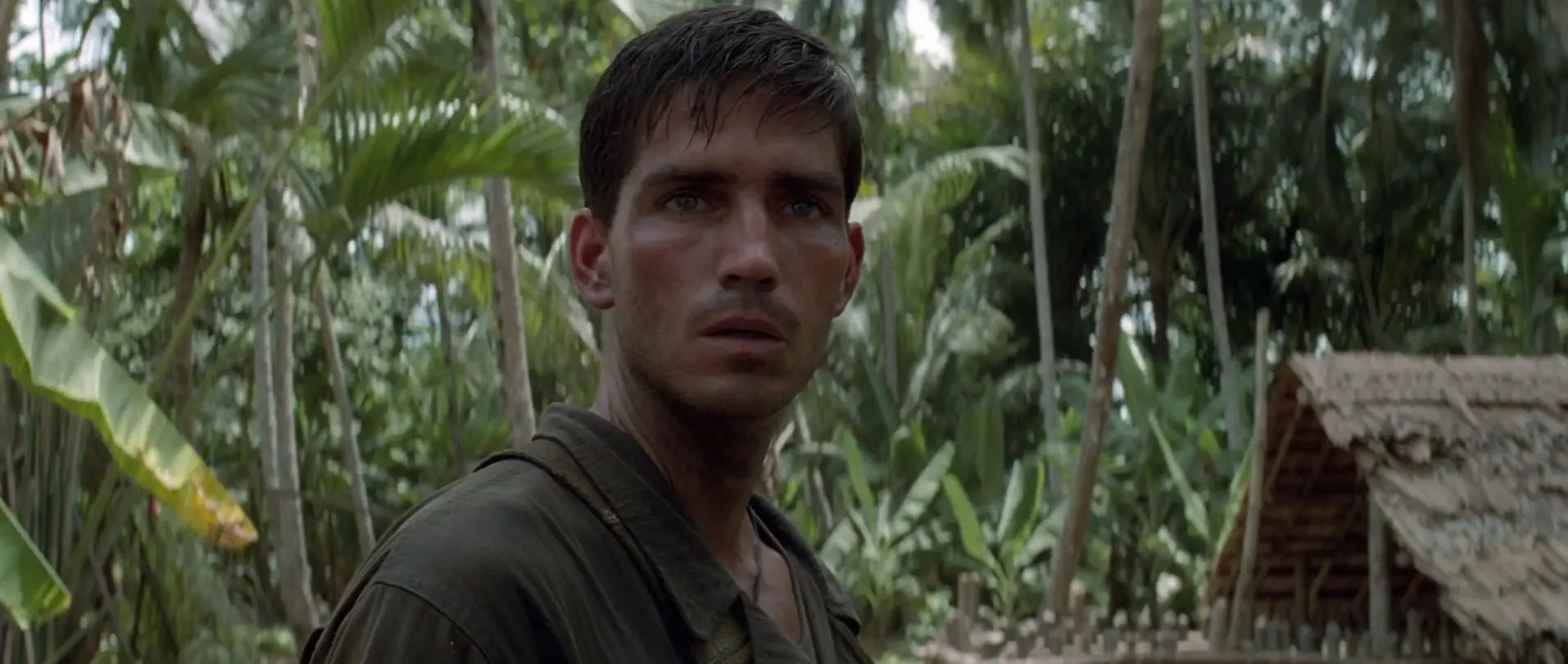
In opening scenes of Terrence Malick’s film, The Thin Red Line, the raw recruit, Private Witt (above), who has gone AWOL from his company in the run up to the battle of Guadalcanal, muses about the problem of evil. He is wandering around a peaceful Melanesian village in a South Pacific island, its inhabitants unaffected by the war raging across the world.

The words he utters to himself are the original words written by James Jones, the author of the novel on which the film is based, published in 1962. Jones asked explicitly:

“This great evil, where’s it come from? How’d it steal into the world? What seed, what root did it grow from? Who’s doing this? Who’s killing us, robbing us of life and light, mocking us with the sight of what we might’ve known? Does our ruin benefit the earth, does it help the grass to grow, the sun to shine? Is this darkness in you, too? Have you passed through this night?” Jones was a veteran of that war.

We keep asking this question even though we’ve had the answer for as long as mankind has been inhabiting this earth. Not only do we ignore the answer but we also choose to muddle ourselves in all sorts of ways in trying to deny that there is an answer. We seem to prefer the darkness Jones refers to than to pass into the light.

Ross Douthat, columnist with The New York Times, writes  periodically on religious issues. He does his best to help us all cut through that darkness. He deals with evil in the context of the influence it has over our faith in God. Appalled by evil, some conclude that there simply can’t be a creator — or at least not a beneficent one — because the world is too laden with suffering and woe.”

There is, he finds, a muddle in their argument because its proponents often profess to be atheists. It isn’t properly speaking an argument that some creating power does not exist. Rather it’s an argument about the nature of that power, a claim that the particular kind of God envisioned by many believers and philosophers — all powerful and all good — would not have made the world in which we find ourselves, and therefore that this kind of God does not exist.

This argument of course ignores the multitude of good things in this world and what their source might be.

Rather than a straight rebuttal of an argument which is as muddled as this one, he suggests a set of challenges to it.

The first challenge he offers emphasises the limits of what the argument from evil establishes. It does not support an argument that God doesn’t exist, nor that the universe lacks a supernatural order. At best it seems to say that the traditional Christian or classical-theistic conception of God’s perfect goodness is somehow erroneous or overdrawn. 

The second challenge is that deniers of a ‘good God’ would do well to note that the books of  the Abrahamic tradition, which Jews and Christians themselves accept as divinely inspired, contain some of the strongest complaints against the apparent injustices of  the world. They are potentially much more worrying than those found in any atheistic tract. Check out the Bible

Douthat points out that the question of why God permits so much suffering is integral to Jewish and Christian Scripture, to the point where it appears that if the Judeo-Christian God exists, he expects his followers to wrestle with the question. Which means that you don’t need to leave all your intuitive reactions to the harrowing aspects of existence at the doorway of religious faith; there is plenty of room for complaint and doubt and argument inside the fold.

Finally, there is the evidence of the enormous good which Judeao-Christian civilisation has bestowed on this world, in the light of which the exclusive focus on the problem of evil seems a little overblown. Douthat suggests that “even if that evil makes it hard for you to believe in a God of perfect power, you still shouldn’t give up hope that something very good indeed has a role in the order of the world.”

But to return to the question posed by James Jones we must, and would be fools not to, resort to the historical sacred documents we have in Holy Scripture.

Romano Guardini shows us what we are really up against. In a chapter on ‘The Enemy’ in his meditations on the life and teachings of Christ in his book, The Lord, he gives us a very clear vision and understanding of the source of all evil in the world. He does this in the context of the accounts of Christ’s miracles in the New Testament – and one in particular.

Then there was brought to him a possessed man who was blind and dumb; and he cured him so that he spoke and saw. And all the crowds were amazed, and they said, ‘Can this be the Son of David?’ But the Pharisees, hearing this, said ‘This man does not cast out devils except by Beelzebub, the prince of devils.’ And knowing their thoughts Jesus said to them, ‘Every kingdom divided against itself is brought to desolation, and every city or house divided against itself will not stand. And if Satan casts out Satan, he is divided against himself; how then shall his kingdom stand? . . . But if I cast out devils by the Spirit of God, then the kingdom of God has come upon you’.  (Matt. 12:22–28). 

He tells us that what is reported here is essential to any genuine understanding of the New Testament. The account, he says, suggests similar cases of possession that Jesus has cured. “Not as a doctor cures; not even as Jesus himself has usually cured, by simply applying his miraculous powers of healing to the ravaged body. Here, behind the torment of body and soul, the Lord recognizes an evil power: the Demon, Satan. It is he who has made the invalid his abode; the physical pain involved is a result of his terrible habitation. It is he whom Jesus attacks, dislodging him by sheer spiritual force, and with him the accompanying ailment.” 

He is aware that sceptical and ultra-rationalist moderns  protest against the existence of intangible powers. He says they willingly enough recognise natural reality on the one hand, spiritual norms on the other:  given conditions of being and of intention. But then they baulk, afraid of fantastic folly. All reference to the demonic smacks of the unclean, of things belonging to a lower level of religion that must be overcome.  Here, he says,  lies the crux of our attitude toward Jesus: do we accept him, once and for all, as our ultimate authority in everything, or do we rely solely on our own judgment? 

He says that “If we think as Christians, we accept him as the starting point and norm of all truth, and we listen to everything he says with open minds, eager to learn, particularly when we are dealing, not with chance remarks of Jesus, but with a fundamental attitude that asserts itself again and again. The Lord’s acceptance of the inevitable struggle with satanic powers belongs to the kernel of his Messianic consciousness. He knows that he has been sent not only to bear witness to the truth, to indicate a way, to animate a vital religious attitude, to establish contact between God and man; but also to break the power of those forces which oppose the divine will. 

“For Jesus there is more than the mere possibility of evil as the price of human freedom; more than the inclination to evil, fruit of individual or collective (inherited) sin. Jesus recognizes a personal power that fundamentally wills evil: evil per se. It is not satisfied by the achievement of positive values through wicked means; it does not simply accept the evil along with the good. Here is something or someone who positively defies divinity and attempts to tear the world from God’s hands—even to dethrone God.”

Isn’t this the answer to the cri de coeur of James Jones, echoed by Malick? Jones asks, “Who’s doing this? Who’s killing us, robbing us of life and light, mocking us with the sight of what we might’ve known? … Is this darkness in you, too? Have you passed through this night?”  One senses that the question intuits the answer.

Guardini goes on to assert that the demon’s plan is to  lead the world into apostasy and self-destruction. This is what Holy Scripture means when it says that Satan creates that darkness which refuses the light that comes from God and is the seducer of mankind; that “He was a murderer from the beginning” for “by the envy of the devil, death came into the world” (John 8:44; Wisdom 2:24). 

“The Bible often speaks of him as lord of a “kingdom,” founder of a perverted order in which the hearts and minds of men—their creations, their deeds, their relations to things and to each other—seem sensible and coherent, but actually are senseless and incoherent. Long passages in John’s gospel describe Satan’s attempts to establish a kingdom of evil in opposition to God’s holy kingdom, anti-world to the new divine creation unfolding.”

This was the struggle witnessed by and bewildering Jones and his creation, Private Witt, in the horrors of Guadalcanal. It is the struggle which bewilders us as we contemplate the atrocities of October 7 on the border of Israel, of the devastation in Gaza, in Ukraine, Sudan and the Congo today.

Devastation on the Ukrainian-Russian border (NYT image)

But Guardini reassures us that Satan is no principle, no elementary power, but a rebellious, fallen creature who frantically attempts to set up a kingdom of appearances and disorder. He has power, but only because man has sinned. He is powerless against the heart that lives in humility and truth. His dominion reaches as far as man’s sinfulness, and will collapse on the Day of Judgment—a term long in itself, for every moment of evil is dreadfully long for those who stand in danger of Satan—but only a moment as compared with eternity. 

“‘Soon’,” as the Apocalypse reveals, it will be over (3:11; 22:7). Jesus knows that he has been sent forth against Satan. He is to penetrate Satan’s artificial darkness with the ray of God’s truth; to dispel the cramp of egoism and the brittleness of hate with God’s love; to conquer evil’s destructiveness with God’s constructive strength. The murkiness and confusion which Satan creates in men’s groping hearts are to be clarified by the holy purity of the Most High. Thus Jesus stands squarely against the powers of darkness; he strives to enter into the ensnared souls of men—to bring light to their consciences, quicken their hearts and liberate their powers for good.”

Terrence Malick and the Passion of Franz Jägerstätter

RG-10_00660.NEF
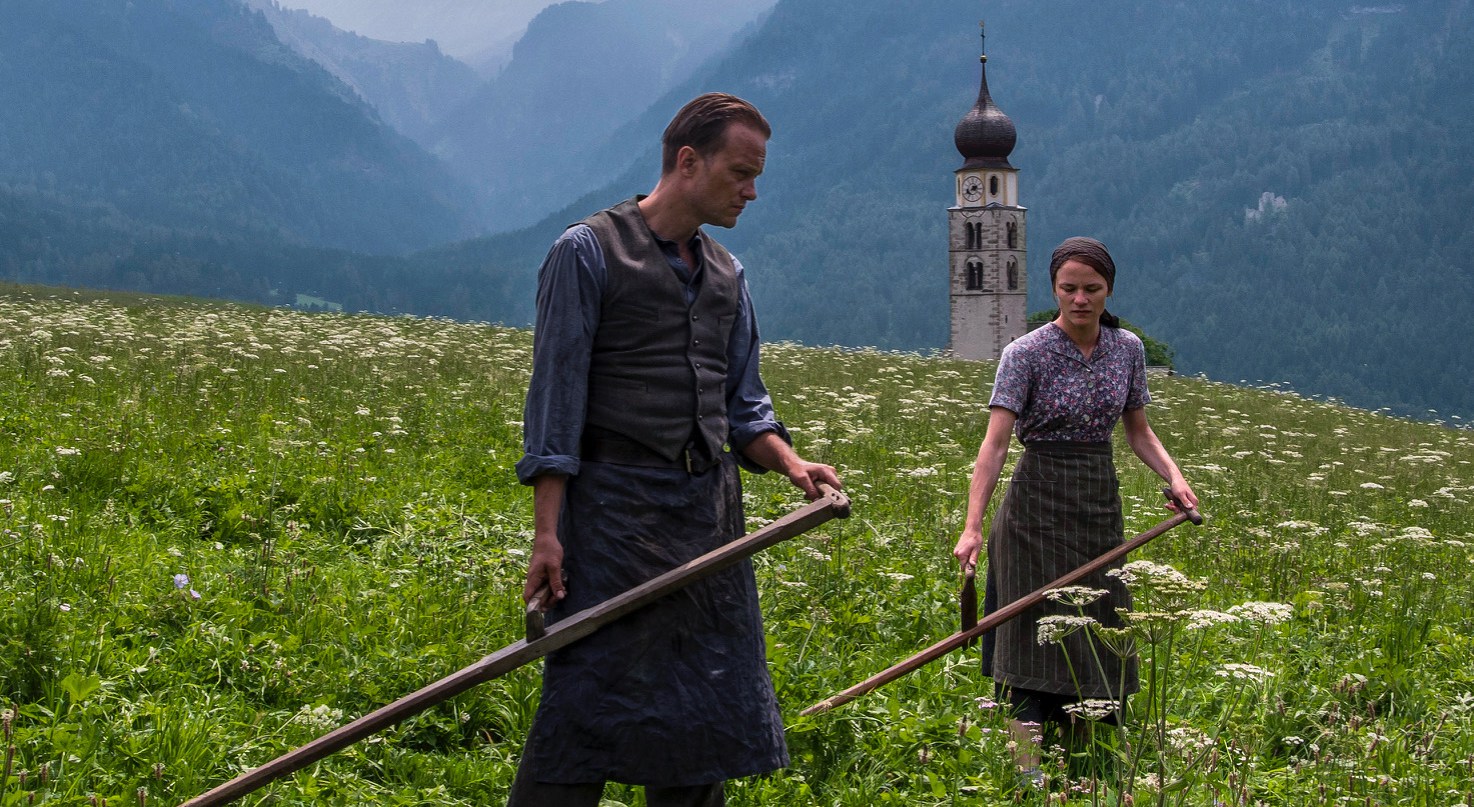
August Diehl as Franz Jägerstätter and Valerie Pachner as Franziska Jägerstätter

Ireland, indeed all countries in the world plagued with errant secularism, is in the throes of a battle over the issue of freedom of conscience for its citizens. Now, the great film director and auteur, Terrence Malick, is about to raise the stakes for the protagonists in this war.

If Robert Bolt and Fred Zinnemann did it for the rights of conscience in the Public Square with A Man For All Seasons in the middle of the last century, Malick is going to do it for our time. While Bolt and Zinneman nuanced their treatment of St. Thomas More’s faith and convictions with an emphasis on human character, Malick’s subject takes the issue to full frontal level on behalf of the law of God.

The Irish secularist parliament is currently passing legislation permitting the termination of pregnancy – which really means the termination of innocent human lives. This legislation was wilfully sanctioned by two thirds of the Irish electorate in a clear Yes and No referendum last May. A suggestion that practising Catholics who ticked Yes on the ballot paper might have something on their consciences afterwards was much mocked in the weeks that followed. If they dare to reflect on the hero of Malick’s new film they may be inclined to mock less. Their decision last May and the legislation now being built on it, will not only terminate lives but will require countless medical professionals – doctors, nurses, hospital staff and more – to cooperate in each of those killings in violation of their consciences.

Malick’s new film, Radegund, chronicles the life of a martyr of the twentieth century who was executed by guillotine in 1943 for refusing to take the life of another and refusing to accept as just, a government which had made unjust and inhumane laws.

The film takes its name from the small Austrian village of Sankt Radegund. It was the birthplace of Franz Jägerstätter, who was executed at Brandenburg Prison in 1943. The choice by Malick of this subject for his tenth film in 45 years is, one might suspect, to round off his exhaustive exploration through all his work of the struggles of men and women on this earth in their pursuit of happiness.

franz_j_gerst_tter-jaegerst_portraet_quadr
Franz Jägerstätter

Of all his heroes – or anti-heroes – Franz Jägerstätter is the one who by the authority of the Roman Catholic Church can be said definitively to have achieved just that. He was beatified on ‎26 October 2007, Linz, Austria by ‎Pope Benedict.

He was born on 20 May 1907, to his unmarried mother, Rosalia Huber, and to Franz Bachmeier, who was killed during World War I. After the death of his natural father, Rosalia married Heinrich Jägerstätter, who adopted Franz and gave the boy his surname of Jägerstätter in 1917.

Franz received a basic education in his village’s one-room schoolhouse – Radegund still has a population of a little over 500 souls. Rosalia’s father helped with his education and the boy became an avid reader – but not in any way a “saintly” child or teenager. He was the first in his village to own a motorcycle and he flaunted it to great effect – winning the hearts of the local girls, with not very moral consequences.

However, things changed when in 1936 he married a young girl in the village. She was part of the gift of graces which God gave him and which would eventually flower in his martyrdom. They went to Rome for their honeymoon and there a kind of conversion took place under the influence of what he saw in both the city and in his young wife’s simple piety and devotion.

He returned to his small farm – left to them by step-father – and worked as hard as any small farmer must. They had three little daughters and he took on the job as sacristan in the local church to help add to their small income. He now went to Mass and Holy Communion every day that he could. The character and depth of his piety could be sensed from his resolve to refuse the customary offering for his services at funerals. He preferred the merits from the spiritual and corporal works of mercy over any remuneration.

Then came the Nazis, the annexation of Austria by Germany, the Anschluss, and war. In the gathering storm of the mid to late 1930s, while much of Austria was beginning to follow the tide of Nazism, Franz became ever more rooted in his Catholic faith and placed his complete trust in God. He began thinking deeply about obedience to legitimate authority and obedience to God, about mortal life and eternal life and about Jesus’ suffering and Passion.

Franz was in no way political nor part of any resistance movement, but in 1938 he was the only local citizen to vote against the Anschluss, because his conscience prevailed over the path of least resistance.

When war broke out and the Nazi grip on Austria became vice-like, Franz was called up for military service and sworn in on 17 June 1940. His resistance to active service on the field of battle for conscientious reasons was known and for a period and with the help of some officials he managed to serve while still working his farm.

He had, however, by now become convinced that any participation in the war was a serious sin and decided that any future call-up had to be met with his refusal to fight. “It is very sad”, he wrote, “to hear again and again from Catholics that this war waged by Germany is perhaps not so unjust because it will wipe out Bolshevism…. But now a question: what are they fighting in this Country – Bolshevism or the Russian People?

“When our Catholic missionaries went to a pagan country to make them Christians, did they advance with machine guns and bombs in order to convert and improve them?… If adversaries wage war on another nation, they have usually invaded the country not to improve people or even perhaps to give them something, but usually to get something for themselves…. If we were merely fighting Bolshevism, these other things – minerals, oil wells or good farmland – would not be a factor”.

Jägerstätter was at peace with himself despite his witnessing the masses’ capitulation to Hitler. Mesmerized by the National Socialist propaganda machine, many people knelt when Hitler made his entrance into Vienna. Catholic Churches were forced to fly the swastika flag and subjected to other abusive laws.

The Battle of Stalingrad lasted from 23 August 1942 until 2 February 1943. It was the largest confrontation of World War II and decimated the Wehrmacht. The debacle increased demand for soldiers in the field and in February 1943 Franz was called up again for military service. He presented himself at the induction centre on 1 March 1943 and announced his refusal to fight.

He was held in custody at Linz in March and April, transferred to Berlin-Tegel in May and subject to trial on 6 July 1943 when he was condemned to death for sedition. The prison chaplain was struck by the man’s tranquil character. On being offered the New Testament, he replied: “I am completely bound in inner union with the Lord, and any reading would only interrupt my communication with my God”.

After his sentence one last attempt was made to get him to relent – for his protest was an embarrassment even in that murderous regime. His wife and parish priest were brought to the prison to dissuade him. The techniques of persecutors never change. Thomas More faced the same challenge to his faith.

On 9 August, before being executed, Franz wrote: “If I must write… with my hands in chains, I find that much better than if my will were in chains. Neither prison nor chains nor sentence of death can rob a man of the Faith and his free will. God gives so much strength that it is possible to bear any suffering…. People worry about the obligations of conscience as they concern my wife and children.

“But I cannot believe that, just because one has a wife and children, a man is free to offend God”.

Franz Jägerstätter, would not bow his head to evil. No mercy was shown. He was laid on the platform of the guillotine, facing the blade and without a blindfold.

This is the man whom Terrence Malick has now chosen to portray for us, a reminder that no matter what the season, as Franz Jägerstätter explained to his interrogators who tried to probe and probe why he was taking the path he had chosen, the grace of God is sufficient for every man and the ultimate cause of his salvation.

Malick, an auteur who probes consciousness and consciences like no other filmmaker of our time, is a worthy successor to his great influences, both of whom left us with masterpieces on the life of an earlier martyr for conscience , Carl Theodor Dreyer with The Passion of Joan of Arc (1928), and more recently Robert Bresson with The Trial of Joan of Arc (1962).

The film is scheduled for release in Germany before the end of the year. Worldwide release will follow soon after.

The riches of Terrence Malick

4982_1

We need a break from the culture wars. In the Middle Ages the Church tried on occasion to get the warring feudal kings, princes and barons – or whatever – to take time out from their seemingly endless wars. They tried to promote what in my Irish language history class was called a ‘sos cogadh’, if my memory, and my Irish, serve me right. It was a kind of ceasefire, literally a rest from warfare, like we tried to have between the IRA and the British security forces in our local Irish ‘troubles’ here at end of the last century.

So a unilateral ‘sos cogadh’ it is, for a few days at any rate. We will take a break from Abortion – sorry, Amnesty – International, same-sex marriage, Donald Trump Vs Hillary Clinton, corrupted education systems, ISIS, European football and all those stressful topics.

We will take a dive into the deep end of the cultural reservoir and reflect for a little on the deep, deep cinema of Terrence Malick.

I was moved to do this by a piece I read some time ago on the Aleteia website, posted on the occasion of the fifth anniversary of the release of Malick’s magnum opus, The Tree of Life.

There, Matthew Becklo reminded us that when The Tree of Life hit movie theatres the responses were all visceral. “Some hailed it as an instant classic; others dismissed it as pretentious garbage; and a whole lot of people left the theatre scratching their heads.” He himself is in the first category and in an effort to win over those who either hated it, or were just plain confused by it, he gives us a few reasons to give this beautiful artefact another look in 2016.

His first reason is the verdict of that authoritative voice, the late Roger Ebert. Before he died, Ebert included it in his list of the ten greatest films ever made. Ebert said “I believe it’s an important film,” and will only increase in stature over the years.”

Not only has the film done so but it has done so because with the passage of time and the opportunity that this gives for revisiting it, not just once or twice but many times, you will see further into its depth with each viewing. The real reason for this is that Malick’s later films are not just rooted in the human. They connect us in some way with the divine. They are in fact prayers. They do not shy away from the sensual, albeit with delicacy. Neither does the Song of Songs. In all this Malick’s work bears a great affinity with those other masters – whose influence has had a bearing on his art – Robert Bresson and Andrei Tarkovsky. Ebert in fact wrote, “Terrence Malick‘s new film is a form of prayer. It created within me a spiritual awareness, and made me more alert to the awe of existence.”

Malick’s two films since The Tree of Life do exactly the same thing, each one taking a different angle on our existence. To the Wonder explores the mystery of love, not just human love but divine love as well – and the mysterious point where the two meet. The Knight of Cups takes us through the terrifying capacity of our kind to destroy ourselves in the pursuit of pleasure – with Hollywood as the metaphor for evil. The evil is not so much in what it produces as in the environment into which it sucks all those who participate within it.

But it is not just the spiritual meaning of Malick’s work, not just the way in which he explores the connections between our actual existence and our struggles with our destiny, which spell-bind us. It is the visual presentation of this. Here his co-artist plays his part. He was Emmanuel Lubezki, the first person to win the cinematography Oscar three years in a row: for Gravity (2013), Birdman (2014), and The Revenant (2015). He was nominated for his work on The Tree of Life – but the Academy was a bit off that year so he did not get it, nor did they. Lubezki has been Malick’s cinematographer since The New World, that other metaphorical work which explores in the tale of Pocahontas the complexities of the troubling reality of colonisation and multiculturalism.

For Matthew Becklo another compelling reason for revisiting the film is that its meaning is easier to follow the second time around. He observes that “The visual grandeur of The Tree of Life was enough to distract anyone from its storyline. But Malick also experimented freely with his characters and their locations, creating what many saw as an overly loose narrative. Even Sean Penn was displeased, remarking that ‘clearer and more conventional narrative would have helped the film’.”

“Malick,” he says, “does ask his viewers to keep their eyes (and minds) open, but he won’t leave them in the dust when they do. On a second viewing, the storyline becomes crystallized, and separated out from the more poetic sequences. This opens the door to a deeper dive into the meaning of the film as a whole.”

Robert Barron has produced a short YouTube essay on The Tree of Life in which he explores and comments of the themes of this visual and poetic masterpiece of cinema. Barron shows us how it is also a deep reflective work of natural theology. Perhaps The Tree of Life might be the best way of bringing us to a permanent ‘sos cogadh’ in our infernal culture wars?