Long live the Queen

image

This might irritate some, but it shouldn’t. In reality it is all about reminding a people where they have come from, what their history is and how it has unfolded. It reminds them how it has given them the stable, even if imperfect, political system they – and much of the world – benefits from today.

Back Story, courtesy of the New York Times:

Queen Elizabeth II will announce Prime Minister David Cameron’s legislative program for the next year at the state opening of Parliament in London today.
Hours before her arrival, the royal bodyguards perform a ceremonial search of the basement of the Palace of Westminster, where the two houses of Parliament meet.

It’s a throwback to the discovery of the Gunpowder Plot in 1605, when Guy Fawkes tried to murder England’s king and its ruling classes by blowing up the House of Lords.

Led by parading soldiers, the Queen arrives in a gilded carriage drawn by four Windsor Greys and guarded by coachmen who are still called bargemen because the monarch used to come by river.

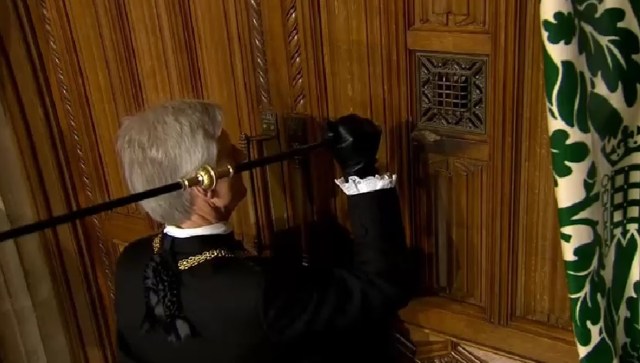
Members of Parliament are ceremonially summoned to the House of Lords by her representative, known as the Gentleman Usher of the Black Rod.

In one of the more colorful rituals, he approaches the doors of the House of Commons, only to have it slammed in his face. The custom dates to the English Civil War and symbolizes Parliament’s independence from the crown.

Only after knocking three times with his ebony stick is he let into the chamber, where he announces, “The Queen commands this honorable house to attend her majesty immediately.”

Everyone then heads to the House of Lords, where the Queen recites the speech from her throne and wearing her diamond-encrusted Imperial State Crown.

Your Morning Briefing is published weekdays at 6 a.m. Eastern and updated on the web all morning.

The ghost of Edmund Burke at the Vatican?

edmund-burke-portrait-006

A pearl of wisdom from Pope Francis’ Exhortation, Amoris Laetitia:

The lack of historical memory is a serious shortcoming in our society. A mentality that can only say, “Then was then, now is now”, is ultimately immature. Knowing and judging past events is the only way to build a meaningful future. Memory is necessary for growth: “Recall the former days” (Heb 10:32). Listening to the elderly tell their stories is good for children and young people; it makes them feel connected to the living history of their families, their neighborhoods and their country. A family that fails to respect and cherish its grandparents, who are its living memory, is already in decline, whereas a family that remembers has a future. “A society that has no room for the elderly or discards them because they create problems, has a deadly virus”; “it is torn from its roots”. Our contemporary experience of being orphans as a result of cultural discontinuity, uprootedness and the collapse of the certainties that shape our lives, challenges us to make our families places where children can sink roots in the rich soil of a collective history.

It echoes the writing of Edmund Burke so closely in his great debate with that apostle of isolationist individualism, Thomas Paine, that we might even think that the ghost of that greatest of Irishmen was among the Pope’s advisers before he presented us with this splendid document about life and love.

Jesse Norman, one of Burke’s most recent biographers, sums up Burke’s thinking:


As Burke shows us, the individual is not simply a compendium of wants; human happiness is not simply a matter of satisfying individual wants; and the purpose of politics is not to satisfy the interests of individuals living now. It is to preserve a social order which addresses the needs of generations past, present and future.

In his own life, Burke was devoted to an ideal of public duty, and deplored the tendency to individual or generational arrogance, and the “ethics of vanity”. His thought is imbued with the importance of history and memory, and a hatred of those that would erase them. He insists on the importance of human allegiance and identity, and social institutions and networks.


An interstellar option?

interstellar-670x440-141022

Back in the 1960s there was a hit musical – well, perhaps a minor hit musical – running in the West End in London called Stop the World – I Want to Get Off! Things were not half as bad then as they are now. But if that ever – ever since Noah built himself an ark – looked like the best option for any members of the human race who still have a head on their shoulders, it must be now.
The big hit from the show was What Kind of Fool Am I? It contained the lines,

What kind of man is this?

An empty shell

A lonely cell in which

An empty heart must dwell

Allister Heath sums up our predicament rather well in this morning’s Daily Telegraph, centering it fairly and squarly in the context of the apparent political disaster unfolding in the most powerful country in the world. Emptiness is abiding sense we get looking across the Atlantic today.


It is remarkable,
Heath observes, how a country that is so good at business, science, the arts and just about everything else can be so bad at politics. There are now 318 million Americans, including many of the world’s most creative and brilliant people: the US electorate ought by rights to be spoilt for choice when it comes to choosing its president.
Yet from this immense talent pool, the American political system has managed to narrow the race down to two supremely flawed human beings, neither of whom remotely deserves to be in the White House.
On the one hand we have Hillary Clinton, a scandal-ridden, uninspiring candidate whose Left-wing policies would destroy what is left of US exceptionalism; on the other is Donald Trump, a demagogue who specialises in whipping up hate and threatening cataclysmic trade wars.

The West End show ran for more than a year and ran on Broadway for 555 performances. It’s revival on Broadway 20 years later was a flop and it suffered a similar fate in Lonon in the late 80s. Perhaps it needs another revival now to remind us of the consequences of the selfish follies of our time
Read Allister Heath’s full article here.