Technology, well-being and our future world

It is difficult to pick up a serious newspaper or magazine, or tune in to a serious podcast today, without finding another essay where someone is worrying about modern technology’s dire impact on our mental health, our political life and our literacy. 

Thomas Edsall mused at length in The New York Times (October 14) on ‘The rise of the Smartphone and the Fall of Western Democracy’. He drew on the research and arguments of, among others, Jonathan Haidt and Jean Twenge.

Haidt is  a social psychologist at New York University;  Twenge, is a professor of psychology at San Diego State University.  Their extensive and rigorous research shows that there is a clear correlation — and perhaps a causal relationship — between the rise of smartphones and an abrupt escalation of teenage anxiety, depression and suicidal tendencies, especially among girls growing up in liberal families.

Haidt has launched an international movement to ban smartphones in schools. There have been a number of American and European studies showing that doing so leads to improvements in student performance and behaviour. However, in April 2025 the often contrarian British medical journal The Lancet questioned the evidence supporting these school policies. Some might say, ‘It would, wouldn’t it’.

But that’s just about the smartphone and its power to distract and confuse children.

Edsall also sees a new and major player threatening us all – the growing use of artificial intelligence. In September, Derek Thompson, co-author with Ezra Klein of the book Abundance, expanded and revised concerns about all this in an essay that originally ran in The Argument, an online magazine. “We can”, he wrote, “already see how technology is affecting our capacity to think deeply right now. And I am much more concerned about the decline of thinking people than I am about the rise of thinking machines.”

Thompson argued that students’ use of A.I. is leading to “the demise of writing,” which matters because writing is an act of thinking. This is as true for professionals as it is for students. In “Writing Is Thinking,” an editorial in Nature, the authors argued that “outsourcing the entire writing process to L.L.M.s (Large Language Models) deprives scientists of the important work of understanding what they’ve discovered and why it matters.”

Why does all this matter? Thompson argued it’s the patience to read long and complex texts, to hold conflicting ideas in our heads and enjoy their dissonance, to engage in hand-to-hand combat at the sentence level within a piece of writing — and to value these things at a time when valuing them is a choice, because video entertainment is replacing reading and ChatGPT essays are replacing writing. “As A.I. becomes abundant, there is a clear and present threat that deep human thinking will become scarce,” he said.

The Free Press has also weighed in on this issue. 

In a special feature on what the editors call ‘The Dawn of the Postliterate Society’ they remind us that It’s no secret that young people today are desperate for meaning. A recent report found that 58 percent of young adults experienced little or no sense of purpose in their lives over the past month. Some attribute this to social media. Others, to a lack of religion.

In an essay in the same online publication, James Marriott of The Times (London) explains why the stakes couldn’t be higher. Our liberal democracy, he writes, was built by widespread literacy—the same widespread literacy that is now being dismantled by screens. Unless we start reading again, he says, our civilisation may not survive.

In another article in The Times, Marriott quotes the great American journalist, chronicler of the wild ‘Sixties’, Joan Didion, writing “I write to find out what I’m thinking”.

Marriott says that for anybody whose job involves writing, the evidence is clear: those who don’t read or who outsource their essays to AI lose the facility for complex thought. “Not reading or writing would be unthinkable”

He cites a paper published earlier this summer by scientists at MIT which restates Didion’s thesis with less elegance but with more empirical rigour. The researchers used wearable brain scanners to measure the cognitive activity of a group of students who used AI to help them write their essays and a group who did the work themselves. The AI-assisted writers ‘consistently underperformed at neural, linguistic and behavioural levels’ compared with those who wrote their own essays. They needed to write in order to think.

But is anyone fighting back? According to, again, the indomitable Free Press, someone is. Enter Shilo Brooks, former Princeton professor and the host of Old School, a new Free Press podcast dedicated to the notion that there is one simple way to bring America’s lost generation home: via reading. “When a man is starved for love, work, purpose, money, or vitality,” Shilo explains, “a novel wrestling with these themes can be metabolized as energy for the heart.” 

Good for Professor Brooks – and good for us all. But Gerald Howard, in another New York Times essay wonders if literary fiction – the fiction which tells us the truth about ourselves – despite its resilience since the very beginning of literature with ‘The Epic of Gilgamesh’ and the epics of Homer is not now threatened by “the structural and cultural headwinds of our time.” 

We mean those we have just explored and our thinking world is now agonising about.

“Is this genre  now in danger of extinction from,” he asks, “a declining attention span, a disappearing audience of people educated enough to understand and appreciate it, or a near-future technological onslaught (see: novels written by A.I. entities)? The sense of a possible ending is palpable.”

Nevertheless, Howard, a retired practitioner at the coalface of publishing, is an optimist and he illustrates how great literature has had to struggle against the odds for centuries. Literature is fragile, he admits. “It serves no obvious purpose. It does not feed us or clothe us or, unless you get very lucky, enrich us. But literature is also as close to immortal as any cultural endeavour of humankind has ever been.” 

Moby-Dick, he points out, “the novel that is America’s clearest contribution to world literature, was so misunderstood and reviled upon its 1851 publication that it destroyed Herman Melville’s career. He had to take up work for the rest of his life as a customs inspector on the New York docks, and his obituary in this paper (the NYT) referred to “Mobie Dick.” It was only after his death and the novel’s rediscovery in the early 20th century that it was recognized for the masterpiece it is.”

“In the mid-1940s every one of William Faulkner’s 20 published works was either out of print or very difficult to find. Faulkner had to grind out screenplays for Hollywood studios to make a living.”

Then he won the Nobel Prize and hasn’t been out of print since.

Think of The Great Gatsby, written and forgotten about until it was distributed free to America’s GIs in the Second World War. It now competes with Moby Dick for the title of  The Great American Novel. 

Technology will do great good for the human race. It will probably also do great harm. But we believe that the human spirit is indomitable and so long as it is we can hope that the great works of literature and great works to come will prevail.

A Watershed Year?

What is it about 2025? Will it be remembered as the year in which a new awakening finally exposed the shallowness and idiocy of the poisonous ‘awokening’ which has blighted our politics and our societies and mark the beginning of its end.

The Mulberry Bush


That so-called ‘awokening’ nightmare was the surface manifestation of the fatal flaws revealed in the answers Patrick Deneen gave to the question he asked in his landmark book, Why Liberalism Failed

Liberalism in its late 20th and early 21st century version failed, he wrote, because it did not live up to its promises. We might also say that it failed because it had absorbed the toxic utopian principles of Marxism – as did those earlier Marxist ideologies of the Communist Manifesto (1848), the Russian Revolution and Chinese Maoism, with all their lethal progeny.

All of these, including contemporary Liberalism, promised a more just society but ended up perverting justice – with utterly lethal consequences in their naked Marxist forms, and with socially destructive consequences in its hidden Marxist contemporary forms.

Signs of hope in 2025

What are the signs which 2025 offers that might make us think our civilisation is on a new threshold? Essentially they are signs of a new Judeao-Christian revival – it embraces Catholics, other Christians of various denominations, and practising Jews.

Where do we look for these signs?  We might begin with the widely reported phenomenon of Catholic baptisms across the secular West last Easter. Around that time The Economist’s four-minute morning news podcast selected as its ‘word of the week’, ‘Catechumen’. It followed later with a report on the phenomenon we have just mentioned. A sceptical secular world is taking notice.

What is being noticed is that many Catholic dioceses in the UK, Ireland, and the US reported significant growth in conversions to the Catholic faith this Easter, with increases in catechumens and candidates for the Rite of Election, particularly among young adults aged 20s and 30s. This surge is seen in both established dioceses and others across the regions, with some leaders attributing the trend to a societal spiritual crisis and increased interest in the Church’s historical and spiritual truths

Specific examples from the UK and Ireland include,

  • Westminster Cathedral which saw over 500 attendees at the Rite of Election, with 250 catechumens. 
  • Southwark Archdiocese (London South of the Thames and Kent) reported over 450 participants.
  • Birmingham saw 201 catechumens and candidates, up from 130 the previous year. 
  • In Motherwell in Scotland numbers rose from 45 to 72 and in 
  • Dublin, nearly 70 individuals joined in the Pro-Cathedral.

These figures, impressive as they are, are dwarfed by the experience of  France, which had a surge in adult baptisms this year — at more than 10,000, the highest number since a national annual report on such figures began in 2002. Something is definitely happening!  

Canterbury Summer 2025

Something amazing definitely did happen this Summer – Mass in Canterbury Cathedral, celebrated by the Papal Nuncio to the UK, Archbishop Miguel Maury Buendia. It happened on July 7, to commemorate St. Thomas Becket. Normally a Mass is celebrated annually in the Catholic Church of St Thomas Becket, but this year’s Mass was the largest Catholic gathering at the cathedral since the Reformation. Disclosure: I had the great privilege of being present at the Mass.

Madeline Tehan reported on this event for the US based Catholic News Agency.“For the first time in modern history, the apostolic nuncio to the United Kingdom has celebrated Mass in England’s most celebrated Anglican cathedral…

During his homily, Maury Buendía said: ‘This Mass of pilgrimage takes place within the context of the jubilee year. It highlights the Christian life as a spiritual journey, moving through life’s trials and joys with hope anchored in Christ. Having travelled as pilgrims today, we do more than just honour a figure from history.’

He continued: ‘The stained-glass windows all around us illustrate the many miracles attributed to St. Thomas in the medieval period. This should be a living story, too. Our world, today as then, is in need of hope. We come in this jubilee year as pilgrims of hope to be inspired by St. Thomas’ holiness and his courageous witness to Christ and his Church.’ ”

In the USA 

In the United States ten dioceses, including Memphis, Rockford, and Los Angeles, experienced significant increases in conversions. For the first time in decades, the US Catholic Church has seen more people joining than leaving, a trend that began to shift around 2024. 

On September 28, The Spectator reported that in the US, school voucher schemes have seen enrolment in private Christian schools rise dramatically.

What is driving all this? There are definite proximate motives and Christian believers know that these factors are at play – but they also know that without the miracle of grace, nothing like this happens.

Just one moving example – The Burns Family in Ohio

Matthew McDonald,  a staff reporter for The National Catholic Register, recounts the story of  the Burns family.  Their path to the Catholic Church this Easter vigil started with a funeral.

Steve Burns, 43, a mechanical engineer who lives in Avon Lake, Ohio, was raised a Free Methodist. His wife, Corrine, 42, a homemaker who worked for years in a wholesale greenhouse, was raised a Catholic but stopped going to church when she was an adolescent. Their son Ryan, 12, wasn’t  baptised.

But when Corrine’s beloved Uncle Tony died in March 2023, she attended his funeral Mass and immediately felt at home. “For the first time I felt right, like I was in the right spot again,” Corrine told the Register. “In my head I’m thinking, ‘I’ve got to get my family in here, too.’ ”

That happened at last Easter’s Vigil Mass at St. Joseph’s in Avon Lake, followed by confirmation and first Communion. At the same Mass, Ryan was baptised, followed by confirmation and first Communion. Steve and Ryan went through the parish’s conversion program – a demanding procedure based on the teaching contained in The Catechism of the Catholic Church.

McDonald explains that these are part of a bumper crop in the Diocese of Cleveland, which welcomed over 800 converts at Eastertime 2025, which is about 50% higher than in 2024 (542) and about 75% higher than in 2023 (465). Significant increases in converts are common and widespread. Many are seeing increases not just since last year but also since 2019, the year before the coronavirus shutdowns led to sharp decreases in conversion. 

Back in Europe

One of the most spectacular Christian witnessing events of the Summer was surely that reported by Rod Dreher on the pilgrimage of young Europeans – and others – to the Cathedral of Chartres. This was  the three-day Pentecost pilgrimage. 

“It was astonishing”, Dreher wrote in his blog, which was republished by Bari Weiss on her website, The Free Press , “and gave me a real sense of hope for the future. You will recall that my journey as an adult into Christianity began at Chartres, which I first visited at seventeen, and was overwhelmed by wonder. Back then, in the summer of 1984, I stood at the center of the labyrinth there, looked all around, and felt strongly in my heart that God is real, and that He is calling me to Himself.”

Dreher took a seat near the altar for the Mass, which began with hundreds of the pilgrims, exhausted from having walked the sixty miles from Paris to Chartres in three days, streaming in carrying flags and banners. “They filled the nave, while many more thousands were outside on the parvis watching and listening to the Mass over loudspeakers and a giant screen. I saw the sunburned faces of these kids passing by, and was in awe. I thought, ‘These are the people who are going to save Christianity in Europe.’  Maybe fanciful, I don’t know, but if it’s going to happen, it will be through them.”

The Charlie Kirk Effect

Last, but perhaps by no means least, is what we read in this report by Amira Abuzeid, also of the Catholic News Agency on September 15. She was reporting on what some are calling “the Charlie Kirk effect,”  “People across the nation, including many college students who are not ordinarily churchgoers, have decided to go to church since the assassination last week of the conservative Christian political activist Charlie Kirk.”

Matt Zerrusen, co-founder of Newman Ministry, a Catholic nonprofit that operates on about 250 campuses nationwide, told CNA he has spoken with Catholic college ministry leaders throughout the country over the last few days, and “every one of them told me they’ve seen bigger crowds” at Masses and lots of people “they’ve never seen before.”

“I have not talked to anyone who has not seen an increase in Mass attendance,” Zerrusen said. “Some schools are reporting increases of 15%.” He told CNA that many more college students are also asking for spiritual direction. “So many people are asking ‘What do I do?’, ‘What is evil? How does God allow this?” Zerrusen said. “They are asking so many basic questions.”

One priest at a large state school in the North East told Zerrusen he spoke over the weekend with 15 young men he had never seen before who sought him out for faith advice. Zerrusen said the spiritual “revival” Kirk’s death has amplified what one he has been observing for months. He pointed out that more than 400 students at Texas A&M University in College Station are attending the Order of Christian Initiation of Adults (OCIA) class at St. Mary’s Catholic Center near campus. Social media users say Kirk inspired them to go to church.

Charlie Kirk said many things which ordinary good people found objectionable. Many have been misinterpreted and the jury may still be out on those. But there can be little doubt that the bullet which severed his neck was inspired by hatred for the Christian principles of sexual morality which he championed. It is hard not to see him as a martyr.

Peggy Noonan wrote a column  on ‘Charlie Kirk and the New Christian GOP’ in the Wall Street Journal in which she said:

“While watching the Charlie Kirk memorial Sunday, I was swept by a memory that yielded a realization.

“The memorial, in State Farm Stadium in Glendale, Ariz., has been well described. There was a height to it, and a gentleness, with a few rhetorical exceptions. More than 90,000 people attended. TV and online viewership is estimated to have reached tens of millions. Halfway through it struck me that the memorial might have been the biggest Christian evangelical event since the first visit to America of Pope John Paul II, in October 1979. He was a year into his papacy. ‘Be not afraid!’ he said, and took America by storm.

“At the memorial there was an altar call—at a public memorial for a political figure. It was singular, and moving. So was the dignity and peacefulness of the crowd. They didn’t indulge their anger or cry out against the foe. It was as if they understood that would be bad for the country. I couldn’t remember a time a big Trump-aligned group did that, as a corporate act, in the past 10 years. It struck me as a coming of age. They were taking responsibility.

“There is something you could have said at any time the past decade that is true now in some new way. It is that the GOP is becoming a more explicitly Christian party than it ever has been. A big story the past decade was that so many Trump supporters, especially but not only working-class ones, were misunderstood as those crazy Christians but in fact were often unaffiliated with any faith tradition and not driven to politics by such commitments.

“But it looks to me as if a lot of those folks have been in some larger transit since 2015, as Kirk himself was. He entered the public stage to speak politics but said by the end that his great work was speaking of Christ. If he had a legacy, he told an interviewer, ‘I want to be remembered for courage for my faith.’ ”

These stories suggest there are seeds of new life in the Catholic Church in many parts of the world. Particularly encouraging is the growth on College campuses allowing hope that the insidious growth of Wokeism may have peaked and that truth as always will out.


ABOUT FORGIVENESS: THE HORRIFYING BUT INSPIRING STORY OF AMANDA KNOX

This is the story of one of the most disturbing miscarriage of justice this century. It is the story of a nightmare transposed to the real world in a civilized European country and inflicted on a 20 year-old American student. But it is also the story of that young girl’s resilience and nobility and the near miracle of how she overcame her adversity and went on to forgive the man at the heart of her truly terrible experience of multiple years of her young life.

On the evening of November 1st, 2007, a young man called Rudy Guede broke into student accommodation in Perugia, Italy.  Meredith Kercher, a 21-year-old exchange student from Leeds was alone in the house. He brutally attacked, raped and murdered her.

Another resident in the house, Amanda Knox, recently arrived from Seattle to study Italian, arrived home after a date with a boy whom she met just a week earlier. The murderer had flown but the evidence of the break-in was all over the place. Amanda called the police and when they came they searched the house and found the dead body of Meredith in her room. Amanda had not seen it up to that point.

It should have been a relatively simple investigation. There was ample forensic evidence at the scene – including DNA evidence which would have led the police directly to Guede, a local living in the same block. 

But a very strange scenario unfolded. The local prosecutor, Giuliano Manini, would not accept the obvious and proceeded to construct the details of this nightmare. He imagined and relentlessly pursued a wild and lurid hypothesis in which three perpetrators of the crime, Amanda, her boyfriend Raffaelo and the actual murderer, Rudy Guede assaulted and murdered Meredith in some kind of Satanic ritual. The details of his concoction are too lurid to even print in this family journal; suffice to say that they were sensational enough to set off a world-wide feeding frenzy in the media. So, not only did we have a legal system mired by the case but also once again had exposed for us the greed and dishonesty of large segments of the international media.

He, incredibly, bamboozled the jury with this story while no effort was made to pursue the evidence which would have produced a just verdict and the conviction for murder of Guede alone.

All three were found guilty of the charges concocted by the prosecutor and Amanda was sentenced to 26 years in prison.  As the verdict was read, a crowd outside the courtroom, which had swallowed the media story hook, line and sinker, burst into cheers. Inside the courtroom, Amanda Knox and her family, her only supporters, began to sob.

Amanda, even as she grappled with the horrors of her situation, already reflected her maturity in dealing with the nightmare she was now living through.

“My mind catapulted to a new sense of reality, which was that the truth didn’t matter and that I didn’t matter and that the only one who could make sense of my life or make it worth living and who could have any sense of control in a very limited way was myself. That was a huge existential shift for me and it was very sad. 

The second act of this story is where the inspiring part begins.

Bari Weiss of The Free Press, in her recent and very impressive interview with Amanda on her podcast Honestly, puts this question to her:

“You’re 22 years old when you’re convicted. Take us back to maybe the moment of the conviction and then the time right after when you’re having to look down the reality of 26 years in a dungeon for something you never did.”

Amanda answers: “That was my moment of growing up. Or as my friend the prison chaplain, Fr Salo, said, that I grew up. I aged 40 years in four. In that moment, she said, my mind catapulted to a new sense of reality

“And I started looking around me with a more clear eye at the life that I had available to me. And I tried to think, what can I possibly do within these limitations that is meaningful to me? And I noticed pretty early on that I actually was very well equipped for that. I was educated. I had learned Italian over the course of two years in prison (awaiting trial). And I could read and write.

“And so many of the women that I was imprisoned with were either foreigners who couldn’t speak Italian or they were Italians who couldn’t read and write.  And so I became the unofficial translator and the unofficial scribe of the prison where I was shipped around to other people’s rooms to help them write their letters for them, read their documents, help them talk to the doctor and explain their ailments. And it became a very meaningful existence that also made my life within the prison environment easier.”

Amanda does not describe herself as religious but she developed a close relationship with Fr Salo. He said to her “If you pray for strength, God doesn’t give you strength. He gives you the opportunity to be strong. She speaks about him in a very beautiful way, explaining how he became her best friend. Fr Salo was in his seventies when she first met him.

“His  way initially of bridging the gap with me was offering me the opportunity to play music in his office under the guise of going to confession…A few times a week, I was allowed to practice playing Beatles songs in his office. And then he invited me to come play music during Mass.”

“And then over the course of time, that time where I’m in his office with him, and he’s helping me learn how to play the piano, we also were talking about just being people, being humans, philosophizing about life, and talking about how do we make sense of the fact that life isn’t fair. And I butted heads with him a lot over this idea that…God has a grand plan that we only get to really appreciate once we’re dead.” 

Fr Salo did believe in her innocence. Every morning on his way to the prison, he would stop by the same cafe to get an espresso, the same one that Manini would go to. And Fr Salo would say to the prosecutor, “you know she’s innocent, right?”

Finally, after serving four years in prison her appeal was granted and the outcome of that was the quashing of her conviction.

On that final day, when she was awaiting the verdict she chose not to wait in a cell underground beneath the courthouse while the jury deliberated. She decided to go back to the prison. “I wanted to go and spend time with Fr  Salo because he had become my friend and my confidant.”

He asked her to sing and recorded her singing voice and said,’ I need to record you singing because I think this is the last time I’m gonna hear your voice. I know you’re going home because I know you’re innocent.’

Fr  Salo was right. She won her appeal and left  prison after four years, not including the years awaiting trial.

And now begins the final act of her story, shorter but even more moving and inspiring than the rest. The nightmare was not really over yet. She explains how the imprint of what had happened remained in her soul.

“I’m the girl accused of murder. My entire life now is defined in a very big way by the most horrible thing that happened to me, that became very public.” Years go by and she is about to get married in a private ceremony. But paparazzi are outside because they’ve tricked some people into revealing the location. She is still haunted by the fact that her life has been taken from her and can never be given back to her by the person who threw her in jail.

She knows she has to go back to Italy to resolve her anguish at its roots. She wants to meet Manini again. She is invited to speak at a conference for the Italian Innocence Project. And the man who put her behind bars sees her speech.

Prior to this, she had sent him two letters, but got no response.  Then, when he sees this speech, he writes to her.

She thought that if she could just have two minutes staring into his eyes and see the soul of the other human being, maybe he would realize his mistake.

At first, he says that he’s unable to meet with her in person because he’s still an acting prosecutor.  But they keep their correspondence going, and she says ,”okay, well, if I can’t see you in person, can we get to know each other?  I want to know you. I told him  that to her he was this nightmarish figure, but that she knew that’s not fair to him, in the same way that the nightmarish version of her out there was not fair to her. “So you tell me who you are.”

And then, in June, 2022, they met face to face in Italy at a private meeting mediated by Fr Salo.

By this stage, over the course of time, and as they were getting closer and closer to this actual in-person meeting, she felt forced to ask herself, why am I doing this? “I realized that if I am setting out in order to get him to admit he was wrong, she was focusing on a door that she couldn’t open.”

“That’s the door that is locked to me. I don’t have control over that. So if that is my goal, then I am doomed to fail. And instead, I ask myself, is there something else in me that is driving this?” Is there something,  she asked herself, not that I can receive from this man, but that I can give him? “And I realized that it was very much that thing that Fr Salo had given me, that ability to see me clearly and to recognize me for the person that I really am.” 

At this point the person who was Dr. Manini became Giuliano. Their relationship is still, in a way, complicated. Their correspondence is private and she has promised to keep it that way.

Before the face to face meeting she describes her emotions. “I woke up that morning and I was utterly terrified. I was also unsure of what I was going to say. And then that morning I just knew…I felt unstoppable. And, you know, I wish upon people moments in their lives when they could feel how I felt in that moment. Because I have never felt more free than when I was able to relinquish so much of what was holding me back, which was that hurt and that pain and that anger, and that hatred for this human being…and instead, embrace the sort of broader self that he is.” 

In her book, Free: My Search for Meaning* published last March, Amanda recounts what Bari Weiss describes as a transcendent moment and what Manini describes as his  “grace”.

In that moment she spoke as though inspired:

“I want you to know that I am innocent. I had nothing to do with Meredith’s murder. You were wrong about me. I was treated as if I was guilty until and unless I could convince you and your colleagues of my innocence. And I failed to do that. But I’m not here to convince you of my innocence.”

“I’m here to let you know that whether you’ve realized your mistake or not, I do not think you are an evil person. Your mistake, which caused great harm to me and my loved ones and to Raffaele and his loved ones, is not the only thing that defines you. I want you to know that despite the fact that I am still hurt today, I am grateful for my experience in which you played an important and influential role.”

“I am grateful because I learned things about myself that I never would have known, both how weak and vulnerable I am, but also how strong. I am a very strong person. I know that in large part because of you.”

“This experience crystallized for me my core values, curiosity, compassion and courage. Curiosity for the truth, not just the version that most serves me. Compassion, especially for those who have made mistakes.”

“And courage to overcome my own fears and pain in order to remain curious and compassionate towards others, especially those who have harmed me. We cannot change the past, but we can change the future. And the mistakes of our past are the opportunities of our future.”

“It is never too late to live up to our values. And I believe you are a person of value. I do not wish you ill.”

“I wish you peace.”

She describes the transformation which she realised had occurred in her. I had “evolved from the philosophical to the spiritual. I felt like a superhero. I felt like I had finally accomplished something that was like the definition of who I was. She had now broken free from the prison of being defined by this thing that I didn’t do.”

“Finally I had done something that wasn’t just a reaction to what was happening to me, it wasn’t just an act of survival. I did not need to go back to Italy to sit down across the table from my prosecutor and say these words to him. That was something that I manifested, that said something about who I was.”

“He came away from that experience using the language of his own spirituality to describe what he felt, which was that he had experienced an act of grace. That’s what he called it.” 

“I did not set out to forgive him. That was not part, it wasn’t part of my  spiritual journey. It wasn’t one of my goals. But I do think that once you really see a person, like really see them, really understand them, in all of their naked flaws, you would, you’d have to be a very cruel and unusual person to not feel compassion for them.”

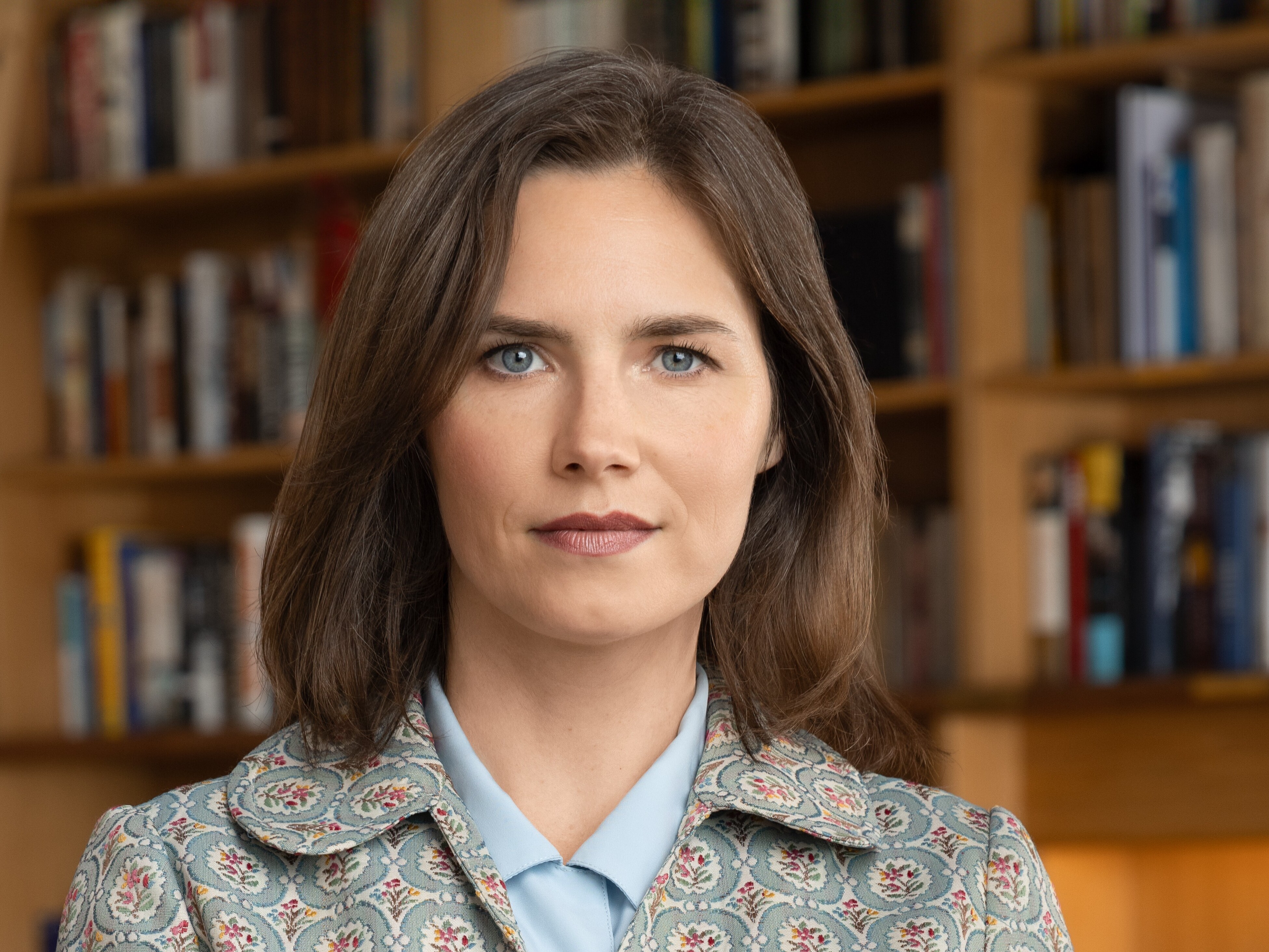
Amanda Knox author of Free: My Search for Meaning

*Free: My Search for Meaning: Amanda Knox: Grand Central Publishing, 304 pages

ISBN-139781538770719   

Revisiting a Modern Classic

Christopher Nolan has described it as the greatest war film ever made. I have not seen or read any elaboration by him of that opinion. It is not necessary. Not only isThe Thin Red Line a searing depiction of war, it penetrates to the heart of the struggle that is endemic in life itself.

One of the people who worked with him in the long process of making the film, Penny Allen has said of Terrence Malick’s oeuvre,

Terry’s work is all about the struggle for life. The fact that it’s a war film for me is only that it’s a metaphor for this and, in an odd way, I feel it’s true of all his films. He never judges people, as if there is nothing in Terry that is about existing morality in the conventional sense; it’s about man’s need for the spirit.

John Toll, his cinema photographer, said 

As much as any film I’ve ever worked on, this picture was about an idea. I believe that what Terry wanted the film to be about, most of all, was that the real enemy in war is the war itself. War  – not necessarily one side or the other – is the great evil. It isn’t often that one gets to work on films of this nature, and I’m grateful that I had the opportunity to participate in it.

There are two quotations, one from literature and the other from folklore which embody the phrase which gives the book by James Jones and Malick’s film its title. One is Rudyard Kiplings story Tommy, depicting the expendable private soldier fate in war:

 Then it’s Tommy this, an’ Tommy that, an’ “Tommy, ‘ow’s yer soul?”

  But it’s “Thin red line of ‘eroes” when the drums begin to roll,

  The drums begin to roll, my boys, the drums begin to roll,

O it’s “Thin red line of ‘eroes” when the drums begin to roll.

  • Tommy, Rudyard Kipling

The other is an old saying from the folklore of the midwestern United States.

There’s only a thin red line between the sane and the mad.

Both of them suggest something of the meaning of Mallick’s film, the second no less than the first. The madness of war, into which we see our world so disastrously embroiled even as we write, is a central theme in The Thin Red Line. But it is not just about the graphic portrayal of action on the World War II battlefield of Guadalcanal Island. It is also about the interior wars within a war as the main protagonists try to cope with this madness.

Two of the chief protagonists in Malick’s The Thin Red Line are Private Witt (Jim Caviezel) and Sergeant Welsh (Sean Penn). Their dialogue with each other,  as the skeptical Welsh tries to grapple with the reluctant but deep-thinking soldier, Witt, from beginning to redemptive end, are at the heart of Malick’s existential and spiritual vision of humanity.

Malick doesn’t talk publicly about his work. He doesn’t give interviews and he doesn’t do press conferences. But what he does do is talk to his actors and producers. Not only does he talk to them but he forms them and collaborates with them in creating the magnificent legacy of philosophy and cinematic art he is leaving us.

At the stage of his career by which he had produced his five masterpieces, Badlands, Days of Heaven, The Thin Red Line, The Tree of Life and To The Wonder, Faber and Faber published a book entitled Terrence Malick – Rehearsing the Unexpected. It was edited by Carlo Hintermann and Daniele Villa and consists of over 300 pages of reflective comments from multiple people who worked with Malick on all those films. In many ways it gives far more insight to the artist than you would ever get in press conferences or interviews with the man himself.

In everything they say you can see not only the artist, his vision and how it evolves, even on the set. You also see the profound influence, subtle but gentle, which he has on all those who work with him and how he draws out of them a powerful collaborative role in giving us the final product.

Jim Caviezel, speaking about the audition process in which he was selected for The Thin Red Line, his first (major) acting role, reflects something of this relationship.

It was a revelation to me, because I was a basketball player and all I ever wanted to do was play in the NBA. But I wasn’t given the gifts, I had to work very hard for what I have. I just took that work ethic and I applied it toward acting and that voice that was calling me to get into the acting profession led me eventually to this moment in time, to do this movie. When I met with Terry, I think he knew I felt uncomfortable because I had put myself out on a limb by giving his wife a rosary and I felt:

“Well, I just blew that audition.’

But he immediately tried to find a place where we both came from and made me feel comfortable around him. What impressed me about him, as I have gotten to know him, is that he has an extraordinary gift: Terry Malick has a mind that is extraordinary but he also has the gift of humility.

Caviezel went on to play Jesus to stunning and harrowing effect in Mel Gibson’s The Passion Of The Christ.

In casting Penn as the hard-nosed Sergeant Welsh it is clear that Malick knew his man.

Penn’s comment on working with Malick clearly shows the rather desperate vision he has of the battles we face in this world.

I haven’t met a non-desperate character on this earth, in some way … People are trying to balance their mortality, against their fears and their sense of themselves as men, as Americans – all of that stuff that’s dealt with in The Thin Red Line; all that balancing against the mysteries: ‘Is there somebody up there, is there not?’ And short of the knowledge of that, there’s some desperation. And war is as desperate as men can get. 

Malick, as Penn saw him, was concerned with the way that we are innocent, concerned with the way that we’re damaged, with the way that we’re cruel, the way that we love – he’s concerned about all the things that represent our lives. And I do think that he is a real poet among academics. ‘Cause he’s both. He’s a very complicated guy.

Ben Chaplin, who plays the troubled Private Bell also perceived Malick’s deepest preoccupations.

In all Malick’s films there’s almost always this question about original sin.

Do we have this thing in-built, this ability, this desire to kill, to destroy what’s around us? How can we maintain an innocence?

To a certain degree, they are all about the loss of innocence. And that loss of innocence is inevitable as soon as a child learns to speak. It’s like the garden of Eden with the apple: if the apple’s there you are going to try it. I suppose that’s what his films share.

As in any war, death is always a presence. The conversations which Witt and Welsh have elicit this reflection from the private about  death and immortality.

I remember my mother when she was dying.

Looked all shrunk up and grey. I asked her if she was afraid.

She just shook her head.

I was afraid to touch the death I seen in her.

I heard people talk about immortality, but I ain’t seen it.

I wondered how it’d be when I died.

What it’d be like to know that this breath now

was the last one you was ever gonna draw.

I just hope I can meet it the same way she did.

With the same … calm.

Cos that’s where it’s hidden – the immortality I hadn’t seen.

He reflected further that many times in our lives we are all afraid of death and most of us don’t want to talk about it, or be near it, but we are all going to end up there some day. He interpreted his character in the film as having a transformation in his soul after spending some time living with the natives on the island. 

There, he said, Witt saw beauty, peace and love; he had received grace in his heart. And that grace equates with God and the grace filled him and made him. But he saw something greater in Heaven than he did on this earth, that there’s another life out there, that you can start living in heaven now, even in hell, and war. And that was a gift that was given to him and that grace keeps growing in him because he keeps finding ways to save men. 

It’s easy to love people when they love you – but what if they hate you? Love your enemies … he concluded.

Mike Medavoy who played a central role in the production of The Thin Red Line said of it afterwards, 

I found the film to be very poetic, very religious: you almost have a Christ figure giving up his life for everybody else, for the rest of the guys. I thought it captured World War II in that venue very well. And, well, for me that character is Terrence Malick.

Sean Penn summed it up this way: The importance of Malick is just showing that it’s okay to put a couple of thoughts into a picture… in a culture that doesn’t. I think it’s really simple: he’s an artist and we need art.

GLIMPSES OF  TRUTH IN ‘THE 3 BODY PROBLEM’

Science fiction has a respectable pedigree stretching from, by general agreement, Mary Shelly’s Frankenstein, down through Jules Verne, H.G Wells and into the mid 20th century with Isaac Asimov, Arthur C. Clarke and others. It’s certainly a robust genre. And while that mid-century flourishing may be considered a golden age there are those who now think we are in a new golden age. 

At the heart of this golden age is the Chinese writer, Cixin Liu. His fascinating and bewildering – in the best possible sense – science fiction will now be found occupying a sizable amount of space in the sci-fi sections of most bookshops. His voluminous imaginative works, replete with scientific, cosmological and astronomical detail, have been translated into more than twenty languages. His most famous, the epic trilogy entitled, Remembrance of Earth’s Past, has sold some eight million copies worldwide. 

The timeline of the trilogy spans the present and into a time eighteen million years in the future. The London Review of Books has called the trilogy “one of the most ambitious works of science fiction ever written.” 

The first part of the trilogy grapples with the threat to planet earth from a rival civilisation in our galaxy on a planet called Trisolaris. This is an ultra-advanced civilisation but its existence is jeopardised by the three-body problem. This is a problem in orbital mechanics which is caused by the unpredictable motion of three bodies under mutual gravitational pull.  It is a classic problem first posed by Isaac

Newton. Cixin Liu wonderfully imagines the chaos this causes in the life of Trisolarans, ultimately provoking their plans to conquer and destroy the civilisation of our planet.

But Earth does temporarily cope with the threat, establishing a deterrent based on mutually assured destruction and forces the Trisolarans to share their technology. Sound familiar?

As the trilogy progresses, however, the threat from Trisolaris becomes a kind of side show and it emerges that a vast Dark Forest – volume two of the trilogy – of alien life is threatening the existence of all the universe’s civilisations. The denouement comes at the end of volume three, entitled Death’s End.

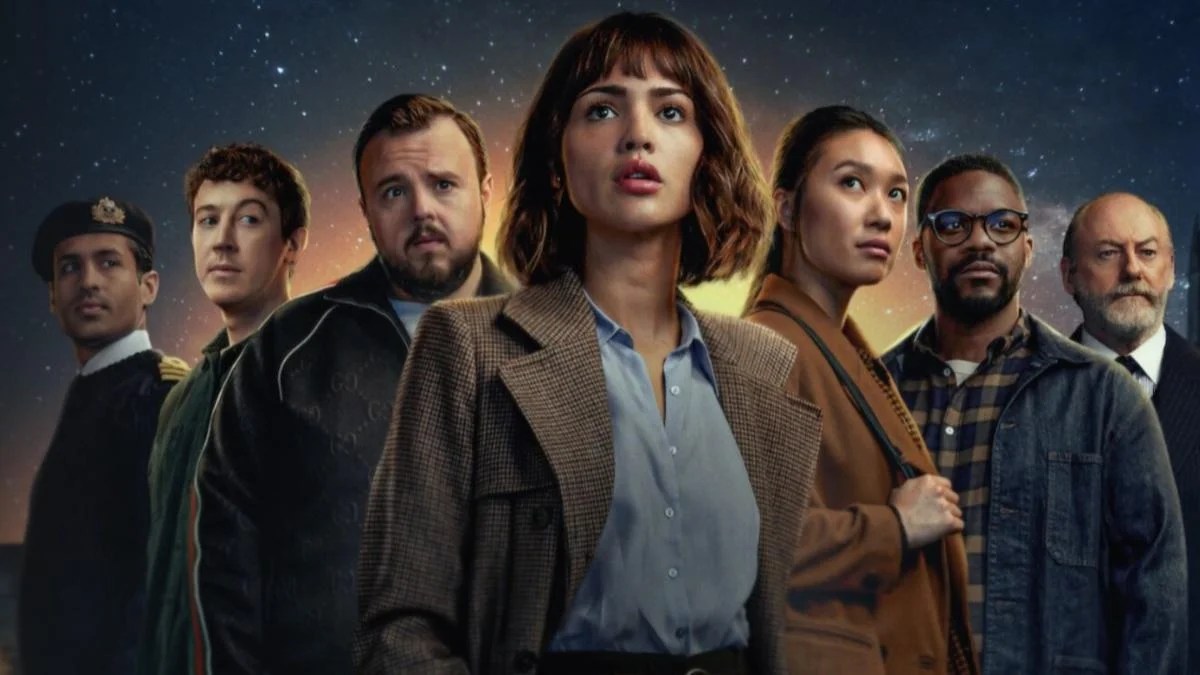
The profile of Cixin Liu expanded exponentially last year when Netflix launched its ten-episode series based on the first volume of the trilogy, The Three Body Problem. The second volume, The Dark Forest, is in production and will be streamed in 2026.

This event provoked a great deal of speculation about the geopolitical significance of the novel. Does Trisolaris stand for the United States and the threat it poses to the other global power of our age, China? Or vice-versa? Alternatively it might be read as a battle which might be envisaged between the technological giants of the 21st century. But a more interesting aspect of these three volumes, however, is what they reveal to us about the question of the existence of God within modern and supposedly atheistic Chinese culture.

Authors don’t like their work being reduced to simplistic interpretations, and Cixin Liu is no exception. “The whole point is to escape the real world!” he said, and not a commentary on history or current affairs.  He says he just wants to tell a good story. He does that, but I also think he does more.

His story, despite what he says, does have some grounding in real events. The first volume features the horrific murder by the Red Guards of the father of the protagonist. Her reaction to this is central to the entire plot. 

In another passage – in Death’s End – he would also have seemed to be sailing close to the wind in terms of a commentary on the history of his country.

The death sentence of a character deemed responsible for the pragmatic destruction of an outlying planet and its entire population is being debated. A discussion on the morality of capital punishment ensues. Is killing the perpetrator of such a crime morally acceptable? Someone asks:

“What about more than that? A few hundred thousand? The death penalty, right? Yet, those of you who know some history are starting to hesitate. What if he killed millions? I can guarantee you such a person would not be considered a murderer. Indeed, such a person may not even be thought to have broken any law. If you don’t believe me, just study history! Anyone who has killed millions is deemed à ‘great’ man, a hero.”

We might ask ourselves who he might have in mind?

A protagonist in the later part of the trilogy is a young scientist. She features in the entire story but really becomes pivotal in Death’s End and in its denouement. She represents the moral heart of the story.

Jiayang Fan is a staff writer at The New Yorker. She met Cixin Liu (below) in Washington when he visited there for the presentation to him of the Arthur C. Clarke Award. Her interview with him was published in TNY’s print edition of 24th June 2019, with the headline “The War of the Worlds.” She describes an episode in the trilogy which depicts Earth on the verge of destruction. 

A scientist named Cheng Xin encounters a gaggle of schoolchildren as she and an assistant prepare to flee the planet. The spaceship can accommodate the weight of only three of the children, and Cheng, who is the trilogy’s closest embodiment of Western liberal values, is paralyzed by the choice before her. Her assistant leaps into action, however, and poses three math problems. The three children who are quickest to answer correctly are ushered on board. Cheng stares at her assistant in horror, but the young woman says, “Don’t look at me like that. I gave them a chance. Competition is necessary for survival.”

In the story the crisis is averted and flight is no longer necessary. All the children survive.

The quotation underscores much of the moral dilemma portrayed in the trilogy. As Fan puts it, 

 In their pursuit of survival, men and women employ Machiavellian game theory and adopt a bleak consequentialism. In Liu’s fictional universe, idealism is fatal and kindness an exorbitant luxury. As one general says in the trilogy, “In a time of war, we can’t afford to be too scrupulous.  Indeed, it is usually when people do not play by the rules of Realpolitik that the most lives are lost.”

Cheng repeatedly rejects such an ethic and persistently dodges all the actions which the roles chosen by her or imposed on her would have had lethal consequences for millions. Her sense of responsibility is her dominant characteristic. Near the end of Death’s End she composes what amounts to her apologia pro vita sua in which she writes, and which I quote without, I hope, spoiling anything:

Later, my responsibilities became more complicated: I wanted to endow humans with lightspeed wings, but I also had to thwart that goal to prevent a war…

And now, I’ve climbed to the apex of responsibility…

I want to tell all those who believe in God that I am not the Chosen One. I also want to tell all the atheists that I am not a history-maker. I am but an ordinary person. Unfortunately, I have not been able to walk the ordinary person’s path. My path is, in reality, the journey of a civilization.

This is the last reference to God in the books but it was not the first. Several key characters, professing atheism, in moments of great crisis say they wish they were not atheists.

Luo Ji got into the car quickly, not wanting Shi Qiang to see the tears in his eyes. Sitting there, he strove to etch the rearview-mirror image of Shi Qiang onto his mind, then set off on his final journey.

Maybe they would meet again someplace. The last time it had taken two centuries, so what would the separation be this time?

Like Zhang Beihai two centuries before, Luo Ji suddenly found himself hating that he was an atheist.

Another character’s response to the crisis she faces is as follows: “No, this can’t be happening,” Dongfang Yanxu said, her voice so low only she could hear it. It was for her own ears, in response to her earlier “god” exclamation. She had never believed in the existence of God, but now her prayers were real.

In another conversation between a group of scientists we find a character opting for Pascal’s wager to help him cope with the atheism which surrounds him.

“Doctor, do you believe in God?”

The suddenness of the question left Ringier momentarily speechless. “… God? That’s got a variety of meanings on multiple levels today, and I don’t know which you—”

“I believe, not because I have any proof, but because it’s relatively safe: If there really is a God, then it’s right to believe in him.

If there isn’t, then we don’t have anything to lose…”

Ringier mused, “If  by ‘God’ you mean a force of justice in the universe that transcends everything—”

Fitzroy stopped him with a raised hand, as if the divine power of what they had just learned would be reduced if it were stated outright. “So believe, all of you. You can now start believing.”  And then he made the sign of the cross.

At another point in the story, when a spaceship has gone off into outer space looking for and hoping to find a habitable planet, which the occupants  fantasise as a new Garden of Eden. They are already experiencing a fatal sense of rivalry with another accompanying spacecraft. One of the occupants poses the question, 

“Will what happened in the first Garden of Eden be repeated in the second?” 

“I don’t know. At any rate, the vipers have come out. The snakes of the second Garden of Eden are even now climbing up people’s souls.”

Long-term hibernation, even for hundreds of years, is an option for scientists working on extended projects. Over the passage of years civilisation goes through periods of extreme decadence, provoked partly by a sense of hopelessness and desperation. In one sequence two central characters emerge from hibernation right into an orgy of licentiousness. 

“Are those people?” Luo Ji asked in wonder.

“Naked people. It’s a tremendous sex party, with more than a hundred thousand people, and it’s still growing.”

Acceptance of heterosexual and homosexual relations in this era was far beyond anything Luo Ji had imagined, and some things were no longer considered remarkable. Still, the sight before them came as a shock to both of them. Luo Ji was reminded of the dissolute scene in the Bible before humanity received the Ten Commandments.  A classic doomsday scenario.

“Why doesn’t the government put a stop to it?” 

Shi Qiang asked sharply.

“How would we stop it? They’re completely within the law. If we take action, the government would be the one committing a crime.”

Shi Qiang let out a long sigh. “Yes, I know. In this age, police and the military can’t do much.”

The mayor said, “We’ve been through the law, and we haven’t found any provisions for coping with the present situation.”

It is not difficult to see a veiled reference by Cixin Liu to some of the mores which have developed in our own time.

In another climatic sequence, the same Luo Ji, one of the central protagonists in the novel is literally digging his own grave, into which he plans to throw himself and await death as doomsday seems to be approaching.

As Luo Ji worked to maintain a blank state in his mind, his scalp tightened, and he felt like an enormous hand had covered the entire sky overhead and was pressing down on him.

But then the giant hand slowly withdrew.

At a distance of twenty thousand kilometers from the surface, the deadly missile changed direction and headed directly toward the sun. The destruction of the planet was averted.

I cannot say that this is an intentional reference, but in the Bible you have this:

“Put forth thy hand from on high, take me out, and deliver me from many waters:  from the hand of strange children:” (Psalm 143:7). 

Finally, in Death’s End, when Cheng Xin is faced with a choice of accepting a mission critical for the survival of mankind, she is surrounded by crowds clamouring for her to accept the challenge. 

She faced the crowd on the plaza. A hologram of her image floated above them like a colorful cloud. A young mother came up to Cheng Xin and handed her baby, only a few months old, to her. The baby giggled at her, and she held him close, touching her face to his smooth baby cheeks. Her heart melted, and she felt as if she were holding a whole world, a new world as lovely and fragile as the baby in her arms.

“Look, she’s like Saint Mary, the mother of Jesus!” the young mother called out to the crowd. She turned back to Cheng Xin and put her hands together. Tears flowed from her eyes. “Oh, beautiful, kind Madonna, protect this world! Do not let those bloodthirsty and savage men destroy all the beauty here.

(Correction: in paragraph four of this post, ‘solar system’ has been replaced by ‘galaxy’.)

HANNAH ARENDT AND THE ‘CRISIS OF OUR TIME’

Undoubtedly, one of the most important books written in, and left to us from the 20th century was and is Hannah Arendt’s The Origins of Totalitarianism. Why? It is a thorough and spellbinding work on the history of the two-century unfolding of that nightmare of butchery and twisted deceit. It is also a deep and penetrating work of political philosophy which serves as a frightening and lasting reminder that humanity is permanently threatened by the destructive seeds from which that cancer grew. She reminds us that it could happen again.

Predictions are of little avail and less consolation, she writes, but goes on to say that there remains the fact that the crisis of our time and its central experience have brought forth an entirely new form of government -Totalitarianism.  In 1966 she held that this, as a potentiality and an ever-present danger, is only too likely to stay with us from now on,. Just as other forms of government which came about at different historical moments and rested on different fundamental experiences, have stayed with mankind regardless of temporary defeats – monarchies, and republics, tyrannies, dictatorships and despotism. 

Nearly sixty years later, with the evidence we have of totalitarian tendencies in our public life we are hardly in a position to dispute her assertion. 

Arendt began writing her study of the origins of totalitarianism as early as 1945. One incarnation of that catastrophic horror had just been eliminated at the cost of a terrible war. Another was still exercising the full force of its tyranny, while the third was about to begin its reign of terror in the Far East. The first to be vanquished was that which had spread across Europe from Nazi Germany; the second was Stalin’s Soviet Empire with its multiple puppet satellites in eastern Europe; the third was the People’s Republic of China with its overcooked clones, North Korea and Vietnam. That one is still with us, carefully camouflaging itself in an attempt to make us think that it is not what it really is.

We think of all these aberrations as 20th century phenomena. Arendt’s great and prophetic work shows us, however, that their origins go back through a century and a half of mankind’s confused reading of our world, human society and the many deadly turnings which political thought took over that period. 

Yuval Levin’s  book, The Great Debate, is a  study of the arguments between Edmund Burke and Tom Paine in the 1790s. In it he showed how the critical divergence in western political thought in our own time dates from then. That debate was essentially over the foundations on which the rights of man are based. In many ways it matches Arendt’s own vision of where our 20th century nightmare started. If we want a dramatic symbol for the turning point which led us to the disasters of our time we might take the enthronement of the goddess of reason on the high altar of Notre Dame de Paris. This was the symbolic and fatal moment when Man was declared to be the centre of all things.

I could not hope and would not dare to try to offer a succinct summary of Arendt’s masterpiece, all 600-plus pages of it. The best I can do is explain that In the three parts of her study – the first edition was published in 1950, later revisions in 1966 – the phenomena she holds to account for the world’s greatest catastrophes and the political impasse she saw in the Cold War in the1960s, are antisemitism, imperialism and totalitarianism which they spawned.

Arendt died 50 years ago (1975). The chilling thing about everything in her work is that she speaks to our world today in so many ways. One of the great evils which she saw in her time and which, in her view, contributed to the despair on which totalitarianism nurtured itself, was loneliness.  She noted that totalitarian regimes fostered the atomisation of individuals in society. Loneliness accompanied this, which along with distrust of others fostered the semi-worship of the all-powerful deadly state systems which the 20th century had to suffer. 

What is one of the tragic human maladies of which 21st century men and women have again become painfully conscious? Loneliness.

She wrote in 1966, reflecting on the deadly attraction of the so-called intelligentsia to this new state system, What’s more disturbing to our peace of mind than the unconditional loyalty of members of totalitarian movements, and the popular support of totalitarian regimes, is the unquestionable attraction these movements exert on the elite, and not only on the mob elements in society. It would be rash indeed to discount, because of artistic vagaries or scholarly naïveté, the terrifying roster of distinguished men whom totalitarianism can count among its sympathizers, fellow-travelers, and inscribed party members.

The dominant elites of the past thirty years may not have been consciously totalitarian but the antisemitic mobs which occupied university campuses, or London’s streets over the past two years did not come out of thin air. Do her reflections on the power and influence of the elites of her own time not sound familiar to us relative to the cancellations, no-platforming, silencing and destruction of freedom of speech in our time – not to mention their insane efforts to redefine and obliterate our very understanding of human nature?

Furthermore, she explained, this attraction for the elite is as important a clue to the understanding of totalitarian movements as their more obvious connection with the mob. It indicates the specific atmosphere, the general climate in which the rise of totalitarianism takes place. It should be remembered that the leaders of totalitarian movements and their sympathizers are, so to speak, older than the masses which they organize so that chronologically speaking the masses do not have to wait helplessly for the rise of their own leaders in the midst of a decaying class society of which they are the most outstanding product.

The ultra progressive capture of our academic institutions is now providing the elders of the movement. Over a few decades this is what has generated the mobs of young people who in the past decade have torn apart whole city districts and occupied campuses today.

Reflecting on what prepares men for totalitarian domination in the non-totalitarian world, she argues, is the fact that loneliness, once a borderline experience usually suffered in certain marginal social conditions like old age, has become an everyday experience of the ever growing masses of our century. 

The merciless process into which totalitarianism drives and organizes the masses looks like a suicidal escape from this reality. The ‘ice-cold reasoning’ and the ‘mighty tentacle’ of dialectics which ‘seizes you as in a vise’ appears like a last support in a world where nobody is reliable and nothing can be relied upon. It is the inner coercion whose only content is the strict avoidance of contradictions that seems to confirm a man’s identity outside all relationships with others. It fits him into the iron band of terror even when he is alone, and totalitarian domination tries never to leave him alone except in the extreme situation of solitary confinement. 

She explains how the process works by destroying all space between men and pressing men against each other, even the productive potentialities of isolation are annihilated; by teaching and glorifying the logical reasoning of loneliness where man knows that he will be utterly lost if ever he lets go of the first premise from which the whole process is being started, even the slim chances that loneliness may be transformed into solitude and logic into thought are obliterated.

 If this practice is compared with that of tyranny, it seems as if a way had been found to set the desert itself in motion, to let loose a sand storm that could cover all parts of the inhabited earth. The conditions under which we exist today in the field of politics are indeed threatened by these devastating sand storms. 

But sand storms are not permanent phenomena. They are destructive but temporary. Their danger, she says,  is not that they might establish a permanent world. Totalitarian domination, like tyranny. bears the germs of its own destruction.

The first part of her study deals with the growth of  secular antisemitism. The second part deals with the nature, legacy and corrupting nature of late 19th  and early 20th  century imperialism. In the third part she shows how the combined and intertwining legacy of these two fatal realities morph into the horror of totalitarianism.

The flawed notions of the rights of man which were championed by Tom Paine et al flourished over the nineteenth century. Add to that the plague of antisemitism and imperialism which spawned what she describes as ‘race-thinking’. This in turn undermined the historic model of the nation state and the sense of community which it nourished. The replacement of the old stabilising notion of the nation state generated pan-ethnic consciousness (Germanic, Slav and Russian) which in turn created stateless populations – including Jews – which found no home in those entities. Those entities themselves were partly driven by a desire for conquest and to create new empires. Out of all this emerged classless mobs worshiping a new notion of political power. These became easy fodder to nourish the central and eastern European totalitarian regimes of the 20th century.

She makes an interesting observation on how the Mediterranean nations somehow partially escaped the frenzy.

The only countries where to all appearances state idolatry and nation worship were not yet outmoded and where nationalist slogans against the ‘suprastate’ forces were still a serious concern of the people were those Latin-European countries like Italy and, to a lesser degree, Spain and Portugal, which had actually suffered a definite hindrance to their full national development through the power of the Church. It was partly due to this authentic element of belated national development and partly to the wisdom of the Church, which very sagely recognized that Fascism was neither anti-Christian nor totalitarian in principle.

The real seed-bed of totalitarianism was Central and Eastern Europe. In the 1920s and 1930s, after the first World War, the chaos among the displaced populations, the ethnic majorities and the corresponding minorities, produced all sorts of conflicts, requiring the setting of new state boundaries. Ireland’s border predicament was a side show in comparison with what mainland Europe was experiencing. But the growth of race-thinking added more poison to the mix. Europe was awash with masses of stateless people. The League of Nations tried to institute what were called ‘minority treaties’ to establish some kind of human rights for these people. They can only be seen as dismal failures.

Add to this confusion the flawed notion of human rights without any philosophical or anthropological foundation – who has them, and on what basis?  In principle the right to have rights, or the right of every individual to belong to humanity, should be guaranteed by humanity itself. But in practice this abstract notion of humanity guaranteed nothing.

The crimes against human rights, which have become a specialty of totalitarian regimes, can always be justified by the pretext that right is equivalent to being good or useful for the whole in distinction to its parts. A conception of law which identifies what is right with the notion of what is good for – the individual, or the family, or the people, or the largest number – becomes inevitable once the absolute and transcendent measurements of religion or the law of nature have lost their authority. 

Here, in the problems of factual reality, we are confronted with one of the oldest perplexities of political philosophy, which could remain undetected only so long as a stable Christian theology provided the framework for all political and philosophical problems, but which long ago caused Plato to say: ‘Not man, but a god, must be the measure of all things.’

She concludes that these facts and reflections offer what seems an ironical, bitter, and belated confirmation of the famous arguments with which Edmund Burke opposed the French Revolution’s Declaration of the Rights of Man. They appear to buttress his assertion that human rights were an abstraction, that it was much wiser to rely on an entailed inheritance of rights which one transmits to one’s children like life itself, and to claim one’s rights to be the ‘rights of an Englishman’ rather than the inalienable rights of man.” (Edmund Burke, Reflections on the Revolution in France). According to Burke, the rights which we enjoy spring from within the nation, so that neither natural law, nor divine command, nor any concept of mankind such as Robespierre’s ‘human race,’ the sovereign of the earth, are needed as a source of law.  (Robespierre, Speeches. Speech of April 24, 1793.)

She asserts that the pragmatic soundness of Burke’s concept seems to be beyond doubt in the light of our manifold experiences. Not only did loss of national rights in all instances entail the loss of human rights. The world found nothing sacred in the abstract nakedness of being human. And in view of objective political conditions, it is hard to say how the concepts of man upon which human rights are based – that he is created in the image of God (in the American formula), or that he is the representative of mankind, or that he harbors within himself the sacred demands of natural law (in the French formula) – could have helped to find a solution to the problem.

The survivors of the extermination camps, the inmates of concentration and internment camps, and even the comparatively happy stateless people could see without Burke’s arguments that the abstract nakedness of being nothing but human was their greatest danger.

But Arendt is not a pessimist. Her final judgement echoes – but in a more Judaeo-Christian way – the final frames of Stanley Kubrick’s  masterpiece imagining of the future of humanity, 2001: S Space Odyssey, where the ‘star child’ enters the edge of the screen suggesting a new beginning for mankind.
She reminds us that there remains also the truth that every end in history necessarily contains a new beginning; this beginning is the promise, the only ‘message’ which the end can ever produce. Beginning, before it becomes a historical event, is the supreme capacity of man; politically, it is identical with man’s freedom. Initium ut esset homo creatus est – that a beginning be made man was created’ said Augustine. This beginning is guaranteed by each new birth; it is indeed every man.

Hope and the Unmasking of Evil

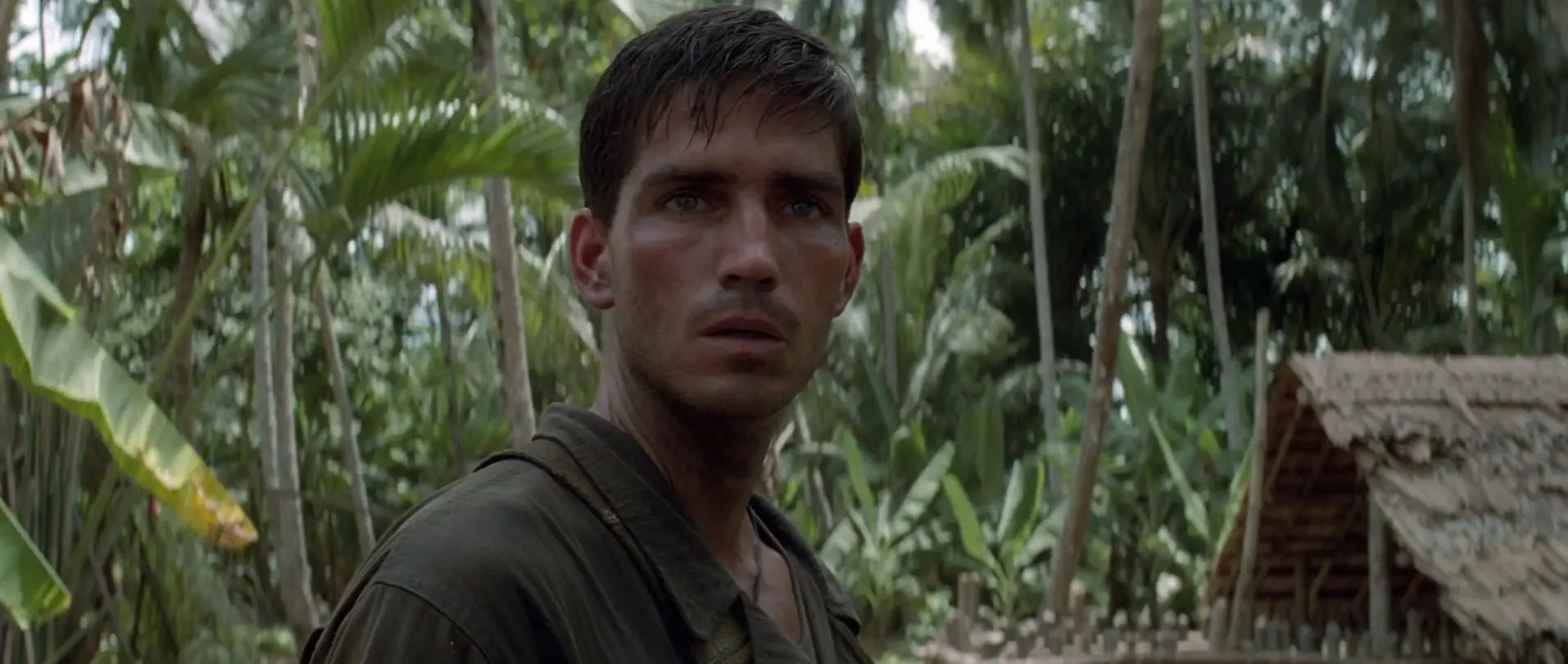
In opening scenes of Terrence Malick’s film, The Thin Red Line, the raw recruit, Private Witt (above), who has gone AWOL from his company in the run up to the battle of Guadalcanal, muses about the problem of evil. He is wandering around a peaceful Melanesian village in a South Pacific island, its inhabitants unaffected by the war raging across the world.

The words he utters to himself are the original words written by James Jones, the author of the novel on which the film is based, published in 1962. Jones asked explicitly:

“This great evil, where’s it come from? How’d it steal into the world? What seed, what root did it grow from? Who’s doing this? Who’s killing us, robbing us of life and light, mocking us with the sight of what we might’ve known? Does our ruin benefit the earth, does it help the grass to grow, the sun to shine? Is this darkness in you, too? Have you passed through this night?” Jones was a veteran of that war.

We keep asking this question even though we’ve had the answer for as long as mankind has been inhabiting this earth. Not only do we ignore the answer but we also choose to muddle ourselves in all sorts of ways in trying to deny that there is an answer. We seem to prefer the darkness Jones refers to than to pass into the light.

Ross Douthat, columnist with The New York Times, writes  periodically on religious issues. He does his best to help us all cut through that darkness. He deals with evil in the context of the influence it has over our faith in God. Appalled by evil, some conclude that there simply can’t be a creator — or at least not a beneficent one — because the world is too laden with suffering and woe.”

There is, he finds, a muddle in their argument because its proponents often profess to be atheists. It isn’t properly speaking an argument that some creating power does not exist. Rather it’s an argument about the nature of that power, a claim that the particular kind of God envisioned by many believers and philosophers — all powerful and all good — would not have made the world in which we find ourselves, and therefore that this kind of God does not exist.

This argument of course ignores the multitude of good things in this world and what their source might be.

Rather than a straight rebuttal of an argument which is as muddled as this one, he suggests a set of challenges to it.

The first challenge he offers emphasises the limits of what the argument from evil establishes. It does not support an argument that God doesn’t exist, nor that the universe lacks a supernatural order. At best it seems to say that the traditional Christian or classical-theistic conception of God’s perfect goodness is somehow erroneous or overdrawn. 

The second challenge is that deniers of a ‘good God’ would do well to note that the books of  the Abrahamic tradition, which Jews and Christians themselves accept as divinely inspired, contain some of the strongest complaints against the apparent injustices of  the world. They are potentially much more worrying than those found in any atheistic tract. Check out the Bible

Douthat points out that the question of why God permits so much suffering is integral to Jewish and Christian Scripture, to the point where it appears that if the Judeo-Christian God exists, he expects his followers to wrestle with the question. Which means that you don’t need to leave all your intuitive reactions to the harrowing aspects of existence at the doorway of religious faith; there is plenty of room for complaint and doubt and argument inside the fold.

Finally, there is the evidence of the enormous good which Judeao-Christian civilisation has bestowed on this world, in the light of which the exclusive focus on the problem of evil seems a little overblown. Douthat suggests that “even if that evil makes it hard for you to believe in a God of perfect power, you still shouldn’t give up hope that something very good indeed has a role in the order of the world.”

But to return to the question posed by James Jones we must, and would be fools not to, resort to the historical sacred documents we have in Holy Scripture.

Romano Guardini shows us what we are really up against. In a chapter on ‘The Enemy’ in his meditations on the life and teachings of Christ in his book, The Lord, he gives us a very clear vision and understanding of the source of all evil in the world. He does this in the context of the accounts of Christ’s miracles in the New Testament – and one in particular.

Then there was brought to him a possessed man who was blind and dumb; and he cured him so that he spoke and saw. And all the crowds were amazed, and they said, ‘Can this be the Son of David?’ But the Pharisees, hearing this, said ‘This man does not cast out devils except by Beelzebub, the prince of devils.’ And knowing their thoughts Jesus said to them, ‘Every kingdom divided against itself is brought to desolation, and every city or house divided against itself will not stand. And if Satan casts out Satan, he is divided against himself; how then shall his kingdom stand? . . . But if I cast out devils by the Spirit of God, then the kingdom of God has come upon you’.  (Matt. 12:22–28). 

He tells us that what is reported here is essential to any genuine understanding of the New Testament. The account, he says, suggests similar cases of possession that Jesus has cured. “Not as a doctor cures; not even as Jesus himself has usually cured, by simply applying his miraculous powers of healing to the ravaged body. Here, behind the torment of body and soul, the Lord recognizes an evil power: the Demon, Satan. It is he who has made the invalid his abode; the physical pain involved is a result of his terrible habitation. It is he whom Jesus attacks, dislodging him by sheer spiritual force, and with him the accompanying ailment.” 

He is aware that sceptical and ultra-rationalist moderns  protest against the existence of intangible powers. He says they willingly enough recognise natural reality on the one hand, spiritual norms on the other:  given conditions of being and of intention. But then they baulk, afraid of fantastic folly. All reference to the demonic smacks of the unclean, of things belonging to a lower level of religion that must be overcome.  Here, he says,  lies the crux of our attitude toward Jesus: do we accept him, once and for all, as our ultimate authority in everything, or do we rely solely on our own judgment? 

He says that “If we think as Christians, we accept him as the starting point and norm of all truth, and we listen to everything he says with open minds, eager to learn, particularly when we are dealing, not with chance remarks of Jesus, but with a fundamental attitude that asserts itself again and again. The Lord’s acceptance of the inevitable struggle with satanic powers belongs to the kernel of his Messianic consciousness. He knows that he has been sent not only to bear witness to the truth, to indicate a way, to animate a vital religious attitude, to establish contact between God and man; but also to break the power of those forces which oppose the divine will. 

“For Jesus there is more than the mere possibility of evil as the price of human freedom; more than the inclination to evil, fruit of individual or collective (inherited) sin. Jesus recognizes a personal power that fundamentally wills evil: evil per se. It is not satisfied by the achievement of positive values through wicked means; it does not simply accept the evil along with the good. Here is something or someone who positively defies divinity and attempts to tear the world from God’s hands—even to dethrone God.”

Isn’t this the answer to the cri de coeur of James Jones, echoed by Malick? Jones asks, “Who’s doing this? Who’s killing us, robbing us of life and light, mocking us with the sight of what we might’ve known? … Is this darkness in you, too? Have you passed through this night?”  One senses that the question intuits the answer.

Guardini goes on to assert that the demon’s plan is to  lead the world into apostasy and self-destruction. This is what Holy Scripture means when it says that Satan creates that darkness which refuses the light that comes from God and is the seducer of mankind; that “He was a murderer from the beginning” for “by the envy of the devil, death came into the world” (John 8:44; Wisdom 2:24). 

“The Bible often speaks of him as lord of a “kingdom,” founder of a perverted order in which the hearts and minds of men—their creations, their deeds, their relations to things and to each other—seem sensible and coherent, but actually are senseless and incoherent. Long passages in John’s gospel describe Satan’s attempts to establish a kingdom of evil in opposition to God’s holy kingdom, anti-world to the new divine creation unfolding.”

This was the struggle witnessed by and bewildering Jones and his creation, Private Witt, in the horrors of Guadalcanal. It is the struggle which bewilders us as we contemplate the atrocities of October 7 on the border of Israel, of the devastation in Gaza, in Ukraine, Sudan and the Congo today.

Devastation on the Ukrainian-Russian border (NYT image)

But Guardini reassures us that Satan is no principle, no elementary power, but a rebellious, fallen creature who frantically attempts to set up a kingdom of appearances and disorder. He has power, but only because man has sinned. He is powerless against the heart that lives in humility and truth. His dominion reaches as far as man’s sinfulness, and will collapse on the Day of Judgment—a term long in itself, for every moment of evil is dreadfully long for those who stand in danger of Satan—but only a moment as compared with eternity. 

“‘Soon’,” as the Apocalypse reveals, it will be over (3:11; 22:7). Jesus knows that he has been sent forth against Satan. He is to penetrate Satan’s artificial darkness with the ray of God’s truth; to dispel the cramp of egoism and the brittleness of hate with God’s love; to conquer evil’s destructiveness with God’s constructive strength. The murkiness and confusion which Satan creates in men’s groping hearts are to be clarified by the holy purity of the Most High. Thus Jesus stands squarely against the powers of darkness; he strives to enter into the ensnared souls of men—to bring light to their consciences, quicken their hearts and liberate their powers for good.”

THE SEARCHING SOUL OF INGMAR BERGMAN

Back in the late 1950s and 1960s the film-maker Ingmar Bergman’s prestige and reputation were at their height. In those years anticipation of the next Bergman film to arrive in cinemas was akin to the anticipation today of the next film from Christopher Nolan or Terrence Malick. They were the works which dominated cultural conversation for months after their release. Why was that? 

In a word I think we can say it was all about ‘meaning’ – man’s search for meaning, the mystery of human and divine love and the existence of God.

Bergman’s language, the visual language  with which he explored this overriding universal theme, was full of symbolism. Indeed, even at that time, symbolism was so central in his language that some whose literacy was less developed, felt the symbolic imagery was somewhat overwrought. That was nonsense. Sadly, however, that illiteracy seems to have increased.

Pope Francis, in his Apostolic Letter of 2022,  Disiderium desideravi, quoted Romano Guardini about the importance of liturgy as our path to God and the importance of symbols in liturgy. Guardini  wrote of what he saw as “the first task of the work of liturgical formation: man must become once again capable of symbols.” The Pope pointed the finger at us all in this regard: “This is a responsibility for all, for ordained ministers and the faithful alike. The task is not easy because modern man has become illiterate, no longer capable of reading symbols; it is almost as if their existence is not even suspected.” Strong words.

Moving back to Bergman’s work, here are even stronger words from Lawrence Brooks – a disaffected figure in the Hollywood ecosystem:

“95% of film directors are so dumb that the very idea of including symbolism in their movies is beyond their capabilities.”  Most film directors are just “trying to get the job done on time, on schedule. Messages & Symbolism in modern film? Ha! People like Fellini, Bergman, Kurosawa, Fincher, Nolan, and Kubrick are very rare indeed.” 

Bergman’s three great early films, The Seventh SealThe Virgin Spring and Through A Glass Darkly, even in their titles are all dependent on our capacity to read symbols if we are to have any chance of understanding what they are about. They are all deeply religious works. Much of his later work, while ultimately leading to questions of human fulfilment, are not explicitly religious. These are.

The Seventh Seal  tells of the journey of a medieval knight (Max von Sydow) and a game of chess he plays with the personification of Death (Bengt Ekerot) who has come to take his life. In The Book of Revelation the Lamb breaks open seven seals. “And when the Lamb had opened the seventh seal, there was silence in heaven about the space of half an hour.” The motif of silence refers to the “silence of God,”, the silence with which the knight is struggling and which is threatening to destroy his faith throughout the film. 

The two powerful iconic images in the film are those of Death playing that game of chess with the knight – which continues at intervals throughout the film – and the final image of the Dance of Death. Both these images are visible today in two different churches in Sweden, both Lutheran but both formerly Catholic.

Another writer from the Hollywood ecosystem, Rick Manly of the University of California, wrote of this film, “With its images and reflections upon death and the meaning of life, The Seventh Seal had a symbolism that was immediately comprehensible to people trained in literary culture who were just beginning to discover the ‘art’ of film, and it quickly became a staple of high school and college literature courses.”

British cultural broadcaster, Melvyn Bragg,  wrote of Bergman’s  work: “It is constructed like an argument. It is a story told as a sermon might be delivered: an allegory…each scene is at once so simple and so charged and layered that it catches us again and again…Somehow all of Bergman’s own past, that of his father, that of his reading and doing and seeing, that of his Swedish culture, of his political burning and religious melancholy, poured into a series of pictures which carry that swell of contributions and contradictions so effortlessly that you could tell the story to a child, publish it as a storybook of photographs and yet know that the deepest questions of religion and the most mysterious revelation of simply being alive are both addressed.”

Ingmar Bergman

Benjamin Ramm is a journalist who writes for the BBC and other media. He argues that It’s not right that Bergman is always described as dark and gloomy. He was a deeply humane artist with great empathy. Bergman’s primary theme, he says, is not death but the redemptive possibility of love.

F. B. Myer, a Baptist pastor, writing  in light of World War I and the sufferings and sorrows that many endured during that time, refers to death as a sister and the enduring comfort and strength that God provides throughout the trials which may accompany it. The shrouded figure accompanying our protagonist throughout The Seventh Seal is spoken of as the personification of Death. In fact we realise at the very end of the film, as the young girl who had been rescued from a vicious attacker, looks and smiles at the face of the shrouded figure, that she is looking at the face of her Redeemer. What in fact is Death but a manifestation in our lives of the Providence of God? The dancing company of pilgrims silhouetted against the sky, following this figure, are on their way to eternity. All of them are people who have struggled against adversity of one kind or another. They are all good people now dancing to their eternal reward.

Another rich vein of symbolism in The Seventh Seal is seen in the figures of Jof and Mia with their infant child. The knight appears to shield them and let them go off unharmed by his shadowy chess opponent whom he assumes wants to harm them. Read it as you wish but his opponent is not taken in by the tossed-over chess board. He is aware of a greater mission to the world of of which this family is a symbol.

The Seventh Seal is an immortal work which ranks as one of the greatest achievements which the art of cinema has left us. It ranks in its own canon as Bach’s Mass in B Minor ranks in the musical canon.

In Benjamin Ramm’s view, what makes Bergman radical is his unfashionable sincerity.

“In over 60 films in a career spanning six decades, Bergman charted the harrowing cost of what he called ‘emotional poverty’. His work in all its variety is arrayed against the cynical, clinical, calculating, careless, and callous; he decries our lack of compassion and our “empty but clever” irony. What makes Bergman radical in our own era is his unfashionable sincerity, which leaves him open to mockery and parody”

Two other films, The Virgin Spring (1960) and Through a Glass Darkly (1961), both of which received Academy Awards, along with The Seventh Seal, constitute a kind of ‘faith trilogy’ in Bergman’ s work . The title of the 1961 film is a reference to St Paul’s first letter to the  Corinthians (13.12).

The Virgin Spring is set in medieval Sweden, It is a tale about a father’s merciless murder of two men and an innocent child implicated in the rape and murder of his young daughter. The story was adapted from a 13th century Swedish ballad well-known throughout Scandinavia. But it is not just a revenge tale. It is the story of the father’s response to a miracle on the site of his daughter’s murder in which a spring gushes forth from the dry forest earth. The father falls on his knees and asks God’s forgiveness for his own vengeful and sinful crime of murder. Bergman was himself a troubled soul – but then so was King David.

Through a Glass Darkly is a story, in a modern setting, about a troubled family group in which the daughter, Karin is suffering from intermittent symptoms of schizophrenia. Meanwhile (spoiler) her brother Minus is at emotional odds with his father, David. They seem not to be able to talk to each other. They are living on an isolated island and when Karin has a relapse she is taken off by helicopter to receive medical attention. At that point father and son help each other and Minus tells his father that he is afraid that he also may be losing his grip on reality. He asks his father if he can survive that way. David tells him he can if he has “something to hold on to”. He tells Minus of his own hope: love. David and his son, quoting Sacred Scripture, discuss the concept of love as it relates to God. They find solace in the idea that their own love may help sustain Karin. The ice is broken and Minus is exultant that he finally had a real conversation with his father. 

Bergman was not entirely happy that he had achieved his artistic and religious objective with this ending. He felt he had not fully expressed the truth he wanted to convey and that the optimistic epilogue was “tacked loosely onto the end,” causing him to feel  “ill at ease” when later confronted with it. He added that “I was touching on a divine concept that is real, but then smeared a diffuse veneer of love all over it.”

Through a Glass Darkly is a more complex story than the other two and while rich in symbolism is also influenced by neo-realism. Despite his reservations It is profoundly moving.  Among Bergman’s 60+ films it ranks as one of his definitive masterpieces.

The Existential Bob Dylan

Nobel Prizes are always reported in the international media. In some years we hear more about them than  than in others. Very few occasions have matched the sensation caused in 2017 by the announcement  that the prize for literature was being awarded to Robert Zimmerman, better known to most of us as Bob Dylan.

The Swedish Academy, was entrusted by Alfred Nobel with the onerous task of distributing annually from his largesse, a cache of very valuable prizes. These were to go to recipients working in a range of disciplines across the world whose work was for the good of humanity. It is fair to say that the Nobel Prize is second to none in terms of the prestige it bestows on those who win it each year. 

In awarding the Nobel Prize for Literature to Dylan in that year the Academy not only broke a mould but did the world of literature a great favour. It freed our imagination from a concept of literature which previous categorisations had imposed on it and us.

There was some shock at the decision. I don’t think there was outrage – and no previous recipients handed back their prizes as OBE recipients from another time did when the Beatles received their honour from Queen Elizabeth. After dealing with the initial surprise at  the award, anyone familiar with Dylan’s oeuvre realised that he thoroughly deserved it. It was only right that his insight, his command of language and his imaginative explorations of the human condition, be recognised, rewarded and celebrated.

Merriam-Webster’s Collegiate Dictionary considers literature to be “writings having excellence of form or expression and expressing ideas of permanent or universal interest.” Britannica notes that the term literature has” traditionally been applied to those imaginative works of poetry and prose distinguished by the intentions of their authors and the perceived aesthetic excellence of their execution.” The 19th-century critic Walter Pater referred to “the matter of imaginative or artistic literature” as a “transcript, not of mere fact, but of fact in its infinitely varied forms.” Dylan’s work fits all these descriptions. The fact that he mostly sings just adds to the power and beauty of his expression.

Dylan, as a condition for receiving his prize, was obliged by the Academy’s rules to “deliver a lecture within six months of the official ceremony.”  This he duly did. Describing the entire extraordinary event as “the Dylan adventure”, the Academy’s late secretary, Sara Danius, commented, “The speech is extraordinary and, as one might expect, eloquent.” 

Dylan concluded his lecture by saying that “Our songs are alive in the land of the living. But songs are unlike literature. They’re meant to be sung, not read. The words in Shakespeare’s plays were meant to be acted on the stage. Just as lyrics in songs are meant to be sung, not read on a page. And I hope some of you get the chance to listen to these lyrics the way they were intended to be heard: in concert or on record or however people are listening to songs these days. I return once again to Homer, who says, ‘Sing in me, oh Muse, and through me tell the story'”.

It is notable that The Odyssey was composed to be sung. Later it was read, but when it was first composed, it was intended for delivery by a trained bard to the accompaniment of a stringed instrument resembling a lyre. Would Homer have been denied a Nobel Prize on that basis? Surely not.

 In his lecture, Dylan talks about the impact that three important books made on him: Herman Melville’s Moby-Dick, Erich Maria Remarque’s All Quiet on the Western Front and Homer’s Odyssey

Bob Dylan has been writing songs all his life. But he has also been thinking about songs, others’ songs, all his life. In 2022 his reflections on the songs which have dominated or influenced popular culture in the 20th and 21st centuries were made public in a remarkable volume published by Simon and Schuster. Entitled The Philosophy of Modern Song, the book is almost a hybrid of a True Detective volume and a work of existential philosophy. A friend of mine, after looking at the visual appearance said he thought it wasn’t worth a second look. But when I quoted a few passages from it he changed his mind.

Dylan seldom, if ever, talks about his own songs. What he has written he has written. They speak for themselves, like all great art. On interpretations of his work – of which there are multitudes – he remains silent, with the exception implied in his famous self-description as “a song and dance man”.

But this silence does not apply to what he has been listening to in the broad popular musical culture of the past century – and even beyond. In The Philosophy of Modern Song we have an extraordinary collection of reflections  on  songs from what is often called The Great American Songbook – with a handful of British for good measure, –  ranging from a haunting song by Stephen Foster from the 19th century down to the last years of the 20th. From each song, some of them apparently banal, sometimes briefly, sometimes at more length, he draws out existential interpretations of our times and the world in which we live.

Bob Dylan’s Philosophy of Modern Song is mainly a celebration of a culture – or a segment of our culture. It revisits sixty-six popular songs which in different ways reflect the simple joys and sorrows, the worries and anguish of a people – mainly North American – in the 20th century. Some of the songs were heard, even heard across the wider world, by millions and were the products of a multi-million dollar entertainment industry. Dylan does not evaluate them on any commercial basis and the songs which were never part of that exploitation, those heard by downtrodden people in impoverished communities, were of equal interest to him in articulating what he saw as this philosophy of our time.

For example, in a rather harrowing reading of a rather dark song called Take Me From The Garden of Evil, he begins calmly enough but then rises to a Jerimiad of existential anguish with echos of Psalm 37 and reminiscent of anything in Albert Camus’ bleaker novels. Take your pick. Inevitably all this is written in Dylan’s own inimitable style.

He begins, where the song does, telling us about the world we would like to live in and in which many people do:

“What you’d like to see is a neighbourly face, a lovely charming face. Someone on the up and up, a straight shooter ethical and fit. Someone in an attractive place, hospitable, a hole in the wall, a honky-tonk with home cooking. Nobody needs to be in a quick rush, no emphasis on speediness, everybody’s going to measure their steps. Your little girl will support you; she waits on you hand and foot, and she sides with you at all times.”

Then he looks at another world, negative and all too familiar, from which the songwriter is praying to escape – and in the end appears to have the determination to do so.

“But you’re in limbo, and you’re shouting at anyone who’ll listen, to take you out of this garden of evil. Get you away from the gangsters and psychopaths, this menagerie of wimps and yellow-bellies. You want to be emancipated from all the hokum. You don’t want to daydream your life away, you want to get beyond the borderlands and you’ve been ruminating too long.

You’ve been suspended in mid-air, but now the stage is set, and you’re going to go in any direction available, and get away from this hot house that has gone to the dogs. The one that represses you, you want to get away from this corrupt neck of the woods, as far away as possible from this debauchery. You want to ride on a chariot through the pillars of light… put money on it. You overpower your fears and wipe them out, anything to get out of this garden of evil. This landscape of hatred and horror, this murky haze that fills you with disgust.

You want to be piggy backed into another dimension where your body and mind can be restored. If you stay here your dignity is at risk, you’re one step away from becoming a spiritual monster, and that’s a no-no.

You’re appealing to someone, imploring someone to get you out of here. You’re talking to yourself, hoping you don’t go mad.

You’ve got to move across the threshold but be careful. You might have to put up a fight, and you don’t want to get into it already defeated.”

That’s at the dark end of his reflections but who can say that it does not resonate with our experience of dimensions of the world we see around us?

On a more sublime and sad level we have this enigmatic reflection on the reality of a society which has side-lined God in its reading of the human condition. In his reading of a poignant  little love song from 1972, If You Don’t Know By Now, he writes,

“One of the reasons people turn away from God is because religion is no longer in the fabric of their lives. It is presented as a thing that must be journeyed to as a chore – it’s Sunday, we have to go to church. Or, it is used as a weapon of threat by political nutjobs on either side of every argument. But religion used to be in the water we drank, the air we breathed. Songs of praise were as spine-tingling as, and in truth the basis of, songs of carnality. Miracles illuminated behavior and weren’t just spectacle.

“It wasn’t always a seamless interaction. Supposedly, early readers of the Bible were disturbed by the harshness of God’s behavior against Job, but the prologue with God’s wager with Satan about Job’s piety in the face of continued testing, added later, makes it one of the most exciting and inspirational books of the Old or New Testament.

“Context is everything. Helping people fit things into their lives is so much more effective than slamming them down their throats. Here’s another way to look at a love song.”

He could be searing in his reading of our time as well as benign and optimistic. God is present in Dylan’s vision of the world and the things that offend God are real to him.

On the subject of what America has done to the institutions of marriage and the family he offers us what is perhaps his most bitter and telling reflection. He jumps off on this one from a platform offered by a mock cynical Johnny Taylor song called It’s Cheaper to Keep Her. 

He writes that soul records, like Hillbilly, Blues, Calypso, Cajun, Polka, Salsa, and other indigenous forms of music, contain wisdom that the upper crust often gets in academia. The so-called school of the streets is a real thing. “While Ivy League graduates talk about love in a rush of quatrains detailing abstract qualities and gossamer attributes, folks from Trinidad to Atlanta, Georgia, sing of the cold hard facts of life. The divorce now becomes his target.

“Divorce is a ten-billion-dollar-a-year industry. And that’s without renting a hall, hiring a band or throwing bouquets. Even without the cake, that’s a lot of dough.

If you’re lucky enough to get into this racket, you can make a fortune manipulating the laws and helping destroy relationships between people who at one point or another swore undying love to one another. Nobody knows how to pull the plug on this golden goose, nor do they really want to. Most especially not those who risk nothing but who keep raking it in.

“Marriage and divorce are currently played out in the courtrooms and on the tongues of gossips; the very nature of the institution has become warped and distorted, a gotcha game of vitriol and betrayal. How many divorce lawyers are parties to this betrayal between two supposedly civilized people? The honest answer is all of them. This would be an unimportant economic slugfest if it was just between the estranged parties.

“After all, marriage is a pretty simple contract – till death do you part. Right there is the reason that God-fearing members of the community regularly gave divorced folks the skunk-eye. If they were willing to disavow that basic contract, what makes you think they won’t disavow anything and everything?

“That’s why historically, if you were a divorced person nobody trusted you.

Marriage is the only contract that can be dissolved because interest fades or because someone purposefully behaves badly. If you’re an engineer for Google, for example, you can’t just wander over to another company and start working there because it’s suddenly more attractive. There’s promises and responsibilities and the new company would have to buy out your contract. But people seldom think logically when breaking up a home.

“Married or not, however, a parent has a duty to support a child. And this matters a whole lot more than divvying up summer homes. Ultimately, marriage is for the sake of those children. 

“But divorce lawyers don’t care about familial bonds; they are, by definition, in the destruction business. They destroy families. How many of them are at least tangentially responsible for teen suicides and serial killers? Like generals who don’t have to see the boys they send to war, they feign innocence with blood on their hands.

“They say married by the Bible, divorced by the law-but will your lawyer talk to God for you? The laws of God override the laws of man every time but clearing the moneylenders from the temple is one thing – getting them out of your life is another. If people could get away from the legal costs, they might have a better chance to keep their heads above water.

“And then there are prenuptial agreements. You might as well play blackjack against a crooked casino. Two people at the height of their ardor lay a bet that those feelings won’t last. They pay lawyers to make sure that whoever has the most assets has that money protected when they start getting mad at each other. Now, those same lawyers will tell you that it’s just a precaution and in many cases these agreements never have to get implemented. But look a little closer and what you realize is these lawyers have even figured out how to get paid way in advance, and indeed, in lieu of a divorce.”

The LA Times and other bastions of liberal progressives did not like all that of course. For them it was misogynistic and backward looking. Dylan, as always, is fearless. While on many occasions he defended those treated unjustly –  like the unjustly convicted ‘Hurricane’ Carter in Hurricane – he never did subscribe to any ideology. It was said recently in a Free Press column by Michael Moynihan that the break between him, Pete Seeger, and the folk movement at the Newport Festival had more to do with his failure to subscribe to their socialism than with electricity.

In The Philosophy, writing about a song called “Old Violin” – sung by the beleaguered and tragic Johnny Paycheck – he reflects: The extended metaphor of obsolescence, of the final go-round, is so vivid, yet so simple, the words so inseparable from Johnny’s performance, that knowing the story does not diminish the song at all. We all feel the pathos of the story. People thought of Johnny Paycheck as a lost cause. That name had nothing to do with what we call pay cheques. It is a genuine name of Polish origin. “But time and again he proved them wrong; he was just like that old violin, a Stradivarius no less, maybe the one that Paganini played. This is as gallant, generous, and faithful a performance as you’ll ever hear.

“This is not always the case. Polio victim Doc Pomus was in a wheelchair at his wedding, watching his bride dance with his brother, while he wrote the lyrics to Save the Last Dance for Me. As amazing and heart breaking as this story is, one can argue that it diminishes it as a song because it takes what used to be a universal message of love and replaces it with a very specific set of images. It’s hard to have your own romance supersede Doc’s once you know the poignant backstory.” This , he also considers, may be the reason so few songs that were made during the video age went on to become standards; we are locked into someone else’s messaging of the lyrics. But miraculously, “Old Violin” transcends.

And finally, an ironic little take on the madness of materialism and our fetishistic preoccupations with personal appearance:

Blue Suede Shoes, written by Carl Perkins’ but better known in Elvis’ rendering, is the handwriting on the wall loaded with menacing meaning. That handwriting allusion is a biblical reference to  Belshazzar’s fateful feast in the Book of Daniel. As Dylan sees it, it is a signal to gate crashers, snoops, and invaders – keep your nose out of here, mind your own business and whatever you do stay away from my shoes.

He reads it like this: “You’d like to be on good footing with everyone, but let’s face it, there’s a harshness to your nature that might go unsuspected and it can be downright nasty when it comes to your shoes. Especially when it comes to your shoes.

“Your shoes are your pride and joy, sacred and dear, your reason for living, and anyone who scrapes or bruises them is putting himself into jeopardy, accidentally or out of ignorance it doesn’t matter. It’s the one thing in life you won’t forgive. If you don’t believe me, step on them by all means-you won’t like what happens.

Slouching towards the City of Angels

The darkness drops again; but now I know   

That twenty centuries of stony sleep

Were vexed to nightmare by a rocking cradle,   

And what rough beast, its hour come round at last,   

Slouches towards Bethlehem to be born?

Courtesy, Los Angeles Times

I don’t think Yeats’ enigmatic lines from The Second Coming, no more than the poem itself have ever been fully fathomed. But that has not stopped them being lauded to in countless literary and other contexts. Today and now they echo through the catastrophic events taking place in Los Angeles as the city burns from the flames fanned by the rough beast, the Santa Ana which descended on it from the valleys to its east.

The incomparable late Joan Didion chose as the title for her most famous collection of essays and journalism, Slouching Towards Bethlehem. In that collection, in a section entitled ‘Los Angeles Notebook, she has a short four-page piece on the natural phenomenon which has now devastated the richest city in America, and probably in the world at an estimated cost of $50 billion.

Didion wrote her piece in the late nineteen sixties. We are shocked by what we are witnessing today in that great city which has played such a significant part in the moulding of our modern culture. If we had remembered what She wrote back then about the phenomenon of this mighty wind we might not have been saddened but perhaps not so shocked.

I take the liberty of giving you the essay here in full – with the recommendation to read Slouching Towards Bethlehem from cover to cover.

There is something uneasy in the Los Angeles air this afternoon, some unnatural stillness, some tension.

What it means is that tonight a Santa Ana will begin to blow, a hot wind from the northeast whining down through the Cajon and San Gorgonio Passes, blowing up sandstorms out along Route 66, drying the hills and the nerves to the flash point. For a few days now we will see smoke back in the canyons, and hear sirens in the night. I have neither heard nor read that a Santa Ana is due, but I know it, and almost everyone I have seen today knows it too. We know it because we feel it. The baby frets. The maid sulks. I rekindle a waning argument with the telephone company, then cut my losses and lie down, given over to whatever it is in the air. To live with the Santa Ana is to accept, consciously or unconsciously, a deeply mechanistic view of human behavior.

I recall being told, when I first moved to Los Angeles and was living on an isolated beach, that the Indians would throw themselves into the sea when the bad wind blew. I could see why. The Pacific turned ominously glossy during a Santa Ana period, and one woke in the night troubled not only by the peacocks screaming in the olive trees but by the eerie absence of surf. The heat was surreal. The sky had a yellow cast, the kind of light sometimes called “earthquake weather.” My only neighbor would not come out of her house for days, and there were no lights at night, and her husband roamed the place with a machete. One day he would tell me that he had heard a trespasser, the next a rattlesnake.

“On nights like that,” Raymond Chandler once wrote about the Santa Ana, “every booze party ends in a fight. Meek little wives feel the edge of the carving knife and study their husbands’ necks. Anything can happen.” That was the kind of wind it was. I did not know then that there was any basis for the effect it had on all of us, but it turns out to be another of those cases in which science bears out folk wisdom.

The Santa Ana, which is named for one of the canyons it rushes through, is a foehn wind, like the foehn of Austria and Switzerland and the hamsin of Israel. There are a number of persistent malevolent winds, perhaps the best known of which are the mistral of France and the Mediterranean sirocco, but a foehn wind has distinct characteristics: it occurs on the leeward slope of a mountain range and, although the air begins as a cold mass, it is warmed as it comes down the mountain and appears finally as a hot dry wind. Whenever and wherever a foehn blows, doctors hear about headaches and nausea and allergies, about “nervousness,” about “de-pression.” In Los Angeles some teachers do not attempt to conduct formal classes during a Santa Ana, because the children become unmanageable. In Switzerland the suicide rate goes up during the foehn, and in the courts of some Swiss cantons the wind is considered a mitigating circumstance for crime. Surgeons are said to watch the wind, because blood does not clot normally during a foehn. A few years ago an Israeli physicist discovered that not only during such winds, but for the ten or twelve hours which precede them, the air carries an unusually high ratio of positive to negative ions.

No one seems to know exactly why that should be; some talk about friction and others suggest solar disturbances. In any case the positive ions are there, and what an excess of positive ions does, in the simplest terms, is make people unhappy. One cannot get much more mechanistic than that.

Easterners commonly complain that there is no “weather” at all in Southern California, that the days and the seasons slip by relentlessly, numbingly bland. That is quite misleading.

In fact the climate is characterized by infrequent but violent extremes: two periods of torrential subtropical rains which continue for weeks and wash out the hills and send subdivisions sliding toward the sea; about twenty scattered days a year of the Santa Ana, which, with its incendiary dry-ness, invariably means fire. At the first prediction of a Santa Ana, the Forest Service flies men and equipment from northern California into the southern forests, and the Los Angeles Fire Department cancels its ordinary non-firefighting routines.

The Santa Ana caused Malibu to burn the way it did in 1956, and Bel Air in 1961, and Santa Barbara in 1964. In the winter of 1966-67 eleven men were killed fighting a Santa Ana fire that spread through the San Gabriel Mountains.

Just to watch the front-page news out of Los Angeles during a Santa Ana is to get very close to what it is about the place. The longest single Santa Ana period in recent years was in 1957, and it lasted not the usual three or four days but fourteen days, from November 21 until December 4. On the first day 25,000 acres of the San Gabriel Mountains were burning, with gusts reaching 100 miles an hour. In town, the wind reached Force 12, or hurricane force, on the Beaufort Scale; oil derricks were toppled and people ordered off the downtown streets to avoid injury from flying objects. On November 22 the fire in the San Gabriels was out of control.

On November 24 six people were killed in automobile acci-dents, and by the end of the week the Los Angeles Times was keeping a box score of traffic deaths. On November 26 a prominent Pasadena attorney, depressed about money, shot and killed his wife, their two sons, and himself. On November 27 a South Gate divorcée, twenty-two, was murdered and thrown from a moving car. On November 30 the San Gabriel fire was still out of control, and the wind in town was blowing eighty miles an hour. On the first day of December four people died violently, and on the third the wind began to break.

It is hard for people who have not lived in Los Angeles to realize how radically the Santa Ana figures in the local imagination. The city burning is Los Angeles’s deepest image of itself: Nathanael West perceived that, in The Day of the Locust; and at the time of the 1965 Watts riots what struck the imagination most indelibly were the fires. For days one could drive the Harbor Freeway and see the city on fire, just as we had always known it would be in the end. Los Angeles weather is the weather of catastrophe, of apocalypse, and, just as the reliably long and bitter winters of New England determine the way life is lived there, so the violence and the unpredictability of the Santa Ana affect the entire quality of life in Los Angeles, accentuate its impermanence, its unre-liability. The wind shows us how close to the edge we are.