A world gone mad – or going mad

Ross Douthat’s latest New York Times column tells us what we already expected to hear sooner or later. The Liberal Agenda is moving on and is now beginning to rub the Gini’s bottle again with the prospect of getting polygamy into the social mix – or should we say mess? We might ask, is it such a big step from serial polygamy (divorce on demand) to this?

Douthat takes his cue from the latest Gallup findings on our social attitudes:

On every issue save abortion, social liberalism is suddenly ascendant in America. The shift on same-sex marriage has captured the headlines, but the change is much more comprehensive: In just 15 years, we have gone from being a society divided roughly evenly between progressive and traditionalist visions to a country where social conservatism is countercultural and clearly in retreat.

This reality is laid bare in the latest Gallup social issues survey, which shows that it’s not only support for same-sex marriage that’s climbing swiftly: so is approval of unwed parenthood (45 per cent in 2001, 61 per cent now), divorce (59 per cent then, 71 per cent today), and premarital sex (53 per cent then, 68 per cent now). Approval of physician-assisted suicide is up 7 points and support for research that destroys human embryos for research is up 12, pushing both practices toward supermajority support.

Oh, and one more thing: The acceptance of polygamy has more than doubled.

Now admittedly, that last one is an outlier: Support for plural matrimony rose to 16 per cent from 7 per cent, a swift rise but still a very low number. Polygamy is bobbing forward in social liberalism’s wake, but it’s a long way from being part of the new permissive consensus.

Read more here.

.

A people not fit for public purpose?

In the Irish referendum campaign the Yes side – in favour of same sex marriage – kept saying all it was about was a handful of words in the country’s constitution. The No side focused on what they feared would be the unintended consequences of what they saw as a radical redefinition of not only marriage but also of the family. The Yes side in turn accused them of scaremongering. It was ugly. No political debate in Ireland in living memory was so ugly and acrimonious.

But that is now history – or is it? If the No side was right, it is only beginning. Conor Brady, former editor of the Irish Times, the paper which was cheerleader  extraordinaire  for the Yes campaign from  start – several years ago – to finish, ominously reflected today in his Sunday Times column on what he saw over the past few months and the past week.
“A revolution”, he said, “without generosity, broadmindedness and a respect for the sweep of history will simply lay the foundations of a new tyranny”.

A friend has just told me of a conversation she had with someone who was speaking to a priest from the old Czechoslovakia and now working in Ireland. The priest says that the atmosphere and culture in Ireland at the moment is almost an exact replica of that in his country just before the Communist take-over. The main similarity he sees is the almost 100% indoctrination of the youth to the ideology. His view? Ireland must now prepare itself for a time of persecution.

The Canadian story about the same issue is worth looking at. What has followed that country’s legislation is a nightmare of bitterness and discrimination and the insertion into the public square of a cancerous growth of the marginalization of conscientious Christians – and people of other faiths as well. The new hostility to religion is not about driving people of faith into the arena to be eaten by wild beasts, but it is about confining them to the margins of society as people not fit for public purpose.

Professor Robert George of Princeton this morning flagged an article in Crisis magazine which it would behove us all to read. It is an account by Lea Z. Singh, a Canadian lawyer, writer and a stay-at-home mom to three young children, of the “unintended consequences” which have occurred in her country in the aftermath of their radical law-making.

Canada legalized same-sex “marriage” in 2005, she wrote, the fourth country in the world to do so. During the rushed public debate that preceded legalization, the Christian and traditional understanding of marriage as the union of a man and a woman had strong support. Polls showed a deep split among Canadians, and the majority (52 percent) were actually against legalization at the time that it occurred.

Opponents of same-sex “marriage” were given all kinds of assurances. The preamble to the Civil Marriage Act states that “everyone has the freedom of conscience and religion,” “nothing in this Act affects the guarantee of freedom of conscience and religion and, in particular, the freedom of members of religious groups to hold and declare their religious beliefs,” and “it is not against the public interest to hold and publicly express diverse views on marriage.”

The Irish electorate was not even given this assurance.

But how quickly things change, she continues. Since the watershed moment of legalization, Canadian social norms have shifted rapidly, and what was once considered fringe or debatable has become the new normal.

Today, different opinions on “gender identity” and same-sex “marriage” are no longer tolerated. Our society is sweeping away respect for religious faiths that do not accept and celebrate same-sex “marriage,” and the Civil Marriage Act’s assurances seem merely farcical. It is not premature to speak of open discrimination against Christians in Canada.

The Canadian Charter of Right and Freedoms declares that Canadians have a fundamental “freedom of conscience and religion” and “freedom of thought, belief, opinion and expression.” But constitutional guarantees are at the mercy of lawyers, and Canadian lawyers have emerged as among the most fiercely intolerant of anyone, including their own colleagues, who fails to support same-sex “marriage.” Read her full account here.

The spread of ideas is a fascinating subject – how they start, how they take root, how they spread, and the consequences which follow; sometimes good, sometimes indifferent and sometimes dire.

John Henry Newman offered a description of the process in his masterly Essay on the Development of Doctrine. What he says offers us a remarkable picture of what has been unfolding before our very eyes in Western culture over the past 50 years or so.

When an idea, he says, is of a nature to arrest and possess the mind, it may be said to have life, that is, to live in the mind which is its recipient. But, when some great enunciation, whether true or false, about human nature, or present good, or government, or duty, or religion, is carried forward into the public throng of men and draws attention, then… it becomes an active principle within them, leading them to an ever-new contemplation of itself, to an application of it in various directions, and a propagation of it on every side.

He cites as example such ideas as the doctrine of the divine right of kings, or of the rights of man, … or utilitarianism, or free trade, …or the philosophy of Zeno or Epicurus, doctrines which are of a nature to attract and influence.

Let one such idea get possession of the popular mind, or the mind of any portion of the community, and it is not difficult to understand what will be the result. At first men will not fully realize what it is that moves them, and will express and explain themselves inadequately. There will be a general agitation of thought, and an action of mind upon mind. There will be a time of confusion, when conceptions and misconceptions are in conflict, and it is uncertain whether anything is to come of the idea at all, or which view of it is to get the start of the others.

It will, he wrote, introduce itself into the framework and details of social life, changing public opinion, and strengthening or undermining the foundations of established order. Thus in time it will have grown into an ethical code, or into a system of government, or into a theology, or into a ritual, according to its capabilities.

Dublin’s Archbishop Diarmuid Martin, in the aftermath of the Irish referendum, described the event as “a reality check”. It was. The day before the referendum a great number of Irish people had made assumptions about the condition of their culture, about the ideas which carried weight within it. Two days later those assumptions were shattered. A radical idea – for many a terrible idea – about the nature of mankind, about gender, the nature of family and marriage had been working under cover for twenty, maybe thirty years. On the 23rd of May, 2015, Ireland awoke to find it in full flower.

But we must not forget that Newman’s words were written in the context of the ever-renewing process of refinement and development of the teaching of the Catholic Church. Those words hold fast to the promise that the truth of its teaching is strangely and marvellously rejuvenated from age to age. We should expect nothing less today.

Genesis of a martyr and a saint

Archbishop Oscar Romero, who was assassinated in 1980 as he celebrated Mass at a small chapel in a hospital called “La Divina Providencia”, was yesterday beatified by Cardinal Angelo Amato, head of the Vatican’s Congregation for Saints’ Causes, during the ceremony in the city of his martyrdom.

“Blessed Romero is another brilliant star that belongs to the sanctity of the Church of the Americas,” said “And thanks be to God, there are many”, the cardinal said.

While Archbishop Romero fame in the world is centered on his brutal killing, what must not be forgotten is that the reasons for his killing – if one can use the word reason in such a context, which is doubtful – were rooted in a hatred for the justice and truth he stood for. That stance intself was rooted in his deep spiritual life. The one would not be there without the other and both went hand in hand in leading him to his martyrdom. The gun – or guns – of his assasins – were trained on everything the man represented.

His boographer, James R. Brockman, S.J., writing in his biography of the newly beatified martyr,

Romero: A Life,quotes his diary for 4 February 1943:

“In recent days the Lord has inspired in me a great desire for holiness. I have been thinking of how far a soul can ascend if it lets itself be possessed entirely by God.” Commenting on this passage, Brockman said that “All the evidence available indicates that he continued on his quest for holiness until the end of his life. But he also matured in that quest.”

Brockman lists some of the characteristics of Blessed Oscar Romero’s spiritual journey:

  • love for the Church of Rome, shown by his episcopal motto, “to be of one mind with the Church,” a phrase he took from St. Ignatius’ Spiritual Exercises;
  • a tendency to make a very deep examination of conscience;
  • an emphasis on sincere piety;
  • mortification and penance through his duties;
  • providing protection for his chastity;
  • spiritual direction;
  • “being one with the Church incarnated in this people which stands in need of liberation”;
  • eagerness for contemplative prayer and finding God in others;
  • fidelity to the will of God;
  • self-offering to Jesus Christ.

Romero was a strong advocate of the spiritual charism of Opus Dei. He received weekly spiritual direction from a priest of the Prelature. In 1975 he wrote in support of the cause of canonization of Opus Dei’s founder, “Personally, I owe deep gratitude to the priests involved with the Work, to whom I have entrusted with much satisfaction the spiritual direction of my own life and that of other priests.”

Romero spent the day of 24 March 1980 in a recollection organized by Opus Dei. That very evening, Romero was fatally shot , one day after a sermon in which he had called on Salvadoran soldiers, as Christians, to obey God’s higher order and to stop carrying out the government’s repression and violations of basic human rights. As soon as he finished his sermon, Romero proceeded to the middle of the altar and at that moment was shot.

Four Irish people on the Irish Catholic website, iCatholic, take part here in a discussion about Blessed Oscar’s life and work and the example he sets for the Church in the modern world.

http://www.icatholic.ie/aqof-16-romero-2/ 

Children in the firing line?

Triumphalism has seldom been more ugly, more thoughtless or more superficial. Ireland, as the whole world now knows, voted to legalize same-sex marriage last week. But it did more than that. It abandoned reason in favour of raw and untrammeled emotion – and emotion untrammeled, as we know – or should know – can be an unaccountable monster. Love, fairness, and equality were the catch-cries of the winning campaign from start to finish. In their moment of triumph, however, there was little evidence of any of these qualities. What were in evidence were cruelty, unfairness and gross arrogance – and some children bore the brunt of of it.

Two two instances, among many, of children being thrown to the wolves of hatred and bullying abuse emerged in the past few days.

Two days ago, a distraught mother posted to her Facebook friends that during the campaign three of her children have had a difficult time in school. The worst was suffered by her 12 year-old in 6th class. “It began quite some time ago when a group of peers shouted at her, ‘You’re Catholic, you hate gay people’. She is a sassy miss and defended herself very well while keeping her dignity. However in the last week she has really suffered. She has always been friendly and never had falling outs with anybody…ever. Her immediate group of friends (about 4) laid into her because, as they said, ‘No’ people are ‘haters’, ‘bigots…blah, blah, blah’”.

Elizabeth (not her real name) told them “stop insulting my entire family and aunties and uncles.” They shut up. But then, on Wednesday, they were making presentations of work in class. Her presentation was good. She had put her heart and soul into it. There were rounds of applause for everyone but hers was greeted with a deathly and devastating silence. She has been crying since she came home, her mother told us in her post. This she fears, as does Elizabeth, is only the beginning.

Earlier in the week there was an account from another school, in the rural outskirts of Dublin. On the day of the referendum, or the day before, the class teacher – again 6th with 11 and 12 year-olds – foolishly invited the class to vote on the issue being presented to the country’s electorate. This was not to be done by anything as protective of freedom as a secret ballot. No, this was by a show of hands.

The vote went the way of the Dublin vote in the actual referendum – 70 to 30 for same-sex marriage. Fair enough, that might have been expected. What might not have been expected – although surely a sensitive teacher, knowing her class as she should, might have anticipated it – was the tsunami of vitriolic abuse the young “Yes” voters, probably following the example of their parents, then unleashed on the “No” children, who were probably also just following the lead of their parents.

Everyone says that there has been a radical turning of the social and moral tide in Ireland now. How radical?

There is a rather chilling little video film – about 20 minutes long – on YouTube. It may be ironic in intent, its purpose is ambiguous, but in the context of these stories it certainly loses some of its ambiguity. If what has happened in Ireland last week is another victory for the forces of the gender revolution, then the message of this film, in the context of those two sad little stories about 12 year-old children in two Irish schools, resonates ominously indeed.

The film builds on the fantasy premiss that our world is now a place where gay is not only good but where gay is the only good. It presents us, not with a sci-fi fantasy but with a sci-fi nightmare which a child in one Irish school and a group of children in another a few days earlier must surely have felt they were living in as their peers set upon them mercilessly.

Will the battalions of the Yes-to-same-sex-marriage campaign – official Ireland, Ireland’s child welfare agencies, the children’s charities in Ireland, and Ireland’s media, who were so triumphant all week, now come to the rescue of the new victims of bullying, unfairness and inequality?

Moses got it badly wrong – the Irish put it right by out-voting God


Even as a (gay) atheist, Matthew Parris writes in this week’s Spectator, I wince to see the philosophical mess that religious conservatives are making of their case. Is there nobody of any intellectual stature left in our English church, or the Roman church, to frame the argument against Christianity’s slide into just going with the flow of social and cultural change? Time was — even in my time — when there were quiet, understated, sometimes quite severe men of the cloth, often wearing bifocal spectacles, who could show us moral relativists a decent fight in that eternal debate. Now there’s only the emotional witness of the ranting evangelicals, most of them pretty dim. How I miss the fine minds of bishops like Joseph Butler, who remarked drily to John Wesley: ‘Sir, the pretending to extraordinary revelations, and gifts of the Holy Ghost, is an horrid thing, a very horrid thing.’

So, wearily and with a reluctance born of not even supporting the argument’s conclusion, let me restate the conservative Catholic’s only proper response to news such as that from Dublin last weekend. It is that 62 per cent in a referendum does not cause a sin in the eyes of God to cease to be a sin.

Can’t these Christians see that the moral basis of their faith cannot be sought in the pollsters’ arithmetic? What has the Irish referendum shown us? It is that a majority of people in the Republic of Ireland in 2015 do not agree with their church’s centuries-old doctrine that sexual relationships between two people of the same gender are a sin. Fine: we cannot doubt that finding. But can a preponderance of public opinion reverse the polarity between virtue and vice? Would it have occurred for a moment to Moses (let alone God) that he’d better defer to Moloch-worship because that’s what most of the Israelites wanted to do?

Read all of his searing satire here.

Like rugby, only more triumphalist

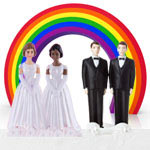
gay-marriage-image

From Melanie McDonagh in The Spectator:

In more ways than one it’s impossible to be heard above the din right now in the wake of the Yes vote in Ireland on gay marriage. There’s a special noise that goes with an orgy of self-congratulation, a roar of mutual approbation, and it drowned everything else out in Dublin as the results came in today. Like rugby, only more triumphalist. Actually, I was watching the scene from the Sky studio in Millbank, where my interlocutor in central Dublin, Patrick Strudwick, a journalist and activist, was appearing on a screen on the streets and had to shout over the crowd to make himself heard, to repeat, over and over again, ‘It’s a victory for love, for equality, for human rights’.

Mind you he did go off piste sufficiently to declare that I was a bitter loser and a bigot (I was expressing concern that the family courts would be influenced by the vote when it came to decisions on the guardianship and custody of children). Oh and that this was a victory over the forces of the Catholic Church because no one would ever listen to them again on account of the cover ups of the clerical child abuse scandals. As a summary of the sentiments and subtlety of the Yes campaign it was, I’d say, bang on.

Read the rest of the article here.

Marriage is dead. Long live Marriage!

It’s over in Ireland. The Irish people, by something close to a 60 – 40 majority popular vote have redefined marriage out of existence in their State Constitution and have replaced it with a shallow charade which they will now call marriage.

Marriage however, that primeval bond between a male and a female, still exists – and will exist so long as a man and a woman come together, as did Adam and Eve, to beget children. Long live marriage.

But the reality now is that the future of natural marriage, the conjugal union of man and woman, in the story of mankind will be even more fraught with difficulty than it has been in the past. It has never had an easy passage – either because of the folly and selfishness of individuals or the pandering of their public representatives to that same folly and selfishness. The first big compromise on the part of the latter was divorce. Now we have this. Ireland’s story is just one piece of a global jigsaw – symbolic for all sorts of reasons, but still just a piece. The New York Times now triumphantly declares that Ireland has advanced to the vanguard of this deconstructive process.

Ireland’s electorate has now robbed natural marriage of its constitutional protection in the Irish State. The laws relating to family, children, and all those things which the State’s endorsement of marriage framed and supported are essentially cut adrift in a sea which will be stormy, treacherous and at times destructive of society’s common good and the well-being of individuals. Because of this foolish action, which they thought was just a matter of changing a name, broadening a definition to include something else, they are complicit in an act which is an attempt to change human nature itself. As one opponent of the decision described it, “grotesque nonsense

Watch this space.

How did this all happen? We know the short-term story well. For an American and global perspective read After the Ball: How America Will Conquer Its Fear and Hatred of Gays in the ’90s. This was a book published in 1989 by Marshall Kirk and Hunter Madsen which argues that after the gay liberation phase of the 1970s and 1980s, gay rights groups should adopt more professional public relations techniques to convey their message. This they did with a success which all marvel at. The blueprint was then applied to Ireland

For the Irish story, read how Atlantic Philanthropies promoted and funded the infiltration of Ireland’s state and charitable agencies to achieve yesterday’s referendum victory.

But the origin of this social crisis – John Waters, Irish newspaper columnist of the first rank, described it as a social catastrophe – goes back centuries, indeed almost a millennium. Essentially it all began when sentiment and human emotions began to gain the upper hand over human reason.

In The Allegory of Love, C. S. Lewis would have us believe, very convincingly, that a radical shift in human consciousness and culture began with the sudden appearance of what we call “courtly love” in 11th century Languedoc. Lewis explored this theme and thesis in this book, one of his masterworks, perhaps his greatest.

The dominant sentiment he explores is love. But it is love of a highly specialised sort, “whose characteristics may be enumerated as Humility, Courtesy, Adultery, and the Religion of Love.” This all began with the love poetry specific to that time and that place, the love poetry of the Troubadours. The characteristics of this sentiment, Lewis tells us, and its systematic coherence throughout this poetry as a whole, “are so striking that they easily lead to a fatal misunderstanding. We are tempted to treat ‘courtly love’ as a mere episode in literary history – an episode that we have finished with…”

But we have not finished with it. He sees an unmistakable continuity connecting these love songs with the love poetry of the later Middle Ages, and thence, through Petrarch and many others, with that of the present day. If the thing at first escapes our notice, this is because we are so familiar with the erotic tradition of modern Europe that we mistake it for something natural and universal and therefore do not inquire into its origins. As Lewis says, it seems to us natural that love should be the commonest theme of serious imaginative literature. He looks back at literature preceding this southern French explosion, from the earlier Middle Ages back into antiquity, and finds that “what we took for ‘nature’ is really a special state of affairs, which will probably have an end, and which certainly had a beginning in eleventh-century Provence.” He continues:

It seems – or it seemed to us till lately – a natural thing that love (under certain conditions) should be regarded as a noble and ennobling passion: it is only if we imagine ourselves trying to explain this doctrine to Aristotle, Virgil, St. Paul, or the author of Beowulf, that we become aware how far from natural it is…

French poets, in the eleventh century, discovered or invented, or were the first to express, that

romantic species of passion which English poets were still writing about in the nineteenth. They effected a change which has left no corner of our ethics, our imagination, or our daily life untouched…

Compared with this revolution the Renaissance is a mere ripple on the surface of literature. There can be no mistake about the novelty of romantic love: our only difficulty is to imagine in all its bareness the mental world that existed before its coming – to wipe out of our minds, for a moment, nearly all that makes the food both of modern sentimentality and modern cynicism.

The death of marriage, as we knew it in our language and our laws, came late in the evolution of our culture, infected as it was, slowly but surely by this creeping dominance of sentimentality over reason. First came the advance of divorce. Then a sizeable proportion of couples abandoned marriage in the name of love – which was all that mattered to them. Cohabitation became a new norm. Then came the demand for social acceptance of homosexual love. Its lobby demanded that marriage be redefined to provide them with society’s badge of acceptance – even while society’s concept of what marriage really is was already in its death throes as a result of earlier and successive redefinitions.

To come to grips with and understand this long revolutionary process, Lewis tells us that we need to

conceive a world emptied of that ideal of ‘happiness’ – a happiness grounded on successful romantic love – which still supplies the motive of our popular fiction. In ancient literature love seldom rises above the levels of merry sensuality or domestic comfort, except to be treated as a tragic madness, an ἄτη which plunges otherwise sane people (usually women) into crime and disgrace. Such is the love of Medea, of Phaedra, of Dido; and such the love from which maidens pray that the gods may protect them.

At the other end of the scale we find the comfort and utility of a good wife acknowledged:

Odysseus loves Penelope as he loves the rest of his home and possessions, and Aristotle rather grudgingly admits that the conjugal relation may now and then rise to the same level as the virtuous friendship between good men. But this has plainly very little to do with ‘love’ in the modern or medieval sense; and if we turn to ancient love-poetry proper, we shall be even more disappointed.

Plato will not be reckoned an exception by those who have read him with care… Those who call themselves Platonists at the Renaissance may imagine a love which reaches the divine without abandoning the human and becomes spiritual while remaining also carnal; but they do not find this in Plato. If they read it into him, this is because they are living, like ourselves, in the tradition which began in the eleventh century.

So what has all this to do with the Irish referendum? This: the Irish “Yes to Equality” rode home to victory on the on the shoulders of this very same “love” which emanated from the songs of the Troubadours of the 11th century. It wasn’t that the young and old who voted Yes to “love and equality” had been reading courtly love poetry. No, they had been fed on the artefacts of 18th and 19th century romanticism, morphing in the 20th and 21st century into a voraciously consumed diet of pop culture expressed through sentimental Hollywood movies and ultra-sentimental pop songs – not to mention soap-operas and the chic lit of Maeve Binchy, Cecelia Aherne et al.

The current West End production of Rodgers and Hammerstein’s Carousel is moving to Dublin for a very short season next month. I watched some clips of the 1950s Hollywood version the night before the referendum. I love the show. But while watching it I had premonitions of what was going to happen the next day. How could any generation, I thought, fed on this and much inferior sentimental material do otherwise that vote for “love” over all the other values at stake.

The helplessly smitten Julie (Shirley Jones) sang:

Common sense may tell you

That the ending will be sad

And now’s the time to break and run away

But what’s the use of wond’rin’

If the ending will be sad

He’s your fella and you love him

There’s nothing more to say.

There is nothing more to say, for the moment. This excepted: the crown is in the hands of a usurper but the King lives, and always will, albeit in the shadows. The marriage of man and woman is as indestructible as is human nature itself. No tyranny, not even a democratic one, can destroy it.


Battle for natural marriage lost in Ireland – next up, battle for freedom of conscience

Just after mid-day in Ireland today the Iona Institute, leader of one of the voluntary campaign groups fighting against the redefinition of marriage by Irish Government and the entire political establishment in the country, effectively conceded victory to its opponents. Their statement said:
We would like to congratulate the Yes side on winning such a handsome victory in the marriage referendum. They fought a very professional campaign that in truth began long before the official campaign started.

For our part, The Iona Institute is proud to have helped represent the many hundreds of thousands of Irish people who would otherwise have had no voice in this referendum because all of the political parties backed a Yes vote.

A formal announcement from the count is expected to be made in Dublin Castle by mid afternoon.

The Institute thanked the thousands of volunteers up and down the country who worked day and night to try and secure a No vote.

Commenting on the outcome, David Quinn said: “We believe a fought a good campaign. It was always going to be an uphill battle. However, we helped to provide a voice to the hundreds of thousands of Irish people who did vote No. The fact that no political party supported them must be a concern from a democratic point of view.

He concluded: “Going forward, we will continue to affirm the importance of the biological ties and of motherhood and fatherhood. We hope the Government will address the concerns voters on the No side have about the implications for freedom of religion and freedom of conscience.”

It’s a free world, but is it a fair one?

  
Now we know what we knew all along but had not proved it. Irish print media has again shamed itself with its blatant unfairness. Three times more “YES” articles than “NO” articles on the country’s marriage referendum appeared in newspapers in the three weeks prior to the poll which takes place today.

The finding is based on independently conducted research commissioned by PR and Public Affairs company MKC Communications from Newsaccess Media Intelligence.

A detailed analysis of coverage of the Referendum in ten national titles – Irish Times, Irish Independent, Irish Examiner, Daily Mail, The Herald, The Star, Sunday Independent, Sunday Times, Sunday Business Post, and Mail on Sunday — showed that there was a total of 424 “Yes” articles across those titles in that period, with just 135 “No” articles.

A further 214 “Neutral” articles were carried in the same period by the same newspapers.

This is not an opinion poll. All articles were read and analysed by Newsaccess Media Intelligence in terms of whether the tone of the piece was in favour of a YES vote, a NO vote or a NEUTRAL analysis of the referendum.

Last night a statement from the company explained the motivation behind its research.

“Because of the enormous significance of tomorrow’s Referendum, and the welter of charge and counter-charge about the media’s treatment of the subject in recent weeks, we decided that it would be an important exercise to bring some scientific measurement and facts to the issue of how the Referendum debate was reported in Irish media. 773 articles were printed in the newspapers analysed in a three week period, and the level of coverage for a single topic is possibly unprecedented in recent times”.

Irish newspapers have no statutory obligation to be fair and balanced. In this case they reflected the political establishment which, officially, was totally lopsided in its support for the coalition Goverenment’s proposal. Secretly, however the two major parties had a number of parliamentary representatives who were going to vote against. A handful of these eventually declared themselves publicly and already there are calls for their expulsion. Freedom in modern Ireland is a very qualified comodity – and it is likely to become more so. 

“Unlike broadcast media, which must provide balanced coverage of referenda, the print media are not subject to such strictures and this research confirms the broad and widespread support in the Irish print media for a ‘Yes’ vote”, said Laurie Mannix, Managing Director.

For copy of the report, contact MKC Communications 01 7038600

Snapshot of political bankruptcy


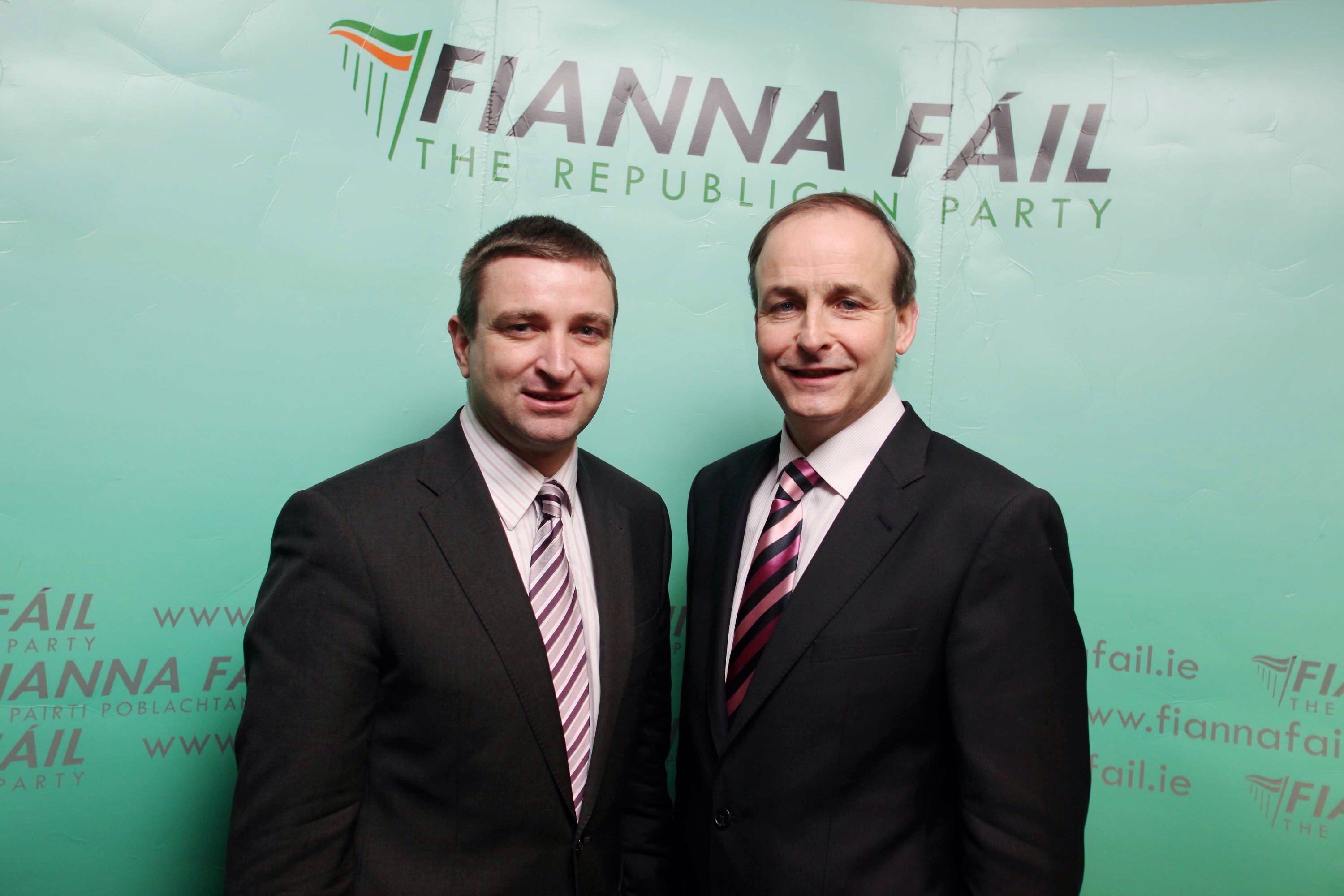
Collins (left) and his Party leader Michael Martiin
 
Has Ireland reached the nadir of political life and culture?

The Fianna Fail Party’s director of elections and spokesperson on Justice and Equality, Niall Collins, was on Irish radio (SpiritFM) this morning in discussion with Petra Conroy, who was representing the case for the defence of marriage. The case will go to judgement of the people in tomorrow’s referendum on same-sex unions – deciding whether they may be recognised as identical with the union of a man and a woman or not.

Collins, unable to deal with the arguments Conroy was presenting to him began to get offensive. Conroy had to take time out from the arguments to establish whether or not he was discussing the issue or attacking her personally. It ended up that he was.

Conroy: Niall can I ask you a question? You’ve mentioned “nonsense”, you have mentioned “lies”, you mentioned “disingenuousness”. Can I ask you do you think that I, everything that I am saying…?

Collins: No, the campaign you are associated with.

Conroy: I’m part of that campaign.

Collins: yeah you’re part of a campaign that is a big lie.

Conroy: Do you think what I have said today, the case I have outlined, is just lies to cover a desire to treat gay people as unequal.

Collins: Yes I do.

Conroy: So you think I’m lying and misleading, in order to cover… That’s something, that really is something! Actually I don’t normally ask this but I really hope that you take that back.

Collins: What I have said is that the no campaign is a big lie, and it is, and you’re associated with the No campaign.

The implications of Collins’ remarks are clear. He is his Party’s shadow Minister for Justice and Equality.

For decades, for most of the last century in fact, Fianna Fail was the largest political party in the Republic of Ireland, and was the party in power for most of that time. Post financial meltdown, into which it stupidly shepherded the country, it no longer is. It still aspires to greatness but with this kind of material at its heart there is little sign that this will be anytime soon.