Michael Kirke was born in Co. Donegal and attended St. Eunan’s College in Letterkenny, 1957-1962. In 1966 he graduated from University College Dublin (History and Politics). In 1966 he began working on the editorial desk of The Evening Press in Dublin and in 1968 went to the newsroom of the Irish Press group of newspapers – contributing news and features to the group’s three titles, The Irish Press (morning paper), The Evening Press and The Sunday Press. In 1969 he went to Belfast and covered the initial unravelling of the Unionist hegemony in the province. Later that year he became the group’s education specialist. In 1973 took leave of absence to pursue postgraduate studies in education in Trinity College Dublin where he graduated in 1976. In 1978 he left journalism and moved into teaching. In 1981 was appointed headmaster of Rockbrook Park School in Dublin (www.rockbrook.ie). In 1994 resigned from that post and moved to live in the West of Ireland (Galway) where he began working part-time in media again. He is now back in Dublin working, among other things, as a freelance writer. His main interests are in political, cultural and educational affairs – as well as issues related to religious faith.
The ruthless totalitarian tendency of the Irish Government seems to be coming to the attention of some politicians on the continent of Europe. The Chairperson of the Group of the European People’s Party in the Council of Europe and a member of the Italian Parliament, Luca Volontè, has declared that it is “truly shocking to see the government of an advanced Western country trying to deny the basic human rights of its own citizens like this.” He is talking about the Irish government of Enda Kenny and Eamon Gilmore.
“Even nations with the most permissive abortion laws do not normally go so far as to trample on the basic right to conscientious objection.” Volontè, Chairman of the Dignitatis Humanae Institute said in a statement two days ago.
Volontè, speaking of the Kenny government’s abortion legislation which will force health providers to act contrary to their ethically held principles, continued: “This bill claims human rights apply only to human beings, and not to institutions. But such a manipulative attempt at semantics casually disregards what it is that defines an institution, particularly a healthcare provider – at its core is an ethos, and individual employees who are dedicated to fulfilling that ethos. Far from seeking to maintain an amoral healthcare system, this bill will impose a new morality upon hospitals and those who serve in them, one which allows for no objection and uses all the authority of the State against any who would refuse to be accomplice to a clear moral evil.”
The cynically entitled “Protection of Life During Pregnancy Act” – which, if honesty were the hall-mark of the Irish Government, would be entitled the “Selective Protection of Life During Pregnancy Act” – explicitly denies the right of conscientious objection and enforces a no-right-to-refuse condition upon 25 Hospitals.
Recalling his work as the President of the European People’s Party (the largest party) in the Council of Europe Parliamentary Assembly in Strasbourg, Luca Volontè added that the Council of Europe´s Resolution 1763 clearly states:
“No person, hospital or institution shall be coerced, held liable or discriminated against in any manner because of a refusal to perform, accommodate, assist or submit to an abortion, the performance of a human miscarriage, or euthanasia or any act which could cause the death of a human foetus or embryo, for any reason.”
Such compulsion would be unprecedented in Ireland, and has been successfully challenged recently elsewhere.
In April this year, a Scottish Court ruled in the ‘Doogan & Anor v NHS Greater Glasgow & Clyde Health Board’ trial that two midwives could not be required to delegate, support or supervise staff who were involved in abortions. It looks like the Irish courts are going to be busy sorting out the human rights mess which the Irish government has created for itself with this legislation as it tramples on the rights of the unborn and on the rights of all its citizens.
Despite repeated refusals from the Irish Department of Health to work out an accommodation, Luca Volontè spoke of his hope for changes to the proposed law: “It is not unreasonable to ask for exemptions for staff (or institutions) on the grounds of conscience, whether they be religious or ethical; such accommodation is provided in many other Western nations which practice abortion. Freedom of thought and/or conscience is not only guaranteed by international law, it is innate to our human dignity. It is truly shocking to see the government of an advanced Western country trying to deny the basic human rights of its own citizens like this.”
The juxtaposition of two stories on the Irish Independent online in a pathetic way reflects something of the moral confusion our world finds itself in today. In one, Liam Fay fulminates against the Catholic Church and indeed against the very reality of religion itself over the mild remarks made recently by Fr. Kevin Doran in the exercise of his responsibility as a board member of the Mater Hospital. In the other, we learn of a woman suing her family for the pressure they put her under to abort her twin daughters. One is the harbinger of a new religious persecution in Ireland; the other further evidence of the diabolical and rampant selective genocide – now called gendercide – in progress on the subcontinent of India.
Fay’s intemperate rant was frightening in its intolerance of any tolerance other than his own narrowly based “scientific” view of the world and mankind. It was also frightening in its offering of further evidence of the relentless progress of what we are increasingly justified in calling the Cromwellian faction in Irish politics and media, the subject of a post here a few weeks ago.
The same strategy is evident in every line of Fay’s diatribe against Fr. Doran, the Mater Hospital, and the religious beliefs of the majority of the population of this planet. Fay is utterly blind to the reality that his own world view is determined by an utterly unproven tenet – that there is no God and that anyone who thinks there is a God has no right to live his live, organise his society and his world in the light of that reality. Fay’s totalitarianism tells the world that it must, on the contrary, organise itself according to his beliefs. Ultimately what he proposes as scientific is in fact a belief, and no belief is more dangerous and frightening than the one which proclaims itself to be scientific.
Tolstoy said it all about this type of thinking when he described the grotesque self-assurance of General Pfuel in War and Peace. It was the worst of all, stronger and more repulsive than any other, because he imagines that he knows the truth – science – which he himself has invented but which is for him the absolute truth.
The utterly dishonest programme of denigration of the religious and priests of this country, and of all and any who uphold and promote – for the sake of the common good – the social teaching of the Catholic Church, is plain for all to see and is typified by Fay. They are following in the steps of Thomas Cromwell, who knew that for King Henry VIII to succeed with his reformation and greed-motivated destruction of the monasteries, he would have to sustain it with strong yet simple reasons calculated to appeal to the popular mind. Some decent pretext had to be found for presenting the proposed measure of suppression and confiscation to the nation. For this reason the failures of a handful of religious houses was the device used to blacken the characters of the monks and nuns throughout the land. That sounds familiar in a modern Irish context.
This Cromwell did and followed on with one of the greatest acts of cultural vandalism and religious persecution in the early modern age. Fay, no doubt, would say “good riddance”.
Both these stories point to one thing: that the culture of death, a culture rooted in a philosophy of hedonism, is a reality in our world and the forces promoting it are formidable. While ultimately it has within itself the seeds of its own destruction – like communism before it, its very unnaturalness will eventually destroy it, – the longer it takes to stagger to its demise, the more innocent human lives will lie in its wake.
A message from Ireland’s Pro Life Campaign – No Surrender!
The abortion Bill passed through the Seanad this evening. It has been a very difficult and gruelling few weeks for pro-life supporters.
This video captures the mood and feeling outside Leinster House when pro-life people came together in silent vigil during the Dáil and Seanad votes on the abortion bill.
The road back will not be easy but the strength and resolve of the pro-life movement which has emerged in recent months is the kind of foundation that will ensure this unjust law will be overturned.
Thomas Cromwell – securer of monastic assets for Henry VIII
Is there a whiff of the stench of Henry VIII and Thomas Cromwell about something happening in Ireland just now?
The New Advent encyclopedia tells us that one of the first practical results of the assumption of the highest spiritual powers by king Henry VIII was the appointment of Thomas Cromwell as the king’s vicar-general in spirituals, with special authority to visit the monastic houses, and to bring them into line with the new order of things.
This was in 1534. A document, dated 21 January, 1535, allowed Cromwell to conduct the visitations through “commissaries”. Parliament met early in the following year, 1536, with the twofold object of replenishing an exhausted exchequer and of anticipating opposition on the part of the religious to the proposed ecclesiastical changes. According to the royal design, the Commons were to be asked to grant Henry the possessions of at least the smaller monasteries.
But Cromwell, who is credited with the first conception of the design, knew that to succeed, a project such as this must be sustained by strong yet simple reasons calculated to appeal to the popular mind. Some decent pretext had to be found for presenting the proposed measure of suppression and confiscation to the nation, and it can hardly now be doubted that the device of blackening the characters of the monks and nuns was deliberately resorted to.
This they did and followed on with one of the greatest acts of cultural vandalism and religious sacrilege the modern world has ever seen.
Does all that sound a little familiar? Does it in some way send a shiver down your spine when you read news stories in the Irish newspapers about attempts by the State to confiscate the assets of Irish religious orders?
Irish society took advantage of the charitable dispositions of several religious orders of nuns in the late 19th and early 20th centuries. The State acquiesced in this, right up to the end of the 20th century, without giving any practical help, without any oversight or regard for the need for adequate training for the work entrusted to these charitable organisations.
Now, in the 21st century the same State is proceeding to portray these institutions to the public mind as sadistic and sinister abusers of women which the state had “innocently” left in their care. This campaign of vilification is being carried out at the instigation and prodding of elements of the Irish media, the driving force behind the new Irish “Reformation”. The State is now going after the property and assets of these religious institutions, most of which is still in daily use for their work of education, health-care and attending to the indigent in society.
The same media is now reporting that four religious congregations which have refused to contribute to the compensation fund for residents of their former Magdalene laundries had combined gross assets worth €1.5 billion when the last comprehensive assessment of their financial resources was made in 2009.
Friday’s Irish Times reports on the impasse between the State and these institutions. Most of the assets, it tells us, comprise property and buildings in use as schools, hospitals, facilities for health and disability services, making it impossible for the value of the assets to be realised. “Some of the assets are held in trust, making transfer problematic. With the property market depressed, 2009 values no longer stand, and attempts to dispose of land have not been successful.
“Yesterday Taoiseach Enda Kenny accepted in the Dáil that the orders could not be compelled to pay, and that moral persuasion would have to be applied. There have been calls for the four orders be stripped of their charitable status.”
Well, this is 2013, and the rule of law is a little more nuanced than it was in the fifteen thirties. But is the agenda not really the same? No one for a moment denies that girls and women suffered in these institutions. No one for a moment denies that the institutions were operated and run in a cultural and religious environment which now repels us. But the responsibility for what happened, the responsibility for the continuation for a century and a half was not the sole responsibility of a few organizations. It was the responsibility of the whole society.
What the Irish State and the “intelligentia” in the Irish media which is now effectively the puppet-master of the Irish State , is trying to do is an exercise in scapegoating of the most unjust kind. Henry VIII and Thomas Cromwell used the pretext of some undoubted bad eggs in English monasticism to destroy much of the religious fabric – and a great deal of the social fabric – of late medieval England. The French Revolutionary forces used the pretext of the undoubted excesses of the French clerical and ecclesiastical class to destroy the Catholic Church in France in the late 18th century. In both cases – and in this one also, it seems, undoubted injustice was used as a pretext to perpetrate much greater injustices.
The Irish Times, in its moderate and balanced report on Friday, outlined the situation of the two biggest orders involved in this controversy as follows:
Sisters of Mercy
The country’s largest order, with 2,000 members, founded by Sr Catherine McAuley in 1834, has played a central role in educational provision. In 2009 it had total property assets of over €1 billion. Some €660 million related to schools in use, €60 million to a hospital in use; the value of congregation residences was €200 million and a further €70 million related to other services.
It had €182 million in financial (non-property) assets but it argued that providing for the care of its members as well as funding its core services would account for all of that.
The order ran two of the Magdalene laundries, in Galway and Dun Laoghaire. The Government requested the order to sell all the properties (valued at €11.6 million) it offered to the statutory fund for institutional survivors. As of the last report six weeks ago, it had paid more than €1.6 million.
Sisters of Charity
Founded in Dublin by Mary Aikenhead in 1815, the Sisters of Charity are associated with education and healthcare, and founded St Vincent’s Hospital. With about 250 members in its Irish province, it had some €266 million in assets in 2009, virtually all of which was restricted or committed to provision of services or welfare of its elderly members.
A €5 million offer was made to the statutory fund in 2009 but only €2 million was paid. The order said it could not afford to hand over the remaining €3 million because of the downturn in the property market. It ran two Magdalene laundries, one in Donnybrook in Dublin and the other in Peacock Lane in Cork.
The institutions are quietly fighting this injustice but the public opprobrium being heaped on them for defending their rights and the work which they have been doing and want to continue doing is relentless. For many, all this is part of a bigger agenda of Ireland’s liberal left to destroy for once and for all the work and influence of the Catholic Church in the Ireland. They may just be right.
“The history of Israel also shows us the temptation of unbelief to which the people yielded more than once. Here the opposite of faith is shown to be idolatry. While Moses is speaking to God on Sinai, the people cannot bear the mystery of God’s hiddenness, they cannot endure the time of waiting to see his face. Faith by its very nature demands renouncing the immediate possession which sight would appear to offer; it is an invitation to turn to the source of the light, while respecting the mystery of a countenance which will unveil itself personally in its own good time. Martin Buber once cited a definition of idolatry proposed by the rabbi of Kock: idolatry is “when a face addresses a face which is not a face”.[10] In place of faith in God, it seems better to worship an idol, into whose face we can look directly and whose origin we know, because it is the work of our own hands. Before an idol, there is no risk that we will be called to abandon our security, for idols “have mouths, but they cannot speak” (Ps 115:5)
Excerpt From: Francis, Pope. “Lumen Fidei”,13 iBooks.
This material may be protected by copyright.
The New York Times this weekend gave us its considered views on the state of the marriage battle in the culture wars. It embodies a very flawed vision of mankind, society and the institution of marriage. If lawmakers continue on the path some of them seem determined to follow, propelled by this kind of media thinking, are they laying the basis for a great deal of confusion and trouble in decades to come?
As historic and welcome as we found the Supreme Court’s two recent decisions on same-sex marriage, the Times tells us, they served to emphasize the lingering inequality for millions of gay and lesbian Americans who do not live in the 13 states that enforce the right of all adult Americans to marry the person of their choosing.
If it is inequality to deny it to two people of the same sex whose sexual urges mover them in that direction why is it not inequality to refuse to legitimize the marriage of three persons whose sexual urges move them to want to legitimize such a relationship as a marriage? No just reason can be given for this discrimination. Sexual difference is the only real basis for the existence of the institution of marriage. Ignore this difference and confusion and dysfunction seem inevitable.
In New Jersey, Gov. Chris Christie, a Republican, they complain, is standing by his 2012 veto of a measure to allow gay couples to marry and is refusing to free Republican legislators to follow their conscience on an override vote. Mr. Christie is imposing a large ideological tax on thousands of couples and their families whose interests he is supposed to protect. He is depriving them of federal benefits, which their tax payments help underwrite.
Why should sex only and not all loving relationship be the basis for the provision of these benefits? Logic suggests that any registered committed loving relationship should merit receiving them. Christie’s case can be clearly seen as based on fiscal logic and an understanding that making a sexual relationship the sole basis for these benefits would he inherently discriminatory.
Certainly, The Times editorial judges, the Supreme Court propelled the nation toward greater equality in late June with two 5-to-4 rulings that restored same-sex marriage in California and struck down the central provisions of the Defense of Marriage Act, the dreadful 1996 law that denied federal benefits to same-sex couples married in states that permit it.
It is a very unequal equality so long as it has nothing more than sexual partnership as its basis.
The Times tells us that by disposing of the California case on narrow procedural grounds, the Supreme Court perpetuated a mean and irrational patchwork in which duly wed couples may not be considered married when they cross state borders.
This whole movement is creating an utterly irrational and discriminatory patchwork which will ultimately undermine all the laws and institutions which society has put in place over centuries to facilitate orderly social and family relationships. The result will be that there will no longer be any fundamental basis for the laws governing polygamy/polyandry.
Eliminating that unfair system, the Times argues, will require a multipronged effort — to add more states to the list of 13 that permit same-sex marriage and to challenge remaining state laws that violate the standards of equal protection as the Defense of Marriage Act did. Last Tuesday, the American Civil Liberties Union filed a challenge to a Pennsylvania law that allows marriage only between a man and a woman and rejects other states’ marriage equality laws.
“Eliminating that unfair system” will simply compound further unfairness if it is based on nothing more than sexual relationships. To be truly fair it should be based on all relationships of mutual commitment of love and support.
They commend the Obama administration which the see moving with commendable diligence and speed to extend benefits like health care, life insurance and immigration rights to gay and lesbian married couple,…benefits like vision, dental and long-term care insurance and survivors’ annuities.
On what rational basis can the same benefits be denied to couples in other diverse “family” – their much vaunted love for “diversity” seems a very restricted one – arrangements entailing permanent commitments? What they envisage will leave us with a very flawed and inherently unjust law. It is not based on any proper understanding of equality. The concept of equality espoused by the gay and lesbian advocates is totally flawed because it is giving equal status to two different things.
The problem as it affects entitlement to benefits is that once the difference, nature’s own “diversity”, between the sexes is denied then a new definition of equality is accepted and should be absolutely applied. If not, these laws will be unjust and the unjust distribution of benefits which they will lead to will eventually be challenged. If the courts are just they will be overturned in one way or another.
The discrimination is only beginning. The only just way forward in this needlessly created morass would seem to be to forget about marriage as the ground on which all these benefits, rights, etc., are granted and institute a fair and universal system based on all forms of committed relationships. That may cause fiscal turmoil, but if it does, so be it. That is the price which will have to be paid for accepting an equality which ignores the differences between the sexes and the special arrangements which millennia of human experience have guided humanity to put in place to cater for the needs which flow from these differences, this beautiful and glorious diversity.
If anyone, in the aftermath of last week’s shameful political shenanigans in the Irish parliament, doubts the character and determination of sacked Minister, Lucinda Creighton, to be a force in the public life and politics of that country in the years ahead, let them begin by reading her blog entry today. It was published in the Irish Mail on Sunday and is now posted on Lucinda Creighton.ie.
This is not a manifesto for a future Irish politics but it is a preliminary for such a manifesto. It addresses from the depths of her heart and soul the concerns which thousands of Irish people share with here this week – not just on the issue of abortion but on the corruption in the very heart of a country which in just two and a half years will be celebrating the centenary of the beginning of its final battle for freedom and independence as a state among the nations of the earth. What freedom, what independence, many are asking? Lucinda Creighton seems to be on the verge of offering Ireland something to make that a redundant question.
On July 1st she delivered a speech in the Irish chamber of deputies, the Dail, in which she elaborated her concerns about abortion in a general societal sense, as well as focusing on specific aspects of the proposed and shamefully designated Protection of Life in Pregnancy Bill which she considered, and still considers, to be deeply flawed.
In it she referred to an underlying cancer afflicting Irish public life – in politics, in business, and above all in the media. Reaction to that was near-apoplectic in some quarters. The cries of hurt and indignation from those who thought they were being targeted made headlines the next day
“My speech”, she correctly says, “was incorrectly picked up as singling out members of the Fine Gael Parliamentary Party for participating in group think. This is not what I said.”
“What I said in fact, was that group think is a negative feature in society, in the media and in political life. Increasingly we are all supposed to think and speak the same way. There is less and less room in this country for a diversity of opinion, for real and meaningful debate and for genuine analysis. We are all supposed to swim with the tide on every occasion. I consider this dangerous. I am certain that this is dangerous for our democracy.”
That is just as things are in Ireland and the daily exasperation of the millions who listen to and read what the Irish media turns out on a daily basis is sufficient evidence to prove it. When the manifesto for a New Ireland come this must be among the serious illnesses to which it will address itself.
Bloody but unbowed, Ms. Creighton tells us that “This was a long and difficult week, particularly for many in the Fine Gael party. Five of us argued for the right to express an alternative … view on this vitally important piece of legislation. We lost the internal battle to have our voices heard and our consciences respected. This is not a good thing for the democratic process in this State.
“Much of the commentary in the aftermath of Thursday’s vote confirmed to me that our media perpetuates the blind group think which prevailed and contributed to the economic collapse in this country.”
She tells of her “alarm” listening to one of Irish radio’s premier news analysis programmes on the morning after her historic stand against the “flawed” legislation. “The level of analysis or understanding of what is happening in our shambolic Parliamentary system was alarming,” she said.
“A commentator from the Irish Times seemed only capable of understanding the events of the week in terms of ‘strength’, ‘power’ and ‘crushing opponents’. To him it was just a numbers game. He was entirely uninterested in the substance of the disagreement, or the fact that an important viewpoint was ignored or ‘whipped into line’.
“He seemed to believe that the only issue at hand was the fact that ‘only five’ TDs had voted against the legislation and this was somehow a great victory for the Government, its senior figures and Fine Gael. This is a sad and shallow analysis, which ignores the fundamental questions of democracy which were raised thoughout the last few weeks when elected Members of our Parliament were, in many instances, coerced and cajoled into voting for legislation they clearly considered to be faulty and against their better judgement.”
One of the most shocking spectacles in the drama in the Irish parliament last Thursday and into the early hours of Friday morning was the speech of a young woman member, Michelle Mulherrin, voting against her conscience after the whipping she had received from the party leader, Prime Minister, Enda Kenny. Ms. Creighton’s response to it says it all. “I understand completely the dilemma she found herself in. I was there too. I took a different decision, by voting against the legislation. She clearly wrestled with her ultimate decision and eventually decided to vote for it. She did so to avoid being “booted out” of Fine Gael, her party. I felt sick to the pit of my stomach listening to her speech in the Dáil Chamber – out of sadness for her, and the choice she has clearly been forced to take to avoid expulsion. There is something so, so wrong with this. Citizens of this country ought to be concerned at the words uttered by Michelle. They genuinely gave me a deep sense of foreboding.
“In every other modern western democracy that I have studied, public representatives are not and would never be, forced to choose between their conscience and their party. That is worth considering and reflecting upon. This includes Australia, New Zeland, the USA, the Netherlands, Germany, Belgium, Switzerland and many, many more. In my investigations I could not find any other democratic country on this planet that forces people to vote against their conscience. Ireland has the dubious distinction of standing alone in its denial of conscience. This is not something I am proud of. Nobody should be.”
“The great democrat and peace maker Mahatma Ghandi said ‘In matters of conscience, the law of the majority has no place’. This is correct. History has taught us what savagery and crimes against humanity can occur, when people abandon their conscience, for the sake of the quiet life, or worse, to satisfy personal ambition. Our State should guard against this, rather than try to normalise it. And we as citizens should demand that this be so.”
She concludes by saying that politicians in her country “really do need to stand up and be counted” – and there will be more cries of hurt and pain from the numerous public representatives who know very well that they have failed to do so, and who have not had the courage to tell the truth about their shame like Deputy Mulherrin. Ms. Creighton sees the value of the discipline in parliamentary democracy. “I don’t advocate the abandonment of the Whip system. It is an essential fundament of a stable economy and a stable society. Coherent positions and voting by political parties are essential in the context of the annual Budget, all finance measures, social welfare measures and so on. But there it should stop.”
Finally, she has a word for those “commentators” who cheer the crushing of political opponents, and applaud the stifling of debate in Ireland. We are back to the driving force behind group think. They “do no service to either good journalism or good politics. In fact they are complicit with the rot in a system which so desperately needs changing. Their anxiety to take quotes and spin from ‘well placed sources’ may make their contributions sound plausible and knowledgeable. In fact, they are missing the real story.”
There has been a good deal of sympathising, moaning, regrets at the loss of a promising political voice in Irish politics over the past few days and this weekend. These words tell us that we need not worry. This is a voice which is not going away and for that the Irish should all – well, nearly all, – be very grateful. There will be no shortage of stories, real stories, coming down the line.
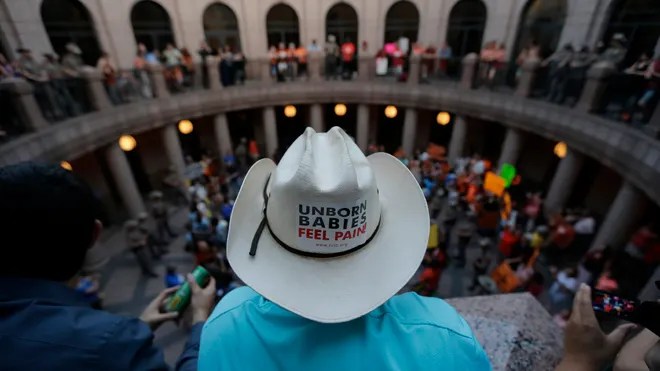
This week, over in Texas, another pro-life battle raged in the Austin legislature. But in this case victory went to the pro-life side – for now. It all goes to show that what we are engaged in is a global struggle and one that will continue for a long, long time.
The words of the Texan pro-abortion Democrats – who lost this battle – could be taken as a mirror image of the words of the Irish pro-life campaigners facing their defeat in Ireland’s legislature this week, bloody but unbowed. This battle in the culture war will run and run. Eden is a long way off.
The New York Times reports from Texas: To explain why he and his colleagues continued to fight when the outcome was certain, Mr. Kirk Watson, the chairman of the Senate Democratic caucus, posted a Facebook photo earlier in the week showing an orange T-shirt bearing a statement: “A foregone conclusion has never stopped a group of citizens committed to ideals of democracy and liberty from taking a stand and fighting with everything they’ve got. This is Texas, baby. Remember the Alamo.”
The next step will be a court challenge to the new law before Mr. Perry’s signature has time to dry; the many proposed amendments and discussion of them were clearly intended to build a record that could eventually be reviewed by the courts.
In closing her own speech late Friday night, Ms. Wendy Davis told the groggy lawmakers, those in the gallery and beyond, “The fight for the future of Texas is just beginning.”
And then, minutes after the vote, she spoke again, through a bullhorn, to an immense crowd of supporters in front of the Capitol building. Ms. Davis called out to the orange-clad throng to turn their anger into political change. “Let’s make sure tonight is not an ending point,” she said. “It’s a beginning point as we work to take this state back.”
A defiant statement was issued by Ireland’s Pro Life Campaign this evening in the wake of the Irish parliament’s chamber of deputies, the Dail, passing abortion legislation last night. PLC spokesperson Caroline Simons said that “Thousands of people across Ireland feel a deep sadness at what happened but also a determined motivation to turn this bad situation around.
“The constitutional protection for unborn babies achieved in 1983 was undermined by the Supreme Court decision in X. That decision made it possible to legislate for the unjust destruction of unborn children. It is shameful that our Government should activate all this now,” Ms Simons said.
“Thousands of people feel deep sadness at what has happened. We know that Ireland, without abortion, has been among the safest places in the world for women to be pregnant. We now move into a new phase of activity where we will work to restore full constitutional protection for unborn children and a legal order that operates to discourage abortion, not promote it. That work starts today.”
“The pro-life movement is mobilised and growing. We have seen the biggest ever gatherings of pro-life people in recent weeks. We may not have as many media friends as our opponents but we will continue to work with every sector of society to promote and defend the dignity of human life.”
“Opinion polls show that where it is shown that abortion is not a treatment for suicidal feelings – and it is not – there is strong opposition to abortion.”
“There is deep disappointment that the Taoiseach and Fine Gael reneged on their pre-election pro-life promise and over the Government’s bullying of TDs whose consciences were troubled by this legislation. What has happened is an indictment of our political culture. But the pro-life movement has new impressive role-models in former Minister Lucinda Creighton and Fine Gael TDs Terence Flanagan, Brian Walsh, Billy Timmins, Peter Mathews and Sinn Féin TD Peadar Toibín who dared to dissent.
“We thank those TDs for their impressive leadership in the defence of human dignity. Our members will work as never before to ensure that they and others like them get a resounding mandate at the next election,” she concluded.