Pope Benedict XVI’s farewell address. Courtesy of Catholic voices.
Pope Benedict’s farewell


The Irish Times reports today that a “pro-choice Abortion Rights Campaign” has launched “10 days of abortion rights action” in an effort to get legislation introduced by the Irish parliament before the summer.
Read that another way and please tell me if it is not an accurate re-phrasing: “10 days campaign for the right to terminate the life of a child in its mother’s womb”. Can that really be a right – just because you call it by another name?
At a press conference in Dublin yesterday, the spokeswoman for this campagn, Sinéad Redmond, said there were 142 days until the Oireachtas (the Irish legislature) summer recess. “That’s 142 days when women’s lives in this country are at danger.”
As part of the campaign, 30,000 postcards reading “Greetings from Ireland, failing to take action on abortion since 1992. Legislate for X” will be sent to TDs and Senators.
The group urged the Government to ensure that suicide be included in any legislation as a grounds for abortion, saying its exclusion would be “highly discriminatory”.
A request to Ms. Redmond: Please give us the comparative statistics for women (per 100,000 pregnancies) who have died in Ireland – either by suicide as a result of pregnancy or in giving birth to their child – and women who have died having “legitimate” abortions in other jurisdictions where “legal” abortion services are provided.
There is plenty of information out there on this topic. The TDs and senators who are going to be bombarded by Ms. Redmond and her friends should be provided with some information rather than slogans and sound bytes. Try this source to start with. This was reported in the British Medical Journal on the basis of Finnish studies. The graph speaks for itself.
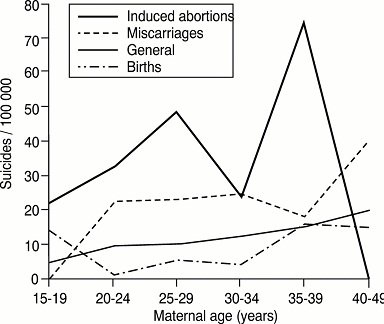
The pro-abortion activists are clutching at straws on this. Why do they not state the simple truth which is that they want abortion on demand and argue the case on whatever legitimate grounds they can find for this? Meaningless slogans implying some kind of victimhood just makes no sense at all.

Brendan O’Neill has done it again with another spot-on column in the Telegraph. He writes:
I have a dream that one day I will open a newspaper and not see any articles about pervy priests or leering politicians. I know what you’re thinking: if only priests would stop perving and politicians would stop leering then perhaps we wouldn’t have to read about them. I think it’s more complicated than that. I think the omnipotence of sexual abuse scandals in public and political debate is not down to the fact that men in positions of power are now more wicked and warped than they were at any point in history. Rather it reflects the extent to which accusations of sexual impropriety have become the key currency of political and moral infighting, the main means through which one dents institutions and people that one detests.
Read more here.

Has the penny dropped at a last? Are we all about to wake up to the fact that our tolerance of the porn industry – or at best, our inept efforts to deal with it – is the greatest and most devastating cooperation in the evil of child abuse that the world has ever seen. Are we at last ready to accept that if a blatant act of showing pornographic images to a child is a form of child abuse, then so also is the broadcast of such images through film, TV, or over the Internet – at any hour of the day – also effectively the destruction of innocence.
Last week police in Australia gave a stark warning to parents to wake up to this. Now the government of Iceland is drafting legislation in an attempt to confront the plague. It is probably a bonus that it is liberal-minded Iceland doing this. Were it some Catholic country attempting to lead the way the cries of “censorship” and moans about “conservative reactionaries” would have been the inevitable result. With Iceland taking the vanguard position the project stands a much better chance of success.
The current issue of The Week reports that Iceland could become the first Western democracy to attempt to ban internet porn under radical new proposals announced last week. It already has laws forbidding the printing and distribution of porn (and bans lap dancing and strip clubs) but these laws have not been updated to cover the internet. Under the legislation being drafted by Interior Minister Ögmundur Jónasson, Iceland would introduce internet filters and firewalls similar to those used by China. It is also looking at other ways to enforce the proposed law, such as making it illegal to use Icelandic credit cards to access pay-per-view sex sites. The rationale for the ban is the damaging effects internet porn is held to have on children and on attitudes towards women.
Inevitably sceptics – and those with other agendas – argue that it would be impossible to enforce. Bravo for Iceland for at least trying.
Meanwhile, as though providing a preliminary statement for the prosecution of pornographers, a member of Australia’s Online Child Exploitation Squad (OCES), Detective Senior Sergeant Lindsay Garratt, said in an interview following the recent arrests of a sports coach and teacher whom police believe had been operating as online predators: “It wasn’t too many years ago that we were talking about stranger danger, the offender down at the playground” but now the internet “has brought the offenders into the house without parents being aware of it.
“Parents need to be aware of the enormity of the issues and do what they can to protect their own children. Parents need to take a lead role and educate kids.”
Advances in technology, he said, had expanded the dimensions of this problem enormously.
“We’re now in an environment where child exploitation material is really rife,” he said.
“In the early ’90s we were talking in megabytes and now we’re talking in gigabytes and terabytes and it won’t be long before we’re talking petabytes (one million gigabytes).”
He said that despite several warnings, “sexting” continued to be a major issue among teenagers and he was aware of cases involving children as young as 10 and 11. “As soon as a child is given access to a computer, the internet or a mobile phone, they really need to have a clear understanding of the risks,” he said.

There is a very interesting follow-up by Ross Douthat on his own NYT blog to his “Catholic Moment” column in the paper at the weekend. In it he concludes:
Again, I’m not denying that the Catholic faith will always be rowing against the currents of a late-modern mass democracy like ours. But boats can beat successfully against a current (and make room for more passengers on board), or they can just be carried backward toward the sea. A “Catholic moment” exists, in this sense, when the barque of Peter seems to be making some headway — and to the extent that such a moment has vanished in our own era, as much blame has to belong to the rowers who ignored obvious rocks, smashed their oars or kicked holes in the bottom as to the river of modernity itself.
It’s all here.

Context: the Irish parliament’s proposal to legislate for abortion on the basis of the risk of an expectant mother committing suicide.
The real-life story of Oscar winner, Rita Moreno (West Side Story), recounted in her autobiography and reported in today’s Daily Telegraph, show where the real risks of suicide lie.
After her relationship with (Elvis) Presley ended, she discovered she was pregnant with (Marlon) Brando’s child. “To my shock and horror, Marlon immediately arranged for an abortion,” she writes. It was this episode, she says, that prompted her suicide attempt at Brando’s home.
“I went to bed to die,” she writes. “This wasn’t a revenge suicide, but a consolation, an escape-from-pain death.”
Moreno was rushed to hospital to have her stomach pumped and her therapist begged her and Brando – who died in 2004 – never to see one another again.

Sad, even terrifying, but true: James Delingpole in his Telegraph blog this weekend:
I’ll tell you what I fear. I think we have now reached that stage of last-days-of-the-Roman-Empire intellectual and moral depravity where almost no one in our dominant corporate/political/financier/lawyer class believes it’s worthwhile or even possible to do the right thing any more. Some of them may be vaguely aware that, yes, the only way the world is ever going to recover from the economic mess we’re in is through a radical agenda of cost-cutting, contraction of the state, sound money, and lower taxes. But they’ve made up their minds that none of this is a votewinner in our heavily socialised Western economies and that therefore the only hope is simply to grab what you can while you still can – and forget any fancy, idealistic notions you may have had about making the world a better place.
Read the whole piece here.

Extraordinary though it was, perhaps still more extraordinary was the world-wide response to the news. Pope Benedict XVI’s announcement of his abdication was truly historic. But for Catholics, for whom he has been for the past eight years the Vicar of Christ on earth, it was simply one more act carried out within the context of everything they believe about the nature and character of this office. For everyone else it was a strange and sensational event in a drama which is only half understood – if even that. For believing Catholics it was providential; for others it was a riddle to be grappled with, marveled at, even laughed at and for some an opportunity to grind once again any number of axes with which they have been trying to wound, if not slay, this man since he took office in 2005.
Twitter’s collapse under the weight of all this within minutes of the news breaking was just one of the indications of the reach of interest which the Catholic Church “enjoys”. Although venerated and loved by hundreds of millions, this universal body of believers is reviled by a significantly smaller number whose enmity and disdain is nourished by the powerful elite which dominates the Western world’s media.
It was not just Twitter and the other social media which carried this massive load of news, comment and analysis. Mainstream media, from the ridiculous to the prestigious, lined up friends and enemies of the Catholic Church in general, and Pope Benedict in particular, to do battle with each other. It really was amphitheater stuff. For the most part it was bewildering fare for any Catholic with an understanding of the Church and the office of its Supreme Pontiff.
One of these in particular, written two days after the event, seems to illustrate the phenomenon we are talking of. Ruth Marcus, Washington Post columnist, writing on Wednesday the 13th, used the whole event as a pretext to attack – politely on the surface but somewhat less so under the surface – the Catholic Church’s sacramental theology. Wielding her feminist weaponry she weighed in on the issue of the priesthood and took no prisoners in her attack on the pope and the Church for not permitting the priestly ordination of women.
What Marcus’ view of the Church – as well as what perhaps ninety percent of the entire media output surrounding this story – shows is the apparently unbridgeable gap between the worldview of those who see and subscribe to the existence of the happy marriage of faith and reason and those for whom reason alone is the standard by which to judge everything they see and experience.
Marcus and many more who consider themselves the apostles and apologists of modernity, those who – even while professing to be religious – cannot really comprehend what religion is about, are this kind of rationalist. But as was so clearly defined and explained by Joseph Ratzinger and his predecessor, Pope John Paul II, this kind of absolute rationalist almost inevitably succumbs to relativism – and that road leads to many forms of nightmare.
Why do we say “professing to be religious”? Because for them religion can only ever be a kind of social construct – something made by man for his own purposes, either for his consolation or to help him cope with his vague sense of the divine which will be there if he is in any way reflective.
These two worldviews now dominate Western civilization and in fact have generated two separate civilizations. These now live uneasily side by side but are currently producing all the signs of an impending conflict of dimensions not seen since the first Christians came into conflict with the Roman world, and before that, when the Judaic world came into conflict with the Hellenist forces of Antiochus and his successors.
Reading so much of the commentary generated around the impending event announced this week produces an inordinate sense of frustration in believing Christians. An enormous chasm seems to have opened up between those for whom God is a living Being who really does exist, and those for whom he is at best a vaguely perceived possible solution to some of the more persistent puzzles of our human condition.
For the former it is a theological truth that his essential mode of communication with the beings he has created is through the agency of grace and a gratuitous gift called Faith. For the latter this is nonsense. This renders any dialogue between them very fraught indeed.
Ruth Marcus’ difficulty in coping with the concept of the Catholic priesthood is just one illustration of the kind of impasse that divides these two civilizations. There are many, many more and they seem to multiply with each year that passes. Marcus has no concept, it seems, of what every faithful Catholic believes the sacraments are, what they do and how they came to be. If she did I think she would respect the right to believe and not denigrate that belief as something “backward” to which she then attributes numerous unworthy motives of greed, power, and rigidity. To her they are simply social constructs, now being held in place against the forces of modernity to preserve the hegemony of a male establishment over one half of humanity.
To faithful Catholics all the sacraments are a God-given foundation for their lives on this earth to help them on their way to eternal life. A Catholic – even if he is Pope – will no more interfere with the sacrament of holy orders, its matter and form, than he or she will interfere with the matter (bread and wine) and form of the sacrament of the Eucharist, or with the sacrament of penance in which a penitent confesses his sins to an ordained priest to obtain absolution from God. Ruth Marcus version of modernity simply cannot comprehend such a system, but is at the same time not really prepared to tolerate its existence without denigration.
Another currently more fraught flash-point in the clash of these two civilizations just now is that of marriage. Divorce constituted the first redefinition of the institution which Christians believe was elevated to the level of a sacrament by the founder of their faith. For a Catholic, marriage remains an indissoluble bond, broken only be death. The arrangements of the state to provide for the legal dissolution of that bond have no real effect on that bond for the validly married Catholic. He or she who becomes the victim of a divorce forced on them remains married. This is incomprehensible to a brand of modernity. Equally incomprehensible to a Christian – as well as to many non-Christians, of course – is the redefinition of marriage now being pursued by some which declares that a marriage bond can be established between two human beings of the same sex. This defies not only their faith but also their rational grasp of human biology.
Marcus’ special axe is the feminist one. “The common chord of orthodox religions’ struggle against the tides of modernity involves women,” she writes, “specifically whether to loosen doctrinal restrictions on women.” She goes on to equate a current struggle between Jewish women who want to wear the tallit, a prayer shawl traditionally only worn by men, with Catholic women who want to be ordained as priests. For her it was a fitting coincidence that the latest skirmish in Israel on this issue occurred the same day that Pope Benedict XVI announced his abdication.
“One of the central questions facing the Catholic Church — one of the stances on which Benedict was most unrelenting and on which his successor is likely to be similarly rigid — is the ordination of women,” she wrote. Most of us would not have thought so, but perhaps if feminism is your big issue then it is.
Marcus thinks that the “rational move”, for a church facing a dire worldwide shortage of priests, would be to expand the pool of potential candidates. This concession to modernity would not be resisted by the faithful, she argues, “because polls in the United States and abroad show strong majorities in support of women serving as priests.” That is precisely where raw rationalism takes you. The Catholic Church has always had and always will have a shortage of priests in relation to the task of evangelization it has been given.
The goal of the Catholic Church is not a numerical one. It is the sanctity and salvation of each individual soul on this earth, one by one. The total headcount is incidental. Had it been otherwise Christ would have watered down his insistence on the Eucharist which caused a portion of his following “to walk no more with him”. Indeed, the rational thing for Christ to have done when he came into conflict with the religious authorities of his time would have been to seek some accommodation with them. He did not, because the truth he told took precedence over the modernity of his time.
She is also wrong about resistance. The “faithful” who would ignore the sacramental truths about priesthood would no longer be faithful. The faithful who live by these sacraments will be, if necessary, the remnant of Israel. They know that to abandon the sacraments, their essential matter and form, is to abandon their faith in Christ.
Marcus, in her opening observations mentions her daughter’s bat-mitzvah at which three generations of women wore the tallit – as did the presiding rabbi. That rabbi was also a woman. From there she goes on to talk of restrictions on women in the Catholic Church. Consider this. A rabbi is, as I understand it, essentially a teacher. The Catholic Church has down through the centuries had many teachers who were women – some of whom are formally recognized as doctors of the church. Among its greatest teachers and spiritual inspirations have been Catherine of Sienna, Julian of Norwich, Teresa of Avila, Hildegaard of Bingen – and in our own time Edith Stein, Teresa of Calcutta and, dare I say it, Rita Antoinette Rizzo. Who? She who is better known as Mother Angelica. These women, and many like them, had no trouble emerging from the “restrictions” imposed on them by the Catholic Church.
But all this is poppy-cock to the ultra modernist. Modernity itself is not a problem for Christians. Indeed modernity is the air that they breathe and the substance of their mission. They were exhorted by the predecessor of Benedict XVI not to be afraid of it. But modernity divorced from faith and reason is a card of the wildest and most treacherous kind. Christians are challenged to read the world in the light of something beyond reason and with that “something” to redeem it. Faithful to their sacramental life in all its divine dimensions and the message of the gospel, they will. Sadly, those anchored in a world in which faith and reason remain divorced from one another, cannot comprehend the world of these others and if their power permits it they will inevitably ridicule them, marginalize them and condemn them to obscurity – or worse. But these others will still to hear those words, “Be not afraid”, and continue on regardless.

Two stories – at least – in yesterday’s Sunday Telegraph in London puzzled over the mystery of David Cameron’s strange behaviour in the recent past. Janet Daley asked how Cameron could go from what looked like a possible triumph in his European Union difficulties to what looked like a scuttling of his own party on the redefinition of marriage legislation. Christopher Booker puzzled over the same thing but soon came up with an answer which might well be, for most of us, the solution to the riddle of Cameron’s folly.
“The greatest puzzle about the ‘gay marriage’ furore” Booker wrote, “is why this issue suddenly erupted from nowhere to the top of the political agenda. Why has David Cameron been willing, as one commentator put it, to ‘trash his party’ in pushing so hard for something that, before the last election, he refused to endorse or to include in the Tory manifesto? And why, just as it was provoking the biggest Tory rebellion in decades, was it also prompting a similar row in the French National Assembly?”
Janet Daley, reading the conundrum in terms of keeping Cameron’s political scoreboard, confesses that she can’t keep up.
Was his European summit intervention a triumph over the EU budget, or not? She asked. And if it was a success, does it cancel out the ghastly calamity of the earlier half of the week? That depends on whether the cleverness and determination of the second half was more revealing of the Prime Minister’s true character than the bloody-minded foolishness of the first. The same-sex marriage question should have been, she said, “on the scale of the country’s immediate problems, an issue of vanishingly small political import had been propelled into a five-star megacrisis of stupendous proportions”.
Was it, as one of Daley’s disgruntled and mystified confidants from the tory back benches said, a silly, off-the-top-of-our-heads gesture inspired by a half-understood observation of the US presidential election. She suggested that it might be a question of “a juvenile crush on the charismatic guy across the Pond.” Barack Obama, the epitome of “cool” in the eyes of star-struck Cameroons, had committed himself to legalising gay marriage – and he had won the election by taking states with largely urban, metropolitan electorates. Ergo, thought the great brains of Downing Street, endorsing gay marriage brings you electoral success in cosmopolitan conurbations of the kind that the Tories need to win, she said.
So what does Daley conclude? That Cameron may be too facile with language and arguments? She thinks that, maybe like a very bright but vaguely lazy student, while he can pull out a gifted verbal performance when it is absolutely necessary – when his political life depends on it – he then slips back into haphazard sloppiness when the crisis is past?
Booker’s analysis ultimately gives Cameron more credit, but if it does it is also more worrying for anyone with a modicum of democratic instinct. Ultimately, as well, it could signal an even deeper crisis for Cameron’s own party for it will be seen as signalling a subtle and sinister subversion of British sovereignty to the creeping hegemony of the European Union and the Council of Europe.
The real story behind this drama goes back to 2010, Booker argues. It has three main players, the Home Secretary Theresa May, our former Lib Dem equalities minister, Lynne Featherstone, and that shadowy institution, the Council of Europe in Strasbourg, with its controversial adjunct, the European Court of Human Rights.
In March 2010, ministers from the 47 countries represented in the Council of Europe agreed a “Recommendation” on “measures to combat discrimination on grounds of sexual orientation or gender identity”. Section IV focused on Article 8 of the European Convention on Human Rights, guaranteeing “respect for family life”. It proposed that where national legislation recognised same-sex partnerships, these should be given the same legal status as those between heterosexuals. There was no mention of marriage as yet, except in a proposal that “transgender persons” should be entitled to “marry a person of the sex opposite to their reassigned sex”.
Four days before the 2010 general election, the Tory party issued a pamphlet, signed by Theresa May, in which a section on “lesbian, gay, bisexual and transgender [LGBT] issues” promised that the party would “consider the case for changing the law to allow civil partnerships to be called and classified as marriage”. But this was not in the manifesto, nor, after the election, in the Coalition Agreement.
In June that year, the European Court of Human Rights (ECHR) ruled that, though there was no obligation on countries to recognise same-sex partnerships, Article 8 did not specify that the right to enjoy family life applied only to couples of different sexes. It could be taken as equally applying to same-sex couples. The court proposed that, when a “consensus” emerged among the member states, this could allow the right to same-sex marriages to be recognised under the convention.
Shortly afterwards, Lynne Featherstone, the equalities minister, set out new guidelines allowing “religious music” to be used in civil partnership ceremonies. She suggested that this should be regarded as a step towards allowing gay marriages. In September, the Lib Dem party conference backed her call for same-sex marriages to be legalised.
In December a campaign group, Equal Love, helped a group of British same-sex couples to launch an action in the ECHR asking for civil partnerships to be given full marriage status. They were supported by Peter Tatchell, who told the BBC that banning gay people from marriage sent “a signal that we are regarded as socially and legally inferior”.
The campaign – with much conferring behind the scenes between ministers and gay lobby groups – was under way. In March 2011, May and Featherstone issued an official policy document, “Working for Lesbian, Gay, Bisexual and Transgender Equality: Moving Forward”. It committed the Government to work “with all those who have an interest in equal civil marriage” on how “legislation can develop”. Furthermore, it committed the Foreign Office and the new Gender Equality Office to work for “full implementation” of the Council of Europe’s 2010 Recommendation, with a target date of June 2013.
In November 2011, when Britain took over the six-monthly chairmanship of the Council of Europe, it put this at the top of the agenda. (Featherstone had already committed £100,000 of government money to creating an LGBT unit in Strasbourg to plan implementation of the policy). Britain was so keen to take the lead that, on March 27 last year, the UK’s representation in Strasbourg organised the council’s first “closed conference” (ie, public not admitted), to agree detailed plans for the June 2013 implementation, with a keynote address from Featherstone. A speech by the British judge, Sir Nicolas Bratza, then head of the European Court of Human Rights, signalled that the court was ready to declare same-sex marriage a “human right”, as soon as enough countries fell into line.
Such are the real reasons that our Government needed to rush through last week’s vote on gay marriage. We are committed to “full implementation” of the Council of Europe’s policy no later than this June (and hence the similar law now being rushed through in France). It has been a brilliant political coup by the gay lobby, aided by Featherstone, May and those shadowy European bodies that, in so many ways, now rule our lives. But why weren’t we told more honestly and openly why it has all happened?
And that is the question which makes this whole issue a much bigger one than the sentimental journeys of some gay people or the sympathies of those who fail to see the importance of fundamental change in the definition of an institution which is at the heart of a stable society and which has such bearing on the welfare of children. The calculated manipulation of political institutions, the manipulation of public opinion and the deceit at the heart of all this is what should really be disturbing us. If the political establishment is prepared to this in pursuit of one policy it will do it for any policy.
(Posted earlier this evening on Conjugality)

This is an all points spin warning about serious twisters hitting Ireland today – courtesy of the Irish Times. The warning comes courtesy of the Pro Life Campaign at approximately 1600 hours today. Read and judge for yourselves. This is what we – and the unborn – are up against.
Irish Times presentation of latest poll on abortion “grossly distorted”, says Pro Life Campaign
The presentation by The Irish Times of today’s Ipsos MRBI poll on abortion was “grossly distorted”, according to the Pro Life Campaign.
In its analysis of the poll results, The Irish Times states that public support for abortion legislation has risen from 23% in 1997 to 71% today.
Ms Sherlock said: “This is a completely distorted and inaccurate presentation. The 1997 MRBI poll which The Irish Times claims showed only 23% support for abortion actually found 77% of people supported abortion in a variety of circumstances, depending on how the question was asked. However, like the poll published in today’s Irish Times, it made no distinction between abortion and necessary medical treatments in pregnancy.
“The 23% mentioned by The Irish Times was just one of the findings in a multiple choice question that included other categories of support for abortion.
“Five years later, in 2002, when the electorate had an actual choice to make in a referendum, 49% voted YES to row back on the X case ruling. An IMS poll conducted just afterwards found an additional 5% voted NO on pro-life grounds.
“In other words, despite findings like the one cited by The Irish Times from 1997 and the latest Ipsos MRBI poll, when the people have an actual democratic choice, a clear majority rejects abortion.”
Ms Sherlock concluded: “Polls showing high levels of support for abortion are nothing new. Whenever the question suppresses the distinction between induced abortion (that targets the life of the baby) and necessary medical treatments to preserve the life of the mother (where every reasonable effort is made to save the life of the baby), the results show high support for abortion. Such polls, however, significantly under represent the opposition among the electorate and create an inflated perception of the extent of public support for abortion.”
ENDS
 Garvan Hill
