Children in the firing line?

Triumphalism has seldom been more ugly, more thoughtless or more superficial. Ireland, as the whole world now knows, voted to legalize same-sex marriage last week. But it did more than that. It abandoned reason in favour of raw and untrammeled emotion – and emotion untrammeled, as we know – or should know – can be an unaccountable monster. Love, fairness, and equality were the catch-cries of the winning campaign from start to finish. In their moment of triumph, however, there was little evidence of any of these qualities. What were in evidence were cruelty, unfairness and gross arrogance – and some children bore the brunt of of it.

Two two instances, among many, of children being thrown to the wolves of hatred and bullying abuse emerged in the past few days.

Two days ago, a distraught mother posted to her Facebook friends that during the campaign three of her children have had a difficult time in school. The worst was suffered by her 12 year-old in 6th class. “It began quite some time ago when a group of peers shouted at her, ‘You’re Catholic, you hate gay people’. She is a sassy miss and defended herself very well while keeping her dignity. However in the last week she has really suffered. She has always been friendly and never had falling outs with anybody…ever. Her immediate group of friends (about 4) laid into her because, as they said, ‘No’ people are ‘haters’, ‘bigots…blah, blah, blah’”.

Elizabeth (not her real name) told them “stop insulting my entire family and aunties and uncles.” They shut up. But then, on Wednesday, they were making presentations of work in class. Her presentation was good. She had put her heart and soul into it. There were rounds of applause for everyone but hers was greeted with a deathly and devastating silence. She has been crying since she came home, her mother told us in her post. This she fears, as does Elizabeth, is only the beginning.

Earlier in the week there was an account from another school, in the rural outskirts of Dublin. On the day of the referendum, or the day before, the class teacher – again 6th with 11 and 12 year-olds – foolishly invited the class to vote on the issue being presented to the country’s electorate. This was not to be done by anything as protective of freedom as a secret ballot. No, this was by a show of hands.

The vote went the way of the Dublin vote in the actual referendum – 70 to 30 for same-sex marriage. Fair enough, that might have been expected. What might not have been expected – although surely a sensitive teacher, knowing her class as she should, might have anticipated it – was the tsunami of vitriolic abuse the young “Yes” voters, probably following the example of their parents, then unleashed on the “No” children, who were probably also just following the lead of their parents.

Everyone says that there has been a radical turning of the social and moral tide in Ireland now. How radical?

There is a rather chilling little video film – about 20 minutes long – on YouTube. It may be ironic in intent, its purpose is ambiguous, but in the context of these stories it certainly loses some of its ambiguity. If what has happened in Ireland last week is another victory for the forces of the gender revolution, then the message of this film, in the context of those two sad little stories about 12 year-old children in two Irish schools, resonates ominously indeed.

The film builds on the fantasy premiss that our world is now a place where gay is not only good but where gay is the only good. It presents us, not with a sci-fi fantasy but with a sci-fi nightmare which a child in one Irish school and a group of children in another a few days earlier must surely have felt they were living in as their peers set upon them mercilessly.

Will the battalions of the Yes-to-same-sex-marriage campaign – official Ireland, Ireland’s child welfare agencies, the children’s charities in Ireland, and Ireland’s media, who were so triumphant all week, now come to the rescue of the new victims of bullying, unfairness and inequality?

Moses got it badly wrong – the Irish put it right by out-voting God


Even as a (gay) atheist, Matthew Parris writes in this week’s Spectator, I wince to see the philosophical mess that religious conservatives are making of their case. Is there nobody of any intellectual stature left in our English church, or the Roman church, to frame the argument against Christianity’s slide into just going with the flow of social and cultural change? Time was — even in my time — when there were quiet, understated, sometimes quite severe men of the cloth, often wearing bifocal spectacles, who could show us moral relativists a decent fight in that eternal debate. Now there’s only the emotional witness of the ranting evangelicals, most of them pretty dim. How I miss the fine minds of bishops like Joseph Butler, who remarked drily to John Wesley: ‘Sir, the pretending to extraordinary revelations, and gifts of the Holy Ghost, is an horrid thing, a very horrid thing.’

So, wearily and with a reluctance born of not even supporting the argument’s conclusion, let me restate the conservative Catholic’s only proper response to news such as that from Dublin last weekend. It is that 62 per cent in a referendum does not cause a sin in the eyes of God to cease to be a sin.

Can’t these Christians see that the moral basis of their faith cannot be sought in the pollsters’ arithmetic? What has the Irish referendum shown us? It is that a majority of people in the Republic of Ireland in 2015 do not agree with their church’s centuries-old doctrine that sexual relationships between two people of the same gender are a sin. Fine: we cannot doubt that finding. But can a preponderance of public opinion reverse the polarity between virtue and vice? Would it have occurred for a moment to Moses (let alone God) that he’d better defer to Moloch-worship because that’s what most of the Israelites wanted to do?

Read all of his searing satire here.

Like rugby, only more triumphalist

gay-marriage-image

From Melanie McDonagh in The Spectator:

In more ways than one it’s impossible to be heard above the din right now in the wake of the Yes vote in Ireland on gay marriage. There’s a special noise that goes with an orgy of self-congratulation, a roar of mutual approbation, and it drowned everything else out in Dublin as the results came in today. Like rugby, only more triumphalist. Actually, I was watching the scene from the Sky studio in Millbank, where my interlocutor in central Dublin, Patrick Strudwick, a journalist and activist, was appearing on a screen on the streets and had to shout over the crowd to make himself heard, to repeat, over and over again, ‘It’s a victory for love, for equality, for human rights’.

Mind you he did go off piste sufficiently to declare that I was a bitter loser and a bigot (I was expressing concern that the family courts would be influenced by the vote when it came to decisions on the guardianship and custody of children). Oh and that this was a victory over the forces of the Catholic Church because no one would ever listen to them again on account of the cover ups of the clerical child abuse scandals. As a summary of the sentiments and subtlety of the Yes campaign it was, I’d say, bang on.

Read the rest of the article here.

Marriage is dead. Long live Marriage!

It’s over in Ireland. The Irish people, by something close to a 60 – 40 majority popular vote have redefined marriage out of existence in their State Constitution and have replaced it with a shallow charade which they will now call marriage.

Marriage however, that primeval bond between a male and a female, still exists – and will exist so long as a man and a woman come together, as did Adam and Eve, to beget children. Long live marriage.

But the reality now is that the future of natural marriage, the conjugal union of man and woman, in the story of mankind will be even more fraught with difficulty than it has been in the past. It has never had an easy passage – either because of the folly and selfishness of individuals or the pandering of their public representatives to that same folly and selfishness. The first big compromise on the part of the latter was divorce. Now we have this. Ireland’s story is just one piece of a global jigsaw – symbolic for all sorts of reasons, but still just a piece. The New York Times now triumphantly declares that Ireland has advanced to the vanguard of this deconstructive process.

Ireland’s electorate has now robbed natural marriage of its constitutional protection in the Irish State. The laws relating to family, children, and all those things which the State’s endorsement of marriage framed and supported are essentially cut adrift in a sea which will be stormy, treacherous and at times destructive of society’s common good and the well-being of individuals. Because of this foolish action, which they thought was just a matter of changing a name, broadening a definition to include something else, they are complicit in an act which is an attempt to change human nature itself. As one opponent of the decision described it, “grotesque nonsense

Watch this space.

How did this all happen? We know the short-term story well. For an American and global perspective read After the Ball: How America Will Conquer Its Fear and Hatred of Gays in the ’90s. This was a book published in 1989 by Marshall Kirk and Hunter Madsen which argues that after the gay liberation phase of the 1970s and 1980s, gay rights groups should adopt more professional public relations techniques to convey their message. This they did with a success which all marvel at. The blueprint was then applied to Ireland

For the Irish story, read how Atlantic Philanthropies promoted and funded the infiltration of Ireland’s state and charitable agencies to achieve yesterday’s referendum victory.

But the origin of this social crisis – John Waters, Irish newspaper columnist of the first rank, described it as a social catastrophe – goes back centuries, indeed almost a millennium. Essentially it all began when sentiment and human emotions began to gain the upper hand over human reason.

In The Allegory of Love, C. S. Lewis would have us believe, very convincingly, that a radical shift in human consciousness and culture began with the sudden appearance of what we call “courtly love” in 11th century Languedoc. Lewis explored this theme and thesis in this book, one of his masterworks, perhaps his greatest.

The dominant sentiment he explores is love. But it is love of a highly specialised sort, “whose characteristics may be enumerated as Humility, Courtesy, Adultery, and the Religion of Love.” This all began with the love poetry specific to that time and that place, the love poetry of the Troubadours. The characteristics of this sentiment, Lewis tells us, and its systematic coherence throughout this poetry as a whole, “are so striking that they easily lead to a fatal misunderstanding. We are tempted to treat ‘courtly love’ as a mere episode in literary history – an episode that we have finished with…”

But we have not finished with it. He sees an unmistakable continuity connecting these love songs with the love poetry of the later Middle Ages, and thence, through Petrarch and many others, with that of the present day. If the thing at first escapes our notice, this is because we are so familiar with the erotic tradition of modern Europe that we mistake it for something natural and universal and therefore do not inquire into its origins. As Lewis says, it seems to us natural that love should be the commonest theme of serious imaginative literature. He looks back at literature preceding this southern French explosion, from the earlier Middle Ages back into antiquity, and finds that “what we took for ‘nature’ is really a special state of affairs, which will probably have an end, and which certainly had a beginning in eleventh-century Provence.” He continues:

It seems – or it seemed to us till lately – a natural thing that love (under certain conditions) should be regarded as a noble and ennobling passion: it is only if we imagine ourselves trying to explain this doctrine to Aristotle, Virgil, St. Paul, or the author of Beowulf, that we become aware how far from natural it is…

French poets, in the eleventh century, discovered or invented, or were the first to express, that

romantic species of passion which English poets were still writing about in the nineteenth. They effected a change which has left no corner of our ethics, our imagination, or our daily life untouched…

Compared with this revolution the Renaissance is a mere ripple on the surface of literature. There can be no mistake about the novelty of romantic love: our only difficulty is to imagine in all its bareness the mental world that existed before its coming – to wipe out of our minds, for a moment, nearly all that makes the food both of modern sentimentality and modern cynicism.

The death of marriage, as we knew it in our language and our laws, came late in the evolution of our culture, infected as it was, slowly but surely by this creeping dominance of sentimentality over reason. First came the advance of divorce. Then a sizeable proportion of couples abandoned marriage in the name of love – which was all that mattered to them. Cohabitation became a new norm. Then came the demand for social acceptance of homosexual love. Its lobby demanded that marriage be redefined to provide them with society’s badge of acceptance – even while society’s concept of what marriage really is was already in its death throes as a result of earlier and successive redefinitions.

To come to grips with and understand this long revolutionary process, Lewis tells us that we need to

conceive a world emptied of that ideal of ‘happiness’ – a happiness grounded on successful romantic love – which still supplies the motive of our popular fiction. In ancient literature love seldom rises above the levels of merry sensuality or domestic comfort, except to be treated as a tragic madness, an ἄτη which plunges otherwise sane people (usually women) into crime and disgrace. Such is the love of Medea, of Phaedra, of Dido; and such the love from which maidens pray that the gods may protect them.

At the other end of the scale we find the comfort and utility of a good wife acknowledged:

Odysseus loves Penelope as he loves the rest of his home and possessions, and Aristotle rather grudgingly admits that the conjugal relation may now and then rise to the same level as the virtuous friendship between good men. But this has plainly very little to do with ‘love’ in the modern or medieval sense; and if we turn to ancient love-poetry proper, we shall be even more disappointed.

Plato will not be reckoned an exception by those who have read him with care… Those who call themselves Platonists at the Renaissance may imagine a love which reaches the divine without abandoning the human and becomes spiritual while remaining also carnal; but they do not find this in Plato. If they read it into him, this is because they are living, like ourselves, in the tradition which began in the eleventh century.

So what has all this to do with the Irish referendum? This: the Irish “Yes to Equality” rode home to victory on the on the shoulders of this very same “love” which emanated from the songs of the Troubadours of the 11th century. It wasn’t that the young and old who voted Yes to “love and equality” had been reading courtly love poetry. No, they had been fed on the artefacts of 18th and 19th century romanticism, morphing in the 20th and 21st century into a voraciously consumed diet of pop culture expressed through sentimental Hollywood movies and ultra-sentimental pop songs – not to mention soap-operas and the chic lit of Maeve Binchy, Cecelia Aherne et al.

The current West End production of Rodgers and Hammerstein’s Carousel is moving to Dublin for a very short season next month. I watched some clips of the 1950s Hollywood version the night before the referendum. I love the show. But while watching it I had premonitions of what was going to happen the next day. How could any generation, I thought, fed on this and much inferior sentimental material do otherwise that vote for “love” over all the other values at stake.

The helplessly smitten Julie (Shirley Jones) sang:

Common sense may tell you

That the ending will be sad

And now’s the time to break and run away

But what’s the use of wond’rin’

If the ending will be sad

He’s your fella and you love him

There’s nothing more to say.

There is nothing more to say, for the moment. This excepted: the crown is in the hands of a usurper but the King lives, and always will, albeit in the shadows. The marriage of man and woman is as indestructible as is human nature itself. No tyranny, not even a democratic one, can destroy it.

Battle for natural marriage lost in Ireland – next up, battle for freedom of conscience

Just after mid-day in Ireland today the Iona Institute, leader of one of the voluntary campaign groups fighting against the redefinition of marriage by Irish Government and the entire political establishment in the country, effectively conceded victory to its opponents. Their statement said:

We would like to congratulate the Yes side on winning such a handsome victory in the marriage referendum. They fought a very professional campaign that in truth began long before the official campaign started.

For our part, The Iona Institute is proud to have helped represent the many hundreds of thousands of Irish people who would otherwise have had no voice in this referendum because all of the political parties backed a Yes vote.

A formal announcement from the count is expected to be made in Dublin Castle by mid afternoon.

The Institute thanked the thousands of volunteers up and down the country who worked day and night to try and secure a No vote.

Commenting on the outcome, David Quinn said: “We believe a fought a good campaign. It was always going to be an uphill battle. However, we helped to provide a voice to the hundreds of thousands of Irish people who did vote No. The fact that no political party supported them must be a concern from a democratic point of view.

He concluded: “Going forward, we will continue to affirm the importance of the biological ties and of motherhood and fatherhood. We hope the Government will address the concerns voters on the No side have about the implications for freedom of religion and freedom of conscience.”

It’s a free world, but is it a fair one?

  
Now we know what we knew all along but had not proved it. Irish print media has again shamed itself with its blatant unfairness. Three times more “YES” articles than “NO” articles on the country’s marriage referendum appeared in newspapers in the three weeks prior to the poll which takes place today.

The finding is based on independently conducted research commissioned by PR and Public Affairs company MKC Communications from Newsaccess Media Intelligence.

A detailed analysis of coverage of the Referendum in ten national titles – Irish Times, Irish Independent, Irish Examiner, Daily Mail, The Herald, The Star, Sunday Independent, Sunday Times, Sunday Business Post, and Mail on Sunday — showed that there was a total of 424 “Yes” articles across those titles in that period, with just 135 “No” articles.

A further 214 “Neutral” articles were carried in the same period by the same newspapers.

This is not an opinion poll. All articles were read and analysed by Newsaccess Media Intelligence in terms of whether the tone of the piece was in favour of a YES vote, a NO vote or a NEUTRAL analysis of the referendum.

Last night a statement from the company explained the motivation behind its research.

“Because of the enormous significance of tomorrow’s Referendum, and the welter of charge and counter-charge about the media’s treatment of the subject in recent weeks, we decided that it would be an important exercise to bring some scientific measurement and facts to the issue of how the Referendum debate was reported in Irish media. 773 articles were printed in the newspapers analysed in a three week period, and the level of coverage for a single topic is possibly unprecedented in recent times”.

Irish newspapers have no statutory obligation to be fair and balanced. In this case they reflected the political establishment which, officially, was totally lopsided in its support for the coalition Goverenment’s proposal. Secretly, however the two major parties had a number of parliamentary representatives who were going to vote against. A handful of these eventually declared themselves publicly and already there are calls for their expulsion. Freedom in modern Ireland is a very qualified comodity – and it is likely to become more so. 

“Unlike broadcast media, which must provide balanced coverage of referenda, the print media are not subject to such strictures and this research confirms the broad and widespread support in the Irish print media for a ‘Yes’ vote”, said Laurie Mannix, Managing Director.

For copy of the report, contact MKC Communications 01 7038600

Snapshot of political bankruptcy


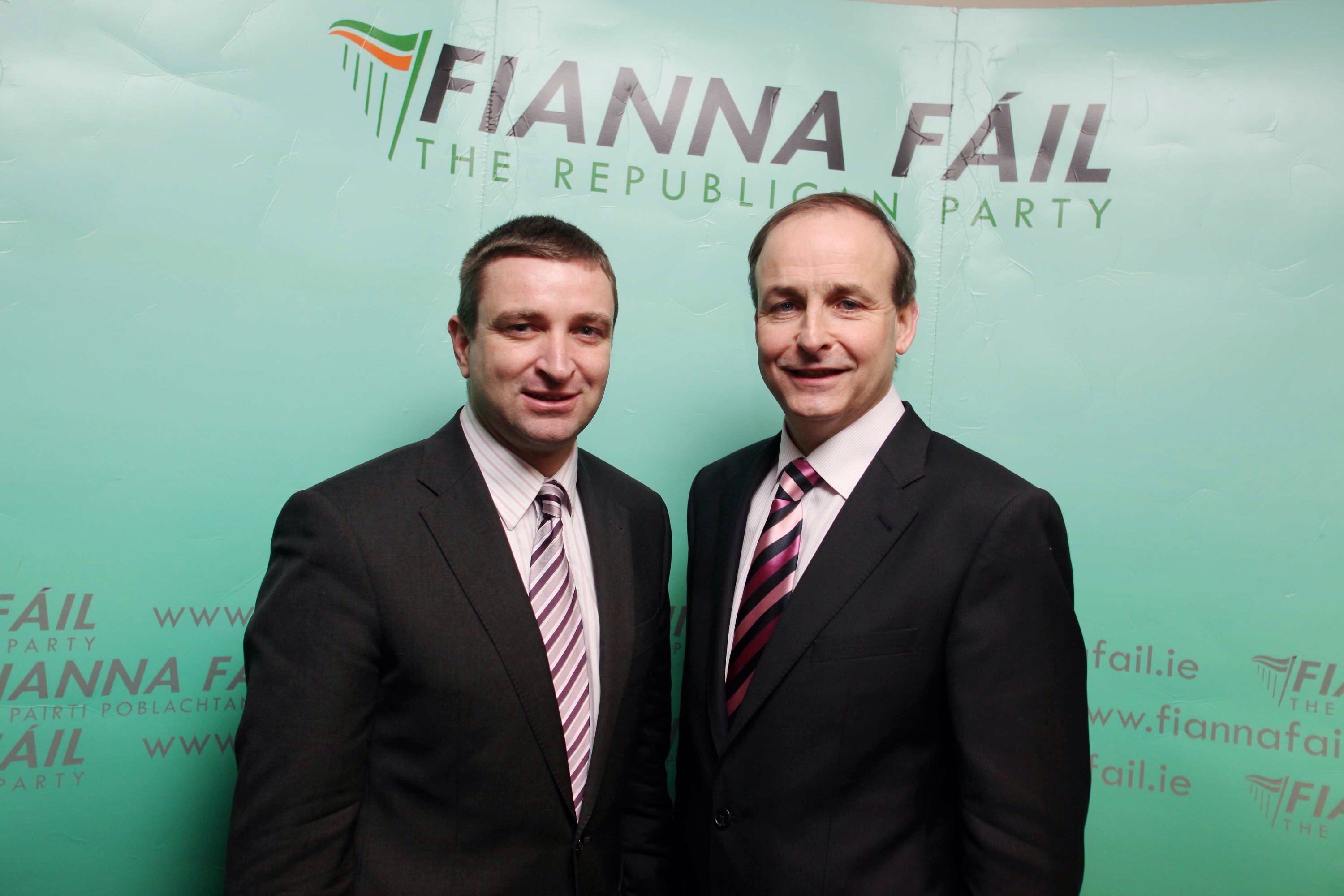
Collins (left) and his Party leader Michael Martiin
 
Has Ireland reached the nadir of political life and culture?

The Fianna Fail Party’s director of elections and spokesperson on Justice and Equality, Niall Collins, was on Irish radio (SpiritFM) this morning in discussion with Petra Conroy, who was representing the case for the defence of marriage. The case will go to judgement of the people in tomorrow’s referendum on same-sex unions – deciding whether they may be recognised as identical with the union of a man and a woman or not.

Collins, unable to deal with the arguments Conroy was presenting to him began to get offensive. Conroy had to take time out from the arguments to establish whether or not he was discussing the issue or attacking her personally. It ended up that he was.

Conroy: Niall can I ask you a question? You’ve mentioned “nonsense”, you have mentioned “lies”, you mentioned “disingenuousness”. Can I ask you do you think that I, everything that I am saying…?

Collins: No, the campaign you are associated with.

Conroy: I’m part of that campaign.

Collins: yeah you’re part of a campaign that is a big lie.

Conroy: Do you think what I have said today, the case I have outlined, is just lies to cover a desire to treat gay people as unequal.

Collins: Yes I do.

Conroy: So you think I’m lying and misleading, in order to cover… That’s something, that really is something! Actually I don’t normally ask this but I really hope that you take that back.

Collins: What I have said is that the no campaign is a big lie, and it is, and you’re associated with the No campaign.

The implications of Collins’ remarks are clear. He is his Party’s shadow Minister for Justice and Equality.

For decades, for most of the last century in fact, Fianna Fail was the largest political party in the Republic of Ireland, and was the party in power for most of that time. Post financial meltdown, into which it stupidly shepherded the country, it no longer is. It still aspires to greatness but with this kind of material at its heart there is little sign that this will be anytime soon.

Veteran sociologist on the absurdity of redefining marriage in the Irish Constitution

Trinity College Dublin

WHY PEOPLE SHOULD VOTE NO TO SAME-SEX MARRIAGE

By Anthony Coughlan

Since history began the institution of marriage between men and women has existed in all societies to ensure that the next generation, children, are brought up wherever practicable by the mothers and fathers who are responsible for conceiving them, until those children reach adulthood.

This is ABC in any sociology textbook. Male-female marriage is the basis of the natural links between the generations. It antedates the great religions. No society anywhere, apart from a few in recent years in Latin America and Europe, has regarded marriage as covering homosexuals, because lesbian and gay couples cannot conceive or produce children.

What we are being asked to do on Friday is to amend Article 41 of the Constitution to change marriage and the family from the male-female-based institution that it has always been understood to be in Ireland’s Constitution and laws, into something profoundly different.

It is not a mere matter of EXTENDING THE SCOPE AND COVERAGE of the institution of marriage and the family to include LGBT people. It is TO TRANSFORM FUNDAMENTALLY THE SOCIAL, CONSTITUTIONAL AND LEGAL CHARACTER OF THE INSTITUTION ITSELF.

If people vote Yes it means that henceforth in Ireland families based on so-called “marriage” between two males or two females – who are incapable as couples of producing children – will be included among families that are stated in our Constitution as being  “the natural primary and fundamental unit group of Society . . . a moral institution possessing inalienable and imprescriptible rights antecedent and superior to all positive law. . . the necessary basis of social order and as indispensable to the welfare of the Nation and the State.”

That is a ludicrous proposition, as UCC Professor John A. Murphy has pointed out in the Irish Times.

If we agree to write such an absurdity into the Irish Constitution, it will surely make this country and those in our political class who are responsible for it, into an international laughing stock … And deservedly so.

There are some 198 States in the world. Fewer than one-tenth of them, 17 I understand, have introduced same-sex marriage – all of them by Parliamentary vote or Court order.

Writing same-sex marriage into one’s State Constitution however is permanent, irreversible and likely to have many unforeseen, unintended and unwanted consequences. No other country has done that.

A MUCH MORE EFFECTIVE WAY OF DOING JUSTICE to the 1-2% of the population who are permanently homosexual without transforming the nature of marriage for the 98-99% who are not, would be to give recognition in the Constitution to civil partnerships, which is not the case at present.

Such an obvious way of being fair to our homosexual fellow-citizens does not seem to have been considered by the Government in its rush to push through homosexual “marriage” without any teasing out of its likely complex consequences in a Green Paper or White Paper beforehand.

If Irish voters transform the nature of marriage in the Constitution by voting Yes on Friday they will be endowing gay and lesbian couples with exactly the same constitutional rights to “procreate”, to “found” a family and to have children as opposite-sex couples have.

How can two men “found” a family?

Gay and lesbian couples can only exercise their new constitutional right to “procreate as a family” by the use of eggs or sperm donated by others and the use of surrogate mothers who are willing to “rent out” their wombs to others for nine months at a time.

That is why surrogacy is a relevant issue. It is not an invention, as Yes-side people assert.

Surrogacy means more children being brought up without links to their genetic mothers. It means more exploitation of poor women in poor countries for the benefit of rich people.

Surrogacy is unregulated in Ireland now, but if we change the Constitution homosexual couples will be able to claim it in the Courts as essential to the exercise of their new constitutional rights to procreate and to found families as couples – on the ground of “equality”.

This is presumably the reason why the Government wants to get voters to change the Constitution first, and thereby clear a constitutional path to facilitating surrogacy for LGBT couples by ordinary statute law later.

CAN AMERICAN MONEY BUY AN IRISH REFERENDUM?

One of the many unconsidered consequences of voting to change the Constitution is that it would alter the legal-political effect of the first Lisbon Treaty Protocol, which the Government used to persuade Irish people to ratify the Lisbon Treaty in 2009, after they had rejected it in 2008.

The Lisbon Treaty, which establishes the EU Constitution, gives the EU the power to lay down human rights standards as a matter of supranational law across its 28 Member States. Article 9 of the EU Charter of Fundamental Rights allows for same-sex marriage and the right “to found a family” on that basis.

As it stands, Ireland’s Lisbon Treaty Protocol is an insurmountable legal barrier to supranational EU law on marriage, the family and education across the EU. If we remove that barrier by changing the Constitution ourselves, we clear the way for EU law on same-sex marriage in all EU countries by decision of the EU Court of Justice in due time.

Ireland would thus become a bridgehead in the EU for the powerful pharmaceutical companies that make up the donor-assisted human reproduction industry and the accompanying lucrative surrogacy business in America and Europe.

Can American money buy an Irish referendum? That is the question put in an Irish Times article (and further afield) last week under that title.

In it we were informed how key elements of the Yes campaign – Marriage Equality, the Gay and Lesbian Equality Network(GLEN), and the Irish Council for Civil Liberties, have received some $17 million in recent years from the American foundation, Atlantic Philanthropies, to help transform the position of marriage in the Irish Constitution.

The taxpayer-funded Irish Human Rights and Equality Commission(IHREC), the State’s official human rights body, wrongly advised the Government, the political parties and the general public that there is a right to same-sex marriage under the European Convention on Human Rights, even though the Court which interprets the Convention has laid down in the Hamalainen v.Finland case that there is no such right.

It turns out that the IHREC too got €2 million from Atlantic Philanthropies.

It has been calculated from Atlantic’s own web-site that this single American foundation invested €735 million in Irish projects in the past 13 years, of which €25 million has been devoted to agencies promoting change in the area of LBGT interests.

It is clear from its web-site also that the Board of this US-based body has had intimate relations with the Government and has determinedly exerted that influence in recent years to change Irish social policy  and the Irish Constitution as regards same-sex marriage. The money it provided has been responsible for the systematic lobbying of politicians of all parties on this matter.

We were also told last week that the withdrawal of Government funding of pre-marriage courses by the Catholic charity Accord, is mere coincidence. Then the next day we learned that the Government agency Tusla, which finances Accord, has just received €8 million from the same Atlantic Philanthropies. The coincidences get more curious.

Whether they are aware of it or not, it looks very much as if the key bodies on the Yes-side mentioned have become outriders for US-based Big Pharma, the American social media companies that are cheerleaders for this issue, and the accompanying gender-neutral ideology which seeks to legitimate same-sex marriage across Europe.

If voters change the Constitution on Friday the Irish State will become an ideological flag-bearer in the EU for the powerful economic interests involved in the donor-assisted human reproduction industry and the lucrative international surrogacy business that is its complement.

Worth mentioning in conclusion is that if people vote Yes it will become constitutionally impossible for future Irish public policy to support or favour male-female couples and their children in any way over the “families” of homosexuals.

That is what constitutional and legal “equality” will have to mean.

The new constitutional position of marriage and the family will then have to be taught in our schools, at least in civics classes.

THIS IN TURN IS LIKELY TO CAUSE FAR MORE PAINFUL CONFUSION REGARDING SEXUAL IDENTITY and orientation among vulnerable adolescent young people in the future than is the case at present or has been in the past.

Voters feel that they are being pressurized into voting Yes in order to do the decent thing by homosexuals.

They are told they should feel guilty by not voting for “equality” when the Constitution provides that all citizens are already equal before the law.

They are being deceived and misled by many people who should know better.

IRISH VOTERS SHOULD HAVE THE COURAGE OF FREE CITIZENS, THOUGHTFUL LIBERALS AND TRUE REPUBLICANS and give the nonsense that is currently being thrown at them from all sides a firm “No”.

The State can then take the creative social policy initiative of putting civil partnership into the Irish Constitution, setting a good international example in doing that.

That would give affectional shared-domicile relations between same-sex couples, whether homosexual, platonic friends or siblings who desire such, full constitutional recognition, while leaving marriage and the marriage-based family as it has always been.

But for that to happen voters must say No to same-sex “marriage” first.

A PERSONAL NOTE FROM THE AUTHOR

My views on marriage are not religiously based, but are grounded rather in the ABCs of sociology and anthropology. I do not belong to any of the No-side groups on this matter.

I have however taught social policy at TCD for over 30 years, and dealt a lot with family law and public policy on family issues over that time.

I have nothing personal to gain by giving my views on this issue.

I do so only because as a social science professional I believe that Irish voters will be making a mistake which many will come to regret if they vote on Friday to transform fundamentally the character of marriage and the family based on marriage in their State Constitution. No other country has done this.

Irish social policy can easily do justice to the interests of LGBT people by building upon Civil Partnership and putting that into the Constitution in some future referendum, without transforming the nature of marriage for everyone else in this one.

I set out my reasons for holding this view in the article above.

With reference to the point in the article about American money being used to buy an Irish referendum, I understand that Mr Chuck Feeney, who did outstanding work for the Irish Peace Process in the 1990s, has had no say for years in the funding decisions of the Board of the Atlantic Philanthropies foundation.

(John) Anthony Coughlan is Associate Professor Emeritus in the School of Social Work and Social Policy in Trinity College Dublin.

Former Irish President outrages her people with sectarian insult

  
Independent member of the Irish parliament, Mattie McGrath, has called on former President Mary McAleese to desist from characterising those advocating a No vote in the same sex marriage referendum as homophobic or bigoted. Deputy McGrath made his comments after Mrs McAleese yesterday referred to the “bog standard, Irish Catholic attitude to gay people,” as one full of bias and prejudice

“I think the kind of language that was used by Mary McAleese yesterday is incredibly offensive and patronising in the extreme”, McGrath said.
“To characterise a traditional view, even if one legitimately disagrees with that view, in such a grossly hurtful way is beneath the great dignity that one would normally associate with her. 

Referring to another notorious intervention in the debate last week by a psychologist, Maureen Gaffney, supporting the Yes campaign, the Deputy said, “It seems however that over the top and absurd descriptions are becoming par for the course since Dr Gaffney described those on the No side as morally equivalent to Nazi’s.” 

McGrath said he was alarmed that she has seen fit, as a member of the Council of State – a position she holds ex officio as a former President – to make such high profile and derogatory interventions with little or no regard to how that role will be undermined. 

“I accept entirely that as a mother of a gay son she is passionate about this issue, as we all are for different reasons, but that does not give us carte blanche  to use this kind of demeaning language. 

McGrath complained that McAleese has breached  “a long, noble and well established precedent for former Presidential Office Holders to maintain a prudent discretion about Government policy. 

“In contrast to Mrs McAleese we have heard nothing from former President Mary Robinson, who on the face of it is far more qualified to offer guidance on this matter given her role as UN Human Rights High Commissioner and who could confirm that no ‘right’ to marry a person of the same sex exists in UN Declarations or Protocols. 

He called on McAleese  “to immediately withdraw her remarks about bog standard catholic views, which if they were spoken in the north of Ireland could easily be characterised as sectarian and divisive”  

Two men who spoke up for children and defied the gender ideology establishment

The testimonies of two men which every voter should see before going out to the polling station in Ireland next Friday.

Keith Mills believes that it’s important for him, as a gay man, to speak out about his belief that children deserve a mother and a father whenever the circumstances of life allow, since too many people are being bullied into silence. He explains that the referendum is not about equality because already, through civil partnerships, we have a means of giving gay couples legal protection and recognition – in a ceremony that is almost identical to civil marriage, right down to saying the words “I do”.
Furthermore, Paddy Manning points out that a gay or lesbian relationship is simply a different thing to a marriage. “Marriage is, at its heart, about children and providing those children with their biological parents. Recognising difference is not discrimination.”

Keith agrees that the referendum is about children “because everyone knows marriage IS almost always about children – and because the government wants to change the section of the Constitution on the family.” But in order to have children, gay men like him either need to adopt or to use surrogacy. Surrogacy, he says, “turns children into commodities, putting adult desires above the rights of children, having babies made to order and wombs for rent.” If the referendum passes, as Mr Justice Kevin Cross, Chairman of the independent Referendum Commission, confirmed last week, it will make it very difficult for Irish law to give preference to motherhood and fatherhood compared with having two parents of the same sex.

A Yes vote pretends there is no “distinction” between the union of two men or two women and the union of a man and a woman. It also says it doesn’t matter if a child is deliberately deprived of either a father or a mother.