Questions to answer?

The Irish Times reported today that the country’s Minister for Health James Reilly has again been taken to task by the Ceann Comhairle (Speaker in the Irish parliament) for failing to answer a Dáil question about primary care centres.

But in the light of the revelations in one of the country’s newspapers last week perhaps he has even more serious questions to answer – like the question of the position of the new CEO, Dr. Tony O’Brien, whom he has appointed to the Health Service Executive?

Sam Coulter Smith, clinical professor of obstetrics and gynaecology at the Royal College of Surgeons, was quoted las Saturday as saying that he was “shocked and very disappointed” to learn that Irish women who travel to Britain for abortions are being told they should hide this from their doctors. This advice was given to them by agents of the Irish Family Planning Association

Dr. O’Brien, the new HSE chief, was  Chief Executive of the Irish Family Planning Association from December 1991 to August 2002. He was also Chief Executive of the UK Family Planning Association from May 1995 to April 1996, an organisation which is even more suspect that its Irish equivalent, when it comes to cavalier approaches to women’s and children’s health.

Was advice like this being given to women under Dr. O’Brien’s watch at the IFPA?

In the light of last week’s revelations there has now been a call by members of the Oireachtas (parliamentary) Committee on Health and Children for an independent review of counselling practices at IFPA and HSE crisis pregnancy counselling clinics. The Irish Pro Life Campaign has welcomed the call.

Perhaps the country’s “paper of record”, the Irish Times, will now no longer be able to ignore this 5-day-old story if it is forced on to the records of the Oireachtas.

Reported in today’s Irish Independent, Fine Gael TD Jerry Buttimer, Chairman of the Oireachtas Committee on Health and Children, said he would be contacting the HSE as a matter of urgency to “seek clarification on the nature, independence and partiality of their inquiry”.

His concerns were echoed by other members of the Committee including TDs Regina Doherty, Denis Naughton, Mary Mitchell O’Connor, Robert Troy, Mattie McGrath and Senator John Crown.

Dr Ruth Cullen of the Pro Life Campaign said: “We welcome the fact that the Oireachtas Committee on Health and Children are treating the findings of the undercover investigation with the seriousness they deserve.  It is vital that an independent review takes place without delay. These findings transcend the abortion debate.  The type of counselling shown by the undercover investigation to take place at IFPA and HSE pregnancy counselling clinics quite literally puts women’s lives at risk.

She continued “We are calling for an independent public inquiry into how such professional malpractice has been allowed to go unnoticed and uncorrected by the body legally tasked with monitoring them. Since the Health Service Executive (HSE) are themselves implicated in the failure of proper governance of the crisis pregnancy agencies, they are part of the problem and cannot be allowed to supervise the investigation.”

“The reality is that the Irish taxpayer is subsidising counsellors to give unsafe information to women.   This must be investigated promptly and thoroughly” Dr. Cullen concluded.

See link to today’s Irish Independent report  – HSE chiefs face grilling over illegal advice on abortion. See link to reports from last Saturday’s Irish Independent Shocking breach of good medical practice says Rotunda Chief and Revealed – The Abortion advice that could put lives at risk

So what is the real agenda?

After all this will they still be proclaiming themselves as the guardians of women’s health?

In today’ s Irish Independent,  Gemma O’Doherty reports a shocking story which puts this big question-mark over the self-advertising of the Irish Family Planning Association, an affiliate of International Planned Parenthood Federation.

A “Shocking breach of good medical practice” is how the Master of one of the country’s major maternity hospitals describes the abortion advice given at IFPA centres throughout the country which could put lives at risk. O’Doherty’s report follows.

STAFF at some taxpayer-funded pregnancy counselling services are putting women’s lives at risk and breaking the law, an undercover probe has revealed.

The investigation was carried out over several months by a team of women, some from the pro-life movement, who secretly recorded counsellors at 11 locations around the country.

Some of the advice they gave about abortion was illegal, according to a leading lawyer, and some was medically dangerous, a top doctor says.

In several instances, women were told to hide their abortions from their doctors, a course of action that could endanger life if post-surgery abortion complications remain undiagnosed.

A small percentage of women suffer perforation of the womb following terminations, which can remain undetected but can cause problems in later pregnancies.

The Irish Independent has viewed and listened to the investigation tapes.

Following a five-hour examination of the material, the HSE has launched an investigation.

A spokesperson said that any potential breaches of the legislation will be pursued.

Gardai at Dublin’s Store Street station are also looking into the findings of the probe.

At the Dundalk office of the Irish Family Planning Association (IFPA), a client was told she could lie to her doctor about having had an abortion, advice that could put a woman’s life at risk, Professor Sam Coulter Smith, the master of Dublin’s Rotunda Hospital, has warned.

He said he was aware of cases where women have died because they did not tell their doctors they’d had a termination.

At two Dublin branches of the IFPA in Tallaght and Cathal Brugha Street, women were also told they could conceal their abortions from doctors.

The same advice was given by a HSE employee at Ballinasloe Crisis Pregnancy Support Service in Galway.

In response, Dr Simon Mills, a barrister and medical doctor, said: “It is definitely reckless and probably negligent advice to tell a woman to conceal from doctors something that may be a vital part of her medical history.

“This is especially the case if she presented unwell in the immediate aftermath of a termination and felt that she shouldn’t tell her doctor about it when it could be the key piece of information to deliver prompt and life-saving treatment.

“If somebody turned around and said the reason I didn’t tell my doctor was because a counsellor told me it wasn’t necessary, civil liability would almost certainly arise and I think it is possible that criminal liability could too.”

The revelations come a week after the first private abortion clinic on the island of Ireland opened its doors in Belfast.

The investigation was carried out by a group of women posing as pregnant clients. The research team, made up of 30 people, included teachers, lawyers and doctors. Some of them come from the pro-life movement.

They instigated the probe after receiving information that some pregnancy advice centres may be breaking the law.

The clinics involved are overseen and funded by the HSE’s Crisis Pregnancy Programme (CPP).

This state body was set up to cut the number of unplanned pregnancies and the number of Irish women travelling for abortions by making the other two options of parenting and adoption more ‘attractive’.

At the Tallaght and Cork branches of the IFPA, women were told how to get an abortion pill, which is illegal here, by smuggling it into the State through Northern Ireland.

The HSE has confirmed that crisis pregnancy counsellors should not provide information on how to get the abortion pill.

The pills induce an abortion by causing a miscarriage. They should only be taken under medical supervision because they can cause bleeding, severe infection or, in rare instances, death.

A leading constitutional lawyer, Paul Anthony McDermott, has said that telling somebody how to access and take an illegal drug could be seen as “aiding and abetting a crime”.

Some of the results of the undercover recording show:

– At Dundalk IFPA, a woman was told: “Now when you go for medical attention they have no way of knowing that you have had an abortion. You need to say that you had a miscarriage. They will know you were pregnant but you need to say that you had a miscarriage.”

– A counsellor at Tallaght IFPA told a woman how to import the abortion pill illegally. She said: “If you have an address in the North or you can buy a PO box number, and get them to send it . . . You can. . . then go and collect the tablets in the North and take them down here.”

– At the Sexual Health Centre in Cork, another woman was told how to get an abortion pill. Her counsellor said: “I suppose I’m not encouraging you to break the law or get into trouble . . . but it can be done.”

She also admitted that giving this sort of advice could get her arrested.

According to the HSE’s CPP, information given by counselling services about abortion must be truthful, objective and must not involve the ‘promotion or advocacy’ of it.

Last year, more than €3.1m of public money was spent on crisis pregnancy services overseen by the HSE.

A spokeswoman for the organisation said the CPP would “agree whatever measures necessary with these agencies to ensure that the highest possible standard in crisis pregnancy counselling is provided within the existing legal framework”.

In a statement, the IFPA said that “all of its counsellors set out to work in adherence with the law” and that its services operate “under protocols and procedures which take into account all legislative requirements”.

An offer to review the audio and video evidence from the probe was declined by the organisation.

It was furnished with the transcripts of the investigation by the Irish Independent three weeks ago.

Eilis Mulroy, a Galway-based solicitor who was part of the research team and is a member of the pro-life movement, said: “We had heard that questionable practices were going on.

“The 1995 Abortion Information Act is very clear when it comes to the obligations of counsellors and the information they are allowed to give.

“But our investigation found that this legislation is being breached on a wide scale and that Irish women in crisis pregnancies are getting dangerous medical advice.

“This reflects a high level of contempt for their health and well-being, not to mention the law.”

Last night, the Irish Medicines Board expressed “grave concern and disappointment” that healthcare professionals would give advice on how to source illegal medicines.

A spokesperson said: “This contradicts our consistent warnings against such practices. We would additionally be concerned in relation to abortifacients in that self-medication is not appropriate for such products.”

The most recent statistics show that 4,149 Irish women had terminations in Britain in 2011.

The revelations come as an expert group set up by Health Minister James Reilly prepares to publish a report on whether abortion should be legalised in Ireland under limited circumstances.

– Gemma O’Doherty

Exploring integrity

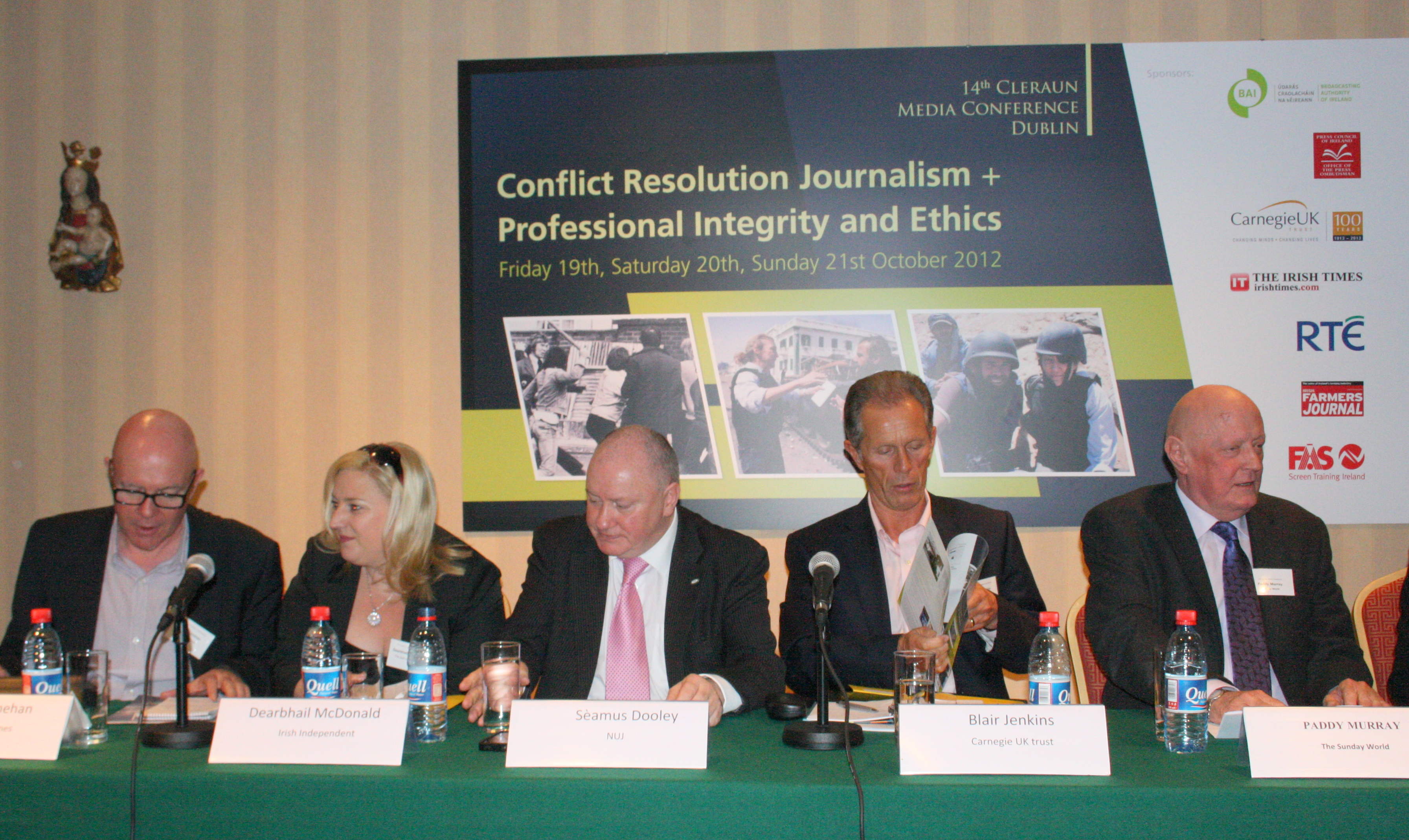
Hugh Linehan, Dearbhail McDonald, Seamus Dooley, Blair Jenkins and Paddy Murray - the panel for the discussion on the Leveson Inquiry.
Hugh Linehan, Dearbhail McDonald, Seamus Dooley, Blair Jenkins and Paddy Murray – the panel for the discussion on the Leveson Inquiry.

It was low-key – something over  one hundred people, representing a generation span spread over about 60 years, and it took place in a relatively small venue which serves as a home for about a dozen university students. But it was high-end in every other way you looked at it –  theme, quality of presentation, depth and vigour and a panel of speakers to die for.

It was the biennial Cleraun Media Conference , held in Cleraun University Centre in Dublin, Ireland. Its theme was professional integrity and ethics in the context of conflict resolution journalism – which must look a little like an oxymoron to many who associate journalism with the promotion of  what it thrives on, conflict generation  rather than conflict resolution. But resolving that paradox was what the conference was all about and what it did in a very deep and penetrating way  – both in the presentations from journalists and film makers from the very top of the media pyramid, and in the questions and discussion from Ireland’s top media practitioners and students from its third-level media schools.

Over three days, from the opening on Friday to its conclusion on Sunday, participants heard from documentary producers, directors, editors and presenters of the calibre of Peter Taylor of BBC’s Panorama, Stefan Ronovicz (editor of  the 2010 BAFTA winner, Terror in Mumbai), and the veteran  and universally admired flim-maker, George Carey. The audience was riveted listening to Paul Conroy, Sunday Times photographer who is still recovering from the injuries he received in Syria in the targeted military attack which took the lives of his colleagues Marie Colvin and Remi Ochlik earlier this year.

From the home front there were film makers Alan Gilsenan , Steve Desmond, and Trevor Birney, Barbara O’Shea and Anne Cadwallader, and the icing on that particular cake, Kevin Bakhurst, the new MD of News and Current Affairs in RTE, post Mission to Prey scandal. Hugh Lenihan, Dearbhail McDonald, Paddy Murray, and Blair Jenkins OBE – formerly of BBC Scotland and STV – participated in a panel which dissected the proceedings, so far, of the Leveson Inquiry in Britain. This was  moderated by the Irish Ombudsman and Information Commissioner, Emily O’Reilly, a former political correspondent with The Irish Press and columnist with The Sunday Times.

At the end of the conference Blair Jenkins was presented with the Cleraun Award for Outstanding Contribution to Journalism, a contribution which had it most recent manifestation in the publication of his recent report for the Carnegie UK Trust, Better Journalism in the Digital Age, on journalism ethics and regulation.

But if that line-up was impressive the outcomes were no less so and the impact of the three days’ proceeding was well reflected in the constant tweeting from the conference by the media students attending, picking up and recirculating the insights and observations which were coming hot and heavy from the speakers in their presentations and in their follow-up Q and A sessions.

No summary can really do justice to what went on at this conference and the best place to get a taste of it all will be to go to the Dublin Institute of Technology’s Journalism School soundcloud and (later) YouTube webcast of the proceedings which should be posted over the next few days, and in due course on the conference’s own webpage.

But if one line of thought could summarise the outcome, it was the clear conviction presented by all the speakers and taken away by all the participants that, when it comes down to it, integrity comes from the inner life of the human subject, not from rules and regulations – necessary though they may be. There was a good deal of talk about the soulless DNA of certain publications needing to be replicated in the DNA of people who wanted to be successful journalists within those organisations. But it was clear that if the DNA of those human beings lacked the chromosomes of common decency and human courtesy then it was bye-bye to any hope for integrity and ethics in conflict-resolution journalism or any other kind of journalism you care to mention.

Last, but not the least significant element in this entire venture was the heavy-hitter sponsorship which it attracted and which – presumably – made it possible: RTE, Ireland’s public broadcasting service, The Irish Times,  the Broadcasting Authority of Ireland, the Office of the Press Ombudsman, The Carnegie UK Trust, the Irish Farmers’ Journal, and the screen training division of FAS, the Irish National Training and Employment Authority.

Last words – Jenny McGovern’s tweet at the end of the conference: Jenny McGovern ‏@Jenabelle4@Cleraun GREAT JOB!!!

Does this not make an awful – and awesome – lot of sense?

I found this interesting comment on a post – equally interesting, as well as being disturbing – on the Conjugality blog this morning:
Fr. Bill MCNeeley commented on Marriage = biology (not bigotry) with this: It reminds me of when in my senior year of an Episcopal Church seminary (I am now Catholic) and one of my classmates said, “Conservatives in the church can hit the road if they do not like inclusive language.” I pointed out that such a statement is not inclusive. She replied “Oh, it’s okay to exclude those who are not inclusive.”

See the video here.

Regrettably, the end of the line

Perhaps a day will come when this decision can be reversed. Today, with a heavy heart, I sent this to the subscriptions department of The Irish Times.

Regrettably, because of what seems to me to be an inbuilt editorial bias towards the so-called pro-choice side in the ongoing debate on abortion I wish to cancel my subscription for morning delivery of the Irish Times. I say “so-called” because we are all, hopefully, pro-choice. What we should be judged on is the justice of the choices we make. 

I have no wish to provide funding for what appears to be an extension of a campaign to introduce abortion legislation to Ireland.  I am not referring to the free expression of opinion on the issue, either by columnists or leader writers  My concern is about a bias I find in the treatment of news stories.
One small example is the burying of Patsy McGarry’s minimal news coverage of the Irish Bishops’  pastoral initiative at the bottom right hand corner of page 6 yesterday (cf some observations on this in a post on http://www.garvan.wordpress.com). 
Another example would be your sub-editorial treatment – the report itself was fair enough – of the medical conference on maternal health a few weeks ago. This spoke volumes to me about your lack of openness to any positive pro-life stories in the news. Had that conference produced a story which would have served the cause of introducing abortion legislation here I have very little doubt but that it would have got a much more explicit headline and an much better space than the far-left column of a right hand page. I cannot judge about what is happening on the letters page but I have anecdotal evidence that many people on the pro-life side do send letters which never see the light of day.
My observation to you would be that while your by-lined reporters try to be reasonably objective, your anonymous sub-editors are playing a different game.
 
Yours sincerely
 

Michael Kirke.

Is the “paper of record” troubling consciences?

Well what do you know? The “paper of record” has done it again. If you wanted some detailed news about what the leaders of the Catholic Church in Ireland is offering to its followers this weekend by way of information and encouragement to take a stand consistent with the belief and moral teachings of the institution they have freely chosen to follow, which paper would you go to? Not the paper of record.

Below are the three reports from Saturday morning’s Irish broadsheets. The Irish independent gives us nearly 400 words in its comprehensive summary of what the Irish bishops have issued to the parishes throughout the county. The Irish Examiner gives us over 200 and a good report. The Irish Times, however, gives us just over 150 words from its renowned even-handed religious affairs correspondent and buries the story at the bottom right hand corner of page six, probably one of the most “invisible” news slots in any newspaper.

Wonderful – and this after last week’s numbers debacle where the Times reported – apparently under “tweeting” pressure from the pro-abortion people –  that “several” thousand protesters thronged the ranks of a pro-choice street demonstration in Dublin last weekend when in fact a serious count using the video images from the demo showed that the number did not even reach one thousand.

Combine this observation with everything else we have been reading in the Irish Times in the past few months pertaining to the abortion issue and it is very hard not to conclude that here we have a paper which has deliberately set it face in the direction of the Mecca of introducing abortion legislation into Ireland.

What choice has a conscientious person who considers that such legislation, if put on the statute books of this country, would lead to the wholesale taking of the innocent lives of babies awaiting delivery from their mothers’ wombs? One choice, I think – if they are paying subscribers to that paper.  Cancel their subscription because it looks very much like a financial subscription to a cause supporting that wholesale slaughter.

Irish independent

Church launches new anti-abortion campaign

By Luke Byrne, Saturday October 06 2012

The Catholic Church will tomorrow begin a public campaign to oppose access to abortion in Ireland under any circumstances.

A pastoral message is to be read out at Mass opposing abortion and earlier this week all 1,360 parishes north and south of the Border were sent material on the church’s opposition to abortion, including homily notes, prayers, and posters.

The move is being seen as the opening salvo in the church’s campaign to lobby against access to abortion here.

It follows a promise by Cardinal Sean Brady in August that priests would be provided with the resources to campaign on the issue.

The homily notes have suggested that tomorrow’s first Bible reading come from the creation account of life from Genesis. “This provides an ideal context in which to speak of the beauty and sanctity of human life as part of the gift of God’s creation,” it said.

A prayer card has also been provided for parishioners. Along with a prayer, the card will say: “As science makes clear it is at fertilisation that a new, unique and genetically complete human being comes into existence.”

Responding to the planned campaign, Senator Ivana Bacik said she believed that the church’s moral power had been “significantly weakened” by the sexual abuse scandals.

“I think it’s disheartening that the church still thinks it can dictate to women regarding sexual health matters,” she said.

“I think the church should get its own house in order,” she added.

The church has also called for a month of prayer dedicated to the theme of ‘Choose Life’ to begin tomorrow, which it has called ‘Day for Life Sunday’.

The literature has told priests that it is not necessary for the Government to legislate for legal abortion in Ireland following the 2010 European Court of Human Rights case against the State.

Instead, it said that the Government “could choose to protect the life of the unborn baby in the womb” by changing the Constitution to set aside the Supreme Court ruling in the ‘X-case’.

As part of the campaign, the bishops’ conference has also commissioned a website at www.chooselife2012.ie

Ms Bacik said that the issues of the ‘X-case’ have twice been put to referendum and both times Ireland supported safe abortion in the case where a mother’s life was at risk.

Irish Examiner

Church to launch pro-life campaign with messages to Mass-goers

By Juno McEnroe, Political Reporter, Saturday, October 06, 2012

The Catholic Church will launch its pro-life campaign this weekend with anti- abortion messages for Mass- goers, posters in churches, and testimonies from women who have experienced crisis pregnancy.

The campaign details, letters, and materials have been sent to 1,360 parishes ahead of the release of the Government’s expert group report on abortion.

Primate of All Ireland, Cardinal Seán Brady, recently said the Church would run a campaign against legalising abortion in Ireland.

Cardinal Brady said the State was not obliged to legislate for abortion as a result of the judgment of the European Court of Human Rights on the so-called ABC case, which the expert group is addressing.

The “choose life” campaign will run for the next four weeks. Notes sent to priests on homilies read: “Any mother or father who has gazed in wonder at an ultrasound scan of their baby, or heard his or her heart beating for the first time, will know how rapid and beautiful is the development of their baby in the womb.”

Priests are also being advised to tell Mass-goers the Government should introduce laws or a constitutional amendment that would set aside the Supreme Court ruling in the X case, which allowed for abortion in some circumstances.

The Irish Times

Bishops launch anti-abortion month

PATSY McGARRY

Ireland’s Catholic bishops have called on “all who believe in the equal dignity and beauty of every human life” to “join us in calling on our public representatives to respect the humanity and life of children in the womb and to reject abortion.”

The bishops made their appeal in a special pastoral message which will be read and distributed in all Catholic parishes on the island this weekend. It coincides with “Day for Life Sunday” tomorrow, which also marks the start of a month of prayer around the theme “Choose Life!”, announced last month.

Relevant “Choose Life!” material was sent to all 1,360 Catholic parishes in Ireland this week to promote the month of prayer campaign. A special website chooselife2012.iehas been launched with a complementary Choose Life! presence on social media (Choose Life 2012 on Facebook, and @Chooselife2012 on Twitter and on YouTube).

The bishops said their message was for people of all backgrounds and traditions across the island.

The reign of Chaos looming

‘Love sex and marriage in liberal societies’ was the subject. The speaker was one of Britain’s leading philosophers, Professor John Haldane of St Andrew’s University in Scotland.

In a lecture, delivered to the Iona Institute in Dublin last Friday night, Professor Haldane argued that about the only non-conflicted terms in his title were the two words “and” and “in”. Everything else had more or less gone by the board and utter confusion seemed to reign around them in public and private discourse. The consequences of this were nothing short of disastrous.

Take the term “marriage”, he said. It is no longer accepted by some as even a “good thing”. And for those who might accept it as a “good thing” – if we can keep to our 1066 and All That categories – there is dispute as to whether or not marriage should be used to formalize relationships between men and women, same sex couples, sibling couples or indeed polyamorous relationships.

In a Standpoint article in May of this year, Haldane said that with regard to marriage the primary focus to date has been on two-person, same-sex unions but the claims of polyamourous groups and incestuous partners are also beginning to be pressed.

Why has all this happened? Why have conceptual issues – the facts and values on which they are based, their description and the prescriptions surrounding them, got as muddled as they are? The roots of the problem lie partly in history and in the twin developments which unfolded in the late 18th and 19th centuries – industrialization and urbanization. With these developments social structures and most importantly the family, came under pressure and to a degree wilted under that pressure. With that wilting came far-reaching consequences.

The end result of all this, Haldane suggested, is that people are utterly confused and no longer know know what to think.

How can we resolve this? He suggested two approaches with which we might start but left us in no doubt but that the way back to any kind of healthy normality would be long and arduous.

His first suggestion was by way of what he termed “external consideration” of the concepts and the realities involved – whether it be Love, Sex, Marriage, Liberality or even Society itself. For example, consoder whether marriage is or is not a useful concept and a useful practical institution for society, for the family? How is it useful and what description of it is the most useful? On the basis of this kind of an examination some clarity can be achieved and hopefully some agreement might be reached. The implication of what he was saying was that in terms of the current debate we are a long way from even the possibility of agreement. It is nothing short of a tower Babel situation out there.

The second approach was by way of “immanent critique” of the concept and the realities – do they hold within themselves inherent contradictions, are they consistent? Will traditional marriage stand up to this? This critique can be used to clarify all the positions in the debate and by rational examination we might reach a consensus.

In terms of the wider issues, the nature of society today and the politics seeking to organize it, he went back again to the developments in the 19th century and the utter degradation of the new urban populations and the efforts to deal with this. What began as Utilitarianism – the effort to achieve the greatest happiness for the greatest possible number –  ended up as the political philosophy which we have today when politicians shy away from values and seek solutions in the material order. The effect of this was ultimately to drain politics of real human values and any sense of the dignity of man and what man is in his essence. That has ultimately led to the neutral state.

In his Standpoint article Haldane dealt with this problem in a critique of an address in Westminster last December by Nick Clegg, Britain’s Deputy Prime Minister.

“Clegg”, Haldane said, “takes liberal values to be incompatible with certain kinds of social arrangements, or at odds with the state endorsing and supporting them, and these include a traditional understanding of marriage and the family. This reading, however, points to the paradox of progressive liberalism: on the one hand advancing a liberal social programme; on the other rejecting the right of the state to promote or protect particular social forms, such as the traditional family.

But such neutrality, Haldane clearly believes, is really a mirage and what we have ended up with is not neutral at all – it has put secularism in the place of religion and all those values which connect with religion. It would seem that because these values do connect with religion then the “neutral” state cannot acknowledge them – with disastrous results for our understanding of human beings and their needs. Immanent critique, the thought,  reveals this paradox.

Returning to the topic of “external consideration” he gave an example of how rapidly the political consensus about these terms – again, Love, Sex, Marriage and Society – has changed over the past decade or so. About eight years ago Kofi Anan, then the General Secretary of the United Nations, gave an address which reflected a view on these matters – and the family in particular – with which no one had much difficulty. The same understanding is no longer accepted and that speech would probably cause a major controversy if delivered in that particular forum today.

In his Standpoint article Haldane pointed out that in the 1980s and 1990s the policy issues that seemed most pressing upon family life were ones concerning divorce and children’s rights (also certain economic measures to do with welfare benefits). More recently the strongest challenge is that posed by “alternative sexual lifestyles”. Along with abortion, sexuality has become one of the main issues of contention between traditional morality and politics, and the moral and social philosophy of liberal pluralism. Although a range of matters is in contention, the most prominent is the issue of homosexual practice and its recognition by the state.

In Standpoint again, he drew attention to the strong connections between marriage and family life. Common experience and an increasing body of empirical research tells us that it matters that children are raised in a family context, and that it is best for a child if this consists of a mother and father, ideally supplemented by male and female of older generations and by siblings. Evidently these considerations bear on the issue of same-sex and polyamorous households and so connect with current debates about the legal recognition of sexual partnerships.

 In his Iona lecture he predicted a demographic time bomb in our presence which connects with these considerations. By 2050, 60% of the population in the West – if current trends continue – will have no brothers, no sisters, no cousins, no aunts or uncles.

This is the road we are on. Is there any way off this road? No, unless we return to thinking about the Common Good, the needs of society, families and children, and stop thinking about our atomized selves.

Haldane concluded his Standpoint article by asking,

How then to proceed? On the one hand, discrimination in law on the basis of private, consensual sexual practice is hard to justify and impossible to implement. On the other hand, society has a right to expect its commonly shared interests to be protected, and these include the norm of two-person, non-incestuous, heterosexual marriage, particularly as that bears upon the needs and formation of children. Reasoning about what policies it is rational for an individual or a government to pursue has to be related to the question of what burdens and harms arise from the effort to encourage or to enforce any given option. Here it may be  useful to make the distinction between value-promoting and value-protecting policies.

 The aim of politics is the promotion and protection of certain social goods, and an emphasis on the rights and liberties of citizens risks overlooking the welfare and interests of the community, including those of its fledgling members, children. Notice that even in caricaturing the 1950s model of marriage and the family, Nick Clegg speaks of the “bread-winning dad” and the “homemaking mother”. Perhaps this is an unintended compliment to the virtues involved in co-operatively orienting one’s life to the interests of others. Certainly it stands in contrast to a contemporary image of adults asserting their right to have marriage redefined to accommodate themselves without regard to the natural facts of life and the natural needs of children. Which then seems the more caring and generous picture and which the more conducive to the good of society?

 (About Professor Haldane: In addition to lecturing in philosophy at St Andrew’s, Professor Haldane is also Director of the Centre for Ethics, Philosophy and Public Affairs at the university.

He is author of a number of books, including Reasonable Faith, Faithful Reason: Essays Catholic and Philosophical, and An Intelligent Person’s Guide to Religion.

He has published some 200 academic papers covering areas such as the history of philosophy, philosophy of the mind, metaphysics, and moral and social philosophy.

He is a regular newspaper columnist and broadcaster and was elected Chairman of the Royal Institute of Philosophy in 2010.

He has held a number of prestigious lectureships and fellowships at institutions including Georgetown University, Cambridge University and the Gregorian University in Rome.

He is a member of the Pontifical Council for Culture.)

Here and there…on September 30

With hindsight revolutions can look very organised things. We think of them as great turning-points. They may be that but the way they turn is never something certain and determined – as it might seem to have been when we get down to writing history.

The so-called “Arab Spring” is one such phenomenon. There is no question but that what we are watching there is a kaleidoscope of turning-points across North Africa and the Middle East. But who can dare say what the final outcomes will be in those diverse locations. Some might prove to be a flourishing Springtime indeed, but there are real and justified fears that others will result in long cold Winters.

A conference of 30 representatives of Justice and Peace commissions representing European Bishop’s Conferences met in Malta recently to work out some policy options on this phenomenon but failed to solve the quandary which these events always present to outside interested parties when it comes to doing something practical.

But there is good advice. Firstly, don’t apply “trivialising stereotypes” to these events which for so many are literally a matter of life and death. So perhaps we should drop the simplistic “Arab Spring” altogether. Secondly, – and this is where the quandary appears – respect the right of other nations to define democracy in accordance with their traditions and religious beliefs but  at the same time don’t ignore the “need to protect dignity and human rights.”

We could do with a little more of this respect on our home turf as well.

It was all precisely what  the Pope stressed in his visit to the Lebanon – the  importance of working to ensure “that cultural, social and religious differences are resolved in sincere dialogue, a new fraternity, where what unites us is a shared sense of the greatness and dignity of each person, whose life must always be safeguarded and protected.”

Reports are that Pope Benedict XVI is getting it hot and heavy in cyberspace. Andrea Tornelli, the sharpest of sharp Vatican journalists tells us that the Italian reputation management company Reputation Manager has demonstrated this in a study published recently. Using its software system and a dedicated team of editorial staff for the analysis of data relating to the Italian web world, including social media, Reputation Manager compared the digital identities of Pope Benedict and the Dalai Lama. The Buddhist leader gets a much easier ride. Surprise, surprise.

I don’t know what Buddha promised his followers, but we do know what Josef Rattzinger signedup for when he nailed his colours to the mast: “Woe to you when all men speak well of you” (Luke 6, 24-26). The true disciples of Jesus are, in fact, a sign of contradiction: “If you had been of the world, the world would love its own: but because you are not of the world (…) therefore the world hateth you- (…) If they have persecuted me, they will also persecute you.” (John 15, 18-20).

So popularity is not what this is all about. Nevertheless, perhaps we need a few more cyber-Christians out there taking on the detractors.

Jeremy O’Grady, editor-in-chief of The Week, draws our attention to an interesting contrast in media coverage of two recent events.  While there are general cries for “free speech” in the commentary on the trailer for the film The Innocence of Muslims which has provoked such outrage across the Islamic World and the deaths of many, including the US ambassador in Libya, there is a whiff of cowardice on the part of the media as well.

There is, he says, much talk about the appropriate policy reaction. Some say governments are is unduly restricting freedom of expression but others that there is too little restriction. But he points out that government are not the key players in this hue and cry at all. “Scouring newspaper web-sites,” he point out, “I can’t find one that has embedded an extract of the offending trailer, an Exhibit A that would let viewers gauge why and whether it warranted so much fuss. Contrast that with the treatment of Piss Christ, the 1989 work, deeply offensive to Christians, of a crucifix submerged in the artist’s urine. It’s being exhibited in a Manhattan gallery this week, and to illustrate the news story behind it, every other website has a picture of it. Free expression? This isn’t a question of policy; it’s a question of fear. The sword is mightier than the pen: that’s the truth journalists prefer to deny.” Well said Jeremy. As George Orwell said, to see what is in front of our noses requires a constant struggle.

Repeat after me: “No medical evidence was offered”

This, in The Irish Times, September 24, helps put the record straight in “the paper of record”:

Sir, – Claire Brophy (September 19th) has got her facts wrong regarding the A, B, C v Ireland case.
C did not have cancer when she became pregnant and she most certainly did not have to travel to England for an abortion “so that her cancer could be treated”. C had completed chemotherapy for “a rare form of cancer” when she came pregnant and had sought information from her GP, “as well as several medical consultants” on what treatment options would be available her should her cancer happen to relapse during pregnancy. No medical evidence on the supposed life-threatening nature of a condition she might develop was offered to the court and no information regarding which medical specialties she had allegedly consulted was offered.

There exist specialists within medicine for a reason: it is a subject too extensive for every doctor to know everything. If a patient’s healthcare needs are beyond your capabilities you refer to your specialised colleague for expert input, such as in the case of cancer complicating pregnancy. Did this happen in the case of C? We simply don’t know. Perhaps the IFPA could enlighten us before people criticise Irish healthcare.

What we do know is that we have already heard from specialists who are far more qualified in the area of gynaecological oncology than I or Claire Brophy. Speaking at the International Symposium on Maternal Health in Dublin, Dr Frédéric Amant, who for his groundbreaking research into the safe delivery of chemotherapy during pregnancy was described by Lancet Oncology as “leading the agenda on cancer in pregnancy” concluded that, “in the case of cancer complicating pregnancy, termination of pregnancy does not improve maternal prognosis”. This mirrors the comments of our own home-grown expert in oncology, Dr John Crown, who tweeted earlier this year, “I don’t think I ever had a case where abortion was necessary to save mom”. The experts have spoken.

Finally, there’s no room in this debate for the unsubstantiated claims made by Ms Brophy and by Patricia Lohr (September 13th) that women are travelling to England for “life-saving abortions”. I would invite them to reveal the British department of health statistics, which are available under FOI, any case whereby an Irish woman accessed a “life-saving abortion” in England on account of being refused life-saving treatment in Ireland. – Is mise,

Dr EOGHAN de FAOITE,
O’Connell Avenue, Dublin 7.

Why do they not listen? The amount of misinformation being circulated by those campaigning for abortion and the dishonesty underlying it is truly appalling.