One of Ireland’s Catholic bishops this evening preached in his cathedral in Sligo, calling for a free and responsible reflection on the vital question facing Ireland’s citizens next Friday in the country’s referendum on marriage. The call comes as three new opinion polls on the likely result of the referendum show further slippage in inittialy strong support for the Government’ s proposal to redefine marriage. One newspaper describes the support as “plummeting”.
The opposition to the proposal, centering largely on the belief that it will result in bad laws leading to children – through surrogacy, assisted human reproduction and adoptions – being deprived of the knowledge and love of their biological parents. Mothers and Fathers Matter is the cri de coeur of the campaign.
Every citizen and long-term resident has a vested interest in how society defines and protects marriage and the family founded on marriage, said Dr.Kevin Doran
Bishop of Elphin, As Christians, you HAVE received the Holy Spirit. You are called to exercise the gifts of wisdom and right judgement and to be witnesses to Jesus Christ. As citizens, you are the people with the vote and you have a responsibility to use it, for the common good. Nobody else can exercise that responsibility on your behalf.
I would hope that, over the past few months, you have thought carefully about this question and that you have also reflected on the content of the two statements issued by the Irish Catholic Bishops, one before Christmas and the other in March. If you have not read them, then I believe you should do so before Friday. You can get copies of them either here in the Church or online.
There are a few points that I would ask you to consider carefully in making your own decision before God.
1. The Constitution is the document which underpins our whole legal system. To define marriage in the Constitution as a relationship between two people without distinction as to their sex, would be a major change. It would mean that family law could no longer give preference to a mother and father relationship as the form of parenthood best suited to the needs of children. It would make it increasingly difficult to speak in public about marriage being between a man and a woman. In the absence of any conscience clause, I would be concerned, for example, at what teachers might be expected to teach our children.
2. I would ask you to consider carefully how a same sex union, however loving, can be said to be the same as marriage. It is true, of course, that all people are equal. Reason, however, points to the truth about human sexuality that makes the relationship of man and woman unique. This uniqueness has been recognised in every culture and has always been associated with the openness of marriage to the gift of life. That is why society has always sought to “guard with special care the institution of marriage”. Why would we suddenly want to change that now?
3. During these past few months, many commentators have described same-sex marriage as a human right. I would ask you to take account of the fact that the European Court of Human Rights, which is not a religious organisation, issued a statement only last Summer making it clear that same-sex marriage is not a human right.
There is one final point that I want to make. It comes straight from our second reading[1] this Sunday. St. Paul encourages the people of Ephesus: “to preserve the unity of the Spirit by the peace that binds you together”. We need to acknowledge that the issue of same sex-relationship is a reality for many in our society and, among them, families in our own parishes. We need to remember that we are “all called into one and the same hope”. This is a challenge for the Church, both now and for the years ahead.
As far as the referendum is concerned, however, I believe that the truth is quite clear. I also believe, quite honestly, that society can respond to the human rights of all who live together in committed relationships, without changing the meaning of marriage.
I encourage you to reflect carefully, to pray for wisdom from God’s Spirit and then to go out and vote on Friday.
Frank Furedi in Spiked.com reflects on the deeper reasons which might lie behind the collapse of the opinion polls’ authority and reliability in the British General Election. There was nothing wrong with their system of polling. The source of the problem the pollsters now have is the fear, distrust and uncertainty the people have in relation to each other and the bureaucratic idepolgy which is dominating their lives. What he say of Britain may well be reflected to an even higher degree in the outcome of Ireland’s marriage referendum which takes place this day week.
The pressure to conform and the fear of social isolation can lead to what the German social scientist Elisabeth Noelle-Neumann identified in 1974 as a ‘spiral of silence’. According to this theory, people’s assessment of the opinions held by the majority influences and modifies the way they express their own views. Some individuals feel anxious about expressing sentiments that differ from the consensus outlook, as expressed in the political and media realm, and it is thought that, ‘prompted by a “fear of social isolation”’, some are ‘less likely to express their own viewpoint when they believe their opinions and ideas are in the minority’. Typically, the fear of negative social sanctions influences the way people express attitudes about numerous morally charged ‘threats’, such as foreigners, crime or terrorism.
Of course, in virtually every social setting there is always an element of self-censorship. But in contemporary Britain, the all-too-understandable impulse to conform is continually reinforced by the message ‘You can’t say that!’. Regrettably, the only time these insecure voices feel confident enough to express their true opinions is in the secrecy of the polling booth. This is why, from time to time, a seemingly predictable election campaign can result in a surprising outcome.
Sadly, significant sections of the political and cultural establishment would rather that the people always felt that ‘We are not allowed to say that’. This is the 21st-century version of the old oligarchical ideal, ‘Know your place’. Which is why fighting for a culture of tolerance and open debate, and above all for freedom of speech, is so important today.
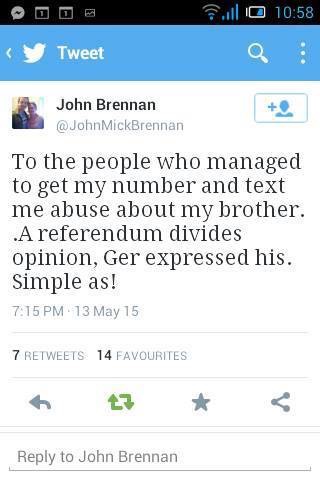
This tweet says a great deal about this – from the brother of a star footballer who dared to put pen to paper explaining his reasoned convictions which are making him defend marriage as we have known it from time immemorial:
For many of a certain generation in Ireland oranges are a special fruit. They bring back a memory from their schooldays – to an essay in the prose anthology on their English literature course. It was A.A. Milne’s short dissertation on this tasty fruit – entitled “Golden Fruit”.
Today, in our very confused way of thinking about equality we would probably proscribe rather than prescribe this quirky little essay if anyone ever suggested that it might be put back on the school curriculum. You see, it discriminates. It tells us that for A.A. Milne – he of Winnie the Pooh – “of the fruits of the year I give my vote to the orange” and concludes his first paragraph by saying that “Bread and butter, beef and mutton, eggs and bacon, are not more necessary to an ordered existence than the orange”. Heavy discrimination indeed.
But don’t get him wrong. He values other fruits and puts the wonderful little cherry second only to the orange. But he does make a choice – although for many the cherry’s pleasures will be their thing. For others it will be the ultra-healthy banana, the fruit that they say has everything.
However, the big problem with all this is that we are discriminating between things when we should, by virtue of post-modern ideology, be treating them all as equal – and equality understood as signifying that there is not an iota of difference between them.
They are equal in one sense, in that they are all fruits. They are not equal insofar as they are each their own sweet, juicy, somewhat bitter thing respectively. By virtue of those differences we treat them differently. We peel and orange. Try peeling a cherry and you will look rather silly. Some people eat their kiwis, skin and all. Others prefer not to. Try eating a banana without removing its jacket and you will know all about it.
And so to marriage. The most fundamental bond between us all in this world should be love – and there are, thankfully, some blessed people among us who truly do love everyone. But if they do, they do so in an ordered way and discriminate between each of those they love according to their nature and needs. The expression of their love follows on that discrimination in ways appropriate to each – loving their husband or wife in one way, their children in another, close friends in another and their neighbours in yet another. Discrimination is not a dirty word. It is a product of human reasoning. The dirt comes if the particular outcome is unkind, unjust and unreasonable.
The love of two people of the same sex can probably have the same emotional intensity as that between couples of the opposite sex. When, however, it is sexually expressed there is no parallel between the potential biological consequences of the two. Both may have a powerful unitive force but only one has the potential for procreation of the species. This makes all the difference and demands that we distinguish between them, for the sake of individuals and for the good of society.
This differentiation is not based on what we might call an “equalitative” discrimination. It is, however, a difference which we will ignore at our cost. If our language ignores these realities by calling the formal recognition which societies give to each by the same name of “marriage”, we will cripple our intelligence and our capacity to think reasonably about things, and these things in particular.
Oranges are not the only fruit, as Jeanette Winterson reminded us. Despite A.A. Milne’s expressed preference for them, they are not even necessarily the best fruit, but if we insist on calling cherries oranges what kind of pickle are we all going end up in?
The question being asked in Ireland this morning is not whether the Government will win its ill-considered referendum asking its people to redefine marriage as a bond between people regardless of their sex, but whether it can long outlive the defeat of this proposal.
The Irish people are a warm-hearted lot but they are not irrational. Among the countries of Europe most tried by the debacle of the financial melt-down in the last decade, they were the ones who resisted the emotional response and knuckled down to sort it out. All observers now give them credit for this. The only rage which they gave vent to was in the face of another piece of gross mismanagement by their Government when it muddled its way through the realignment of the country’s water utility.
Despite what very suspect opinion polls – conducted through cell-phone users in many cases – are telling us, the writing on the wall for the Enda Kenny and his ministers is ominous. It has been a bad week for them – and it is still only Wednesday.
On Monday their star spokesman and campaign leader, Minister Simon Coveney, was pummelled on television by the reasoned legal and social policy arguments of his podium opponent, Senator Ronan Mullen, and pro-marriage supporters in the studio audience. He could not answer any questions convincingly and was left plucking emotional strings. His efforts, combined with similar responses from the pro-redefinition segment of the audience, did nothing but show that there simply are no rational arguments which can be advanced for this proposal, riddled as it is with inconsistencies.
Yesterday the Irish Times – now beginning to redeem itself in some eyes as an even-handed communicator of news and opinion – carried op-eds on the issue from two expert witnesses – to employ a legal metaphor – exposing the deep flaws in Government policy. Emeritus Regius Professor of Law in Trinity College, Dublin, William Binchy, exposed the fallacies in the Government’s arguments that the passing of this referendum would have no impact of the State’s child welfare laws. In the other piece, another former Trinity academic, sociologist and constitutional expert, Dr. Anthony Coughlan, argued that the impact of a ‘Yes’ vote would have repercussions beyond Ireland’s shores. By effectively nullifying a protocol won by Ireland under the Lisbon EU Treaty, the passing of the referendum could lead to same-sex marriage becoming an undeniable human right throughout all 28 EU states. For many this suggests that the entire project, funded as it is by international gender ideologists, is a Trojan Horse designed to destroy marriage across the European continent.
That was yesterday. Today we have news of another own-goal by the Government itself. The lead story in the online Irish Times this morning covers the retrospective withdrawal by a Government quango of funding for the Catholic Church’s marriage advisory council, ACCORD. Despite the attempt to dress this up as routine cost-cutting, the ineptly handled decision makes the Government look every inch the draconian agents that they are. People have been reminded that the Minister for Children – whose brief this comes under – is the same man who as Minister for Health two years ago shepherded the Government’s abortion legislation through parliament. After a thoroughly undemocratic exercise, he reminded Catholic hospitals that their funding would be cut if they did not implement that legislation as law required. He is now trying to tell people that the cutting of ACCORD’s funding has nothing to do with plans to redefine marriage. Good luck to him.
Add to this the truly scathing letter in this morning’s Irish Times from one of the country’s leading liberals, Emeritus Professor of History in University College Cork, John A. Murphy. It is not just the razor-sharp content of this letter which will dismay the Government. It is the fact that it comes from one of the country’s most respected historians, that he is one who has often been highly critical of the Catholic Church, and that his liberal credentials are impeccable.
Finally – although probably not, because it is still only 11.30 as this is written, – after a flood of ‘Yes’ endorsements from a range of celebrity sports stars, media people and pop stars, most of it mindless gushing of emotion, comes a very reasoned argument from one of the stars of Ireland’s most popular and most participative sport, Gaelic Football, the first cousin of Australian Rules Football. This comes from Dublin star, Ger Brennan, and again makes front page news in the largest circulation morning paper in the country, the Irish Independent.
Brennan writes, “The Universal Declaration of Human Rights proclaims that everybody is equal in dignity and it holds that marriage is a male-female union. I don’t think the Declaration of Human Rights is homophobic. I’m voting ‘No’”. Brennan’s well argued declaration, exuding respect for his gay friends and playing companions, will speak to his generation in a way that will worry a Government that thought it had that constituency in its grasp. This will put a serious dent in the Dublin metropolitan vote, as will Murphy’s in the second largest metropolitan area, Cork.
But the most significant element in all these interventions in the debate is not just that they question this proposal. It is that they place a massive question mark in people’s minds about the general competence of this Irish Government.
Sitting in the studio audience for a TV debate on Ireland’s Marriage Referendum last night in Dublin I could not suppress the sense of a multiple tragedy unfolding before me which this primeval battle induced.
Whatever way this plays out on May 22, it seems that a nemesis awaits us.
If this foolish and careless Government succeeds it will not kill the reality that is marriage. The reality that the word marriage gives institutional form to, that is, the coming together in conjugal union of man and woman, is beyond the manipulative control of governments. They can mess with the word which describes it as much as they like but as long as men and women exit, it will exist.
But this messing by governments with those things that nature designed does have consequences for human beings and their life in society. In this case, the Irish Government will become responsible for the clouding in people’s minds of what marriage really is. This in turn will have consequences for generations to come. This will be the first tragedy.
If the Irish Government drains the word marriage of its true meaning, its essential identity, by describing it as a bond between people regardless of their sex, homosexuals and heterosexuals will suffer equally and the victory which some homosexuals feel they will have won will prove to be, and will be seen to be, as hollow as the arguments now being advanced for it.
For those who understand that the essence of a thing remains the same no matter what we call it, marriage will remain what it is and always was – a lifelong bond between a man and a woman, open, where nature allows, to the begetting of future generations. “A Rose by any other name would smell as sweet.” For those who think that they have changed the thing because they have changed the name – or turned one thing into another by using the other’s name – there is the tragedy of delusion. This is the second tragedy.
This was the tragedy averted by Solomon who in his wisdom was able to resolve the folly of the woman who sought to relieve her pain of loss by dividing in two the child of her companion. But Irish Prime Minister Enda Kenny is no Solomon. He has succumbed to the foolish thinking of a militant group of culture warriors who have led the gay community astray into thinking that access to marriage is just a matter of manipulating language.
If the Irish Government wins this referendum everyone will wake up on the May 24 and find that nature has preserved this thing called marriage. But they will also find that in the futile attempt to meddle with nature they will have a meaningless human artefact posturing as “marriage” in their nation’s Constitution. This sham thing will be bringing with it a myriad of muddy legal complications. Bad laws impact on human lives, some with tragic consequences. There will be numerous personal tragedies as “motherless” and “fatherless” children search for their natural progenitors to try to rescue them from the limbo of those quotation marks. Some will succeed, more will never do so. This is the third tragedy.
And if this chaos is avoided and a “No” victory results, what nemesis awaits us? This will be the nemesis for a bitterly disappointed community which has been misled into thinking that this manipulation of language, spun by a Government which has in turn been manipulated by an international ideological movement backed by millions of dollars – scandalously ignored by a biased national media, – was going to bring it to a haven of happiness and contentment.
The utterly bewildering illusion being fed to people that this is a struggle for equality has been spun so effectively that the consequences of its inevitable evaporation will be tragic. A Government complicit in this charade is a truly bad Government. It is now compounding this crime by declaring that a rejection of their proposal – a proposal which declares that two things which are different from each other are in fact the same – will amount to a disdainful rejection of some of their fellow human beings by the majority of the electorate.
The gay community – as it is called, and isn’t there something wrong with the very idea of segregating people into communities on the basis of their sexuality? – has been deceived into thinking that redefining marriage is a solution to the difficulties they experienced in human societies in the past or present. They have been deceived into thinking that it will in some way compensate for wrongs done to them. It will not and it never do so, because it is a meaningless act. This deceit is just one more tragedy.
The final tragedy has already taken place. When we should be concentrating our efforts on the task – always necessary – of building up the cultivation of real civilizing values in our community we are distracted and divided by this unreal conflict. True equality should be our goal, true values of fraternity and justice should be our objective and not this false synthetic concoction of something that can never really exist.
This horrible and divisive battle, which ideologues have forced on a good-humoured and generally kind-hearted nation, may be leading it into a new – even if as yet low-level – era of civil strife. After last night’s debate, one member of the audience on the “Yes” side came over to the speaker for the “No” side and uttered with uncivil vehemence words of bitter reproach for what he had presented to all, in good faith, for consideration. The producers of the programme – which was rchesrated with exemplary skill and fairness by presenter Claire Byrne and her team, – in a departure from normal procedure before these debates, separated the “Yes” and “No” supporters into separate rooms. “No” participants wondered why, and in fact regretted the segregation and the loss of the chance to mix and share views. But it was a sign of the times.
Of course there will be. It will be their next target.
Does anyone doubt that education is where they hope to have their final victory in the battle for a genderless society. This battle is not about the rights of gay people. It is a doom-laden vision of human nature held by ideologists who think that by controlling language and thought they can change human nature itself. A “yes” vote is not a vote for gay people’s rights. The gender ideologues are lying when they say it is.
A “No” vote is a vote for the preservation of our sense of what it is to be human. End of story.
Ireland is now in the second last week of its liberal establishment’s tiresome campaign to get the country to radically change its understanding of marriage as an institution naturally fitted to the conjugal relationship between a man and a woman. All the opinion polls are still pointing to a triumph for them. But there are warnings of hubris. This morning’ mass-circulation Sunday Independent carries that warning in a no-holds-barred column by one of the country’s more open-minded journalists and TV hosts, Brendan O’Connor.
The Yes campaign, he muses, must be very nervous looking at what just happened in the UK. Everybody knew what the result in the UK election was going to be. Every poll was in agreement. Neck and neck. Hung parliament. Weeks of manoeuvring to try and create a Government. Everybody agreed. And, as usual, when everyone agrees so wholeheartedly on something, they were all wrong. The media was wrong, the polls were wrong; the whole establishment got it wrong.
The Yes side must be wondering this weekend if the same could be true here. What if the polls are wrong? What if the media is wrong? What if the whole political establishment has got this one wrong? On Friday morning, Antony Worrall Thomson, of all people, pointed out that a lot of Tory voters are his age and they tend not to admit their intentions in advance, saving the truth instead for the privacy of the ballot box. And lets face it, being a No voter in this country is even more shameful that being a Tory in the UK. So the likelihood is a lot more people are lying about their voting intentions in the upcoming referendum. And who could blame them?
O’Connor goes on to catalogue what might at first have looked like winning strokes by the Yes campaign – Twitter et al calling for a Yes vote, massive media support, 100% party political approval – but which reflection might suggest could turn out to be a poisonous concoction. He also mentions the abusive treatment of the opposite side but does not talk about public revulsion at the denial of freedom of expression which their tearing down of No posters is provoking
A friend of mine visited his barber yesterday. The barber told him that he had a few young people in with him earlier, potentially Yes voters, who spoke of their disgust at such hostile, negative and undemocratic tactics.
The thing about Irish people, O’Connor says, is that they don’t like being told what to think. They don’t like being told what to think by the media. They don’t like being told what to think by politicians. And they certainly don’t like being told what to think by the bosses of tech companies. It’s the kind of thing that is bound to get people’s backs up.
The No campaigners can only hope that the Yes campaigners do not read O’Connor’s warning and change their tactics to a more democratic one. Keep the own goals coming and they will be more than happy.
Under a sub-deitor’s rather lame headline in today’s Irish Times, columnist Breda O’Brien, unveils a very worrying picture of deceit and manipulation at the heart of Irish public life. The headline itself speaks volumes. No one on the sidelines of the Yes/No battle raging in Ireland just now over the proposed change in Ireland’s constitution to change the understanding of the institution of marriage can have any doubt about what the headlines would be like if the questions she asks were asked about the other side. It would be a front page story. It would be time to inflict a “shock and awe” bombardment on the neanderthals who want to cling to an understanding of marriage as something between a man and a woman, something to which the welfare of society and the health and happiness of children is naturally tied.
O’Brien begins calmly with a few hypothetical suppositions and then proceeds to turn the pages of a book which has been on our open shelves but which a media and political culture blinded by groupthink has been unable to see. She writes:
Suppose I confessed that over the past number of years, the Iona Institute, of which I am an unpaid patron, has received millions of American dollars to advance a particular agenda.
Those dollars have allowed us to grow from a single-person organisation to a highly skilled, mobilised, fully professionalised lobbying machine employing seven full-time staff and numerous consultants.
Those staff and consultants operate “inside the machinery of government”, and people associated with Iona have ended up on key boards such as the Irish Human Rights and Equality Authority.
It enabled us to change the agenda on a government working group in 2006 and persuaded it to make recommendations that were ruled out in the original remit of that group.
Suppose I admitted that between September and November 2009 alone, Iona met with more than 40 politicians, including three ministers one-to-one.
When I tell you that absolutely none of that is true of Iona because it has never received any American money and never had instant access to key politicians, but that instead I’m describing the Gay and Lesbian Equality Network (GLEN), eyes will glaze over and the salivating interest will disappear.
Groupthink has been exalted to an Irish sacrament. While journalists were targeting tiny bootstrap conservative organisations and accusing them of being American-funded, GLEN, the most successful lobby group in Irish history, was swimming in greenbacks.
This is a story for investigative journalists that doesn’t even require much investigation. Try typing GLEN into the search box of the Atlantic Philanthropies website.
GLEN did everything described in the first paragraphs of this article while registered as a charity with the Revenue Commissioners. GLEN Campaign for Marriage registered with the Standards in Public Office Commission in 2015 – will this affect its fundraising?
If Atlantic Philanthropies is beyond question, if shedloads of money used to advance agendas render you beyond scrutiny, we should just let the anniversary year of 2016 go by without comment, as an utterly failed Republic.
And what shedloads. According to Atlantic, GLEN received $4,727,860 between 2005 and 2011.
Yes, four and three quarter million dollars. (Incidentally, GLEN explained to The Irish Times in 2013 that it gets only half its funding from Atlantic.)
Atlantic explains that in 2005, “GLEN was essentially a voluntary organisation with a single-funded post working on gay HIV strategies, which was funded by the HSE”. GLEN does not provide services. It focuses on policy and legislative change.
By the last report, Catalysing LGBT Equality and Visibility in Ireland, GLEN is described thus: “Their multi-year grant from Atlantic enabled them to ramp up their work into a full-time, highly professionalised lobbying machine. It works ‘inside’ the machinery of government where it uses a ‘principled pragmatist’ model in which it consolidates support, wins over the doubtful and pacifies those who are opposed.
“GLEN leaders believed that the most viable way to embed long-lasting social change was to legislate incrementally, waiting to advocate for civil marriage until the population was acculturated to the ordinariness of same-sex unions.”
It must be the most successful “acculturation” in Irish history.
The only acceptable narrative is that this is a benign grassroots movement, because if we admitted that it is instead a slick, elite movement of highly educated professionals funded from abroad we might have to admit we were skilfully manipulated. And that could not be true.
Atlantic credits itself with securing civil partnership in 2010, describing it as “some of the most far-reaching legal protections for gay and lesbian couples in the world”.
Civil partnership affords far greater rights than “US state-based civil marriage because the latter cannot include federal rights in critical areas such as immigration, tax and health benefits”.
Funny, I thought civil partnership was discriminatory and second class.
In 2009, GLEN had 348 media appearances – 179 broadcasts and the rest ranged from national newspapers to the Law Society Gazette. Almost one per day.
Let’s not forget Marriage Equality, whose name even ended up on the referendum ballot paper. They got a mere $475,215 from Atlantic.
But it enabled them to set up a full-time office, to lobby and use “backroom” tactics like “hiring professional political advisers who were working with the government on other issues to report back on the government’s thinking on same-sex marriage”.
Oh, and the other part of Yes Equality, the Irish Council for Civil Liberties (ICCL)? From 2001 to 2010, it got $7,727,700 and another $3,829,693 in 2010 and 2013. Sure, ICCL didn’t spend all that on redefining marriage. Just some of it. Do tell, ICCL, exactly how much.
This is not Atlantic Philanthropies funding a hospital or school. This is foreign money being systematically invested to change public opinion, to deliver seamlessly a Yes in a referendum that has enormous consequences for family law for generations.
All the while soothing us by spinning it as just “seventeen little words”. Can American money buy an Irish referendum? Let’s wait and see.
And let us see if these questions asked by O’Brien will have any traction across the Irish broadcast and print media spectrum? Regardless of what the answer to that question may be perhaps we can place some hope in the old adage, “You can fool all the people some of the time, and some of the people all the time, but you cannot fool all the people all the time.”
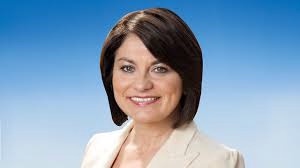
Flying in the face of what still looks like a strong showing of public opinion in favour of the Irish Government’s proposal to get constitutional backing for same-sex marriage, another Irish Senator has declared herself as a ‘No’ voter. Her decision is based on what she describes as the false reasoning behind the proposal and the refusal of its adherents to recognise its implications for children’s rights and the good of the family as the natural unit of society.
In her statement, independent Senator Fidelma Healy-Eames – who was expelled from the main Government Party two years ago for her opposition to its legislation for abortion – declared her position she saying:
If I viewed the Referendum question as just an adult issue and one of love and equality, then I would be undeniably a ‘Yes’ voter. Gay people are undoubtedly equal and capable of loving relationships. However, the Referendum is far from that simple. It has deeper ramifications for children, for their identity and for society.
I am voting No in the Referendum after careful deliberation. The union of a man and woman is a unique union in marriage. It is the only union that can create children naturally. Giving every child an equal opportunity to a mother and a father is right and just and is worthy of the constitutional seal. This should not be changed by redefining marriage in the forthcoming Referendum. A union of two men or two women is different and will deny a child either a mother or a father.
Government ministers have claimed that this referendum has to do with equality only. This is untrue. We are being asked whether we want to amend Article 41, which deals with ‘The Family’. There is a separate Article in the Constitution – Article 40 – which deals with ‘Equality’, but it will not be affected in any way by the result of this referendum. It is ludicrous to insist that amending the specific article that deals with ‘The Family’ has nothing to do with children.
‘Yes’ Campaigners have been quick to claim that all concerns in relation to children have been dealt with by the Children and Family Relationships (CFR) Act. This is not true. The CFR Act contained some worthwhile provisions relating to children’s and fathers’ rights, but these were hopelessly combined with extremely complex issues like adoption and donor-assisted human reproduction (DAHR) for gay couples. These were issues which should have been addressed separately and calmly, not rushed through in the course of an emotionally-charged referendum campaign.
Given that there are so many concerns about children, it is strange that the Government has ignored the position taken by countries like Portugal, where Same Sex Marriage has been passed into law but the preference remains for a child to have a mother and father. This would appear to be the best of both worlds and significantly more ‘in the best interests of the child’.
While the latest opinion polls still show a strong majority in favour of the ‘Yes’ vote, the ‘No’ campaign is confident that these will be as unreliable as polls which predicted same-sex marriage victories in Croatia, Slovenia and Slovakia but which were turned into defeats when the electorates in those countries itself actually went to vote. The inaccuracy of polls prior to yesterday’s general election in Britain again showed that the only poll that counts is the secret ballot on the day itself. The agressive and intimidating tactics of the supporters of the Government measure in Ireland adds to doubts about the accuracy of polling. The illegal tearing down and defacement of ‘No’ posters and publicity material, the agressive picketing of meetings and other tactics is at a level not seen in Ireland in recent memory.
Edmund Burke, champion of modern democracy, gracing the front lawn of Trinity College, Dublin, where he graduated.
Bruce Arnold’s astounding open letter to Ireland’s Prime Minister (Taoiseach), Enda Kenny, should find him a place in the pantheon of political thinkers alongside Edmund Burke, Abraham Lincoln, Cicero and just a handful of others.
This letter, a call to prudence and wisdom to a straying political establishment is heroic, practical and much deeper in its implications than it might at first seem.
Edmund Burke, an Irishman in England’s 18th century House of Commons, twice called on his fellow parliamentarians to come to their senses. Firstly he did so over their folly in their treatment of the American colonists. Secondly he warned them of the bloody consequences which he saw flowing from the rash political excesses of their French contemporaries in 1789.
In the one, his call for conciliation with the British settlers in America, he failed to win their support and both England and the thirteen colonies paid the price in a bloody war. In the other he was more successful and his countrymen set their faces against the excesses of the French and braced themselves for the eventual and finally victorious struggle with the megalomaniac who sought to straddle the world.
Arnold is an Englishman, a journalist and writer, who has made his home in Ireland and, while not a parliamentarian, is playing a crucial role as one of the leading voices of the only political opposition Ireland’s parliament has today.
Ireland’s Dáil now bears all the hallmarks of a one-party state. Recently it rushed through an important and radical piece of legislation on Children and Family Relationships. While this enactment contained some important reforms it was, however, riddled with provisions which many felt were inimical to children and the family. It was initially envisaged that it would make provision for surrogacy as a legitimate way for same-sex couples to beget children. This was withdrawn for strategic reasons and will now be proposed in separate legislation. Other elements were questioned but, despite some efforts by independent parliamentarians to propose amendments, the Party machines on all sides of the parliament, Government and non-Government, pushed the Bill into law.
Simultaneously – and not coincidentally, for the latter was part of strategic plot to help win the other – it rushed through legislation for a referendum on same-sex marriage. It was so rushed in fact that they did not even take time to get the Irish language – the “first” official language of the State – wording of the measure to synch with the English. They had to correct this to avoid what would have been a very embarrassing legal quagmire.
Arnold’s open letter – ostensibly to the Taoiseach but it should in fact be taken to heart by 90% of the Irish parliament who have sheepishly followed his lead on these things – deals with the detail of what is proposed to the electorate as a change to their constitution. It reveals the devastating superficiality of what is passing for government in the Irish Republic today and which is exemplified in this current political action.
This journalist, in the role now of a true tribune of the people, is calling on Ireland’s political class to come to its senses and to start thinking seriously again. His call has worrying resonances, touching on much more than one single issue. His questioning of the political wisdom of this small country’s parliament casts doubt over its competence to deal with everything that it touches. The context of Arnold’s remarks is the current issue of this referendum. The broader issue which it exposes is that of quality of governance – which is why we can call the letter “astounding”. That this should be so on the eve of Ireland’s centenary celebrations of its achieving independence as a nation is truly disheartening.
Ireland gave the gift of Edmund Burke to England in the 18th century, and to parliamentary democracy across the world. He is now recognised as the father of a political philosophy which puts common sense, the value of the common good and an inherent but open-minded respect for society’s good traditions, over fanatical ideology. Perhaps England has now returned the compliment by giving Ireland a voice which loudly and clearly speaks to power on behalf of a people whose parliament is now attempting to foolishly destroy an institution which has served it beneficially from time immemorial and replace it with an empty and meaningless shell, genderless marriage, which will serve no one’s real interest.
Arnold first wrote to Kenny on this issue of the referendum in February last. That was a more formal approach, raising the constitutional, social and moral questions that are actively bothering about 25 percent of the electorate – a percentage increasing as the campaign continues towards it finale on May 22. Most people now concede that the result of this ballot will be much closer than the opinion polls suggest.
This letter, Arnold begins, is more familiar and personal than the previous one for reasons that will soon become apparent.
We have known each other for the whole of your political career, having first met after you succeeded your father in the by-election that resulted from his death. Henry Kenny was a friend of mine during his two short years as a parliamentary secretary to the Minister for Finance, Richie Ryan. These were my first two years as a journalist working in the Dail. It is probable I met you at that time as well. With ups and downs, inevitable in the relationship between politicians and the journalists who record their lives, I have always had an admiration for your calm style, in opposition and in power, and for a quality I have admired in you, the likeable human appeal that I think of when I think about the career of another politician I have always greatly admired, Jack Lynch. He had the common touch as you have, an ability to be naturally relaxed and friendly.
Perhaps the most important challenge you faced in your political career was the last general election. Fianna Fail had made an undoubted mess of their time in office, tolerating excessive spending, wildly uncontrolled property development and a political dishonesty that was deeply damaging to this country.
I supported your candidature and your courage in putting a quality back into the search for power and a set of principles, not always effective, but good enough to support in the contest during that election. You had the good grace to recognise and acknowledge my consistent support for your campaign and I have no hesitation in saying now that I did it for good and reasoned endorsement of those principles for which you stood.
I have to confess that much of this support and sympathy has been undermined by the inept and already damaging impact of your handling of the Marriage Referendum. If the referendum is carried, I see this as irreparably damaging to moral life in this country, to married life and the future of the family, and leading to the encroachment of wildly inappropriate approaches to the birth and development of children. It runs the risk of splitting the country irreparably.
I have shown recently (through the document I circulated on Wednesday about international developments in the area of same-sex marriage) how totally out of step with the rest of the world Ireland has become in pursuing an unwanted and unjustified constitutional amendment. It is being pushed through in a political atmosphere of almost total ignorance and hysteria. If the referendum is carried, Ireland will be the only jurisdiction in the world providing explicitly for same-sex marriage in its Constitution. It will become the flag bearer for same-sex marriage and gender ideology internationally.
This week, in a pithy and courageous call to the people, Brendan Howlin used a phrase about an aspect of the economy that resonated immediately with me. He called for “the full ventilation of the full truth”. In the marriage referendum the opposite has been the case. In your article in the Irish Independent on April 27th, for example, you repeat the blatant untruth that underlies your whole approach (“… importantly, marriage equality will not in any way affect the institution of marriage. It will only extend equal legal protections to all couples.”). How then could the Chief Justice of the US Supreme Court also say on April 27th, to proponents of gay marriage: “you’re not seeking to join the institution, you’re seeking to change what the institution is. The fundamental core of the institution is the opposite-sex relationship and you want to introduce into it a same-sex relationship?”
Do you, Enda, take us all for fools? The dogs in the street know that marriage will change radically. What is now a natural institution that predates the Constitution and is protected by it, will become an artificial creation of the Constitution and be defined by it.
An approach of almost unprecedented ignorance is being purveyed and blindly supported. Talk of love and equality is no substitute for reasoned analysis of the consequences. Huge sums of money from outside the state have been employed, contrary to firm expenditure principles in most other political campaigns. Ministers are hailing the Yes Vote while at the same time refusing to say why and how it is appropriate. They are not answering any of the questions being put to them. Largely this is because they do not know the answers.
You are leading a campaign in a prejudicial and one-sided way that has all the faults of previous referendums, faults that led on several occasions to successful challenges by private citizens. The purpose of a referendum is to allow the Irish people to legislate directly on whether to amend their Constitution or not. Such acts of direct legislation should take place without voters feeling pressurised and intimidated by the Government of the day into voting in a particular way, with all members of that Government favouring a particular outcome, and certain organs of the State being allowed or even encouraged to act in a one-sided way also.
The Gardai have been engaged, quite inappropriately, on the side of the Yes Vote. Their permitting of voter registration sites in universities, enrolling young people, to be used as posts to distribute Yes campaign materials and literature and to be decked with Yes campaign posters and murals, is a denial of their pledge to uphold the Constitution. Young and innocent people are being deliberately misled. The older generations are bewildered by the mood of near-hysteria that prevails in the country.
The criticism of the Gardaí by Nuala O’Loan was devastating. Yet Minister Fitzgerald has taken no effective action as she should have done. She has tolerated silently this putting of the legality of the referendum process at risk. How would you like to stand in an election in which the supervision of the integrity of the ballot, the collection of votes and the transfer of boxes were all entrusted to Sinn Féin with that party supervising registration? That is what it looks like when the Gardaí take sides in a referendum. Have no doubt that the Supreme Court would deem this to be a grave misconduct. You and the members of your Government have been silent about it.
I gave you a copy of a Private Study Paper on Same Sex Marriage in the Irish Constitution with my letter of 25th February. (It is referred to as a private study paper as it was prepared by private citizens who have done work the State should have done.) You replied to me saying that you would read the study paper. I acknowledge that you heeded my call to rectify the crass error in the Irish text of amendment, but I have not heard from you since.
You have instead chosen to deal with an issue that is exceptionally complex, both legally and morally, and which has implications for family law that are at the borders of medical technology and that stretch ethics to their very limits, and indeed beyond, in a trivial manner through a one-page referendum Bill, a single line in the Constitution and a threadbare draft Marriage Bill.
That is no way for a developed state to behave. It is also entirely contrary to the intent and spirit of the huge reform work undertaken by the Constitutional Review Group led by Ken Whitaker. I cannot understand why you have chosen to approach same-sex marriage in such a reckless and ill-thought out manner, a manner that would result in referendum after referendum to try to correct the results of a “yes” vote and which will make us the laughing stock internationally.
It has now also come to my attention that the Marriage Referendum, if carried, will serve to subvert directly the first of the Irish (Treaty of Lisbon) Protocols in relation to Article 41 (The Family) and Article 42 (Education). As Leader of the Opposition, you witnessed the defeat of the referendum on the Treaty of Lisbon in June, 2008 and it being subsequently carried in a second referendum in 2009, once certain protocols for Ireland were secured. These protocols became legally binding when, appended to the Croatian Accession Treaty, it became law on December 1st, 2014.
It really is bewildering for me to see that once we adopt a protocol to protect the integrity of Article 41 and Article 42 of the our Constitution from being overridden by European law and the new wave of European genderless ideology, which utterly and falsely denies the differences between men and women, we then proceed within six months thereafter to try to change, radically and irreparably, our national understanding that marriage is based on gender difference. Thereafter, we will insist that the falsehood of genderless ideology be taught to our children in schools.
Young children and young adults will become increasingly confused, when as boys and girls, young men and young women, they are told that there is no difference between the male and the female. If this Referendum is carried our young people will be told in schools that marriage, which is based on the dignity of the difference between a man and a woman, has no regard to this difference. Can you not see how the false genderless ideology will underpin all of this in a way that leads to confusion? Great confusion will be done to our young people in realising their true identities and their God-given potential?
While certain countries in Europe are being seduced by a false gender ideology, which denies the differences between men and women, we have a clear defence against this falsehood with the first of the Irish (Treaty of Lisbon) Protocols. You worked hard for these protocols yet your Government are now trying to abolish their protection. More significantly, ministers are telling the Irish people nothing about this. Can you not see how wrong this is? Has no adviser explained that the first of the protocols, which were necessary to secure the carrying of the referendum on the Treaty of Lisbon in 2009, will be destroyed if this referendum is carried?
In fairness to you, one cannot expect that you will have heard this from our Irish Human Rights and Equality Commission. This body is meant to advise all of us independently upon how our human and constitutional rights are being affected. Since leading representatives of the Irish Council for Civil Liberties and the Gay and Lesbian Equality Network shape its policy statements, there is no surprise there.
In the light of all that has happened and of our long relationship, I would deeply appreciate answers from you to the following questions:
Did the Ministers for Justice and Equality or Foreign Affairs and Trade or the Attorney General inform the Government of the Irish (Treaty of Lisbon) Protocols when considering the Marriage Referendum Proposal? Was there any discussion about the first protocol (in so far as it protects Articles 41 and 42) being totally undermined by the Marriage Referendum proposal?
When Article 41.3.1 of the Constitution provides that the State pledges to protect the institution of Marriage upon which the Family is founded from attack, what does this really mean for a marriage of two men? Does it not mean that they will have a constitutional right to donor assisted human reproduction and surrogacy to “found” their family? Must not all legislative restrictions on these practices be subject to this new and radical constitutional right?
Did the Minister for Education and Skills inform the Government of the potential effect on the education system of
placing same-sex marriage on the same level as heterosexual marriage for the future of primary and secondary education in our country in terms of what will be taught to children and young adults about gender, sexual orientation and sexual practices?
Has the Minister for Justice and Equality informed the Government of her view of the involvement of the Gardai on
the “yes” side of the referendum campaign?
Have you not considered the inappropriate and unwarranted statements made by state employees on behalf of their organisations, pledging a support they should be unable to offer?
We need answers. Remembering your father and what he stood for, I need answers.
I do not doubt that you and the Government have done enormous damage to any fair, balanced and EQUAL handling of this Marriage Referendum. I think that you should put a stop immediately by qualifying your position and that of the Government and indicating that you at least are reconsidering your own vote on 22 May, and that you are doing this in light of the many unforeseen, unintended and unconsidered consequences of this referendum that have been brought to your attention.
Yours sincerely,
Bruce Arnold
Will debate-shy Kenny respond meaningfully to this wise and democratic cri de coeur? Kenny has made prepared speeches on the issue. He has yet to engage in public debate on the matter – despite multiple invitations to do so. Will he even give a meaningful reply to this letter? We are, wisely, not going to hold our breath.






 Garvan Hill