A Watershed Year?

What is it about 2025? Will it be remembered as the year in which a new awakening finally exposed the shallowness and idiocy of the poisonous ‘awokening’ which has blighted our politics and our societies and mark the beginning of its end.

The Mulberry Bush


That so-called ‘awokening’ nightmare was the surface manifestation of the fatal flaws revealed in the answers Patrick Deneen gave to the question he asked in his landmark book, Why Liberalism Failed

Liberalism in its late 20th and early 21st century version failed, he wrote, because it did not live up to its promises. We might also say that it failed because it had absorbed the toxic utopian principles of Marxism – as did those earlier Marxist ideologies of the Communist Manifesto (1848), the Russian Revolution and Chinese Maoism, with all their lethal progeny.

All of these, including contemporary Liberalism, promised a more just society but ended up perverting justice – with utterly lethal consequences in their naked Marxist forms, and with socially destructive consequences in its hidden Marxist contemporary forms.

Signs of hope in 2025

What are the signs which 2025 offers that might make us think our civilisation is on a new threshold? Essentially they are signs of a new Judeao-Christian revival – it embraces Catholics, other Christians of various denominations, and practising Jews.

Where do we look for these signs?  We might begin with the widely reported phenomenon of Catholic baptisms across the secular West last Easter. Around that time The Economist’s four-minute morning news podcast selected as its ‘word of the week’, ‘Catechumen’. It followed later with a report on the phenomenon we have just mentioned. A sceptical secular world is taking notice.

What is being noticed is that many Catholic dioceses in the UK, Ireland, and the US reported significant growth in conversions to the Catholic faith this Easter, with increases in catechumens and candidates for the Rite of Election, particularly among young adults aged 20s and 30s. This surge is seen in both established dioceses and others across the regions, with some leaders attributing the trend to a societal spiritual crisis and increased interest in the Church’s historical and spiritual truths

Specific examples from the UK and Ireland include,

  • Westminster Cathedral which saw over 500 attendees at the Rite of Election, with 250 catechumens. 
  • Southwark Archdiocese (London South of the Thames and Kent) reported over 450 participants.
  • Birmingham saw 201 catechumens and candidates, up from 130 the previous year. 
  • In Motherwell in Scotland numbers rose from 45 to 72 and in 
  • Dublin, nearly 70 individuals joined in the Pro-Cathedral.

These figures, impressive as they are, are dwarfed by the experience of  France, which had a surge in adult baptisms this year — at more than 10,000, the highest number since a national annual report on such figures began in 2002. Something is definitely happening!  

Canterbury Summer 2025

Something amazing definitely did happen this Summer – Mass in Canterbury Cathedral, celebrated by the Papal Nuncio to the UK, Archbishop Miguel Maury Buendia. It happened on July 7, to commemorate St. Thomas Becket. Normally a Mass is celebrated annually in the Catholic Church of St Thomas Becket, but this year’s Mass was the largest Catholic gathering at the cathedral since the Reformation. Disclosure: I had the great privilege of being present at the Mass.

Madeline Tehan reported on this event for the US based Catholic News Agency.“For the first time in modern history, the apostolic nuncio to the United Kingdom has celebrated Mass in England’s most celebrated Anglican cathedral…

During his homily, Maury Buendía said: ‘This Mass of pilgrimage takes place within the context of the jubilee year. It highlights the Christian life as a spiritual journey, moving through life’s trials and joys with hope anchored in Christ. Having travelled as pilgrims today, we do more than just honour a figure from history.’

He continued: ‘The stained-glass windows all around us illustrate the many miracles attributed to St. Thomas in the medieval period. This should be a living story, too. Our world, today as then, is in need of hope. We come in this jubilee year as pilgrims of hope to be inspired by St. Thomas’ holiness and his courageous witness to Christ and his Church.’ ”

In the USA 

In the United States ten dioceses, including Memphis, Rockford, and Los Angeles, experienced significant increases in conversions. For the first time in decades, the US Catholic Church has seen more people joining than leaving, a trend that began to shift around 2024. 

On September 28, The Spectator reported that in the US, school voucher schemes have seen enrolment in private Christian schools rise dramatically.

What is driving all this? There are definite proximate motives and Christian believers know that these factors are at play – but they also know that without the miracle of grace, nothing like this happens.

Just one moving example – The Burns Family in Ohio

Matthew McDonald,  a staff reporter for The National Catholic Register, recounts the story of  the Burns family.  Their path to the Catholic Church this Easter vigil started with a funeral.

Steve Burns, 43, a mechanical engineer who lives in Avon Lake, Ohio, was raised a Free Methodist. His wife, Corrine, 42, a homemaker who worked for years in a wholesale greenhouse, was raised a Catholic but stopped going to church when she was an adolescent. Their son Ryan, 12, wasn’t  baptised.

But when Corrine’s beloved Uncle Tony died in March 2023, she attended his funeral Mass and immediately felt at home. “For the first time I felt right, like I was in the right spot again,” Corrine told the Register. “In my head I’m thinking, ‘I’ve got to get my family in here, too.’ ”

That happened at last Easter’s Vigil Mass at St. Joseph’s in Avon Lake, followed by confirmation and first Communion. At the same Mass, Ryan was baptised, followed by confirmation and first Communion. Steve and Ryan went through the parish’s conversion program – a demanding procedure based on the teaching contained in The Catechism of the Catholic Church.

McDonald explains that these are part of a bumper crop in the Diocese of Cleveland, which welcomed over 800 converts at Eastertime 2025, which is about 50% higher than in 2024 (542) and about 75% higher than in 2023 (465). Significant increases in converts are common and widespread. Many are seeing increases not just since last year but also since 2019, the year before the coronavirus shutdowns led to sharp decreases in conversion. 

Back in Europe

One of the most spectacular Christian witnessing events of the Summer was surely that reported by Rod Dreher on the pilgrimage of young Europeans – and others – to the Cathedral of Chartres. This was  the three-day Pentecost pilgrimage. 

“It was astonishing”, Dreher wrote in his blog, which was republished by Bari Weiss on her website, The Free Press , “and gave me a real sense of hope for the future. You will recall that my journey as an adult into Christianity began at Chartres, which I first visited at seventeen, and was overwhelmed by wonder. Back then, in the summer of 1984, I stood at the center of the labyrinth there, looked all around, and felt strongly in my heart that God is real, and that He is calling me to Himself.”

Dreher took a seat near the altar for the Mass, which began with hundreds of the pilgrims, exhausted from having walked the sixty miles from Paris to Chartres in three days, streaming in carrying flags and banners. “They filled the nave, while many more thousands were outside on the parvis watching and listening to the Mass over loudspeakers and a giant screen. I saw the sunburned faces of these kids passing by, and was in awe. I thought, ‘These are the people who are going to save Christianity in Europe.’  Maybe fanciful, I don’t know, but if it’s going to happen, it will be through them.”

The Charlie Kirk Effect

Last, but perhaps by no means least, is what we read in this report by Amira Abuzeid, also of the Catholic News Agency on September 15. She was reporting on what some are calling “the Charlie Kirk effect,”  “People across the nation, including many college students who are not ordinarily churchgoers, have decided to go to church since the assassination last week of the conservative Christian political activist Charlie Kirk.”

Matt Zerrusen, co-founder of Newman Ministry, a Catholic nonprofit that operates on about 250 campuses nationwide, told CNA he has spoken with Catholic college ministry leaders throughout the country over the last few days, and “every one of them told me they’ve seen bigger crowds” at Masses and lots of people “they’ve never seen before.”

“I have not talked to anyone who has not seen an increase in Mass attendance,” Zerrusen said. “Some schools are reporting increases of 15%.” He told CNA that many more college students are also asking for spiritual direction. “So many people are asking ‘What do I do?’, ‘What is evil? How does God allow this?” Zerrusen said. “They are asking so many basic questions.”

One priest at a large state school in the North East told Zerrusen he spoke over the weekend with 15 young men he had never seen before who sought him out for faith advice. Zerrusen said the spiritual “revival” Kirk’s death has amplified what one he has been observing for months. He pointed out that more than 400 students at Texas A&M University in College Station are attending the Order of Christian Initiation of Adults (OCIA) class at St. Mary’s Catholic Center near campus. Social media users say Kirk inspired them to go to church.

Charlie Kirk said many things which ordinary good people found objectionable. Many have been misinterpreted and the jury may still be out on those. But there can be little doubt that the bullet which severed his neck was inspired by hatred for the Christian principles of sexual morality which he championed. It is hard not to see him as a martyr.

Peggy Noonan wrote a column  on ‘Charlie Kirk and the New Christian GOP’ in the Wall Street Journal in which she said:

“While watching the Charlie Kirk memorial Sunday, I was swept by a memory that yielded a realization.

“The memorial, in State Farm Stadium in Glendale, Ariz., has been well described. There was a height to it, and a gentleness, with a few rhetorical exceptions. More than 90,000 people attended. TV and online viewership is estimated to have reached tens of millions. Halfway through it struck me that the memorial might have been the biggest Christian evangelical event since the first visit to America of Pope John Paul II, in October 1979. He was a year into his papacy. ‘Be not afraid!’ he said, and took America by storm.

“At the memorial there was an altar call—at a public memorial for a political figure. It was singular, and moving. So was the dignity and peacefulness of the crowd. They didn’t indulge their anger or cry out against the foe. It was as if they understood that would be bad for the country. I couldn’t remember a time a big Trump-aligned group did that, as a corporate act, in the past 10 years. It struck me as a coming of age. They were taking responsibility.

“There is something you could have said at any time the past decade that is true now in some new way. It is that the GOP is becoming a more explicitly Christian party than it ever has been. A big story the past decade was that so many Trump supporters, especially but not only working-class ones, were misunderstood as those crazy Christians but in fact were often unaffiliated with any faith tradition and not driven to politics by such commitments.

“But it looks to me as if a lot of those folks have been in some larger transit since 2015, as Kirk himself was. He entered the public stage to speak politics but said by the end that his great work was speaking of Christ. If he had a legacy, he told an interviewer, ‘I want to be remembered for courage for my faith.’ ”

These stories suggest there are seeds of new life in the Catholic Church in many parts of the world. Particularly encouraging is the growth on College campuses allowing hope that the insidious growth of Wokeism may have peaked and that truth as always will out.
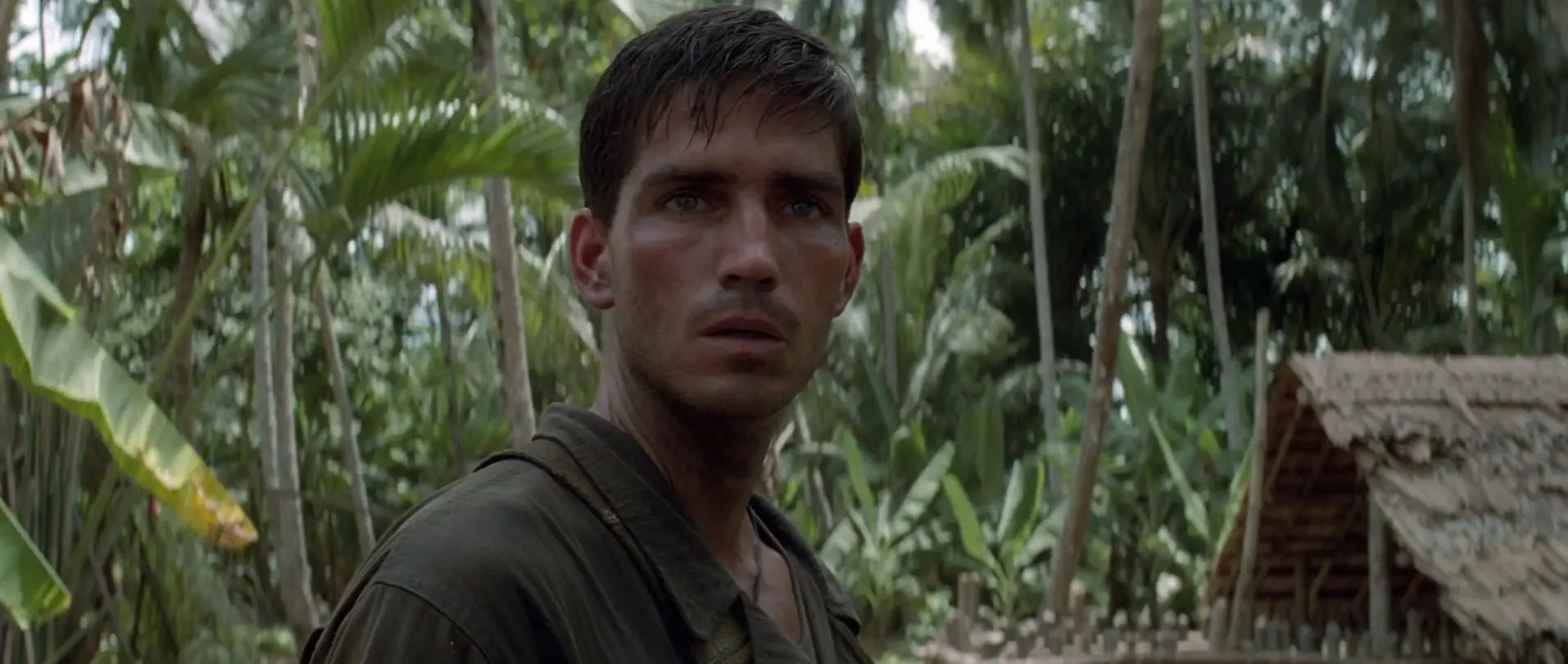



Hope and the Unmasking of Evil

In opening scenes of Terrence Malick’s film, The Thin Red Line, the raw recruit, Private Witt (above), who has gone AWOL from his company in the run up to the battle of Guadalcanal, muses about the problem of evil. He is wandering around a peaceful Melanesian village in a South Pacific island, its inhabitants unaffected by the war raging across the world.

The words he utters to himself are the original words written by James Jones, the author of the novel on which the film is based, published in 1962. Jones asked explicitly:

“This great evil, where’s it come from? How’d it steal into the world? What seed, what root did it grow from? Who’s doing this? Who’s killing us, robbing us of life and light, mocking us with the sight of what we might’ve known? Does our ruin benefit the earth, does it help the grass to grow, the sun to shine? Is this darkness in you, too? Have you passed through this night?” Jones was a veteran of that war.

We keep asking this question even though we’ve had the answer for as long as mankind has been inhabiting this earth. Not only do we ignore the answer but we also choose to muddle ourselves in all sorts of ways in trying to deny that there is an answer. We seem to prefer the darkness Jones refers to than to pass into the light.

Ross Douthat, columnist with The New York Times, writes  periodically on religious issues. He does his best to help us all cut through that darkness. He deals with evil in the context of the influence it has over our faith in God. Appalled by evil, some conclude that there simply can’t be a creator — or at least not a beneficent one — because the world is too laden with suffering and woe.”

There is, he finds, a muddle in their argument because its proponents often profess to be atheists. It isn’t properly speaking an argument that some creating power does not exist. Rather it’s an argument about the nature of that power, a claim that the particular kind of God envisioned by many believers and philosophers — all powerful and all good — would not have made the world in which we find ourselves, and therefore that this kind of God does not exist.

This argument of course ignores the multitude of good things in this world and what their source might be.

Rather than a straight rebuttal of an argument which is as muddled as this one, he suggests a set of challenges to it.

The first challenge he offers emphasises the limits of what the argument from evil establishes. It does not support an argument that God doesn’t exist, nor that the universe lacks a supernatural order. At best it seems to say that the traditional Christian or classical-theistic conception of God’s perfect goodness is somehow erroneous or overdrawn. 

The second challenge is that deniers of a ‘good God’ would do well to note that the books of  the Abrahamic tradition, which Jews and Christians themselves accept as divinely inspired, contain some of the strongest complaints against the apparent injustices of  the world. They are potentially much more worrying than those found in any atheistic tract. Check out the Bible

Douthat points out that the question of why God permits so much suffering is integral to Jewish and Christian Scripture, to the point where it appears that if the Judeo-Christian God exists, he expects his followers to wrestle with the question. Which means that you don’t need to leave all your intuitive reactions to the harrowing aspects of existence at the doorway of religious faith; there is plenty of room for complaint and doubt and argument inside the fold.

Finally, there is the evidence of the enormous good which Judeao-Christian civilisation has bestowed on this world, in the light of which the exclusive focus on the problem of evil seems a little overblown. Douthat suggests that “even if that evil makes it hard for you to believe in a God of perfect power, you still shouldn’t give up hope that something very good indeed has a role in the order of the world.”

But to return to the question posed by James Jones we must, and would be fools not to, resort to the historical sacred documents we have in Holy Scripture.

Romano Guardini shows us what we are really up against. In a chapter on ‘The Enemy’ in his meditations on the life and teachings of Christ in his book, The Lord, he gives us a very clear vision and understanding of the source of all evil in the world. He does this in the context of the accounts of Christ’s miracles in the New Testament – and one in particular.

Then there was brought to him a possessed man who was blind and dumb; and he cured him so that he spoke and saw. And all the crowds were amazed, and they said, ‘Can this be the Son of David?’ But the Pharisees, hearing this, said ‘This man does not cast out devils except by Beelzebub, the prince of devils.’ And knowing their thoughts Jesus said to them, ‘Every kingdom divided against itself is brought to desolation, and every city or house divided against itself will not stand. And if Satan casts out Satan, he is divided against himself; how then shall his kingdom stand? . . . But if I cast out devils by the Spirit of God, then the kingdom of God has come upon you’.  (Matt. 12:22–28). 

He tells us that what is reported here is essential to any genuine understanding of the New Testament. The account, he says, suggests similar cases of possession that Jesus has cured. “Not as a doctor cures; not even as Jesus himself has usually cured, by simply applying his miraculous powers of healing to the ravaged body. Here, behind the torment of body and soul, the Lord recognizes an evil power: the Demon, Satan. It is he who has made the invalid his abode; the physical pain involved is a result of his terrible habitation. It is he whom Jesus attacks, dislodging him by sheer spiritual force, and with him the accompanying ailment.” 

He is aware that sceptical and ultra-rationalist moderns  protest against the existence of intangible powers. He says they willingly enough recognise natural reality on the one hand, spiritual norms on the other:  given conditions of being and of intention. But then they baulk, afraid of fantastic folly. All reference to the demonic smacks of the unclean, of things belonging to a lower level of religion that must be overcome.  Here, he says,  lies the crux of our attitude toward Jesus: do we accept him, once and for all, as our ultimate authority in everything, or do we rely solely on our own judgment? 

He says that “If we think as Christians, we accept him as the starting point and norm of all truth, and we listen to everything he says with open minds, eager to learn, particularly when we are dealing, not with chance remarks of Jesus, but with a fundamental attitude that asserts itself again and again. The Lord’s acceptance of the inevitable struggle with satanic powers belongs to the kernel of his Messianic consciousness. He knows that he has been sent not only to bear witness to the truth, to indicate a way, to animate a vital religious attitude, to establish contact between God and man; but also to break the power of those forces which oppose the divine will. 

“For Jesus there is more than the mere possibility of evil as the price of human freedom; more than the inclination to evil, fruit of individual or collective (inherited) sin. Jesus recognizes a personal power that fundamentally wills evil: evil per se. It is not satisfied by the achievement of positive values through wicked means; it does not simply accept the evil along with the good. Here is something or someone who positively defies divinity and attempts to tear the world from God’s hands—even to dethrone God.”

Isn’t this the answer to the cri de coeur of James Jones, echoed by Malick? Jones asks, “Who’s doing this? Who’s killing us, robbing us of life and light, mocking us with the sight of what we might’ve known? … Is this darkness in you, too? Have you passed through this night?”  One senses that the question intuits the answer.

Guardini goes on to assert that the demon’s plan is to  lead the world into apostasy and self-destruction. This is what Holy Scripture means when it says that Satan creates that darkness which refuses the light that comes from God and is the seducer of mankind; that “He was a murderer from the beginning” for “by the envy of the devil, death came into the world” (John 8:44; Wisdom 2:24). 

“The Bible often speaks of him as lord of a “kingdom,” founder of a perverted order in which the hearts and minds of men—their creations, their deeds, their relations to things and to each other—seem sensible and coherent, but actually are senseless and incoherent. Long passages in John’s gospel describe Satan’s attempts to establish a kingdom of evil in opposition to God’s holy kingdom, anti-world to the new divine creation unfolding.”

This was the struggle witnessed by and bewildering Jones and his creation, Private Witt, in the horrors of Guadalcanal. It is the struggle which bewilders us as we contemplate the atrocities of October 7 on the border of Israel, of the devastation in Gaza, in Ukraine, Sudan and the Congo today.

Devastation on the Ukrainian-Russian border (NYT image)

But Guardini reassures us that Satan is no principle, no elementary power, but a rebellious, fallen creature who frantically attempts to set up a kingdom of appearances and disorder. He has power, but only because man has sinned. He is powerless against the heart that lives in humility and truth. His dominion reaches as far as man’s sinfulness, and will collapse on the Day of Judgment—a term long in itself, for every moment of evil is dreadfully long for those who stand in danger of Satan—but only a moment as compared with eternity. 

“‘Soon’,” as the Apocalypse reveals, it will be over (3:11; 22:7). Jesus knows that he has been sent forth against Satan. He is to penetrate Satan’s artificial darkness with the ray of God’s truth; to dispel the cramp of egoism and the brittleness of hate with God’s love; to conquer evil’s destructiveness with God’s constructive strength. The murkiness and confusion which Satan creates in men’s groping hearts are to be clarified by the holy purity of the Most High. Thus Jesus stands squarely against the powers of darkness; he strives to enter into the ensnared souls of men—to bring light to their consciences, quicken their hearts and liberate their powers for good.”

René Girard, Conversion and its Consequences

(René Girard, Part 3)

Fyodor Dostoyevsky – a central figure in Girard’s journey

Rene Girard’s first book, the fruit of his thinking and research in the 1950s was published in 1960. It was called Deceit, Desire, and the Novel.   Writing it resulted in not just a fascinating study of the genesis of  great writing but it also transformed his own life forever.

He describes his attitude and disposition as he started work on that book. It was “very much in the pure demystification mode: cynical, destructive, very much in the spirit of the atheistic intellectuals of the time. I was engaged in debunking.” He realised  that at the heart of his negative attitude was just one manifestation of his theory of imitative desire, mimesis. He was following the crowd. 

In writing Deceit, Desire and the Novel he explores what he takes to be the mind, the thought process and even the souls of great novelists. Among whom, as explicit models of his theory, are Marcel Proust, Dostoevsky and Cervantes.

He argues that with a number of great writers their first conception of their novels was very different from what they ultimately became. “The author’s first draft is an attempt at self-justification, which can assume two main forms. It may focus on a wicked hero, who is really the writer’s scapegoat, his mimetic rival, the one whom he desires to debunk, whose wickedness will be demonstrated by the end of the novel. It may also focus on a “good” hero, a knight in shining armour, with whom the writer identifies, and this hero will be vindicated by the end of the novel.”

But Girard then puts the writer to the test and argues that If the writer has a potential for greatness, after writing his first draft, as he rereads it, he sees the trashiness of it all. His project fails. The self-justification the novelist had intended in his distinction between good and evil will not stand self-examination. The novelist comes to realise that he has been the puppet of his own devil. He and his enemy are truly indistinguishable. The novelist of genius thus becomes able to describe the wickedness of the other from within himself, whereas before it was completely artificial. 

“This experience is shattering to the vanity and pride of the writer. It is an existential downfall. Very often this downfall is written symbolically, as illness or death, in the conclusion. In the case of Proust and Dostoyevsky it is explicitly presented as a change in outlook. Or to take Don Quixote, on his deathbed he sees finally his own mimetic madness, which is also illness and death. And this existential downfall is the event that makes a great work of art possible.”

In this imagining of the writer’s mind, Girard sees the following happening: once the writer experiences this collapse and a new perspective, he can go back to the beginning and rewrite the work from the point of view of this downfall. It is no longer self-justification. It is not necessarily self-indictment, but the characters he creates are no longer “Manichean” good guys or bad guys.

“So the career of the great novelist is dependent upon a conversion, and even if it is not made completely explicit, there are symbolic allusions to it at the end of the novel. These allusions are at least implicitly religious. 

“When I realized this, I had reached a decisive point in the writing of my first book, above all in my engagement with Dostoyevsky. Dostoyevsky’s Christian symbolism was important for me. Demons (The Possessed), presents Stepan Verkhovensky, whose deathbed conversion is particularly moving, but there is also the end of Crime and Punishment and The Brothers Karamazov. The old Verkhovensky discovers that he was a fool all the time and turns to the Gospel of Christ. This is the existential conversion that is demanded by a great work of art.

“When I wrote the last chapter of my first book, I had had a vague idea of what I would do, but as the chapter took form I realized I was undergoing my own version of the experience I was describing. I was particularly attracted to the Christian elements, for example, Stepan Verkhovensky’s final journey… So I began to read the Gospels and the rest of the Bible. And I became a Christian.”

Girard, however, later reflecting back on that conversion, realised that it was no more than what he called “an intellectual-literary conversion”, something deeply satisfying, even enjoyable. But he realised that his initial conversion did not imply any change of life. The change in his life came when he found out that he had a cancerous spot in the middle of his forehead. A biopsy revealed a cancerous growth. “From that time on I was pretty scared.  For all I knew, I had melanoma, the worst form of skin cancer.” 

It turned out to be a false scare but it brought him to a point where his intellectual conversion, which was a very comfortable experience, self-indulgent even, was totally changed. “I could not but view the cancer and the period of intense anxiety as a warning and a kind of expiation, and now this conversion was transformed into something really serious in which the aesthetic gave way to the religious.”

This was an agonising time. But for him it was significant that it coincided with the liturgical period of Lent in 1959. He was aware of this although he had never been a practicing Catholic. He was now thirty-five years old. Then on the Wednesday before Easter, his doctor gave him the ‘all clear’. That Wednesday is traditionally the end of  the lenten period of penance, the beginning of the holiest part of Holy Week. 

After that experience, he went to confession and  had his children baptized. His wife and he were remarried by a priest. So on Holy Thursday he went to Mass and received  the Eucharist. “I felt that God liberated me just in time for me to have a real Easter experience, a death and resurrection experience.”

He later reflected that the prior conversion was too easy. “it entailed no demands or commitments which I perceived at the time, but it prepared the way. So with the definitive conversion I was both emotionally and mentally prepared to accept God’s grace and believe.”

In his interview with James Williams, the editor of A Girard Reader, a collection of key extracts from his books, he describes himself as just ‘an ordinary Christian’.

In that interview he revealed some things about what being a Christian meant to him and what he saw as some essential commitments for any true Christian. Williams asked him about his dispositions towards non-Christians and a pluralistic society? He was asked “Do you favour converting all non-Christians to Christianity?”

Girard simply recalls what Jesus said, “I am the way, the truth, and the life,” and that he told his disciples to go into the world and make converts. “If we give that up, are we still Christian? The idea that if we respect other religions more than our own and act only according to politically correct principles, peace will break out all over the world is fantasy and delusion. I think the Christians who do not want to share their faith do not really believe. The fear of religious tyranny – meaning the forced imposition of our Faith on others –  is an  anachronism. It is a false issue which puts political correctness ahead of the truth and the only way of telling it (the truth) is by connecting with people”

On a  question related to the mission Christ gave his disciples, Williams also asked should one’s Christian faith enter into one’s approach to other religions and cultures? Or is it necessary to “bracket out” one’s faith in order to do scholarly work or to be a thinker?

To this he answered, “I don’t think you can bracket out a faith which is responsible for the best in the modern world. That is totally artificial. I don’t think you can bracket out any idea or ideal that you really hold — or that holds you. If you bracket out something that is central to your life, you become a shadow of yourself and your intelligence is not effective.”

Asked about those who advocate the suspension of their own belief in their approach to other religions he said, “No, that is a Stoic term, and you can practice that if you believe in Stoicism. But it has nothing to do with being a Christian or with real Christianity.

“If you believe that Christianity is the truth, including societal truth, you are not going to reach the truth by bracketing it out. You can see the result of this method all around us, in the current academic debacle for instance. The biblical scholars who are still talking in terms of bracketing truth out are still thinking in nineteenth-century terms. They are on their way to a goal which the deconstructors reached long ago. If we must have nihilism, let us not dilute it with water and let us drink it full strength, with Nietzsche, Heidegger, and the deconstructors. In order to reach the end of the present crisis we must…not interminably repeat attempts which already failed a hundred years ago, like “the quest for the historical Jesus.” Mine is a search for the anthropology of the Cross, which turns out to rehabilitate orthodox theology.

The interviewer then raised the question of freedom and totalitarianism. Girard responded by drawing attention to what he saw as the two forms of totalitarianism. One tries to destroy the concern for victims openly and directly. Its proponents basically attempt to kill as many victims for as little reason as possible. To him this was effectively  a process of mass scapegoating.

Then he went on to point out that today there is in place a process of insidious totalitarianism. In this it is hard not to think that he was foreseeing the bizarre way in which political correctness has degenerated in all the excesses of ‘woke’ culture. 

“Communism in many of its forms was insidious, but it will probably be replaced by ideologies still more insidious which outflank the Gospel on the left, presenting themselves as better than the Gospel…Some of these people see themselves as super-Christians, but they are heirs of the predecessors of Marx who thought they could achieve a new humanism. Feuerbach, for example. But they laid the groundwork for a disrespect of truth. I think it would be helpful to study Feuerbach, who was a primary agent of the transformation of Christianity into Marxism.”

On the question of death, dying and assisted suicide he had this to say. 

“The experience of death is going to get more and more painful, contrary to what many people believe,…euthanasia will make it more rather than less painful because it will put the emphasis on personal decision in a way which was blissfully alien to the whole problem of dying in former times, It will make death even more subjectively intolerable, for people will feel responsible for their own deaths and morally obligated to rid their relatives of their unwanted presence.

Euthanasia will further intensify all the problems its advocates think it will solve.

Rene Girard firmly believed that Christianity had all the answers to the existential problems which confront us in this world and we are presented with choices which our mimetic desires suggest to us.

“One should always look to the Gospels.”

“What are the prescriptions of the Kingdom of God? Basically, give up a dispute when mimetic rivalry is taking over. Provide help to victims and refuse all violence. I find the allegory of the sheep and goats in Matthew 25 to be a key text; it’s all there. When we identify with the person in need or who has been victimized, we encounter the Son of Man, Jesus. What the mimetic theory as such facilitates is the understanding that these ethical prescriptions or principles are against the mimetic spirit of the mob. The Gospels show that faith emerges when individuals come out of the mob.

“All the excesses of the modern world are distortions of Christian truth. The fact that there is a new type of individual in Christianity is the most important thing in the world. The Christian person is new and would have been viewed by traditional cultures as subversive. The only difference is that our narcissistic culture is a deviation and a caricature of the Christian person, not its fulfillment.”

Of the real and the unreal

About four years ago, a then twenty-six year old Irish writer – now world famous, if reviews of your books in The New York Times and a host of other national and international media is enough to give you that reputation – made this remark in an interview: “So yeah, I don’t know. I like Christianity. I’m a fan of Jesus and his whole philosophy, but not the social teaching aspects of it, of course.” She has said more on the topic since, most of it in the same nonchalant vein, betraying the inherent but increasingly shallow links Irish people of her generation have with the Faith of their Fathers. It also betrays an abysmal ignorance of the essence of what that religion and its practice really are. 

Who this young writer is, or why she is famous, is irrelevant in the context of what follows. She is one of several million, indeed hundreds of millions, who have lost the plot of what it is to be Catholic and Christian. Modernity is a mixed blessing – which is a way of saying that it is a blessing and a curse. It’s malefaction is its destruction of the human race’s grasp of the essence of the real world, and our place in it, by its corruption of the religious sense.

The only way back from this confused state which has suffocated the faith of so many and particularly that of the generations since the 1960s, is an effective articulation of the truth about the catholic church, what it is in its essence, and what its mission is. Only then will intelligent young people be able to break away from the prejudices about Christ’s church with which everything from shallow practice down to heinous scandals has left them. Only then will a young person who can now talk about “the crushing power of the catholic church” – another young Irish writer – come out and separate the wheat from the weeds, defend and protect the institution founded by Christ for the salvation of mankind.

We cannot talk of this being a crisis. Crises are relatively short-lived. Just as epidemics become endemic, crises can turn into something more permanent that we have to live with, cope with and build our defences against. The phenomenon which produced the response we began with is older than the ’60s. In a book published one hundred years ago, Romano Guardini wrote of the sad consequences of the failures in understanding we are looking at here. Their origins do not lie in the early twentieth century, nor even in the liberalism of the nineteenth century. They go back to early modernity and the emergence of a new  consciousness of individuality. The failure to balance this consciousness with social and communal consciousness created a rift which we can follow as it developed down through the centuries to our own time.

He wrote of this in terms of the tension which he saw then, and we see now, between the church and the individual. He connected this with a broader tension between the community and the individual which also had its manifestation in relations between the church and the individual, thereby imperilling our understanding of the very essence of the church.

In the Middle Ages the objective reality of the church, like that of society in general, was directly experienced. The individual had been integrated into the social organism in which he or she freely developed a distinctive personality. At the Renaissance individuals attained a critical self-consciousness and asserted their own independence at the expense of the objective community. By doing so, however, they gradually lost sight of their profound dependence upon the entire social organism. 

Consequently, he argued, the modern person’s consciousness of his or her own personality, no longer closely bound up with the conscious life of the community, overshot a critical mark and detached itself from its living social context. In terms of their relationship with the church, individuals began to think of the church, with its claim to authority, as a power hostile to themselves. At the time in which Guardini was writing this, James Joyce was the literary world figure deeply affected by the malaise he was describing. 

The mission Guardini envisaged for the Christian then was to foment an understanding of the true relationship between the church and the individual. It must still be so, one hundred years later. It will always be so. 

To achieve this, he maintained, our conceptions of society and individual personality must once more be adequate. To get there to any degree, self-consciousness and the sense of life within community must again be brought into harmony, and in terms of religious faith the inherent interdependence of the church and the individual must again be accepted as a self-evident truth. 

For him, modern man needed to see how the church and the individual personality are mutually bound together, “how they live, the one by the other.” It was in this context and in this mutual relationship that we could only properly explain the justification of ecclesiastical authority. This could only be done if people freed themselves from “the partial philosophies of the age, such as individualism, state socialism, or communism.” In our age there is no shortage of partial philosophies competing to warp our understanding of reality. He put it this way:

Once more we must be wholeheartedly Catholic. Our thought and feeling must be determined by the essential nature of the Catholic position, must proceed from that direct insight into the center of reality which is the privilege of the genuine Catholic.  

We agonise today, we talk and write about the atomistic disintegration of our society, and the sad consequences of family break-up, loneliness and worse which it brings in its wake. One hundred years ago he talked and wrote about the individual personality “starving in frigid isolation” if it is cut off from the living community. Being cut off from the church was even worse. The richness of the life which union with the church gives to the individual is the only true fulfilment of life, a “precondition of their most individual and personal life”. The church must necessarily be intolerable to those who fail to see this in her, to those who view her only as a power which confronts them and which, far from having any share in their most intimate, vital purpose, actually threatens or represses it. This, sadly, is the view of many today, who have not heard or understood that she is something infinitely different from that.

A person’s living will cannot accept a church so conceived… But the individual whose eyes have been opened to the meaning of the church experiences a great and liberating joy, for such individuals see that it is the living presupposition of their personal existence, the essential path to their perfection. They are aware of profound solidarity between their personal being and the church, how the one lives by the other, and how the life of the one is the strength of the other.  

He concluded optimistically that the possibility of loving and living in the church in this way is not something remote: we can love the church by virtue of a supreme grace which may be ours today, and it is the grace which we need most. But for Christians to help make this happen in our time, what he wrote back in 1922 applies even more to 2022. It must be taken into account that men and women of the present generation cannot love the church merely because they were born of Catholic parents. 

With equal force he warned that it would be folly to think that the love we are looking for could be produced by the intoxication of oratory and mass meetings. Neither would vague sentiments give us that love. He said that the young generation of his time was too honest for that. Honesty may well be a virtue more found in the young than in those of a certain age, something as true today as it was a hundred years ago.

To neutralise the atomistic process in which we still seem locked, Guardini wrote: One thing only can avail: a clear insight into the nature and significance of the church. We must realize that, as Christians, our personality is achieved in proportion as we are more closely incorporated into the church and as the church lives in us. When we address her, we say with deep understanding not “thou” but “I”. 

If I have really grasped these truths, I shall no longer regard the church as a spiritual police force, but blood of my own blood, the life of whose abundance I live. I shall see it as the all-embracing kingdom of my God, and his kingdom in my soul as its living counterpart. Then will the church be my mother and my queen, the bride of Christ. Then can I love her! And only then can I find peace! We shall not be at peace with the church till we have reached the point at which we can…love it. Not till then…” 

Tale of an Old Rabbit

This will be a long read – but well worth a visit after nearly 23 years. It is Tom Junod’s account in Esquire of his meetings with Fred Rogers – famed as ‘Mister Rogers’ of The Neighbourhood. This recently became the subject of the film, A Beautiful Day In the Neighbourhood.

it’s not a bad post to put beside my previous one, Twilight of the gods? Now also posted on MercatorNet as Can societies abandon religion and continue to prosper?

Junod begins his story like this.

Once upon a time, a little boy loved a stuffed animal whose name was Old Rabbit. It was so old, in fact, that it was really an unstuffed animal; so old that even back then, with the little boy’s brain still nice and fresh, he had no memory of it as “Young Rabbit,” or even “Rabbit”; so old that Old Rabbit was barely a rabbit at all but rather a greasy hunk of skin without eyes and ears, with a single red stitch where its tongue used to be. The little boy didn’t know why he loved Old Rabbit; he just did, and the night he threw it out the car window was the night he learned how to pray. He would grow up to become a great prayer, this little boy, but only intermittently, only fitfully, praying only when fear and desperation drove him to it, and the night he threw Old Rabbit into the darkness was the night that set the pattern, the night that taught him how. He prayed for Old Rabbit’s safe return, and when, hours later, his mother and father came home with the filthy, precious strip of rabbity roadkill, he learned not only that prayers are sometimes answered but also the kind of severe effort they entail, the kind of endless frantic summoning. And so when he threw Old Rabbit out the car window the next time, it was gone for good.

Read on here.

Take no part in the words of darkness, but instead expose them…

utopia
A dark alleyway leading nowhere
For the past half-century, the received wisdom among our cultural elites has been that the West is fundamentally bigoted and illegitimate and must be transformed. Melanie Phillips is at it again, taking on these elites and exposing their shallow folly. This woman is indefatigable.

In a superb article in the Jerusalem Post she tells the world that it is eating itself up with contradictions. It does so every time it rubbishes faith and religion because it is cutting the ground from underneath its own feet. By doing so it is putting reason in the same skip.

Among unbelievers, she writes, it is an article of faith that reason, science and modernity are in one box and religion, superstition and obscurantism in another.

Ah yes; the rational, factual, grounded secular world. The one that is currently disinviting speakers and violently attacking universities on the grounds of upholding freedom and equality. The one that is spewing unhinged lies and paranoid distortions at Israel and the Jewish people. The one that appears to be spinning off its axis into utter madness.

Phillips reminds us that this week the Jewish cycle of readings from the five books of Moses begins again in their synagogues. Christians can get into the same boat and identify with everything she reflects on at this turn of the Jewish liturgical year. Christians will begin their cycle with the beginning of Advent in a little more than a month’s time.

The secular world, she reflects, looks on with indifference, bemusement or contempt. The reason for this is something the secular world cannot bring itself to grasp.

The same secular world consigns Christians, the younger brothers and sisters of the Jewish people, to the same quaint – but not harmless – category of deluded human beings.

Because the peoples adhering to these traditions are determined to abide by their faith – and in the case of Christians are determined to evangelize, to spread their faith – they are not just harmless delusionals. They are an obstacle to real human progress and must be at least marginalized – if not destroyed.

But the tragic irony of this situation is that the “rationalists” mocking the faithful are leading western civilization on a path of self-destruction.  “For”, as Phillips points out, “in setting out to destroy the biblical basis of western civilization, the secular world is in the process of destroying reason itself.”

Phillips’ reading of how this self-destructive process has been operating is this:

For the past half-century, the received wisdom among our cultural elites has been that the West is fundamentally bigoted and illegitimate and must be transformed. Accordingly, biblical codes embodying objective truth and goodness have been replaced by ideologies such as moral and cultural relativism, materialism, anti-capitalism, anti-imperialism, anti-racism, utilitarianism, feminism, multiculturalism, universalism and environmentalism.

Indeed what she says echoes words of warning of Pope John Paul II at the end of the last century:

(With) the fall of ideologies which bound politics to a totalitarian conception of the world — Marxism being the foremost of these — there is no less grave a danger that the fundamental rights of the human person will be denied and that the religious yearnings which arise in the heart of every human being will be absorbed once again into politics.

This is the risk of an alliance between democracy and ethical relativism, which would remove any sure moral reference point from political and social life, and on a deeper level make the acknowledgement of truth impossible. Indeed, “if there is no ultimate truth to guide and direct political activity, then ideas and convictions can easily be manipulated for reasons of power. As history demonstrates, a democracy without values easily turns into open or thinly disguised totalitarianism”. (Veritatis Splendor,101)

These movements are all utopian, Phillips asserts. Each in its own way wants to create a new kind of human being and a perfect world. The greens believe they will save the planet. The multiculturalists believe they will excise bigotry from the human heart. The universalists believe they will create the brotherhood of man.

The problem with all these ideologies, she says, is that they are anti-reason.

She is right. The fatal flaw of all these ideologies is that they aim at a utopian perfection and reject the evidence which our reason patently places before our eyes: our fallen nature is of itself incapable of the perfection they dream about. For both the Jew and the Christian that of course is not to say that perfection cannot be attained. “Be you perfect as your heavenly Father is perfect.” For both these faiths God is real, He is perfect and has promised us redemption.

Phillips traces the hostility of these ideologies to their inherent irrationality:

Moral relativists attack the Mosaic code. Environmentalists attack the (misunderstood) assertion in Genesis that mankind has dominion over the Earth. Materialists attack the belief that there can be anything beyond the universe at all. And so on.

It is no coincidence that these ideologies are both anti-reason and anti-Jew, for Judaism and reason are not in separate boxes at all. The one in fact created the other.

She deconstructs the popular misconception that science and faith are in these “separate boxes”. For the development of science, she argues, monotheism was essential. As the Oxford mathematics professor, John Lennox, puts it: “At the heart of all science lies the conviction that the universe is orderly.”

Science grew from the idea that the universe is rational; and that belief was given to us by Genesis, which set out the revolutionary proposition that the universe had a rational creator. Without such a purposeful intelligence behind it, the universe could not have been rational; there would have been no place for reason in the world, because there would have been no truths or natural laws for reason to uncover.

She then catalogues the great scientists and philosophers, right up to our own time, for whom the idea of science without God was nonsense. They were Jews and Christians.

As we know, not all of them grasped all the implications of the truth which they stumbled on. Many indeed misinterpreted it. But they had one essential clear; God existed and was the author of the universe. Francis Bacon said God had provided us with two books – the book of nature and the Bible – and that to be properly educated one must study both.

Isaac Newton, Descartes, Kepler and Galileo – who said “the laws of nature are written by the hand of God in the language of mathematics,” are all on her list.

As CS Lewis wrote: “Men became scientific because they expected law in nature, and they expected law in nature because they believed in a lawgiver.”

But for her the significant point is that it was not religion in general but the Bible in particular that gave rise to science. She tells us how the Hungarian Benedictine priest Stanley Jaki has shown that in seven great cultures – the Chinese, Hindu, Mayan, Egyptian, Babylonian, Greek and Arabic – the development of science was truncated. All made discoveries that carried human understanding forward, yet none was able to keep its scientific discoveries going.

Jaki attributes this to two critical features that these cultures had in common: a belief in pantheism and in the cyclical concept of time. Science could proceed only on the basis that the universe is rational and coherent and thus nature behaves in accordance with unchanging laws. It was therefore impossible under pantheism, which ascribed natural events to the whims and caprices of the spirit world.

The other vital factor in the creation of science and modernity was the Bible’s linear concept of time. This means that history is progressive; every event is significant; experience is built upon. Progress was thus made possible by learning more about the laws of the universe and how it works.

Given all this, it comes therefore as no surprise to her that the Jewish people find themselves in the very eye of the civilizational storm. The same can be said for the Christians. For her this new hatred is deeper than the perennial scourge of anti-Semitism, something for which confused Christians in their falleness bear a terrible responsibility over many centuries. This new scourge is, she says, all part of the unfolding story of the modern world turning savagely against the very creed on which it itself is based.

I dare to suggest that in her own way she is admonishing us to beware of the darkness of which that great Jewish Christian, St. Paul, warned the people of Ephesus and Thessalonica, surrounded as they were by the secular pagan culture of his time:

“Once you were darkness, but now you are light in the Lord; walk as children of the light (for the fruit of the light is found in all that is good and right and true), and try to learn what is pleasing to the Lord. Take no part in the unfruitful words of darkness, but instead expose them… Look carefully then how you walk, not as unwise men but as wise, making the most of the time, because the days are evil” (Eph 5:8-11, 15-16; cf. 1 Th 5:4-8).

Thank you, Melanie Phillips, for your wisdom and your courage in swimming against this relentless current which threatens to sweep us away in its madness.

“Silence” – the novel

silence-978144729985101

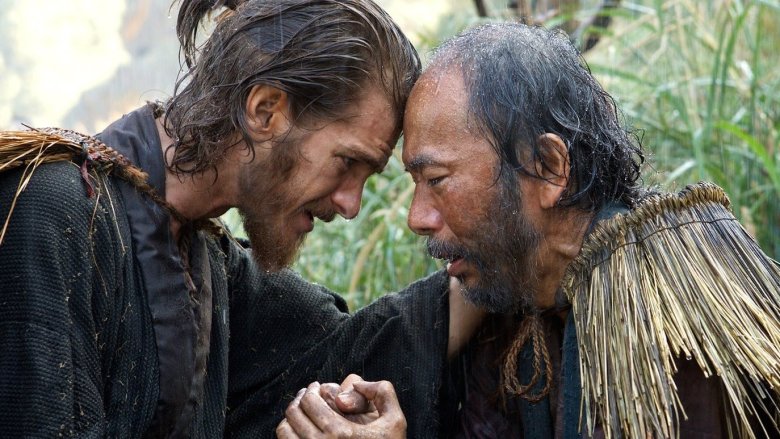
Indeed “there’s a divinity that shapes our ends”. Could it be that there is something providential behind the movement out of the literary shadows of Shusaku Endo’s novel, Silence, which is now being effected by its translation into the medium of film by Martin Scorsese? The film was released in the US last week and is being released in Europe today (Friday 30 December).

This novel is extraordinarily relevant to our time and to the story of faith and religion in the modern world. It is a novel about persecution, about compromise of principles, about apostasy and mercy, about heroism and cowardice. All of these are central to the harrowing tale at the centre of Endo’s Silence, considered to be his masterpiece by many.

mi_21110195914215663

Endo was a Catholic. In his life he mirrored the eternal conflict of the believer with the world, the world which does not know God. This is the conflict which Romano Guardini refers to when he writes of the “true light” of Christ “showering radiance on everyone who comes near him.”  But, the great German theologian says, “if that person is ‘seeing’ in the worldly sense, something in him is willed to seek the world and himself rather than the Messiah. His eye is fixed on world and self and remains so.”

In Endo’s life this conflict was very much set in the context of his native Japan – a country and a culture which had for centuries determinedly set its face against Christ and God, opting instead for the world as seen through the vision of the Buddha. But the context of his Japan is now the context of every Christian in the Western world – a world which has set out either to reject God and persecute believers, or which seeks to redefine God in its own image. The “Silence” of the title of Endo’s novel is the apparent failure of God to speak and act in the face of human suffering, injustice and  persecution. But this silence is really the test of faith, a test which ultimately separates those who see the “true light”, or “hear” the true voice of God, from those who do not – with glorious consequences for some and tragic consequences for others.

In his introduction to the novel Endo wrote of its genesis:

For a long time I was attracted to a meaningless nihilism and when I finally came to realize the fearfulness of such a void I was struck once again with the grandeur of the Catholic Faith. (Silence xx) But this brought him to another problem, that of “the reconciliation of my Catholicism with my Japanese blood”.

The great question for him, one that is at the heart of the brutal persecutions depicted in the novel, is how to resolve the conflict which the Western trappings of the universal truth of Christ’s teaching presented to the guardians of Japanese culture and tradition.

The novel reveals the murderous bewilderment of the Japanese cultural elite when confronted with the success of the Christian missionaries in the sixteenth century. There was, on their part, a terrible and utterly flawed identification of the universal message of Christ with the cultural values of the agents who brought that message.

What makes the novel so relevant to the world today is that the universal truth of the message is again in conflict with the cultural elites – this time with the modernist and post-modernist and post-truth values increasingly dominating our consciousness and our culture.

On the one hand there is rejection and, where power makes it possible, persecution of Christians. On the other hand there is the tendency to modify the teaching to suit the new self-image of mankind which is now being absorbed and disseminated by contemporary cultural elites. This is the equivalent of the “swamp” which Endo saw in Japan, absorbing and distorting the essential truth brought by the missionaries. He described it as a swamp that “sucks up all sorts of ideologies, transforming them into itself and distorting them in the process” (Silence, xix). This, of course, is the perennial tightrope which truth always has to walk in any and every process of inculturation.

This is the issue at the heart of the novel on one level.

silence

On another parallel level Endo tells the sad story of the personal faith of individuals. Two of the three priests central to the story apostasize. The one who keeps protesting about God’s silence eventually hears a voice which he takes to be the voice of Christ. The voice tells him to trample on the image, the public sign his persecutors demand. “You may trample. You may trample. I more than anyone know of the pain in your foot. You may trample. It was to be trampled on by men that I was born into this world. It was to share men’s pain that I carried my cross.”

But the denouement of the novel, from the hell on earth in which his soul, if not his body, has to go on living for thirty more years, shows us that it is his own, or another voice which he hears, not the voice of God. The suffering Japanese Christians, whom he fooled himself into thinking that he was acting out of mercy towards, went on suffering – and he even acquiesced in that suffering. His efforts at self-justification have all the hall-marks of torturous self-delusion.

The Silence of the novel is not the silence of men, it is the silence of God; it persists. Like the history of Christian martyrdom teaches – no matter how hard this is to understand – the ways of God are not the ways of man. The mercy of God is not the mercy of man. The heroes of this novel, Fr. Garrpe, Monica and the other Japanese martyrs depicted knew this; the anti-heroes of this novel, Ferreira and Rodrigues, did not know this. Martyrs down through history know this; the world does not know this.

On this level I doubt very much if the film is going to achieve much clarity. Martin Scorsese talks of it in terms of his personal journey – a journey which took him form a Catholic Italian upbringing in New York, through The Last Temptation of Christ, to this and beyond. For Liam Neeson it may be similar, this time from an Ulster Catholic upbringing to, who knows what? We shall have to leave that to another judgement.

In a recent interview Neeson is quoted as saying that the movie’s exploration into faith and its theme of standing up for what you believe in made him examine where doubt fits into religion.

“The other component of faith that [director] Martin Scorsese explores in the film is doubt. They’re both [together],” he says. “And I think it is a God-given component. If we have this free will to question and if one believes in God, I think you celebrate that.” Really? The freedom we have to doubt is God-give. The doubt is our contribution.

Neeson added that one doesn’t have to be religious to appreciate the film’s message. “We all (have) faith in something whether it’s faith in a marriage or relationship or faith in your work,” he explains. “It can be applied to anything.” That all sounds a little too much like an echo from the “swamp” which pained Endo so much.

But Neeson is not reading the novel. He may be reading Scorsese’s script. On a personal level it is about faith and fear, rather than faith and doubt. The nemesis of the apostates is not that they doubted, or apostatized because of doubt. The key to their tragedy was the weakness of their faith in the face of a demand to deny divinity. In the end the heroism of their activity in spreading the faith was insufficient when that faith was put to the ultimate test, that of accepting God in his silence. The focus of the novel  – in the case of three of the characters, Rodrigues, Ferreira and the Japanese peasant, Kichijiro, – is on the destructive power of this weakness which brought them to their doom, their living hell.

Endo has been rightly compared to Graham Greene and Flannery O’Connor in his preoccupations and the paradoxes he uses to explore them. He is also that very unique thing, a Catholic writer from an Asian culture. As such his work must stand, in spite of its complexity, its paradoxical character and its consequent risk of misinterpretation, as an essential link in the long and troubled history of the evangelization of the Far East, and Japan in particular.

God’s juggler?

695214

Bob Dylan’s in the news. I couldn’t help thinking of him the other day when I read this:

Then the sixth angel blew his trumpet, and I heard a voice from the four horns of the golden altar before God, saying to the sixth angel who had the trumpet, “Release the four angels who are bound at the great river Euphra’tes.” So the four angels were released, who had been held ready for the hour, the day, the month, and the year, to kill a third of mankind.

Dylan believes that. In his famous 1984 Rolling Stone interview he said, provocatively as he often is, and enigmatically as he also often is:

I believe in the Book of Revelation. The leaders of this world are eventually going to play God, if they’re not already playing God, and eventually a man will come that everybody will think is God. He’ll do things and they’ll say, “Well, only God can do those things. It must be him.”

That might remind you of something someone else said not so long ago – someone at a considerable remove from where you might expect to find Bob Dylan on the spectrum. This was what Republican Senator Rand Paul, (Kentucky) said in support of the pro life movement:

For 43 years, a few unelected men and women on the Supreme Court have played God with innocent human life.

They have invented laws that condemned to painful deaths without trial more than 61 million babies for the crime of being “inconvenient.”

In 1973, the U.S. Supreme Court’s Roe v. Wade ruling forced abortion-on-demand down our nation’s throat.

So, one wonders about those four demon angels at the Euphrates. Have they arrived? The valley of the Euphrates, or thereabouts, is one part of the world where there are men and women playing God just now. If we add a few more from around the world – well, maybe we will not get as far as a third of mankind killed, but we are certainly on a bad road trip.

Dylan is a truly special kind of human being. He deserves the Nobel Prize. If you don’t think so listen to him again. Forget the cant about him not writing poetry and start thinking outside the box. There is no Nobel Prize for music. There should be and perhaps this is the best place to start. In terms of lyrics Dylan’s worst efforts – and there are not too many in that category – can be pretty bad. But at his best he can really fill you with awe and wonder.

If the Nobel Commitee was going to look into the world of popular culture for creative souls who have opened windows, given people things to think about which will help them better understand the human condition, they could do much worse than this – they might have chosen the Rolling Stones.

In that long interview with Rolling Stone – I hope this is not getting confusing – he showed some of the depths of his spirit. He also showed how essentially humble the man is. He was asked about all the labels he’s been burdened with over the years.

People have put various labels on you over the past several years: “He’s a born-again Christian”; “he’s an ultra-Orthodox Jew.” Are any of those labels accurate?

Not really. People call you this or they call you that…. I would never call it that, I’ve never said I’m born again. That’s just a media term. I don’t think I’ve ever been an agnostic. I’ve always thought there’s a superior power, that this is not the real world and that there’s a world to come. That no soul has died, every soul is alive, either in holiness or in flames. And there’s probably a lot of middle ground.

What is your spiritual stance, then?

Well, I don’t think that this is it, you know — this life ain’t nothin’. There’s no way you’re gonna convince me this is all there is to it. I never, ever believed that. I believe in the Book of Revelation.”

You’re a literal believer of the Bible?

Yeah. Sure, yeah. I am.

Are the Old and New Testaments equally valid?

To me.

Do you actually believe the end is at hand?

I don’t think it’s at hand. I think we’ll have at least 200 years. And the new kingdom that comes in, I mean, people can’t even imagine what it’s gonna be like. There’s a lot of people walkin’ around who think the new kingdom’s comin’ next year and that they’re gonna be right in there among the top guard. And they’re wrong. I think when it comes in, there are people who’ll be prepared for it, but if the new kingdom happened tomorrow and you were sitting there and I was sitting here, you wouldn’t even remember me.

When you meet up with Orthodox (Jewish) people, can you sit down with them and say, “Well, you should really check out Christianity”?

Well, yeah, if somebody asks me, I’ll tell ’em. But, you know, I’m not gonna just offer my opinion. I’m more about playing music, you know?

There is something very attractive about that simplicity, that mixture with faith and unpretentiousness – harking back to another famous interview with a journalist away out of his depth. Dylan ended by saying something like, “I’m just a song and dance man”, God’s juggler, as it were.

It is not that Dylan doesn’t express his views. He does, and sometimes quite strongly. It’s that he does so with a readiness to pull back from any suggestion of arrogance. His lyrics have been prophetic but he will not accept the mantle of the prophet. He detaches himself from them, he will even say that in instances he did not really know what some lines meant when he wrote them. He leaves us to read them for ourselves and work out their meaning. In that there is something of the quality which a true artist, a true genius, often touches, the quality of mystery which is essential in all great art. The Academy has done well this time round.

The price of truth – everything for Kayla Mueller

If only, if only, the kind of heroic honesty shown by the 26-year-old martyr, Kayla Jane Mueller, who lost her life in Syria in recent days, was more commonplace among us, what a better world we would be living in. Indeed, if it were so there might be less need for martyrs like Kayala to sacrifice their innocent lives.

Kayla, imprisoned and blindfolded in an underground cell at the hands of ISIS in Syria, lost her life in an air strike on the ISIS position in which she was being held.

It seems that Kayla might have been freed had she told the militant group she was married to Omar Alkhani. Mueller’s boyfriend was posing as her husband in a detention cell in Syria, The Associated Press reported. Kayla refused to do so because it would have been a lie.

Alkhani reportedly said that ISIS militants told Mueller that her boyfriend would be unharmed if she was honest with them. The 26-year-old reportedly chose to be honest and denied being Alkhani’s wife, instead of saving herself. Alkhani last saw Mueller for few seconds when the guards uncovered her face to show it was her.

Kayla’s parents released a letter she was able to send her family last spring from her captivity by ISIS, after she had been a prisoner for about 9 months. In it she tells her family that she’s safe and well-treated; she doesn’t want them to worry. In it she reveals the depth of her faith and her extraordinary fortitude.

“I have been shown in darkness, light + have learned that even in prison, one can be free. I am grateful. I have come to see that there is good in every situation, sometimes we just have to look for it. I pray each each day that if nothing else, you have felt a certain closeness + surrender to God as well + have formed a bond of love + support amongst one another …

“The gift that is each one of you + the person I could + could not be if you were not a part of my life, my family, my support. I DO NOT want the negotiations for my release to be your duty, if there is any other option take it, even if it takes more time …

“None of us could have known it would be this long but know I am also fighting from my side in the ways I am able + I have a lot of fight left inside of me. I am not breaking down + I will not give in no matter how long it takes.”

“I wrote a song some months ago,” Kayla Mueller told her family, “that says, ‘The part of me that pains the most also gets me out of bed, w/out your hope there would be nothing left…’ — The thought of your pain is the source of my own, simultaneously the hope of our reunion is the source of my strength. Please be patient, give your pain to God. I know you would want me to remain strong. That is exactly what I am doing. Do not fear for me, continue to pray as will I + by God’s will we will be together soon.”

“All my everything, Kayla”.

Confessions of Faith and Reason

IMG_0444.JPG

Confessions of faith – or confessions of reasons for having faith – seem to be more and more common in recent times. A few weeks ago we had Daily Telegraph columnist and blogger, Tim Stanley, telling us “If you have to choose between being liberal and being Christian, choose Christian”, and going on to explain why.

More recently we had Ross Douthat, columnist with the New York Times, in the wake of hostile Catholic and pseudo Catholic reaction to his expressed concerns about the Synod of Bishops, feeling the need to explain to us “Why I am a Catholic”.

This is good. Catholics need clarity. These upfront declarations are giving us some of this clarity.

Stanley’s reflections were on the back of the revelations about ex-bishop Conry’s pitiable affair and subsequent fall, coupled with the then-approaching aforementioned synod on the family.

He observed the prevalent temptation to focus on the human, sometimes frail aspects of the Church and drew on the wisdom of a priest-blogger whom he admires greatly, Fr. Alexander Lucie-Smith, who urges us to do the opposite.

Fr. Lucie-Smith’s sentiments on the issue, Stanley observes, apply to all Christians (and Jews, and Muslims etc): while the secular world obsesses about political division within the Church, what really matters is the “theological reality” of its mission.

In this mission, the priest says, One needs to distinguish… between a group of people who are united sociologically (for want of a better word) and a group of people who are united in Christ, which is a theological reality. Unity in Christ is something we are always on the way to achieving, if we were not constantly impeded by our sins. Thus we should be in a constant state of repentance for our sins, in that they frustrate the unity that Christ prayed for and which He bequeathed us on Calvary.

Stanley adds: The Catholic Church will always have its troubles. The solution is prayer and putting one’s faith in the Holy Spirit.

The Reformation is, of course, he continued, a reminder of the fragility of the Church. The resilience of Catholicism in Britain today shows its ability to withstand anything – and grow from strength to strength. Its greatest threat is a general decline in belief (aided by the mistakes of clerics) and the emergence of a new anti-religious consensus that discourages commitment to the divine. But perhaps it’s best not to think of this as a crisis but as a challenge to believers. 

This was written in the same week that Louise Mensch made her confession of a conflicted faith in a moving piece in The Spectator about her own struggle to reconcile her private and spiritual life – and her deference to Catholic Church teachings on the sacraments of marriage and the Eucharist.

Stanley remarks on how difficult this is to do, and to talk openly about, in this liberal world in which we now cohabit with people embracing all sorts of heterodoxy. But do it we must – and if we are to be true to our beliefs about what really matters, we really only have one choice. He quotes Fr Lucie-Smith again:

If you have to choose between being liberal and being Catholic, choose Catholic… This is the true fault line: those who believe in the Body of Christ and our vocation to belong to it through baptism, and those who believe the Church needs to catch up with the world, and other such dreary clichés. St Paul had to put up with a lot of them, because he writes: “Do not conform yourselves to this age but be transformed by the renewal of your mind, that you may discern what is the will of God, what is good and pleasing and perfect” (Rom 12:2). 

Stanley concludes: Pray to have the strength not to conform but to be who you truly are. Which is a sinner saved by Grace.

Ross Douthat, for his part put his confession in this nutshell:

I am a Catholic for various contingent reasons (this is as true of converts as of anyone else), but on a conscious level it’s because I am a mostly-faithful Christian who is mostly convinced that Roman Catholicism is the expression of Christianity that has kept faith most fully with the early church and the words of Jesus of Nazareth himself.

That’s a pretty useful nutshell, although it doesn’t make any reference to the vital role of grace in that “because”.

He elaborated a little on the basis of a point made in a talk by Cardinal George Pell, – recently of Sydney and now of the Roman curia, — that the search for authority in Christianity began not with pre-emptive submission to an established hierarchy, but with early Christians who “wanted to know whether the teachings of their bishops and priests were in conformity with what Christ taught”.

This, Douthat said, is crucial to my own understanding of the reasons to be Catholic: I believe in papal authority, the value of the papal office, because I think that office has played a demonstrable role in maintaining the faith’s continuity, coherence and fidelity across two thousand years of human history. It’s that role and that record, complicated and checkered as it is, that makes the doctrine of papal infallibility plausible to me.

There is a wealth of ignorance about the Faith of the Catholic Church out there. The more conversations like this that we have the better chance there is that we will escape from this pit and will become Catholics who will be who they “truly are”. A source of that liberating truth is the Catechism of the Catholic Church, a source with the stamp of approval of that Magisterium in which the early Christians, and later Christians like Douthat, Stanley, Mensch et al, found and continue to find reassurance that what we believe is “what Christ taught”. Why would you choose anything else?