Since this article was published on Michael Kirke’s Substack several weeks ago, surveys and reports continue to frighten us about the decrease in reading in nearly all segments of our population. Last year Britain’s National Literacy Trust reported that just 1 in 3 (32.7%) children and young people aged 8 to 18 said that they enjoyed reading in their free time in 2025. This marks a 36% decrease in reading enjoyment levels sincethe Trust started asking about this in 2005. The latest, in the past few days reported that children’s reading has decreased, while not dramatically, at least going in the wrong direction. A few days ago The Irish Times reported that the percentage of children who said they never read for fun was just 11 per cent in those aged between five and 12-years-old.
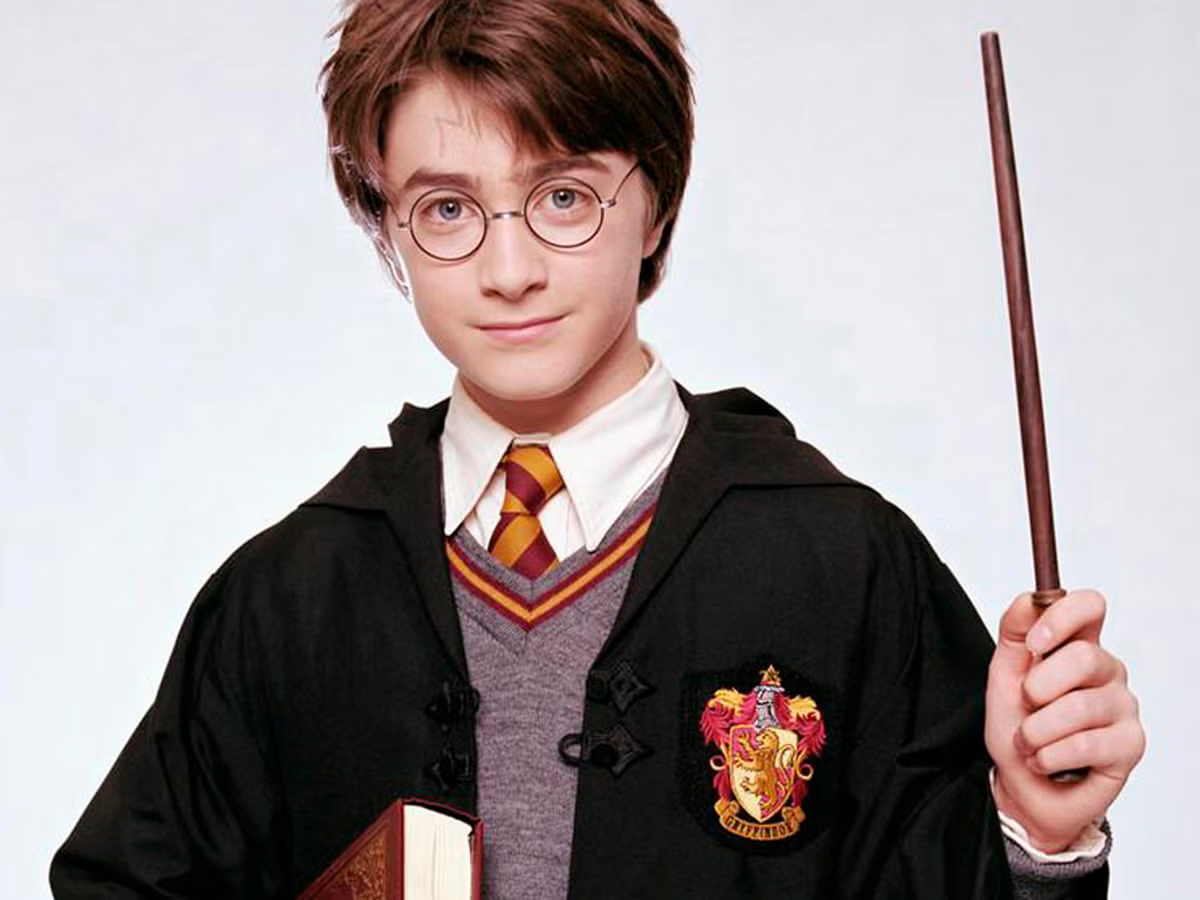
Harry Potter was supposed to have solved this problem. With a wave of his magic wand he seemed to have lured millions of young and not so young away from their smart devices and back to reading books. He hadn’t. Reading books, books in the hand, is once again a minority pursuit.
We may worry about Large Language Models, LLMs, or Artificial Intelligence, as it is inaccurately called, and the unknowable destructive consequences we fear it may bring in its wake. But AI is maybe just the last piece of a jigsaw which has already been composed and is already wreaking havoc on our civilisation. And not only on our inherited values but on some of the fundamental characteristics which our culture has engrained in our human nature
In what is being described as one of the most important essays The Atlantic, the century-old and fabled American magazine, has published in recent years, one of its staff writers, Rose Horowitch asserts, in a study entitled, ‘The End of Reading’: “mass literacy may turn out to have been a relatively brief episode in human history rather than the permanent condition many assumed it would become.”
Her argument is more than just an assertion that “people read fewer books.” She is asking whether, in what she identifies as a ‘post literate society’, an entire way of thinking is disappearing.
Her essay could indeed be taken as a companion piece to Pope Leo XIV’s magisterial recent encyclical, Magnifica Humanitas. Her essay is very long but it is not quite as long as that document. However, it spells out in more alarming detail the rubicon which our civilisation may already have crossed, bringing to and end our republic of letters as Julius Caesar set in train the events which ended the Roman Republic.
Horowitch begins with Ptolemy’s Library of Alexandria as a symbol of civilization’s faith in written knowledge. He scoured the world for books and founded this library. She reminds us that reading is not an instinct but a learned cognitive technology. human beings evolved to speak; writing has existed for only a tiny fraction of our history. Literacy therefore requires continual cultural support. Failing to get that support, Alexandria’s library perished.
This is important because it means literacy can also decline and even disappear.
There is now strong evidence that Americans today read substantially fewer books than previous generations. Evidence about the rest of the world is mixed. The overall picture is complicated by the vast expansion of media forms – electronic and audible media have had a huge impact on physical book reading.
Surveys show that fewer people are making reading a central, habitual part of their leisure; nevertheless, many of those who still read continue to read deeply. The transformative reality has been the substantial change from a print-centred hard-copy reading culture to a much more fragmented culture of print, e-books and audio—and, more fundamentally, a culture in which the book has to compete for attention with an unprecedented range of immediately available alternatives.
Interestingly Ireland may be an outlier in all this. A recent international consumer study found that 91% of Irish respondents had read a book during the previous year, compared with 85% across the 19 countries surveyed; 81% had bought a book. That makes Ireland rather different from the more pessimistic picture sometimes painted of the anglophone world. Perhaps the fact that per capita, Irish writers have won more Nobel Prizes for literature than any other country in the world has something to do with this.
One of Horowitch’s observations is that Americans probably consume more words than ever—emails, texts, captions, posts—but almost none of this requires sustained concentration. The issue is not the quantity of text but its character. Her main worry is that our practice of deep reading has diminished and in this she sees a threat to our very way of thinking, to our capacity to think clearly, imaginatively and even logically.
One might observe the reality of what passes for human dialogue in social media as an example of this degeneration. In the process of bringing about this disturbing change she does not argue that television or the internet have been the villains. Rather, the omnipresent electronic gadgets in our pockets, smartphones, are the real Trojan horses, with the powerful forces they unleash from their bellies.
Infinite novelty has always been a distracting force undermining our studied creativity by generating a kind of chaos in our minds. Add to that the temptation through which these devices urge us to immediate gratification. On top of this we have algorithmic optimisation which generates a flood of constant interruption. While Meta and Co. have refused to accept responsibility for this in the case of their young consumers, they have nevertheless agreed – more or less – to pay $17 billion dollars in compensation for the damage US courts declare that they have done. That figure may be just a fraction of what they, YouTube, TikTock and other players will end up paying across the world.
Horowitch herself still enjoys novels once immersed in them, but getting over the initial barrier has become much harder because the discipline of attention has been corrupted by so many competing agents.
Horowitch also looks at all this in an educational context, ranging from early learning to the pinnacle of third level. A college professor assigned Bleak House as a text to students, asking for a precis of its opening paragraphs. The professor was presented with absolute gobledegook, probably with what we now call slop. Metaphors, other literary devices, nuances, were all garbled showing a dreadful incapacity to move beyond a nakedly literal reading.
Professors are reporting that students struggle to finish assigned books, prefer summaries of great books, expect lectures to replace reading, regard reading itself as an unnecessarily inefficient method of acquiring information. One professor says students increasingly feel that assigning a book is deliberately making knowledge harder to obtain. For Horowitch that observation is especially striking because it suggests a different conception of education. The goal shifts from forming a mind to simply delivering information.
Horowitch sees the arrival of AI as potentially worsening the problem. If AI reliably summarizes books, articles and arguments, many people may conclude there is little reason to read originals. AI can be a help to understanding complex and deep texts but the inevitable path of least resistance may trump all that. Ironically, she thinks, the technology most capable of generating text may reduce the number of humans who actually engage with it deeply.
But for Horowitch this is not just a matter of losing the pleasure of reading great and meaningful literature. It is about something which will have – and already has – and impact on the way we live our lives together and promote human flourishing. Look again at Magnifica Humanitas for a detailed and wisdom-filled reflection on this.
Anthony Trollope’s late novel, The Way we Live Now is a rich piece of nineteenth century literature but it is also a critique of the degeneration of the society of his time and the corruption of values which utilitarianism and the industrial revolution brought in their wake. It predates Leo XIII’s Rerum Novarum which addressed the same problem on a more theological and sociological level.
As we alluded to earlier, our technological prowess seems to be killing our capacity for logical argument, respect for evidence, capacity to handle nuance and any appreciation of the value of delaying judgement. Our post-literate society instead, above all, values performance, celebrity and personality, putting emotional immediacy before reflection.
Horowitch suggests that politics inevitably changes when citizens no longer habitually read extended arguments. In her view we live in a dangerous time. If literacy declines, civilization itself changes—not because books are morally superior, but because they cultivate a distinctive mode of thought. The danger is not simply that people know less, but that they lose the mental habits that only extended reading reliably develops.
On my bookshelves sits one of my moat valued texts. It is the late Professor Denis Donoghue’s exploration of reading as an enriching human pursuit. Its title is The Practice of Reading. We must do all we can to ensure that never becomes a meaningless phrase.
Christopher Nolan’s Odyssey – and Homer before him – reminded us of the Late Bronze Age Collapse. The obliteration of the Library of Alexandria was the prelude to the collapse of the classical world. In the intervening centuries until now we have had a number of close shaves, not least the scourge of secularism and its pseudo-religious offspring, wokism. We should be aware that we take our civilisation for granted at our peril.