It has been boasted of as the biggest democratic event in the history of mankind. Half the world – at least – is going to the polls over these two months to elect local government assemblies, national assemblies, international assemblies, or heads of states.
All the countries in the European Union are heading into elections on the 23rd of next month to elect a new European Parliament. In many of them elections for local assemblies are also taking place. Why does this civic right and duty, which should be an inspiring, hope-filled and uplifting experience, induce such a distasteful feeling and even disgust in our hearts?
As those of us living in Dublin, Ireland, made our way to work yesterday through streets which overnight were festooned with banks of posters pinned to streetlamps, our hearts sank. A myriad of smiling and determined faces stared at us from these lampposts, asking us to give them our “number one” vote. Could that sense of disgust, that sense of wanting to look the other way, be in some way connected with the disillusionment of the people of Ireland – I cannot readily speak for other parts of the world – over the past few years which is reflected in opinion poll surveys showing ever decreasing support for the nation’s political establishment. This is a disillusionment bred out of the experience of broken promises, lies and corruption which is what a large section of the Irish electorate now associates with its political parties.
Ireland you are not alone. Across the Irish Sea the same disillusionment is being experienced. Jeremy O’Grady, editor of The Week writes in the current issue:
What a disquieting maxim it is: “honesty is the best policy”. Blam: just like that, a virtue is demoted to a stratagem. Yet even as a stratagem, few of our politicians seem to have much faith in it. They act as if dishonesty always has a better pay-off.
He is loath to accept that they’re devoted to telling lies. However, the Daily Telegraph columnist, Peter Oborne is less shy about pointing the finger in this direction. Oborne maintains that in Britain, since the time of John Major’s premiership, lies and politicians have been constant bedfellows. Oborne has written a book on the subject, The Rise of Political Lying, in which he says “mendacity and deception” have become the norm, adding that British politics “now lives in a post-truth environment”.
O’Grady, while clearly not liking the politicians edging away from virtue, faults them on simple pragmatic grounds. This isn’t just unvirtuous: it’s a strategic error. So move over Machiavelli. I believe honesty does pay. I honestly do.
But is there any hope of Aristotle – or even Plato – replacing Machiavelli? Not much, unless the voters of the world look all these smiling and determined faces and ask them to make themselves accountable to the Truth with their deeds, not pretending to do so behind a veil of false promises. Our feelings of hopelessness in the face of their past deceit and hypocrisy is the first thing they have to address before they begin to make new promises about what they are going to do in the future. Only then will we have any chance of being able to walk out into our streets and not be reminded, with every few yards we travel, of sad betrayals of misplaced trust.
It may be ‘realpolitik’ but let us be generous and read it as magnanimity and forgiveness. Benedict Brogan of the Daily Telegraph summed it up this morning as follows:
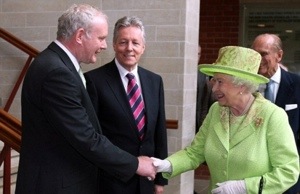
“Last night was a historic one. One sight summed up the importance of the occasion – Northern Ireland’s deputy first minister Martin McGuinness donning evening wear and sitting down to a white-tie dinner of halibut and beef at the table of Her Majesty the Queen in Windsor Castle. The former IRA member was there to mark the visit to Britain of the Irish President Michael Higgins – the first time a head of the Irish state has been officially welcomed to Britain since his country became independent.
“It’s the closure of the circle that started with Queen’s landmark visit to Ireland in 2011, and underscores how entwined Great Britain and Ireland are. But it’s also particularly poignant as one of the moments of Mr Higgins’s visit will be when Her Majesty shows him the colours of the disbanded Irish regiments which hang in Windsor castle, which will serve as a reminder that the Irish fought gallantly in the First World War, and that in this centenary year this is a discreet but potent way for the Irish to move closer to dealing with a past that for a long time was hidden, ignored and treated as something shameful. It is to the Republic’s credit that great steps have been taken to acknowledge the sacrifice of thousands of Irishmen in the Great War, and that we are moving steadily to the point when the Republic’s ambassador, who has only recently started attending the Remembrance Day service at the Cenotaph, will be able to take part fully and lay a wreath.”
Am I right in thinking that one truth which gets completely lost when nationalism dominates – or even influences – our consciousness is that there are no bad peoples, there are only bad, half-good or good people? There are cultural influences among people which can create good or bad tendencies within groups of people, but ultimately changes for the better or otherwise only take place when they take root in people as invividuals.
What now challenges all of us living in these islands off the northwest coast of the continent of Europe is to live in our shared inheritance. This is an inheritance which has been forged over centuries in which our ancestors acted at times gloriously, at times wisely, at times shamefully. It was all there, and what we are today has been influenced by all that. But we do have a choice. While we cannot forget any of those things, and should not deny them, we can choose which of them is going to influence us more in the present and therefore in the future.
Does it not seem that the most important thing about the forthcoming event being organised by Ireland’s new political movement, the Reform Alliance (RA), in the Royal Dublin Society’s conference centre on 25 January is first and foremost the challenge it throws down to us to free our imagination?
Ostensibly “policy” is on the agenda. But unless we break free of the bondage which ties us to habits of thought about ourselves and our society, which have become second nature to us over the past few decades, then we will be wasting our time.
Philip Blond, an English philosopher and political thinker with an Irish lineage, is addressing the conference. This gives us reason to hope that it is all on the right track. Blond has written about the condition of Western society in his paradoxically entitled book, Red Tory[1]. In it he looks at the generally sorry state we have allowed ourselves to get into and how we have enslaved ourselves in all sorts of practical ways.
Philip Blond
However, he writes, even our minds are not free. In order to be truly liberated we have to be able to imagine an alternative to the prevailing order. This we manifestly cannot do at present. So colonised have we become by consumption, fantasies of glamour, and cynicism about the public good that we cannot envisage anything different from that which we currently experience. In order to create such an alternative one has to look both backwards and forwards. Backwards, because history tells us that things were different once and that what has happened need not have occurred. Forwards because with knowledge of an alternative past in a manner that isn’t simply naive or idealistic, it is possible to envisage a better future that we all might inhabit.
That must surely be the starting point and basis for any creative political life which will offer us a way out of the mess we are now in. Our thinking about education, health, social and economic policy has to engage in a truly Promethean struggle and to break itself free from the ideological bonds of selfish individualism and once again see the common good as the only foundation stone on which a just and equitable society can be built.
It is hard to know why we lost the plot so badly. Were we so scared of Communism and Socialism that we overcompensated by elevating the individual to the centre of the universe? Did we then surrender ourselves to selfishness and narcissism – which is the inevitable consequence of setting the individual up as master of all he surveys? Whatever the reason for us getting there, we must now find a way out of this prison.
Blond in his book offers an analysis of why this happened in Britain over the past half century, and what the dire consequences were. It does not take a huge leap of the imagination to see how what he describes applies to the island of Ireland in almost equal measure – or to see that the pace of our pursuit of our neighbour’s folly has increased to breakneck speed. Blond is addressing the RA conference and hopefully he will underline all this in the stark detail which he provides in his book.
He traces a good deal of the rot back to the 1960s when what he describes as “fragments of the middle classes”, some of them associated with the ‘new left – the ultra fashionable intellectual left of that era – “preached personal pleasure as a means of public salvation.” They had little idea what they were doing, he says.
While toxic to civilised middle-class life, this mixture was lethal to the working class. Some measure of sexual liberation was necessary, and could have led to a deepening of loyal relationships between men and women. But, in reality, it was contaminated by narcissism from the outset. For the working class this narcissism meant the dissolving of the social bonds that had kept the poorest together during the worst times of the 1930s – illegitimacy increased and family breakdown began in earnest.
He then goes on to describe how the “new left”, contaminated by this self-centred ideology became disengaged from the politics and needs of working-class people, “as a politics of desire overwhelmed whatever was good and decent in its prior ethic. This license to express the self allowed the advocates of liberation in the late 1960s to embrace drugs and hedonism as if personal emancipation for bohemians would lead to the liberation of all.” The consequences of this were disastrous for the working class as the cancer seeped into the building blocks of society – the family and the communities which families constituted. This corrosive culture of self-indulgence continues to flourish.
The family is the first and the most intimate social institution that human beings have, Blond reminds us, – it might vary by extension but nothing can challenge its decisive importance. But just look at what has happened to the British family: in 1964, 63,300 births were recorded outside marriage, only 7.3% of all births. In 2003 it was 257,225, over 41% of all those born.
If present trends continue, soon the majority of UK children will be born out of wedlock, with all the pejorative consequences for the young that both sociology and statistics have amply elucidated. For example, each child born to unmarried parents has only a 38% chance of seeing out their childhood with both parents present. Marriage is clearly better for children: 70% of children of married parents can expect their mother and father to stay together during their childhood. But marriage is failing too: the number of divorces rose in 2008 to 167,000; in 1961 there were only 27,000 divorces granted.
Do the Irish think they are immune from this contagion? From the way all Irish political leaders are charging ahead with every piece of permissive legislation the Irish liberal left shouts for, you would think they do.
Last year the Iona Institute surveyed the situation in the Republic of Ireland and revealed the following:
<p style=”padding-left:30px;”>■ There are now 200,000 adults who have suffered a broken marriage. This is five times more than in 1986 (divorce was put on the statute books in the Republic in 1996).
■ There has been an increase of 80 per cent in the number of lone parent families since 1986
and the total now stands at almost 190,000.
■ There are 121,000 cohabiting couples, up nearly fourfold in just ten years.
■ The number of children being raised in non-marital families is now one in four, which is
drawing close to American and British levels.
As Blond says, “The picture isn’t pretty” – neither in Britain nor in Ireland. With family breakdown affecting so many – and continuing to increase, – “the fundamental bedrock of civic life has been destroyed.” He points the finger without apology – and Ireland knows that the finger is pointing in the same direction there:
It was some of the very people who thought themselves left-wing – the pleasure-seeking, mind-altering drug takers and sexual pioneers of the 1960s who instigated the fragmentation of the working-class family and sold the poor the poisonous idea of liberation through chemical and sexual experimentation.
And they haven’t gone away, you know.
The whole problem has been compounded by the disastrous corrosion of political life and political institutions. In both Britain and Ireland huge segments of the electorate have been disenfranchised by the merging of all established political forces, left and right, into one amorphous mass of politically correct puppets pandering to that other increasingly arrogant force in the public life of a country – the mass media.
As the influence of this force grew, public representatives needed to take account of it at all times. To do this more effectively they had to enlist the help of professionals from within the media and the “spin doctor” came into existence. The term itself denotes deceitfulness. All this further enhanced the media’s influence to the point where it can only now be described as power. The unelected tribunes within the media now effectively lead the elected representatives along the path of least resistance to goals which they identify as “progress”, manipulating the politicians who live in fear and dread of being pilloried by this new bardic class. This is the trend in every country but true with far more dire consequences in Ireland where a monolithically liberal-left clique dominates the country’s print and broadcast media. Meanwhile increasing numbers of the electorate look on in helpless dismay.
Blond sums it up like this:
The real outcome of the last thirty years of the left-right legacy is a state of disempowerment. Nowadays we have the worst of the left and the right combined in one philosophy: an authoritarian, illiberal, bureaucratic state coupled with an extreme ideology of markets and the unlimited sway of capital. Little wonder then that most Britons feel they cannot influence their locality let alone their region or nation. Passive and compliant, all we can do is shop – and after a while that doesn’t make us particularly happy either.
Members of the Reform Alliance in the Irish Parliament: Billy Timmins, Paul Bradford, Peter Matthews, Fidelma Healy-Eames, Lucinda Creighton and Terence Flanagan.
Many in Ireland – it is estimated that between 40 and 50 percent are disillusioned with all the political options presented to them by the current political establishment – are living in hope. Their hope is that what is now stirring in the public square will emerge as a political force to challenge this essentially corrupted status quo. They hope that it will restore integrity to the system, that it will offer them something in which they can again place their trust, their aspirations for the future, the future of their children and their country.
[1] Blond, Philip, Red Tory. How the Left and Right Have Broken Britain and How We Can Fix It. Faber and Faber, London. 2010.
There is more good news for the disenfranchised Irish in today’s Sunday Independent (Dublin).
The paper reports that the Reform Alliance, initiated by the members of the Irish parliament expelled for voting against abortion for reasons of conscience,will stage its first rally rally this month as it seeks set out its principled stall in the political arena.
The Alliance, the paper tells us, has been secretly planning the event – scheduled for January 25 – over the past two months away from the glare of the media spotlight.
“We thought, ‘New Year, new political ideas’. The timing seems right,” Ludinda Creighton told this newspaper last night. She added: “This is not about any one individual, but about being a vehicle for new thinking.”
The Alliance is currently made up of seven former Fine Gael party members; TDs Ms Creighton, Denis Naughten, Billy Timmins, Peter Mathews and Terence Flanagan and senators Paul Bradford and Fidelma Healy Eames.
There will be no shortage of snipers ready to try to take down this brave effort to put integrity back into Irish public life. The online comments with the Indepandent’s story offers plenty evidence of sniper activity. The left-liberal alliance is not going to sit around but will be out with all guns blazing. This movement is anchored on principles – honesty, respect for the truth, trust, sincerity and loyalty. The actual debate is something else. Let us all first agree on the principles. The rot in Irish political life is not in the policies primarily. Any rottenness there comes from the rot in the minds and hearts of those at the head of the political machines colluding in the system. Reform, radical reform at this deepest level is what is necessary. Reform the roots and the branches will flower.
Where does the much-trumpeted legislation for the abortion of unborn children introduced by the Republic of Ireland’s Government now stand? Currently it seems to be in some trouble. It sounds even worse – depending on your point of view – that President Obama’s Obamacare debacle.
The Irish College of Psychiatrists has advised its members not to participate in reviewing cases where women might look for an abortion expressing suicidal thoughts. They want proper clinical guidelines and the provision of these is fraught with difficulty – indeed some would say are impossible because they will be unable to provide doctor with any kind of legal protection.
The College has described the enactment of the Protection of Life During Pregnancy Act without clinical guidelines as “very haphazard and unsatisfactory” and has expressed “extreme concern” at the absence of any guidance for general medical practitioners on accessing suitable psychiatrists to assess a pregnant woman showing signs of suicidality; at the absence of guidelines for a psychiatrist seeking a second psychiatric opinion; and the lack of training for obstetricians in up-to-date psychiatric issues as well as for psychiatrists in obstetric issues.
The Protection of Life During Pregnancy Act came into force on January 1st. A “Guidelines on Implementation Committee” was appointed last year by the Department of Health to draw up clinical guidelines on how the legislation would work in practice but this has yet to report.
The Act provides that a pregnant woman who is expressing suicidal thoughts and seeking an abortion may have one if three medical practitioners, including two psychiatrists, have “jointly certified in good faith” that there is a real and substantial risk to her life by suicide which can only be averted by an abortion.
There is also provision for a review panel, to be “established and maintained” by the Health Service Executive (HSE) “of at least 10 medical practitioners”. On this basis the HSE must request medical bodies, including the College of Psychiatrists, to nominate members to be appointed to it. Psychiatrists are not at all happy with this.
Miriam Silke, representing the College, told The Irish Times that until the guidelines were issued the college would not recommend to its members participation in the panel. “We simply do not know when they will be issued. We have not heard anything since the Bill came into law. I presume work is progressing but they aren’t imminent. It is very haphazard and unsatisfactory.”
“Dr Anthony McCarthy, perinatal psychiatrist at the National Maternity Hospital and former president of the college, said the new legislation failed to provide ‘real solutions’ for women in distress. A pregnant woman expressing suicidal thoughts would be seen by a psychiatrist, he said, but if that psychiatrist wanted to get a second opinion it was unclear how this would be obtained, the Times reported.
Dr. Ruth Cullen of the Irish ProLife Campaign issued a statement on the latest debacle on Saturday saying that “the deep-seated flaws in the Government’s new abortion law are starting to reveal themselves.”
Dr. Cullen added: “The Government knew perfectly well when it introduced the law that abortion is not a treatment for suicidal feelings and may in fact be detrimental to women’s health.
“The fact that the Government this week activated the new law without any clinical guidelines in place is further proof that the push for abortion legislation over the past year had everything to do with achieving an ideological goal rather than concern for women’s lives or the lives of their unborn babies.
“The truth behind the deep-seated flaws in the new legislation are starting to reveal themselves. This will only continue as more and more people begin to realise that the new law was never about evidence based medicine but about introducing an abortion regime in Ireland.”
Another fine mess from Prime Minister Kenny and his gifted Minister for Health, Dr. James Reilly.
Colette Browne, ultra feminist, ultra liberal and cheerleader of the pro abortion campaign in Ireland seems worried – although she is trying to hide it.
She is not alone.
Deep down the “monstrous regiment” of men and women which manipulated the Irish political system to legislate for abortion on demand with the formula “I-demand-an-abortion-and-I will-kill-myself-if-you-don’t-give-me-what-I-want” know that they have awakened the conscience of a nation – and they fear the consequences.
Enda Kenny is widely seen as having betrayed those who elected him by wilting under the pressure from Ireland’s left-liberal league and put a very flawed – even from a purely legal point of view – abortion act on the statute books. The medical profession is is now telling him that his act is unworkable. No Irish politician in living memory has been looked on with such distaste or has been spoken of in such hostile terms as this man has.
After his perceived betrayal of the electorate Kenny then mercilessly punished his political party members who refused to go along with his folly. These have since begun to talk to each other about reform of the Irish political environment and in a language which is music to the ears of voters who for the life of the current Government, and longer, have experienced wholesale disenfranchisement. This group now stands poised to put together a political option for these disenchanted voters. At a conservative estimate this group probably now constitutes more than 40% of the Irish electorate.
With an admirable strategy the reformers are not rushing to set up any definitive structure but are simply setting up a stall to attract politicians of any and all parties who are sick of the deceitful and self-serving politics which Kenny and his rump is now identified with. Just now, the water is being tested to find women and men for whom principle, integrity and decent human values come first. Policies will follow but will follow in a mould consistent with those values.
Kenny is currently trying to garner credit of Ireland’s tentative economic recovery. But Ireland’s relatively competent permanent public servants, the International Monetary Fund , the European Central Bank and the European Commission are the ones who have rescued Ireland from its notorious bailout. All the Irish political parties were complicit in the creation of the economic melt-down which necessitated the drastic measures which corrected it. Whatever party was in power when the bailout was forced on Ireland would have done what Kenny’s coalition government has had to do. No choice, no credit. The Irish people are not fools. They know this.
Colette Browne
So what is the problem for Browne et al? It is this. They see an embryonic political movement which has the potential to set at naught all their political scheming to turn Ireland into a “progressive” and “modern” society made to their own image and likeness. They want to kill off this embryo before it has a chance to complicate their lives and their dream. Browne’s chosen tactic, employed in a recent column in the Irish Independent, was cynicism and abuse.
Other than a love of spouting meaningless banalities about the need for unspecified change and reform . . . what does the Reform Alliance (the provisional designation of the new movement) stand for? She asks.
Rhetorically she wonders why we are so convinced that we need a new political party when no one knows what it will stand for. Something of a non sequitor there?
In her response to the case for a new party put by an independent member of the existing Dáil (parliament) she retorts: “Sounds great doesn’t it? A thrusting new young party to enter the political fray and shake up the cosy-consensus politics that has come to dominate Leinster House.”
She asks: “Where does it stand on economic issues? With none of its members voting against the Government on any money bill, can we assume that they support the Government’s economic policies?
“What about social issues, such as abortion and gay marriage? We know that the members have a very conservative attitude to abortion but does this conservatism also seep into other areas?”
She knows full well that at this stage this movement is not about policies because there is no party yet to have an articulated policy. What she and others want is that these individuals might act prematurely so that they could then be slaughtered. She knows full well what some of them are thinking but she and others cannot properly begin their attack until policies are articulated. This is very frustrating.
Ms Lucinda Creighton, Browne reminds us all, has previously stated that she is against gay marriage and another member, Fidelma Healy Eames, has railed against the “scale and pace” of social legislation undertaken by the Government. Lucinda Creighton, formerly a Kenny government minister was the most prominent member sacked by him for her disobedience to the machine. She is clearly the driving force behind the new movement – and consequently the number one target that the liberal left want to get their teeth into. But she is too wily for them.
Browne then goes on to moan about the sameness of Irish political parties and analyses the problem pretty well: Irish voters now have no meaningful choice when they go to the polls. She does not put it this way, but the truth is that in recent elections Irish voters were presented with a range of politically corrected puppets of the liberal and equally monolithic Irish media to chose from. But clearly Browne does not like what she sees coming down the tracks and her strategy is to shout to us all, “Don’t be fooled – this is just more of the same.” That is where a great number of Irish people hope she is wrong. There is now an expectation that the local and European election in a few months time will show the true state of Irish political opinion. Some see these elections and the national elections due in over a year’s time as an opportunity for the biggest shake-up in Irish politics in 80 or 90 years.
Ireland’s Iona Institute points out how the country’s Justice Minister is speaking with a forked tongue.
In the Irish parliament this week, the Institute says, Alan Shatter delivered a speech that inadvertently but comprehensively demonstrated the case against redefining marriage.
We have said all along that redefining marriage radically redefines parenthood, attacks the rights of children and attacks freedom of religion. Minister Shatter’s vision of the family as outlined in his Dail speech proves this.
He sees no special place in Irish law or social policy for motherhood or fatherhood or the natural ties.
He has no real understanding of the state of marriage in Ireland currently.
He has a very shrivelled view of religious freedom.
The words ‘mother’ or ‘father’ appear nowhere in his speech. He simply does not seem to believe that society has any special interest in encouraging men and women to raise their children together in loving unions.
There is no indication that he sees the sexual unions of men and women as being different in any socially significant way from any other kind of sexual union, or indeed from any other kind of emotional union, period.
He was very far from the mark when he said in his speech, “we are more deeply attached to marriage as a society than ever”.
It is true that more of us are married in absolute terms. But that is only because there are more of us anyway.
But our marriage rate is now lower than Britain’s, and Britain’s is the lowest it has ever been.
More than a third of births are outside marriage. Almost 250,000 Irish people are divorced or separated and our rate of cohabitation has soared.
If the Minister for Justice is unaware of these facts, or is prepared to ignore them, then that is deeply worrying. What, if anything, would compel him to say, we are no longer so attached to marriage?
On the matter of religious freedom, he told the Dail that he will ensure religious solemnisers of marriage don’t have to perform same-sex marriages. But the Constitution almost certainly forces him to do that in any case.
But what happens to marriage guidance counsellors, wedding planners, wedding stationers, florists, photographers? Must they all go along with the proposed redefinition of marriage or be driven out of the business? The answer appears to be yes.
So Minister Shatter’s speech shows just how high the stakes are in this debate and how vitally necessary it is that we play our part in it.
Irish media reported today that the first abortion has been carried out in a Dublin maternity hospital under its new law. The reports, it transpired, were inaccurate and a government agency spokesperson clarified in the course of the day that the law has not yet come into force. The significance of the reports, however, is that they show the blurring of the lines between what is ethical medical practice and the muddled practice that is likely to follow from this legislation and which may be anything but ethical.
The Irish Times once again enraged readers with its heavily nuanced report in which it was not difficult to detect, reading between the lines, its triumphal view that this was more evidence that the march of progress in Ireland was well under way.
The Pro Life Campaign (PLC) issued a statement in response to the reports. Dr Ruth Cullen, its chairperson, said: “While the precise circumstances surrounding the intervention in this tragic case are unknown, what is clear is that the Government’s abortion legislation permits doctors to blur the distinction between necessary life-saving interventions in pregnancy and induced abortion (where no effort whatsoever is made to save the life of the baby).
“Now that the blurring of such important ethical distinctions is permitted in law, it is inevitable that abortions directly and intentionally targeting the life of the unborn child will take place, even on the threat of suicide ground, where there is no medical evidence to justify an intervention.
“This is the stark reality of what members of the Oireachtas voted for recently and why the pro-life movement was so vocal in its opposition to the Bill.
“The new abortion law was not needed to safeguard women’s lives in pregnancy. The tragedy reported today of a mother losing two children has been used again to give the misleading impression that the recent abortion legislation was needed to safeguard women’s lives.
“The HSE confirmed today that the law has not yet come into force. On foot of this, one has to ask is The Irish Times suggesting that the law was broken by the doctors in Holles Street or does it now accept that the new law was not needed to protect women’s lives?
“In truth, life-saving interventions have always been in place. Ireland, without abortion, is a recognised world leader in safety for pregnant women. It is a tragedy that those campaigning for abortion legislation have been successful in creating the opposite impression,” she said.
Dr Cullen also expressed concern at the way The Irish Times today repeated the claim that Savita Halappanavar died because she was denied a termination of pregnancy.
“The Irish Times has obviously decided to ignore the conclusions of the coroner’s inquest into the tragic death of Savita and decided instead to stick rigidly to its original misleading presentation of what happened. This is most regrettable,” Dr Cullen concluded.
The ruthless totalitarian tendency of the Irish Government seems to be coming to the attention of some politicians on the continent of Europe. The Chairperson of the Group of the European People’s Party in the Council of Europe and a member of the Italian Parliament, Luca Volontè, has declared that it is “truly shocking to see the government of an advanced Western country trying to deny the basic human rights of its own citizens like this.” He is talking about the Irish government of Enda Kenny and Eamon Gilmore.
“Even nations with the most permissive abortion laws do not normally go so far as to trample on the basic right to conscientious objection.” Volontè, Chairman of the Dignitatis Humanae Institute said in a statement two days ago.
Volontè, speaking of the Kenny government’s abortion legislation which will force health providers to act contrary to their ethically held principles, continued: “This bill claims human rights apply only to human beings, and not to institutions. But such a manipulative attempt at semantics casually disregards what it is that defines an institution, particularly a healthcare provider – at its core is an ethos, and individual employees who are dedicated to fulfilling that ethos. Far from seeking to maintain an amoral healthcare system, this bill will impose a new morality upon hospitals and those who serve in them, one which allows for no objection and uses all the authority of the State against any who would refuse to be accomplice to a clear moral evil.”
The cynically entitled “Protection of Life During Pregnancy Act” – which, if honesty were the hall-mark of the Irish Government, would be entitled the “Selective Protection of Life During Pregnancy Act” – explicitly denies the right of conscientious objection and enforces a no-right-to-refuse condition upon 25 Hospitals.
Recalling his work as the President of the European People’s Party (the largest party) in the Council of Europe Parliamentary Assembly in Strasbourg, Luca Volontè added that the Council of Europe´s Resolution 1763 clearly states:
“No person, hospital or institution shall be coerced, held liable or discriminated against in any manner because of a refusal to perform, accommodate, assist or submit to an abortion, the performance of a human miscarriage, or euthanasia or any act which could cause the death of a human foetus or embryo, for any reason.”
Such compulsion would be unprecedented in Ireland, and has been successfully challenged recently elsewhere.
In April this year, a Scottish Court ruled in the ‘Doogan & Anor v NHS Greater Glasgow & Clyde Health Board’ trial that two midwives could not be required to delegate, support or supervise staff who were involved in abortions. It looks like the Irish courts are going to be busy sorting out the human rights mess which the Irish government has created for itself with this legislation as it tramples on the rights of the unborn and on the rights of all its citizens.
Despite repeated refusals from the Irish Department of Health to work out an accommodation, Luca Volontè spoke of his hope for changes to the proposed law: “It is not unreasonable to ask for exemptions for staff (or institutions) on the grounds of conscience, whether they be religious or ethical; such accommodation is provided in many other Western nations which practice abortion. Freedom of thought and/or conscience is not only guaranteed by international law, it is innate to our human dignity. It is truly shocking to see the government of an advanced Western country trying to deny the basic human rights of its own citizens like this.”
A message from Ireland’s Pro Life Campaign – No Surrender!
The abortion Bill passed through the Seanad this evening. It has been a very difficult and gruelling few weeks for pro-life supporters.
This video captures the mood and feeling outside Leinster House when pro-life people came together in silent vigil during the Dáil and Seanad votes on the abortion bill.
The road back will not be easy but the strength and resolve of the pro-life movement which has emerged in recent months is the kind of foundation that will ensure this unjust law will be overturned.




 Garvan Hill