Signs of promise of a new Irish politics

Lucinda Creighton – not going away anytime soon

If anyone, in the aftermath of last week’s shameful political shenanigans in the Irish parliament, doubts the character and determination of sacked Minister, Lucinda Creighton, to be a force in the public life and politics of that country in the years ahead, let them begin by reading her blog entry today. It was published in the Irish Mail on Sunday and is now posted on Lucinda Creighton.ie.

This is not a manifesto for a future Irish politics but it is a preliminary for such a manifesto. It addresses from the depths of her heart and soul the concerns which thousands of Irish people share with here this week – not just on the issue of abortion but on the corruption in the very heart of a country which in just two and a half years will be celebrating the centenary of the beginning of its final battle for freedom and independence as a state among the nations of the earth. What freedom, what independence, many are asking? Lucinda Creighton seems to be on the verge of offering Ireland something to make that a redundant question.

On July 1st she delivered a speech in the Irish chamber of deputies, the Dail, in which she elaborated her concerns about abortion in a general societal sense, as well as focusing on specific aspects of the proposed and shamefully designated Protection of Life in Pregnancy Bill which she considered, and still considers, to be deeply flawed.

In it she referred to an underlying cancer afflicting Irish public life – in politics, in business, and above all in the media. Reaction to that was near-apoplectic in some quarters. The cries of hurt and indignation from those who thought they were being targeted made headlines the next day

“My speech”, she correctly says, “was incorrectly picked up as singling out members of the Fine Gael Parliamentary Party for participating in group think. This is not what I said.”

“What I said in fact, was that group think is a negative feature in society, in the media and in political life. Increasingly we are all supposed to think and speak the same way. There is less and less room in this country for a diversity of opinion, for real and meaningful debate and for genuine analysis. We are all supposed to swim with the tide on every occasion. I consider this dangerous. I am certain that this is dangerous for our democracy.”

That is just as things are in Ireland and the daily exasperation of the millions who listen to and read what the Irish media turns out on a daily basis is sufficient evidence to prove it. When the manifesto for a New Ireland come this must be among the serious illnesses to which it will address itself.

Bloody but unbowed, Ms. Creighton tells us that “This was a long and difficult week, particularly for many in the Fine Gael party. Five of us argued for the right to express an alternative … view on this vitally important piece of legislation. We lost the internal battle to have our voices heard and our consciences respected. This is not a good thing for the democratic process in this State.

“Much of the commentary in the aftermath of Thursday’s vote confirmed to me that our media perpetuates the blind group think which prevailed and contributed to the economic collapse in this country.”

She tells of her “alarm” listening to one of Irish radio’s premier news analysis programmes on the morning after her historic stand against the “flawed” legislation.  “The level of analysis or understanding of what is happening in our shambolic Parliamentary system was alarming,” she said.

“A commentator from the Irish Times seemed only capable of understanding the events of the week in terms of ‘strength’, ‘power’ and ‘crushing opponents’. To him it was just a numbers game. He was entirely uninterested in the substance of the disagreement, or the fact that an important viewpoint was ignored or ‘whipped into line’.

“He seemed to believe that the only issue at hand was the fact that ‘only five’ TDs had voted against the legislation and this was somehow a great victory for the Government, its senior figures and Fine Gael. This is a sad and shallow analysis, which ignores the fundamental questions of democracy which were raised thoughout the last few weeks when elected Members of our Parliament were, in many instances, coerced and cajoled into voting for legislation they clearly considered to be faulty and against their better judgement.”

One of the most shocking spectacles in the drama in the Irish parliament last Thursday and into the early hours of Friday morning was the speech of a young woman member, Michelle Mulherrin, voting against her conscience after the whipping she had received from the party leader, Prime Minister, Enda Kenny. Ms. Creighton’s response to it says it all. “I understand completely the dilemma she found herself in. I was there too. I took a different decision, by voting against the legislation. She clearly wrestled with her ultimate decision and eventually decided to vote for it. She did so to avoid being “booted out” of Fine Gael, her party. I felt sick to the pit of my stomach listening to her speech in the Dáil Chamber – out of sadness for her, and the choice she has clearly been forced to take to avoid expulsion. There is something so, so wrong with this. Citizens of this country ought to be concerned at the words uttered by Michelle. They genuinely gave me a deep sense of foreboding.

“In every other modern western democracy that I have studied, public representatives are not and would never be, forced to choose between their conscience and their party. That is worth considering and reflecting upon. This includes Australia, New Zeland, the USA, the Netherlands, Germany, Belgium, Switzerland and many, many more. In my investigations I could not find any other democratic country on this planet that forces people to vote against their conscience. Ireland has the dubious distinction of standing alone in its denial of conscience. This is not something I am proud of. Nobody should be.”

“The great democrat and peace maker Mahatma Ghandi said ‘In matters of conscience, the law of the majority has no place’. This is correct. History has taught us what savagery and crimes against humanity can occur, when people abandon their conscience, for the sake of the quiet life, or worse, to satisfy personal ambition. Our State should guard against this, rather than try to normalise it. And we as citizens should demand that this be so.”

She concludes by saying that politicians in her country “really do need to stand up and be counted” – and there will be more cries of hurt and pain from the numerous public representatives who know very well that they have failed to do so, and who have not had the courage to tell the truth about their shame like Deputy Mulherrin.  Ms. Creighton sees the value of the discipline in parliamentary democracy. “I don’t advocate the abandonment of the Whip system. It is an essential fundament of a stable economy and a stable society. Coherent positions and voting by political parties are essential in the context of the annual Budget, all finance measures, social welfare measures and so on. But there it should stop.”

Finally, she has a word for those “commentators” who cheer the crushing of political opponents, and applaud the stifling of debate in Ireland. We are back to the driving force behind group think. They “do no service to either good journalism or good politics. In fact they are complicit with the rot in a system which so desperately needs changing. Their anxiety to take quotes and spin from ‘well placed sources’ may make their contributions sound plausible and knowledgeable. In fact, they are missing the real story.”

There has been a good deal of sympathising, moaning, regrets at the loss of a promising political voice in Irish politics over the past few days and this weekend. These words tell us that we need not worry. This is a voice which is not going away and for that the Irish should all – well, nearly all, – be very grateful. There will be no shortage of stories, real stories, coming down the line.

Victories, but no peace in sight

Austin, Texas

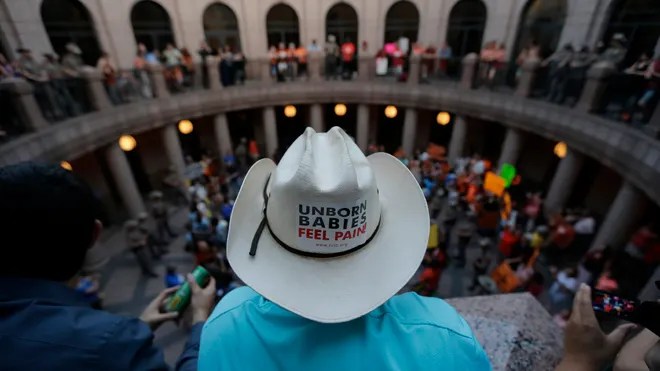
This week, over in Texas, another pro-life battle raged in the Austin legislature. But in this case victory went to the pro-life side – for now. It all goes to show that what we are engaged in is a global struggle and one that will continue for a long, long time.

The words of the Texan pro-abortion Democrats – who lost this battle – could be taken as a mirror image of the words of the Irish pro-life campaigners facing their defeat in Ireland’s legislature this week, bloody but unbowed. This battle in the culture war will run and run. Eden is a long way off.

The New York Times reports from Texas: To explain why he and his colleagues continued to fight when the outcome was certain, Mr. Kirk Watson, the chairman of the Senate Democratic caucus, posted a Facebook photo earlier in the week showing an orange T-shirt bearing a statement: “A foregone conclusion has never stopped a group of citizens committed to ideals of democracy and liberty from taking a stand and fighting with everything they’ve got. This is Texas, baby. Remember the Alamo.”

The next step will be a court challenge to the new law before Mr. Perry’s signature has time to dry; the many proposed amendments and discussion of them were clearly intended to build a record that could eventually be reviewed by the courts.

In closing her own speech late Friday night, Ms. Wendy Davis told the groggy lawmakers, those in the gallery and beyond, “The fight for the future of Texas is just beginning.”

And then, minutes after the vote, she spoke again, through a bullhorn, to an immense crowd of supporters in front of the Capitol building. Ms. Davis called out to the orange-clad throng to turn their anger into political change. “Let’s make sure tonight is not an ending point,” she said. “It’s a beginning point as we work to take this state back.”

Inside the Texas Capitol

“When I use a word,” said Humpty-Dumpty Kenny “it means just what I intended it to mean, and neither more nor less.”

Paraphrasing Lord Hartley Shawcross: “The Dáil is sovereign; it can make any laws. It could ordain that all blue-eyed babies should be destroyed at birth, and because the Dáil so declared it, it would be legal.” More or less, setting aside the small complication of a Supreme Court appointed by the same sovereign and a Head of State who owes his position to the manipulation of the Fourth Estate. We will have legal abortion in Ireland in a matter of weeks.

Legal, but utterly immoral. It is not enough that Parliament “reflect” society. Parliament’s duty is seek justice and legislate according to the principles of that justice and right reason. In the Irish parliament’s debate on abortion – and debate was all it was, a debate without any determining effect – one member spoke of Ireland’s old law prohibiting the destruction of children awaiting birth as being “out of kilter with society”. Well, that parliament has now changed this and by an abuse of the spirit and letter of its Constitution has legalized the snuffing out of those lives.

Abuse? Yes. The party system, governed by a whip regime, the exercise of which in this case proved to be nothing short of totalitarian, has lead to this immoral law being passed and in the process of so doing  has denied the representatives of the people their fundamental right of personal political judgement and freedom of conscience.

But what was more frightening about the entire process which has led to the passing of this bad law was the abuse of language. Yesterday’s statement from the Pro Life Campaign  outlines some of it – the questions which the Parties-in-Power refused to answer or answered with blatant untruths. But it went much farther that this. It was indeed surreal. It reminded one of Alice in Wonderland.

‘“When I use a word,” said Humpty-Dumpty “it means just what I intended it to mean, and neither more nor less.”

“But,” said Alice, “the question is whether you can make a word mean different things.”

“Not so,” said Humpty-Dumpty,” the question is which is to be the master. That’s all”.’

Taoiseach Enda Kenny kept telling the Irish people that he was not changing Irish law, that he was not introducing abortion to Ireland, etc, etc. Yet the international Press, the pro-abortion lobbies across the world were rejoicing at what he was trying to do and are celebrating today. They grasped the truth of all this. Is he stupid? does he think the Irish people are stupid? Or is he Humpty Dumpty?

But Humpty-Dumpty had a great fall. Mr. Kenny’s natural political life is coming to an end. Most people expect that he will not contest another general election. Some regret that because they would like to see him fall like Humpty Dumpty.

“My end is my beginning”, Mary Queen of Scots, is reported to have said before she went to the block. Ex-Minister Lucinda Creighton will not go to the block but had she lived in the age of Mary she might have. Nevertheless, very many Irish people hope that Queen Mary’s words will apply to her – that Kenny’s taking of her political life will be just the beginning of a political life free from a system as corrupt as that which he sought to impose on her. She and the four party colleagues who broke from the straitjacket their leader tried to force them into – along with the senators of the party who will do the same over the next few hours – stand tall among the sad members of that party who professed themselves to be pro-life and then voted for abortion.

Ireland needs a new politics. Lucinda Creighton and her honourable colleagues offer a new hope that the disenfranchised Irish might get this.

Conscience-free politics – truly bizarre

Two faces of Irish politics – Creighton and Kenny

Irish TAOISEACH (prime minister) Enda Kenny thinks politics is all about fixing things. He is a mechanic without a clue when it comes to principles – either philosophical or anthropological, not to talk of his bizarre theology. He is now is facing an unprecedented party rebellion for the very reason that he has failed on all these counts. Those who rebelled against him in the Irish parliament – and those who will do so over the next two weeks – know that there is more to life and the pursuit of the common good than “arranging things” so that those who want to can do what they like – regardless of its consequences.

This abortion Bill which the Irish parliament is about to pass into law will be the undoing of Kenny’s reputation as any kind of statesman. It may also be the undoing of his party and many are hoping that it may be the catalyst which will bring about a realignment of Irish political forces into a meaningful one where the illiberal ideologues of the left, and their populist followers, will be confronted with a politics guided by a true perception of humankind and its common good.

Kenny – and the governments of whatever party mixes which have been in power for the last 20 years – inherited a constitutional mess created by a rogue Supreme Court decision, the notorious “X” case decision, based on faulty evidence. This decision compromised the Irish Constitution’s guarantee of the right to life of children in their first nine months of life. Kenny and his acolytes’ ham-fisted effort to “fix” this mess is even more flawed than what it tried to fix.

Mr Kenny has adopted a hardline stance against those who voted against the Government’s legislation last night. He expelled all four members from the parliamentary party immediately, promising to end their political careers. But Irish people looking on at this debacle can now see a handful of principled politicians who are prepared to think about what they are being asked to sign their names to. On the other side they see a crowd of sheep following a leader who ordered them to vote with him, regardless of their conscience.

Both Ireland’s main political parties – whose origins go back to Ireland’s Civil War over 90 years ago – now look like unravelling. The Fianna Fail party leader, Michéal Martin, supports the legislation and if principled voices within the party had not prevailed he would also have denied its members freedom of conscience on this matter. Potentially the Irish parliament has now been divided into two camps, those from who conscience counts for something and those for who it clearly counts for nothing – for it it doesn’t pertain to matters of life and death what does to what does it pertain?

This unravelling will be no bad thing. There is every hope now that the women and men of principle – of any and no party – inside and outside the parliament might now come together to give an effective voice to a disenfranchised electorate disillusioned for at least a decade by a political culture devoid of anything other than a “fix-it-up-at-any-cost” mentality.

Lucinda Creighton, a Minister in Kenny’s government, whom all observers expect will take her stand against him on the issue next week, made a powerful defence of the dissidents’ case in the parliament yesterday and would be the natural leader if a new political force were it to emerge. If it does this will be no single issue movement but a movement based on a vision of human society and the true nature of humankind within it – just, free and enterprising. There are many currently outside the formal politics of the country who would have been ashamed to stand beside those currently in power but who would be very happy to cooperate and support those who are now revealing themselves as politician with principles.

Ms. Creighton put her cards on the table in the parliament in a long, articulate and detailed speech on Monday. At one point she told us that I’ve had people contact me in recent months condemning me for having a ‘moral’ or ethical concern about abortion. Some demanded that I leave my morals or conscience aside in order to support abortion. Now I must say that I find this bizarre.

There is an emerging consensus in Ireland which suggests that having a sense of morality has something to do with the Catholic Church. It is automatically assumed that if you consult your conscience, you are essentially consulting with Rome. This is deeply worrying. It is a lazy way of attempting to undermine the worth of an argument, without actually dealing with the substance. This is not just a Catholic issue, any more than it is a Protestant or Muslim issue. This is not a religious issue. It is a human rights issue.

This was nothing less than a veiled criticism of her leader who has been proclaiming his peculiar brand of religion and politics around the country over the past few months – a very bizarre political philosophy indeed.

I wonder what one should consult when voting on a fundamental human rights issue such as this, Ms. Creighton continued, if not one’s own conscience? My personal view is that all I can do, when making a decision on life and death, and that is what we are considering here, is consult my conscience, which is based on my sense of what is right and what is wrong. What else can I consult? The latest opinion poll? The party hierarchy? The editor of the most popular newspaper?

I mentioned groupthink, which is a corrosive affliction in this country. We saw it in the Haughey era, we saw it during the Celtic Tiger era, and we see it on this question of abortion. It is easy to understand why people in positions of responsibility want thorny issues to simply disappear. It is far easier than risking conflict, unpopularity or worse; paying the price for speaking up…

Some were very offended by her groupthink remark. Well, they would, wouldn’t they? ‘Groupthinkers’ never see themselves as such.

This is a voice we have not heard in Irish politics for many years. This represents a political philosophy of depth and substance worthy of Ireland’s greatest political thinker, Edmund Burke. Hopefully this will be the beginning of a new era in Irish politics in which cant, posturing and “fixing” will be a thing of the grim past.

A further six Fine Gael may follow Ms. Creighton next week. With two thirds of Michéal Martin’s party voting contrary to his line and without any substantial policy differences between them and the Fine Gael rebels on other issues, there is every hope that the old outdated party structure might finally crumble.

Green shoots of an Irish Spring?

09c28-37077_10151429033962363_1934346932_n

In the New York Times today Thomas Friedman raises a question posed by a former C.I.A. analyst which roused my curiosity and made me half wonder if it might not be a lead-in to a piece about our current discontents here in Ireland.

Why are we seeing so many popular street revolts in democracies? OK, our generally polite demonstrations on the pro-life issue have hardly been revolts. Nevertheless, the underlying anger and resentment which they reveal do not seem to be too far short of something more serious and do suggest that in them there might be a suggestion of the green shoots of an Irish Spring.

In mulling over the analyst’s question Friedman describes a political response which will be familiar to all in a Brazilian, Turkish or Russian context. But it also has a resonance in the context of many political conversations which I’m sure many of us have had on the island of Ireland. The rising discontent is palpable since it became clear that the bigger partner in our current government nakedly betrayed the trust which a sizeable portion of its electorate placed in it at the last general election on the issue of abortion.

The American analyst, Paul R. Pillar, in a recent essay in The National Interest, asks: “The governments being protested against were freely and democratically elected. With the ballot box available, why should there be recourse to the street?”

Friedman believes that the convergence of three phenomena provides an answer. Whatever about the other two, the first certainly has an uncomfortably familiar ring in the Irish contect. It is what he describes as the rise and proliferation of illiberal ‘majoritarian’ democracies. “In Russia, Turkey and today’s Egypt, we have seen mass demonstrations to protest ‘majoritarianism’ — ruling parties that were democratically elected (or “sort of” in Russia’s case) but interpret their elections as a writ to do whatever they want once in office, including ignoring the opposition, choking the news media and otherwise behaving in imperious or corrupt ways, as if democracy is only about the right to vote, not rights in general and especially minority rights.”

Rights is what is vexing the Irish electorate just now – not just any ordinary rights but what most people consider basic fundamental rights, like the right to life and the right of freedom of conscience. The discontented among the Irish consider that these rights are now being trampled on by their government. Not all politicians are ignoring what many consider to be the high-handed and deeply undemocratic behaviour or the ruling parties in government.  Some are resisting being dragooned into supporting the pro-abortion legislation now being pushed through the parliament.

One, who just yesterday declared his rebellion against the Party, summed up the basis for his revolt as follows:

“This bill is not in line with Fine Gael values and some of our long-term supporters are very distressed with the current state of affairs,” Fine Gael TD Terence Flanagan has told the Sunday Independent newspaper. “I am totally in favour of women getting all necessary supports during pregnancies,” he said, but added: “Most people would not be impressed with a TD who voted for something that they believed to be fundamentally wrong.”

Flanagan has declared that in the new law which will require Irish hoppitals to perform abortions there is “real and significant cultural change” being engineered in those institutions.

Highlighting one of the things which is driving pro-life Irish people to despair in their government, he pointed to the way in which the parliament has been simply going through the motions of debate and ignoring the arguments put before it. He said: “Over the course of two sets of hearings conducted by the Joint Committee on Health and Children, we were presented with compelling evidence that abortion is not a treatment for suicidal intent; in fact, it may even contribute to it.”

The Fine Gael TD said: “It gives me no pleasure to dissent from my party, but prior to the last general election, Fine Gael gave a commitment to the electorate that it was ‘opposed to the legalisation of abortion’. In deciding how to legislate on such a uniquely life-or-death issue as abortion, a legislator must have the freedom to follow his or her own conscience on the matter.” He added that he did not agree “with those who say we should set aside our own beliefs when we deal with so grave an issue”. As a legislator he considers that “I am constitutionally free to oppose this bill and I am conscientiously obliged to do so”.

What the protesters in Turkey, Russia and Egypt all have in common, Friedman argues, is a powerful sense of “theft,” a sense that the people who got elected are stealing something more than money: the people’s voice and right to participate in governance. Nothing can make a new democrat, someone who just earned the right to vote, angrier, he wrote. The Irish are not exactly “new democrats”. They have struggled against governments which imposed unjust laws before. They are angry now because they have to do what they never thought they might have to do – give vent to extra-parliamentary rage against their own elected government.

As Egyptian satirist Bassem Youssef wrote in the Egyptian daily Al Shorouk last week, on the first anniversary of the election of President Mohamed Morsi of the Muslim Brotherhood’s party: “We have a president who promised that a balanced constituent assembly would work on a constitution that everyone agrees on. We have a president who promised to be representative, but placed members of his Muslim Brotherhood in every position of power. We have a president and a party that broke all their promises, so the people have no choice but to take to the streets.”

The Irish now have a prime minister leading his party toward legislation which is the very opposite of what he promised them to get elected. Furthermore, he is doing so in spite of all the expert evidence being given to him that his proposed legislation is deeply flawed. He is seen as not even attempting to address this evidence with any kind of counter-argument. His actions are seen as having all the subtlety of a steamroller. It is the same fuel which is driving all discontented democracies.

Friedman’s second converging element is in the economic sphere and this is not absent from the Irish scene either. The rising anger he sees across democracies comes, he thinks, from the failure of governments to level with their electorates on what is really going on and in particular about all those things which are squeezing the middle class and the aspiring middle class, the working backbone of all electorates.

The last element contributing to this convergence is the crucial one of means to an end. Democracies now have new weapons in their arsenals. “Thanks”‘ Friedman says, “to the proliferation of smart-phones, tablets, Twitter, Facebook and blogging, aggrieved individuals now have much more power to engage in, and require their leaders to engage in, two-way conversations — and they have much greater ability to link up with others who share their views to hold flash protests. As Leon Aron, the Russian historian at the American Enterprise Institute, put it, ‘the turnaround time’ between sense of grievance and action in today’s world is lightning fast and getting faster.” All this is also playing out in the Irish body-politic, playing a big part in bringing 40,000 demonstrators on to Dublin’s street in the beginning of June, the biggest pro-life demonstration in the country’s history.

The net result of Friedman’s convergence across the world is this: “Autocracy”, Friedman writes, “is less sustainable than ever. Democracies are more prevalent than ever — but they will also be more volatile than ever. Look for more people in the streets more often over more issues with more independent means to tell their stories at ever-louder decibels.” Why should Ireland be an exception?

Shouting “stop” to a sickening charade of democracy

Two more Irish politicians have indicated their determination to oppose the abortion legislation of  Irish Prime Minister Enda Kenny. There is still only a handful of members of the Irish parliament who have so far come out in opposition to Kenny’s proposed legislation which is being forced through the two houses of the parliament. In what many see as a charade of democracy, where procedures are following the letter but certainly not the spirit of the rules of the political game, the Bill will pass into law in two weeks time unless some miracle change of heart occurs among the two hundred odd members making up the two houses of the  parliament. The handful of brave members of the ruling party whose right of conscience is being denied have as much hope at present as the lone protester standing in front of the tanks in Tienanmen Square 24 years ago.
Fine Gael Senator Tom Sheahan and Independent TD Denis Naughten have today added their voices to the opposition to  the Government’s proposed legislation and have announced that they will vote against it. Sheahan will do so at the cost of losing his parliamentary party membership, losing the party whip.
Senator Tom Sheahan confirmed that he would vote against the legislation given serious issues he has with it while Deputy Denis Naughten, a member of the Oireachtas Health Committee said that he wouldn’t be voting for the legislation if the provision for abortion on the grounds of suicide remains.
In a statement today Deputy Chairperson of the Pro Life Campaign Cora Sherlock welcomed the decision of  Senator  Sheahan and Deputy Naughten.
Ms. Sherlock said: “It is heartening that more Oireachtas Members understand what is really contained in this Bill and see how truly unjust it is.  For example the Bill permits abortion through the full nine months of pregnancy and it denies the fact that abortion, rather than being a treatment for suicidal ideation, actually exposes women to greater risk of negative mental health consequences.”
She continued: “We applaud those who are willing to stand up against this legislation.  They deserve our thanks. It is completely undemocratic that to date there has been no real debate in the Dáil on what the abortion Bill actually contains. If there was I expect that many more TDs and Senators would voice their opposition to it.”
“Our Taoiseach has ignored the right of conscience on this issue.   It is a shame that TDs and Senators are being forced to chose between their livelihood and their conscience”, Ms. Sherlock concluded.
Meanwhile a government minister, Lucinda Creighton, has again spoken of her reservations about the Bill. The Irish Times reported her as saying  yesterday, “Under the legislation, there are mechanisms for the mother to vindicate her right to life, which is absolutely correct and appropriate. But there is no mechanism for the unborn child,” Ms Creighton said during a working visit to Paris. “The challenge for the legislature is to balance the constitutional protection for both.”Such a measure would “not necessarily” mean that the attorney general would come into contact with the mother, “but could perhaps review the file”. There were “a variety of legal avenues”, she said. But “there has to be some consideration given to it as we go through the committee stage of the legislation.” Asked whether the draft legislation needed amendments, she replied, “Absolutely.”Ms Creighton said she still had deep reservations about the suicide clause, which would allow a suicidal pregnant woman to seek an abortion. “My views haven’t changed. I think the suicide clause is quite dubious.”“I always felt that our whip system is outmoded and used to excess. I would like to see a different approach. It would be good for our politics if members were able to express different opinions within reason, particularly on issues of conscience . . . People have very, very personal beliefs.”

Fine Gael’s Brian Walsh – one of the government party members who has already entered the field against the legislation – has warned Kenny that up to 10 of his colleagues will do the same.

“We now appear poised to enact legislation based on absurd premise that the suicidality of one human being can be abated by the death of another. This is medico-legal nonsense and a principle that I cannot support,” Mr Walsh said.

Highlighting the undemocratic character of the entire procedure – fearful nof what the outcome might be, Kenny refused to put the issue directly to the people in a referendum – Walsh accused the Government of designing parts of the legislation – particularly the inclusion of a clause to allow a pregnant woman claiming that she is suicidal the right to an abortion – to suit the politician, rather than the mother and the child.

A Machiavellian “product of political expediency”

Professor Binchy addressing the parliamentary committee on the subject of the Bill which has now been partially drafted.

And still they gazed, and still the wonder grew

That one… pig-headed Government, apparently deaf and blind to all reasonable argument – but unfortunately not dumb – could carry on with this treacherous and lethal folly. William Binchy, one of the finest legal minds in Ireland and former Regius Professor of Laws at Trinity College Dublin, in an op-ed in this morning’s edition of the Irish Times lays bare the folly of the Irish Government’s drive for abortion legislation.

He calls for “plain speaking”, something that is in very short supply in the Irish media generally and from the mouths of most of Ireland’s public representatives in particular where forked tongues are heavily oversupplied.

As Professor Binchy outlines it for us, the Government is proposing, for the first time since Ireland became independent from Britain nearly 100 years ago, that a law be passed prescribing the death of innocent human beings.

The forked tongues insist on calling these human being foetuses, an “it” rather than a “thou” or “I”. When “your” and “I”, dear reader, were conceived we were not an “it”. We were “I” and “”thou”, the same as today and forever. Our levels of consciousness did not make us an “it”. Making us an “it”, then or now would, not have made our destruction – had we been treated in the way the Irish Government is now proposing to treat thousands of our fellow human beings – any less heinous.

In what it is proposing, Professor Binchy points out, the Irish Government is flying in the face of the evidence of psychiatrists presented to it last January, as well as the overwhelming evidence of international research. He continues:

It falsely claims that it is bound to take this step by the judgment of the European Court of Human Rights, whereas in fact the judgment merely requires clarity in our law. The Bill provides no extra clarity as to medical treatment. Instead, it sets up a procedure for decision-making and decision-makers, with no guidance beyond current medical practice as to the content of any decision to be made.

 The Taoiseach claims that the Bill doesn’t change the position but he is here engaging in a tricky use of language. The Bill changes the position in practice in a profound way. It requires hospitals that respect the equality and dignity of everyone to introduce facilities for the termination by obstetricians of the lives of babies of physically healthy mothers where suicidal ideation is established in accordance with the criteria for abortion set out in the Supreme Court decision of over 20 years ago.

The Bill defines “unborn as it relates to human life” as meaning “following implantation until such time as it has completely proceeded in a living state from the body of the woman”.

He concludes with his call for plain speaking and gives us some of his own.

Everybody knows that the Bill is the product of political expediency (and, for the Labour Party, an important and necessary step on a sure road to wide-ranging abortion).

Those who are lawyers know that it is not legally required. Those who are doctors know that it is not medically necessary. And those who are psychiatrists know that it is actually damaging to the welfare of some of their patients.

Let us strive over the coming weeks to encourage our legislators to step back from the brink and instead ensure that there is clear legal support and extra clarity for current medical practice that recognises the humanity of mothers and their unborn children.

 This proposed legislation is threatening to divide Ireland into two opposing camps harbouring animosity and bitterness towards each other on a scale not seen since the bitter civil war which divided the country after independence and persisted through many decades. No Irish Taoiseach has been regarded with the animosity and loathing with which Taoiseach Enda Kenny is now regarded by a very sizable percentage of the Irish electorate since the two decades following that civil war. His party came to power after the last general election on the basis of support from Ireland’s pro-life majority and on the understanding that he would protect the life of the unborn. He is now reviled for breaking that promise and that revulsion will be the dominant taste of his legacy in Irish history – regardless of all the commendable work the public servants of his government are now doing to pull Ireland out of the economic mess for which all its politicians of the last decade bear responsibility.

Language alert – now at DEFCON 1

In the midst of the present debate it is very worthwhile taking  a look at this letter which appeared in the Irish Independent on 24 January this year. This process of language distortion in the service of ethical and social and programming is in top gear in Ireland just now.

  Language is all important in the current debate about abortion. Subtle changes in the use of terms can gradually help to bring about and even justify ways of looking at ethical issues that previously were not acceptable.

A famous example of this comes from an editorial in the September issue of ‘California Medicine’, 1970, which referred to changing attitudes to abortion in western society. It refers, in the following excerpt, to the need for a linguistic strategy if abortion was to gain acceptance.

“Since the old ethic has not yet been fully displaced, it has been necessary to separate the idea of abortion from the idea of killing, which continues to be socially abhorrent.

“The result has been a curious avoidance of the scientific fact, which everyone really knows, that human life begins at conception and is continuous, whether intra- or extra-uterine, until death.

“The very considerable semantic gymnastics that are required to rationalise abortion as anything but taking a human life would be ludicrous if they were not often put forth under socially impeccable auspices.”

It is suggested that this schizophrenic sort of subterfuge is necessary because while a new ethic is being accepted the old one has not yet been rejected.

This is a stark reminder to all of us not to allow slippage in our use of language, which could entail radically transforming our society and the state to facilitate the taking of life in an unjustifiable manner.

We can see how far the US has moved down that road of destruction since that editorial of 1970.

We are on the edge of that precipice just now.

Seamus Grimes
Tirellan Heights, Galway

Dreadful contradictions of the proposed Irish abortion law

This is from a very clear article in today’s Irish Independent. What hope is there that any of those we have empowered to make decisions about our lives and deaths will open their ears to reason, even just to listen and try to answer instead of spouting out meaningless spin?

Our Constitution upholds the right to life of the unborn as well as the born. This helps keep notions of death as a treatment for any condition out of our healthcare services. The other heads of this bill go to great lengths to reaffirm our commitment to the lives of pregnant women and the unborn. The approach taken to suicide during pregnancy contradicts these commitments and questions the legitimacy of the proposed approach.

International medical evidence shows that abortion is not a safe treatment for suicide. Those parts of the bill should be removed, and a commitment given to provide the most effective, evidence-based treatments for pregnant women with suicidal ideation. That would better serve the health and rights of pregnant women and their unborn children.

Read the full article by Dr. Donal O Mathuna  here.

The voice of experience, compassion and conscience

Ireland’s Rubicon moment

The stark choice, a choice in which each one faces a lifetime of guilt depending on the decision made, now confronts Ireland’s elected representatives. The voices of reason, experience and compassion are loud and clear. The Irish Government has refused to listen to them. It now remains to be seen if the joint houses of the Irish parliament will rubber stamp a proposed law which will put unborn babies and their mothers at the mercy of unscrupulous medical practitioners. The evidence from across the world shows that there is no shortage of these in every jurisdiction. Why would Irish politicians think that the situation would be any different there?

It’s is now all down to conscience and the letter from a good nun which appeared in yesterday’s Irish Times speaks clearly to the consciences of every Irish man and woman – but above all to each and every elected representative who will have to get up from his seat in the chamber next July and walk to the division lobby. On that day they will take Ireland across a Rubicon. What that journey will lead to is in their hands. Sr. Consilio Fitzgerald is very clear about what their choice involves. Would that they were all so clear. She writes,

Many of the distressed women who came to Cuan Mhuire over the past 50 years, came because they were suffering distress having undergone an abortion. Our mission at Cuan Mhuire is to help them understand their own goodness and their infinite value before God. They tell us of the difficulties they encountered at the time of their decisions. Despite all of our support and encouragement to help them rebuild their lives and relationships, many find it exceedingly difficult – almost impossible – to cope with their sense of loss.

It has long been accepted practice in Ireland that there are rare occasions where intervention may be necessary to save a mother’s life. This sometimes results in the unintended death of the child. This causes deep grief for the parents but mothers intuitively understand the reasons and may come to accept them.

The Government seeks to make abortion available in Ireland on the grounds of a “threat of suicide”. Medical and psychiatric evidence does not indicate abortion as an appropriate treatment for suicidal tendencies. In my experience abortion has never proved to be the appropriate response to the threat of a suicide. On the other hand we have helped many, many women who had abortions and had subsequently developed suicidal tendencies. Many of them did not really understand the consequences of an abortion and the devastation it causes. They needed love and care and non-judgmental support.

We – all of us – will have to live with our conscience if we allow, or acquiesce, in the enactment of this legislation. It is for this reason that all political representatives should be free to follow their individual conscience in deciding how to vote. Our medical, nursing and midwifery professions are central to the values, loving culture and quality of our society. They have long protected the right of an unborn child to live and fulfil God’s plan. Let us recall the words of Christ: “What does it prophet a man to gain the whole world and lose his soul”.

I am writing this letter – the first such letter I have ever written – in defence of the unborn child and the welfare of the mother. Also, I will know on my death bed that I have done all that I can to speak out on their behalf and on behalf of so many more were such legislation to be enacted in our name by our political representatives.