A Watershed Year?

What is it about 2025? Will it be remembered as the year in which a new awakening finally exposed the shallowness and idiocy of the poisonous ‘awokening’ which has blighted our politics and our societies and mark the beginning of its end.

The Mulberry Bush


That so-called ‘awokening’ nightmare was the surface manifestation of the fatal flaws revealed in the answers Patrick Deneen gave to the question he asked in his landmark book, Why Liberalism Failed

Liberalism in its late 20th and early 21st century version failed, he wrote, because it did not live up to its promises. We might also say that it failed because it had absorbed the toxic utopian principles of Marxism – as did those earlier Marxist ideologies of the Communist Manifesto (1848), the Russian Revolution and Chinese Maoism, with all their lethal progeny.

All of these, including contemporary Liberalism, promised a more just society but ended up perverting justice – with utterly lethal consequences in their naked Marxist forms, and with socially destructive consequences in its hidden Marxist contemporary forms.

Signs of hope in 2025

What are the signs which 2025 offers that might make us think our civilisation is on a new threshold? Essentially they are signs of a new Judeao-Christian revival – it embraces Catholics, other Christians of various denominations, and practising Jews.

Where do we look for these signs?  We might begin with the widely reported phenomenon of Catholic baptisms across the secular West last Easter. Around that time The Economist’s four-minute morning news podcast selected as its ‘word of the week’, ‘Catechumen’. It followed later with a report on the phenomenon we have just mentioned. A sceptical secular world is taking notice.

What is being noticed is that many Catholic dioceses in the UK, Ireland, and the US reported significant growth in conversions to the Catholic faith this Easter, with increases in catechumens and candidates for the Rite of Election, particularly among young adults aged 20s and 30s. This surge is seen in both established dioceses and others across the regions, with some leaders attributing the trend to a societal spiritual crisis and increased interest in the Church’s historical and spiritual truths

Specific examples from the UK and Ireland include,

  • Westminster Cathedral which saw over 500 attendees at the Rite of Election, with 250 catechumens. 
  • Southwark Archdiocese (London South of the Thames and Kent) reported over 450 participants.
  • Birmingham saw 201 catechumens and candidates, up from 130 the previous year. 
  • In Motherwell in Scotland numbers rose from 45 to 72 and in 
  • Dublin, nearly 70 individuals joined in the Pro-Cathedral.

These figures, impressive as they are, are dwarfed by the experience of  France, which had a surge in adult baptisms this year — at more than 10,000, the highest number since a national annual report on such figures began in 2002. Something is definitely happening!  

Canterbury Summer 2025

Something amazing definitely did happen this Summer – Mass in Canterbury Cathedral, celebrated by the Papal Nuncio to the UK, Archbishop Miguel Maury Buendia. It happened on July 7, to commemorate St. Thomas Becket. Normally a Mass is celebrated annually in the Catholic Church of St Thomas Becket, but this year’s Mass was the largest Catholic gathering at the cathedral since the Reformation. Disclosure: I had the great privilege of being present at the Mass.

Madeline Tehan reported on this event for the US based Catholic News Agency.“For the first time in modern history, the apostolic nuncio to the United Kingdom has celebrated Mass in England’s most celebrated Anglican cathedral…

During his homily, Maury Buendía said: ‘This Mass of pilgrimage takes place within the context of the jubilee year. It highlights the Christian life as a spiritual journey, moving through life’s trials and joys with hope anchored in Christ. Having travelled as pilgrims today, we do more than just honour a figure from history.’

He continued: ‘The stained-glass windows all around us illustrate the many miracles attributed to St. Thomas in the medieval period. This should be a living story, too. Our world, today as then, is in need of hope. We come in this jubilee year as pilgrims of hope to be inspired by St. Thomas’ holiness and his courageous witness to Christ and his Church.’ ”

In the USA 

In the United States ten dioceses, including Memphis, Rockford, and Los Angeles, experienced significant increases in conversions. For the first time in decades, the US Catholic Church has seen more people joining than leaving, a trend that began to shift around 2024. 

On September 28, The Spectator reported that in the US, school voucher schemes have seen enrolment in private Christian schools rise dramatically.

What is driving all this? There are definite proximate motives and Christian believers know that these factors are at play – but they also know that without the miracle of grace, nothing like this happens.

Just one moving example – The Burns Family in Ohio

Matthew McDonald,  a staff reporter for The National Catholic Register, recounts the story of  the Burns family.  Their path to the Catholic Church this Easter vigil started with a funeral.

Steve Burns, 43, a mechanical engineer who lives in Avon Lake, Ohio, was raised a Free Methodist. His wife, Corrine, 42, a homemaker who worked for years in a wholesale greenhouse, was raised a Catholic but stopped going to church when she was an adolescent. Their son Ryan, 12, wasn’t  baptised.

But when Corrine’s beloved Uncle Tony died in March 2023, she attended his funeral Mass and immediately felt at home. “For the first time I felt right, like I was in the right spot again,” Corrine told the Register. “In my head I’m thinking, ‘I’ve got to get my family in here, too.’ ”

That happened at last Easter’s Vigil Mass at St. Joseph’s in Avon Lake, followed by confirmation and first Communion. At the same Mass, Ryan was baptised, followed by confirmation and first Communion. Steve and Ryan went through the parish’s conversion program – a demanding procedure based on the teaching contained in The Catechism of the Catholic Church.

McDonald explains that these are part of a bumper crop in the Diocese of Cleveland, which welcomed over 800 converts at Eastertime 2025, which is about 50% higher than in 2024 (542) and about 75% higher than in 2023 (465). Significant increases in converts are common and widespread. Many are seeing increases not just since last year but also since 2019, the year before the coronavirus shutdowns led to sharp decreases in conversion. 

Back in Europe

One of the most spectacular Christian witnessing events of the Summer was surely that reported by Rod Dreher on the pilgrimage of young Europeans – and others – to the Cathedral of Chartres. This was  the three-day Pentecost pilgrimage. 

“It was astonishing”, Dreher wrote in his blog, which was republished by Bari Weiss on her website, The Free Press , “and gave me a real sense of hope for the future. You will recall that my journey as an adult into Christianity began at Chartres, which I first visited at seventeen, and was overwhelmed by wonder. Back then, in the summer of 1984, I stood at the center of the labyrinth there, looked all around, and felt strongly in my heart that God is real, and that He is calling me to Himself.”

Dreher took a seat near the altar for the Mass, which began with hundreds of the pilgrims, exhausted from having walked the sixty miles from Paris to Chartres in three days, streaming in carrying flags and banners. “They filled the nave, while many more thousands were outside on the parvis watching and listening to the Mass over loudspeakers and a giant screen. I saw the sunburned faces of these kids passing by, and was in awe. I thought, ‘These are the people who are going to save Christianity in Europe.’  Maybe fanciful, I don’t know, but if it’s going to happen, it will be through them.”

The Charlie Kirk Effect

Last, but perhaps by no means least, is what we read in this report by Amira Abuzeid, also of the Catholic News Agency on September 15. She was reporting on what some are calling “the Charlie Kirk effect,”  “People across the nation, including many college students who are not ordinarily churchgoers, have decided to go to church since the assassination last week of the conservative Christian political activist Charlie Kirk.”

Matt Zerrusen, co-founder of Newman Ministry, a Catholic nonprofit that operates on about 250 campuses nationwide, told CNA he has spoken with Catholic college ministry leaders throughout the country over the last few days, and “every one of them told me they’ve seen bigger crowds” at Masses and lots of people “they’ve never seen before.”

“I have not talked to anyone who has not seen an increase in Mass attendance,” Zerrusen said. “Some schools are reporting increases of 15%.” He told CNA that many more college students are also asking for spiritual direction. “So many people are asking ‘What do I do?’, ‘What is evil? How does God allow this?” Zerrusen said. “They are asking so many basic questions.”

One priest at a large state school in the North East told Zerrusen he spoke over the weekend with 15 young men he had never seen before who sought him out for faith advice. Zerrusen said the spiritual “revival” Kirk’s death has amplified what one he has been observing for months. He pointed out that more than 400 students at Texas A&M University in College Station are attending the Order of Christian Initiation of Adults (OCIA) class at St. Mary’s Catholic Center near campus. Social media users say Kirk inspired them to go to church.

Charlie Kirk said many things which ordinary good people found objectionable. Many have been misinterpreted and the jury may still be out on those. But there can be little doubt that the bullet which severed his neck was inspired by hatred for the Christian principles of sexual morality which he championed. It is hard not to see him as a martyr.

Peggy Noonan wrote a column  on ‘Charlie Kirk and the New Christian GOP’ in the Wall Street Journal in which she said:

“While watching the Charlie Kirk memorial Sunday, I was swept by a memory that yielded a realization.

“The memorial, in State Farm Stadium in Glendale, Ariz., has been well described. There was a height to it, and a gentleness, with a few rhetorical exceptions. More than 90,000 people attended. TV and online viewership is estimated to have reached tens of millions. Halfway through it struck me that the memorial might have been the biggest Christian evangelical event since the first visit to America of Pope John Paul II, in October 1979. He was a year into his papacy. ‘Be not afraid!’ he said, and took America by storm.

“At the memorial there was an altar call—at a public memorial for a political figure. It was singular, and moving. So was the dignity and peacefulness of the crowd. They didn’t indulge their anger or cry out against the foe. It was as if they understood that would be bad for the country. I couldn’t remember a time a big Trump-aligned group did that, as a corporate act, in the past 10 years. It struck me as a coming of age. They were taking responsibility.

“There is something you could have said at any time the past decade that is true now in some new way. It is that the GOP is becoming a more explicitly Christian party than it ever has been. A big story the past decade was that so many Trump supporters, especially but not only working-class ones, were misunderstood as those crazy Christians but in fact were often unaffiliated with any faith tradition and not driven to politics by such commitments.

“But it looks to me as if a lot of those folks have been in some larger transit since 2015, as Kirk himself was. He entered the public stage to speak politics but said by the end that his great work was speaking of Christ. If he had a legacy, he told an interviewer, ‘I want to be remembered for courage for my faith.’ ”

These stories suggest there are seeds of new life in the Catholic Church in many parts of the world. Particularly encouraging is the growth on College campuses allowing hope that the insidious growth of Wokeism may have peaked and that truth as always will out.

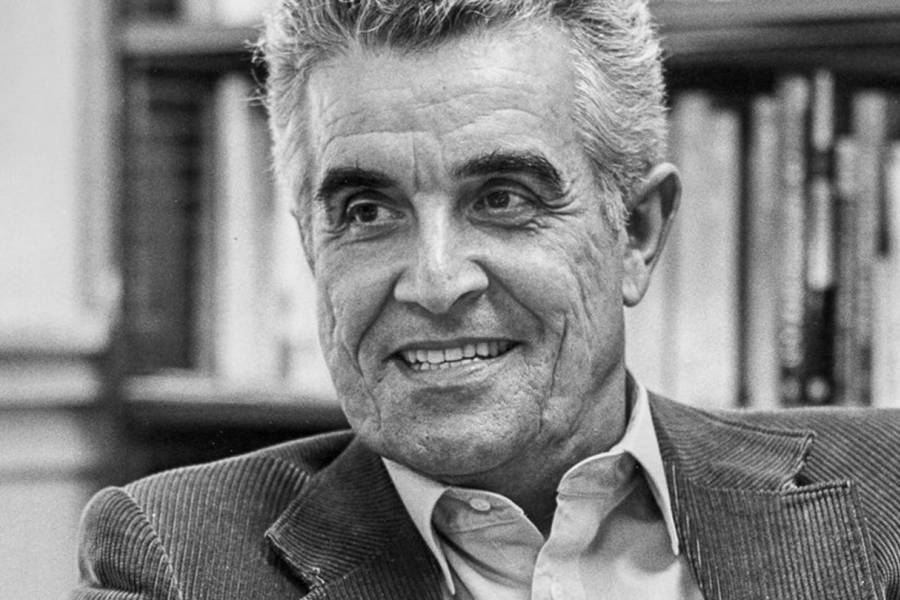

René Girard, The Golden Bough and Mimesis

René GIRARD, PART 2

René Girad was born into a Catholic family in Avignon in France on 25 December 1923. His father, Joseph Girard, was a historian.

René studied medieval history at the École des Chartes, Paris. In 1947, Girard went to Indiana University. He was to spend most of his career in the United States. Although his research was in history, he also taught French literature. A multi-disciplinary character was a marked feature of his academic interests. This facilitated his occupation of positions in a variety of prestigious institutions – at Duke University, Bryn Mawr College and Johns Hopkins University, Baltimore, where he became a full professor in 1961.

In 1981, Girard was appointed Professor of French Language, Literature, and Civilization at Stanford University, where he remained until his retirement in 1995 and subsequently in an active emeritus role. On 17 March 2005, Girard was elected to the Académie française.

Throughout these years he published just short of 30 books, covering all the interlocking disciplines which were the subjects of his thought and research,

Girard’s reading of Dostoevsky, in particular, The Brothers Karamazov and The Possessed (Demons) – especially the deathbed. conversion of Stepan Verkhovensky in that book – were influential in his conversion from agnostic to Christianity. But equally important was where  his reading of Sir James Frazer’s The Golden Bough led him.

Girard read and studied Frazer’s book before his conversion to Christianity. He suspected flaws in Frazer’s reading of mythology and how it contradicted  the Bible.

In The Golden Bough Frazer catalogued all the mythic scapegoats of the ancient stories. But he confused the scapegoating of Christ with the ancient mythical scapegoats. Frazer failed to see that Christ was an innocent victim of scapegoating.

From his murderers’ point of view his death would save the people, as Caiphas said in his unconsciously prophetic utterance. Girard says that Frazer was perfectly right to point to the similarities between the ancient myths and Christianity – in both instances you have a victim who is killed by an entire community. In the ancient myths the victims were eventually seen as gods. In Christ’s case the victim was in fact God incarnate.

“But what Frazier didn’t see, which is the simplest thing of all and should convince everybody immediately, if they were honest, that Christianity is very different from mythology – while being the same. It is exactly the same situation but it is very different because Christianity tells you that Christ was innocent whereas all myths tell you that the victim is guilty….People don’t see that this is the first time in the history of mankind that a myth occurs where the victim is not guilty but innocent, sent by God himself.”

Answering why Christ’s death on the Cross is a saving event, Girard explains that “If you read the ‘mythical’ situation the way I do you can see there is something that is not purely human about it. In classical mythology we are offered all these victims and we take them for culprits, and so forth. In the case of Christianity there are a few disciples who say ‘no, no, He is not guilty’, who maintain to the end that he is innocent. Therefore they say the truth simply. They say a truth which is anthropological before being religious, but which is the same thing.”

Girard points out that Christ’s death on the Cross frees humankind from this deep, profound, inescapable and largely hidden cycle of the scapegoating impulse in which his mythologies imprisoned him. Scapegoating in biblical accounts goes back to the story of Cain and Abel and features in many other biblical accounts – for example in the suffering endured by the prophets. Christianity asserts with certainty that it is the only true religion. It tells the truth about man and about God.  In an interview with Peter Robinson of Stanford’s Hoover Institute, Girard commented, ”Very few people take this statement seriously, as you well know. They should take that literally.” Answering the question as to why don’t they see that Christianity is different, he replies, “They do not want it. Christianity destroys mythology.”

Girard’s rebuttal of Frazer’s errors is complex, the details of which we do not have the space to unravel here. But at the root of it he finds  “That incoherence traditionally attributed to religious ideas…associated with the theme of the scapegoat. Frazer treats his subject at length; his writing is remarkable for its abundance of description and paucity of explanation. Frazer refuses to concern himself with the formidable forces at work behind religious significations, and his openly professed contempt for religious themes. (This) protects him from  unwelcome discoveries.” 

At the heart of Frazer’s total mis-reading of the Passion of Christ is his rejection of the sacrifice at its heart. Girard comments that anyone who tries to subvert the sacrificial principle by turning to derision invariably becomes its unwitting accomplice. Frazer is no exception. “His work in treating the act of sacrificial substitution as if it were pure fantasy, a non phenomenon, recalls nothing so much as the platitudes of second-rate theologians.” 

Because of a wilful blindness, Girard alleges, modern thinkers continue to see religion as an isolated, wholly fictitious phenomenon cherished only by a few backward peoples or milieus. And these same thinkers can now project upon religion alone the responsibility for a violent projection of violence that truly pertains to all societies including our own. This attitude is seen at its most flagrant in the writing of Frazer. Along with his rationalist colleagues and disciples, he was perpetually engaged in a ritualistic expulsion and consummation of religion itself, which he used as a sort of scapegoat for all human thought.

Elsewhere Girard argued that the historical phenomenon of Christians warring with Christians was not in fact a Christian phenomenon but its contrary.

Girard’s second revolutionary idea is that of mimetic desire, that is desire driven by the impulse to imitate another or the other. Mimesis = imitation. This can be good or bad. In Sacred Scripture there are two short passages which lead us to a consideration of René Girard’s theory. By this theory he potentially de-fangs the pernicious analysis of human desire inflicted on us by Sigmund Freud.

In the third letter of St John we are exhorted,

“Beloved, do not imitate evil but imitate

good. He who does good is of God; he who does evil has

not seen God.”

In the letter of St James we are asked:

“What causes wars, and what causes fighting among you? Is it not your passions that are at war in your members? You desire and do not have; so you kill.

And you covet and cannot obtain; so you fight and wage war.”

Girard identifies a triangular relationship in desire – object, model and subject are the same. In his interview with Girard, Peter Robinson puts this in the simplest of terms: 

Serpent, Eve, apple?

Girard accepts this. “Serpent in the mimetic theory of desire is an image of the mediator, the one who directs the subject towards the bad desire.

The churches, you know, who know what they are talking about, better than most people think, know that example is the key to bad as well as good behaviour. This is what I call mimetic desire.”  In the pursuit of illicit desires this is what we call  the occasion of sin.

The imitative nature of desire will often lead to conflict, sometimes violent and catastrophic conflict. Mythology warns us of this: Paris desires Helen and makes Menelaus his enemy and the end of it all is the destruction of Troy.

In this reading of our nature and the process of desiring, Girard identifies good and bad desires – good desires leading to human fulfilment, bad desires leading to rivalry and conflict. One of the great classical spiritual books, Thomas a Kempis’, The Imitation of Christ, points us in the direction of God  – as all great spiritual writing does, encouraging us to do as St James did.

But as Girard points out, people polarise around objects of desire. This is true even for food, shelter, places where you can live and so on. But because of limited availability, scarcity, conflict ensues. Desire to have what the other has, and which we have no right to have, makes for conflict, envy, aggressive attempts to acquire it.

Gil Ballie, is a lay theologian and one of the leading interpreters of Girard’s thought. He summarises mimetic attraction  and its importance in terms of the current crisis in our culture.

We are, he says, in a civilizational crisis, one that is the outworking of anthropological mistakes that have long festered. Increasingly in the history of Western culture, mistakes which we have forgotten or ignored or misconstrued. Among these he lists mimesis, but also  “the most essential fact of human existence, namely, religious longing.” 

“This feature of the human condition is vastly more important than the opposable thumb or the discovery of fire. Our mimetic predisposition cannot be overlooked without catastrophic consequences, nor can its role in mankind’s religious life be discounted. The great question is: how is this religious acuity awakened and thereafter properly ordered? No small number of people have tried to dispense with it as the residue of an earlier stage of human affairs. It is only a matter of time, however, before that religious longing is transferred to ideologies that promise to relieve the boredom of not having a real religion, ideologies that exonerate the violence of their adherents.” 

Baillie cites a moment in the tragic life of the poet Sylvia Plath which tragically illustrates our emptiness and our struggle to escape from it. He quotes a passage in Plath’s journals where she longs for God and for purpose in her life. In desperation, she toys with the possibility of committing herself completely to some political “cause” with a capital “C,” the violence of which could be justified as a “splurge of altruism.” Countless people today, he says,  are doing exactly that. Plath’s final desperate response was suicide.

“There is one feature of this quintessential religious longing that must be recognized: it is always mediated. It is awakened by another or others. The entire biblical canon and the history of the Church provide the guidelines for properly channeling this religious longing, and it does so by showing us countless examples of sinners and saints whose lives and legends convey something about how our religious longing might properly be channelled and ordered.”

In the final part of this series we will look at Girard’s personal journey and how his conversion and deep religious life brought him and us to an understanding of mankind’s deepest aspirations and how to fulfil them.

René Girard and the test of history

(Part One)

The final years of the nineteen hundreds and the early years of the succeeding century produced two thinkers whose ideas had an enormous influence on our culture over the twentieth century, extending even into the present age.

Both were effectively enemies of religion, even  virulently so. One will be familiar to us, his name even having a byword status in our language. The other is not so familiar but, regardless of that, they both left a mark on our culture which did much to transform it from an essentially Christian one into a post Christian atheistic one.

The first of these is Sigmund Freud. The second is the anthropologist, Sir James Frazer. Freud’s legacy is a vastly more extensive one than that of Frazer – and not malign in all its aspects. But his reading of man’s nature and his emphasis on sexual appetite as the root of our desires has been both a determinant of the under-belly of our popular culture and a potent force destroying many of the noble values which have characterised our civilisation for millennia.

Sir James Frazer’s seminal work is The Golden Bough, famous enough and influential enough to be very meaningfully referenced in Francis Ford Coppola’s film, Apocalypse Now. Frazer is not taken very seriously by professional anthropologists but that does not diminish his influence on our culture. Frazer’s destructive idea helped sow the seeds of twentieth century agnosticism and atheism.

Frazer presented The Golden Bough as an exhaustive study of human mythology and how it reveals to us the deeper aspects of anthropology. In particular he focused on the pervasive phenomenon of scapegoating as the cathartic  agent which rescued human societies from one catastrophe after another. Think of the myth of Oedipus here. Frazer’s grave and destructive error, however, was to include the scapegoating, suffering and death of Jesus as just one more myth in the long catalogue which he assembled. He failed to see the radical difference between the scapegoating of Christ and all the others in his list – remember, Caiphas did present Christ to the Sanhedrin as such. 

“Nor do you understand that it is expedient and politically advantageous for you that one man die for the people, and that the whole nation not perish” (John 11:50).

But neither Caiphas nor Frazer understood the true meaning of Christ’s voluntary sacrifice for the redemption of mankind.

There is one twentieth century thinker  who many regard as one who by the end of this century will be regarded as one of the greatest influences on our time and whose thought will explode the fallacies perpetrated by, among others, both Frazer and Freud. His reading of man as man and our relationship with God and the world will tower head and shoulders over all others. He will do so because he directly confronts Freud’s corrupt reading of the roots of human desire.  He also demolishes Frazer’s simplistic confusion of the phenomenon of mythological scapegoating with Christ’s truly salvific sacrifice on the Cross.

This man was René Girard (1923-2014). Girard was a man whom Bishop Robert Barron describes as one of the great Catholic philosophers of our time and predicts that in the future his influence will be regarded as that of a modern Church Father.  Girard was a member of the Académie Française, taught in the universities of Indiana, Johns Hopkins and finally in Stanford. Barron classifies two types of academics, those who beguile you with brilliant ideas and those who will shake our world. Girard, he says, was one of the latter. The Canadian sociologist, Charles Taylor, writes of the “ground-breaking work” of  Girard. In reading contemporary attempts of our efforts to confront our society’s problems it is not unusual to find writers talk of ‘Girardian’ approaches to these.

But his influence is multifaceted and penetrates into the secular world in a remarkable way. He has influenced some of the leading movers and shakers in Silicon Valley – people like Peter Theil and Mark Andriessen. J.D. Vance has attributed his conversion to Catholicism to reading Girard. Thiel, founder of PayPal and now one of the West’s leading public intellectuals studied under Girard at Stanford. He has said that Girard has had a tremendous impact on his life, and considers the author’s book Things Hidden Since the Foundation of the World           to be Girard’s masterpiece.

Theil says “Girard ranges over everything: every book, every myth, every culture — and he always argues boldly. That made him stand out against the rest of academia, which was and still is divided between two approaches: specialized research on trivial questions and grandiose but nihilistic claims that knowledge is impossible. Girard is the opposite of both: He makes sweeping arguments about big questions based on a view of the whole world. So even when you set aside the scandalous fact that Girard takes Christianity seriously, there is already something heroic and subversive about his work.”

Bari Weis, former Wall Street Journal and New York Times writer, and now upsetting mainstream media’s applecart as founder-editor of The Free Press, published a series  recently listing nine twentieth century prophets. Girard was one of them. The piece on Girard was by one of his recent biographers, Cynthia Haven.

Haven reflected on how  “Today, a single tweet could wreck a career. It could even bring down a government, if the stars are aligned. Mobs gather online instantly, ideologies form seemingly overnight, and cancel culture punishes those who dare dissent. This precarious, pernicious world is the one we live in now. But decades before anyone had heard of “doxxing” or “downvoting” or “dragging,” a French literary scholar at Stanford, born more than 100 years ago, warned of what was to come. He foresaw the perils of combining human nature with a globally connected world.”

“When the whole world is globalized, you’re going to be able to set fire to the whole thing with a single match,” predicted Girard. 

In Girard’s deep and penetrating study of the nature of human desire – forget Freud’s blinkered sexual preoccupations – he explored envy, imitation, crowd behaviour, and reciprocal violence. Starting in the 1950s, he first developed his insights not by poring through datasets or running a social science lab but, surprisingly, from a deep study of great literature.  Great novels tell us the truth, he said. In them we see the truest reflections of men and women’s inner being.

Girard was not a superficial optimist. Neither was he a grim pessimist. He was a man of Faith and Hope but he did take the apocalyptic passages of Sacred Scripture seriously. He looked at the point at which we have now arrived in human history and worried deeply about what he saw unfolding. He takes very seriously the apocalyptic passages in the New Testament. For example the second letter of St Peter:

“Since all these things are thus to be dissolved, what sort of persons ought you to be in lives of holiness and godliness, waiting for and hastening the coming of the day of God, because of which the heavens will be kindled and dissolved, and the elements will melt with fire!  But according to his promise we wait for new heavens and a new earth in which righteousness dwells.

“Therefore, beloved, since you wait for these, be zealous to be found by him without spot or blemish, and at peace.  And count the forbearance of our Lord as salvation. ”

Girard has written, “History you might say is a test for mankind but we know very well that mankind is failing that test.” (quote from his book, Battling To The End). He explains what he means by this: “Mankind is failing that test because mankind has the truth in the reality of Christianity, which is there. This truth has been there for 2000 years, and instead of moving ahead and becoming more widespread it is becoming more restricted.”

But he goes on to say that when the anti-religious are attacking Christianity, it is not the essence pf Christianity they are attacking but their own false reading of it. What is really going on is an effort to restore a mythical pagan world.

Girard reflects that when he was a child, before the invention of the atom bomb priests always talked in church of the apocalyptic texts, particularly before Advent, the last Sunday of Pentecost time. He speaks of how they impressed him. “In a way the inspiration of my whole work is there. I have been talking about these texts all the time.”

“In some way the gospels and scripture are predicting that mankind will fail the test of history since they end with an eschatological theme, literally the end of the world”.

Girard’s calm rational vision of the ‘end times” are reminiscent of what Romano Guardini wrote about the Book of Revelation

“The apocalyptical is that which reveals temporality’s true face when it has been demasked by the eternal. It was given to St. John to behold this. No pleasurable favor, this gift of the visionary eye. He who has it can no longer look upon the things of existence without trembling at sight of ‘the hair’ by which they hang. He lives under the awful pressure of constant uncertainty. Nothing is safe. The borders between time and eternity melt away. From all sides eternity’s overwhelming reality closes in upon him, mounting from the depths, plunging from the heights. For the visionary life ceases to be peaceful and simple. He is required to live under duress, that others may sense how things really stand with them; that they not only learn that this or that is to take place—still less the futile details of the time and circumstances—but that they may possess the essential knowledge of what all existence undergoes at the approach of the eternal. Only he reads the Apocalypse properly who leaves it with some sense of this.”

In exploring the errors of our time and in presenting his interpretation of our true nature  Girard seems to be offering us a way out  of our contemporary self-destructive maze. What that way is, based on the twin pillars of his study of the process of human desiring and the truly redemptive sacrifice of Jesus Christ which Frazer denied, will be approached in part two of this article.

“Atheism was the centre from which ran out all the mischiefs and villainies” of the French Revolution

EDMUND BURKE AND THE WAR ON THE ORIGINS OF SECULARISM – Part Two

The Goddess of Reason enthroned by the revolutionaries on the High Altar of Notre Dame Cathedral in Paris

Edmund Burke’s battles with what he saw as the malign interpretations in early Protestantism of mankind’s relations with the Creator is the focus of this second part of our reflections on the early life of this great Irishman.

Edmund Burke can be seen as an early warrior in the crucial confrontation of our civilisation with the degenerating phenomenon of secularism. Richard Bourke’s splendid book Edmund Burke: Empire and Revolution  has a much wider focus and constitutes what was   described by the late Seamus Deane, himself a Burke scholar, as “the finest of all books on Edmund Burke”. I hope I can be forgiven for a degree of paraphrasing of Professor Bourke’s words in what follows.

The Catholic influences in Burke’s life are not over-emphasised by Professor Bourke. Nevertheless they were very real and cannot but be taken into account in any assessment of his overall grasp of the Christian faith. The backdrop of the Penal Laws to his life and the lives of many in his wider family, and to his Catholic friends and associates, inevitably had a bearing on what he could write and say. 

The author tells us that Burke’s sister, Juliana, married Patrick William French, a member of a prominent Catholic family from Galway. Burke himself was to marry Jane Nugent, daughter of the Catholic physician Christopher Nugent, based in Bath, whose son is also known to have married a Nagle from Ballyduff. Burke remained on intimate terms throughout his life with Richard Hennessy, the Irish Catholic brandy merchant, whose family had intermarried for generations with the Nagles. His “strong and affectionate memory” of Cork families like the Barretts and the Roches is similarly evident in much of his correspondence.  

We are told how Burke’s intimacy with his Nagle relations first developed during the five years  or so that he spent in the Blackwater Valley, beginning around 1737. Having received his earliest education from his mother and subsequently from assorted instructors, Burke was sent to reside with the Nagles in Ballyduff. He went to school in nearby Monanimy Castle, where he was first taught Latin by a Mr. O’Halloran, the village schoolmaster.  

O’Halloran’s influence shows in Burke’s familiarity with Virgil. In a letter of that time he quotes the classical Master’s tribute paid in the Georgics to “the pathways of the stars and the heavens, the various lapses of the sun and the various labours of the moon”. In a letter to his lifelong friend from his school days, Richard Shackleton, revealing a Christian sense of wonder, he wrote:

“What grander Idea can the mind of man form to itself than a prodigious, glorious, and firy globe hanging in the midst of an infinite and boundless space surrounded with bodies of whom our earth is scarcely any thing in comparison . . . held tight to their respective orbits. . . by the force of the Creator’s Almighty arm.”

In a debate in Trinity in 1749, talking about the Sermon on the Mount, he spoke of how the Christian religion marked an advance on heathen morality by educating the feelings of the heart, perhaps sensing the same idea embraced in John Henry Newman’s wonderful phrase, “heart speaks unto heart”.

Burke’s friend, Richard Shackleton, was a committed Quaker coming from that famous Ballitore family whose school Edmund attended before Trinity, also in the company of Richard. The author notes how Burke was aware of the “Different Roads” towards Christian truth which both he and his friend earnestly pursued, and reflected on the “melancholy” fact that there existed “Diversities of Sects and opinions among us.” He lamented the reality of Christian disunity.  

For Burke, the author notes, toleration among Christians was a mark of piety, although his attitude to infidels was another matter. His hostility to atheists would reach a crescendo in the 1790s in connection with the French Revolution: “Atheism,” he said, “was the centre from which ran out all their mischiefs and villainies.” Beginning in the 1790s, he vociferously denounced the “enlightened” ideals of the Revolution. His intention was to ridicule the presumptuousness of natural reason and the pretensions of moral philosophies based on hostility to organised religion. 

The shadow of the “wars of religion” of the 17th century, not to mention the Irish rebellion of 1641 and the Cromwellian aftermath loomed large over the thinkers of the early 18th century. For many, religion was a malign force and they looked for ways to remove that malignity. For others that was a false road to peace and simply reflected a total misunderstanding of what the Christian religion was about.

Professor Bourke explains: While toleration… seemed to him a basic ingredient of the Christian message, he thought the dogmatism of sceptical deists promoted persecution. It was a common refrain among polemical deists that religion was a source of bigotry, leading inexorably to sectarian prejudice and strife. Burke accepted  Bishop Berkeley’s inversion of this formula:

“Christianity was a morally emollient system of belief. Religion was commonly a pretext of animosity, but never its fundamental cause…the identification of blind fury with religious piety by sceptics was the product of a pernicious brand of fanaticism.”

In formulating his approach to reconciling the worlds of faith and reason he argued that eighteenth century irreligion replicated the same tendency and could only provoke more conflict. The deist project to realise the “freedom of philosophy” nurtured an uncritical belief in the oracles of  reason. With this certainty came contempt for the utility of social habit, and disregard for the natural moral sentiments of mankind. 

Burke saw no alternative but to take on the radical sceptics and deists who were hell-bent on not only denuding religion of all meaning and value, but on destroying civilisation in the process. One of the targets of the sceptics was the destruction of the idea of mystery in religion and the elevation of pure reason as the only source in which mankind could find the answer to the meaning of life.

Burke argued, according to Professor Bourke, that while the foolish might expect that they could penetrate metaphysical secrets, the wise were struck with awe in contemplating the operations of the universe. Burke settled on this perspective after an extensive study of theology. In the process he came to doubt the powers of pure reason. This did not imply a rejection of the utility of rational inquiry. It meant instead that Burke accepted the limitations on human knowledge.

Burke’s weapon of choice was a polemical and satirical tract entitled A Vindication of Natural Society in which he attempts to expose the limits of deism. To some it was confusing, missing the satirical thrust of the work – because it is not at all a “vindication”. It is an attack on religious scepticism as publicised by men like John Toland, Anthony Collins, Matthew Tindal and Viscount Bolingbroke. 

From it, if read accurately, Professor Bourke says that Burke emerges as a figure keen to credit natural sentiment and convinced of the ongoing bearing of divine providence on human life. The immortality of the soul and promise of an afterlife were essential  to his conception of providential theodicy.

He saw the work of those authors as a pernicious attempt to barbarise and denature man. In their different ways, Thomas Hobbes, the third Earl of Shaftesbury, Anthony Collins and Bernard Mandeville had variously contributed to this process. In their hands, the ancient schools of philosophy had been resuscitated and debauched in the service of a dogmatic assault upon religion. 

For Burke the style of reasoning of these writers dismantled the foundation of all belief. Its influence would lead to the elimination of Christianity as well as to the destruction of society in general. 

In the 1750s, Burke challenged the deists’ denial of providence which he saw as something driven by a determination to annihilate mystery. In the process this threatened to dissolve all confidence in society, and everything that supported benign credulity and civilisation.  

One of them had declared “Where the mystery begins, religion ends.”

For Burke mystery could be credited in the absence of demonstration on the basis of reasonable faith. The idea of reasonable faith implied degrees of probability extending from moral certainty to extreme implausibility. For him, Christian revelation, while not a mathematical certainty, nonetheless commanded our assent. Although the content of scripture was often miraculous in nature, its credibility could not reasonably be doubted.  

Edmund Burke’s political thinking, his un-ideological and common sense approach to the way we can best organise the business of statecraft, is now at the heart of the thinking of many who are opposing the dying but still poisonous progressive liberalism that has infected our public squares.

But much of Burke’s clear-sighted analysis of the attacks on religion in his time – and what, prophetically, that to which he saw them leading – can still also be of use to us in our ongoing conflict with the secularist movement of our time with all its crazy progeny. 

(First published in print and online in Position Papers)

Next Week: The Journey of Thomas Stearns Eliot – Part One

EDMUND BURKE AND THE WAR ON THE ORIGINS OF SECULARISM

Part One

The forward march of secularism may seem to be a relentless one. It is. But we should also observe that it is a pointless one. A march to nowhere. Secularism and its deformed progeny, the so-called secularist world, have been well analyzed in its roots and progress by Charles Taylor, Brad Gregory and others in recent years. There is no question but that it has been a destructive force in our civilization, masquerading as benign progress. Taylor and Gregory note its origins in the corruption of the Christian faith dating back to the Reformation and beyond.

But it is not a triumphant force and champions of Christianity have been opposing it for centuries with their robust allegiance to its dual enemies, faith and reason, ever since it appeared among us in either its nascent or full-blooded incarnation.

For both Taylor and Gregory the gradual flowering of this weed emerged with what Taylor terms the disenchantment of religion following the Protestant Reformation and the emergence of the illusion that reason alone had all the answers. In its most viral form religion itself, for Protestant “influencers,” became a solely rational thing and faith, if it did not satisfactorily answer all the questionings of reason, was but a fanciful thing.

But the voices which have resisted the removal of the element of enchantment from religious consciousness over the centuries have not been vanquished and never were. They were there when the first sceptical utterances began to emerge in the seventeenth century and then reached something of a crescendo in the eighteenth, morphing into deism and outright atheism. In the nineteenth century the great John Henry Newman exposed the inevitable consequences of the liberal mindset of his age, and in the twentieth and twenty-first centuries his thought has proved an important part of the foundation of the powerful encyclicals of Pope John Paul II and Pope Benedict XVI defending the truth about mankind and our destiny.

From the secular world itself, in the twentieth century, the voices of G.K. Chesterton, T.S. Eliot, C.S. Lewis and many more spoke up for the truth of Christianity, exposing once again the folly of men who say in their heart, “there is no God.” Ross Douthat of the New York Times very recently drew our attention to a reality that secularist triumphalism wants to ignore:

Yet for Christianity, the modern era is actually two stories intertwined: a story of conflict and failure and disappointment for many Christian institutions, their division and their weakness in the face of other powers, woven together with the story of the Christian religion’s resilience and global spread. Whether or not liberal modernity represents a “metaphysical catastrophe” (to pluck a phrase from one of its eloquent religious critics), it has created a world civilization in which the Gospel has been preached in the far corners of the planet; in which there are today, according to one study, 2.6 billion Christians; in which, amid a long-running crisis for Western Catholicism, more young Catholics attended the just-completed World Youth Day in Portugal than inhabited all of medieval Rome and Paris and London put together.

Back at the beginning of what Brad Gregory calls the “unintended reformation,” the very existence of Christian faith in the anglophone world was, either intentionally or unintentionally, under attack from thinkers nurtured in Protestantism – Bacon, Hobbes, Locke. Later, and more virulent, in the seventeenth century, came Bernard Mandeville, Viscount Bolingbroke, David Hume, and a host of others displaying various brands of scepticism, deism, and atheism. But there were voices of opposition, and among these one of the most powerful was Edmund Burke’s. Burke is probably the Irishman in history who has had the greatest influence on mankind’s efforts to organise the world in a civilised way for the betterment of humanity. The only competitors I can think of would be the Irish missionaries of the early Middle Ages – people like Saints Columbanus, Gall, Columba, Killian, and others who brought Northern Europe back from the brink of barbarism.

But just as it is impossible to engage with the modern literary world without knowing and understanding something of the work of James Joyce, Yeats, and Beckett, so it is impossible to engage with the great political debates of our time without knowing Edmund Burke and the influence he has had on political thought over the past 250 years. Burke is best known for the four great causes he espoused on behalf of mankind throughout his political career. These were firstly his search for justice for the people of the Indian subcontinent, victims of the East India Company operating under the protective umbrella of the British Empire. Secondly, there was his futile effort to try to rein in the folly of the British monarch and parliament in their trampling on the civil rights of the citizens of New England. Thirdly, there was his constant effort to ameliorate the lot of Catholics in Ireland and Britain, persecuted as they were by the Penal Laws passed by the English parliament in the early 1700s. Finally there was his resistance to the influence of the revolutionary forces unleashed in France in 1789 which he saw as a force which could destroy all religion and as a consequence the wellbeing of humanity itself.

But to understand Burke and everything he stood for we have to go back to his early years and the first great cause he undertook – his defence of religion, faith, and reason in the face of the enemies we have referred to earlier. This phase of Burke’s life has rarely been examined in much detail. Those four great causes have overshadowed the early part of his life. Yet it is crucial in understanding the man and everything for which he stood.

In 2015, as I think never before, Burke’s early years in Ireland, even his childhood and adolescence, his time in Trinity College Dublin, his move to London to study law, his early writings, and his preoccupations with religion and philosophy, were masterfully dealt with by Professor Richard Bourke in his book, Edmund Burke: Empire and Revolution. Bourke covers this ground exhaustively. However, as his title suggests, the main focus of the work, just short of a thousand pages, is Burke’s more global preoccupation.

Not only, however, is his life and thinking in those years of interest in the context of what Conor Cruise O’Brien referred to as “The Great Melody,” the title of his biography of Burke. They also represent a fifth great cause to which Burke vehemently lent his not inconsiderable powers of persuasion – the cause of religion.  Burke was intensely conscious mankind’s dependence on religion for the future of our civilisation, threatened by what we now see were the poison seeds of secularism.

Professor Bourke, with great subtlety, sets Burke’s Protestant faith in the context of the Penal Laws: his father’s pragmatic conversion, his mother’s under-the-radar Catholicism; his close relations with his mother’s up-front Catholic family, the Nagels of Ballyduff in Cork with whom Edmund lived and was schooled during some of his childhood years; his schooling up to the age of fifteen in the Shackleton Quaker school in Ballitore; his years in Trinity where he developed his debating skills and his theological sensibilities which became the armour and armament for his battles with the skeptics, deists, and atheists of his time; finally, his early years in London studying law.

In part two of this article we will look at how Professor Bourke explores those early years and how Edmund Burke confronted what he saw as the malign interpretations of mankind’s relations with the Creator in early Protestantism.

Part 2, THE DELUSION OF ‘SECULARISM TRIUMPHANT’, next Friday.

(Posted on Position Papers on )

Cameron ‘does God’, but…

20140422-152947.jpg

Charles Moore, writing in the Daily Telegraph about the attacks on David Cameron which followed his Church Times article describing Britain as a Christian country, noted some inconsistencies in the Prime Minister’s thinking. Specifically, he pointed out how Cameron has sold out on one of the country’s most valuable Christian institutions, marriage.

Of all the human institutions developed in the light of Christianity, marriage has been the most abiding. It is because of Christianity that marriage became a lifelong and increasingly equal bond between one man and one woman, chiefly in order to bring up children lovingly. Without Christian teaching, it was not much more than a property deal about women (with sex thrown in), made between men.

Because he wanted to be seen to modernise his party, Mr Cameron decided to introduce single-sex marriage. In rushing forward to do so, he made no attempt to reflect on the Christian heritage which he now extols. He never seems to have thought about why the relationship between a man and a woman might not, in fact, be the same as that between a man and a man or a woman and a woman.

Although an exemplary parent himself, he did not consider how refounding marriage on a quite different basis could endanger the rights of children. The people who framed his new law started – too late – to consider what marriage law actually involves and found that the law of consummation, central to the definition of marriage, could not apply to any same-sex act. Quite unintentionally, marriage has been redefined, with sex taken out of it. The good Christian Mr Cameron has trivialised and de-Christianised our greatest social bond without meaning to. Not surprisingly, he chose not to speak about marriage at all in his Church Times article last week: he would not have known what to say.

Moore’s Telegraph article is here.

The children of wrath?

What is it about the anti-God brigade that makes them so hate-filled and, well, just downright unpleasant. They truly seem to be the children of wrath. The genuine children of light – as opposed to the faux variety – do at times let themselves down and indulge in rants which border on or cross the line of human decency. But by and large they are restrained by that essential ingredient of their cultural heritage – the charity of Christ.

Take a random comment thread from any faith story on the internet and what are you likely to find? You find yourself wading into a quagmire of irrational contempt, animosity and downright hatred towards anyone professing faith. You don’t even have to go anywhere near the more extreme end of this spectrum, the Dawkins Quarter, to get this. Scroll through any of these stories and you will find yourself not a little depressed by the experience. If you don’t encounter mockery then it will be sterile cynicism or worse.  But you will hardly ever encounter an attempt at a real engagement of minds. It is seriously sad.

Over the past few years the secularist/religion debate was frequently pitched in terms of one motion: The Catholic Church is (is not) a force for good in the world. Sometimes it was broader and put in terms of “Religion is (is not) a force for good in the world”, a Christopher Hitchens-style generalisation. Hitchens’ book, God is not Great, underlined the problem of debating the question in those terms. Its subtitle, “How religion poisons everything”, said it all. Hitchens’ “religion”,  by his definition, is really no religion. The opponent of any and every faith has the faithful at his mercy on this platform. Hitchens’ generalisation of faith allows him to bundle together, for the purposes of confusion, every kind of lunacy which men have for millennia described as religion.

The only meaningful debate on this topic will be one where religion is defended and professed on the basis of the specific doctrines it teaches and the way of life it proposes for its followers – regardless even of how faithfully its followers succeed in living up to those teachings and that way of life.

In many of those debates over the past few years the defenders of the mainstream Christian Churches – and for the most part it was the Catholic Church which was put in the dock – were on the losing side. This was primarily because they failed to demand that the teaching of their church, and not the motley collection of red herrings thrown at them, be made the focus of debate. If that were done, and if the cumulative effect of the effort of millions of Christians across the world to live according to the authentic Christian principles of their church, taking account of the development of its teaching down through the ages – and its influence on our civilization as it did so – then there would be no contest.

Leave aside the red herrings of issues generated by the inherent weakness, folly and sinfulness of mankind and you will find in the teaching of the Catholic Church, enshrined in its moral and social doctrines, a guide second to none for mankind’s flourishing. Examine all of these as closely as you like and you will not fail to find in them an understanding of our human condition which if acted on universally would be the greatest imaginable force for good in the world, bar none. Just do it, and see.

The argument against religion on the basis of the ignorance, weakness or malice of those who profess to follow Christ’s teaching while in fact following some aberrant concoction of their own, is no argument against the truth and value of this teaching. We might use an analogy. Great art is not diminished in its value to mankind, nor in its power to move our race, when confronted by the ignorant, even when they collect it and hoard it as a marketable commodity.  The sense of loss felt after the recent burning of some priceless works of art by some crazed woman underlines our appreciation of the value and power to do good of the world’s great literature, music and art.

Ignorance is ever a threat to beauty. Ignorance, culpable or otherwise, has also always been a threat to goodness an truth. That the truth of the Christian religion has historically and contemporaneously been held hostage by the misguided, the ignorant, and even evil people (like vicious slavers in the New World), is inadmissible as evidence against it.

A gem of moral wisdom encountered recently in a book of moral questions and answers compiled in the last century – with resonances very pertinent for our own times – might illustrate how much of the misery we inflict on each other globally might be alleviated if we were more attentive to the teaching of Christ’s Church.

The question, from a person with an eye on Irish history, was asked:

 Suppose a person is in possession of land by ancestral right –  land confiscated in the time of Cromwell, and given to one of his ancestors. Legally, he owns the land. Is it the teaching of the Cathoiic Church that he morally owns it or does the land rightly belong to the descendants of the original owner?

 The answer, from a renowned moral theologian of his day[i], was this:

 The confiscation was unjust, and the newcomer held the land on a title that no moral law could sanction. But time heals many wounds. Some of his successors were better than himself; they became bona fide holders of the proceeds of his robbery. The best moral instructors of mankind – and among them the Catholic Church takes the prominent place – have come to the conclusion that to safeguard public order and the rights of the community as a whole, the claims of these successors must be maintained, even in conscience, when a long period of peaceful possession has elapsed.

 The principle is termed “prescription,” and is universally acknowledged. The period varies in the different countries, but the time since CromweIl is long enough to satisfy the most exacting reading. The present holder may keep what he has without being troubled in conscience.

 If a person questions that conclusion, he must meet certain difficulties. The real owner in the days of Cromwell held the land from an ancestor who disturbed the previous owners in the days of a previous invasion. So through the days of the Milesians, the Firbolgs, and the countless other regimes of which history knows nothing. If we reject the principle of “prescription” we must face the suggestion that no human being on the globe at the present moment owns a single particle of anything he holds.

 Another question was asked. This was probably some time early in the last century. It’s clarity is uncompromising.

 Should the right of conquest be always recognized?

 The “right of conquest” , he answered, has been asserted by bellicose invaders and by their “scientific” supporters. It is no better than the right of the highway robber to seize all he can on a night-raid.

 Can we see anything but wisdom and a force for good in a world view which enshrines principles of common sense and justice like these? This is just a glimpse of the patrimony of the authentic Christian Church, passed from generation to generation in the manner eluciadated in the first encyclical letter from the current incumbent of the See of Peter, “Lumen Fidei.”

 The Church, like every family, passes on to her children the whole store of her memories. But how does this come about in a way that nothing is lost, but rather everything in the patrimony of faith comes to be more deeply understood? It is through the apostolic Tradition preserved in the Church with the assistance of the Holy Spirit that we enjoy a living contact with the foundational memory. What was handed down by the apostles — as the Second Vatican Council states — “comprises everything that serves to make the people of God live their lives in holiness and increase their faith. In this way the Church, in her doctrine, life and worship, perpetuates and transmits to every generation all that she herself is, all that she believes.

 The often flawed striving and rough hewing of mankind to implement this patrimony should not be the measure of the value or goodness of the Foundation itself. What is frightening in the contemporary debate – and it is often hard to recognise it as a debate – is the flight from reasonableness in failing to recognize this distinction, a flight accompanied by what appears to be a visceral hatred of the very idea that underlying our existence there might just be that benign “divinity that shapes our end” and that this Divinity subsists in the Catholic Church.


[i] Dr. Michael J. O’Donnell, Professor of Moral Theology in st. Patrick’s College, Maynooth, Ireland, in the early decades of the twentieth century.

A letter in today’s Irish Independent

A letter in today’s Irish Independent tells us that “there is insufficient moral consensus in Ireland to ground consideration of the country’s future.”

“The clash of antagonistic wills,” Philip O’Neill writes, “evident in the abortion debate and in current discussion of what to do in Syria or with our economy, often parades as rational debate, leaving us with little more than intensified divisions.” So far so good. Certainly, a lot of parading, a good deal of intensity and deep, deep division. Parading is clearly a sham but intensity and division are no bad things in themselves. Fear and loathing of both, which O’Neill seems to harbor, may well be harmful if they lead you to some of his conclusions.

“The continuing drift away from the church”, he writes, “is perhaps the most telling change. However, this is not indicative of a new paganism but a justifiable expression of dissatisfaction with a form of religion that had become radically focused on itself. Even the priests express unease at the church’s sometimes neurotic fear of the slightest shift from fidelity to its programme.”

I think we are dealing with more than the “slightest” shifts in contemporary Irish Catholicism here. If the utterances emerging from some of the followers and sympathesiers of the Ascociation of Catholic Priests are anything to go by, a good few Protestants are more in tune with orthodox Catholicism than with this kind of “fidelity”.

Who ever said morality was about consensus? Well, sadly, a lot of people did – and that is where the radical divide lies. The Catholic Church’s teaching will never be developed or defined by consensus. It is a given – by God – or it is nothing. Otherwise we will just be indulging in another bit of democratic groping for the truth. Mankind in human society deepens in its understanding of the revealed truth down through the ages. That is very different from a process of consensus.

There is no doubt but that a search is involved if we are to know the Truth. But is is not to be found in consensus. It will be found in the way and in the spirit which Pope Francis’ encyclical, Lumen Fidei, suggests when he quotes Saint Irenaeus of Lyons who tells how Abraham, before hearing God’s voice, had already sought him “in the ardent desire of his heart” and “went throughout the whole world, asking himself where God was to be found”, until “God had pity on him who, all alone, had sought him in silence”.

With friends like this….thoughts on P.C. own goals

Over the past few years Christmas has become a bit of a battlefield between those who value the customs and traditions we associate with the season and the P.C. brigades. While some of the age-old traditions might seem to be on the losing side, all is not as it might seem. With their blatant excesses the “politically correct” may be their own worst enemies in the long run. The latest that caught the eye was in the school in Britain where little children were singing – hopefully Advent carols – about Mary and Joseph making their way to Bethlehem. They were stopped and told to change the lyrics for fear that someone might be offended.  In the original words they sang, “little donkey, carry Mary safely on her way.” This was far too explicitly Christian, they were told – Mary was the offending word, – and were ordered to change the lyrics to “carry Lucy safely on her way.” With friends like this the multi-culturalists don’t need enemies. They are so devoid of logic and common sense that they inevitably bring down so much ridicule on their heads that sensible people – who are really in the majority when they put their minds to it – see through their folly and begin to think again for themselves. They even begin to find their way back home. This is probably part of what happened over the past few Christmases. A survey just reported on has found that in spite of all the multicultural ballyhoo about Christmas being “offensive” to non-Christians, in spite of all the rampant materialism which invades this most spiritual of seasons, in spite of all the consumption and self-indulgence, Church attendance at Christmas services in Britain has gone up 15 percent since the beginning of this millennium. There are, presumably, multiple factors contributing to this – among them the influx of Catholic immigrants from Eastern Europe – but surely the folly about Lucy, added to the follies we read about when schools feel they have to avoid putting on Nativity plays because they might offend non-Christians, must be making people think. Do some of not them say to themselves, “how dare they try to take our valued traditions away from us?” Is it any wonder that parents might decide to bring their children to something which will speak to them of the event which is at the heart of our very civilization? Perhaps there is also in this something of a reaction to the onslaught of Richard Dawkins – and his cohorts –  over the past few years, branding us all as deluded – if not dangerous – dreamers. The great advantage of being challenged is that it makes people think and thinking then may urge them to act. OK, this is just Christmas attendance at a communal celebration of faith. The attendance at services throughout the rest of the year is still in decline. But this is a celebration of when it all started and perhaps it may help a lot of people to start all over again.  Bring it on!


 Not too far removed from all that was the spectacular own-goal by the pseudo liberals in La Sapienza University in Rome who made themselves the laughing stock of Europe by insulting the Pope after Christmas. Last time it was Muslims who were up in arms when Pope Benedict quoted a medieval Emperor’s not too flattering question about Islam’s contribution to religion. This year it was the “intellectuals” of  La Sapienza who staged a protest sit-in when the Pope was invited to address the university. His crime? He had quoted – 18 years ago –  an Austrian philosopher who had the temerity to suggest that Galileo’s treatment at his trial was “reasonable and fair” by the standards of the time. The Pope’s office responded with dignity and issued a statement saying that “Following incidents known to all” it seemed best to cancel the event to which the Rector had invited him. “However,” it went on, “the Holy Father will send the university authorities a copy of the address he intended to give.” And what an address! It must have heaped coals on the heads of the silly protestors. He spoke of truth, goodness and the proper relationship between the Church of God and the university in which men sought above all to search for these things in freedom. 

“What does the Pope have to do with, or have to say to the university”, he asked? “Surely he must not attempt to impose the faith on others in an authoritarian way since it can only be bestowed in freedom. Beyond his office as Shepherd of the Church, and on the basis of the intrinsic nature of this pastoral office, there is his duty to keep the sensitivity to truth alive; to continually invite reason to seek out the true, the good, God, and on this path, to urge it to glimpse the helpful lights that shine forth in the history of the Christian faith, and in this way to perceive Jesus Christ as the Light that illuminates history and helps us to find the way to the future.”


This, and the 200,000 people from all over Italy, intellectuals, politicians, ordinary people, who turned up in St. Peter’s Square on January 20, to categorically disassociate themselves from the clique who had insulted the Pope and shamed the University, was a perfect response to a shameful folly.