Michael Kirke was born in Co. Donegal and attended St. Eunan’s College in Letterkenny, 1957-1962. In 1966 he graduated from University College Dublin (History and Politics). In 1966 he began working on the editorial desk of The Evening Press in Dublin and in 1968 went to the newsroom of the Irish Press group of newspapers – contributing news and features to the group’s three titles, The Irish Press (morning paper), The Evening Press and The Sunday Press. In 1969 he went to Belfast and covered the initial unravelling of the Unionist hegemony in the province. Later that year he became the group’s education specialist. In 1973 took leave of absence to pursue postgraduate studies in education in Trinity College Dublin where he graduated in 1976. In 1978 he left journalism and moved into teaching. In 1981 was appointed headmaster of Rockbrook Park School in Dublin (www.rockbrook.ie). In 1994 resigned from that post and moved to live in the West of Ireland (Galway) where he began working part-time in media again. He is now back in Dublin working, among other things, as a freelance writer. His main interests are in political, cultural and educational affairs – as well as issues related to religious faith.
Are the high tides and violent winds which have in recent times been battering the coastal defences of religious freedom beginning to abate? A sign of hope that religious tolerance might be making a comeback is contained in the latest post from the United Kingdom based media agency, Catholic Voices.
It tells us that the Glasgow-based Catholic adoption service, St Margaret’s, can keep its charitable status while continuing to operate a policy that prioritizes married heterosexual couples following a landmark decision by the Scottish Charity Appeals Panel. At the heart of the ruling is a recognition of the charity as a Catholic organization with the right to manifest its religious belief.
Austen Iverigh’s commentary gives the full story here.
Channel Four’s (British television channel) take on the latest twist in the Amanda Knox debacle – with a 1500 year perspective. Is that a Justinian reference – or should it be 2500 years?
“Italian job: a justice system under the spotlight.
“The Amanda Knox story has come back to fascinate and appal us, thanks in large part to the Italian legal system which is longwinded and complex.
In the latest stage of this tortured judicial journey, an Italian court has overturned the appeal which overturned the first sentence against Amanda Knox and Raffaele Sollecito. This means that Ms Knox and her ex-boyfriend could each spend another 25 years at least in jail.
“But there is bound to be another appeals stage and then Italy’s supreme court has its final say. In the case of Amanda Knox that will then lead to extradition hearings which may or may not result in the young American spending time behind Italian bars.
“As for Mr Sollecito, he was discovered near the border with Austria this morning, and because he poses a flight risk, the Italian Carabinieri have seized his passport. Apart from the obvious human drama, this story highlights the judicial culture clash between the country that gave us the foundations of modern law 1500 years ago and the country that thinks it has perfected the system in the 21st century.”
Firstly, congratulations on a wonderful conference – first in a series we hope. It was very well-organised, sharp and insightful. The hopes of your supporters were already high but this raised them even higher.
The media response was so bad it was good. The cynicism and the hostility which oozed from it were so obvious that it only made them look pathetic. It simply shows that they are, apparently incorrigibly, still locked in the closed circle of the group think of the pseudo-liberal establishment.
The reform movement which you have begun is, I think and hope, in the spirit of these paraphrased words which I encountered just this morning and which I immediately read in the context of the mission you have undertaken. This is the spirit which should be in the heart of any citizen who is properly conscious of his social responsibilities, and especially in the heart of anyone engaging actively in the public square. This man’s words are for us all when speaks of a
…mission of being in the heart of the people,…not just a part of my life or a badge I can take off; it is not an “extra” or just another moment in life. Instead, it is something I cannot uproot from my being without destroying my very self. I am a mission on this earth; that is the reason why I am here in this world.
He writes of the need for us all to
… regard ourselves as sealed, even branded, by this mission of bringing light, blessing, enlivening, raising up, healing and freeing.
If this vision of the world and its people were to become a reality then might we not see
All around us … nurses with soul, teachers with soul, politicians with soul, people who have chosen deep down to be with others and for others. But once we separate our work from our private lives, everything turns grey and we will always be seeking recognition or asserting our needs, we stop being a people.
This, surely, is the key to integrity in public life which has been lost – not only in Ireland but in a great swathes of all Western democracies. If, on the contrary, he writes,
we are to share our lives with others and generously give of ourselves, we also have to realize that every person is worthy of our giving. Not for their physical appearance, their abilities, their language, their way of thinking, or for any satisfaction that we might receive, but rather because they are God’s handiwork, his creation. Appearances notwithstanding, every person … deserves our love. Consequently, if I can help at least one person to have a better life, that already justifies the offering of my life… We achieve fulfilment when we break down walls and our heart is filled with faces and names!
These are in fact the words of the new “hero” of Eamon Gilmore and David Norris, none other than Pope Francis. You can read these in a secular context – almost, and certainly as Gilmore would – or you can read them in a religious context. It doesn’t matter. They ring true in both and I would say that for the vast majority of the people who came to support the Reform Alliance on Saturday they are at the heart of their hopes for a new politics in Ireland.
The practical policies and suggestions which were emerging on Saturday were interesting and valuable but they will only really be different from anything that has gone before if they are grounded in this spirit, in this vision of a mission of true service to our people. If not it will be back to what you have all thankfully set your faces against, a return to the “perpetuation of party politics”.
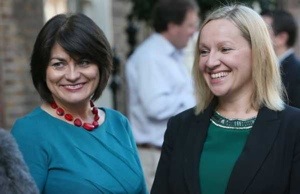
Looking forward, not backwards: Senator Fidelma Healy-Eames and Deputy Lucinda Creighton
John Waters’ despairing column in today’s Irish Times about the ‘promise’ of a new politics in Ireland has a certain quality of ‘negative capability’. I would like to think that this is what he wanted it to have. The Reform Alliance is, I hope, not about dreams people might have had in the past but is about the framework within which we will build our future in a wider world.
We can sit and curse the darkness or we can crack a match and look for a way out. To do that we don’t have to have the answer to every question. In fact we don’t have to have an answer to any of them. We only need the determination to look for them, the honesty to tell it as it is and the courage to break the chains of deceit which bind us in the present system. One of those chains is the mythical Irish dream which John Waters uses as a foil to highlight the folly of our contemporary delusions.
We can only start from where we are. But where we are going to must be a new place, a real place, not some mythical past created by an Irish “genius”. Let us be less insular, let us be human first. It is not terribly important that we are Irish. What is important is that we have a human community to organise, and organise together. The tragedy of our present state derives from the deficiencies in our humanity which we have indulged – greed, weakness, cowardice, dishonesty and disloyalty. These are the first things we have to recognise and set our face against. The rest will not be easy but it will follow if we grasp this stinging nettle. “Fare forward, travellers!”
A new book about Richard Nixon and Henry Kissinger and their role in the horrors associated with the events which led to the creation of Bangladesh is frightening. A Times Literary Supplement (10 January, 2014) reviewer writes of it:
Bass (the author) deploys White House recordings, including several new transcripts, to excellent effect, and although the bigotry and small-mindedness of Nixon and Kissinger are widely understood and known, the book contains enough material to make the reader sick. As Bass recounts in one instance, “Nixon bitterly said, ‘The Indians need – what they really need is a – . . .’ Kissinger interjected, ‘They’re such bastards.’ Nixon finished his thought: ‘A mass famine’”. The bigotry and rage are not limited to Indians, either (‘they’re just a bunch of brown goddamn Muslims’, Nixon says of the Pakistanis).*
There are three great realms of intolerance in this world – and probably always have been: cultural intolerance, religious intolerance and racial intolerance. Of the three, racial intolerance is the most irrational, blind and obnoxious. In these utterances of this supposedly wise and powerful duo we have all three mixed up together.
This is naked evil. There is no other way to judge it. A commandment forbids that we judge as evil the men who uttered these words and harboured these thoughts. But if this is the consequence of the political philosophy of realpolitik then that is an evil philosophy and we must call it such.
I don’t know if there is anything as genocidal as these remarks on record from the administration of United Kingdom of Great Britain and Ireland which presided over the Irish Famine in the 19th century. I don’t think so. That these words should come from the mouths of an elected representative of a civilised people, and his learned and widely admired aide, is truly shocking. The prevailing laissez faire economic philosophy of the 19th century is offered as an excuse for government neglect of the starving Irish. It is a weak enough excuse. But what can excuse the racism, the callousness and the arrogance of these two – and how many more – in the middle last quarter of the 20th century, in living memory.
The grounds for disillusion – even disgust – with the political class are hard to cope with. Is it really true that “all power corrupts”? It seems that we should worry much less about absolute power than about power in its more ordinary manifestations. This is where the real rot lurks.
What is the antidote to this poison? Our only hope of escape from this evil would seem to lie in the spirit of these words:
People in every nation enhance the social dimension of their lives by acting as committed and responsible citizens, not as a mob swayed by the powers that be. Let us not forget that ‘responsible citizenship is a virtue, and participation in political life is a moral obligation’. Yet becoming a people demands something more. It is an ongoing process in which every new generation must take part: a slow and arduous effort calling for a desire for integration and a willingness to achieve this through the growth of a peaceful and multifaceted culture of encounter.**
That is an excerpt from the Apostolic Exhortation, Evangelii Gaudium, recently given to the world by Pope Francis whom the incumbent successor of Richard Nixon is due to meet shortly. We can be sure that the White House has by now dealt with the dreaded leakage problem which opened the world’s eyes to what went on in the mind and heart of Nixon and his advisers. We may have mixed feelings about Edward Snowden and his ilk but there is an upside as well as a downside to their approach to ‘open government’. Do we really think that we now enjoy a purer, selfless and more just exercise of political power than we did half a century ago? We would be naive to think so.
In the modern state, even in states which proclaim themselves of the people, for the people and by the people, our only hope of integrity, honesty and dignity is in remembering and living by those words, ‘responsible citizenship is a virtue, and participation in political life is a moral obligation’.
*THE BLOOD TELEGRAM: Nixon, Kissinger, and a forgotten genocide. Gary Bass, 475pp. Knopf. $30.
**Excerpt From: Francis, Pope. “Evangelii Gaudium, Apostolic Exhortation”, 220. 24-XI-2013.
The share of countries with a high or very high level of social hostilities involving religion reached a six-year peak in 2012, according to a new study by the Pew Research Center. A third (33%) of the 198 countries and territories included in the study had high religious hostilities in 2012, up from 29% in 2011 and 20% as of mid-2007. Religious hostilities increased in every major region of the world except the Americas. The sharpest increase was in the Middle East and North Africa, which still is feeling the effects of the 2010-11 political uprisings known as the Arab Spring.1 There also was a significant increase in religious hostilities in the Asia-Pacific region, where China edged into the “high” category for the first time.
Independent deputies, Shane Ross and Stephen Donnelly
Shame, again, on the Irish Times for a headline overloaded with hostile prejudice. How did polite refusals like those of Stephen Donnelly, Shane Ross and others become a “spurn”?
“Senior Independents in Leinster House”, the paper told us this morning, “are set to spurn an invitation to attend the first Reform Alliance conference, dealing a blow to the effort by the dissident Fine Gael group to expand its political base.”
“TDs Stephen Donnelly and Shane Ross, and Senators Katherine Zappone and and Feargal Quinn, have all said they will not attend the event in Dublin on Saturday week. Neither will they be joining the alliance.” wrote Arthur Beesley. The independents in question should be on the phone to complain to him.
What Mr Donnelly, who had expressed an interest in attending the event, said yesterday was that,while he would not go along. “I wish them the very best and I think anything which challenges the the cartel that is Irish politics is welcome,” Spurn? Doesn’t sound like spurning to me.
Mr Ross, TD for Dublin South, for his part said he would be delighted to discuss any ideas with the Reform Alliance but not in a “formal atmosphere” that would be interpreted as giving “formal support” to the group. That sounds very reasonable and fair. Again, I don’t hear any spurning there.
Mr Quinn said he had not been invited to join and had no intention to do so. “I intend to retire from the Seanad at the end of the current term – otherwise, I’ll get a divorce,” he said.
It seems to me that all the spurning is being done by the Irish Times itself. Could it be that there is a conflict of interest between the Reform Alliance’s agenda for open and honest politics and this formerly great newspaper’s agenda for molding its own kind of Ireland?
A date error was contained in the post “Ireland imagining a new politics” (January 10). Divorce went on the Irish statute books in 1996, not 1986. The error was inserted by this writer in parenthesis within information sourced from the Iona Institute. There was no error in the Iona Institute’s information.
Does this resonnate? Who wrote it? When and where?
“Solidarity is a spontaneous reaction by those who recognize that the social function of property and the universal destination of goods are realities which come before private property.
“The private ownership of goods is justified by the need to protect and increase them, so that they can better serve the common good; for this reason, solidarity must be lived as the decision to restore to the poor what belongs to them.
“These convictions and habits of solidarity, when they are put into practice, open the way to other structural transformations and make them possible.
“Changing structures without generating new convictions and attitudes will only ensure that those same structures will become, sooner or later, corrupt, oppressive and ineffectual.”
Does it not seem that the most important thing about the forthcoming event being organised by Ireland’s new political movement, the Reform Alliance (RA), in the Royal Dublin Society’s conference centre on 25 January is first and foremost the challenge it throws down to us to free our imagination?
Ostensibly “policy” is on the agenda. But unless we break free of the bondage which ties us to habits of thought about ourselves and our society, which have become second nature to us over the past few decades, then we will be wasting our time.
Philip Blond, an English philosopher and political thinker with an Irish lineage, is addressing the conference. This gives us reason to hope that it is all on the right track. Blond has written about the condition of Western society in his paradoxically entitled book, Red Tory[1]. In it he looks at the generally sorry state we have allowed ourselves to get into and how we have enslaved ourselves in all sorts of practical ways.
Philip Blond
However, he writes, even our minds are not free. In order to be truly liberated we have to be able to imagine an alternative to the prevailing order. This we manifestly cannot do at present. So colonised have we become by consumption, fantasies of glamour, and cynicism about the public good that we cannot envisage anything different from that which we currently experience. In order to create such an alternative one has to look both backwards and forwards. Backwards, because history tells us that things were different once and that what has happened need not have occurred. Forwards because with knowledge of an alternative past in a manner that isn’t simply naive or idealistic, it is possible to envisage a better future that we all might inhabit.
That must surely be the starting point and basis for any creative political life which will offer us a way out of the mess we are now in. Our thinking about education, health, social and economic policy has to engage in a truly Promethean struggle and to break itself free from the ideological bonds of selfish individualism and once again see the common good as the only foundation stone on which a just and equitable society can be built.
It is hard to know why we lost the plot so badly. Were we so scared of Communism and Socialism that we overcompensated by elevating the individual to the centre of the universe? Did we then surrender ourselves to selfishness and narcissism – which is the inevitable consequence of setting the individual up as master of all he surveys? Whatever the reason for us getting there, we must now find a way out of this prison.
Blond in his book offers an analysis of why this happened in Britain over the past half century, and what the dire consequences were. It does not take a huge leap of the imagination to see how what he describes applies to the island of Ireland in almost equal measure – or to see that the pace of our pursuit of our neighbour’s folly has increased to breakneck speed. Blond is addressing the RA conference and hopefully he will underline all this in the stark detail which he provides in his book.
He traces a good deal of the rot back to the 1960s when what he describes as “fragments of the middle classes”, some of them associated with the ‘new left – the ultra fashionable intellectual left of that era – “preached personal pleasure as a means of public salvation.” They had little idea what they were doing, he says.
While toxic to civilised middle-class life, this mixture was lethal to the working class. Some measure of sexual liberation was necessary, and could have led to a deepening of loyal relationships between men and women. But, in reality, it was contaminated by narcissism from the outset. For the working class this narcissism meant the dissolving of the social bonds that had kept the poorest together during the worst times of the 1930s – illegitimacy increased and family breakdown began in earnest.
He then goes on to describe how the “new left”, contaminated by this self-centred ideology became disengaged from the politics and needs of working-class people, “as a politics of desire overwhelmed whatever was good and decent in its prior ethic. This license to express the self allowed the advocates of liberation in the late 1960s to embrace drugs and hedonism as if personal emancipation for bohemians would lead to the liberation of all.” The consequences of this were disastrous for the working class as the cancer seeped into the building blocks of society – the family and the communities which families constituted. This corrosive culture of self-indulgence continues to flourish.
The family is the first and the most intimate social institution that human beings have, Blond reminds us, – it might vary by extension but nothing can challenge its decisive importance. But just look at what has happened to the British family: in 1964, 63,300 births were recorded outside marriage, only 7.3% of all births. In 2003 it was 257,225, over 41% of all those born.
If present trends continue, soon the majority of UK children will be born out of wedlock, with all the pejorative consequences for the young that both sociology and statistics have amply elucidated. For example, each child born to unmarried parents has only a 38% chance of seeing out their childhood with both parents present. Marriage is clearly better for children: 70% of children of married parents can expect their mother and father to stay together during their childhood. But marriage is failing too: the number of divorces rose in 2008 to 167,000; in 1961 there were only 27,000 divorces granted.
Do the Irish think they are immune from this contagion? From the way all Irish political leaders are charging ahead with every piece of permissive legislation the Irish liberal left shouts for, you would think they do.
Last year the Iona Institute surveyed the situation in the Republic of Ireland and revealed the following:
<p style=”padding-left:30px;”>■ There are now 200,000 adults who have suffered a broken marriage. This is five times more than in 1986 (divorce was put on the statute books in the Republic in 1996).
■ There has been an increase of 80 per cent in the number of lone parent families since 1986
and the total now stands at almost 190,000.
■ There are 121,000 cohabiting couples, up nearly fourfold in just ten years.
■ The number of children being raised in non-marital families is now one in four, which is
drawing close to American and British levels.
As Blond says, “The picture isn’t pretty” – neither in Britain nor in Ireland. With family breakdown affecting so many – and continuing to increase, – “the fundamental bedrock of civic life has been destroyed.” He points the finger without apology – and Ireland knows that the finger is pointing in the same direction there:
It was some of the very people who thought themselves left-wing – the pleasure-seeking, mind-altering drug takers and sexual pioneers of the 1960s who instigated the fragmentation of the working-class family and sold the poor the poisonous idea of liberation through chemical and sexual experimentation.
And they haven’t gone away, you know.
The whole problem has been compounded by the disastrous corrosion of political life and political institutions. In both Britain and Ireland huge segments of the electorate have been disenfranchised by the merging of all established political forces, left and right, into one amorphous mass of politically correct puppets pandering to that other increasingly arrogant force in the public life of a country – the mass media.
As the influence of this force grew, public representatives needed to take account of it at all times. To do this more effectively they had to enlist the help of professionals from within the media and the “spin doctor” came into existence. The term itself denotes deceitfulness. All this further enhanced the media’s influence to the point where it can only now be described as power. The unelected tribunes within the media now effectively lead the elected representatives along the path of least resistance to goals which they identify as “progress”, manipulating the politicians who live in fear and dread of being pilloried by this new bardic class. This is the trend in every country but true with far more dire consequences in Ireland where a monolithically liberal-left clique dominates the country’s print and broadcast media. Meanwhile increasing numbers of the electorate look on in helpless dismay.
Blond sums it up like this:
The real outcome of the last thirty years of the left-right legacy is a state of disempowerment. Nowadays we have the worst of the left and the right combined in one philosophy: an authoritarian, illiberal, bureaucratic state coupled with an extreme ideology of markets and the unlimited sway of capital. Little wonder then that most Britons feel they cannot influence their locality let alone their region or nation. Passive and compliant, all we can do is shop – and after a while that doesn’t make us particularly happy either.
Members of the Reform Alliance in the Irish Parliament: Billy Timmins, Paul Bradford, Peter Matthews, Fidelma Healy-Eames, Lucinda Creighton and Terence Flanagan.
Many in Ireland – it is estimated that between 40 and 50 percent are disillusioned with all the political options presented to them by the current political establishment – are living in hope. Their hope is that what is now stirring in the public square will emerge as a political force to challenge this essentially corrupted status quo. They hope that it will restore integrity to the system, that it will offer them something in which they can again place their trust, their aspirations for the future, the future of their children and their country.
[1] Blond, Philip, Red Tory. How the Left and Right Have Broken Britain and How We Can Fix It. Faber and Faber, London. 2010.