Another UN Trojan Horse Dismantled

At last we have a bit of good news showing that the Irish government can be persuaded to make a stand against the politically correct virus with which other states, endemically afflicted with this disease, seek to infect Irish society. On Monday, 10 October the busy-body UN Human Rights Council published its draft report on Ireland’s human rights record as part of the UN’s Universal Periodic Review (UPR). The report included recommendations from six countries for Ireland to bring in abortion.

Ireland’s Pro Life Campaign once again led the charge against this insidious interference and as an accredited NGO of the United Nations. It was represented by its legal consultant Caroline Simons in Geneva last week at the public session of the UN Human Rights Council prior to the publication of the draft report.

Also there was Irish Justice Minister, Alan Shatter, representing the Government and he was questioned on a wide range of human rights related issues which the UN deemed Ireland’s record was in some way suspect. Some 60 stakeholders and NGOs made submissions to the Universal Periodic Review. The Irish Government accepted many of the recommendations in the report but rejected all the calls relating to abortion.

Commenting on Monday’s UN Human Rights Council report on Ireland, Dr Ruth Cullen of the Pro Life Campaign said:

“The Pro Life Campaign welcomes the decision of the Government not to support recommendations from a number of countries for Ireland to introduce abortion. These calls for abortion legislation fly in the face of the UN’s own recent research showing that Ireland, without abortion, is a world leader in terms of safety for women in pregnancy.[1]

“Maternal safety in Ireland, it should be noted, is better than in the six countries pressurising Ireland to introduce abortion – Holland, Germany, Denmark, Slovenia, Norway and Spain.”

Since Mr. Shatter is someone who as an opposition politician was unambiguously in favour of Ireland introducing legislation for abortion in Ireland – and presumably personally still is – we can be very grateful that that the Irish Constitution still prohibits this legislation and will continue to do so until the people decide otherwise in a referendum. In reality, Ireland’s future generations, that is the unborn, will have to thank the Irish Pro-Life Campaign and its Trojan work to protect this provision of the Irish Constitution for their very existence. Hopefully they will be able to continue to dismantle and disarm the numerous Trojan Horses that the UN and others continue to assail them with.

[1] Report on Maternal Mortality, UN, UNFPA, World Health Organisation, 2010.

A Wider Irish World

Two things – from a bigger number – have struck me about ourselves in the context of the commemorations of the 9/11 terrorist massacre. It deserves no other name. The first makes me sad, and the second is part of why it makes me sad.

The first is the moaning which is going on about America’s response and the supposed consequences of that response – loss of civil liberties, unpopularity in the world, the financial costs of waging war to protect itself (and in reality, us as well) from its enemies of the moment, and so on. I write from an Irish perspective and have to admit that the stage has been reached where a feeling of revulsion arises in me as I turn the page of a newspaper to see yet another analysis of so-called American decline and fall. I move quickly on to the next page.

The second is the awareness of how much of what happened is part of our world. I don’t mean the wider world but I do mean a wider Irish world. The atrocity of 9/11 was undoubtedly a global event, but it was also very much and event closer to home for us than for many other societies. National identity is not a simple thing anymore. It is a very complex thing in the modern world and it is important to come to terms with it. A nation’s diaspora, for some reason perhaps more so for the Irish than for other nations, is part of its identity. Identity is no longer bounded by territory. It is bounded by somenting much more transcendent.

This was brought home to me this morning which I read and was deeply moved by an article in the New York Times which is part of its commemorative series, THE RECKONING: AMERICA AND THE WORLD A DECADE AFTER 9/11,  http://www.nytimes.com/2011/09/11/us/sept-11-reckoning/queens.html?hp . Something about the community described here, its people and their tragic losses, connected in a way which transcended the ocean between us.

Furthermore, this transcendent identity which the real world has created for us here on this island over two centuries has a kind of liberating effect. It liberates us from the small-minded insularity which sometimes seems to engulf us – and just now more than ever before as we bemoan our loss of an illusory sovereignty.

The connection between this and the sadness induced by the other is precisely because the other seems to heartlessly obliterate the lives and preoccupations of these people. There is a callousness about the analysis they offer of the American response which goes beyond a simple assessment of the means and method of that response and seems to question the very right of Americans to attempt to defend themselves and vindicate their dead and suffering.

Below is the text of the specific article to which the link above should also take you. It is long, but no less moving for that.

Hit Hard by 9/11, a Piece of Queens Struggles to Let Go

The terrorist attacks scythed through generations of firefighters and Wall Street traders in the largely Irish-Catholic neighborhoods on the Rockaway peninsula. Also, the neighborhood’s Muslim bagel man; and the connection between the 9/11 families and wounded American soldiers.

By ANNE BARNARD Published: September 8, 2011

Just off the boardwalk, towheaded children bounced on a blow-up trampoline. Grown-ups bantered and showed off babies. An annual charity event was starting off summer on the Rockaway peninsula, a sliver of Queens jutting into the Atlantic Ocean. In the usual place of honor, between the Budweiser and the barbecue, stood photographs of grinning young men: all childhood friends, all dead.

The roguish blond one brandishing the beer mug — Charles F. X. Heeran— died on Sept. 11, 2001. One of 12 killed from his church alone, he worked at the bond-trading firm Cantor Fitzgerald, high up in the World Trade Center. The one in shades and flak vest, Michael D. Glover, joined the Marines, spurred by Charlie’s death. In 2006, Lance Corporal Glover was killed by a sniper in Iraq.

Ten years after 9/11, a kind of memory industry hums along in Rockaway.

The peninsula suffered one of the nation’s most concentrated losses when the terrorist attacks scythed through generations of firefighters and Wall Street traders in the largely Irish-Catholic neighborhoods here. Fifty-nine people from Rockaway died; about 70 counting summer and former residents. One enclave, Breezy Point, lost 32 of its 5,000 people. A proportional hit to New York City would have taken 51,000 lives.

So every summer come the memorial events, one after another, a comfort and a duty to many around here, and a growing burden to others. Every bereft family, it seems, has its own golf outing or concert or surfing contest — all for charity.

This is one ripple effect of the attacks that few here want to see fade: People are still responding with personal action, switching careers to risk death fighting wars, or fires, starting organizations that rush, even compete, to help neighbors in need.

Rockaway’s effort to come to grips with the collective trauma of Sept. 11 often seems like a denser version of the nation’s struggle as a whole. As the 10th anniversary approached, families here were weighing how much to keep 9/11 a centerpiece of identity and daily life — and how much to edge mourning aside and move ahead.

The unusual interconnectedness of the grief — the shared loss of multiple relatives, friends and neighbors — made the ambivalence all the more raw.

At the July 1 charity event, Mr. Heeran’s older brother, Sean, stepped to a microphone. His voice broke as he saluted the killing of Osama bin Laden: “Here’s a shout-out to Seal Team 6!”

Then he thanked the crowd for supporting the RIBS Foundation, short for Rockaway Irish Boys, which honors his brother and two friends. Since 2002, it has handed out $200,000 to neighbors facing problems like medical bills and tuition shortfalls.

Sipping a beer nearby was Mike Moran, a firefighter who lost his brother,John, a fire battalion chief, on Sept. 11. His family was pondering a big step. The 10th golf outing for John Moran, held earlier in this same spot, might be the last.

“Ten years is enough,” their mother, Peggy, 80, said. “I don’t expect everyone else to be in mourning with me.”

But that notion had already brought pushback from an old family friend — the Heerans’ father, Bernie, a retired firefighter.

Devoting himself to charity, Bernie Heeran has become the neighborhood’s designated custodian of 9/11 memories, building a prayer garden at the church, raising money for the parish school and a memorial park, and covering the walls of his pub, the Harbor Light, with photographs and mementos of the dead.

To some neighbors, the pub is a comforting shrine; others call it a depressing mausoleum.

Still, most people accept one another’s mixed feelings, said Steve Stathis, who runs Rockaway’s first and largest post-9/11 charity, the Graybeards.

“Ten years is usually the last memorial,” he said at his surf shop. “Should it be the last one? Everyone said we’d never forget. I really don’t know how I feel about that. Is there a time when it’s right to stop?”

He sometimes hears people grumble about Mr. Heeran’s pub.

“But he’s the one who lost a son,” Mr. Stathis said he tells them. “What are you going to say: ‘I think you should redecorate’? There’s only one answer: It’s up to each family. Who are we to say?”

Network of Bereavement

Beach 129th Street in the Belle Harbor section of Rockaway has the storefronts of a small-town Main Street — gas station, deli, barber — and a few clapboard houses. The five Heerans — Sean, the fraternal twinsCharlie and Billy, and two sisters — grew up there, in Rockaway fashion, amid herds of children whose parents were friends and who stayed friends into adulthood.

Children roamed free, “pool hopping” through backyards; parents knew where they had been before they got home. Most went to the parochial school, St. Francis de Sales. Later, teenagers calling themselves Rockaway Irish Boys worked as lifeguards by day and sneaked beers by night in a spot on the beach called the Cove.

“We caused havoc,” Billy Heeran recalls.

Many followed fathers and uncles into the Fire Department; others followed a Catholic-school network to Wall Street. So when hijacked jetliners crashed into the World Trade Center, they ravaged an extraordinarily interlaced world.

The Heerans, mourning Charlie, 23, found themselves in a nexus of bereavement. His brothers worked in finance — Sean, fatefully, had just left Cantor — and lost dozens of colleagues. Their father, Bernie, lost a dozen firefighter friends.

Bernie Heeran held court on his porch, accepting condolences and soothing firefighters who felt guilty for being alive. Scores of neighborhood men dug rubble all day, then drank at the Harbor Light. Some decided to turn their basketball league, the Graybeards, into a charity organization. Forty people showed up for the first meeting.

Two months after the attacks, a jetliner crashed — almost unbelievably — right into the neighborhood, near the pub. Men exhausted from ground zero ran out to douse flames and collect bodies. One of the five killed on the ground was Charlie Heeran’s close friend Christopher Lawler, 23.

The surreal coincidence brought numerous reporters to Rockaway, along with the first inkling that there was such a thing as too much focus on Sept. 11. Bernie Heeran told his story again and again: how he pushed Charlie to work on Wall Street, where it was “safe”; how in a last phone call he advised him to go to the roof, where, it turned out, there was no escape.

Eventually, Mr. Heeran stopped talking.

Life went on — differently. Already patriotic, the neighborhood became more so. The Heerans’ next-door neighbors were among the first to change their lives. One, Jimmy Brady, then 24, flew home from New Zealand, where he played professional rugby, to join the Fire Department. He recalls feeling he was rushing to defend his home, “like coming back to your country in a war.” His brother quit college to do the same.

Another friend, Michael Glover, postponed law school to join the Marines. He could not have been more steeped in 9/11. His uncle, Peter E. Hayden, a deputy fire chief and friend of the Heerans, initially commanded the north tower rescue.

Mr. Glover, who grew up living with the Haydens, told them he was fighting for Charlie. He was killed in Fallujah, Iraq, in 2006, wearing his uncle’s cross, made of ground-zero steel.

Billy Heeran remembers hearing the news: “I almost fainted.”

The Heeran brothers had helped start the RIBS Foundation to honor Charlie and the friend killed by the plane in Queens, Mr. Lawler. Now they added Mr. Glover, 28. They bought a weekend house, to get away and enjoy being together. They wrote Internet messages to Charlie on his birthdays, envisioning him in heaven in a Hawaiian shirt.

Each seized his first chance to join the Fire Department. They had taken the qualifying test before the attacks, a Rockaway tradition, never intending to join. But their finance jobs in Lower Manhattan had come to feel eerie.

Their Brooklyn firehouses might seem an odd refuge — a firefighter from Sean’s house died with his brother, a police officer; one of Billy’s colleagues lost his father, a fire chief. Firefighters now train constantly for the next 9/11 — a subway gas attack, for instance. It worries the brothers’ friend Mr. Brady enough that he urges his wife to take the bus.

But Sept. 11 was already woven through the brothers’ lives. It even led to Sean’s marriage. His childhood friend Lynn Allen, after her brother Richie died that day on his first firefighting mission, dropped into a Midtown bar where Sean was moonlighting. They traded tips on peaceful places to pray. (Sean recommended St. Patrick’s.) They married in 2005 and named their first daughter Charley Mae, after her uncle Charlie.

Later, at a bar with firefighters, Billy met Elise Berlau, from Kansas. On their first date, she asked if he knew anyone killed on Sept. 11. When he replied that he lost his twin, he recalls, “There was a silence for like 10 minutes.”

That moment sealed their bond. Ms. Berlau came to understand that marrying Billy was marrying Rockaway, and to some extent, Sept. 11.

During the difficult Septembers, she said, men repair to bars: “Their approach to grieving is just sharing memories. The wives, the girlfriends just kind of step away.”

But, she said as they chased their toddler around their oceanside apartment, “It doesn’t rule my life.

“And,” she added, turning to Billy, “it doesn’t rule yours.”

No Escape at Home

Ten years later, 9/11 is inscribed on the Rockaway landscape. The altered Manhattan skyline shimmers across the bay. Names of the dead can be read on a stained-glass dome in a memorial park; on trees where streets dead-end at the beach; on a new church organ. American flags flutter from porches and streetlights.

People wear signs of grief on their bodies. It is rare to walk down Beach 129th Street without seeing a memorial T-shirt or bracelet or tattoo. Every Tuesday, volunteers tend the new park between 8:30 and 10:30 a.m. — roughly the time of the attacks. Every summer, the anniversary windup stirs emotions. This year, they are more intense.

Mike Moran is brash and jocular, known for his taunt at an October 2001 concert, “Osama bin Laden, you can kiss my royal Irish ass!” But at his family’s event in June, he broke down telling how Sept. 11 persuaded him and his longtime girlfriend to marry.

He is alive because he switched shifts that day; his entire fire truck crew died. In July, he watched the mangled truck towed from storage, as if in a funeral, and installed in the museum at ground zero.

Now the family was contemplating closing another chapter: the annual golf outing that honors Mr. Moran’s brother, John. Attendance is down. And the event is always bittersweet, their sister Ellen said, because it forces family members to publicly confront one another’s grief.

“It’s very easy for me to put the walls up around myself and contain my own pain,” she said, “but very difficult for me to watch my mother and my brother and sister in pain.”

Her mother, Peggy, leaned on Ellen’s arm, eyeing the men talking to her grandson Ryan, who was 7 when his father died. Now 17, he takes military survival courses, hoping to join the Navy Seals. Peggy Moran confided later that she worries he courts danger because he hears too much about “his father the hero.”

“He wasn’t a hero,” she said. “He was just an ordinary person,” doing his job.

Ellen Moran, 56, is often reminded that some wounds go too deep to redeem with charity and patriotism. After her brother died, a close relative, a child, developed severe emotional problems that persist in adulthood. Ms. Moran’s neighbor, who lost a brother, committed suicide.

There is no escape in Rockaway, Ms. Moran said. You bump into 9/11 relatives in the store, you socialize with them; when they marry each other, you are invited. But there is comfort in that, too, she said.

Later, at the RIBS golf outing, Charlie Heeran and his friends were clearly not forgotten. Friends toasted the 3-month-old Michael Glover Tubridy, one of several babies named for the fallen Marine. Most spoke anonymously about their neighborhood aid work, displaying a Rockaway aversion to self-promotion.

“You may not hear much about it,” Sean Heeran told the crowd. “But you know it’s happening — and it’s you.”

Younger men smoking nearby were children on Sept. 11. But it is a defining memory; each Saturday at the beach, they plant an American flag in the sand. One, just back from Iraq, ribbed his friends: “You felt safer when I was over there, right?”

Sitting nearby, Mr. Glover’s uncle, Pete Hayden, retired from the top uniformed job in the post-9/11 Fire Department, said he no longer gave speeches on his experience. “I didn’t want to talk about it anymore,” Mr. Hayden said.

Six days later came a 9/11 tradition that swings the focus from private grief toward public patriotism, Wounded Warrior Weekend. Flag-waving crowds cheered as injured Iraq and Afghanistan veterans rode into Rockaway — famous now among many veterans for its hospitality — to stay in families’ homes. Fire trucks, police helicopters and fireboats escorted them, a show of Rockaway’s clout in the uniformed city agencies.

One family held a sign connecting military sacrifices to firefighters’ deaths on 9/11: “Thank you for avenging our 343 fallen brothers.”

‘This’ll Be the Last One’

On Sunday morning, a piece of crumpled steel from Sept. 11 will be unveiled in the memorial park in Belle Harbor. Across the water, a growing construction site glitters by night, slowly filling the space where the towers stood.

Belle Harbor’s priest, Msgr. John Brown, has requested remembrances for a parish history. There has been little response. “The first question I got,” he said, “was, ‘Why?’ ”

In their no-frills way, the Heeran brothers are taking stock.

“I think about what my brother would be doing,” Sean said. “He’d be a multimillionaire on Wall Street. He’d be a father.”

Billy said: “I’m over his death. But not over the fact that he was killed by terrorists.”

Their whole family is going to ground zero on Sunday, for the first time in years. Billy hates seeing other bereaved parents there; Sean and his wife prefer visiting their brothers’ graves. (They had the grim luck of recovering remains.) “I think this’ll be the last one,” Billy said. “I just want Sept. 12 to be a new day.”

Small things still flatten Ellen Moran: catching her mother crying at her rosary; seeing pictures of her brother John’s boys. “I’m caught off guard more often than I would like today, that it’s still such a powerful shock,” she said. “That whole surrealness, it just hits you again — like, did that really happen?”

For renewal she visits the beach, where things never change — big families, rusty beach wagons — or her new grandchild, her first, and thinks, “Finally things are looking up.”

The Morans ultimately decided to stop the annual John Moran golf outing. But Bernie Heeran plans to take over.

 

An Imminent Awakening of Consciences?

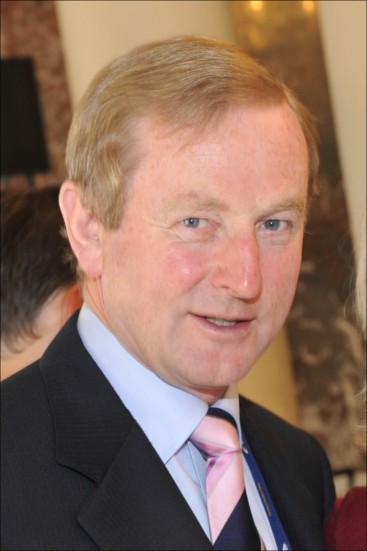
Might it be only a matter of time before a sizable section of the Irish electorate wakes up to what is really going on under the surface in the political and media seconded onslaught on the universal Catholic Church? There are signs that it may not be much longer before they see through how the Irish Labour Party’s  the Labour atheist liberals are steamrolling the blustering but ultimately lightweight Enda Kenny into a secularist cul-de-sac which is an alien place for most of his party faithful.

The Labour Party’s unscrupulous exploitation of the victimhood of those who suffered sexual abuse and the constant use of the “safe place for children” mantra will surely soon begin to wear thin. The lady doth protest too much and the reality of compassion fatigue will set in – as it has for many already. When it does, the nakedness of the secularists’ venom will become clear and we will all be able to deal with the real issue here – the battle for the hearts and mind of the people of Ireland.

As matters stand just now every effort to expose this real agenda is confronted with a nauseating and hypocritical cry of horror that the abuse of children is being heartlessly ignored – for any number of ulterior and unworthy motives.

If and when people who have a real faith-based loyalty to the Catholic Church, the Church which the majority of Irish people still believe was founded by Jesus Christ himself and on which they believe the ultimate good of their society and their eternal salvation depends, begin to see what is really going on here then there may be a political reckoning for the resurgent Labour Party and their fellow-travellers which they did not… well, reckon on.

Paul Cullen, writing in The Irish Times on Tuesday  http://www.irishtimes.com/newspaper/ireland/2011/0906/1224303590313.html

hinted at the way this whole affair might be unfolding politically. His observations suggested something of the inexorable law of unintended consequesnces which might be unfolding for Mr. Kenny.

The Vatican’s response of last Saturday, he says, “by dint of its detailed rebuttal of the accusations hurled by the Taoiseach Enda Kenny and the deputy prime minister and foreign minister, Eamon Gilmore, over the summer, puts the ball firmly back in their court. It demands of that they substantiate the claims they have made against the spiritual leaders of the country’s dominant faith.”

Eamon Gilmore tells us he has no interest in being drawn into a prolonged bout of nit-picking with the Vatican over “this phrase and that”. “As the leader of a secular, left-wing party, he can probably afford to adopt this stance, safe in the knowledge that it will play well with his natural support base”, Cullen thinks.

The Taoiseach, he says, faces a different challenge, both personal and political. “He is a committed, Mass-going Catholic, and this fact lent his criticisms of last July particular pungency. He is also the leader of a traditional, right-of-centre political party with long historical ties to the church. As such, he can’t just brush off the implied criticism of his position contained in the Vatican’s response. He must also pay heed to the words of Archbishop of Dublin Diarmuid Martin, almost a lone voice in his church in criticising his colleagues’ response to abuse.”

There is enormous respect for Archbishop Martin and that he would now be calling for some accountability from Mr. Kenny is significant and something that will be noticed.

What might be coming down the tracks for Irish politicians was predicted for their counterparts across the Irish Sea this week in London’s Daily Telegraph. This was in the context of the handling by politicians there of the effort to ameliorate some of the rather horrific consequences of Britain’s abortion laws. It seems that the Conservative leadership have got cold feet about some amendments to legislation which would have this effect. They have been “got at” by the abortion lobby and are putting pressure on back-bench Tories who were favouring the amendment.

Christina Odone commented in the Telegraph: “This kind of bullying, once the preserve of the Labour Party, is surfacing among Tories under a PM who feels insecure about “ethical” issues. As a former (and according to his then tutor Vernon Bogdanor, brilliant) PPE student, Dave knows his rights from his wrongs. The problem is, he also knows that the liberal establishment he curries favour with (those hacks and TV producers, think-tankers and PR professionals he’s partied with since his 30s) abhor any hint of a conservative morality”

She then sounds a warning note, which members of the Irish parliament might do well to take note of: “But beware, Members of Parliament, of following pied piper Dave over the cliff. As the ever-splendid Ann Widdecombe has warned, a vote against the amendments may well cost you your post. The reason? Three little words: Dr Evan Harris. The former Tory minister points out how Dr Harris, who enjoyed a comfortable majority (7683) as Lib Dem MP in Oxford West and Abingdon, had irked, with his secularist agenda, Christians in his constituency. During the election, Church groups lobbied against him. And they won: to the shock horror of the liberal establishment who revere Dr Harris for his right-on atheist fundamentalism, the good doctor bit the dust; Nicola Blackman, a young Tory, took the seat with a 17 majority.

“That’s quite a turnaround. And it should send a shiver of fear down every MP’s spine today: you mess with people of conscience at your peril.” http://blogs.telegraph.co.uk/news/cristinaodone/100103496/abortion-vote-the-fate-of-dr-evan-harris-should-be-a-warning-to-mps-who-ignore-their-christian-voters/

Perhaps it is time for Irish parliamentarians to take stock of the real value of their political capital and not take their electorate too much for granted, playing fast and loose as they have been with their emotions – and their consciences.

Upstanding or grandstanding?

As posted on www.MercatorNet.com  this morning.

Hopes that the Vatican’s recent response to attacks by Ireland’s politicians might relieve some of the tension in Irish Church-State relations seem over-optimistic. The Vatican was ostensibly commenting on an inquiry into how the Catholic diocese of Cloyne dealt with clerical sex abuse of children. But more significantly, it responded vigorously and rigorously to fierce criticism by politicians – includingan extraordinary attack on the Holy See made in parliament by Prime Minister Enda Kenny.

Immediate reaction by Irish politicians in the last few days has been guarded but they were hardly conciliatory. Mr Kenny said he stood by his allegations. Foreign Minister Eamon Gilmore remained “unconvinced”. This was before either of them had studied the document. The omens are not good.

This is a great pity. If the interests and the welfare of children were really what the government was striving for –Mr Gilmore’s mantra – then the appeal of the Vatican would not be falling on deaf ears. The document calls for “the restoration of mutual confidence and collaboration between Church and State authorities, which is essential for the effective combating of the scourge of abuse. Naturally, the Holy See is well aware that the painful situation to which the episodes of abuse have given rise cannot be resolved swiftly or easily, and that although much progress has been made, much remains to be done.”

We can only hope, however, that when all the face-saving has been done – because politicians are very reluctant ever to say “I was wrong about that” — Church and State will abandon the blame game, work together and get on with the job of making society a safer place for children.

In the long term, however, what is disturbing about this conflict is what it reveals about the character of contemporary Irish political life. There is a shameless populism in the politicians’ grandstanding. It is this populism that keeps them at loggerheads with the Holy See.

Government spokesmen have been riding on the crest of a wave of “public anger and frustration.” It was quite clear that their hope was that this anger might continue to prejudice the public’s view of Vatican’s response. Their hopes are being realised.

But this crisis in relations with the Holy See should prompt the public to question the Irish Government’s own record. Just last week a sociologist from Trinity College Dublin pointed out the dangers of exaggerating clerical child abuse. Dr Helen Buckley, a sociologist at Trinity College Dublin, said serious scandals such as that in the Catholic diocese of Cloyne attracted huge media focus which was disproportionate to the incidence of child sex abuse cases. Clerical sexual abuse needs to be reported on in correct proportion to the “tiny” minority of the population affected, she said.

“A lot of the [media] activity in the past few months concerns Cloyne, and while it is very serious, it’s quite tiny,” Dr Buckley said. “I feel there’s a danger because clerical sex abuse touches such a nerve in this country, and the [child protection] system could become skewed. It needs to be seen in proportion,” she said.

Recently appointed to the Irish Health Service Executive’s advisory committee on children and family services, Dr Buckley voiced concern at the proposed introduction of mandatory reporting of cases of child abuse. Ironically, the whole question of mandatory reporting – and the Church’s supposed reservations about it — was a key one in the Irish government’s trenchant attack on the Vatican.

Will the Irish government act on the recommendations of people like Dr. Buckley with the same determination as it demanded from the Church authorities? In all the bluster there has been no mention of the shocking revelations last year that the Irish Health Service Executive (HSE) “believes that approximately 200 children have died in state care in the last ten years.”

“The figures are emerging”, the report went on, “as part of a nationwide probe and are ten times greater than the previously admitted number of deaths — the HSE had said that 23 children had died in care.” This all came to light following an audit of HSE files following the controversy over a report into the tragic death of a teenager.

Newspaper columnist Sinead Ryan was scathing: “We have no cohesive child-welfare policy funded and run by a single entity. We are brilliant at writing reports on how to care for children and abysmal at actually caring for them. We are worse at holding anyone accountable when failures happen.”

The Vatican has spoken very candidly of its shame and sorrow “for the terrible sufferings which the victims of abuse and their families have had to endure within the Church of Jesus Christ, a place where this should never happen.” No such words as yet from the state in respect of the deaths of 200 children taken into its care. In fact, the bureaucracy has denied allegations, admitted the possibility of a higher tally only under extreme pressure and stonewalled inquiries even by the responsible minister. The chief executive of Barnardos, Fergus Finlay, said that the deaths were “deeply shocking, as is the fact that the review team has not been handed a single file.”

“This is a scandal of enormous proportions for which some immediate answers are required in the public interest,” declared Alan Shatter, now the Minister for Justice, last year. “How could it be the case that so little value was attached to the lives of these children and that until now, no action was taken to identify and collate the numbers dying in care or to review the circumstances of their individual deaths?”

Some Irish people are beginning to see a double standard at work.

The Arts and Mystery

“The painter Jasper Johns once remarked: ‘I can imagine a society without any art at all, and it is not a bad society.’ I wonder what he meant.”

Thus Professor Denis Donoghue began his series of BBC Reith Lectures in 1982, “The Arts without Mystery”. They have remained in my memory for those 29 years as one of the most intriguing and wise examinations of the arts, their reception and their relationship with our society which I have ever heard. I revisited them again recently, courtesy of a BBC podcast. They are as relevant today as they were 29 years ago. Not only are they relevant in what they say explicitly,  but they seem to connect indirectly with many other issues confronting us three decades on.

 “I hope Johns meant,” he continued, “that he would prefer art not to exist at all than that it should exist as a commodity among commodities, its mystery removed. I want to talk about the arts in relation to the mystery that surrounds them, not as a problem to be cleared up but as the very condition in which they appear at all. In that sense, mystery is to be acknowledged, not resolved or dispelled.

“It has become a scandal to speak of mystery. Many people regard talk of it as sheer mystification, a pretentious claim upon profundity, as if the only situation worth talking about defeated every reasonable attempt to deal with it. But I want to reinstate mystery and to distinguish it from mere bewilderment or mystification. One of the strongest motives in modern life is to explain everything and preferably to explain it away. The typical mark of modern critics is that they are zealots of explanation; they want to deny to the arts their mystery, and to degrade mystery into a succession of problems. But the effort is perverse.”

It seems to me that the malaise Donoghue refers to here is one which is also at the root of the modern flight from religion. Something has developed in our culture which is averse to the existence of mystery in our lives and has generated the prevailing secularism – that vision which tells us that the world and its panorama of ultimately explainable objects constitute all that there is an all that there ever will be.

 “The philosopher Gabriel Marcel,” Donoghue recalled, “has distinguished a mystery from a problem in this way. ‘A problem,’ he says, ‘is something which bars my passage. It is before me in its entirety. A mystery is something in which I find myself caught up, and whose essence is therefore not to be before me in its entirety. It is a proper character of problems to be reduced to detail: mystery, on the other hand, is something which cannot be reduced to detail.’ When we refer, for instance, to the mystery of ‘Being’, we don’t mean that it is something that comes to our attention as an obscurity, so that we can regard the obscurity as the first stage of clarification—as if at a later stage the issue would become clear or at worst clearer. If ‘Being’ is a mystery, it is a mystery through and through, not a difficulty to be cleared up.

“If we want to take the mystery out of life, it’s because mystery is thought of as an insult to our intelligence; that the part we play in it is merely one of bewilderment.”

Donoghue distinguishes mystery from mystification He takes as an example of the latter, Peter Shaffer’s play(and later screenplay), Amadeus. The play is based on the notion that Mozart was murdered by Antonio Salieri, a rival composer. Salieri, driven mad with jealousy and raging against a God who gave the divine gift of musical inspiration to the oafish Mozart – as portrayed by Shaffer – at one point slits his own throat in an unsuccessful suicide attempt. Donoghue doesn’t much like the play, which he sees as an example of a work of art seeming to proclaim itself as mysterious.

“Shaffer is trying to give his Salieri a force of radiance which nothing shown in the play warrants. Mystification is his recourse to false altitude, which in a dim light looks like the real thing: The sublimity is specious, as specious as the comforting implication, throughout Amadeus, that art is the modern substitute for religion.”

There is no mystery here. There is only a pretence of mystery which cosily deals with the unease we surely feel in the face of the mysteries which really do exist. This cosy treatment of mystery is for Donoghue a result of the

“modern vanity which supposes that everything can be known or that only what is knowable has a claim upon our interest. The artist and the priest know that there are mysteries beyond anything that can be done with words, sounds or forms. If we want to live without this sense of mystery, we can of course, but we should be very suspicious of the feeling that everything coheres and that the arts, like everything else, fit comfortably into our lives.”

Donoghue does not confuse art with religion, or artists with priests. But he does see a relationship between the two in their common revelation to us of the existence of mystery and the presences of which we can be aware in no other way.  

 “Even in a world mostly secular, the arts can make a space for our intuition of mystery, which isn’t at all the same thing as saying that the arts are a substitute for religion. There is nothing in art or in our sense of art which corresponds to my belief in God. In religion, our faith and love are directed beyond ourselves. In art, faith doesn’t arise. It’s enough that the arts have a special care for those feelings and intuitions which otherwise are crowded out in our works and days. With the arts, people can make a space for themselves, and fill it with intimations of freedom and presence.”

 Extrapolating from Donoghues’s ideas on the arts in this series there is possibly another parallel between the arts and religion which can be drawn. Donoghue talks at length of the nature of the relationship between art and society and the artist and the managers of our society, our politicians. Not only are the critics constantly attempting to explain away the mysterious in the art they are confronted with. So also are the managers of our society suspicious of any artistic expression which cannot be dealt with in this way – until such time as they can organise themselves to neuter it. It is as though the very existence of mystery implies a threat to their explanations to us of all that exists. Comunist Russia did this throughout most of its history. Just read any account of the cat and mouse conflict between Andrei Tarkovsky and the watchdogs of soviet cinema. Human history shows exactly the same response to religion on countless occasions when it has proclaimed its mysteries to mankind and the truths it teaches, directly or indirectly emanating from those mysteries. Donoghue reminds us:

 “The artistic vision is in some way ineffable, unspeakable; it deflects every attempt to pin it down by knowledge or to define it in speech. The stories” – he gives the examples of the Greek myths of Prometheus and Philoctetes  – “say that art is not to be assimilated to the comfortable ways of a society. The artist is an eagle, not a dove.  In the Preface to The Tragic Muse Henry James said that the relation between art and society is one of conflict, and that the conflict is ‘one of the half-dozen great primary motives’, presumably because it touches upon many other motives once you let it spread.

“But why should there be antagonism between politics and art? Isn’t there room for both? The trouble is that both politics and art are universalist in their ambition, each claims a total vision of life. More emphatically, artists have resented the claim that politics knows what reality is, and that this knowledge is fully represented in political institutions.”

The same can be said for religion. When Professor Donoghue goes on to look at the radical change which has taken place in the past 40 years or so in the public acceptance of the arts he does not see something entirely benign. Indeed he sees something very sad indeed – and what he sees can be translated into what we have also seen in the public acceptance of what is now called a-la-carte religion, a religion devoid of any real meaning beyond a simple life-style choice.

“Thirty or 40 years ago it was commonly assumed that there were higher values than those administered by our official institutions; government, law, the market, the banks. It was supposed that religion, education and the arts had a special concern for the higher values. The morality of the arts was to bring forward what the official institutions chose to forget; intimate subjective experience. The arts took up that experience and made it their main business. The poet John Crowe Ransom argued that the function of a genuine society is to instruct its members how to transform the values of instinct and appetite into aesthetic values; and he associated aesthetic values with those of religious conviction. He thought that societies might be persuaded to rise above their ordinary selves by observing the rituals of religion and art. In a different account R. P. Blackmur said that the purpose of literature, as of all intellect, creative or critical, is to remind the powers that be, simple and corrupt as they are, of the forces they have to control. Ransom reminded our institutions of what is beyond their offices, though still within the reach of a leap of spirit.

“Only when there is a real belligerence between official and unofficial values is a worthwhile art possible, and middle-class society has discovered how to achieve its victory by pretending that nobody has been defeated. Especially since the turmoil of 1968, societies have learnt that they can deal with dissent by incorporating it. Orthodoxy can be expanded to accommodate heresy, and when the fuss dies down, it can contract again to its norm.  The soft answer turneth away wrath, especially if it is accompanied by grants, fellowships and other felicities. The universities discovered that they could take Modernism off the streets by offering courses on its favourite texts….

“The management of the arts is a system by which it is pretended that desire is the same as need and may be appeased by money and fame. If it were successful, it would complete the secularisation of their spirituality, a process well established in the universities, where the most radical arts are taught, defined and assimilated….

“A gallery is not the best place to look at paintings, precisely because it is the best place to study the history of art; for the same reason that people become interested in ‘comparative religion’ when they have given up believing in any of the religions they compare.”

If the cosying up of the state – and forget whether it is a state of the right, left or centre, with whatever label it wants to give itself, “people’s republic,” “democratic republic” or any other kind of “res publica”, – is inimical to art and its mysteries, so too is it to religion if in its heart if fails to acknowledge the truth of mystery. Such a state is truly secular and secular in the most crippling way. This is the secularism which on its outer fringes is currently waging open war against religion in the western world. Good. The Church must exist side by side with all comers in the world, and it must endlessly seek to reveal to them the Truth of which it is custodian, a Truth whose crown is mystery. In so existing, however, it must be careful to sup with a long spoon when supping with the princes of this World.

 We have but given fragmentary samples of this very impressive series of lectures. For the full lecture series, in six thirty-minute sessions, go to the BBC Reith Lecture archive at www.bbc.co.uk

LANGUISHING WITH THE JUNK

This silly posturing by the Irish Government on the Cloyne Report is an embarrassment to us all. They have succeeded, and in particular Enda Kenny has succeeded, in his over-the-top rhetoric in his so-called “historic” speech in Dail Eireann, in turning a local tragedy into a full-blown international diplomatic brouhaha. The Vatican is not a central player in this matter – nor did the Cloyne Report make it so. Mr. Kenny did. He did so on the basis of a more inept misreading of the ambiguously interpreted 1997 letter from Cardinal Castrillón Hoyos than even the Cloyne Report was guilty of.

Ireland’s Taoiseach, Enda Kenny

This whole thing is somewhat reminiscent of the rhetoric of the IRA when they held the British Government responsible for the atrocities they perpetrated in Northern Ireland over the last decades of the 20th  century.While they were proclaiming themselves as freedom fighters they were simply compounding all the alienation between the two Northern communities which was the real cancer there. Instead of addressing the real and tragic sources of conflict, they exploited that tragedy to pursue their own anachronistic nationalist ideology.

Mr. Kenny has now succeeded in turning the tragedy of the destruction of children’s lives into a weapon which other ideologues can use to further their barely concealed anti-catholic venom.

Historic speech? I think history will in years to come view this speech as just a piece of ill-judged folly. More than one commentator has noted the hand of a not very competent speech-writer behind it, and clearly a speech-writer with an ulterior agenda. It might have been a good speech; it might have been a just speech; it might even have been a speech which would have deal a severe body-blow to the clericalism which has bedevilled this country since Catholic Emancipation in the early 19th century. But it wasn’t.

The leader of a country can very usefully reassert the principles of independence and sovereignty which serve the common good of a nation. But it should be done with the dignity worthy of a people. It should be just and truthful.  As it was it was neither clever, competent nor just. It misunderstood what the Church is and it misunderstood even the incompetence of the role which some of the Church’s servants have played in this tragedy. It was angry but its anger smacked of little more than that of a spoiled child.

Bishop Fulton Sheen once said “There are not one hundred people in the United States who hate the Catholic Church, but there are millions who hate what they wrongly perceive the Catholic Church to be.” Enda Kenny surely added to the number of people in Ireland today who hate the Catholic Church for the very spurious reasons which he has presented them with. The bag of supporting letters he boasts of would seem to suggest so anyway. By failing to distinguish between errors of individual administrators in the Church, serving the Church badly, and the Church itself, which – in spite of the incompetence of some and the crimes of others – gives witness of heroic sanctity and apostolate throughout the world, he has done no service to anyone. Least of all has he served the victims of abuse who in truth will only find true healing of their wounds in that very Fold which he so intemperately excoriates.

A reading of this whole situation has been put to me by a friend from across the Atlantic. It sums up the fine mess we have got ourselves into as follows.

“From over here the reasoning seems to be:   the Irish government is upset at the Vatican because it didn’t make the Irish bishops take action.  The bishops, in turn, didn’t take action because they thought it was not what the Vatican would want.  The behavior of those who committed these actions would be considered illegal no matter where they took place.  So why didn’t the Irish government bring charges against the individuals involved when they found out about these actions? Forget about the hierarchy’s response.  Is the hierarchy running the government?  Is Ireland ruled by the Catholic Church?

“I would answer my question by saying that a clerical mentality pervades both the Church and the laity (Irish government).  The behavior was covered up or excused for the reason of not causing scandal.  Instead, by covering it up, an even greater scandal develops.  If these cases were dealt with by the criminal justice system as they arose, that would have served as a deterrent to further such cases.  But the inaction only allowed them to spread.  The bishops should have disciplined right away.  And the government should have acted earlier. “

The world looking at Ireland today can hardly be very edified by any of the local protagonists in this drama. Clearly, it’s not just our financial credit rating that is at junk level. Our general governance rating, civil and ecclesiastical, is also languishing with the junk.

Scapegoats Solve Nothing

The human urge to create scapegoats for the failures of individuals or societies collectively is a universal one. One cannot but help think that a manifestation of that urge can be seen in the rush to pin blame on the Catholic Church for all the abuse of children, now being exposed so harrowingly, which have been perpetrated within our society over the  later decades of the last century. The truth is that all of us must beat our breasts and accept responsibility for our blindness to this evil, willful or otherwise. The creation of scapegoats serves no purpose in a civilised society.

Ireland paraded its own version of the scapegoat before the world with a vengeance last week, with its prime minister, Mr. Enda Kenny, launching a vitriolic attack on the Vatican for its alleged complicity in a local Catholic diocese’s failure to adequately deal with abusive clerics. For some he was a hero. For others he was at best playing the disingenuous populist. The truth is that he missed the point entirely.

If we want to deal effectively with the scourge of abuse we will have to deal with the underlying moral roots of the malaise we are confronted with. Creating scapegoats is just sweeping the problem under the carpet and preventing us from getting on with the task of creating a society in which the gift of childhood innocence is adequately protected.

As in the body biological, so in the body politic. When the human skin manifests certain symptoms – for example, a swelling here, a reddening there, or an itch elsewhere – doctors will ask a few questions. If the symptoms are widespread enough the questions will be deeper and the examination will be thorough – or should be – until the root cause is identified. There will be an effort to relieve the symptoms but that will not be considered a solution to the underlying problem which both he and his patient both suspect may be lurking in the undergrowth. If he just tells his patient “take these three times a day and don’t worry”, he will probably end up being struck off the medical register.

We are doing just this with the whole child abuse crisis. Child protection measures are no more than sticking-plaster – with a touch of analgesic cream – on a cancerous growth in the heart of our society. The scapegoating of the Catholic Church for its undeniable failures in applying its own sticking-plaster is a smokescreen preventing us seeing what really lies at the heart of this malaise. The irony is that the Catholic Church is the only institution in society which in its solemn and official teaching points to the way in which society could be relieved of this mortal disease.

Ross Doubthat in a column in the New York Times back in May last year raised the very unpopular spectre of what might be some of the root causes of the incidence of abuse.  He reproduced a chart from the John Jay Report on sexual abuse in the Catholic priesthood, commissioned by the U.S. Council of Catholic Bishops, showing the number of credible accusations of abuse across the last half-century. On the basis of that he argued that “something in the moral/cultural/theological climate of the 1960s and 1970s encouraged a spike in sexual abuse”. He also asserted that the data showed that we’ve since seen the church come to grips with the problem, at least in the United States.

He did point out that it was “important to note that most of these incidents were reported in the 1990s and 2000s, years after they took place. This raises the question of whether the low numbers for the 1950s reflect a real difference between the rate of abuse in the Eisenhower era and the rate in the decades that followed, or whether it’s just that fewer of the victims from the ’50s have come forward with their stories, because of advanced age, greater shame, etc.” However, in spite of that, he could not but feel that the data suggest that “something significant really did shift, and escalate, in the years around the sexual revolution.” It is very hard to deny, he concluded, “that something changed in the 1960s, and not for the better.”

We know it did, don’t we? In fact we are never done boasting about it – our revolution, our liberation from repression and form all those taboos about sexual behaviour. This is the stuff we are sweeping under the carpet. The Irish, we are told, only discovered sex when TV came along in the 1960s. Then, bit by bit we accommodated ourselves to every permissive element in the new culture. But will we admit that this has anything whatsoever to do with the scandals we are now having to deal with? Not a hope.

Let us face the truth. The abuse of children is just part of a wider abuse. It is immediately horrific because it involves a sinister double fault. But our thinking is flawed. We talk about innocence but we do not really know what innocence is. We have obliterated guilt from our conscience in all matters of sexual morality which relate to ourselves as adults but we still try to hang on to a concept of guilt affecting the conscience of a child when abuse is perpetrated on him or her. We are right there but we are being inconsistent and hypocritical when we deny it to our own consciences.

The Jay report revealed a pattern which showed the effect of this erosion of conscience in the clerical segment of a population. If another survey were carried out among the general population it would also show a pattern but it would be different. There would be no evidence of any restoration to a normal healthy understanding of the true meaning of sexuality. Pope Paul VI’s encyclical, Humanae Vitae, spelled out for us some of the basic moral principles which should govern human sexuality. Some Pope John Paul II’s encyclicals and the Catechism of the Catholic Church further clarified and reaffirmed these. Self-abuse and homosexual practices – which are essentially the same – were intrinsically evil acts. There was pandemonium. For some it was nonsense, for others it was outrageous and dangerous, potentially a psychologically damaging teaching. No, in the permissive society all these things must be accepted as normal. The damage done to children and adolescents when they are abused is horrendous – but it is even more horrendous than some of the most vociferous condemnations even understand, precisely because of their own very flawed understanding of the true meaning of human sexuality, the meaning which has been almost universally destroyed in the Western world in the later part of the 20th century.

Let us forget the scapegoats and get back to the real world. If we want to deal effectively with the scourge of abuse we will have to deal with the underlying moral roots of the malaise we are confronted with. Then we might begin to do something about the child abuse perpetrated by our divorce culture, by our soft-porn TV channels beamed into children’s bedrooms, and by our totally inadequate responses to the drink and drug culture which is wasting away the lives of so many young people. Creating scapegoats is just preventing us from getting on with the task of creating a society in which the gift of childhood innocence is adequately protected.

An Endless Battle

One night in December, 1170, King Henry II of England, so the story goes, cried out in exasperation, “Will no one rid me of this meddlesome priest?” Prompted by that outburst, four knights in his entourage saddled up their horses, boarded a boat for England – Henry was holding court in France that Christmas, half of which constituted his Angevin Empire – and made their way to Canterbury Cathedral. There they set about murdering the Archbishop on the steps of the high altar as he was about to say Mass.

Why? Because Henry II and Archbishop Thomas á Becket were at loggerheads over their respective rights and duties. It all started over a case in which a criminal cleric had received what was deemed to be a too-lenient sentence in a Church court. At that primitive stage in the development of the common law system the respective jurisdictions of Church and State were not as defined as they are today. Church law was universal and codified to a degree that could not be matched by secular law. The law of might-is-right was still very prevalent as the law of the land in that age. Clerics had a right to be tried in Church courts just as the aristocracy had also the right to be tried by their peers in the House of Lords – or the Great Council as it was then known. But things were changing.

Henry II, although a rough and brutal man of his time, was one of the great law-making kings of England, seeking to bring the rule of law to bear on all in his kingdom. In this he clashed with the Church, particularly in the person of Thomas á Becket – who at one time was his Chancellor, as well as his bosom friend and companion. Church law was founded on Christian principles of justice, charity and mercy and ultimately was there to serve the work of the Church in the salvation of souls. To be able to do this work effectively, its freedom from the secular power was deemed essential. On this principle Becket had to make a stand against the incursions of the King – whose business was patently not the salvation of souls. Make a stand he did, and paid for it with his life.

Becket became a martyr and the place of his death and burial became one of the great shrines of medieval Europe. Henry repented his outburst, took responsibility for its consequences and came to the Canterbury and did public penance. How private that penance was is another matter. Becket, however, in the long history of the tensions between Church and State in the realm of lawmaking, remains a powerful symbol for all those who have to proclaim themselves in every age, as St. Thomas More did, “the King’s good servant, but God’s first.” Becket’s influence still resonated in the 16thcentury when the English king finally did what Becket was essentially protecting the Church against – its domination by the secular power. Legend has it that Henry VIII, after he had executed St. Thomas More for refusing to recognise him as head of the Church in England, also had Becket tried. He then had his remains exhumed, and subsequently burned for his alleged treason. It is only a legend – but legends have their own way of telling the truth.

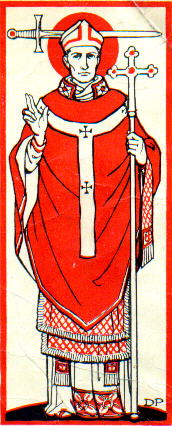
St. Thomas á Becket

The great battle between those who set their hearts on the life of this world and those who have a clear vision of life here as but an integral part of an eternal life, seems endless. It is always there to some degree. But sometimes it flares up into all-out conflict – as it did with the persecution of the first Christians. So too, with the wars of the Protestant Reformation which were settled eventually with the acceptance of that horrific compromise, Cuius regio, eius religio, which translates as “Whose realm, his religion”  – the ruler will tell you what religion you must adhere to. Most horrific of all among the persecutions of believers were the horrors perpetrated in the twentieth century by the twin evils of communism and national socialism.

At times the conflict is a clearly defined struggle of good and evil. At other times not so. Such was the struggle between Henry II and Thomas á Becket. Both men were seeking justice in their own way – and while Becket’s vision of man and his destiny was a superior one to that of Henry, he was compromised to a degree by the evil perpetrated by those whom he sought to serve – and save – through the agency of a free and untrammelled Church.

Eight-hundred-odd years separate us today from the battle between Henry and Becket but there are signs that the Catholic Church in Ireland is now engaged in a conflict that in many ways is not dissimilar to theirs. The Church in Ireland has been tragically and shamefully compromised by its members, its servants, high and low. By their shameful acts of abuse and by the blundering response of some to those crimes, it has been left vulnerable to attack and is in danger of being crippled to the extent that its very raison d’être, evangelization and the salvation of souls, is compromised. As it seeks to protect itself and its mission it is accused of seeking to protect its “power”. Nonsense. The Church seeks neither power nor any rights other than those on which it depends to fulfil its sacred duties.

Now, in the Irish Republic, under the guise of “wise” lawmaking, under the guise of a “prudent” extension of the rule of law, the administration of one of its most precious sacraments is under threat, the sacrament of the reconciliation with God of men and women, burdened by the sins of their fallen nature. A law is being proposed to the Irish parliament, requiring Catholic priests to break the seal of confession, a privilege of the repentant sinner which has existed for the past 2000 years. By this law any priest to whom a penitent confesses a sin of sexual abuse of a minor – sins of murder, treason, drug-dealing and all the rest are not of the same gravity as this one sin, the law implies – will be obliged to report the sinner and his sin to the police. The proposed law will probably not fly anyway. Its inherent inconsistency, its impractability, its ignorance of the very procedure in the confessional –  where a confessor in principle does not identify the person confessing – will bring it down.

But the more serious implication lies in the very fact that it has been proposed. It is an interference by a secular state in the spiritual and sacramental mission of the Church, the very principle for which St. Thomas á Becket died.

A Catholic knows that when he talks to a priest in Confession, that priest to whom he is speaking is there in persona Christi. He comes to talk to him because he is truly sorry for sinning against God and his fellow men, because he fully repents and looks for grace to help him never to offend again. Under the law now being proposed in the Irish Republic, that confessor, in persona Christi, will leave that confessional and report what he has heard to the secular power. Forget contrition, forget penance, forget repentance – just go and take your punishment from the judges of the secular courts and from the tabloids and all who read them and are longing to drool voyeuristically over your sordid sins. Seek first the justice of your secular power. Forget the rest, it effectively says.

It is difficult not to see all this as part of a pattern, manifesting once again that endless battle between the temporal and the spiritual. The secular state of our day has taken from Christians their concept marriage and redefined it out of existence – first with divorce, and then with other aberrations. In Ireland it is now about to take the Catholic Sacrament of Reconciliation and destroy it with a penal law the like of which has not been seen since the 18th century. There is a famous Irish ballad called The Croppy Boy. The boy in question, a young soldier in the Irish rebellion of 1798, came to the priest’s house for confession. The redcoats had got there before him and one of them, impersonating the priest, heard his confession in which he spilled all the beans of his rebellious life. When he had unburdened his soul the redcoat revealed his true identity.

With fiery glare and with fury hoarse,

Instead of a blessing he breathed a curse:

“Twas a good thought, boy, to come here and shrive,

For one short hour is your time to live.”

“Upon yon river three tenders float,

The priest’s in one – if he isn’t shot –

We hold this house for our lord and King,

And, Amen, say I, may all traitors swing!”

The boy in the song tells us his sins. There is nothing shocking about them. There is no mention of sexual abuse. It is just a story. But the shock of the song is that a man took the place of God in a sacred place, a man intervened and corrupted an act by which God has willed to bestow forgiveness and restore supernatural life to a repentant sinner. It is the very same shock which Catholics in Ireland experienced when their Prime Minister announced last week that the sacred seal of the Sacrament of Confession was going to be abolished under Irish law. The stand taken by Thomas á Becket is a stand for all time.

This doesn’t look very even-handed…

Is this Irish Times balanced editing? The reporting is straightforward enough. PRO-CHOICE (200) – those nice positive people – get pride of place in the headline over ANTI-ABORTIONISTS (5000) – those negative “anti” types? It all looks like more public opinion programming by yours truly. Pro-choice is not enough. We are all pro-choice. Come out and tell us what your choices and what their consequences are.