From dysphoria to dysfunction?

gender-wars

Pia de Solenni is an American moral theologian. Last night she talked in Dublin to a group of people who came to hear her views on issues related to gender and the deconstruction of millennia of understanding about human nature and the sexes which is now in progress.

While the question was asked, and answered, about where all this has come from – with Descartes being something of a villain of the piece – and the question of where it was all going being at least tentatively answered – down the tubes being one scary option, the real quandary was something we had to go home and think about: what can be done to save the day?

My notes from her talk were not very comprehensive and  I would not dare to try to recapitulate all that she said. However, in 2013, the National Catholic Register published an article which she wrote. In it some of the key influences and observations which underpinned last night’s talk are contained in it. They offer some clues as to how we might escape from this quandary.

It was entitled ‘Theology of Women in the Church’ Only Beginning to Be Revealed. It harked back to some words of Pope Francis on this now famous exchanges with journalists on this flight back from World Youth Day in the summer of that year, when he simply observed that  ‘we don’t have a deep theology of women in the Church.’ Her article continues :

His comments were a timely preface for the 25th anniversary of John Paul II’s apostolic letter Mulieris Dignitatem (The Dignity and Vocation of Women), marked by this year’s Solemnity of the Assumption.

When I was doing graduate theology work in Rome, the document had been out for many years. John Paul II had continued to teach on the topic and had articulated the need for a “new feminism.”

However, as one of my friends observed, the common translation of this “new feminism” was a type of elitist feminism. It was applicable to women who were well educated, had successful careers and were married with children and household help.

While I was on my way to being well educated, I certainly didn’t have the rest of the ensemble. I was studying with priests and seminarians, mostly. I had no desire to join their ranks, despite our common discipline. At the same time, my friend was educated and married with small children. But working outside of the home would have placed too great a burden on her family. We also knew there were plenty of other women who didn’t fit the mold. I was convinced that the new feminism had to include all of the various states in the lives of women, not just educated, affluent wives and mothers.

This became the impetus for my doctoral work, in which I surveyed various feminist and gender theories to explore why the questions of feminine identity and vocation remained. I then used the thought of Thomas Aquinas, a saint and a brilliant doctor of the Church (sometimes inaccurately identified as a misogynist), to develop a feminism of complementarity or an integral feminism, one that sees the sexual differences as constructive. I wanted a feminism that considered a woman in her entirety, not just in terms of what she did or didn’t do: a new feminism.

As I progressed in my research, I realized just how visionary Pope John Paul II had been. He wasn’t offering a Catholic version of a fascist salute to motherhood. He was taking the concept of motherhood in a wholly different direction. After all, by the time he was writing, the developed world knew that women could match, and even surpass, men in most things. Instead of answering a question that had long sought an answer by defining women in terms of what men do, he focused on who a woman is, a much more elusive topic.

Still, my first reading of Mulieris didn’t satisfy me. I thought it was fine, but not meaty enough. It took a while before I saw that it was both subtle and groundbreaking, particularly in light of his other work. Six years after this apostolic letter, he wrote another, Ordinatio Sacerdotalis (Reserving Priestly Ordination to Men Alone). For such a controversial topic, it was certainly a short document, just a few pages. He summarized Church teaching and almost abruptly concluded, “I declare that the Church has no authority whatsoever to confer priestly ordination on women and that this judgment is to be definitively held by all the Church’s faithful.”

From this point on, John Paul II stopped talking about women’s ordination. He focused on Mary, the woman, whom, in Mulieris, he had set up as a paradigm for all humanity, including himself and every other priest, by virtue of her response to God’s call.

The shift to Mary emphasizes the change in emphasis from doing to being. We actually know very little about what Mary did. But we know who she is: the Mother of God. Her ability to become a mother fundamentally enabled her to be open to God in a relationship that only a woman could have. Her response, uniquely feminine, paradoxically, became the model for all humanity.

Toward the end of John Paul’s life, the Congregation for the Doctrine of the Faith, under Cardinal Joseph Ratzinger, issued a letter to the bishops, The Collaboration of Men and Women in the Church and in the World, which emphasized that women “have a role in every aspect of society.”

If we follow the example of Mary, that means working from within, wherever we happen to be, whether as chancellor of a major archdiocese, a mother home with small children, in business, politics or countless other places. It means recognizing that women bring something to the table by virtue of who they are rather than simply by what they do.

If Mary’s role as homemaker had been so vital, Jesus would have left the preparation of the Passover meal to her and not to the apostles. (I’m willing to bet she would’ve put on a better spread.) She was defined by who she was, by her relationship with Jesus, not by what she did. Similarly, we know that the apostles weren’t the smartest or the holiest bunch of men. But Jesus didn’t pick them for their accomplishments.

Twenty-five years after Mulieris Dignitatem, women have more positions in Church offices, and certainly women could have more leadership, but the vocation of women can’t be limited to a clericalist framework. Women, like men, exist in every sector of society, and both have critical contributions to make, regardless of what they do, because being a woman or a man should constructively influence the outcome. Within the Church, women need to be able to have a unique voice, not one that mimics that of men.

Pope Francis’ comments indicate that this work has only just begun.

Much, much more will be required to get us to the point where we understand both women and men for who they are.

On the more explicit gender confusion issue which she spoke about last night this article which she posted on Crux last year covers many of the points she made to us. Again, they give us something to chew on and think through about what might be the best way to rescue ourselves from the quagmire into which we find ourselves sinking fast.

Throughout history, women have been denigrated and oppressed by men. While I don’t always agree with some feminist activists, I certainly acknowledge that I would not have had the opportunities that I have without feminist efforts to right so many wrongs.

Despite these advances, today’s “trans movement” (particularly the transwoman sector) inadvertently takes us back to a time when women were valued based on their appearance, and whether they fit someone else’s preconceived notion of femininity. In essence, all it takes to be a woman today are [fake] breasts and good hair.

As a culture, we are telling women that the feelings and sentiments of a particular group of men – in this case, men who regard themselves as women – matter more than they do. That’s patriarchy by definition, even if women happen to agree to it.

Yes, some individuals suffer from gender dysphoria, but I am very hesitant to say that their struggle gives them the right to identify with the sex of their choice. As a woman, I cannot concede that being female simply means that one wears makeup, sexy lingerie, and a hair-do.

In fact, I was raised in a post-feminist environment where my femininity was not measured by my bra size and whether I could arouse a man. Rather, my female identity was confirmed by science, which demonstrates that every cell of my being is female no matter how I look or what I do.

My being a woman literally has to do with my being, not my doing. Hence, I can live out my life without fitting some ideal of a woman, whether it’s Mad Men’s or anybody else’s.

Let’s be clear here: No one cares about a woman using the men’s restroom. The Target debate has focused on men using women’s restrooms, because most people understand that women and girls are physically vulnerable in a way that men are not.

Whether we’re talking about Target, or states that have passed legislation along the same lines, the practical result now is that any man, whether he’s identifying as a woman or looking for his next victim, may use the women’s restroom because he feels like it.

So much for women’s rights.

Nevertheless, the bathroom discussion is couched in the language of civil rights and discrimination. Talk about a culture-war trap. In fact, on Monday the Justice Department filed a civil-rights suit against the state of North Carolina because it refuses to rescind a bill that requires individuals to use the bathroom correlating with their biological sex.

Some forms of patriarchy include attempts to protect women from other males, but that’s really more of an excuse to protect women for a particular man or group of men. Worse types of patriarchy utterly disregard the dignity and significance of a woman.

Rather than a civil rights issue, I would argue that the bathroom wars indicate that we’re entering an entirely new phase of patriarchy which declares victory every time it destroys a safe space for women, including bathrooms, fitting rooms, locker rooms, and so on.

This new patriarchy scored a breakthrough when Bruce Jenner, in his April 2015 interview with Diane Sawyer, casually commented that he looked forward to becoming a woman so that he could paint his nails and drink wine with his girlfriends. Jenner equated being a woman with the most trivial accidentals, while mainstream media outlets, including awards from Glamour and ESPN, celebrated his courage.

Never mind that he couldn’t even stand for his Vanity Fair debut, lest we see that his male anatomy remained.

Another defeat for women came after Jenner’s transition to a new identity as Caitlyn, when he (perhaps channeling his inner Dionne Warwick) famously stated that the hardest part about being a woman was deciding what to wear each day. Patriarchy triumphed again.

Time after time, the new patriarchy reinforces that being a woman is simply about the externals, what you look like. Cue Hugh Hefner.

Again, some individuals suffer greatly from gender dysphoria, and they should be treated with respect and dignity. But their struggles cannot justify yet another era in which women are reduced to nothing more than body parts and their ability to satisfy a man, even if it’s one and the same person.

Pia de Solenni is a moral theologian and cultural analyst. She serves as the Associate Dean of the Augustine Institute – Orange County, California.

Brexit being played to the gallery?

boris-thumbs-up
Boris Johnson – politicians behaving badly?

As we tune in to the Brexit show, somehow, it is hard not to feel that there could be a little more maturity in evidence than at times there seems to be. At one level it is excellent and indeed very dignified – as we saw in Prime Minister May’s address to the British Parliament. It was again in evidence this morning in her address to the global audience at Davos.

But when it comes to the soundbites reaching  us through the media’s reported comments from politicians across the continent of Europe – not to mention the media’s own comments – the dreaded infection of populism now seems to be at pandemic level.

Immaturity begets immaturity, it seems. Nowhere was this more in evidence than in the response of that rather funny man, Boris Johnson, to some of the reactions to Mrs. May’s House of Commons address. But Boris is not now addressing the Oxford Union. He is the successor of Lord Palmerston and should be playing that part rather than playing to the gallery.

Brexit is very serious business – for both Britain and Europe. The people of the United Kingdom, admittedly by a not very large majority, have indicated their will. Even though across the territories of that kingdom there are clear differences of opinion on the matter, the fact is that by the terms of the venerable and ancient constitution which political life is organised there, the decision to leave the EU is democratically valid.

This is where the immaturity and lack of respect of their European partners – as matters still stand – shows itself. For all parties what maturity and mutual respect would seem to demand would be an acceptance of the will of a people and then an agreement to get down to work to rearrange matters on questions of trade, movement of people, and anything else that is amiss in the apple cart after this “upset”. Apple carts do get upset from time to time.

But, in the popular press at any rate, that is not what we are getting. European press and some European politicians seem to be mainly preoccupied with saving their faces. To do that they seem to need to tell their public audience that Britons cannot be allowed to seem to do well as a result of their decision. On that cue Boris Johnson jumps up from his seat to talk about the silliness of thinking that Britons should be given “punishment beatings” for upsetting the apple cart.

The reality is that the European Union is not the be-all and the end-all of Western civilization. It is a political solution to real problems which Europe has had since the nation states of the continent evolved and which in the 20th century were partly – but only partly – responsible for two disastrous wars. There are many features of this political experiment which have brought their own problems and there have been turnings in its evolution in which many observers detect the seeds of self-destruction – or at least serious deficiencies.

British influence over the years of UK membership tried to correct what was perceived as faulty. It failed to do so and the end result is Brexit. There was in essence a clash of civilizations, or at least a clash of cultures. The basis of this clash might be seen in the observation of Tolstoy about 150 years ago.

Writing in War and Peace of one of the German generals in the Russian army, he summarized what he saw as the national characteristics of some Europeans:

Pfuel was one of those hopelessly and immutably self-confident men, self-confident to the point of martyrdom as only Germans are, because only Germans are self-confident on the basis of an abstract notion- science, that is, the supposed knowledge of absolute truth. A Frenchman is self-assured because he regards himself personally, both in mind and body, as irresistibly attractive to men and women. An Englishman is self-assured, as being a citizen of the best-organized state in the world, and therefore as an Englishman always knows what he should do and knows that all he does as an Englishman is undoubtedly correct. An Italian is self-assured because he is excitable and easily forgets himself and other people… The German’s self-assurance is worst of all, stronger and more repulsive than any other, because he imagines that he knows the truth- science- which he himself has invented but which is for him the absolute truth.

The European Union is not founded on absolute truth. Its constitution did not come from Mount Sinai.The tone of European reactions to Brexit seems to suggest that they believe it did. Until they adopt a little more of the characteristic pragmatism of the British they will continue to make the British nervous. They will also continue to look silly in their approach to sorting out the real difficulties that the British decision has created. Sorting out difficulties is what politics is all about. Get on with it people, and stop this silly posturing.


Real news and fake scandal

maxresdefault

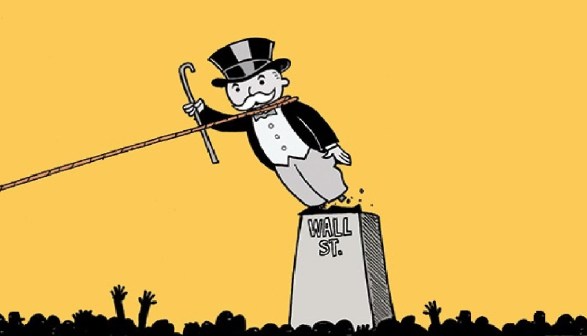
A great deal of fuss – shock-horror fuss – is being made of the revelation this morning that the combined wealth of the eight richest people in the world is as much as the assets of the poorest 3.6 billion people in the world. This is according to the charity Oxfam.

What does this mean in real terms ? Probably relatively little of moral consequence. In moral terms what really matters is what way any or all of those eight are living their lives, what they do with their wealth – good, bad or indifferent. When someone gives us that information we will then be able to point or wag our fingers at these plutocrats – if that is want we feel obliged to do.

Who owns what is of relative importance. Surely what is of moral or even serious economic significance is what use we make of what we own. We have, hopefully, got over the silly worry of who buys into what industry and whether ownership of British-based car manufacturing is in the hands of Indians, Germans or Chinese.

It has proved far more beneficial to workers in Britain that the industry in which they work is run and managed efficiently and that they have good jobs as a result. With globalization there is obviously a certain loss of local political control and a certain taint of colonization. But by and large the benefits which have accrued to ordinary people through global competition far outweigh the disadvantages.

The reality is that the number of people living on less than $1.25 per day has decreased dramatically in the past three decades, from half the citizens in the developing world in 1981 to 21 percent in 2010, despite a 59 percent increase in the developing world’s population.

This does not deny the fact, as a recent World Bank analysis has pointed out, that extreme poverty is still the lot of 1.2 billion people on the planet. Despite all the progress made, Sub-Saharan Africa still accounts for more than one-third of the world’s extreme poor. But beware of false or pseudo scandal. A silly response to this real scandal would be to point the finger at these eight billionaires or trillionaires.

Equally silly would be the response which patronizingly wags the finger at the populations of Sub-Saharan Africa and tell them that they can solve their poverty by having fewer children. We have yet to see the consequences which that kind of a solution to poverty is going to have in China. The signs are not good.

Five years ago Thomas Piketty’s book, Capital, took the world by storm. But really it was a storm in a teacup. It is not much talked about now. It was in fact little more that a reworking of Karl Marx, the original disaster-economist, who can probably blamed for bringing more misery to the world than anyone in history – even Genghis Kahn.

After the initial ‘excitement’, criticism of the book began to bite and it was suspected that Piketty’s policy recommendations were more ideologically than economically driven and could do more harm than good. Mr Piketty’s focus on soaking the rich smacks of socialist ideology, not scholarship. That may explain why “Capital” is a bestseller. But it is a poor blueprint for action. That was a verdict in The Economist.

Hopefully the shock and awe of the current ‘scandal’ of the super-rich will not give his theory a new lease of life.

“An assault on journalism, democracy, and basic human rationality”

glenn-greenwald-original_350

Glenn Greenwald, one of the journalists who helped give us the full picture – well, a fuller picture anyway – on Edward Snowden (firstly on American PBS’ FRONTLINE and then on the documentary, Citizen Four, now issues these somewhat somber warnings about the machinations of the CIA and its manipulation of the US media.

The serious dangers posed by a Trump presidency are numerous and manifest. There is a wide array of legitimate and effective tactics for combating those threats: from bipartisan congressional coalitions and constitutional legal challenges to citizen uprisings and sustained and aggressive civil disobedience. All of those strategies have periodically proven themselves effective in times of political crisis or authoritarian overreach.

But cheering for the CIA and its shadowy allies to unilaterally subvert the U.S. election and impose its own policy dictates on the elected president is both warped and self-destructive. Empowering the very entities that have produced the most shameful atrocities and systemic deceit over the last six decades is desperation of the worst kind. Demanding that evidence-free, anonymous assertions be instantly venerated as Truth — despite emanating from the very precincts designed to propagandize and lie — is an assault on journalism, democracy, and basic human rationality. And casually branding domestic adversaries who refuse to go along as traitors and disloyal foreign operatives is morally bankrupt and certain to backfire on those doing it.

Beyond all that, there is no bigger favor that Trump opponents can do for him than attacking him with such lowly, shabby, obvious shams, recruiting large media outlets to lead the way. When it comes time to expose actual Trump corruption and criminality, who is going to believe the people and institutions who have demonstrated they are willing to endorse any assertions no matter how factually baseless, who deploy any journalistic tactic no matter how unreliable and removed from basic means of ensuring accuracy?

Read the full article here.

Groupthink in a nutshell

447e3438-d751-4ff4-925d-32f1b1f4a4a0-57850-00003b2bf3920fff_tmp
Peter Thiel, in his interview with Maureen Dowd in the New York Times, seems to put the group-think bubble in a nutshell – if that’s not mixing my metaphors too much.

Thiel became the pariah of Silicon Valley – and further afield – when he opted for Donald Trump in the US election. Dowd conducted a long interview with him and in it sets the apparent craziness of American politics over the past year in a context which makes it all seem quite sensible, even if full of risk. That is perhaps the best context for a healthy politics in any country.

He recalls that he went through a lot of “meta” debates about Mr. Trump in Silicon Valley. “One of my good friends said, ‘Peter, do you realize how crazy this is, how everybody thinks this is crazy?’ I was like: ‘Well, why am I wrong? What’s substantively wrong with this?’ And it all got referred back to ‘Everybody thinks Trump’s really crazy.’ So it’s like there’s a shortcut, which is: ‘I don’t need to explain it. It’s good enough that everybody thinks something. If everybody thinks this is crazy, I don’t even have to explain to you why it’s crazy. You should just change your mind.’”

Thiel is undoubtedly one of those influencers in the culture which, If they didn’t exist, we would have had to invent them. But thank heavens he does exist – because no one on the planet could ever have invented this one.

The frightening thing about conventional wisdom is how stupid it can be. Thiel is one of those who defy conventional wisdom and who is a force which will hopefully expose the fallacies of the illiberal-left dictatorship of our time and bring the sheep who have been duped by it back to some semblance of rational humanity.

The first crack in the whole illiberal-left monolith has already appeared in the very environment from which Thiel himself comes. He thinks the bigger tech companies all want to get a little bit off the ledge that they had gotten on, he said when asked how he had managed to get so many of them to turn up to a meeting with the President-elect in Trump Tower.

“Normally, if you’re a C.E.O. of a big company, you tend to be somewhat apolitical or politically pretty bland. But this year, it was this competition for who could be more anti-Trump. ‘If Trump wins, I will eat my sock.’ ‘I will eat my shoe.’ ‘I will eat my shoe, and then I will walk barefoot to Mexico to emigrate and leave the country.’

“Somehow, I think Silicon Valley got even more spun up than Manhattan. There were hedge fund people I spoke to about a week after the election. They hadn’t supported Trump. But all of a sudden, they sort of changed their minds. The stock market went up, and they were like, ‘Yes, actually, I don’t understand why I was against him all year long.’”

We might wonder when the Hillary fan club of  ‘famous actors’ from Hollywood might take the same message on board. Despite the satirical drubbing they got in the Save The Day parodies, they will probably remain as vain and opinionated as their trivial pursuits and the toxic star-system condition them to be. The only cure for that condition might be a dent in their box-office receipts. That might bring them to their senses.

Read Dowd’s full interview here.

Food for thought – about millennials

This has been around for a few months but it is well worth checking out in case you have not seen it. It is a calm but very astute summing up on the time bomb which the world may be sitting on.

There is no question but that the generation we call ‘millennials’ has within its ranks some very creative minds with strong characters to go with them. But the overall assessment of this generation is for many a cause for concern.

Our only complaint about this particular assessment might be that, in true millennial spirit, the blame is not laid at their door – but at the door of their parents.

Matchless Shakespeare

shakespeare

A long essay in the current issue of National Affairs is devoted to a truth which is known in every corner of the world. But it is also a truth which we need, lest we forget, to keep being reminded of. It is the truth of the extraordinary wisdom and beauty of the inheritance of William Shakespeare.

The focus of the essay is the place of Shakespeare in the cultural life of America, where even in this age he continues to be the most performed playwright in the United States. We talk about film franchises and marvel at the success of Bond and Bourne and others. No franchise matches the volume of Shakespeare’s on celluloid.

But his dominance on the American continent an the film world has really nothing to do with America. His dominance comes from within the universal relevance of his work, it’s wisdom, it’s humanity an it’s beauty. His appeal, the author, Algis Valiunas, points out, has a global extension, and it has long been so.

Sublimity has ever called to sublimity. The great modern nations boast great writers who depict and define the national life and character: Victor Hugo for the French, Johann Wolfgang von Goethe for the Germans, Leo Tolstoy the Russians, Herman Melville and Mark Twain the Americans, and Shakespeare the English. Of course their greatness is hardly confined to their parochial impact: They are masters for all time and every place. And even among these titans an order of rank is observed, as a true aristocracy requires, and it is Shakespeare who ranks supreme


With the exception of Tolstoy, who ripped into Shakespeare with unhinged vehemence as a windbag and nihilist moral trifler, all these masters recognized Shakespeare’s superiority. Hugo composed a 400-page eulogy to Shakespeare as the proto-Romantic, which is to say a worthy precursor to the arch-Romantic Hugo himself. Shakespeare’s work, he pronounced, is “absolute, sovereign, imperious, eminently solitary, unneighborly, sublime in radiance, absurd in reflection, and must remain without a copy.” Goethe’s Wilhelm Meister, besotted with the idea of a life in the theater, would talk about Shakespeare for days, and, in the role of Hamlet with a fly-by-night dramatic troupe, he believed the elder Hamlet’s ghost to be his own father back from the dead. Goethe told his chronicler of after-dinner conversation, Johann Peter Eckermann, that if he had been born an Englishman the incomparable majesty of Shakespeare looming over his every youthful thought would have left him unable to write a word. And whenever some know-nothing cast aspersions on Shakespeare’s characters, Goethe let him have it with both barrels: “But I cry: Nature! Nature! Nothing is so like Nature as Shakespeare’s figures.”

The full text of this very interesting essay is here.

A tale of David and Goliath?

kapmerkel

It is not just Apple which is testing the loyalty and commitment of the Irish to the European project. Ireland is now, along with Apple, challenging the European Union’s demand that this Corporation pay a double-digit billion tax bill to Ireland. Strange as it may seem – although it is not at all strange – Ireland sees much more value in the employment Apple and multiple other giant investors bring to its economy than it does in a once-off windfall. Add to that the dilemma which Brexit has confronted Ireland with and the unthinkable is beginning to become more and more thinkable. Where ultimately does Ireland’s interest as a thriving economy and as an independent nation lie – inside or outside of the European Union?

Yesterday, in the Dublin paper, the Sunday Business Post (see here), an Irish diplomat and former Irish ambassador to Canada, Mr. Ray Basset, wrote of his worries about the path of least resistance which the Irish administration seems to be taking on the question of the terms of Britain’s exit from the Union.

Irish economist and journalist, David McWilliams, comments at length on the implications of what Basset is saying, implying as he does that the Irish government has decided that there is no special relationship with Britain, and that our attitude to Britain and Brexit will be subservient to the EU’s attitude.

“The idea that there is no special relationship”, McWilliams says, “is not only patently false (I’m writing this from Belfast, for God’s sake!), such a cavalier attitude to our nearest neighbour is extremely dangerous economically, verging on the financially treacherous.”

“Insane” is his description of the view that Ireland’s position with respect to Brexit is in any way similar to that of France or Germany or, worse still, to the likes of Hungary. Why? There are multiple reasons: “There are 500,000 Irish citizens living in England. We have a land border with Britain and a bilateral international treaty, the Good Friday Agreement, with London.

“We are umbilically attached to Britain in our two most labour-intensive industries, agriculture and tourism, where the British are by far our biggest clients. One-third of our imports come from Britain. The Dublin/London air corridor is the busiest route in Europe and one of the busiest in the world. In fact, the Irish airline Ryanair is the biggest airline in Britain, carrying far more British people every year than British Airways.”

McWilliams’ very perceptive comment lays out some of the details of the folly he perceives in what appears to be the Irish States’ status quo on negotiations. For him it is tantamount to a  government acting against the interest of its own economy. Apart altogether from the social and economic rupture between Ireland and Britain which the hard line which European negotiators are currently taking on Brexit would cause, there is the risk of a potential trade war with Britain where Ireland can only be damaged immeasurably.

McWilliam’s analysis and fears make a great deal of sense – up to the point where he goes on to protest that he is not himself a eurosceptic – or anything like it. Admittedly he is worried about Europe’s federalist agenda and its implications. Michel Barnier, the EU’s negotiator on Brexit, is a committed federalist.

“Under his federalist vision, the Irish consulate in Spain would be scrapped – so that if an Irish lad got a battering from the Guardia Civil, for example, there would be no Irish consulate to listen to his case and help him out. He also advocated in this report to close down all (Irish and other) consulates in non-EU countries and replace these with one EU consulate.”

McWilliam’s argument, however, is that we should stay in the EU, but draw the line at the present EU. “We shouldn’t embrace any further integrationist stuff nor sign up to any further federalist projects. This means doing precisely the opposite of the Brits. Rather than following the British out of the EU, we should vow never to leave it. The EU can’t kick us out. There is no mechanism. We should simply opt out of Mr Barnier’s plans. This means we have full access to the EU, but we don’t need nor want to go any further – not because of some cultural aversion, but because it’s not in our interest.”

But surely there is a great weakness in that argument, a weakness which the history of Ireland’s relationship with the Union screams out to us. There is no stopping the European juggernaut. When Britain tried to modify it, to bring it to a more common sense position and one which would show more respect for the sovereignty of the nations which make it up, it was in effect sent packing.

Consider the  negotiations of David Cameron when he tried to head off Brexit. Like a famous predecessor he proclaimed that he had plucked a flower from a bed of nettles – but what he got turned into the nightmare which destroyed his political career.

Ireland’s history of two referendums on European treaties where it said “no” to the path Europe was taking speaks for itself. It was soft-soaped, sent back to think again and came up with the “yes” which the juggernaut needed to go forward.

There are many who think that the juggernaut has already gone down the path of self-destruction. It may be so – and this may be the only way that a little country like Ireland will be able to find it own way and exercise the self-determination it needs to make its way in the wider world – which is where its future must surely lie.

Which is what Nigel Farage is essentially saying here.


“Silence” – the novel

silence-978144729985101

Indeed “there’s a divinity that shapes our ends”. Could it be that there is something providential behind the movement out of the literary shadows of Shusaku Endo’s novel, Silence, which is now being effected by its translation into the medium of film by Martin Scorsese? The film was released in the US last week and is being released in Europe today (Friday 30 December).

This novel is extraordinarily relevant to our time and to the story of faith and religion in the modern world. It is a novel about persecution, about compromise of principles, about apostasy and mercy, about heroism and cowardice. All of these are central to the harrowing tale at the centre of Endo’s Silence, considered to be his masterpiece by many.

mi_21110195914215663

Endo was a Catholic. In his life he mirrored the eternal conflict of the believer with the world, the world which does not know God. This is the conflict which Romano Guardini refers to when he writes of the “true light” of Christ “showering radiance on everyone who comes near him.”  But, the great German theologian says, “if that person is ‘seeing’ in the worldly sense, something in him is willed to seek the world and himself rather than the Messiah. His eye is fixed on world and self and remains so.”

In Endo’s life this conflict was very much set in the context of his native Japan – a country and a culture which had for centuries determinedly set its face against Christ and God, opting instead for the world as seen through the vision of the Buddha. But the context of his Japan is now the context of every Christian in the Western world – a world which has set out either to reject God and persecute believers, or which seeks to redefine God in its own image. The “Silence” of the title of Endo’s novel is the apparent failure of God to speak and act in the face of human suffering, injustice and  persecution. But this silence is really the test of faith, a test which ultimately separates those who see the “true light”, or “hear” the true voice of God, from those who do not – with glorious consequences for some and tragic consequences for others.

In his introduction to the novel Endo wrote of its genesis:

For a long time I was attracted to a meaningless nihilism and when I finally came to realize the fearfulness of such a void I was struck once again with the grandeur of the Catholic Faith. (Silence xx) But this brought him to another problem, that of “the reconciliation of my Catholicism with my Japanese blood”.

The great question for him, one that is at the heart of the brutal persecutions depicted in the novel, is how to resolve the conflict which the Western trappings of the universal truth of Christ’s teaching presented to the guardians of Japanese culture and tradition.

The novel reveals the murderous bewilderment of the Japanese cultural elite when confronted with the success of the Christian missionaries in the sixteenth century. There was, on their part, a terrible and utterly flawed identification of the universal message of Christ with the cultural values of the agents who brought that message.

What makes the novel so relevant to the world today is that the universal truth of the message is again in conflict with the cultural elites – this time with the modernist and post-modernist and post-truth values increasingly dominating our consciousness and our culture.

On the one hand there is rejection and, where power makes it possible, persecution of Christians. On the other hand there is the tendency to modify the teaching to suit the new self-image of mankind which is now being absorbed and disseminated by contemporary cultural elites. This is the equivalent of the “swamp” which Endo saw in Japan, absorbing and distorting the essential truth brought by the missionaries. He described it as a swamp that “sucks up all sorts of ideologies, transforming them into itself and distorting them in the process” (Silence, xix). This, of course, is the perennial tightrope which truth always has to walk in any and every process of inculturation.

This is the issue at the heart of the novel on one level.

silence

On another parallel level Endo tells the sad story of the personal faith of individuals. Two of the three priests central to the story apostasize. The one who keeps protesting about God’s silence eventually hears a voice which he takes to be the voice of Christ. The voice tells him to trample on the image, the public sign his persecutors demand. “You may trample. You may trample. I more than anyone know of the pain in your foot. You may trample. It was to be trampled on by men that I was born into this world. It was to share men’s pain that I carried my cross.”

But the denouement of the novel, from the hell on earth in which his soul, if not his body, has to go on living for thirty more years, shows us that it is his own, or another voice which he hears, not the voice of God. The suffering Japanese Christians, whom he fooled himself into thinking that he was acting out of mercy towards, went on suffering – and he even acquiesced in that suffering. His efforts at self-justification have all the hall-marks of torturous self-delusion.

The Silence of the novel is not the silence of men, it is the silence of God; it persists. Like the history of Christian martyrdom teaches – no matter how hard this is to understand – the ways of God are not the ways of man. The mercy of God is not the mercy of man. The heroes of this novel, Fr. Garrpe, Monica and the other Japanese martyrs depicted knew this; the anti-heroes of this novel, Ferreira and Rodrigues, did not know this. Martyrs down through history know this; the world does not know this.

On this level I doubt very much if the film is going to achieve much clarity. Martin Scorsese talks of it in terms of his personal journey – a journey which took him form a Catholic Italian upbringing in New York, through The Last Temptation of Christ, to this and beyond. For Liam Neeson it may be similar, this time from an Ulster Catholic upbringing to, who knows what? We shall have to leave that to another judgement.

In a recent interview Neeson is quoted as saying that the movie’s exploration into faith and its theme of standing up for what you believe in made him examine where doubt fits into religion.

“The other component of faith that [director] Martin Scorsese explores in the film is doubt. They’re both [together],” he says. “And I think it is a God-given component. If we have this free will to question and if one believes in God, I think you celebrate that.” Really? The freedom we have to doubt is God-give. The doubt is our contribution.

Neeson added that one doesn’t have to be religious to appreciate the film’s message. “We all (have) faith in something whether it’s faith in a marriage or relationship or faith in your work,” he explains. “It can be applied to anything.” That all sounds a little too much like an echo from the “swamp” which pained Endo so much.

But Neeson is not reading the novel. He may be reading Scorsese’s script. On a personal level it is about faith and fear, rather than faith and doubt. The nemesis of the apostates is not that they doubted, or apostatized because of doubt. The key to their tragedy was the weakness of their faith in the face of a demand to deny divinity. In the end the heroism of their activity in spreading the faith was insufficient when that faith was put to the ultimate test, that of accepting God in his silence. The focus of the novel  – in the case of three of the characters, Rodrigues, Ferreira and the Japanese peasant, Kichijiro, – is on the destructive power of this weakness which brought them to their doom, their living hell.

Endo has been rightly compared to Graham Greene and Flannery O’Connor in his preoccupations and the paradoxes he uses to explore them. He is also that very unique thing, a Catholic writer from an Asian culture. As such his work must stand, in spite of its complexity, its paradoxical character and its consequent risk of misinterpretation, as an essential link in the long and troubled history of the evangelization of the Far East, and Japan in particular.

Epiphany in Trafalgar Square – beyond ‘Beyond Caravaggio’

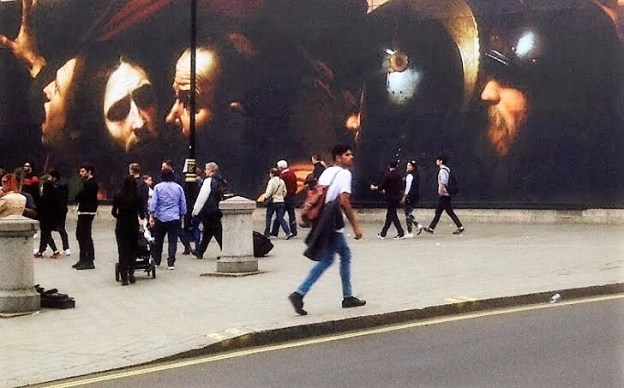
An image has been haunting me for months. It was captured – or, I should say, it captured me – one September evening in Trafalgar Square. It evoked a strange sensation of timelessness, as though 2000 years had been transcended in a moment. Somehow, that historic moment of betrayal in a garden in Jerusalem in 33 AD, was present again in that iconic London meeting place in 2016 – and nobody seemed to care too much. Everyone seemed to be looking the other way. An emblem of our age?

img_1079-2

A few days before the scene depicted by Caravaggio, the subject of the painting prophesied the terrible fate which was going to befall his city within a generation. And it did happen. The Temple was razed to the ground and the streets ran with blood.

Perhaps I should have blessed myself and prayed that this city I was now strolling through, this pivot of the modern world, would be spared a similar fate. I didn’t – even though the stones of Palmyra had recently been strewn around the Mesopotamian desert and the women of Aleppo were weeping – and continue to weep – for themselves and for their children. This morning’s paper tells us that the battle for this city is over but  fears are mounting because of reports that Syrian troops or allied Iraqi militiamen were shooting people in apartments and on the streets.

The forces of militant Islam, I thought to myself, have already proven themselves no less interested in inflicting death and destruction on this city. The same great evil which was at the root of that act of betrayal, in that distant garden, is also the source of today’s horrors, is at the heart of every war.

That face, looking across Trafalgar Square, is a penetrating representation of the face of the one Person who really knows what this evil is, that its origin is a creature of enormous power and that the this creature is the irreconcilable enemy of both God and man.

That look of pity, mixed with dismay – “do you betray me with a kiss” – stopped me in my tracks. I sensed – and know – that this look is eternal. Caravaggio’s spellbinding capture of that look reminds us that each one of those figures strolling before the image is the object of the infinite love behind that gaze. A few moments before, some of them were singing and dancing on this very spot in one of those spontaneous pieces of street theatre you stumble across in this very special place.

Behind that look is the knowledge that, as Romano Guardini observed, “there is more than the mere possibility of evil as the price of human freedom; more than the inclination to evil, fruit of individual or collective (inherited) sin. Jesus recognizes a personal power that fundamentally wills evil: evil per se. It is not satisfied by the achievement of positive values through wicked means; does not simply accept the evil along with the good. Here is something or someone who positively defies divinity and attempts to tear the world from God’s hands—even to dethrone God. God being who he is, this is possible only by leading the world into apostasy and self-destruction.”

Given the look in those eyes one could not but long and long that these wayfarers might know more than they seemed to know; that they might only connect the prophetic words of that betrayed God-man with our world and its sometimes terrible predicaments. We know that human kind cannot bear very much reality and we know that singing and dancing are good for the soul – as does he, – but even just a little recognition of the divine inter-connectedness of all things would surely help?

This momentary musing on a London pavement was occasioned by the National Gallery’s use of a protective hoarding at the Gallery to advertise the ‘Beyond Caravaggio’ exhibition currently being held there to great acclaim. This is the first major exhibition in these islands to explore the influence of Caravaggio on the art of his contemporaries and followers.

After the unveiling of Caravaggio’s first public commission in 1600, artists from across Europe flocked to Rome to see his work. Seduced by the pictorial and narrative power of his paintings, many went on to imitate their naturalism and dramatic lighting effects.

Bringing together exceptional works by Caravaggio’s and the Italian, French, Flemish, Dutch, and Spanish artists he inspired, ‘Beyond Caravaggio’ examines the international artistic phenomenon known as Caravaggism.

This exhibition is a collaboration between the National Gallery, London, the National Gallery of Ireland, and the National Galleries of Scotland. The exhibition continues in London until 15 January. It then moves to Dublin where it opens on 11 February and continues until 14 May – after which it then goes to Scotland.

The image on display in the square is a detail from Caravaggio’s The Taking of Christ, 1602. This painting is on indefinite loan to the National Gallery of Ireland from the Jesuit Community, Leeson St., Dublin, who acknowledge the kind generosity of the late Dr Marie Lea-Wilson who gave them this masterpiece as a gift.